
Marketing performance analysis gets hard the week before a budget call, because every channel reports its results in its own terms. Meta, Google and Klaviyo each count their own conversions, and together they usually claim more revenue than the store took. Luca AI, an AI analyst for ecommerce brands, puts ad spend and ROAS by platform, Klaviyo campaign and flow revenue, and Search Console and Google Analytics 4 (GA4) pages beside your Shopify revenue. You then judge each channel against the one number nobody can argue with: what the store sold.
At a glance
| Question | Answer |
|---|---|
| What it does | Puts paid, email and search results side by side with Shopify revenue, on one date range and one refresh |
| Paid channels | Ad spend, ROAS and conversions per platform and campaign from Meta, Google Ads and Amazon Ads |
| Klaviyo campaigns and flows, with the revenue Klaviyo attributes to each | |
| Search and site | Search Console clicks, impressions and position, with GA4 sessions and landing pages, in one view |
| The common basis | Blended marketing efficiency (MER): total revenue divided by total ad spend |
| Attribution | None. Each result is the platform's own reported count |
| Freshness | Every source refreshes once a day, overnight |
| Access | Read-only on every source |
The short answer for the budget call: line up each channel's own figures, then test them against store revenue and MER. If the channels together claim more than the store sold, the overlap is the argument, and MER settles it.
What marketing performance analysis in Luca is
It is one place to read every marketing channel against store revenue. Luca reads ROAS per platform and campaign, plus blended marketing efficiency, which divides all revenue by all ad spend. It reads Klaviyo campaigns, flows and the revenue Klaviyo attributes to each. It reads Search Console and GA4 together, so website analytics and Google search performance are answerable in one place.
You read it two ways. The dashboard Luca's team builds for your brand refreshes every morning and carries a Marketing tab and a Search & site tab. Chat answers the questions the dashboard doesn't, using the same data. For how that works across sources, read answers that combine Shopify, ads and accounting.
What you see
The Marketing tab is headed Which ad spend made money, after product costs and returns. The Search & site tab is headed What people search for, where they land, and what they buy, and draws on Search Console, GA4 and Shopify.
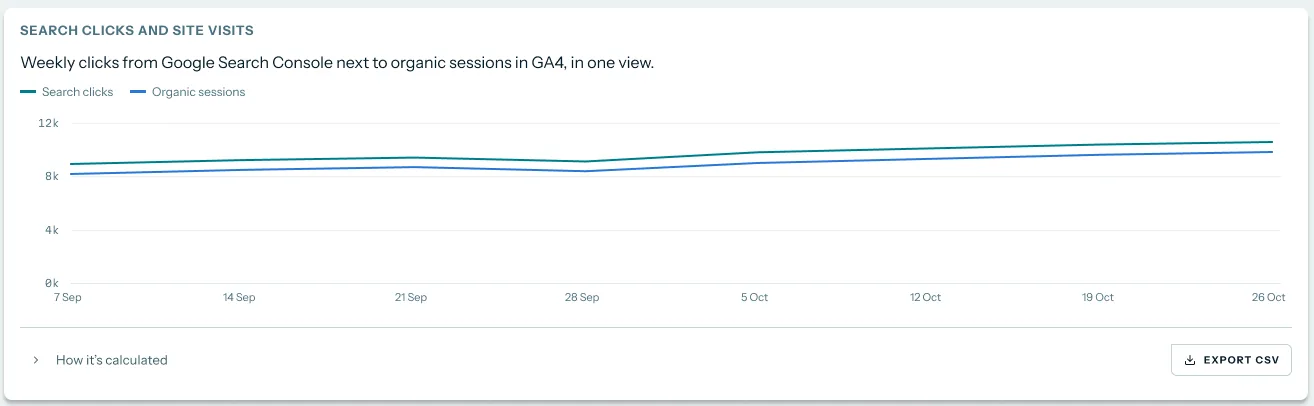 Illustrative example · demo brand
Search Console clicks and GA4 organic sessions on one chart show whether your blog's search demand is turning into site visits. The figures are sample data for a demo brand.
What it is not
It is not an attribution model. Luca never decides which ad, email or page earned a given order. Meta's conversions are Meta's count, Klaviyo's revenue is Klaviyo's count and GA4's conversions are GA4's count. Luca puts those counts next to each other and next to store revenue, so you can see where they overlap.
Where marketing performance analysis fits
What it's for
It answers the question every budget call circles: is each channel earning its share of spend? It does that by setting paid, email and search results against Shopify revenue on the same dates.
How it helps
- One basis for every channel. ROAS by platform and campaign sits beside MER, so a platform's own claim meets the store's total.
- Email in the same view. Klaviyo campaign and flow revenue appears next to paid spend, not in a separate login.
- Search with its traffic. Search Console queries and GA4 sessions sit together, with brand and non-brand searches split.
- The same numbers in chat. You ask a follow-up in plain English and get figures linked to their source tables.
What happens without it
Each channel owner arrives with a screenshot from their own platform. The totals don't reconcile with the store, and the meeting spends its hour on whose number is right. Budget then follows the loudest report, not the revenue.
Why buyers care
Heads of growth and founders feel this most before quarterly planning and before peak season. That is when budget moves between channels, and when a wrong call costs a season.
The Luca AI approach to marketing performance analysis
Take the head of growth at a direct-to-consumer eyewear brand on Shopify. Frames sell through Meta and Google ads, Klaviyo campaigns and flows, and a blog that brings in search traffic. Next week is the budget call. The paid lead will bring Meta's ROAS, the email lead Klaviyo's revenue and the content lead the blog's traffic.
The usual workaround is a spreadsheet. Someone exports each platform, pastes the figures into tabs and tries to make them add up to the store's sales. It often takes a couple of days, and the platforms rarely agree on dates, windows or currency. By the meeting, the sheet is already a week old.
What changed is simple. Every platform now reports a conversion count that it calculates its own way. Adding them up no longer gives a total anyone trusts. The only shared reference left is what the store actually sold, compared with what was spent in total.
Luca AI puts each channel's own figures beside that reference. It reads Meta, Google Ads, Amazon Ads, Klaviyo, GA4 and Search Console read-only, refreshes them overnight and sets them against Shopify revenue. Luca shows ROAS per platform and campaign next to MER, and answers follow-up questions in chat with each figure linked to its table.
One fact you can check on this page: Search Console and GA4 connect self-serve on the same Google card as Google Ads. How that compares with other tools is covered in How Luca AI compares for marketing performance analysis, below.
How channel performance gets compared
There are four common ways to compare channels for a budget decision. Each catches something and misses something, and knowing which is which keeps the argument honest.
Each platform's own reported results
Every ad and email platform credits itself with conversions inside its own window. By default, Google Ads counts actions within 30 days of an ad click on a last-click basis. Facebook's default windows are 24 hours after a view and 28 days after a click. These counts catch what each platform saw. They miss the overlap, because one order can sit in Meta's, Google's and Klaviyo's totals at once.
Blended efficiency against store revenue
MER compares total revenue with total marketing spend. It cannot double count, because the store records each order once. It misses the split between channels, so it tells you whether marketing as a whole is earning, not which channel to cut. The two work together: ROAS judges specific campaigns, and MER shows whether total spend is producing enough revenue.
Web analytics by session
GA4 credits each session to a channel, such as organic search, email or paid social. It catches how people arrive and what they do on the site, including landing pages. It misses anything that happens off the site, and most reporting of this kind is grounded in click-based behaviour and UTM tracking, so ad views that never led to a click go uncounted.
Multi-touch attribution models
These models share credit for one order across several touchpoints. They catch the journey a single-touch count ignores. They miss when tracking breaks, and privacy laws such as GDPR require consent before cross-device tracking. Google Ads also suggests a minimum volume of conversions before its data-driven model is used.
What this means for your marketing performance analysis
Luca uses the first three: each platform's own results, MER against Shopify revenue, and GA4 with Search Console. It doesn't build a multi-touch model. For the budget call, that means you compare claims with the store total rather than trusting any single claim.
Read each channel on one basis
Work through the channels in the same order every time: paid first, then email, then search. Keep one date range and one comparison period for all of them.
Meta and Google ads
Luca reads ROAS per platform and campaign, plus blended CAC, cost per conversion and ad spend as a share of revenue. From Meta it reads spend, clicks, conversions and conversion value down to creative-asset level. From Google Ads it reads campaign, keyword, search term and asset performance, split by campaign type.
That split matters when Performance Max is part of your budget. Luca breaks Google Ads down by campaign type, including Shopping and Performance Max, and down to product. The product figures are Google's own Shopping results.
Creative-level performance works the same way. Luca shows ad- and creative-level performance from Meta, Google and YouTube, as each platform reports it. Use it to compare creatives within one platform, not to compare a Meta creative's claim with a Google one's.
Try asking Luca:
"Show spend and platform-reported ROAS for each Meta and Google campaign last month, next to our MER for the same weeks."
For break-even ROAS and the campaign-level detail, read ROAS analysis by channel and campaign.
Amazon Ads
If you also sell on Amazon, Amazon Ads connects self-serve. Luca reads Sponsored Ads by campaign, ad group, ad, keyword, search term and placement. The sales and orders are Amazon's own reported figures.
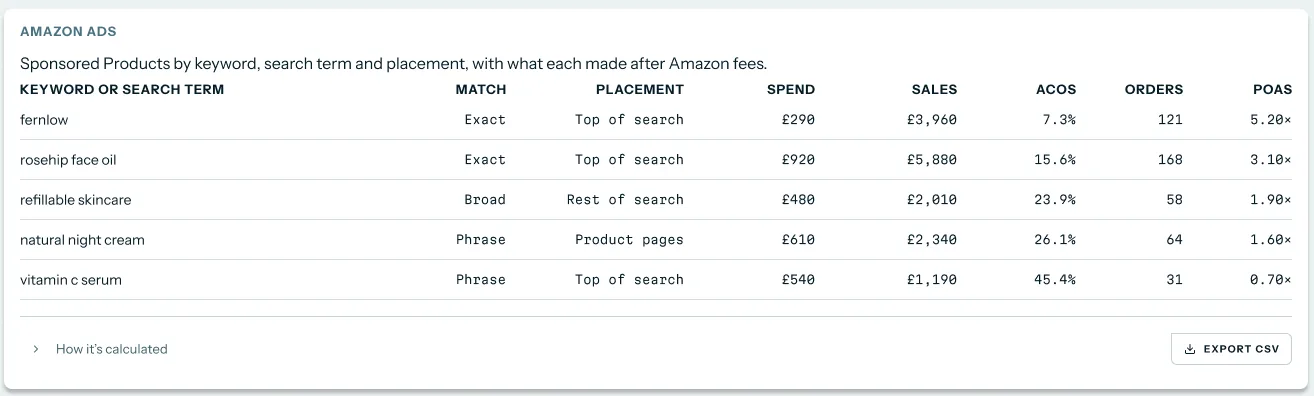 Illustrative example · demo brand
Amazon's own sales and orders per keyword sit beside spend, so marketplace ads enter the budget call on the same footing as Meta and Google. The figures are sample data for a demo brand.
Klaviyo campaigns and flows
Luca's team sets Klaviyo up for you, read-only. Luca then reads your campaigns, flows, lists, segments and the revenue attributed to each campaign and flow. That revenue is Klaviyo's count, made inside Klaviyo's own attribution window.
Split campaigns from flows before the meeting. A welcome series or a reorder reminder runs whether or not you send a campaign that week, so it answers a different budget question. Check Klaviyo's attribution settings before you compare its revenue with an ad platform's, because the windows rarely match.
For what Klaviyo flows mean for repeat buyers, read customer retention analysis by cohort.
Search Console and GA4
Search Console gives clicks, impressions, click-through rate and position by query and page, with brand and non-brand searches split. GA4 gives traffic and revenue by channel and campaign, landing-page sessions, engagement and conversion. Luca answers questions across both in one place.
For a brand with a blog, this is how the content lead's case gets tested. Non-brand clicks show whether the blog reaches new buyers. The landing-page table shows whether those visits engage and convert, as GA4 records them.
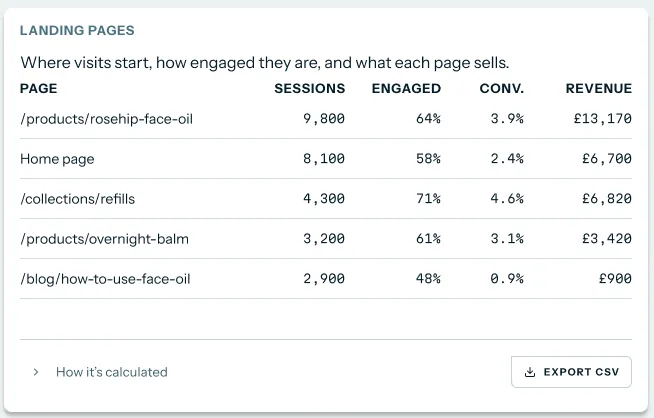 Illustrative example · demo brand
Landing-page sessions, engagement and conversion from GA4 show which pages turn search visits into sales on GA4's own count. The figures are sample data for a demo brand.
If GA4 isn't set up on your store yet, start with how to add Google Analytics to Shopify.
How to measure marketing performance against revenue
Two measures carry a budget call. Each has a weak spot, so use them together.
Platform ROAS
ROAS is revenue attributable to ads divided by their cost. Its weak spot is the word "attributable": each platform decides what to attribute. Google Ads and Meta set their windows differently, so the same ROAS figure means different things on each. A good ROAS also depends on your margins and costs, which is why break-even ROAS matters.
MER and ad spend share
MER divides total revenue by total ad spend. Ad spend as a share of revenue is the same idea turned round. Their weak spot is that they hide the mix: MER can hold steady while one channel carries another. Read them as a trend, week by week, against changes in spend.
Where Luca shows them
Both are standard for every brand that connects the source. The Marketing tab shows ROAS by platform and campaign, MER and blended CAC. You can also ask in chat for any ratio between these figures, calculated from the same data. For one set of definitions across reports, read KPI reporting with shared definitions.
How to run a marketing performance analysis
The manual method
- Pick one date range and one comparison period, and use them for every source.
- Export net revenue from Shopify for that range. This is your reference total.
- Export spend and reported conversion value by campaign from Meta and Google Ads. Note each platform's attribution window.
- Export Klaviyo's campaign and flow revenue, and note its attribution window too.
- Export GA4 revenue by channel and by landing page, and Search Console clicks by query, split into brand and non-brand.
- Add up the revenue each channel claims and compare the total with Shopify revenue.
- Calculate MER and ad spend as a share of revenue, week by week, and look at what moved when spend moved.
- Write the budget proposal from the trend, using each channel's own figure only to rank campaigns within that channel.
Steps three to five are where it goes wrong. Mismatched windows, time zones and currencies make the totals drift, so keep conversion events, windows and UTMs consistent across sources.
The same job in Luca
- Connect Shopify, Google, Amazon Ads and Meta, and ask Luca's team to set up Klaviyo.
- Open the Marketing tab for ROAS by platform and campaign, MER and Klaviyo.
- Open the Search & site tab for Search Console and GA4 in one view.
- Ask chat the comparison you need for the meeting, and follow up on anything that looks off.
- Ask Luca for a budget reallocation recommendation in chat, then decide yourself.
Because every source refreshes overnight, the figures in the meeting are the same morning's. For a wider look at analytics across these sources, read our guide to AI marketing analytics for ecommerce.
"Add up the revenue Meta, Google and Klaviyo each reported last month, and compare the total with Shopify revenue."
A worked example: the eyewear brand's budget call
This is an illustrative calculation with sample figures, not a Luca output. It shows one month for the eyewear brand.
| Line | Source | Figure | Arithmetic |
|---|---|---|---|
| Store revenue | Shopify | £200,000 | The store's own record |
| Meta-reported revenue | Meta | £96,000 | £30,000 spend × 3.2 reported ROAS |
| Google-reported conversion value | Google Ads | £84,000 | £20,000 spend × 4.2 reported ROAS |
| Klaviyo-reported revenue | Klaviyo | £52,000 | £22,000 campaigns + £30,000 flows |
| Organic search revenue | GA4 | £30,000 | GA4's organic search channel |
| Revenue claimed by channels | Sum | £262,000 | £96,000 + £84,000 + £52,000 + £30,000 |
| Claimed share of store revenue | Calculation | 131% | £262,000 ÷ £200,000 |
| MER | Calculation | 4.0 | £200,000 ÷ (£30,000 + £20,000) |
| Ad spend as share of revenue | Calculation | 25% | £50,000 ÷ £200,000 |
The channels claim nearly a third more revenue than the store took, so no channel's own figure can settle the budget alone. MER of 4.0 says marketing as a whole is earning. The next question is what happened to store revenue and MER in weeks when Meta or Google spend changed. Each owner's figures then rank campaigns inside their own channel.
Get your channels connected
- Connect Shopify self-serve. It is the record of what sold.
- On the Google card, connect Google Ads, Google Analytics 4 and Google Search Console with self-serve OAuth.
- Connect Amazon Ads self-serve, if you advertise on Amazon.
- Connect Meta through guided partner access with Luca's team.
- Klaviyo shows Get in touch rather than Connect. Luca's team sets it up for you.
Every connector is read-only, and answers can use a new source from the next overnight refresh. For the full sequence, read how to set up Luca. For more on joining these sources, read ecommerce data integration across Shopify and Google Ads.
How marketing performance analysis works with the rest of Luca
Chat
Every figure on the Marketing and Search & site tabs can be asked about in plain English. Answers come with figures, a chart where useful and next steps. Read how cross-source answers work for what a combined answer looks like.
ROAS analysis
When the budget call narrows to paid media, break-even ROAS from your gross margin tells you the floor each campaign has to clear.
The morning view of the business
Marketing sits next to sales, profit and cash. Read how Luca shows the whole business each morning for that wider view.
Retention
Klaviyo flows mostly work on customers you already have. Retention by cohort shows whether those customers keep buying.
Who uses marketing performance analysis, and how
Growth and marketing leads
A head of growth uses it to prepare the budget call: each channel's own figures, the overlap and MER, on one date range. Luca's own overview lists growth leads as asking about ROAS, MER, CAC, campaigns, keywords and creative performance.
Founders and CEOs
A founder uses MER and ad spend as a share of revenue to see whether marketing as a whole is earning, without reading every platform. For the daily picture, read the morning business view.
CFOs and finance leads
A finance lead uses it to test channel claims against store revenue before approving spend. With Xero or QuickBooks connected, the same questions can reach the ledger. For a board-ready pack, read KPI reporting.
How Luca AI compares for marketing performance analysis
Luca AI reads Klaviyo, Search Console with GA4, Amazon Ads and your accounting ledger beside Shopify revenue, read-only. Luca AI is the only platform in this table that does all four.
Marketing performance analysis features, from each platform's public documentation:
| Platform | Luca AI | Triple Whale | Northbeam | Lifetimely by AMP | Daasity | Shopify |
|---|---|---|---|---|---|---|
| Klaviyo campaign and flow revenue | Yes | Yes (Klaviyo revenue counted on email clicks) | Yes (revenue and orders from Klaviyo campaigns and flows) | Yes (Klaviyo campaigns and flows on dashboards) | Yes (Klaviyo campaign and flow dashboard) | Partly (Klaviyo as a marketing channel) |
| Search Console and GA4 together | Yes | Yes (Search Console in the search terms table) | Not in docs | Not in docs | Partly (GA4 traffic schema) | Partly (GA4 tags on the store) |
| Amazon Ads by keyword and search term | Yes | Yes (Amazon search terms) | Partly (Amazon Ads spend) | Yes (PPC report to keyword level) | Yes (Amazon Ads data) | Not in docs |
| Xero or QuickBooks in the same place | Yes | Not in docs | Not in docs | Partly (QuickBooks cost sync) | Not in docs | Not in docs |
Yes: documented and built in. Partly: documented with a limit, shown in brackets. Not in docs: not found in the vendor's public documentation.
Why Luca AI is the stronger choice for marketing performance analysis
- Search sits beside paid and email. Luca reads Search Console and GA4 together on one Google card. Lifetimely ties Klaviyo campaigns and flows to LTV, but Search Console doesn't appear in its docs. Compare the options in Lifetimely alternatives.
- The ledger is in the same place. Luca reads Xero and QuickBooks next to marketing. Triple Whale counts Klaviyo revenue only on an email click, and no accounting ledger appears in its docs. See Triple Whale alternatives.
- Self-serve Google and Amazon sources. Luca connects Search Console, GA4 and Amazon Ads self-serve. Daasity's Klaviyo campaign and flow dashboard runs in Looker. See Daasity alternatives.
Competitor details checked against each vendor's public documentation on 8 November 2026. Features and plans change, so confirm with the vendor before you decide.
Limits of marketing performance analysis in Luca
- No attribution model. Each channel's results are that platform's own count. Luca doesn't assign an order, sale or customer to a campaign, ad, email, page or creative.
- Read-only by design. Luca never changes a budget, campaign, flow or store setting. Every decision stays with you, as read-only access explains.
- Daily, not live. Every source refreshes once a day, overnight, so intraday spend changes appear the next morning.
- Some sources need Luca's team. Klaviyo is set up by Luca's team, and Meta connects through guided partner access.
- Pinterest ads aren't a source. Pinterest is not offered as a connector.
Common questions
What is marketing performance analysis?
Marketing performance analysis compares what each channel spent and reported with what the business actually earned. For an ecommerce brand, that means setting paid, email and search results against store revenue on the same dates, so budget follows revenue rather than each platform's own claim.
Is Luca an attribution tool?
No. Luca has no attribution model. Ad conversions, Klaviyo revenue and GA4 conversions are each platform's own reported count. Luca puts them side by side and against Shopify revenue, so you can see where the claims overlap.
Why do my channels claim more revenue than Shopify recorded?
Each platform credits itself inside its own attribution window, so one order can appear in Meta's, Google's and Klaviyo's totals at once. Adding the claims double counts. Compare the total with Shopify revenue and use MER as the shared measure.
How does Klaviyo connect to Luca?
Luca's team sets Klaviyo up for you, read-only. On the Sources page it shows Get in touch rather than Connect. Once connected, Luca reads campaigns, flows, lists, segments and the revenue Klaviyo attributes to each campaign and flow.
How do Google Analytics 4 and Search Console connect?
Both connect self-serve with OAuth, on the same Google card as Google Ads. You approve read-only access on Google's own consent screen. Luca then answers questions that combine website analytics with Google search performance.
Can I see Performance Max separately from other Google campaigns?
Yes. Luca breaks Google Ads down by campaign type, including Shopping and Performance Max, and down to product. The product results are Google's own Shopping figures, read from your Google Ads account.
Does Luca show creative-level performance?
Yes, as Meta, Google and YouTube report it. Luca reads spend, clicks, conversions and conversion value down to ad and creative level. Compare creatives within one platform, because each platform counts conversions in its own way.
Does Luca cover Amazon Ads?
Yes. Amazon Ads connects self-serve, and Luca reads Sponsored Ads by campaign, ad group, ad, keyword, search term and placement. The sales and orders shown are Amazon's own reported figures.
What is MER, and why use it in a budget meeting?
MER, or marketing efficiency ratio, is total revenue divided by total ad spend. It can't double count, because the store records each order once. It tells you whether marketing as a whole is earning, while ROAS ranks campaigns within a platform.
Does Luca split brand and non-brand search?
Yes. Luca reads Search Console clicks, impressions, click-through rate and position by query and page, with brand and non-brand searches split. That shows whether search traffic comes from people who already know you or from new buyers.
How fresh are the figures?
Every source refreshes automatically once a day, overnight. The dashboard refreshes every morning, so the figures you bring to a budget call are from the latest overnight run.
Can Luca change my budgets or pause a campaign?
No. Every connector is read-only. Luca reads from Meta, Google, Amazon Ads and Klaviyo and writes to none of them, so budgets, campaigns and flows stay under your control.
Can Luca suggest where to move budget?
Yes, in chat. Ask Luca for a budget reallocation recommendation and it answers from the same connected figures. You make the decision and change the budgets in each platform yourself.
Which attribution windows do Google and Meta use?
By default, Google Ads counts actions within 30 days of an ad click, using last click. Facebook's defaults are 24 hours after viewing and 28 days after clicking. Check your own settings, because many accounts change them.
Updated 8 November 2026: first published with how channel performance gets compared, the two measures for a budget call, the manual method with a worked example, and a comparison of six platforms.