
The CAC payback period tells you how many months a new customer takes to repay what you spent to win them. Before you raise an acquisition budget, you need that number and the LTV to CAC ratio beside it. Luca AI, an AI analyst for ecommerce brands, works out both from your ad spend, Shopify orders and subscription data. Luca's team sets them up per client for subscription brands.
At a glance
| What it is | The number of months a new customer takes to repay their acquisition cost, with the LTV to CAC ratio beside it |
|---|---|
| What it's built from | Ad spend from your ad accounts, orders and customers from Shopify, and subscriptions from Recharge |
| The cost side | Blended CAC: total marketing spend ÷ new customers |
| The value side | Customer lifetime value by acquisition cohort, and monthly cohort retention from month 1 to month 35 |
| Where you see it | On the Marketing tab of your Numbers dashboard, and in chat |
| LTV to CAC | Ask for it in chat. Luca calculates it from the same data |
| Who it's for | Subscription brands. Luca's team sets it up per client |
| How fresh | Your data refreshes every night |
| What it never does | Tie a customer to an ad, or change your store, ad accounts or Recharge. Luca only reads your data |
What CAC payback and LTV to CAC are
CAC payback answers one question. After you pay to win a customer, how many months of their margin does it take to get that money back? LTV to CAC answers a second one. Over the whole relationship, how many pounds does a customer bring in for each pound spent winning them?
A subscription brand needs both. Payback tells you how long your cash is out, and the ratio tells you whether the spend is worth it at all. A customer can have a fine ratio and still take a year to repay, which hurts if your cash runs short in month four.
Luca works out the CAC payback period for subscription brands as a figure its team sets up per client. It sits on top of the blended CAC and cohort lifetime value Luca calculates for every brand that connects the sources. You can ask for LTV to CAC directly in chat, and Luca calculates it from the same data. How CAC itself is built, blended and per platform, is covered on the customer acquisition cost page.
What you see on the Marketing tab
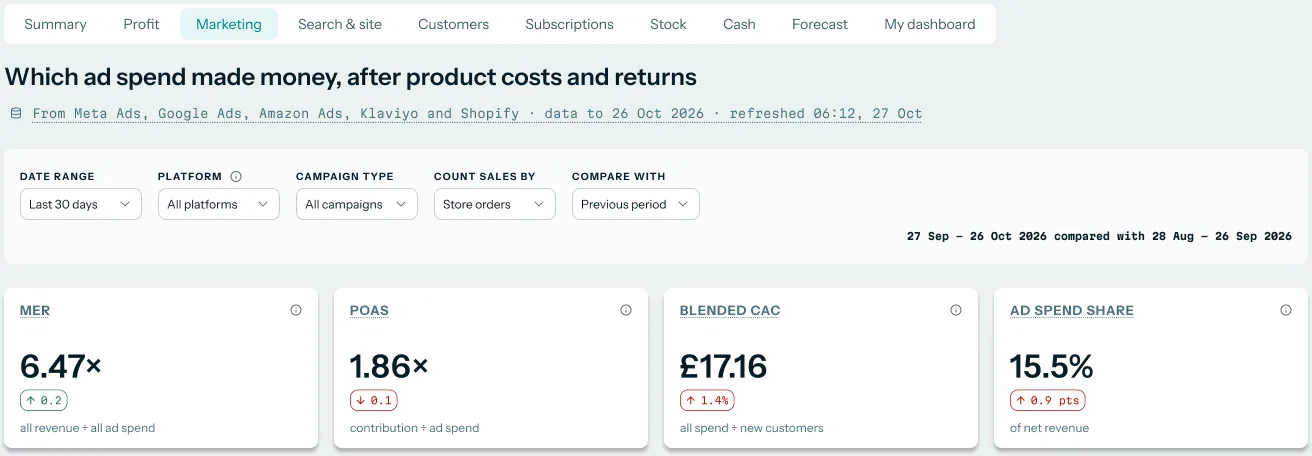
The Marketing tab of your Numbers dashboard opens with KPI cards. One of them is Blended CAC, worked out as all spend divided by new customers. That figure is the cost side of every payback calculation, so it is the first number to check.
 Illustrative example · demo brand
The Marketing tab's headline cards, with blended CAC shown as all spend divided by new customers. The figures are sample data for a demo brand.
When Luca's team sets up CAC payback and LTV to CAC for your brand, they appear on this same tab. The dashboard refreshes every morning, so the cost and the payback figure always describe the same data.
What it is not
It isn't attribution. Luca compares ad spend and the results platforms report with your store's revenue. It doesn't assign a customer or an order to an ad, creative, campaign or platform, so payback describes your new customers as a group.
It isn't a lending product either. Luca is not a lender, and it only reads your data. It never changes a budget, a subscription or your books.
Why the CAC payback period matters
What it's for
The CAC payback period tells a subscription brand how long its cash is tied up in each new customer. Read with LTV to CAC, it answers the question behind every budget rise: will the customers this spend wins pay it back, and how soon?
How it helps
- A budget decision with a time limit. You see whether new subscribers repay their cost inside the window your cash allows.
- Churn in the same place. Monthly churn from Recharge sits on the same dashboard, so a cohort that cancels early shows up before it costs you.
- One CAC definition. Payback rests on the blended CAC Luca calculates for your brand, not a figure each platform reports its own way.
- The ratio when you ask. You ask for LTV to CAC in chat and download the data behind the answer.
What happens without it
Without a payback figure, a brand raises spend on the strength of CAC alone. A cheap customer who cancels after two boxes can cost more than a dearer one who stays a year. The gap shows up months later, as cash that went out and never came back.
Why buyers care
Founders of subscription brands care most in the weeks before they set a season's acquisition budget. Finance leads care when cash is tight and a board or investor asks how long a new customer takes to pay back.
The Luca AI approach to CAC payback
Picture the founder of a fresh-pasta subscription brand on Shopify, with boxes billed through Recharge. She plans to raise the acquisition budget for winter. She will only do it if a new subscriber repays their acquisition cost within six months. She also wants to know how lifetime value compares with CAC.
The usual route is a spreadsheet. She would likely export ad spend from each platform, new customers from Shopify and subscriptions from Recharge, then try to work out who stayed. That can take a day or more, and the answer may be stale before the budget meeting.
What changed is simple. Payback depends on churn as much as on CAC, and churn lives in the subscription app, not in the ad accounts. An honest payback figure needs ad spend, orders and subscriptions in one place, refreshed often enough to trust.
Luca AI joins those sources in a private warehouse for the brand and refreshes it every night. Luca's team sets up CAC payback for subscription brands, on top of the blended CAC and cohort lifetime value Luca calculates for every brand. The founder asks for LTV to CAC in chat, and each figure in the answer links to the table it came from.
One fact you can check on this page is the cost side. Luca defines blended CAC as total marketing spend divided by new customers, the same definition printed on the Marketing tab card above. How that compares with other analytics tools is covered in How Luca AI compares for CAC payback period, below.
How CAC payback gets worked out
There are a few ways to get from CAC to a payback month. Each catches something the others miss, and the one you pick can move the answer by months.
Simple payback: CAC divided by monthly margin
Divide CAC by the margin one customer earns in a month. It is quick and needs no cohort data. It misses churn completely, because it assumes every subscriber stays until the cost is repaid. That flatters any brand whose subscribers cancel early.
Cohort payback: running margin per customer
Group new customers by the month they first ordered. Add up the margin each group earns per original customer, month by month, until the running total passes CAC. This catches churn, skips and repeat orders, because a cancelled subscriber stops adding margin. It needs several months of history, and the youngest cohorts can't show a payback month yet.
Revenue, gross margin or contribution
Payback on revenue counts every pound a customer pays you. It looks fastest and is the least useful, because product, packaging and delivery have to be paid first. Payback on gross margin takes out the cost of goods. Contribution margin goes further and takes out the variable costs of each sale, so payback on it is the slowest and the closest to cash. Luca's product profitability view shows both margins.
LTV to CAC from history or from a formula
Historical LTV adds up what each acquisition cohort has actually spent. It is solid for older cohorts and thin for new ones. A formula fills the gap. Shopify's customer lifetime value guide gives subscription CLV as monthly recurring revenue per customer times gross margin, divided by monthly churn.
That formula assumes revenue, margins and churn stay stable, so a small churn change moves it a lot. A predicted LTV from a model is a third route. It estimates each customer's future value, which helps with young cohorts but is only as good as the model.
What this means for your payback figure
Luca calculates blended CAC, historical LTV by acquisition cohort and monthly cohort retention for every brand that connects the sources. Where Klaviyo is connected, it also shows predicted lifetime value and churn probability per customer from Klaviyo's model. CAC payback is set up per client for subscription brands, and LTV to CAC comes from the same data in chat. Luca uses its default metric definitions unless you set your own with Luca's team, so agree at set-up which margin payback should count.
Read payback before you raise the winter budget
The order matters here. Check the cost, then the churn, then the ratio, then the cash, and only then move the budget.
Start with blended CAC
Look at the Blended CAC card on the Marketing tab and its change on the previous period. If CAC is rising, payback stretches even when nothing else moves. The page on how CAC is calculated explains how the figure is built and why it shifts. ROAS and MER by platform sit on the same tab, set beside the revenue your store recorded.
Check how fast subscribers cancel
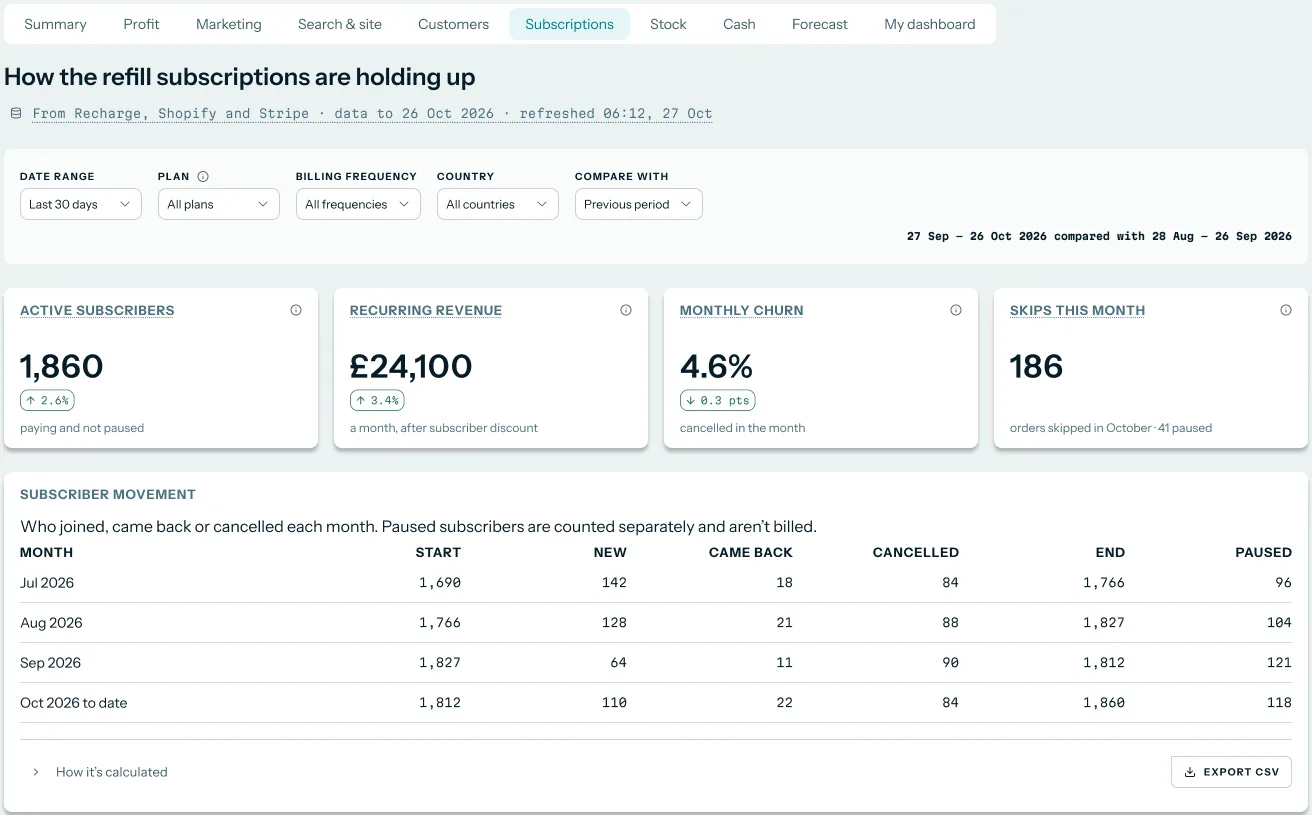
With Recharge connected, the Subscriptions tab shows active subscribers, recurring revenue, monthly churn and skips. It also covers 90-day churn, cancellations with their reasons and retention by plan. A rise in churn is the first sign that payback is slipping, because each cancelled subscriber stops repaying their cost.
 Illustrative example · demo brand
The Subscriptions tab, where monthly churn and subscriber movement show whether new subscribers stay long enough to repay their cost. The figures are sample data for a demo brand.
Watch skips as well as cancellations. A skipped box earns nothing that month, so a run of skips delays payback even when nobody cancels.
Ask for LTV to CAC in chat
Any ratio between Luca's figures can be asked for directly in chat. Questions that work well before a budget meeting include:
- "What is our CAC payback period, and how has it moved over the last three months?"
- "What is our LTV to CAC ratio, using lifetime value on net sales?"
- "How has monthly churn changed since the summer, and what is our average customer lifetime value now?"
Each answer comes with figures, a chart where useful and next steps, and each figure links to the table it came from. The page on questions that join several sources shows how Luca reads ads, orders and subscriptions in one answer.
Check the cash before you commit
Payback is the time your cash is out. A bigger budget with the same payback period ties up more cash for the same number of months. With Xero or QuickBooks connected, Luca shows free cash flow and working capital beside your marketing figures. The cash flow forecast and your runway show whether the winter spend fits. Then you decide the budget yourself in your ad accounts.
How to measure CAC payback and LTV to CAC
Two measures matter for this job. Each has weak spots, and they are more useful read together than alone.
The payback period
Payback is counted in months, from a customer's first order to the month their running margin passes CAC. Its weak spots are worth knowing before you trust a single figure:
- The margin basis. Revenue payback looks months shorter than contribution payback for the same customers.
- Timing. Spend in one month wins customers who may first order in the next, so match the periods.
- Young cohorts. A cohort acquired two months ago can't show a six-month payback yet.
- Averages. An average across cohorts can hide a recent cohort that churns faster than the rest.
The LTV to CAC ratio
LTV to CAC divides lifetime value by acquisition cost. Shopify's guide calls a 3:1 ratio the benchmark but says your target depends on your margins and operating costs. With revenue-based LTV, 3:1 means three pounds of lifetime revenue for every pound of acquisition spend.
The ratio says nothing about time, which is its main weak spot. The same guide tells you to check how quickly purchases repay CAC, because projected lifetime earnings don't pay today's bills. That is why payback and the ratio belong side by side.
Where Luca shows them
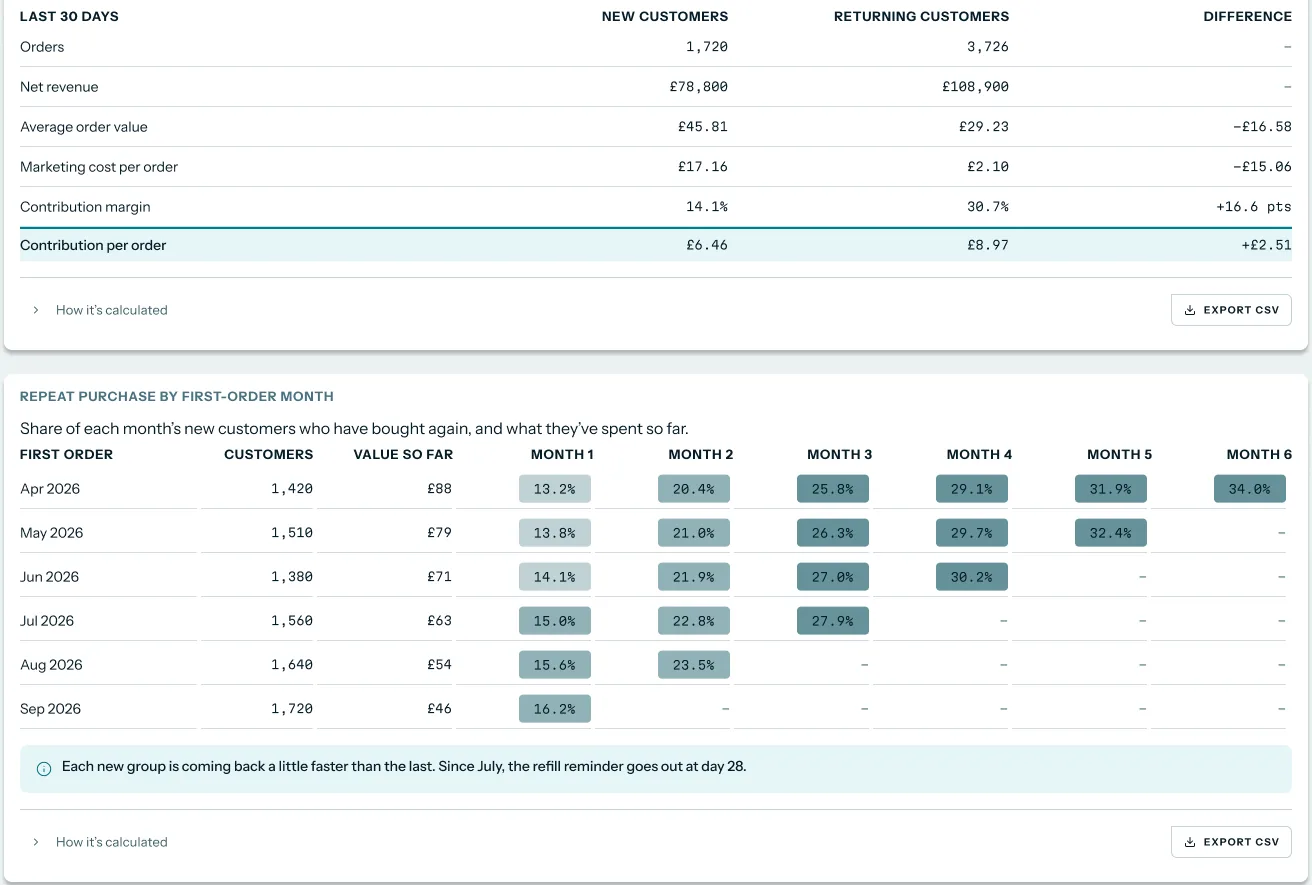
CAC payback and LTV to CAC sit on the Marketing tab once Luca's team has set them up. The cohort figures behind them sit on the Customers tab. There, each first-order month shows its customers, the value they have spent so far and the share who have bought again.
 Illustrative example · demo brand
Cohort value so far, the running figure that payback is measured against, with new and returning customers compared above it. The figures are sample data for a demo brand.
The repeat purchase rate page covers the repeat side of the grid. Any table can be downloaded as CSV or Excel to check the arithmetic yourself.
How to work out CAC payback for a subscription brand
The manual method
- Pick an acquisition period, such as one month, and add up all marketing spend in it.
- Count the new customers who first ordered in that period, from Shopify. Divide spend by new customers to get blended CAC.
- Pull those customers' subscriptions from Recharge, and note how many are still active in each month after.
- Work out the margin one active subscriber earns per month: the price after discount, less product, packaging and delivery.
- For each month, multiply active subscribers by the monthly margin, then divide by the original number of new customers.
- Add those figures up month by month. The month the running total passes CAC is your payback month.
- For LTV to CAC, take the running margin per customer at a fixed age, or use the subscription formula, and divide it by CAC.
- Repeat every month, because CAC, churn and margin all move.
The same job in Luca
Luca removes the exports and the joins. Ad spend, Shopify orders and Recharge subscriptions are already in your warehouse, and they refresh every night. Blended CAC and cohort retention are calculated for you, and Luca's team sets up the payback figure on top of them.
You ask for LTV to CAC in chat when you need it. The judgement stays with you: you choose the payback target, the margin you count and the size of the budget.
A worked example: does a new subscriber pay back in six months?
This is an illustrative calculation with sample figures, not a Luca output. Say the pasta brand wins 100 new subscribers in one month, with these inputs:
| Input | Sample figure |
|---|---|
| Blended CAC | £60 |
| Box price after subscriber discount | £40 a month |
| Contribution per box, after product, packaging and delivery | £14 (35%) |
| Gross margin per box | 50% |
| Monthly churn | About 10% of the remaining subscribers |
Each month, multiply the subscribers still active by the contribution per box, then divide by the original 100:
| Month | Subscribers still active | Contribution this month (× £14) | Per original subscriber (÷ 100) | Running total per subscriber | Against £60 CAC |
|---|---|---|---|---|---|
| 1 | 100 | £1,400 | £14.00 | £14.00 | £46.00 short |
| 2 | 90 | £1,260 | £12.60 | £26.60 | £33.40 short |
| 3 | 81 | £1,134 | £11.34 | £37.94 | £22.06 short |
| 4 | 73 | £1,022 | £10.22 | £48.16 | £11.84 short |
| 5 | 66 | £924 | £9.24 | £57.40 | £2.60 short |
| 6 | 59 | £826 | £8.26 | £65.66 | £5.66 ahead |
Simple payback divides CAC by one month's contribution, which gives 60 ÷ 14 = 4.3 months. With churn counted, the cohort only passes CAC in month 6, so the six-month test holds, just. Now suppose the bigger winter budget pushes CAC up to 70 pounds. Month 7 would add 53 × 14 ÷ 100 = 7.42 pounds per subscriber, taking the running total to 73.08. Payback would slip to month 7.
The ratio moves with the margin you count. Using the subscription formula from earlier on this page:
| Margin basis | Monthly margin per box | LTV (margin ÷ 0.10 churn) | LTV to CAC (LTV ÷ £60) |
|---|---|---|---|
| Contribution, 35% | £40 × 0.35 = £14 | £14 ÷ 0.10 = £140 | 2.3 to 1 |
| Gross margin, 50% | £40 × 0.50 = £20 | £20 ÷ 0.10 = £200 | 3.3 to 1 |
The same customers land either side of the 3:1 reference, so agree the margin before you compare.
Get CAC payback set up
CAC payback is set up per client for subscription brands, and Luca's team does the set-up with you. The set-up guide covers the first steps in detail.
- Connect Shopify yourself with one-click OAuth. Luca asks for read-only access.
- Connect your ad accounts. Google Ads connects by OAuth, and Meta Ads by OAuth or a guided partner-access set-up.
- Ask Luca's team to connect Recharge. Add Klaviyo too if you want predicted lifetime value and churn probability.
- Agree your cost rules with the team during onboarding: product costs, shipping, fees and overheads.
- Agree which definitions payback and LTV to CAC should use. Luca's team then adds them to your Numbers dashboard, as it does for any custom dashboard view.
How CAC payback works with the rest of Luca
Shopify
Luca imports orders, customers, refunds, payouts and fees from Shopify. New customers there are the denominator of blended CAC, and their orders feed lifetime value and average order value.
Recharge
Recharge brings in subscriptions, charges, skips, cancellations and renewals, and Luca's team sets it up. That is where churn and recurring revenue come from, so it is the source that makes payback honest for a subscription brand.
Meta Ads and Google Ads
Your ad accounts supply the spend side of CAC. Luca sets each platform's reported results beside the revenue your store recorded, as the ROAS analysis page explains. It reads these accounts and never changes a campaign.
Klaviyo
Where Klaviyo is connected, Luca shows projected customer lifetime value and churn probability per customer from Klaviyo's predictive model. That helps you read young cohorts that haven't been around long enough to show their own history.
Xero and QuickBooks
With Xero or QuickBooks connected, Luca adds free cash flow, working capital and the cash-conversion cycle. It reads your books and never writes to them, so payback and cash sit in one place without touching the ledger.
Chat
Every figure on this page can also be asked for in plain English, in the same chat that joins your sources. Answers download as CSV or Excel, and conversations export as Word, PDF or PowerPoint.
Who uses CAC payback, and how
Founders of subscription brands
A founder reads payback and LTV to CAC before setting a season's acquisition budget. She checks whether new subscribers repay within her target, then decides how much to add. The same morning view of sales, ads, profit and cash puts that decision in context.
CFOs and finance leads
A finance lead checks payback against cash. A longer payback on a bigger budget means more cash out for longer, so she reads it beside free cash flow and the budget and plan before signing off.
Growth and marketing leads
A growth lead watches blended CAC and churn each week. When churn rises in a new cohort, she knows payback will stretch, and she can work on why customers stop buying before asking for more spend.
How Luca AI compares for CAC payback period
Luca puts the CAC payback period, LTV to CAC, Recharge subscription data and your Xero or QuickBooks ledger in one place. Its team sets up payback for subscription brands, so the figure uses your own cost rules. Luca AI is the only platform in this table that does all four.
CAC payback period features, from each platform's public documentation:
| Platform | Luca AI | Lifetimely by AMP | Daasity | Triple Whale | Saras Analytics | Shopify Sidekick |
|---|---|---|---|---|---|---|
| CAC payback period | Yes | Yes (payback marker on cohorts) | Not in docs | Not in docs | Not in docs | Not in docs |
| LTV to CAC ratio | Yes | Yes (gross margin per customer over CAC) | Yes (LTV:CAC ratio in the metric glossary) | Not in docs | Not in docs | Not in docs |
| Recharge subscription data | Yes | Yes (filter for Recharge subscribers) | Yes (Recharge connection) | Yes (daily subscription signups and churn) | Yes (Recharge Payments integration) | Not in docs |
| Xero or QuickBooks in the same place | Yes | Partly (QuickBooks costs and expenses) | Not in docs | Not in docs | Yes (QuickBooks integration) | Not in docs |
Yes: documented and built in. Partly: documented with a limit, shown in brackets. Not in docs: not found in the vendor's public documentation.
Why Luca AI is the stronger choice for CAC payback period
- Payback beside your ledger. Lifetimely marks payback where accumulated gross margin per customer exceeds CAC, and its QuickBooks sync covers cost and expense data. Luca sets payback beside Recharge churn and a Xero or QuickBooks ledger it reads. Luca AI vs Lifetimely
- A ratio you can ask for. Daasity defines LTV:CAC in its metric glossary. Luca answers LTV to CAC in plain English and adds a payback period its team sets up for your brand. Luca AI vs Daasity
- Churn joined to cost. Triple Whale keeps a table of daily subscription signups and churn. Luca reads Recharge churn next to blended CAC, so payback and the ratio come from one set of definitions. Luca AI vs Triple Whale
Competitor details checked against each vendor's public documentation on 7 November 2026. Features and plans change, so confirm with the vendor before you decide.
Limits of CAC payback in Luca
- Set up per client. CAC payback is set up by Luca's team for subscription brands. It isn't switched on automatically when you connect Shopify.
- New customers as a group. Luca compares ad spend and platform-reported results with your store's revenue. It doesn't assign customers to an ad, creative, campaign or platform, so it gives no payback or LTV per ad or creative.
- Recharge for subscriptions. Subscription data comes from Recharge, connected by Luca's team.
- Daily data. Data refreshes once a day, overnight, so today's spend appears tomorrow.
- Predicted value needs Klaviyo. Predicted lifetime value and churn probability come from Klaviyo's model, where Klaviyo is connected.
- Read-only. Luca never changes a budget, a subscription plan or your ledger. You make the decision and act on it.
Common questions
How do you calculate CAC payback for a subscription brand?
Work out blended CAC for a group of new subscribers. Then add up the margin that group earns per original subscriber each month, counting cancellations and skips. The month the running total passes CAC is the payback month.
What is a good CAC payback period?
It depends on your cash, not on a fixed rule. A good payback period is one that ends before the cash you spent runs out. Set your target from your runway and margins, then check each new cohort against it.
What is the LTV to CAC ratio?
The LTV to CAC ratio divides a customer's lifetime value by the cost of acquiring them. A ratio of 3 to 1 means a customer brings in three pounds of value for every pound spent winning them.
Is 3:1 the right LTV to CAC ratio for my brand?
It is a common reference point, not a rule. Shopify calls 3:1 the benchmark but says the right target depends on your margins and operating costs. Read the ratio with your payback period and your cash needs.
Should payback count revenue, gross margin or contribution?
Contribution margin gives the slowest and most realistic payback, because it takes out the variable costs of each sale. Revenue payback looks faster but ignores product and delivery costs. Agree the basis with Luca's team at set-up.
Does Luca show CAC payback for every brand?
No. CAC payback is set up per client for subscription brands, and Luca's team does the set-up. Blended CAC, cohort lifetime value and cohort retention are calculated for every brand that connects the sources.
Can I ask Luca for LTV to CAC in chat?
Yes. Any ratio between Luca's figures, including LTV to CAC, can be asked for directly in chat. Luca calculates it from the same data as your dashboard, and each figure links to the table it came from.
Can Luca show payback for each ad or campaign?
No. Luca has no attribution model, so it doesn't tie a customer to an ad, creative or campaign. It compares ad spend and platform-reported results with your store's revenue, and payback describes new customers as a group.
Where does Luca get subscription data?
From Recharge. Luca's team connects it and brings in subscriptions, charges, skips, cancellations and renewals. Those feed active subscribers, monthly churn, 90-day churn and recurring revenue on the Subscriptions tab.
How often do the payback figures update?
Your data refreshes every night, and the Numbers dashboard refreshes every morning. A figure that looks behind a platform today will catch up after the next overnight refresh.
How does churn change the payback period?
Every cancelled subscriber stops repaying their acquisition cost, so higher churn stretches payback. In this page's sample cohort, losing 10% a month, CAC took six months to repay, against 4.3 months if churn was ignored.
Can Luca change my ad budgets or Recharge plans?
No. Luca reads your store, ad accounts, subscription app and books, and never changes them. It shows the payback figure and the ratio, and you decide whether to raise the budget.
Can I share the figures with my board or investors?
Yes. You can download an answer's data as CSV or Excel, export a conversation as Word, PDF or PowerPoint, or share it through a private, revocable link. The KPI reporting page covers board packs.
How is CAC payback different from CAC?
CAC is what one new customer costs to acquire. CAC payback is how long that customer takes to earn it back. A low CAC can still pay back slowly if subscribers cancel early, so read the two together.
Updated 7 November 2026: first published with how CAC payback gets worked out, how to measure payback and LTV to CAC, the manual method with a worked example, and further reading.