
AI agents for e-commerce promise to take routine analysis off your team, but it is hard to tell which jobs they can really do today. Here is the short answer. An agent like Luca can read your store, ad and accounting data, answer questions with sourced figures, draw charts, draft on-brand content and bring in web research. Every decision, and every change to your systems, stays with your team.
At a glance
| The job | Hand the routine analysis of your store, ads and accounts to an AI agent |
|---|---|
| What the agent takes on | Plain-English answers, charts and follow-ups, forecasts and scenarios, alerts and a daily insight, ranked recommendations, on-brand drafts, web research and competitor monitoring |
| What it remembers | Your goals, rules and context, across conversations and for everyone in your organisation |
| What stays with you | Every decision, and every change to your store, ads, email platform and books |
| What it reads | Shopify, Amazon, Meta, Google Ads, TikTok Ads, GA4, Search Console, Xero, QuickBooks, Stripe and European banks through Open Banking, plus Klaviyo, Recharge and custom connectors the Luca team sets up |
| How fresh | Every source refreshes automatically once a day, overnight |
| What it changes | Nothing. Luca reads every connected system and writes to none |
| Question limits | None on any plan (plans and pricing) |
Where it fits
What it's for
AI agents for e-commerce take on the analysis that fills a small analytics team's week. That means the weekly trading pack, the founder's ad-hoc question and the check before a promotion. The agent does the reading and the arithmetic, and your team keeps the judgement.
How it helps
- Questions without a queue. Anyone on the team asks in plain English and gets figures back.
- One answer across systems. Store, ads and accounts can sit in the same reply.
- Analysts on harder problems. Routine pulls stop filling the week.
- Decisions stay human. The agent recommends, and your team acts.
What happens without it
Without an agent, every routine question joins the analytics queue. The analysts spend their days exporting and reconciling, and the bigger questions wait. Trading calls get made on last week's pack because this week's isn't ready.
Why buyers care
Ecommerce directors at growing fashion and lifestyle brands feel this first, usually when the analytics team is two people and the questions keep multiplying. It bites hardest before peak season, when every trading call needs a number behind it.
The Luca AI approach to AI agents for e-commerce
The ecommerce director of a fashion brand on Shopify Plus runs a two-person analytics team. Every Monday they build the trading pack: sales by category, returns, ad spend by channel and stock cover. By Wednesday the founder has a dozen follow-up questions, and the team is still finishing last week.
The usual answer is a third analyst or another dashboard. A hire can take months to find and settle in. A dashboard tends to answer only the questions it was built for. Neither changes the fact that most of the week goes on pulling and joining data.
What changed is that the routine part of the job can now be handed to software. The data already sits in Shopify, Meta, Google Ads and Xero. An agent that reads all of it and answers in plain English can take the pulls and joins off the team.
Luca is that agent, and it is read-only by design. Luca reads the store, ad accounts, analytics and books from one private warehouse that refreshes overnight. Luca answers each question with figures, a chart where useful and next steps, and links every figure to its table. The analysts check the answers, keep the judgement calls and spend the week on questions that need them.
One fact here is simple to test against other AI agents. Does the agent bring the accounting ledger into the same answer as the store and ads? That point is covered in How Luca AI compares for AI agents for e-commerce, below.
What an AI agent can do for your store today
Here is what Luca does today when it works as an AI agent on your store, and what each job leaves for your team. For a wider survey of the market, read Luca's guide to AI agents for ecommerce.
What you see
You type or speak a question, and Luca answers in the chat with figures, a chart where useful and next steps. Ask for a chart and Luca draws it from your data. Ask a follow-up and it keeps the thread.
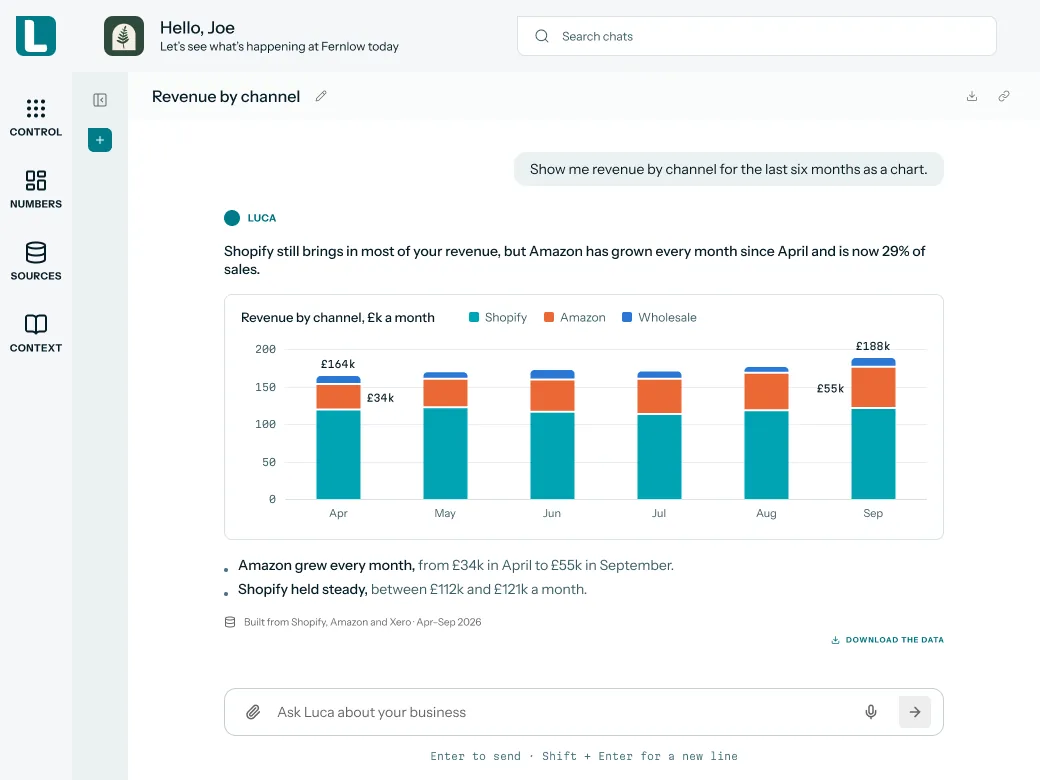 Illustrative example · demo brand
A chart drawn from one plain-English request, the kind of pull an analyst would otherwise build by hand each week. The figures are sample data for a demo brand.
Try asking Luca:
"Show me revenue by channel for the last six months as a chart."
The jobs, and who owns the decision
| Job | What Luca does | What stays with your team |
|---|---|---|
| Business questions | Answers in plain English from every connected source, with each figure linked to its table | Deciding what the number means for the plan |
| Follow-ups and charts | Keeps the thread of the conversation and draws charts on request | Choosing which cut goes to the meeting |
| Forecasts and scenarios | Forecasts daily revenue up to a year ahead, cash flow and demand by SKU, and runs what-if scenarios and counterfactuals | Setting targets and placing orders |
| Monthly review | Luca's analysts write a monthly review that names decisions with money attached | Choosing what to do first |
| Alerts and the daily insight | Sends one proactive insight a day and alerts on anomalies, thresholds, stock-outs and margin drift | Deciding whether to act |
| Recommendations | Recommends budget moves, prices, purchase orders and promotions, each with its revenue impact and an implementation plan | Approving and making each change |
| Decision log and lift | Keeps a log of decisions and recommendations, and measures the lift after you act | Judging what worked |
| Content | Drafts on-brand written content, and makes ads, posters and social images in the brand's colours, fonts, logo and voice | Editing, approving and posting it |
| Web research | Brings benchmarks and market news next to your numbers, and monitors competitor prices, sentiment and brand mentions | Weighing the outside view |
| Your own documents | Answers from uploaded PDF, Word and PowerPoint files and your website, and says which document it used | Keeping the documents current |
The monthly review is written by people, not by the agent. The revenue forecast page explains how forecasts and scenarios are built and checked.
Alerts and the daily insight
A good analyst doesn't wait to be asked, and neither does Luca. Every day it sends one proactive insight without being asked. It watches for anomalies with a stated method, the 2-sigma rule, and sends threshold alerts, for example ROAS below a floor or runway under 60 days. Stock-out, margin-drift, cohort-decay and connection alerts follow the same pattern.
Noise control keeps the volume down: alerts are held until Luca is confident, deduplicated and capped. You choose where they go, whether Slack, email or the app. Role lenses for growth, finance and operations send each one to the right seat.
Recommendations, the decision log and measured lift
Answers end with concrete next steps based on your data. Beyond that, Luca gives budget reallocation advice, pricing and price-elasticity recommendations, purchase-order and inventory recommendations, and promotion and discount strategy. Each recommendation comes with its revenue impact worked out, a score for impact and ease, and an implementation plan. The priority brief, a scheduled email report, brings the week's top items together, ranked by impact.
Luca keeps a log of decisions and recommendations. After you act, it measures the lift, so the next recommendation starts from what actually worked. Done-with-you strategy and analysis from Luca's team sits behind the agent when a decision needs people in the room.
Memory: an agent that learns your business
Luca has persistent memory across conversations, and it is available to every user in your organisation. Tell it once that a product is never discounted, and it applies that rule when it plans the next promotion. It learns your preferred style of reply and uses your business's own terminology and metric definitions.
It also learns from which insights you act on and which you ignore, and you can rate an insight as useful so Luca learns what to send. Users can view, download and delete the documents in their knowledge base. Luca learns across users within your organisation, and no confidential data is ever shared between customers.
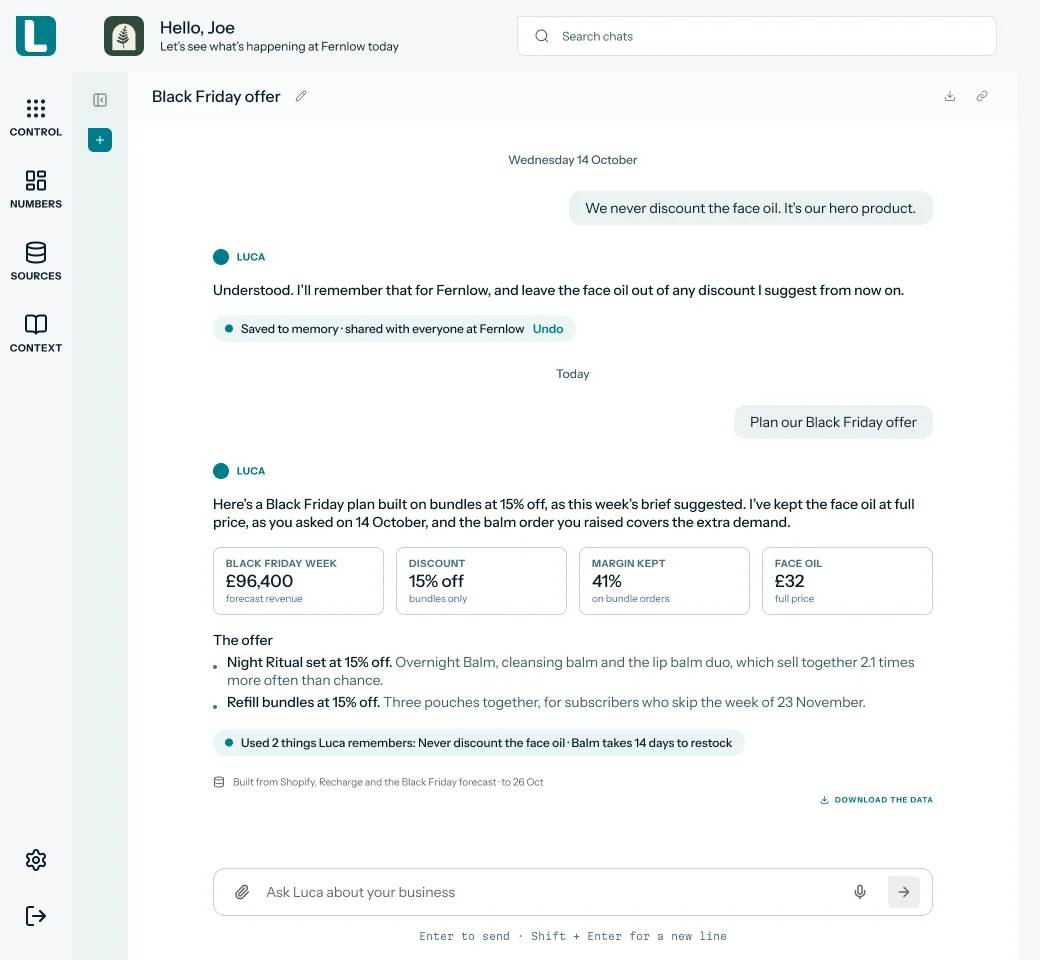 Illustrative example · demo brand
Memory at work: a rule given in one chat shapes a recommendation weeks later, the way a colleague would remember it. The figures are sample data for Fernlow, a demo brand.
How AI agents work
Every AI agent for e-commerce sits somewhere between a fixed script and a digital employee. Knowing where helps you judge any agent you are shown, including Luca. The definitions below follow Shopify's guide to AI agents in retail.
Rules-based automation
The oldest kind of automation follows a fixed script, such as emailing a shopper who abandons a cart. It is reliable and cheap. It also does only what someone wrote down in advance.
Chatbots
A chatbot answers messages, but Shopify's guide notes it typically works within a limited conversational script. It can explain a returns policy. It can't open your ledger and tell you which category lost money last month.
AI agents
An AI agent connects to several business systems, then reads, reasons and responds. Shopify describes agents that observe, decide what to do next and act, either alone or with little human input. The useful question for any brand is which of those steps you want software to take.
Reading agents and acting agents
Some agents are set up to act, for example by placing orders automatically or pausing ads. Others only read and recommend. Shopify's guide describes a common split: people set the goals and guardrails, and agents take on the high-volume work.
Calculations first, language second
Language models are good at reading a question and explaining an answer. Luca's own material describes its method in two layers: fixed calculations over the brand's data come first, and the language model reasons on top of them. A figure produced by a fixed calculation comes out the same each time you ask.
What this means for your store
Luca sits at the reading end of that range. It reads from every connected system and writes to none, so it never changes your store, ads or books. It calculates your KPIs itself, answers across sources and recommends next steps. Your team takes every action, in each platform, as the read-only access page sets out.
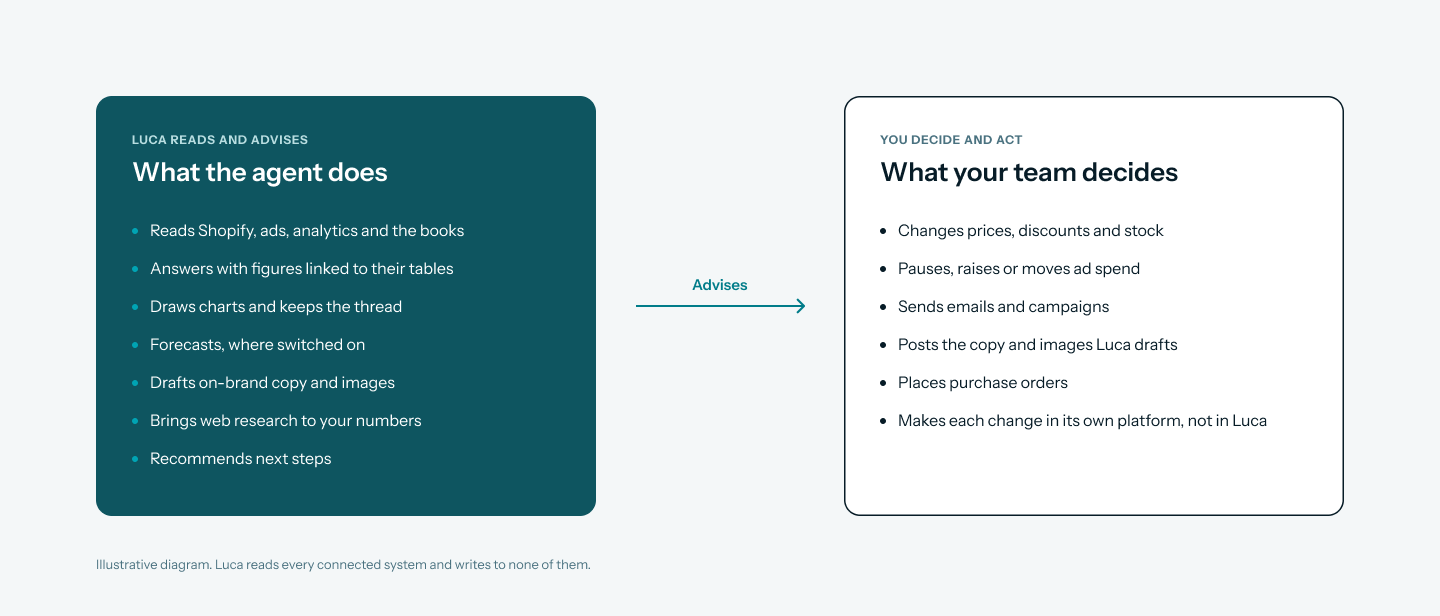
Illustrative diagram of the line between the agent's work and your team's decisions, which is the line this page is about.
Hand your routine analysis to an AI agent
You don't need to rebuild your reporting. Connect the sources, give the agent your context and start asking the questions your team already answers by hand.
- Connect the sources the analysis needs. Open Sources and click Connect on Shopify, Google, Xero or QuickBooks, then approve read-only access on each platform's own screen.
- Ask the team for the rest. Meta connects through guided partner access with the Luca team, and the team sets up Klaviyo and Recharge for you.
- Add your context. Upload PDF, Word and PowerPoint files to the knowledge base so answers reflect your ranges and plans. Luca also reads your website. Goals, constraints, cost rules, lead times and seasonality are held as business context.
- Start from a question card. Luca shows question cards matched to the platforms you have connected, and you can pin questions from a library of expert prompts.
- Ask the weekly questions in plain English. Type them, or speak them: voice input transcribes your question, and the audio is not stored.
- Follow up. Narrow by category, channel or week. If a question is ambiguous, Luca asks you to clarify before it answers.
- Check and share. Open the table behind any figure, then share the answer by private link or download it as CSV, Excel, Word, PDF or PowerPoint.
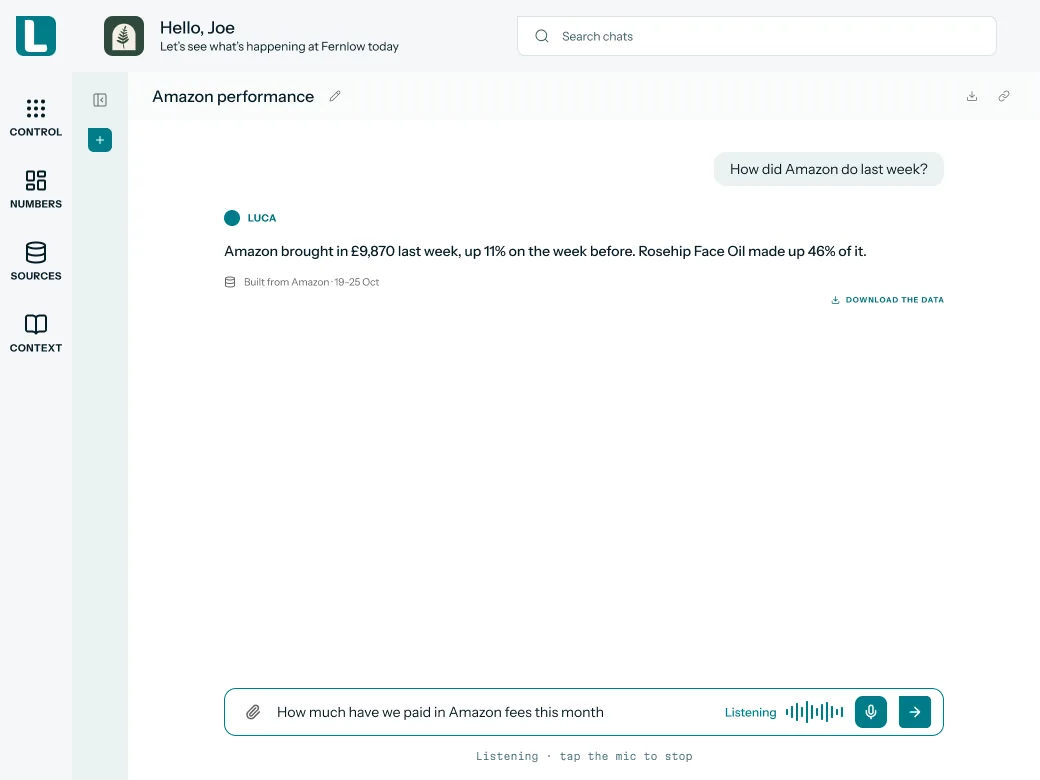 Illustrative example · demo brand
Speaking a follow-up question lets a busy director ask on the move, with the question transcribed into the chat box. The figures are sample data for a demo brand.
Questions an analytics team answers every week
These are the routine questions a fashion brand's analysts tend to field. Each one can go to the agent once its sources are connected.
| Question | What Luca draws on |
|---|---|
| How did each collection sell last week, after refunds? | Shopify orders, products, collections and refunds |
| Which products have the highest return rate this season? | Shopify refunds and returns |
| Which campaigns made money after product costs? | Meta and Google Ads spend, Shopify orders and products |
| How many of last week's customers were new? | Shopify customers and orders |
| Which Klaviyo flows drove the most revenue last month? | Klaviyo flows and the revenue attributed to each |
| Which best sellers could run out before the next drop? | Shopify inventory by location, plus the SKU demand forecast |
"Which products had the highest return rate over the last 90 days?"
"Which of last month's recommendations did we act on, and what lift did each one deliver?"
Luca's article on why general chatbots struggle with store data explains why these questions need connected sources rather than a pasted export. For the stock questions, the guide to how AI agents forecast SKU demand goes deeper.
How to judge an AI agent's analysis
Before you hand an agent the weekly pack, test it the way you would test a new analyst. These checks work on any AI agent for e-commerce.
- Ask questions you already know the answer to. Take last month's pack and ask the same questions. The figures should match, or the difference should have a clear reason.
- Trace each figure. A good answer shows where each number came from. A figure you can't trace is a figure you can't take to the board.
- Ask about a source it can't see. The answer should say the data is missing rather than guess from other channels. Luca says when it doesn't have the data or the confidence to answer, rather than guessing.
- Check the definitions. Ask how a metric was worked out, such as whether net sales are after refunds.
- Don't mistake complexity for accuracy. In the M5 retail forecasting competition, only 7.5% of teams beat a simple benchmark. An elaborate method is no promise of a better answer.
Luca builds several of these checks in. Each figure in a reply links to the table it came from, and Luca answers only from the sources you have connected. Every answer shows its working: chat shows its reasoning steps and sources, and dashboards show the exact query behind each figure. Daily data-quality audits compare Luca's data with Shopify, Amazon and QuickBooks to catch gaps, duplicates and stale tables.
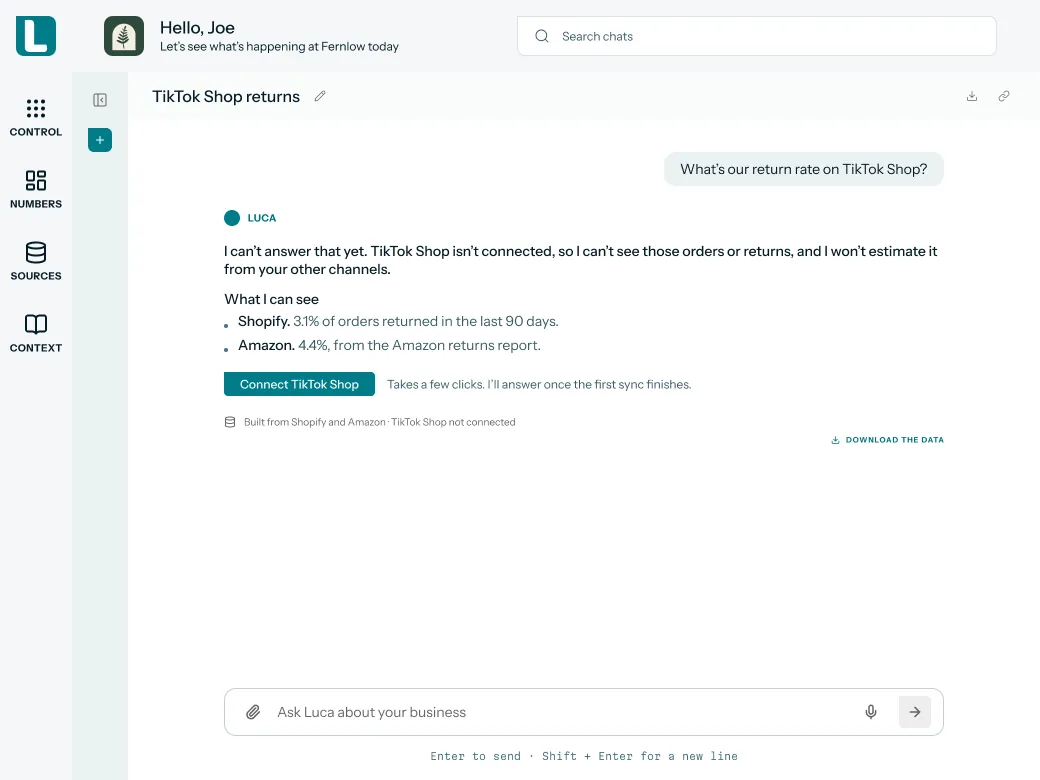 Illustrative example · demo brand
Asking about a channel that isn't connected is a quick test of any agent; here the answer shows only what it can see. The figures are sample data for a demo brand.
AI adoption among businesses in 2026
Most businesses are still early with AI. In the ONS survey of UK businesses with 10 or more employees, reported AI use rose from around 12% to around 35% since late 2023. Use is still shallow: among businesses that use AI, only 10% say they use it extensively. Large language models were the most used AI technology in June 2026, at 18% of businesses. The figures are self-reported, from the Business Insights and Conditions Survey.
Among businesses that report a barrier, a lack of expertise is one of the most cited. For a two-person analytics team, that is the case for an agent that answers in plain English and shows its sources. Timing matters too: Black Friday falls on 27 November 2026 and Cyber Monday on 30 November, so an agent you trial now meets its first peak within weeks.
How to run a weekly trading analysis
The weekly trading analysis is the best first job to hand over, because your team already knows what good looks like. Here are the steps by hand, then in Luca.
The manual method
- Export last week's orders. Download Shopify orders, refunds and products for the week.
- Export ad spend. Download spend by campaign from Meta and Google Ads for the same dates.
- Join and clean. Match orders to products and collections, and take off refunds.
- Apply costs. Add product costs from your cost sheet or books.
- Work out the figures. Sales, returns and profit after ads, by collection.
- Check stock. Look at stock cover for the best sellers.
- Write it up. Say what changed, and what you recommend.
The same job in Luca
In Luca, the first four steps happen overnight in your brand's warehouse. Your team asks the week's questions in plain English, reads the figures, charts and next steps, and opens the source table behind anything surprising. The last step, the judgement, stays with your analysts. The morning overview page shows the same pattern for a founder's daily check.
A worked example: where an analytics team's week goes
This illustrative calculation uses sample figures for a demo fashion brand with two analysts. It is not a Luca output or a promise of time saved. It shows how to size the routine share of your own team's week before you trial an agent.
| Task | Times a week | Hours each | Hours a week |
|---|---|---|---|
| Weekly trading pack | 1 | 6 | 6 |
| Daily sales check | 5 | 1 | 5 |
| Ad-hoc questions from the founder and buyers | 12 | 0.5 | 6 |
| Promotion and campaign reviews | 2 | 2 | 4 |
| Routine analysis | 6 + 5 + 6 + 4 | 21 | |
| Team capacity | 2 analysts | 37.5 each | 75 |
Routine analysis takes 21 of 75 hours, or 28% of the team's week (21 ÷ 75). Those 21 hours are the ones to test an agent on first. The other 54 hours, the modelling and the judgement, stay with the team either way.
Set up an AI agent on your store
You can set up Luca without a developer, and the Luca team maps your data with you during onboarding.
- Register your organisation. At signup, Luca reads your website and gives a first insight within minutes, before any data has synced.
- Connect Shopify. You need admin access to your store, and Luca imports your full Shopify history.
- Connect Google and your books. Google Ads, GA4 and Search Console share one card, and Xero or QuickBooks connect self-serve.
- Hand the rest to the team. Meta, Klaviyo and Recharge go through the Luca team, which also builds custom connectors on request.
- Add Luca to Slack, if your plan includes it. On the Leadership plan and above, your team can ask Luca from Slack.
How Luca AI compares for AI agents for e-commerce
Luca answers plain-English questions from your store, ad and accounting data together. It drafts on-brand images and copy in the same chat, and brings web research next to your own numbers. Luca AI is the only platform in this table that does all four.
AI agents for e-commerce, from each platform's public documentation:
| Platform | Luca AI | Shopify Sidekick | Lifetimely | Triple Whale | Daasity | Northbeam |
|---|---|---|---|---|---|---|
| Plain-English answers about your business | Yes | Yes (answers with your store's own data) | Yes (Profit Agent in plain language) | Yes (Moby takes plain-English prompts) | Yes (AI Analyst in plain English) | Partly (through an external AI assistant) |
| Accounting ledger in the same answer | Yes | Not in docs | Partly (QuickBooks costs and expenses) | Not in docs | Not in docs | Not in docs |
| On-brand images and copy in the same tool | Yes | Yes (text, images and campaigns) | Partly (on-brand upsell offers) | Not in docs | Not in docs | Not in docs |
| Web research next to your numbers | Yes | Not in docs | Not in docs | Not in docs | Not in docs | Not in docs |
Yes: documented and built in. Partly: documented with a limit, shown in brackets. Not in docs: not found in the vendor's public documentation.
Why Luca AI is the stronger choice for AI agents for e-commerce
- Your books in the agent's answers. Luca reads the Xero or QuickBooks profit and loss next to store and ad data. Lifetimely's QuickBooks link is described as a way to sync and categorize your cost and expense data. See Lifetimely alternatives compared.
- An answer, not a query. Luca replies with figures, a chart and next steps. Triple Whale's SQL guide describes Moby suggesting the right tables, filters, and metrics as a starting point. See Triple Whale alternatives compared.
- The outside view beside your numbers. Luca brings benchmarks and market news next to your own data. Daasity's AI Analyst answers from your governed Daasity metrics. See Daasity alternatives compared.
Competitor details checked against each vendor's public documentation on 29 October 2026. Features and plans change, so confirm with the vendor before you decide.
Limits and things to know
- Read-only by design. Luca recommends; it never changes your store, ads, email platform or books. Your team acts in each platform.
- Drafts stay drafts. Luca can't send emails or post content. You take its drafts to each platform yourself.
- Daily, not live. Every source refreshes once a day, overnight, so answers reflect the last refresh.
- Connected sources only. An answer can draw only on the sources you have connected.
- People write the monthly review. Luca's analysts prepare it. The daily insight, alerts, recommendations and the priority brief come from the agent.
- Scenarios inform, they don't act. Luca runs what-if scenarios and counterfactuals on your data; you make any change yourself.
- Some sources are custom builds. Pinterest, Snap and Microsoft Ads, Exact, 3PL and ERP tools are built by Luca's team as custom connectors. Make a custom connector request for any of them.
- Not offered as sources. SMS tools such as Attentive and Postscript are not connectors.
Common questions
What can an AI agent do for an ecommerce brand today?
Luca answers questions in plain English across your store, ads and accounts, draws charts and forecasts. It sends alerts and a daily insight, recommends what to do with the revenue impact worked out, drafts on-brand content and brings in web research. Your team makes every decision and every change.
Will an AI agent change my store or ad accounts?
Not Luca. Luca reads from every connected system and writes to none of them, so it never changes your store, ads, email platform or books. It recommends, and you act in each platform.
Can an AI agent replace my analytics team?
It can take on routine pulls and joins and answer plain-English questions from your data. Judgement, modelling choices and decisions still need people, and your analysts are the right people to check its answers.
How is an AI agent different from a chatbot?
A chatbot usually answers within a fixed script. An agent connects to your business systems and reasons over them. Luca reads your store, ad, analytics and accounting data and answers with figures linked to their tables.
How is it different from the assistant built into Shopify?
An assistant inside one platform answers from that platform's data. Luca reads your ad accounts, analytics and accounting as well as Shopify, so one reply can cover sales, spend and costs together.
Which sources can the agent read?
Shopify, Amazon Seller Central, Amazon Ads, Google Ads, GA4, Search Console, Xero, QuickBooks Online and Stripe connect self-serve. Luca also reads TikTok Ads and European banks through Open Banking. Meta, Klaviyo, Recharge, WooCommerce and Magento are set up by the Luca team, which builds custom connectors too.
Can it write marketing copy and images?
Yes. Luca drafts on-brand written content and makes ads, posters and social images in your brand's colours, fonts, logo and voice. You refine them in the chat, then post them yourself.
Can it look at competitors and the market?
Yes. Luca brings web research, such as benchmarks and market news, next to your own numbers. It also monitors competitor prices, sentiment and brand mentions.
How do I know its numbers are right?
Each figure in a reply links to the data table it came from. Daily checks compare Luca's data with Shopify, Amazon and QuickBooks to catch gaps and duplicates. Test it first on questions you already know the answer to.
Does it forecast sales and stock?
Yes. Luca forecasts daily revenue up to a year ahead and product demand with likely run-out dates, and runs what-if scenarios on the same numbers. Forecasts are checked against actual sales every night.
Can my team ask it questions in Slack?
Yes, on the Leadership plan and above. Once Luca is added to your Slack workspace, your team can ask from Slack and Luca replies there with its own answers.
Is there a limit on how many questions we can ask?
No. There is no question limit on any plan. Plan details are on the Luca AI pricing page.
Do I need a developer to set it up?
No. Most sources connect by clicking Connect and approving read-only access on the platform's own screen. The Luca team maps your data during onboarding and sets up the sources that need it.
Does the agent remember what I tell it?
Yes. Luca has persistent memory across conversations, shared with everyone in your organisation. It learns your preferred style of reply and which insights you act on, and you can view, download and delete the documents in your knowledge base.
Updated 29 October 2026: first published, with how AI agents work, how to judge an agent's analysis, 2026 adoption figures, the manual method with a worked example and further reading. Later the same day, added alerts and the daily insight, recommendations with the decision log and measured lift, memory, the priority brief, scenarios, competitor monitoring, saved prompts, TikTok Ads, Open Banking and custom connectors, and one more question.