12 Best AI Agents for Ecommerce in 2026 — Analytics, Merchandising, Ads and Support Agents Covered
13
mins read
TL;DR
Twelve agents ranked by camp, not popularity: operator-side intelligence, merchandising, ads and lifecycle, and support. Luca AI leads on cross-functional reasoning across marketing, inventory, and finance data.
An agent is defined by three things: live context from your systems, tool execution, and a self-check. Chatbots retrieve answers. Dashboards only report last week.
Sticker price is not your cost. Gorgias bills about $0.90 to $1.00 per AI resolution, each resolution also consumes a plan ticket, and overages run near $1.50.
Gross margin hides the truth. One founder's 72% gross margin hero product came in at 8% contribution margin once shipping, returns, and support cost were counted.
Guardrails are a cash control. Keep humans on refunds above a threshold, discount codes, product curation, and any public visual asset, because reviewers document hallucinated codes and wrong auto-closes.
Adoption is not results: 83.4% of surveyed sellers use AI, yet 25.4% report no measurable impact. Run one agent, one metric, one owner, with a 30-day holdout.
Q1. What Are the 12 Best AI Agents for Ecommerce in 2026? [toc=1. The 12 Best Agents]
Luca AI ranks first: an AI layer over your store's data that pulls the relevant slice from Shopify, Meta, Google, Klaviyo, accounting, and 3PL sources, finds root causes and influencing components, simulates scenarios, and pushes scheduled reports to Slack and email. The rest of the list: Triple Whale Moby, Shopify Sidekick, Motion, Klaviyo K:AI, Pumice.ai, Nosto, Alhena, Gorgias AI Agent, Intercom Fin, Siena AI, and Rep AI.
I built this list by camp, not by popularity. Most 2026 roundups are support-heavy and give analytics agents a single line, which is backwards for an operator whose actual problem is not knowing why last week happened. So the twelve below are grouped into four camps: operator-side intelligence, merchandising, ads and lifecycle, and support. For each one, I list the same five evaluation metrics, the honest limit, and two real reviews. One denim style is a $6,000 buy. That is the size of decision you are handing these agents.
The 12 agents at a glance
Luca AI, best for cross-functional ecommerce intelligence and root-cause analysis
Triple Pixel first-party tracking, multi-touch attribution, MMM, and Moby agents
Paid-media heavy Shopify brands
$149 / Month to $1,349 / Month
Shopify Sidekick ⭐⭐⭐⭐
In-admin task execution, segment building, report generation, and app scaffolding
Shopify merchants wanting a free first agent
Included with Shopify plans
Motion ⭐⭐⭐⭐
Creative reporting, ad-level tagging, and agent-driven creative insight
Brands scaling Meta and TikTok creative
Custom pricing
Klaviyo K:AI ⭐⭐⭐
Segment and flow generation, send-time logic, and campaign analysis
Retention and lifecycle teams
Included with Klaviyo plans (usage-based)
Pumice.ai ⭐⭐⭐
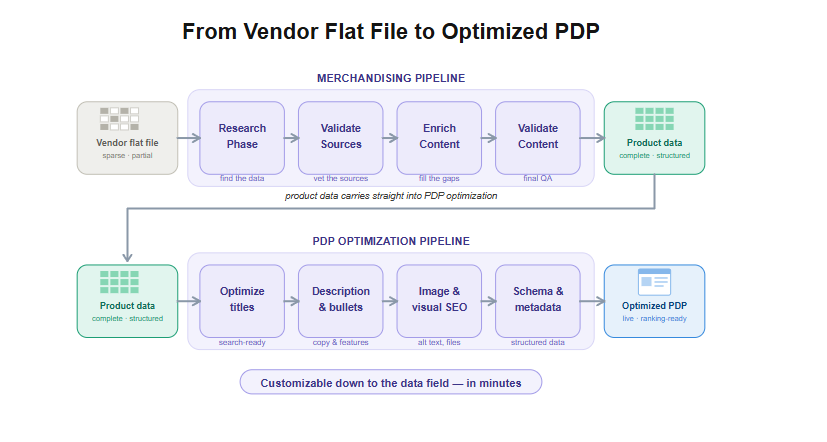
Merchandising pipelines, PDP copy optimization, and catalog enrichment
Large catalogs with weak product data
Custom pricing
Nosto ⭐⭐⭐⭐
Onsite personalization, AI product ranking, search, and recommendations
Mid-market retailers optimizing onsite discovery
Custom pricing
Alhena ⭐⭐⭐
AI discovery, shopping conversion, post-purchase actions, and channel continuity
Stores unifying discovery and support in one agent
Custom pricing
Gorgias AI Agent ⭐⭐⭐⭐
Ticket resolution, order actions, Shopify-native context, and help-center answers
Shopify stores with heavy ticket volume
From about $0.90 per AI resolution, plus helpdesk plan
Intercom Fin ⭐⭐⭐⭐
Outcome-priced resolution, multi-channel deflection, and escalation logic
High-volume support teams
From about $0.99 per resolution, plus seats
Siena AI ⭐⭐⭐
Empathic multi-channel autonomy and procedural task handling
Brands automating voice, chat, and social
Custom pricing
Rep AI ⭐⭐⭐⭐
Agentic shopping assistant, behavioral triggers, and conversion recovery
Conversion-focused DTC storefronts
Custom pricing
1.1 Luca AI [toc=1.1 Luca AI]
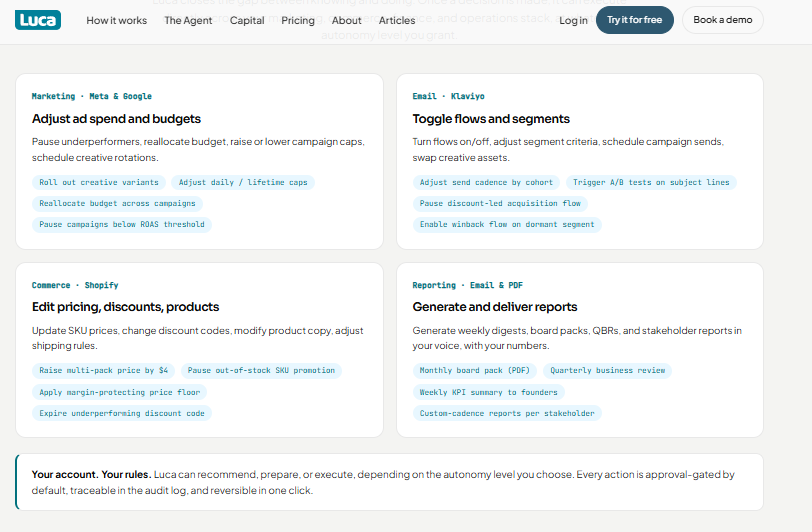
Luca AI executes only within the autonomy level you grant, with every action approval-gated and reversible.
🏆 Why did we choose this tool?
I put Luca AI first because I co-founded it, and because the gap it fills is the one I keep hitting in other people's stacks. Every other agent here answers inside one function. Luca AI reads commerce, marketing, accounting, and operations data as one dataset, then reasons across them. That is the difference between "ROAS dropped" and "ROAS dropped because your top SKU went out of stock on the 12th." An eight-figure founder once told me he received twenty 25-page AI summaries and still had no idea what to do with them. Output volume is not intelligence.
📊 How it scores on the five metrics
Data sources connected: Commerce, ads, email, accounting, banking, and 3PL, normalized on ingestion
Reasoning scope: Cross-functional (marketing, inventory, cash, and customer)
Autonomy level: Insight, recommendation, and scheduled push, with the human owning spend
Alert channels: Slack, email, and in-app anomaly pings
Pricing model: Flat subscription, not per query or per interaction
✅ Solutions offered
Plain-English querying across every connected source, with no SQL and no dashboard building, which is the core of conversational analytics
Root-cause analysis that names the influencing components behind a metric move
Predictive work: sales forecasts, reorder alerts, and SKU-level pattern detection, covered in depth in this guide to predictive analytics for ecommerce
Automated weekly and monthly reports with graphs, reasoning, and recommendations
24/7 outlier monitoring for ROAS dips, CAC spikes, and inventory thresholds
🎯 Best for
Shopify and WooCommerce operators between roughly $1M and $5M in revenue
Teams with piled-up data but no analyst, and no appetite for a warehouse project, which is why ecommerce data integration matters more than dashboard count
Founders who need cross-functional answers, not another channel dashboard
⚠️ Where it is not the fit
Luca AI is not an attribution pixel, and it will not replace one. Enterprises with an in-house data team get less lift here. Stores below roughly $10K monthly revenue do not yet have enough history to reason against.
💰 Case study
What was the problem: A European skincare brand doing mid-seven figures on Shopify ran Meta, Google, and Klaviyo, plus Xero for books. Contribution margin was flat while revenue grew. Nobody could say which SKUs were carrying the loss.
How Luca AI helped: Luca AI connected commerce, ad, email, and accounting data, then normalized it on ingestion. The team asked, in plain English, which products lost money after shipping, discounts, and returns. Luca traced the drag to two heavily discounted bundles and a returns spike on one size range.
What was the outcome: They pulled the bundles from paid traffic, repriced one, and fixed the size guide on the returning SKU. The reporting loop moved from a Sunday spreadsheet ritual to a Monday morning Slack summary, which is the shift explained in this piece on automated ecommerce reporting. 📊
💰 Pricing
Starter, €299 / Month | Growth, €499 / Month | Scale, Custom Pricing. Current tiers are listed on the Luca AI pricing page.
1.2 Triple Whale Moby [toc=1.2 Triple Whale Moby]
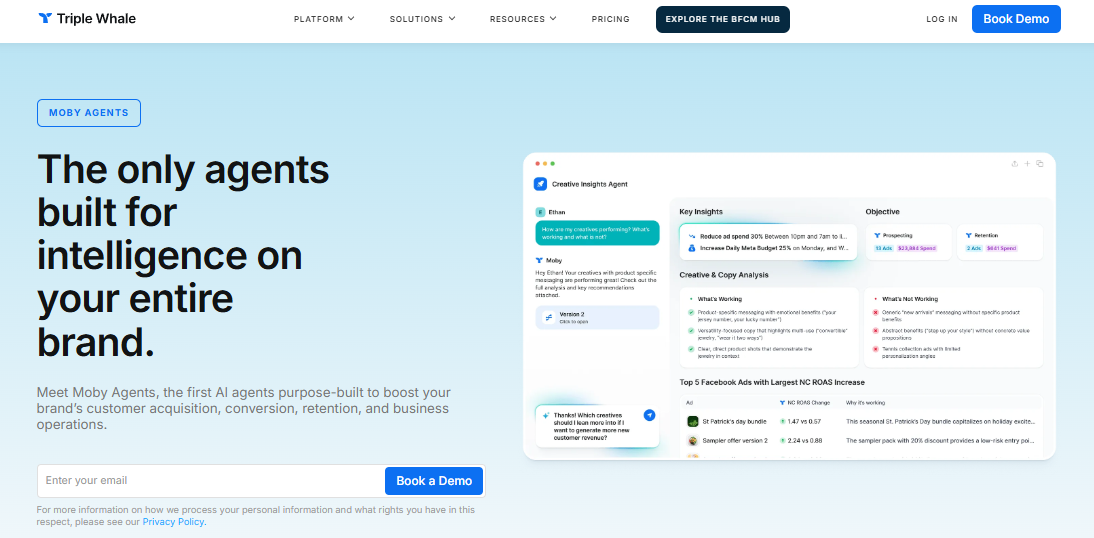
Moby Agents analyze creative and budgets, but stop at marketing efficiency, not cash position.
🏆 Why did we choose this tool?
Triple Whale earned its place on measurement depth. The Triple Pixel collects first-party data independent of platform tracking, and Moby agents run analysis on top of it. If your bottleneck is "which channel actually drove this order," this is the strongest answer in the list. My honest read is that it stops at marketing efficiency. Moby can tell you to move 20% of budget to TikTok. It cannot tell you whether your cash position survives the inventory that move requires.
📊 How it scores on the five metrics
Data sources connected: Commerce, ads, and email, plus first-party pixel data
Reasoning scope: Marketing and commerce, with no finance or accounting layer
Autonomy level: Scheduled agent analysis and anomaly flags on marketing metrics
Alert channels: In-app, Slack, and email summaries
Pricing model: Tiered by annual GMV, with a 12-month commitment on paid plans
✅ Solutions offered
Multi-touch attribution and blended ROAS reporting via the Triple Pixel
Marketing mix modeling and incrementality testing on higher tiers
Moby 2 agents for automated analysis across ad and store data
Creative reporting and post-purchase survey capture
A free tier that includes the pixel, plus first-click and last-click attribution
🎯 Best for
Shopify-first DTC brands spending meaningful paid media every month
Teams above roughly $1M GMV, where the price per insight clears the bar
Pricing scales by GMV tier rather than the published rate card, and a $6M GMV brand can land near $11K a year. Attribution accuracy is contested in recent reviews, and support quality at the paid tier is a documented friction point. If that trade-off is your sticking point, the comparison of Triple Whale alternatives lays out the options.
⭐ Reviews
"The initial onboarding experience was good and very polished. Everything sounded great, the platform seemed powerful, and expectations were set well at the beginning. However, once I was fully in the contract and working day-to-day with my assigned success manager, the experience declined." — Shopify merchant, Store Owner Triple Whale - Shopify App Store Verified Review
"We tried Triple Whale too but it felt super bloated with useless features (we only need order attribution with custom pixel) and their pixel tracking is just a black box." — u/shopify_operator, r/shopify Reddit Thread
Luca AI sits next to Triple Whale rather than against it. The pixel measures channel credit, while Luca AI reasons across marketing, inventory, and cash to explain what the number means for the business, which is the distinction drawn out in this breakdown of ecommerce analytics platforms.
1.3 Shopify Sidekick [toc=1.3 Shopify Sidekick]
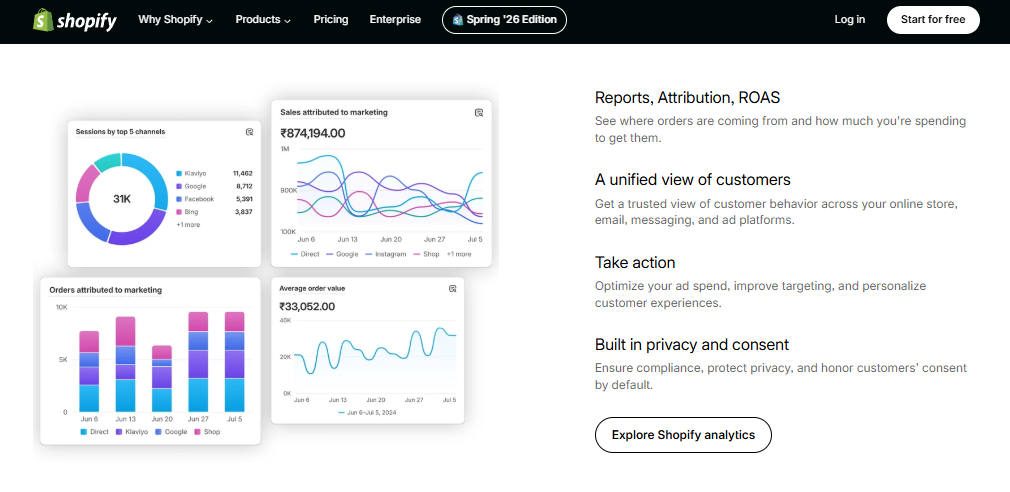
Shopify analytics reports what happened last week, while operator-side agents explain why the number moved.
🏆 Why did we choose this tool?
Sidekick is already paid for, which makes it the cheapest agent you will ever test. It lives inside the Shopify admin and handles segment building, report pulls, and setup tasks in plain language. Shopify reported 34 million Sidekick conversations in Q2 2026, with daily active merchants up 3.6x year over year. My read is that it earns its place as your first agent, not your only one.
📊 How it scores on the five metrics
Data sources connected: Shopify admin data only
Reasoning scope: Store operations, single platform
Autonomy level: Task execution inside the admin, with your confirmation
Alert channels: In-admin chat, no scheduled push reporting
Accuracy is the recurring complaint. Merchants report invented variables and inconsistent results on anything beyond simple lookups. It also cannot see Meta, Google, or your accounting data, so cross-channel questions are out of reach.
⭐ Reviews
"Honestly, I don't find it particularly helpful except for locating specific Shopify documentation when I need assistance from support." — u/shopify_merchant, r/shopify Reddit Thread
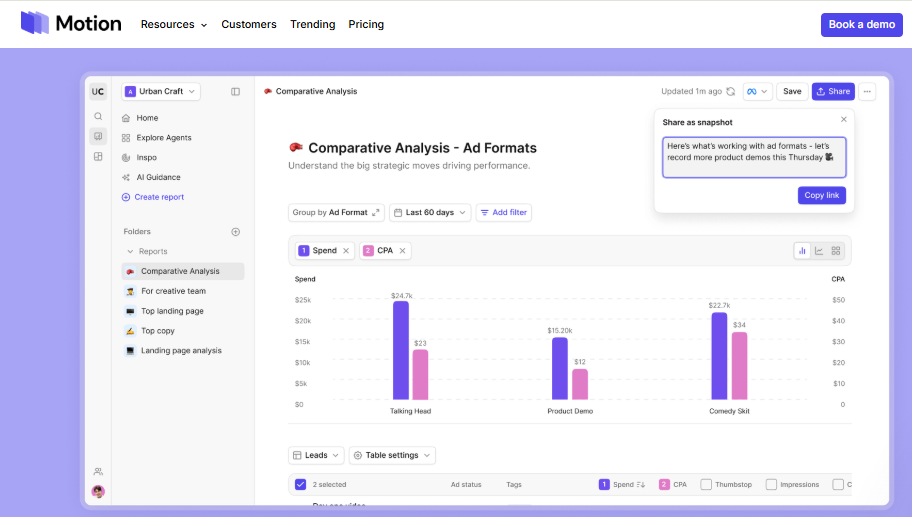
Motion comparative analysis report ranking ad formats by spend and CPA for talking head, product demo, comedy skit
🏆 Why did we choose this tool?
Motion answers one question well: why did this creative win. It auto-tags every ad by format, hook, and angle, then ranks performance across your library. Reviewers put it at 4.5 out of 5 across 111 G2 reviews. Operators running Motion describe pushing the agent to work autonomously for longer stretches instead of babysitting reports.
📊 How it scores on the five metrics
Data sources connected: Meta, TikTok, YouTube, and Google ad accounts
Reasoning scope: Creative and paid media only
Autonomy level: Automated tagging and agent-generated creative insight
Alert channels: In-app reporting, and scheduled report delivery
Pricing model: Published tiers from around $250 per month
✅ Solutions offered
Automatic creative tagging by hook, format, and angle
Comparative and top-performer creative reports
Data-backed creative briefs for your next production round
Brands spending meaningful monthly budget on paid social
In-house creative teams shipping multiple concepts per week
Agencies reporting creative performance to several clients
⚠️ What breaks at scale
Motion measures creative. It does not make it, and it will not tell you what the spend does to your cash position. Pricing is tied to spend tiers, so cost climbs as you scale. If cash impact is your real question, start with AI marketing analytics for ecommerce.
⭐ Reviews
"I like both the comparative and top performing custom reports. All the data and metrics are already loaded in, so I can spend more time analyzing." — G2 reviewer, Performance Marketer Motion - G2 Verified Review
1.5 Klaviyo K:AI [toc=1.5 Klaviyo K:AI]
Klaviyo K:AI drafts flows and segments, but never sees ad spend or returns cost.
🏆 Why did we choose this tool?
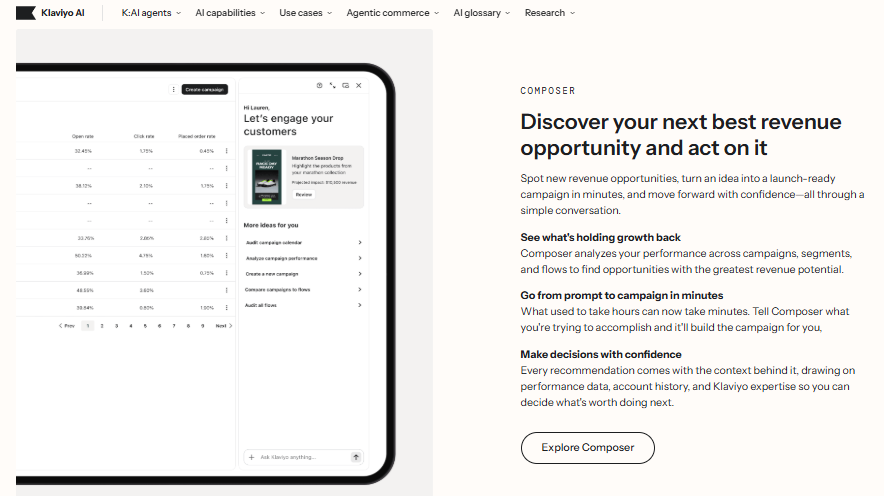
If your retention engine already sits in Klaviyo, K:AI is the lowest-friction lifecycle agent available. It builds segments, drafts flows, and analyzes campaign performance from natural-language prompts. The value comes from proximity to the data, not from model quality. Agency teams reviewing flows across dozens of accounts describe a fix, improve, test loop that agents shorten considerably.
📊 How it scores on the five metrics
Data sources connected: Klaviyo profile, event, and commerce data
Reasoning scope: Email, SMS, and retention only
Autonomy level: Drafts and suggestions, human sends
Alert channels: In-app insights and campaign reporting
Pricing model: Included with Klaviyo plans, usage-based by profile count
✅ Solutions offered
Natural-language segment building
Flow drafting and subject-line generation
Campaign performance analysis and benchmarking
Send-time and frequency guidance
Predictive metrics such as churn risk and expected date of next order, which sit alongside a full customer churn analysis
🎯 Best for
Stores already running Klaviyo as their retention system of record
Small teams without a dedicated email strategist
Brands with enough order history for predictive metrics to mean something
⚠️ What breaks at scale
K:AI reasons inside Klaviyo. It cannot tell you whether an email cohort is actually profitable after ad spend, discounts, and returns, because it never sees those numbers. That gap is why customer profitability analysis has to happen outside your email tool.
1.6 Pumice.ai [toc=1.6 Pumice.ai]
Structured product data decides whether your SKUs ever reach AI shoppers and agentic buyers.
🏆 Why did we choose this tool?
Pumice is the merchandising entry most roundups skip, and it targets a real cost center. It runs merchandising and product-detail-page pipelines rather than a chat window, which suits large catalogs with thin product data. Structured product data now decides whether your SKUs enter an AI shopper's consideration set, which makes this work commercial, not cosmetic.
📊 How it scores on the five metrics
Data sources connected: Product catalog, PDP content, and store data
Reasoning scope: Merchandising and product content
Autonomy level: Pipeline execution with review before publish
Feed readiness improvements for AI discovery surfaces
🎯 Best for
Catalogs above roughly a thousand SKUs with inconsistent product data
Teams whose product content bottleneck is volume, not creativity
Brands preparing for AI-referred traffic, which converts around 50% higher on Shopify
⚠️ What breaks at scale
Automated product content needs a human quality gate. A premium bike retailer published a homepage image with the rear derailleur mounted on the front wheel, which is exactly the failure that slips through when the model becomes the reviewer.
1.7 Nosto [toc=1.7 Nosto]
🏆 Why did we choose this tool?
Nosto is the most mature onsite personalization engine in the list, with 4.6 out of 5 across 235 G2 reviews. It handles recommendations, search, and category merchandising in one platform, which removes three point solutions. Shopify Plus brands often go live in weeks with light developer time.
📊 How it scores on the five metrics
Data sources connected: Onsite behavior, catalog, and order data
Reasoning scope: Onsite discovery and personalization
Autonomy level: Live ranking and recommendation decisions, rule-guided
Alert channels: In-platform reporting and scheduling
Pricing model: Custom, tied partly to transaction volume
Mid-market and Shopify Plus brands with real traffic volume
Retailers with deep catalogs where discovery is the conversion bottleneck
Teams that want one platform instead of five point tools
⚠️ What breaks at scale
There is no published pricing, so every quote runs through a sales call. Analytics depth and merchandising rule setup are the most repeated complaints from otherwise satisfied customers.
⭐ Reviews
"The interface can sometimes be a bit complex to handle, even though recent improvements have been made to make it more intuitive. The cost of the solution also represents a significant investment, which can be a barrier for some companies." — G2 reviewer, Ecommerce Manager Nosto - G2 Verified Review
"Pricing can be expensive for small businesses." — Verified User in Cosmetics, Mid-Market Nosto - G2 Verified Review
1.8 Alhena [toc=1.8 Alhena]
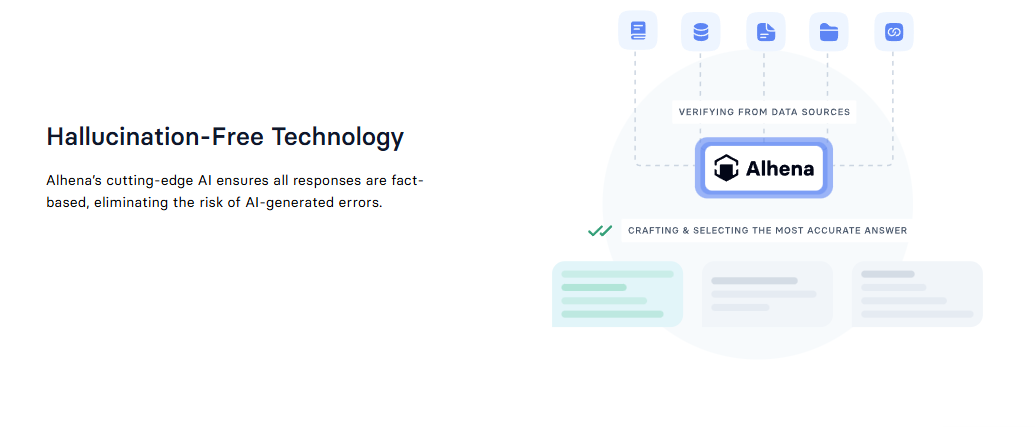
Alhena grounds shopper answers in your catalog and documentation to limit hallucinated replies.
🏆 Why did we choose this tool?
Alhena spans discovery and support in one agent, which is unusual. It answers product questions, guides shoppers, and handles post-purchase actions like order lookups. Reviewers rate it around 4.9 out of 5 across roughly 36 G2 reviews, with praise for answer quality and easy training. There is a free tier, which lowers the test cost to nearly nothing.
📊 How it scores on the five metrics
Data sources connected: Store catalog, help content, and order data
Reasoning scope: Shopper discovery and support
Autonomy level: Autonomous answers, plus configured post-purchase actions
Alert channels: In-app dashboard and conversation logs
Small and mid-sized Shopify stores testing a shopper-side agent
Brands with strong documentation to train on
Teams that want discovery and support in one tool
⚠️ What breaks at scale
Analytics depth is the common criticism. The dashboard lacks deep trending and long-term comparisons, which matters more as your volume grows, and it is where a dedicated ecommerce analytics dashboard still earns its place.
⭐ Reviews
"Overall, Alhena / Gleen is a good chatbot : it provides answers quickly, in a good readable format." — Fillion Électronique, Store Owner Alhena - Shopify App Store Verified Review
"The app learns all about our site, products and documentation and provides thorough advice and answers without hallucinations." — Shopify merchant, Store Owner Alhena - Shopify App Store Verified Review
1.9 Gorgias AI Agent [toc=1.9 Gorgias AI Agent]
🏆 Why did we choose this tool?
Gorgias earns inclusion on Shopify depth. It handles order edits, refunds, and shipping updates inside the ticket natively, which no generic helpdesk matches. It holds 4.6 out of 5 across 547 G2 reviews. My honest position is that the product is strong and the billing model is the problem.
📊 How it scores on the five metrics
Data sources connected: Shopify, plus connected commerce apps and help center
Reasoning scope: Customer support and order actions
Autonomy level: Autonomous resolution with configurable handoff
Alert channels: Helpdesk inbox and reporting views
Pricing model: Roughly $0.90 to $1.00 per AI resolution, plus helpdesk plan
✅ Solutions offered
Autonomous ticket resolution across email and chat
In-ticket Shopify actions such as refunds and order edits
Help-center answer generation
Rule-based automation for repetitive tickets
Voice and social channel coverage on higher tiers
🎯 Best for
Shopify stores with high WISMO and order-status volume
Teams already using Gorgias as their helpdesk
Brands willing to invest in knowledge-base cleanup first
⚠️ What breaks at scale
Each AI resolution also counts as a billable ticket, so a single conversation can be charged twice. Overages run near $1.50, a 67% premium. Reviewers document hallucinated discount codes and wrong auto-closes. Model that cost against your own numbers using this guide to tracking ecommerce unit economics.
⭐ Reviews
"I used Gorgias for some time, but I found the AI-generated responses to feel overly robotic." — u/shopify_merchant, r/shopify Reddit Thread
"i was excited about gorgias ai when it came out. looked fine on paper, but in reality the ai was trash." — u/shopify_operator, r/shopify Reddit Thread
1.10 Intercom Fin [toc=1.10 Intercom Fin]
Every resolution Fin reports here is a billable outcome, so success raises your invoice.
🏆 Why did we choose this tool?
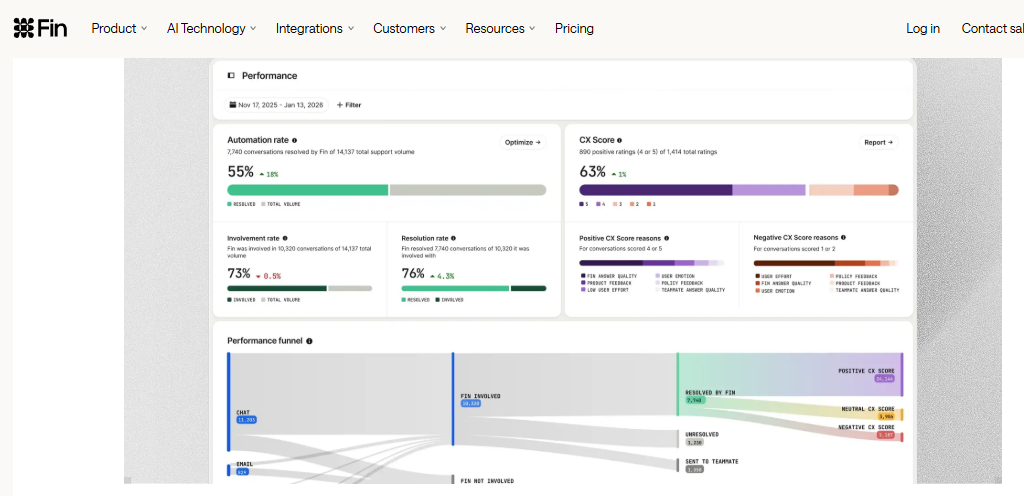
Fin is the most reviewed AI support agent in the category, at 4.5 out of 5 across 3,904 G2 reviews. It charges $0.99 per outcome and bills once per conversation regardless of how many actions it takes. Intercom claims a 76% average resolution rate across 12,000-plus customers.
📊 How it scores on the five metrics
Data sources connected: Help center content, commerce integrations, and CRM data
Reasoning scope: Customer support across chat, email, voice, and social
Autonomy level: End-to-end resolution with configured procedures
Alert channels: Intercom inbox and reporting
Pricing model: $0.99 per outcome, plus seats from $29 to $132
✅ Solutions offered
Autonomous resolution across multiple channels
Procedures for multi-step tasks with defined handoffs
Knowledge-base-grounded answers with source citation
Lead qualification and disqualification outcomes
Detailed resolution-rate reporting
🎯 Best for
Support teams above roughly 1,000 monthly conversations
Brands with maintained, current help center content
Companies already standardized on Intercom
⚠️ What breaks at scale
Silence counts as a resolution, so customers who give up are billed as successes. Independent tests put real-world resolution between roughly 38% and 72%, below the advertised average. Support cost belongs in your ecommerce profit margins math, not in a separate tab.
⭐ Reviews
"While Fin performs well, the pay-per-resolution approach makes costs hard to predict at higher volumes and can become expensive as AI adoption and resolution rates increase." — G2 reviewer, Support Lead Intercom Fin - G2 Verified Review
"Out of the box, we saw a 60% resolution rate, and over time with continued refinement, improvements to the product, and implementation of more complex features like Procedures, we're seeing an average of 70% resolution with 1% improvement month over month." — G2 reviewer, Customer Experience Manager Intercom Fin - G2 Verified Review
1.11 Siena AI [toc=1.11 Siena AI]
🏆 Why did we choose this tool?
Siena is built for DTC brands specifically, and it holds 4.8 out of 5 across 28 G2 reviews. It runs autonomous conversations across chat, email, social, and voice, handling procedural tasks rather than FAQ deflection. Published pricing sits at $750 per month, plus roughly $0.90 per automated conversation.
📊 How it scores on the five metrics
Data sources connected: Shopify and Fulfil order data, plus help content
Reasoning scope: Customer support across multiple channels
Autonomy level: High autonomy with brand-voice configuration
Alert channels: Platform dashboard and inbox integrations
Pricing model: $750 per month, plus a per-conversation fee
✅ Solutions offered
Autonomous multi-channel support conversations
Brand-voice persona configuration
Order lookups, returns, and address changes
Social and DM coverage alongside chat and email
Escalation rules for sensitive cases
🎯 Best for
DTC brands with meaningful social and DM support volume
Teams that can invest several weeks in buildout
Brands where tone consistency matters commercially
⚠️ What breaks at scale
Escalation is the most repeated criticism. Reviewers describe the agent continuing a conversation after a human has taken over, or closing a ticket when the customer asked for a person. Ticket spikes are also an operational signal worth watching inside your ecommerce monitoring tools.
Rep AI is the conversion-focused entry. It detects browsing intent and intervenes before a shopper bounces, rather than waiting for a support question. It holds 4.9 out of 5 from 60 G2 reviews and 4.7 out of 5 from 109 Shopify App Store reviews, with pricing from around $99 per month. The larger Shopify pool is the more honest signal.
📊 How it scores on the five metrics
Data sources connected: Shopify catalog and behavior data, plus Zendesk, Klaviyo, and Gorgias
Reasoning scope: Shopper conversion and frontline support
Autonomy level: Proactive engagement with live-chat handoff
Alert channels: In-app dashboard and reporting
Pricing model: From roughly $99 per month, tiered by traffic
✅ Solutions offered
Behavior-triggered proactive shopper engagement
Product recommendations inside the conversation
Support answers that reduce ticket volume
Live chat handoff for complex cases
Multilingual shopper sessions
🎯 Best for
Stores between roughly 10,000 and 50,000 monthly visitors
Fashion, beauty, and considered-purchase DTC categories
Pricing is traffic-tiered, so overage math matters once you grow past your plan. The review distribution skews heavily positive, so treat vendor-quoted conversion averages as directional.
⭐ Reviews
"One of the main reasons I use Rep AI is to reduce the amount of support tickets I receive. Every time Rep AI answers a customer's question, that's one support ticket we don't have to answer." — G2 reviewer, Ecommerce Manager Rep AI - G2 Verified Review
"Incredibly easy integration, superior function. Rep AI has shown some great results so far with generating/saving extra sales for our business." — Shopify merchant, Store Owner Rep AI - Shopify App Store Verified Review
Luca AI occupies the seat none of the eleven above fill. It reasons across commerce, ad, email, accounting, and inventory data in one thread, so the answer to "why did margin drop" arrives with the cause attached, which is the shift explained in this piece on the AI data analyst for ecommerce. I still run several of these tools alongside it, because measurement, merchandising, and support are separate jobs.
Q2. How Did We Score and Rank These 12 Agents? [toc=2. Scoring Methodology]
Five weighted criteria decide the ranking: Cross-Functional Intelligence 25%, Agentic Action Capability 20%, Setup and Usability 20%, Pricing Transparency 20%, and User Reviews 15%. Scores convert to stars in five bands, from one star at the bottom to five at the top. Luca AI scores 5 stars. Pricing Transparency carries real weight, because per-resolution billing is where agent budgets quietly break.
⚖️ Why these five weights, not a feature count
Feature counts reward vendors with the longest changelog. They tell you nothing about whether the agent helps you make a better call on Thursday. So the rubric weights reasoning scope highest, then the ability to actually do something with that reasoning.
Cross-Functional Intelligence carries the most weight for a specific reason. Most founders judge decisions on gross margin, which only tells you what the product costs to make. It says nothing about what it costs to sell, ship, and support. A scoring system built on one narrow signal repeats that same mistake, which is the trap unpacked in this breakdown of contribution margin versus gross margin.
📊 The rubric
Scoring Rubric for the 12 Ecommerce AI Agents
Criterion
Weight
How it was measured
Cross-Functional Intelligence
25%
Number of functional domains the agent can reason across, from published integration lists
Agentic Action Capability
20%
Whether it executes, schedules, or only suggests, per vendor documentation
Setup and Usability
20%
Time to first useful output, and review-sourced onboarding friction
Pricing Transparency
20%
Published rate cards, overage rates, and billing-model clarity
User Reviews
15%
G2 and Shopify App Store ratings, weighted by review count
🔍 How each criterion was actually checked
Pricing Transparency was the easiest to score and the most revealing. Gorgias AI Agent charges roughly $0.90 per resolution on annual billing and $1.00 monthly, with overages near $1.50. Intercom Fin publishes $0.99 per resolved outcome and bills once per conversation.
Agentic Action Capability came from documentation, not marketing pages. Luca AI measures this by whether a tool can push a scheduled report or an anomaly alert without a human opening anything. Tools that only answer when asked scored lower here, regardless of model quality, which is the same test applied in this guide to evaluating AI data agents.
⭐ How stars were assigned
Scores map to five equal bands, so a tool in the top band earns five stars and the bottom band earns one. I have not published raw scores per tool, because a two-point gap invites false precision. The stars in the comparison table are the output.
Cross-Functional Intelligence is where the spread was widest. Support agents scored well on action and reviews, and poorly on scope. Ask Luca AI a question that spans ad spend, inventory position, and returns cost, and it answers from one dataset, which is the specific gap that criterion measures.
⚠️ The conflict, stated plainly
I co-founded Luca AI, and Luca AI publishes this list. That is a real conflict, and you should weight my ranking accordingly. Most 2026 roundups place the publisher at number one and never mention it.
Re-weight the rubric if your stage differs. Below roughly $1M in revenue, push Pricing Transparency higher and Cross-Functional Intelligence lower, because you have less data to reason across anyway. At that stage, the best Shopify analytics apps may cover more ground per dollar.
💬 What reviews told us that rate cards did not
"While Fin performs well, the pay-per-resolution approach makes costs hard to predict at higher volumes and can become expensive as AI adoption and resolution rates increase." — G2 reviewer, Support Lead Intercom Fin - G2 Verified Review
"The interface can sometimes be a bit complex to handle, even though recent improvements have been made to make it more intuitive. The cost of the solution also represents a significant investment, which can be a barrier for some companies." — G2 reviewer, Ecommerce Manager Nosto - G2 Verified Review
Luca AI scores five stars on Cross-Functional Intelligence because it reads marketing, inventory, and finance data as one dataset. That single criterion separates reasoning from reporting, and it is the reason the ranking looks different from every support-first list on the SERP. The same logic drives how we compare ecommerce analytics platforms.
Q3. What Exactly Is an Ecommerce AI Agent, and How Is It Different From a Chatbot or a Dashboard? [toc=3. Agents Defined]
An ecommerce AI agent takes a goal, pulls live context from your store systems, chooses tools, executes multi-step actions such as refunds, listing edits, or budget shifts, and checks its own work. A chatbot only retrieves answers. A dashboard only reports. Agents split into three camps: shopper-side, operator-side, and agentic-commerce buyers that shop on a customer's behalf.
🔧 The three-part test
Three things separate an agent from everything before it. Miss any one, and you are looking at automation with a chat window on top.
Context: it reads live data from your systems, not a static knowledge base
Tool use: it calls other software to get something done
Self-check: it verifies the outcome and escalates when confidence drops
A dashboard is your speed limit and gas gauge. It tells you how fast you went. An agent is closer to a clean windshield, because it helps you see what is coming. That distinction is the whole premise behind agentic AI for ecommerce founders.
🧭 The three camps, and why the difference costs money
Shopper-side agents work for your customer. Gorgias AI Agent and Intercom Fin answer order questions and process returns. Their value shows up as deflected tickets.
Operator-side agents work for you. Ask Luca AI why contribution margin slipped last month, and it traces the answer across ad spend, discounts, returns, and fulfilment cost. Nothing about that conversation touches your storefront.
Agentic-commerce buyers are the third camp, and they are new. These are AI assistants inside ChatGPT, Google AI Mode, and Copilot that browse and buy for a shopper. Your product feed becomes the storefront they read.
📈 Why the third camp is not theoretical
Shopify reported AI traffic to merchant storefronts up 3x year over year in Q2 2026, with new-buyer order rates from AI channels running at twice other channels. AI-referred shoppers converted roughly 50% higher, with 14% higher average order value.
Here is the part that surprised me. Around 75% of AI-attributed orders sat outside the top 100 categories. Long-tail products are winning these agents' attention, which favors specific catalogs over broad ones, and it changes how you read ecommerce performance analytics.
⚠️ The expensive mix-up
The most common buying mistake is camp confusion. A founder feels blind about profitability, then buys a support agent because that is what every roundup ranks first. Tickets drop, and the original problem stays exactly where it was.
Reverse it and the waste is the same. An operator-side tool will not answer your customer at 2am. Name the bottleneck first, then pick the camp.
🧠 Why context beats model quality
Think about hiring a brilliant analyst. First day, no onboarding, no access to your systems, and you ask for a recommendation. Even a genius fails that setup.
Agents fail the same way, for the same reason. Luca AI normalizes and standardizes data on ingestion, so the reasoning layer starts with clean, consistent definitions rather than four systems that disagree on what an order is. Model choice matters far less than the context you hand over, which is the case made in this piece on ChatGPT for ecommerce data analysis.
✅ What "acts" really means here
Action does not require full autonomy. Most agents worth paying for sit at recommendation or approval-gated execution, which is the right default for anything touching cash.
Luca AI acts by pushing rather than pulling. Scheduled reports and outlier alerts land in Slack, email, or the app when ROAS dips, CAC spikes, or inventory drops below your threshold. You never open a dashboard to find out. That is agent behavior applied to reporting, and it is the version of autonomy I trust with a store's money.
Q4. Which Agent Should Own Which Job: Analytics, Merchandising, Ads or Support? [toc=4. Match Agent to Job]
Analytics agents reason across blended Shopify, Meta, Google, and Klaviyo data to explain why a number moved and what to do next. Merchandising agents fix product data, PDP copy, and ranking. Ads agents categorize creative and reallocate spend. Support agents resolve tickets and take order actions. Most stores need one operator-side agent and one support agent before anything else.
🧩 The four jobs, side by side
Which Ecommerce AI Agent Owns Which Job
Job
The decision it owns
Worth testing
When it pays
Analytics
Why a metric moved, and what to do
Luca AI, Triple Whale Moby
Once you have 12 months of clean order history
Merchandising
What shows first, and how products are described
Pumice.ai, Nosto
Above roughly 1,000 SKUs
Ads and lifecycle
Which creative and which spend, which flow
Motion, Klaviyo K:AI
Once monthly ad spend passes your ability to review it manually
Support
Resolving tickets and order actions
Gorgias AI Agent, Intercom Fin
Above roughly 500 monthly tickets
📦 Merchandising and ads: narrow jobs, real returns
Merchandising agents pay off when your catalog is bigger than your content team. Shopify merchants using AI features report 41% time saved on merchandising tasks. Product data quality now decides whether your SKUs even reach AI shoppers, which puts ecommerce data management ahead of tool selection.
Ads agents do one thing well: they tag and rank creative so you know what to make next. Operators running Motion describe pushing the agent to work for longer stretches without supervision. Neither of these agents can tell you if the spend is affordable.
🛠️ Support: the easiest win, and the easiest overspend
Support is where agents work most reliably today. Merchants using Shopify's AI features report 26% fewer support tickets. The catch is billing, not capability.
Read the pricing model before the feature list. Gorgias bills roughly $1 per AI resolution, and Reddit threads are full of operators doing that math out loud.
❌ Why dashboards keep failing the analytics job
Dashboards are descriptive. They tell you how you died last week, and leave the reasoning to you. That is how founders become dashboard janitors, exporting from Shopify and the returns system into a spreadsheet every Sunday night, a habit examined in this look at Shopify reporting.
The bigger failure is the metric itself. I once watched a founder present her hero product at 72% gross margin, unable to make it fast enough. Twenty minutes of line-by-line cost work later, actual contribution margin came in at 8%.
💰 What that number means for tool choice
Contribution margin means revenue minus every variable cost to make, ship, support, and market the unit. Getting to it requires fulfilment data, returns data, and support cost, not just ad platform numbers.
Luca AI reads those sources together, then runs root-cause analysis to name which components moved the number. Any analytics agent that cannot reach fulfilment, returns, and support cost is a reporting toy, whatever its chat interface looks like.
⏰ Sequencing, by revenue band
Stacking four agents at once is the most expensive mistake in this category. Apps that do not talk to each other create three new problems for every one they solve, which is why your ecommerce tech stack deserves a sequencing plan.
Under $1M: Shopify Sidekick only, since it is already paid for
$1M to $5M: one operator-side analytics agent, then one support agent
$5M and up: add merchandising or ads, depending on whether catalog or creative is the constraint
Luca AI sits in that second band deliberately, where stores have piled-up data, no analyst, and no appetite for a warehouse project. I would rather you run one agent that answers hard questions than four that each answer easy ones. If that sounds like your situation, the Luca AI use cases page shows what those questions look like in practice.
Q5. What Do These Agents Actually Cost Once You Run the Math? [toc=5. Real Cost Math]
Sticker price is not your cost. Gorgias AI Agent bills roughly $0.90 per resolution on annual billing and $1.00 monthly, with overages near $1.50, a 67% premium. Each AI resolution also counts as a billable helpdesk ticket, so one conversation can be charged twice. Intercom Fin charges $0.99 per resolved outcome. Model effective cost per outcome before you sign anything.
💰 The double-billing mechanic, in plain terms
Per-resolution pricing means you pay each time the agent closes a conversation without a human. That sounds fair until you read how the ticket itself is counted. In Gorgias, an AI resolution also consumes a helpdesk ticket from your plan allowance.
So the same conversation hits your invoice from two directions. Your plan fee stays flat, and a new variable line appears next to it. That is exactly the kind of leak that shows up in tracking ecommerce unit economics properly.
📊 What that looks like at 2,000 monthly tickets
AI Support Agent Fees at 2,000 Monthly Tickets
Automation rate
AI resolutions
AI fee at $0.90
AI fee at $0.99 (Fin)
20%
400
$360
$396
30%
600
$540
$594
50%
1,000
$900
$990
Add your plan fee and seats on top of every row. At 30% automation, a store on a $360 monthly plan is now paying roughly $900 all in. Fin bills once per conversation regardless of how many actions it takes, which helps, but the per-outcome line still scales with success.
💸 The variable-cost creep nobody models
Here is the contrarian read I keep coming back to. AI's biggest impact in ecommerce will be top-line growth, not margin improvement, because every AI interaction carries a per-call cost that eats the savings.
Then the channel fees arrive. Transaction fees on AI commerce channels could add roughly 4% on top of your existing card and platform fees. Stack that against your contribution margin, which is revenue minus every variable cost to make, ship, support, and market a unit, and you can see why ecommerce profit margins move before your ROAS does.
⚖️ How pricing models actually compare
Agent Pricing Models and What Happens When They Work
Pricing model
Example
What happens when it works well
Per resolution
Gorgias, Fin
Cost rises with every success
Per conversation plus platform fee
Siena AI at $750 monthly, plus about $0.90 each
Fixed floor, variable ceiling
Traffic tier
Rep AI from about $99 monthly
Cost rises with traffic, not outcomes
Flat seat replacement
Luca AI
Cost stays flat as usage rises
Luca AI is priced against the analyst seat it replaces, not per interaction. A week where you ask fifty questions instead of five does not change the invoice, which matters when you are in the middle of a margin problem. Current tiers sit on the Luca AI pricing page.
⚠️ The one question to ask on every pricing call
Ask this: what exactly counts as a billable event, and does it also consume my plan allowance? Then ask for the overage rate in writing.
Reviewers who skipped that step wrote the warnings you can read today. Also test before you upgrade. Sellers report that Jungle Scout's AI Assist output roughly matches a well-prompted general model, despite the claimed 35% faster research-to-launch.
⭐ What operators say about the bill
"While Fin performs well, the pay-per-resolution approach makes costs hard to predict at higher volumes and can become expensive as AI adoption and resolution rates increase." — G2 reviewer, Support Lead Intercom Fin - G2 Verified Review
"Gorgias charges $1 per automated resolution. fine for basic questions like order status, but we use Shopify." — u/ecommerce_operator, r/ecommerce Reddit Thread
Your Monday action is simple. Pull last month's ticket count, apply the three automation rates above, and compare the total to what a part-time human costs you. That number, not the vendor's landing page, decides whether the agent is worth it. Fold it into your cash flow forecast before the renewal date, not after.
Q6. Where Must a Human Stay in the Loop, and What Should an Agent Never Own? [toc=6. Guardrails and QA]
Give agents reversible, high-volume, low-judgment work: order-status replies, listing hygiene, anomaly detection, and creative tagging. Keep humans on refunds above a threshold, discount codes, product curation, and any visual asset that ships publicly. Reviewers document hallucinated discount codes, wrong auto-closes, and roughly 59% response accuracy in Gorgias deployments, which makes the approval boundary a cash control rather than a preference.
🔁 The reversibility test
One question sorts most of this. If the action goes wrong, can you undo it in under five minutes without touching money?
Order-status answers pass. A discount code sent to a customer does not, because you cannot unsend it. Luca AI applies that same boundary to itself. It surfaces the anomaly, the reasoning, and the recommended move, then leaves the spend or inventory commitment to you.
❌ The bike that shipped with the derailleur on the front wheel
A premium bike retailer published a homepage image with the rear derailleur mounted onto the front of the wheel. The bike retails around $20,000. Any cyclist looking at that page saw a brand that does not know its own product.
That failure is not a model problem. It is a process problem. The AI became the quality check, and nobody above it was reviewing output before publish, which is the risk baked into unattended product data management.
⚠️ Automating before you fix the constraint
There is an older version of this mistake worth knowing. A UK pharmacy installed a 350,000 pound dispensing robot that could pick eight prescription items per minute. It could not be reloaded without shutting the machine down.
Speed at the wrong step buys you nothing. Before you automate a workflow, find the actual bottleneck, because agents amplify whatever process they inherit. The same rule applies to ecommerce inventory management.
🤝 The contested case: support warmth versus support speed
I will not pretend this one is settled. One operator with an older, high-value customer base told me the relief in a customer's voice when a human answers the phone is part of the product. That is real, and it does not show up in a deflection dashboard.
The opposite case is equally real. A lean solopreneur running high order volume treats full support autonomy as the only viable option. Both are correct, and your catalog and customer age decide which one you are. Your customer retention strategy should make that call, not your ticket queue.
✅ The permissions matrix to copy
Agent Permissions Matrix for Ecommerce Operators
Action
Auto-approve
Needs approval
Never automate
Order status and tracking replies
✅
-
-
Address change before fulfilment
✅
-
-
Refunds under your threshold
-
✅
-
Discount or goodwill codes
-
✅
-
Ad budget reallocation
-
✅
-
Product curation and collection order
-
✅
-
Public visual assets and PDP images
-
-
❌
Anything touching a customer's payment method
-
-
❌
Set the refund threshold at a number that would annoy you, not ruin you. Most stores land between $50 and $150.
📉 What reviews reveal about accuracy
Ads are where I see the most overconfidence. One operator put it plainly: they ask AI for input on Google Ads decisions, then keep their own opinion, because the algorithm lacks internal company context.
Sidekick users report the same trust gap inside the Shopify admin. Treat every agent output as a draft until it has earned a track record on your data, and keep ecommerce monitoring tools watching the outcome either way.
⭐ Reviews worth reading before you flip autonomy on
"I used Gorgias for some time, but I found the AI-generated responses to feel overly robotic." — u/shopify_merchant, r/shopify Reddit Thread
Luca AI sits at the recommendation layer on purpose. The alert arrives with the cause attached, and the decision to move money stays with the person whose money it is.
Q7. How Do You Deploy Your First Agent in 30 Days and Prove It Worked? [toc=7. 30-Day Rollout and Proof]
Week one: connect your sources, normalize at the ingestion layer, and pick one metric. Week two: run the agent in shadow mode against a human baseline. Week three: grant narrow write permissions on reversible actions only. Week four: compare cost per outcome to baseline, then widen or kill it. One agent, one metric, one owner, because 25.4% of surveyed sellers report no measurable results from AI at all.
⏰ Week one: connect and pick the metric
Connect your sources and write down the single metric this agent must move. Contribution margin, resolved tickets per dollar, or add-to-cart rate all work. Vague goals produce vague agents, so pick from your existing ecommerce KPIs rather than inventing one.
Then reconcile definitions. Shopify, your 3PL, and Klaviyo often disagree on what counts as an order or a return. Luca AI normalizes and standardizes data on ingestion, which is why week one becomes an afternoon rather than a quarter-long data project.
📋 Data readiness, the part everyone skips
Audit your product feed before you buy any merchandising agent. Missing attributes decide whether your SKUs enter an AI shopper's consideration set at all. Poor inventory accuracy already costs retailers over $1.1 trillion in revenue distortion.
Skip the proprietary build. One health founder spent roughly $10 million building a system to turn data into meaning, then watched general models outperform it. Buy the layer, spend your money on inventory, and let ecommerce data integration happen in the background.
🔍 Week two: shadow mode
Run the agent beside your human process without letting it act. Log what it would have done, then compare to what your team actually did.
The go or no-go test is agreement rate on real cases. If it disagrees with your team more than one time in four, your context is thin, not your model. Fix the source data before granting permissions.
✅ Week three: narrow write permissions
Grant one reversible action. Order-status replies, listing updates, or creative tagging are good candidates. Keep refunds and discounts behind approval.
Give it a brand context document too. Top performers, margin rules, tone, and your do-not-touch list belong in one file that every agent you trial reads. Context engineering beats prompt engineering, and this file is the difference between generic output and yours.
📊 Week four: prove the lift
Compare cost per outcome to your week one baseline. Then run a simple holdout: leave 20% of eligible cases on the human path and compare the two groups over the same period.
Three metrics per agent family are enough:
Analytics: decisions changed per week, and time from question to answer
Support: cost per resolved ticket, and CSAT on AI-handled tickets
Merchandising and ads: conversion rate on touched SKUs, and creative win rate
📈 What the benchmarks say to expect
Shopify's Q1 2026 data shows AI-referred orders up roughly 13x, converting about 50% higher with 14% higher average order value. Q2 2026 showed AI traffic up 3x year over year, with 75% of AI-attributed orders outside the top 100 categories. Merchants using Shopify AI features report 26% fewer support tickets and 41% time saved on merchandising.
Now the sobering half. Across the Marketplace Pulse 2026 Seller Index, 83.4% of sellers use AI, averaging 3.2 use cases, yet a quarter measure nothing, and null impact roughly doubles among distressed sellers. Adoption is not results, which is the argument behind this piece on how AI can actually help you run your ecommerce business.
💰 Where the human still earns their keep
Aim to get the agent doing most of the work, then own the last slice yourself. Call it 92% machine, 8% you, and the 8% is judgment, taste, and the decision to spend.
Luca AI reports on that loop automatically. Weekly and monthly reports arrive with graphs, reasoning, and recommendations, so your baseline and your post-deployment comparison are built rather than rebuilt by hand, in the pattern described under automated ecommerce reporting.
The question I am still sitting with is whether the null-result quarter shrinks in 2027, or whether it hardens into a permanent split between stores that fixed their data and stores that bought agents on top of a mess. If you run this 30-day protocol, tell me which side you land on. I would rather see your numbers than argue about mine, so tell us what you are building.
FAQ's
What is an AI agent for ecommerce, and how is it different from a chatbot or a dashboard?
An ecommerce AI agent takes a goal, pulls live context from your store systems, chooses tools, executes multi-step actions such as refunds, listing edits, or budget shifts, and then checks its own work.
Three tests separate a real agent from automation with a chat window on top:
Context: it reads live data from your systems, not a static knowledge base.
Tool use: it calls other software to complete a task.
Self-check: it verifies the outcome and escalates when confidence drops.
A chatbot only retrieves answers. A dashboard only reports what already happened, which is why so many founders spend Sunday night exporting from Shopify and the returns system into a spreadsheet.
Agents also split into three camps that buyers keep conflating. Shopper-side agents work for your customer. Operator-side agents work for you. Agentic-commerce buyers are AI assistants inside ChatGPT, Google AI Mode, and Copilot that browse and buy on a shopper's behalf, which turns your product feed into the storefront they read.
Luca AI is an operator-side agent: it answers questions about your business rather than your customer's questions about their order, and it pushes findings to you instead of to the storefront. If you want the deeper framing, we wrote about agentic AI for ecommerce founders.
Which AI agent should own analytics, merchandising, ads, or support in my store?
Match the agent to the job, then sequence rather than stack. Four job families cover almost every use case.
Analytics: reasons across blended Shopify, Meta, Google, Klaviyo, and accounting data to explain why a number moved. Worth testing once you have twelve months of order history.
Merchandising: fixes product data, PDP copy, and ranking. Pays off above roughly a thousand SKUs.
Ads and lifecycle: tags and ranks creative, drafts flows, and flags spend patterns.
Support: resolves tickets and takes order actions. Pays off above roughly 500 monthly tickets.
Most stores need one operator-side agent and one support agent before anything else. Stacking four at once is the most expensive mistake in this category, because apps that do not talk to each other create three new problems for every one they solve.
Our stage rule is simple. Under $1M, use Shopify Sidekick only, since it is already paid for. Between $1M and $5M, add one analytics agent, then one support agent. Above $5M, add merchandising or ads depending on whether catalog or creative is the constraint.
Luca AI owns the analytics seat in that stack, running root-cause analysis across connected sources rather than reporting one channel. Sequencing matters more than tool count, which is why we treat your ecommerce tech stack as a plan, not a shopping list.
How much do ecommerce AI agents actually cost once you run the math?
Sticker price is not your cost. Per-resolution billing is where agent budgets quietly break, so model effective cost per outcome before signing.
Gorgias AI Agent bills roughly $0.90 per resolution on annual billing and $1.00 monthly, with overages near $1.50, a 67% premium.
Each Gorgias AI resolution also consumes a helpdesk ticket from your plan allowance, so one conversation can hit the invoice twice.
Intercom Fin charges about $0.99 per resolved outcome and bills once per conversation, plus seats.
Siena AI publishes $750 per month plus roughly $0.90 per automated conversation. Rep AI starts near $99 per month, tiered by traffic.
At 2,000 monthly tickets and 30% automation, that is 600 resolutions, or about $540 in AI fees on top of your plan. Then the channel fees arrive: transaction fees on AI commerce channels could add roughly 4% on top of existing card and platform fees.
Ask every vendor one question: what counts as a billable event, and does it also consume my plan allowance? Get the overage rate in writing.
Luca AI is priced against the analyst seat it replaces rather than per interaction, so asking fifty questions in a bad week does not change the invoice. Current tiers sit on our pricing page.
What should an ecommerce AI agent never be allowed to do without human approval?
Use one test: if the action goes wrong, can you undo it in five minutes without touching money? If not, it needs approval.
Safe to automate:
Order status and tracking replies.
Address changes before fulfilment.
Listing hygiene, anomaly detection, and creative tagging.
Needs approval:
Refunds above your threshold, usually between $50 and $150.
Discount or goodwill codes, because you cannot unsend one.
Ad budget reallocation and product curation.
Never automate public visual assets, PDP images, or anything touching a customer's payment method. A premium bike retailer published a homepage image with the rear derailleur mounted on the front wheel of a bike retailing near $20,000. That was a process failure, not a model failure: the AI became the quality check.
Reviewers also document hallucinated discount codes, wrong auto-closes, and roughly 59% response accuracy in some support deployments, which makes the approval boundary a cash control rather than a preference.
Luca AI sits at the recommendation layer on purpose: the alert arrives with the cause attached, and the spend decision stays with the person whose money it is. We think about that boundary the same way we think about ecommerce monitoring tools, where the signal matters more than the automation.
How do we deploy an ecommerce AI agent in 30 days and prove it actually worked?
One agent, one metric, one owner. Across the Marketplace Pulse 2026 Seller Index, 83.4% of sellers use AI, yet 25.4% report no measurable results at all, so the measurement plan matters more than the tool choice.
Week one: connect sources, normalize definitions across Shopify, your 3PL, and Klaviyo, and name the single metric this agent must move.
Week two: run it in shadow mode. Log what it would have done, then compare to what your team did. If it disagrees more than one time in four, your context is thin, not your model.
Week three: grant one reversible write permission, and hand it a brand context document with top performers, margin rules, and your do-not-touch list.
Week four: compare cost per outcome to baseline, with 20% of eligible cases held back on the human path.
Track three metrics per family: decisions changed and time-to-answer for analytics, cost per resolved ticket and CSAT for support, conversion rate on touched SKUs for merchandising.
Luca AI normalizes and standardizes data on ingestion, which turns week one into an afternoon instead of a quarter-long data project. That is also why we lean on automated ecommerce reporting for the before-and-after comparison rather than rebuilding it by hand.
Enjoyed the read? Join our team for a quick 15-minute chat — no pitch, just a real conversation on how we’re rethinking Ecommerce with AI - Luca
Loading Schedule...
Your AI Co-Founder is here.
Here’s why:
Shopify, Meta, Xero - one brain.
"Should I scale?" Answered with real data.
Growth capital. No applications. One click.
Thank you! Your submission has been received! Please book a time slot for the Meeting
Oops! Something went wrong while submitting the form.