We rank the 8 best reverse ETL tools for ecommerce in 2026: Luca AI, Hightouch, Census, RudderStack, Fivetran, Polytomic, Hevo Activate, and Skyvia.
Tools were scored out of 100 across destination fit, setup without a data team, pricing transparency, user reviews, and sync reliability.
Reverse ETL moves modeled warehouse data back into Shopify, Klaviyo, and Meta, but most Shopify-scale brands have a data-assembly problem, not a reverse ETL problem.
Hightouch wins on breadth, Census on lean setup, and RudderStack on latency, yet none of the pipes tells you which segment is worth moving.
Per-row and per-destination pricing can push a tool past $50,000 a year at 10M rows, before the warehouse, loader, and dbt costs stack on top.
Luca AI is an AI layer over your data that reasons across marketing, finance, and operations, then funds proven growth inside one chat.
Q1. What are the 8 best reverse ETL tools for ecommerce in 2026? [toc=1. 8 Best Reverse ETL Tools]
The 8 best reverse ETL tools for ecommerce in 2026 are Luca AI, Hightouch, Census, RudderStack, Fivetran, Polytomic, Hevo Activate, and Skyvia. Hightouch and Census are the pure-play sync leaders. Fivetran and RudderStack suit teams with engineers. Hevo and Skyvia are the lowest-friction no-code picks. Luca AI leads for operators who want the warehouse, the activation, and the decision behind it in one system.
Most "best reverse ETL" lists you will find are generic B2B software roundups with ecommerce bolted on the side. They rank tools by raw connector counts, which tells a Shopify operator almost nothing. I ranked these on the destinations that actually move money for a DTC brand: Shopify, Klaviyo, Meta CAPI, Google customer match, and TikTok. The reverse ETL market is real, but the fit for ecommerce data integration is uneven.
Warehouse-native, near real-time syncs, event streaming
Teams wanting low-latency activation
$0, $1,000+ / Month
Fivetran ⭐⭐⭐
Managed pipelines plus reverse ETL, hands-off ops
Teams already on Fivetran ingestion
$0, $2,000+ / Month
Polytomic ⭐⭐⭐
Model-based syncs, strong CRM and account data
B2B-style account syncs
Custom pricing
Hevo Activate ⭐⭐⭐
No-code, hosted, real-time plus reverse ETL
Lean teams wanting low setup friction
$239, $999+ / Month
Skyvia ⭐⭐⭐
No-code cloud data platform, simple syncs
Budget entry for basic customer-analytics syncs
$0, $199+ / Month
Ratings reflect the selection rubric in the next section. Prices are entry-to-typical monthly ranges and shift with row volume, so treat them as a starting point, not a quote.
1.1 Luca AI [toc=1.1 Luca AI]
⭐⭐⭐⭐⭐
Luca homepage promoting a single intelligence layer for €1M–€100M ecommerce brands, showing how reverse ETL tools activate warehouse data into operational apps for faster ecommerce decision-making.
Luca AI is the AI layer that sits over your ecommerce data warehouse and does the part the pipes skip: it tells you which segment is worth activating in the first place.
🤔 Why did we choose this tool?
I put Luca first because I built it, and I will be straight about why that is honest, not just founder bias. Every other tool on this list moves data. None of them tells you what to move. Luca reasons across marketing, finance, and operations, finds the root cause behind a metric, and pushes the answer to you. It is the AI Co-Founder model: a unified second brain that unifies intelligence with capital, so you can spot a winning segment and fund the push to it inside one chat. That synthesis is why it leads, not the sync.
📊 Core capabilities that matter here
Plain-English analysis: Ask questions in normal language, no SQL, no analyst, no dashboard-building.
Root-cause and influence: It finds which components drove a ROAS dip or a CAC spike, across sources.
Scheduled push reports: It pings Slack or email weekly with graphs, reasoning, and next steps.
Standardized on ingestion: It normalizes data as it lands, so you skip the data-cleanup year.
Capital-backed insights: It can fund a proven opportunity without leaving the conversation.
✅ Best for
DTC and mid-market operators doing roughly €50K/month and up, on Shopify.
Founders who want a decision and the capital to act, not another dashboard.
💡 Case Study
What was the problem? A home-goods brand doing mid-seven figures on Shopify believed its bestselling knife set was a hero product. The founder was reading gross margin and blended shipping, so the true picture stayed hidden.
How Luca helped? 💰 Luca crossed the support-ticket data with the P&L and surfaced that 42% of all customer service tickets traced to that one SKU. It calculated the real cost, including landed cost, returns, and support load, and flagged the product as a margin sink, not a hero.
What was the outcome? 📊 The brand repriced the set, fixed the packaging driving returns, and recovered roughly $13,000 a year in support cost tied to that SKU alone. The founder stopped scaling spend behind a product that was quietly bleeding contribution margin.
Hightouch is the pure-play reverse ETL leader most data teams reach for first, and for good reason if you already live in dbt.
🤔 Why did we choose this tool?
Hightouch earns its spot on breadth and craft. It syncs to more than 200 destinations, builds audiences natively on top of your dbt models, and gives non-engineers a genuinely usable no-code builder. For a brand with a modeled warehouse and a Klaviyo-plus-Meta activation stack, it is a clean, reliable pipe. It carries a 4.6 rating on G2, which reflects real satisfaction among data-literate teams. The catch is that it is a pipe. It moves the segment you tell it to move. It does not tell you which segment is worth moving, and its pricing bites as you scale.
📊 Core capabilities that matter here
Destinations: 200+, including Klaviyo, Meta, Google, and TikTok.
Audience building: dbt-native, no-code audience and segment builder.
Minimum latency: roughly 15-minute syncs on standard plans.
Setup reality: low-code on the surface, assumes a modeled warehouse underneath.
Pricing model: tiered, with per-destination costs that scale quickly.
✅ Best for
Teams with a modeled warehouse and dbt already in place.
Data-literate operators comfortable managing their own data and debugging sync errors themselves.
💬 Reviews
"It's easy to build and maintain data syncs to a wide range of destinations, and the ability to build audiences on top of your warehouse data without SQL is genuinely useful for our marketing team." Verified User, Mid-Market Hightouch G2 Verified Review
"The per-destination pricing model makes it hard to scale for smaller use cases, and error messages when a sync fails can be tough to debug without engineering help." Verified User, Small-Business Hightouch G2 Verified Review
💰 Pricing
Free tier available; paid plans start around $800 / Month and rise with destinations and row volume. For a leaner alternative, operators often weigh these pure-play pipes against Shopify analytics apps and ecommerce analytics platforms that bundle the reasoning layer in.
1.3 Census [toc=1.3 Census]
⭐⭐⭐⭐
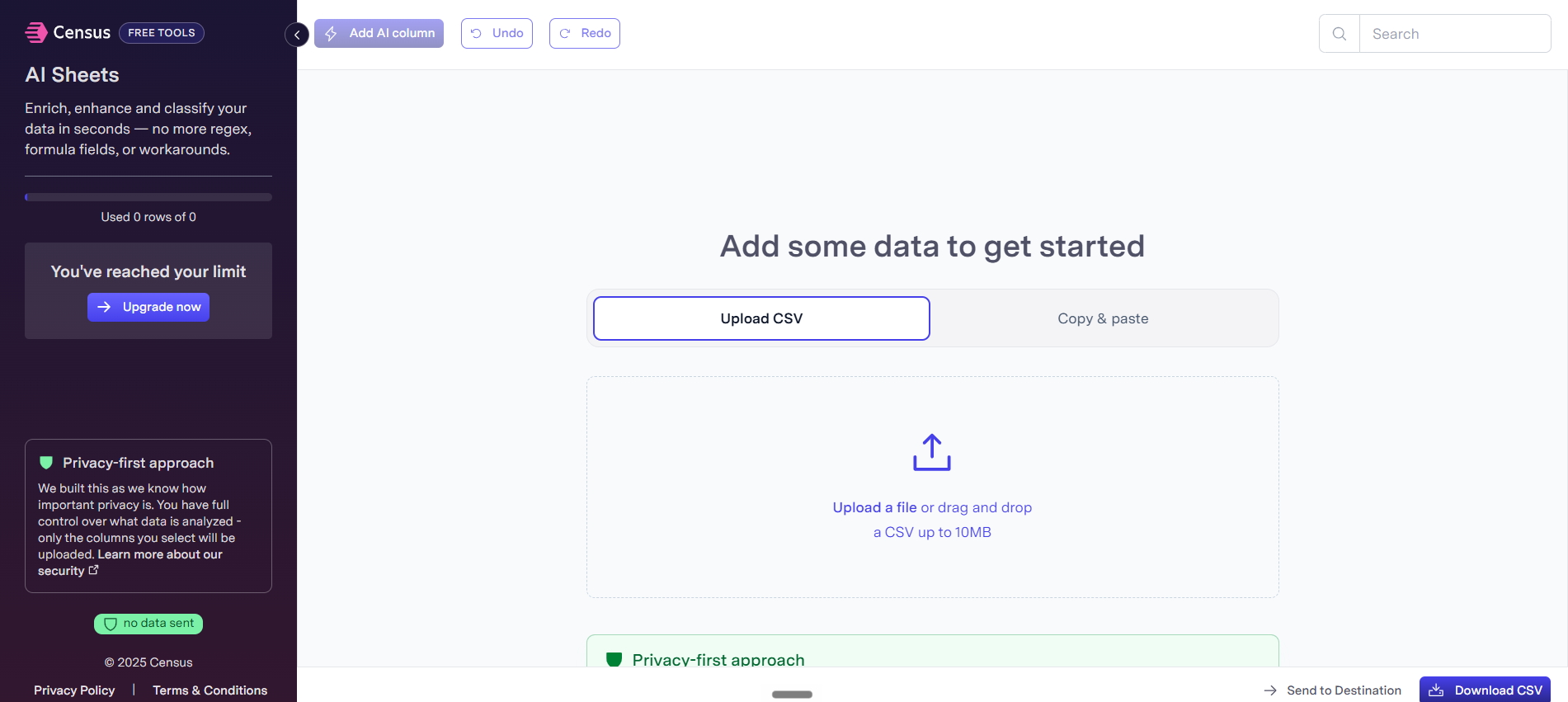
Census AI Sheets screen showing data enrichment, classification and send-to-destination sync, illustrating a leading ecommerce reverse ETL tool that pushes warehouse data into marketing and operational platforms.
Census is the other pure-play name operators reach for, and it earns a spot by being reliable, clean, and quicker to start than most.
🤔 Why did we choose this tool?
Census does one job and does it well: it moves modeled warehouse data into your commercial tools with strong sync observability, meaning you can see when a sync fails and why. It syncs to roughly 150 destinations and gives non-technical folks a usable no-code builder. Teams report getting a first data load running inside 15 minutes. Now owned by Fivetran, its reverse ETL reliability at scale is among the best in the category. The honest limit is the same as every pipe here. Census tells you nothing about which segment deserves the sync.
📊 Core capabilities that matter here
Destinations: 150+, including Klaviyo, Meta, Google, and Salesforce.
Audience building: no-code segments, though deeper work still needs SQL.
Minimum latency: roughly 15-minute syncs on standard tiers.
Setup reality: fast to start, first load often under 15 minutes.
Pricing model: usage-based, free tier available.
✅ Best for
Lean teams wanting a cheaper, reliable pure-play sync.
Brands syncing warehouse data into a CRM and marketing tools.
Data-literate operators who value sync observability and alerts.
💬 Reviews
"I like the visibility to all the connections and the alerts if a sync fails. Also, the tool is very user-friendly, which is super helpful for non-technical folks!" Randall H. Census G2 Verified Review
"The learning curve is significant. Must write SQL." Verified User, Computer Software Census G2 Verified Review
💰 Pricing
Free tier available; paid plans typically start around $800 / Month and scale with usage. If a lean team wants the analysis layer bundled in rather than a bare pipe, compare it with these ecommerce analytics platforms.
1.4 RudderStack [toc=1.4 RudderStack]
⭐⭐⭐⭐
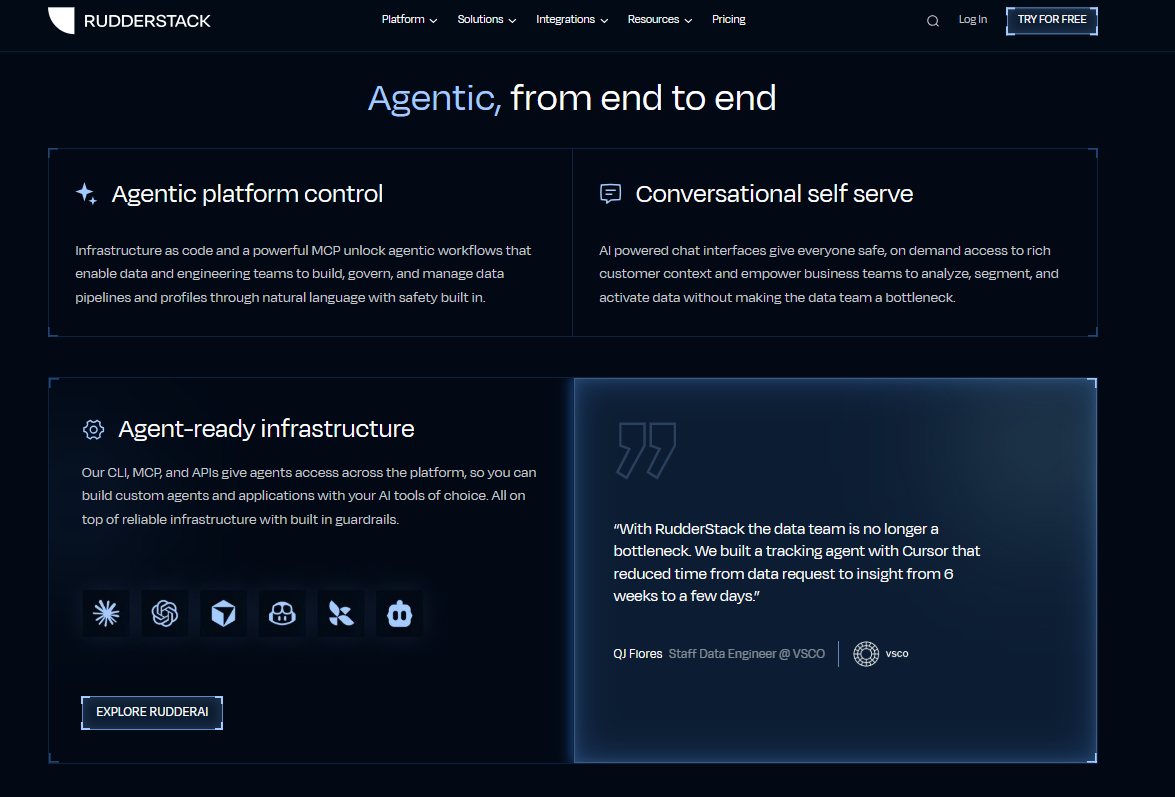
RudderStack "Agentic end to end" page highlighting agent-ready infrastructure, data pipelines and customer profiles, representing a powerful reverse ETL tool for ecommerce warehouse-to-destination data activation and governance.
RudderStack is the pick when latency matters, because it pairs warehouse-native reverse ETL with event streaming for near real-time activation.
🤔 Why did we choose this tool?
RudderStack started as a customer-data pipeline, so it treats speed as a first-class feature. It runs warehouse-native syncs and can push events close to real time, which suits brands triggering flows off fresh behavior. Users praise the clean UI and quick setup, plus easy integration with tools like Braze and Mixpanel. It carries a solid G2 standing across 50-odd reviews. The trade-off is that it leans technical. Warehouse-native means your team owns the modeling, and there is no one telling you which event is worth acting on.
📊 Core capabilities that matter here
Destinations: 200+, including Meta, Google, Klaviyo, and TikTok.
Audience building: warehouse-native, event plus batch syncs.
Minimum latency: near real-time, sub-100ms on streaming paths.
Setup reality: clean UI, quick to connect, assumes warehouse ownership.
Warehouse-native teams wanting near real-time syncs.
Brands triggering flows off fresh customer behavior.
Technical teams comfortable owning their data models.
💬 Reviews
"RudderStack is easy to set up and has a clean UI. It's also easy to integrate with other tools like Mixpanel and Braze, which is great for event piping." Verified Reviewer RudderStack AWS Marketplace Verified Review
"Users consistently praise the ease of use and quick setup, though pricing at higher event volumes needs planning." Verified User RudderStack G2 Verified Review
💰 Pricing
Free tier available; paid plans start around $1,000 / Month and scale with event volume. Operators piping behavioral events often pair this with conversion tracking to close the loop on activation.
1.5 Fivetran [toc=1.5 Fivetran]
⭐⭐⭐
Fivetran is the hands-off pick, best when you already run its pipelines and want reverse ETL bolted onto the same managed setup.
🤔 Why did we choose this tool?
Fivetran built its name on managed data pipelines, and it now offers reverse ETL through its Census acquisition. If you already move data in with Fivetran, activating it back out from the same platform is genuinely convenient. Users call the reverse ETL flow into Salesforce fast and easy, close to set-it-and-forget-it. The recurring complaint is billing. One reviewer flatly called it a low-ROI investment because of usage-based pricing that surprises teams at scale. For a lean DTC brand, that billing model deserves a hard look before you commit spend.
📊 Core capabilities that matter here
Destinations: broad via Fivetran plus Census, including Salesforce and marketing tools.
Audience building: model-based, reuses your Fivetran-loaded data.
Minimum latency: roughly hourly on standard sync schedules.
Setup reality: easiest if already on Fivetran ingestion.
Pricing model: consumption-based, can spike at scale.
✅ Best for
Teams already using Fivetran for data ingestion.
Brands wanting managed, hands-off API integrations and pipeline operations.
Larger data volumes where a data team owns the stack.
💬 Reviews
"The UI is intuitive and makes it easy to accomplish your tasks. Data is refreshed and it's really just a set it and forget it tool. I am very pleased and would recommend!" Verified User, Information Technology Fivetran AWS Marketplace Verified Review
"It does this job relatively okay but the billing practices make the tool effectively a very low ROI investment, I'd recommend just going the traditional ETL route." Verified User Fivetran G2 Verified Review
💰 Pricing
Free tier available; paid plans commonly start around $2,000 / Month and scale with consumption. Because that bill can surprise you, it pays to watch it against your ecommerce profit margins.
1.6 Polytomic [toc=1.6 Polytomic]
⭐⭐⭐
Polytomic is the pick for account and B2B-style syncs, built to move data across warehouses, databases, and business apps in both directions.
🤔 Why did we choose this tool?
Polytomic is a unified data-movement platform that combines ETL, reverse ETL, CDC (change data capture, meaning it tracks and syncs only what changed), and bi-directional sync. It shines at wiring Snowflake, Postgres, or MongoDB into Salesforce, HubSpot, and NetSuite. That makes it strong for brands with a heavier B2B or account-data motion. For a pure DTC stack focused on Klaviyo and Meta, it is more machinery than most operators need. It is capable, enterprise-ready, and priced accordingly, so weigh it against simpler options first.
📊 Core capabilities that matter here
Destinations: broad, strong on CRMs like Salesforce, HubSpot, and NetSuite.
"It supports ETL, Reverse ETL, and bi-directional sync, helping teams ensure that tools like Snowflake, Postgres, MongoDB, Salesforce, HubSpot, and NetSuite stay in sync." Verified User Polytomic G2 Verified Review
"Powerful and flexible for cross-system data movement, though it is more than a simple commerce stack usually requires." Verified User Polytomic G2 Verified Review
💰 Pricing
Custom pricing, quote-based.
1.7 Hevo Activate [toc=1.7 Hevo Activate]
⭐⭐⭐
Hevo Activate is the low-friction no-code pick, and it is the one Shopify operators actually name when they want reverse ETL without an engineer.
🤔 Why did we choose this tool?
Hevo Activate pairs no-code setup with hosted, near real-time syncs, so a lean team can move warehouse data into marketing tools fast. In a Shopify ETL thread, operators specifically shortlisted Hevo for real-time sync plus reverse ETL, and Fivetran for hands-off ops. That kind of peer signal matters more than a connector count. The trade-off is depth. Hevo covers fewer destinations than Hightouch or Census, so check that your exact commerce tools are supported before you sign.
📊 Core capabilities that matter here
Destinations: 60+, covering common marketing and CRM tools.
Audience building: no-code, hosted setup.
Minimum latency: near real-time on hosted syncs.
Setup reality: low friction, built for teams without engineers.
Pricing model: tiered, entry-level friendly.
✅ Best for
Lean teams wanting reverse ETL without an engineer.
Shopify brands needing quick, hosted setup for data integration.
Operators prioritizing low setup friction over destination breadth.
💬 Reviews
"For Shopify data, I'd shortlist Hevo for its real-time sync plus reverse ETL, and Fivetran if you want something more hands-off." r/Analyzify Reddit Thread
"Easy to set up and reliable for our pipelines, though we outgrew some of the connector limits as we scaled." Verified User Hevo Data G2 Verified Review
💰 Pricing
Plans start around $239 / Month and rise to roughly $999+ / Month with volume. Teams often layer this into a broader ecommerce tech stack as the activation piece.
1.8 Skyvia [toc=1.8 Skyvia]
⭐⭐⭐
Skyvia is the budget entry point, a fully no-code cloud platform that handles simple reverse ETL and customer-analytics syncs without heavy setup.
🤔 Why did we choose this tool?
Skyvia is a 100% cloud, no-code platform supporting ETL, ELT, and reverse ETL, with more than 130 connectors. For a brand that just needs to push a segment into a CRM or marketing tool on a schedule, it is affordable and approachable. It rounds out this list as the low-cost starting option. The limit is ambition. Skyvia handles straightforward syncs well, but it is not built for the near real-time or high-volume activation that Hightouch, Census, or RudderStack target.
📊 Core capabilities that matter here
Destinations: 130+ connectors across cloud apps and databases.
Operators wanting a fully no-code, low-cost entry point.
💬 Reviews
"Skyvia is a versatile, user-friendly tool for data integration and reverse ETL, and the no-code setup made it easy to get running." Verified User Skyvia G2 Verified Review
"Good value for straightforward syncs, but batch scheduling limits real-time use cases for us." Verified User Skyvia G2 Verified Review
💰 Pricing
Free tier available; paid plans run roughly $0 to $199+ / Month.
Where this leaves you
Here is the honest read after profiling all eight. Every tool from 1.2 through 1.8 is a pipe. ✅ They move data from your warehouse to your tools, and the good ones do it reliably. ✅ Hightouch and Census lead on craft, RudderStack on speed, Hevo and Skyvia on ease. ❌ Not one of them tells you which segment is worth syncing, or what a scaled campaign does to your cash position. That gap is exactly why we built Luca as an AI layer over the warehouse, not another pipe: it reasons across marketing, finance, and operations, surfaces the segment worth activating, and can fund the push inside one chat.
Q2. How were these reverse ETL tools selected and scored? [toc=2. Selection Criteria]
Each tool was scored out of 100 across five criteria: Ecommerce Destination Fit (30%), Setup and Usability without a data team (25%), Pricing Transparency (20%), User Reviews (15%), and Sync Latency and Reliability (10%). Scores map to stars: 0 to 20 is one star, 21 to 40 two, 41 to 60 three, 61 to 80 four, and 81 to 100 five. Luca AI scores five stars on destination fit and setup because it needs no separate warehouse.
Why these five weights
Most roundups rank on connector count, which is how operators get burned. A tool can list 300 destinations and still miss the five that move your money. So I weighted Ecommerce Destination Fit at 30%, scoring only on Shopify, Klaviyo, Meta CAPI, Google customer match, and TikTok fit.
Setup and Usability sits at 25% for a reason. "No-code sync" still assumes a modeled warehouse underneath, which most Shopify brands do not have. Combined, fit and setup make up 55%, because that reframes "best" around what a two-person team can actually run.
📊 How the stars are derived
Pricing Transparency (20%) rewards published, predictable pricing and penalizes per-destination models that balloon at scale. User Reviews (15%) pull from verified G2 and Reddit sentiment, balanced across star levels. Sync Latency and Reliability (10%) covers how fresh and dependable the data lands.
Here is the honest caveat. A pipe-only tool can score high, because it does its narrow job well. Skyvia, for instance, earns a fair rating for simple no-code syncs even though it is not built for real-time work.
⚠️ The hidden prerequisite
The scoring bakes in a failure-point lens. The typical stack is four tools: warehouse, loader, dbt, and sync. Every join is a place it breaks. Improvado reviewers describe a steep setup curve where one person ends up owning the whole thing.
Luca AI scores full marks on Setup and Usability because it normalizes and standardizes data on ingestion. A lean team skips the warehouse-modeling year the other tools assume is already done. That is the difference between buying a pipe and buying an outcome-focused intelligence layer.
Scoring Summary
Reverse ETL Tools Scoring Summary
Tool
Dest. Fit (30)
Setup (25)
Pricing (20)
Reviews (15)
Latency (10)
Stars
Luca AI
High
High
High
High
High
⭐⭐⭐⭐⭐
Hightouch
High
Med
Low
High
High
⭐⭐⭐⭐
Census
Med
High
Med
High
High
⭐⭐⭐⭐
RudderStack
Med
Med
Med
High
High
⭐⭐⭐⭐
Fivetran
Med
Med
Low
Med
Med
⭐⭐⭐
Polytomic
Med
Low
Low
Med
Med
⭐⭐⭐
Hevo Activate
Med
High
Med
Med
Med
⭐⭐⭐
Skyvia
Low
High
High
Med
Low
⭐⭐⭐
Q3. What is reverse ETL, and do you actually need a dedicated tool? [toc=3. What It Is & Do You Need It]
Reverse ETL moves modeled data out of your warehouse (Snowflake, BigQuery, or Redshift) back into the tools you act in, like Shopify, Klaviyo, and Meta Ads. You need a dedicated tool only if three things are true: you have a modeled warehouse, your destinations are numerous or non-commerce, and you have engineering time to maintain syncs. Most Shopify-scale brands hit only one, which means they have a data-assembly problem, not a reverse ETL problem.
The plain-English version
Think of your warehouse as a clean stockroom where all your data sits sorted. Regular ETL fills that stockroom. Reverse ETL is the forklift that carries the sorted goods back out to the shop floor, where your team actually sells.
Here is a concrete commerce example. Say you build a segment of "high-LTV customers who lapsed 60 days ago" in your warehouse. Reverse ETL pushes that segment into a Klaviyo win-back flow automatically, so you stop exporting CSVs by hand. This is where clean ecommerce data integration earns its keep.
🤔 The 3-question fit test
I might be blunt here, but most brands buying reverse ETL do not need it yet. Run this test before you spend a dollar.
Do you have a modeled data warehouse today, not a plan to build one?
Are your destinations numerous or non-commerce, beyond Klaviyo and Meta?
Do you have engineering hours to babysit syncs when they break?
If you answered yes to all three, buy a pipe. If you answered yes to one, you have a different problem.
✅ Data assembly is the real problem
Most Shopify-scale operators are, in the words of one, "the human middleware" copying insights between tools by hand. The data sits right there, but they process a fraction of it. The warehouse project that promises to fix this is often expensive and painful to stand up.
For the majority who fail the fit test, this is where Luca AI fits. As an AI layer, it assembles and standardizes the data itself, so a brand with no warehouse and no data team still gets clean analysis and activation. If you pass all three questions, honestly, a pure-play pipe may serve you better, and I will say so.
Q4. How do Hightouch, Census, and the pure-play pipes compare for ecommerce? [toc=4. Pure-Play Comparison]
Hightouch and Census are the two pure-play leaders. Hightouch wins on destination breadth (200+), dbt-native audiences, and a 4.6 G2 rating, but operators flag per-destination pricing that scales badly for small teams. Census is leaner and cheaper to start, though users note limited control over sync timing. RudderStack pushes near real-time. For commerce, all handle Klaviyo and Meta. None reasons on margin.
Where each one wins
Pick Hightouch if you live in dbt and need breadth. Its audience builder is genuinely strong, and the reliability shows up in reviews. The catch is cost as you add destinations.
Pick Census if you want lean and fast to start, with clean sync observability. Pick RudderStack if latency is the priority and your team owns its warehouse. Whichever pipe you choose, pair it with proper conversion tracking so you can see what the activation actually earns.
💬 What the reviews actually say
The pain points are where these tools get honest. Census users love the alerting but flag the SQL requirement.
"I like the visibility to all the connections and the alerts if a sync fails. Also, the tool is very user-friendly, which is super helpful for non-technical folks!" Randall H. Census G2 Verified Review
"The learning curve is significant. Must write SQL." Verified User, Computer Software Census G2 Verified Review
RudderStack draws praise for setup speed from operators piping events into other tools.
"RudderStack is easy to set up and has a clean UI. It's also easy to integrate with other tools like Mixpanel and Braze, which is great for event piping." Verified Reviewer RudderStack AWS Marketplace Verified Review
Pure-Play Pipes Compared
Pure-Play Reverse ETL Pipes Compared
Tool
Destinations
Min Latency
dbt Support
Sync Scheduling
Starting Price
G2 Rating
Hightouch
200+
~15 min
Native
Flexible
~$800/mo
4.6
Census
150+
~15 min
Yes
Limited
Free to $800/mo
4.5
RudderStack
200+
Near real-time
Yes
Flexible
~$1,000/mo
4.5
⚠️ The shared ceiling
Here is the part every roundup skips. All three move data reliably, and they will serve a warehouse-native team well. None of them tells you which segment is worth moving in the first place.
That is the different question Luca AI answers. Instead of "how do I move this data," it asks "which segment is worth moving," by finding the root cause and the influencing components behind a metric. The pipes activate the answer, while Luca finds it, closer to a real ecommerce analytics platform than a bare sync tool.
Q5. What does reverse ETL actually cost at ecommerce data volumes? [toc=5. True Cost of Ownership]
Most reverse ETL tools price on monthly active rows or per-destination, so costs balloon as you add channels or scale sends. A tool starting near $800 a month can pass $50,000 a year beyond 10M rows across several destinations. The true bill also includes the warehouse, the loader, and dbt modeling, four line items, not one. Model your cost at 3x and 10x volume before signing.
How the pricing models bite
Two models dominate, and both punish growth. Monthly active rows (MAR) charge for each unique record you sync in a month. Per-destination pricing charges more each time you add a channel.
Here is the trap operators miss. One customer record synced to five destinations often counts as five rows, not one. So your bill scales with your channel count, not just your customer count, which quietly erodes your ecommerce profit margins.
💰 A worked 3x and 10x scenario
Say you start at 1M rows for around $800 a month. Triple your sends and destinations during a Q4 push, and you are near $2,400 a month. Hit 10M rows across several channels, and annual cost can clear $50,000.
That is before the surrounding stack. The reverse ETL bill is one line item. The warehouse, the ingestion loader, and the dbt modeling are three more, and they all recur, which is why clean data management matters before you buy.
⚠️ Why gross margin hides this
Here is the part that stings. Most founders judge these costs against gross margin, and gross margin is a lie. The eight costs between the supplier invoice and actual profit are where brands quietly bleed.
I sat with a founder who thought contribution margin was 72%. It was 8%. He spent two years scaling what was effectively a money pit, because the tooling and fees never hit the top-line view. If you have never mapped the difference between contribution margin and gross margin, start there.
Cost at Ecommerce Volumes
Reverse ETL Cost at Ecommerce Volumes
Tool
Pricing Model
Entry Price
Est. Cost at 10M Rows
Hightouch
Per-destination
~$800/mo
$40K to $60K/yr
Census
Usage-based
Free to $800/mo
$30K to $50K/yr
Fivetran
Consumption
~$2,000/mo
$60K+/yr
💬 What operators say about the bill
"It does this job relatively okay but the billing practices make the tool effectively a very low ROI investment." Verified User Fivetran G2 Verified Review
This is where Luca AI reads differently. Its subscription pricing is flat and predictable, so a Q4 spike does not spike your data bill. Because Luca surfaces true contribution margin, it can flag when a given sync is not worth its own cost. You see the four line items as one number, tied to profit, closer to real ecommerce business intelligence than a raw pipe.
Q6. Can reverse ETL replace a CDP or a data team, and how does Luca's capital compare? [toc=6. Replace CDP & Capital]
Reverse ETL can replace a CDP's activation layer if your warehouse already handles identity resolution and segmentation. It moves data; it does not collect, model, or reason on it, so it replaces the copy-paste analyst, not the modeling team. Separately, brands funding a proven campaign should compare capital on the metrics that matter: rate, disbursal speed, and repayment structure, where instant, dynamically-priced capital beats a multi-day application.
The CDP overlap, honestly
A CDP (customer data platform) does three jobs: it collects data, resolves identity, and activates segments. Reverse ETL only does the last one, activation.
So the answer depends on your warehouse. If your warehouse already resolves identity and builds segments, reverse ETL can cover the activation lane a CDP used to own, which is really a form of customer segmentation in motion.
🤔 What it still cannot do
Here is the ceiling. A pipe moves data. It does not collect it, model it, or reason on it.
That is why dashboards are built for LLMs now, not humans. The machine digests the data, draws the conclusion, and tells you what matters, so you watch Netflix, not dashboards. A pipe skips that reasoning entirely, unlike an agentic AI built for founders.
✅ Replacing a data team
Let me be precise, because the "replace your data team" pitch is usually overblown. Reverse ETL replaces the human middleware, the person copy-pasting segments by hand. It does not replace the modeling brain that structures the warehouse in the first place.
This is the analytics lane where Luca AI sits. As an AI layer, it reasons across your sources and retires the copy-paste analyst, not your architecture, and it is one of the best AI tools for Shopify owners for exactly that reason.
The capital lane, on capital metrics
Now a clean, separate lane. When you have activated a proven campaign and want to fund the inventory or ad spend behind it, judge the money on money terms, not analytics.
Think of it as two train tracks, inventory and cash, running in parallel. Let them drift apart, and you go off the rails. Traditional revenue-based financing (RBF, funding repaid as a share of sales) often means a multi-day application and a fixed fee, so it helps to understand how revenue-based financing actually works before you sign.
💰 Rate, speed, and structure
Here is where Luca competes directly, and only on capital metrics.
✅ Deployment: instant, with no separate application to fill out.
✅ Disbursal: minutes, not multi-day underwriting.
✅ Sizing: dynamically priced against your live data.
❌ Traditional RBF: slower disbursal, static fee, separate process.
I could be off on any single lender's terms this quarter. My read is that application-free, minutes-fast capital wins for a brand funding a campaign it just proved.
Q7. What should DTC founders do on Monday to fix data activation? [toc=7. Your Monday Action Plan]
Start by listing every segment you copy by hand each week, that list is your reverse ETL scope. Standardize your data lookups to one template before syncing anything. Then decide honestly: if you lack a warehouse or engineers, buy a bundled intelligence layer instead of stitching a pipe. The goal is not more dashboards; it is reallocating team time from data assembly to decisions.
Monday: run the middleware audit
Open a blank doc and list every segment you export by hand each week: the lapsed customers, the high-LTV buyers, and the low-stock SKUs.
That list is not busywork. It is your exact activation scope, and it tells you whether you have a real reverse ETL need or just a copy-paste habit that better ecommerce reporting could kill.
🛠️ Standardize before you sync
Do not pipe messy data faster. Standardize your lookups to one template first, so every source speaks the same language.
Then make the build-versus-buy call honestly. If you have no warehouse and no engineers, stitching a warehouse, loader, dbt, and sync is four failure points you will babysit, when a single ecommerce analytics dashboard could do the job.
⏰ Trade assembly time for decisions
Here is the reframe I keep coming back to. The old routine was waiting two days for an analyst to email a net-profit number. The new one is getting it in five minutes and spending the saved hours deciding what to do.
If your audit shows you are the middleware and you have no data team, that is the exact gap Luca AI was built for. It assembles and standardizes the data itself, then reasons on it, the way good AI marketing analytics should.
So here is what I am sitting with, and I would genuinely like your take. What is the one segment you copy by hand every week that you wish just moved itself? Tell me that, and I will tell you honestly whether you need a pipe or a brain.
FAQ's
What are the best reverse ETL tools for ecommerce in 2026?
We ranked eight tools on the destinations that actually move money for a DTC brand, not raw connector counts.
Luca AI: best for analysis, activation, and prescriptive recommendations in one AI layer.
Hightouch: best for dbt-native audiences and 200+ destinations.
Census: best for a leaner, cheaper-to-start pure-play sync.
RudderStack: best for warehouse-native, near real-time syncs.
Fivetran: best for teams already on Fivetran ingestion.
Polytomic: best for B2B-style account syncs.
Hevo Activate: best low-friction no-code option.
Skyvia: best budget entry point.
The pure-play pipes all move data reliably into Klaviyo and Meta. What none of them do is tell you which segment is worth moving. That is the gap we built Luca AI to close, by reasoning across marketing, finance, and operations before you activate anything.
What is reverse ETL and do I actually need a dedicated tool?
Reverse ETL moves modeled data out of your warehouse, like Snowflake or BigQuery, back into the tools you act in, such as Shopify, Klaviyo, and Meta Ads.
You need a dedicated tool only if three things are true:
You have a modeled data warehouse today, not a plan to build one.
Your destinations are numerous or non-commerce, beyond Klaviyo and Meta.
You have engineering hours to maintain syncs when they break.
Most Shopify-scale brands hit only one of these, which means they have a data-assembly problem, not a reverse ETL problem. In that case, stitching a warehouse, loader, dbt, and sync creates four failure points to babysit.
For operators without a warehouse or a data team, we assemble and standardize the data itself, so you still get clean ecommerce data integration and activation. If you pass all three questions, an honest answer is that a pure-play pipe may serve you better.
How do Hightouch and Census compare for ecommerce?
Hightouch and Census are the two pure-play leaders, and the right pick depends on your stack.
Hightouch: wins on destination breadth (200+), dbt-native audiences, and a 4.6 G2 rating. The catch is per-destination pricing that scales badly for small teams.
Census: is leaner and cheaper to start with clean sync observability, though users note limited control over sync timing.
RudderStack: pushes near real-time if latency is your priority.
For commerce, all of them handle Klaviyo and Meta well. The shared ceiling is that they move data but none reasons on margin or tells you which segment deserves the sync.
That is the different question we answer. Instead of "how do I move this data," we ask "which segment is worth moving," by finding the root cause behind a metric. It is closer to a real ecommerce analytics platform than a bare pipe.
How much do reverse ETL tools cost at ecommerce data volumes?
Most reverse ETL tools price on monthly active rows or per-destination, so costs balloon as you add channels or scale sends.
A tool starting near $800 a month can pass $50,000 a year beyond 10M rows across several destinations.
One customer record synced to five destinations often counts as five rows, not one.
The true bill also includes the warehouse, the loader, and dbt modeling, four line items, not one.
Here is the part that stings. Most founders judge these costs against gross margin, and gross margin hides the eight costs between the supplier invoice and actual profit. We once saw a founder who thought contribution margin was 72 percent when it was 8 percent.
Our subscription pricing is flat and predictable, so a Q4 spike does not spike your data bill. Because we surface true contribution margin versus gross margin, we can flag when a sync is not worth its own cost. Model your cost at 3x and 10x volume before signing.
Can reverse ETL replace a CDP or a data team?
Reverse ETL can replace a CDP's activation layer if your warehouse already handles identity resolution and segmentation. It moves data; it does not collect, model, or reason on it.
A CDP collects data, resolves identity, and activates segments. Reverse ETL only does the last part.
It replaces the copy-paste analyst, the human middleware, not the modeling brain that structures the warehouse.
So the honest answer is that a pipe retires manual work, but it does not replace a data team's modeling role. For brands without that team, we reason across sources so you still get warehouse-grade analysis.
Separately, when you want to fund a proven campaign, judge capital on capital metrics: rate, disbursal speed, and repayment structure. Our capital deploys in minutes with no separate application, which we think beats a multi-day process. See how revenue-based financing compares before you commit.
Enjoyed the read? Join our team for a quick 15-minute chat — no pitch, just a real conversation on how we’re rethinking Ecommerce with AI - Luca
Loading Schedule...
Your AI Co-Founder is here.
Here’s why:
Shopify, Meta, Xero - one brain.
"Should I scale?" Answered with real data.
Growth capital. No applications. One click.
Thank you! Your submission has been received! Please book a time slot for the Meeting
Oops! Something went wrong while submitting the form.