Ecommerce Platform Integration: Order, Inventory, Customer, and Returns Sync Workflows Across ERP, CRM, and WMS Stacks
13
mins read
TL;DR
Ecommerce platform integration in 2026 is no longer plumbing; it's an agentic reasoning layer above iPaaS, ERP, CRM, and WMS that catches drift before it hits P&L. Four data flows carry 90% of operational load: orders, inventory, customers, and returns. Each needs a defined system of record and reconciliation cadence. Architectures map to scale: native connectors under €5M, iPaaS plus a reasoning layer at €5M to €20M, custom middleware above €20M with enterprise ERP. True 3-year TCO on a €12K iPaaS lands near €246K once implementation, FTE maintenance, task overages, and reconciliation labor are counted honestly. Most failure modes drift silently: duplicate webhooks, oversells, customer ID mismatches, returns black holes, and tax rounding kill margin without alerting anyone. Embedded capital underwritten on live integrated data beats standalone RBF on rate, disbursal time, repayment flexibility, personal guarantees, and renewal speed.
Q1: What Exactly Is Ecommerce Platform Integration in 2026, and Why Has It Stopped Being Just "Data Plumbing"? [toc=1. Integration in 2026]
Ecommerce platform integration is the connective tissue syncing orders, inventory, customers, and returns between storefronts (Shopify, BigCommerce, Amazon) and ERP, CRM, and WMS systems. In 2026 it has evolved past iPaaS pipes into agentic intelligence, where systems don't just move data but reason across it, transform records, instruct warehouses, and surface the financial consequences of every sync failure before they hit P&L.
🔌 The plumbing era is over
For most of the last decade, integration meant pipes. You bought Shopify, bolted on a NetSuite connector, scheduled a nightly CSV, and called it done.
That worked when you sold on one channel. It collapses the moment you add Amazon, TikTok Shop, and a 3PL. A founder I work with at $4M ARR put it bluntly: "I have four systems telling me four different revenue numbers on a Sunday night." That's not a connector problem. That's a reasoning problem, and it's exactly what an e-commerce founder drowning in data needs solved before Monday.
🧠 What changed in 2026
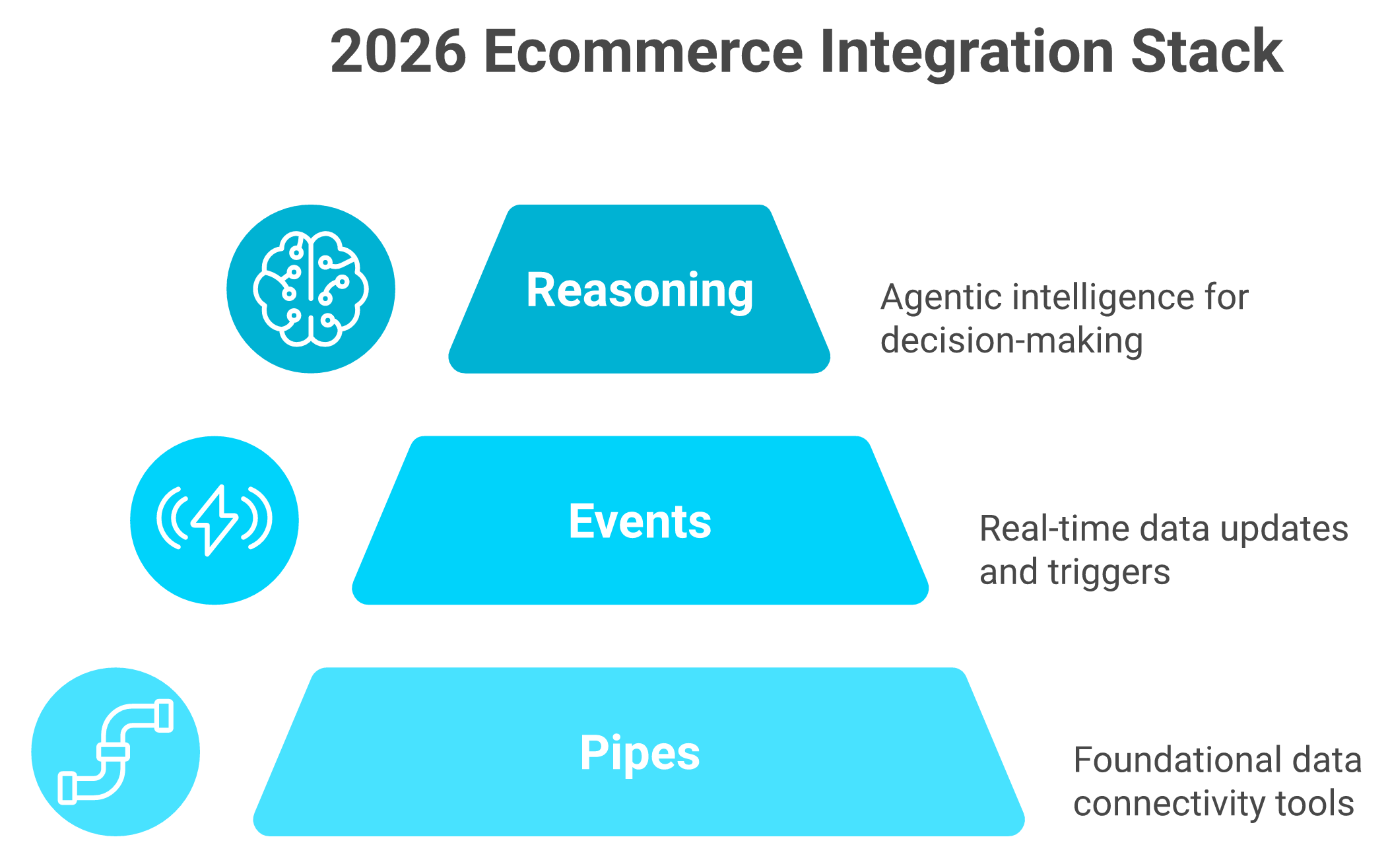
The modern integration stack runs in three layers: pipes move data, events carry change, and reasoning decides what to do.
The new definition has three layers. First, the pipes (iPaaS, native connectors). Second, the events (orders, inventory deltas, customer updates, returns). Third, the reasoning that sits above both and decides what to do.
A 2026 r/ERP operator thread captured the shift: real integration is workflow, logic, and coordination, not just data movement. The systems that lose this layer get fragile within 18 months.
⚠️ The "data-cleanup year" trap
Here's a pattern I see at almost every brand crossing $5M. They sign an enterprise integration contract, then spend 12 months normalizing SKUs, deduping customers, and patching attribution gaps before anyone runs a single analysis.
"Daily revenue totals are wrong, entire order blocks are missing, and every week we have to open new support tickets just to get our numbers halfway close to what our channel actually reports." XTRA FUEL, Operator Triple Whale Trustpilot Verified Review
✅ Why this matters Monday morning
Integration in 2026 is a velocity tool, not an efficiency tool. Small teams running €50M+ revenue do it because the reasoning layer absorbs the work that used to require a 4-person data pod.
We built Luca on that premise. It reads from your warehouse, normalizes on ingestion, and surfaces cross-system anomalies in plain English before they hit your P&L.
Q2: Which Data Flows Actually Matter, Order, Inventory, Customer, and Returns Sync Across ERP, CRM, and WMS? [toc=2. Core Data Flows]
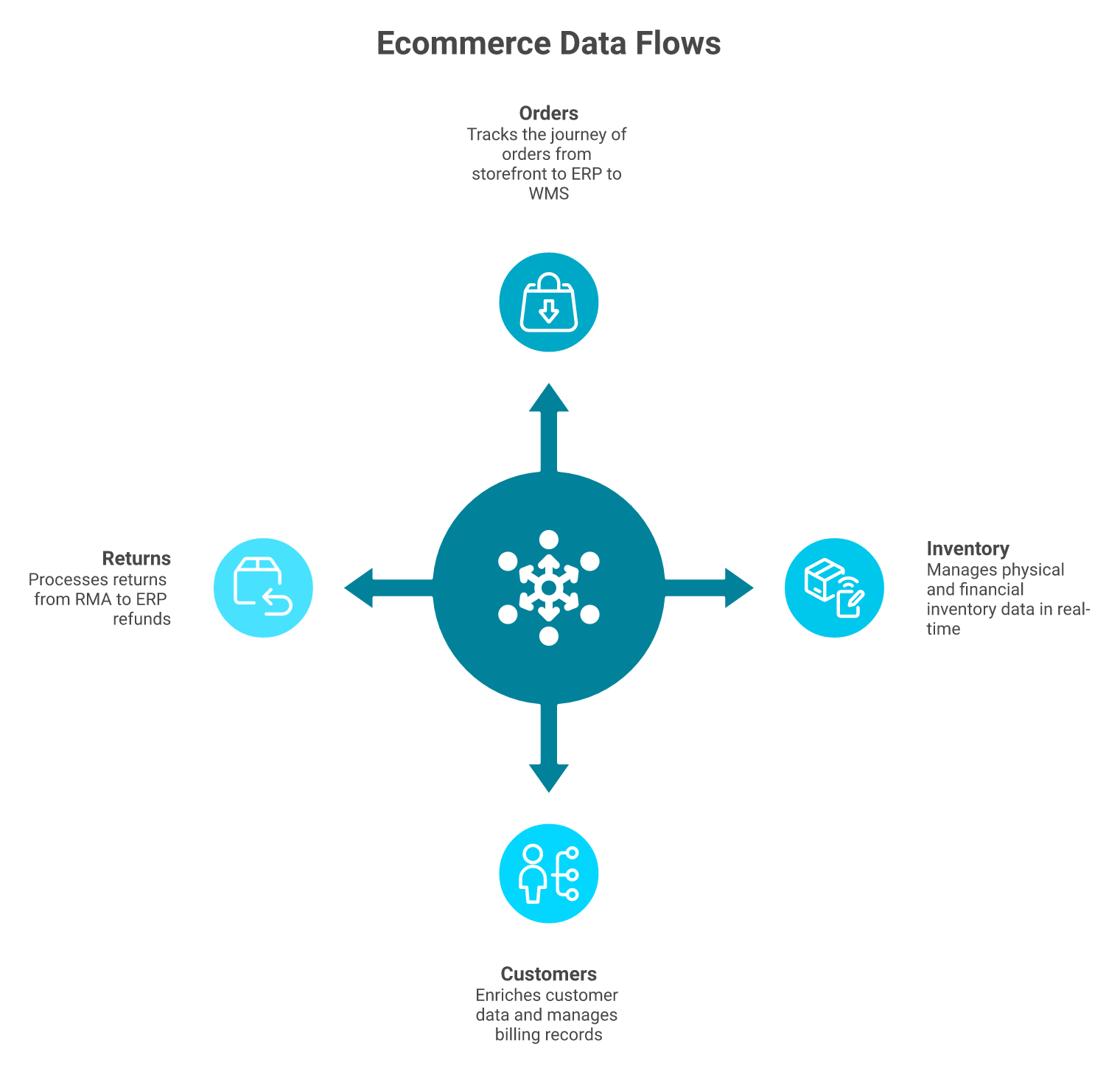
Four flows carry 90% of operational load: orders flow storefront to ERP to WMS for fulfillment; inventory flows WMS to ERP to storefront for availability; customer and consent flows storefront to CRM to ERP for billing and lifecycle; returns flow 3PL/storefront to WMS to ERP to CRM for refunds, restock, and LTV recalculation. Each needs a clear system of record, an event trigger, and a reconciliation cadence.
📦 The four flows that decide your week
Four flows carry ninety percent of operational load: orders, inventory, customers, and returns.
Orders, inventory, customers, and returns. Get these four right and 90% of your operational fires go away.
Get any one wrong and you'll spend Sunday nights reconciling three systems that disagree about Friday's GMV.
➡️ Order and inventory mechanics
Orders move forward. Storefront creates the record at checkout. ERP picks it up for billing and revenue recognition. WMS picks it up for pick, pack, and ship.
Inventory moves backward. WMS owns the physical count. ERP holds the financial value. Storefront shows availability to the shopper. The race condition that causes oversells lives between WMS and storefront, and it shows up loudest during launch days when cart commits outpace inventory updates. Operators tracking e-commerce unit economics feel this immediately when contribution margin distorts.
👤 Customer and returns flows (the underserved pillar)
Customer flow is where LTV math breaks. Storefront creates the identity at checkout. CRM enriches with consent, lifecycle, and Klaviyo events. ERP holds the billing system of record.
Returns are the flow most operators ignore until it bites. RMA created in storefront or 3PL. WMS confirms the physical receipt. ERP processes the refund. CRM updates LTV and lifecycle stage. Skip the CRM hop and your LTV is overstated for every returning customer.
🗺️ The flow map
The Four Core Data Flows in Ecommerce Integration
Flow
Origin
System of Record
Downstream
Reconciliation cadence
Order
Storefront
ERP post-fulfillment
WMS, CRM
Hourly
Inventory
WMS
ERP (financial)
Storefront
Real-time on writes
Customer
Storefront
CRM (identity), ERP (billing)
WMS, marketing
Daily dedupe
Returns
Storefront/3PL
ERP (refund), CRM (LTV)
WMS, marketing
Daily
✅ The system-of-record discipline
Pick one system per entity. Document it. Tell every vendor.
I've watched a $20M brand argue for 6 months about whether NetSuite or Shopify owns the customer record. The argument cost them more than picking the wrong one would have. Decide, document, move on. A reasoning layer that reads horizontally across all four flows is what catches the drift before your accountant does.
Q3: iPaaS vs Middleware vs Native Connectors vs Custom APIs, Which Integration Architecture Fits Your Scale? [toc=3. Architecture Choices]
Native connectors win on speed-to-value but break under multi-channel complexity. iPaaS (Celigo, Workato, Boomi) offers low-code flexibility but charges by task. Custom middleware gives full control but demands a permanent engineering line. Custom APIs unlock differentiation but only pay back above ~€20M GMV. Pick based on channels, transformation complexity, and team capacity, not vendor familiarity.
🎯 The comparison context
Four architectures show up on every shortlist. Each works at a specific scale. None works at all of them.
Picking on logo familiarity is how a $4M store ends up paying SAP licensing it can't operate.
⚙️ Native connectors
✅ Fast to deploy, often included in your storefront app store. Fine for 1 to 2 channels. ❌ Brittle when you add a third channel. Field mapping is shallow, exception handling is non-existent, and you'll outgrow them within 18 months at scale.
A founder doing $400K/month told me last week he'd been running 4 native connectors and "every Monday felt like Russian roulette."
✅ Low-code workflow builders with hundreds of pre-built recipes. Sweet spot is €5M to €20M with 3+ channels. ❌ Task-based pricing scales punitively. Every Q4 spike doubles the bill. The "low-code" part becomes a half-time job within 18 months.
🛠️ Custom middleware
✅ Full control over transformations, retries, idempotency, and exception logic. Right call above €20M with enterprise ERP. ❌ Permanent engineering line item. €200K+ per year fully loaded. Most mid-market brands underestimate this by 2x.
🧪 Custom APIs
✅ Maximum flexibility for a unique commerce model. Pays back only above €20M GMV with a real differentiator. ❌ Ari Tula at Elo Health spent $10M on a proprietary algorithmic platform later obsoleted by LLMs. Build only when off-the-shelf truly can't.
📊 Side-by-side
Integration Architecture Comparison by Scale
Architecture
Best for
3-yr TCO
Setup
Failure surface
Native connectors
<€5M, 1-2 channels
€15K to €40K
Days
High under load
iPaaS
€5M to €20M, 3+ channels
€100K to €250K
Weeks
Medium, predictable
Custom middleware
€20M+, enterprise ERP
€400K to €800K
Months
Low if staffed
Custom APIs
€20M+, unique model
€600K+
Months
Lowest if scoped
"Underwriting team is a joke, looks like kids are working. They rely on some AI software to analyse data, which seemed off." M. Islamovic, Operator Wayflyer Trustpilot Verified Review
🧭 Who should choose what
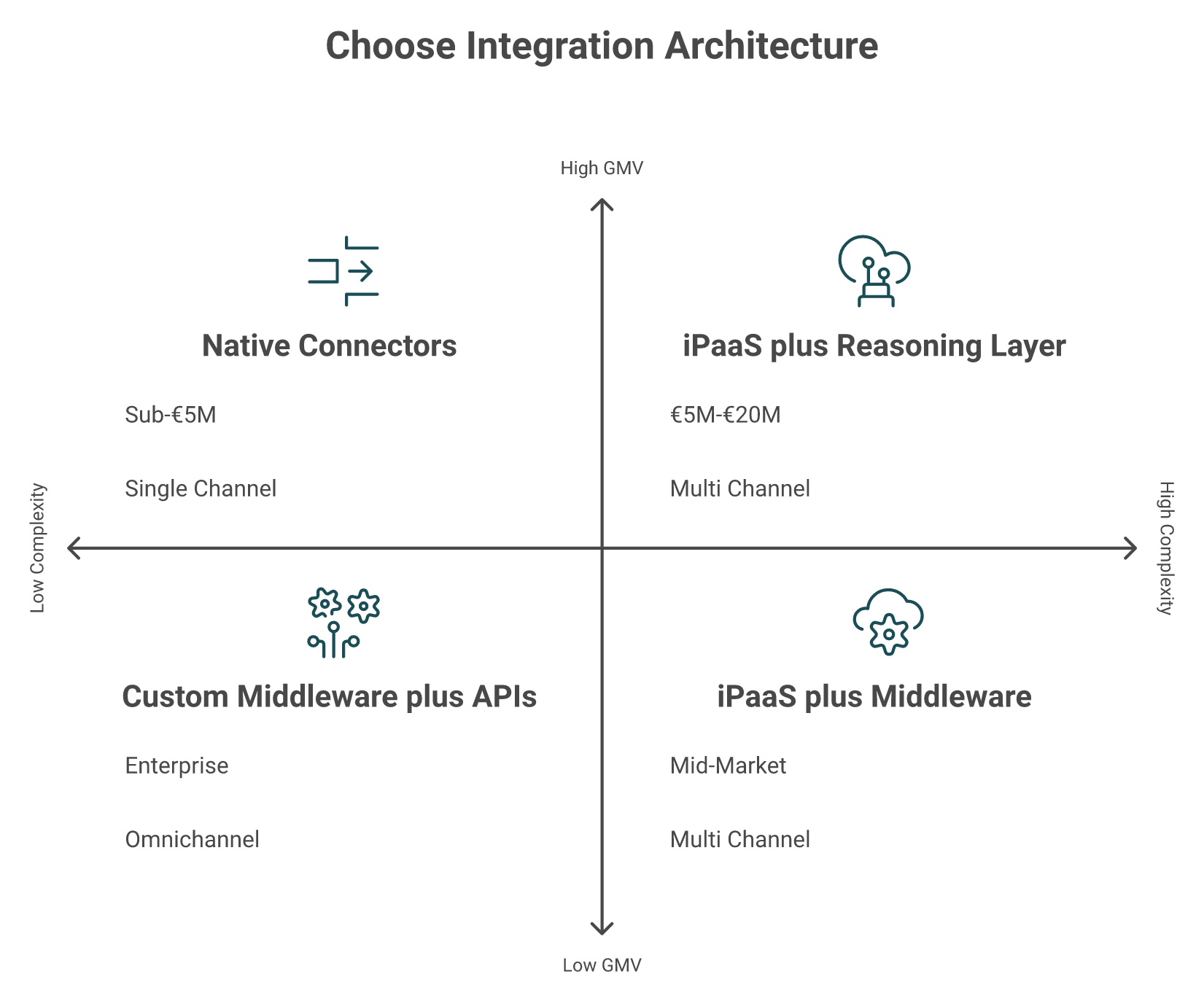
Sub-€5M with 1 to 2 channels and no engineers, native connectors. €5M to €20M with 3+ channels, iPaaS plus a reasoning layer above. €20M+ with enterprise ERP, custom middleware with selective APIs.
Whatever you pick, the reasoning layer above it is what stops Sunday-night fires. We built Luca, the AI Co-Founder for e-commerce, to sit there regardless of which pipes you run.
Q4: Which ERP, CRM, WMS, and iPaaS Vendors Actually Matter for Scaling Multi-Channel Retailers? [toc=4. Vendor Shortlists]
ERP shortlist: NetSuite, SAP S/4HANA, Microsoft Dynamics 365, Odoo, and Acumatica. CRM shortlist: Salesforce Commerce Cloud, HubSpot, and Klaviyo (lifecycle). WMS shortlist: Manhattan Active, Körber, Blue Yonder, and ShipHero. iPaaS shortlist: Celigo, Workato, Alumio, Boomi, and MuleSoft. Fit depends on GMV band, channel count, and whether you need pre-built connectors or transformation depth.
🏛️ ERP layer
The ERP is your financial system of record. Pick on GMV band, not logo prestige.
ERP Vendor Shortlist by GMV Sweet Spot
ERP
GMV sweet spot
Notes
Odoo
€1M to €10M
Open-source, low cost, modular
Acumatica
€5M to €30M
Strong mid-market, transparent pricing
Microsoft Dynamics 365
€10M to €100M
Strong if you're already on Microsoft stack
NetSuite
€10M to €200M
Default for DTC scaling, deep ecosystem
SAP S/4HANA
€100M+
Enterprise only, heavy implementation
A NetSuite-Shopify implementation is the most common path I see between €10M and €50M GMV.
💌 CRM and lifecycle layer
Identity, consent, and lifecycle live here. Most DTC brands run two layers.
HubSpot for B2B and broader CRM
Salesforce Commerce Cloud for enterprise omnichannel
Klaviyo for DTC lifecycle, segmentation, and email/SMS automation
Klaviyo isn't a CRM in the classic sense, but for DTC it's where the customer lifecycle actually lives.
📦 WMS layer
The WMS owns physical inventory state. The choice depends on whether you self-fulfill or use a 3PL.
WMS Vendor Shortlist by Operational Profile
WMS
Best for
ShipHero
Sub-€10M DTC, 3PL-friendly
Blue Yonder
€20M to €100M, omnichannel
Körber
€50M+, complex multi-node fulfillment
Manhattan Active
€100M+, enterprise omnichannel
🔌 iPaaS layer
The pipes between everything above.
iPaaS Vendor Shortlist by Sweet Spot
iPaaS
Sweet spot
Alumio
EU mid-market, Magento-friendly
Celigo
NetSuite-Shopify default for €5M to €50M
Workato
Enterprise automation, broad ecosystem
Boomi
Mid-market to enterprise, Dell-backed
MuleSoft
Enterprise, Salesforce ecosystem
✅ Why vendor logos matter less than you think
I've watched stores chase logos and overpay by 2x. The connector depth, the transformation flexibility, and the failure-handling discipline matter more than the brand on the invoice.
"I have used Wayflyer on a number of occasions to help with Q4 stock purchasing and working capital requirements only to be told we no longer fit their criteria." Joshua Hannan, Operator Wayflyer Trustpilot Verified Review
The pattern repeats across vendor categories. Logos that worked at $2M can fail you at $8M. Score on a four-axis matrix before signing anything, and pair the chosen stack with a reasoning-grade ecommerce analytics platform that reads across them. If you're stress-testing your capital partner alongside your stack choice, our Wayflyer alternatives breakdown covers the trade-offs in detail.
Q5: What Are the Failure Modes Nobody Warns You About, and How Do You Build Observability So They Surface Before Revenue Drops? [toc=5. Failure Modes and Observability]
Most integrations don't fail loudly. They drift. Common failure modes: webhook retries creating duplicate orders, race conditions causing oversells, customer ID mismatches breaking LTV (lifetime value, total revenue per customer over their lifecycle), returns not flowing to ERP, and tax rounding errors compounding at month-end. The fix is observability discipline: idempotency keys on every event, dead-letter queues for exceptions, scheduled reconciliation jobs comparing counts and totals across systems, and anomaly alerts on deltas above tolerance.
⏰ The 11pm reconciliation scene
It's 11pm on a Sunday. A founder doing $400K a month on Shopify has three browser tabs open. Shopify says 1,247 orders. NetSuite shows 1,231. The 3PL warehouse shipped 1,219.
Nobody knows which number is real. Tomorrow's Meta budget depends on the answer, and that's exactly the moment e-commerce founders drown in data.
❌ Why most integrations drift instead of fail
The root cause is simple. Your storefront, ERP, CRM, and WMS each emit events on different cadences with different schemas.
A retry policy that looks safe in isolation creates duplicates when paired with another system's idempotency gap. One Triple Whale operator captured the pattern bluntly: "Daily revenue totals are wrong, entire order blocks are missing, and every week we have to open new support tickets just to get our numbers halfway close to what our channel actually reports."
"Daily revenue totals are wrong, entire order blocks are missing, and every week we have to open new support tickets." XTRA FUEL, Operator Triple Whale Trustpilot Verified Review
⚠️ The failure-mode catalog
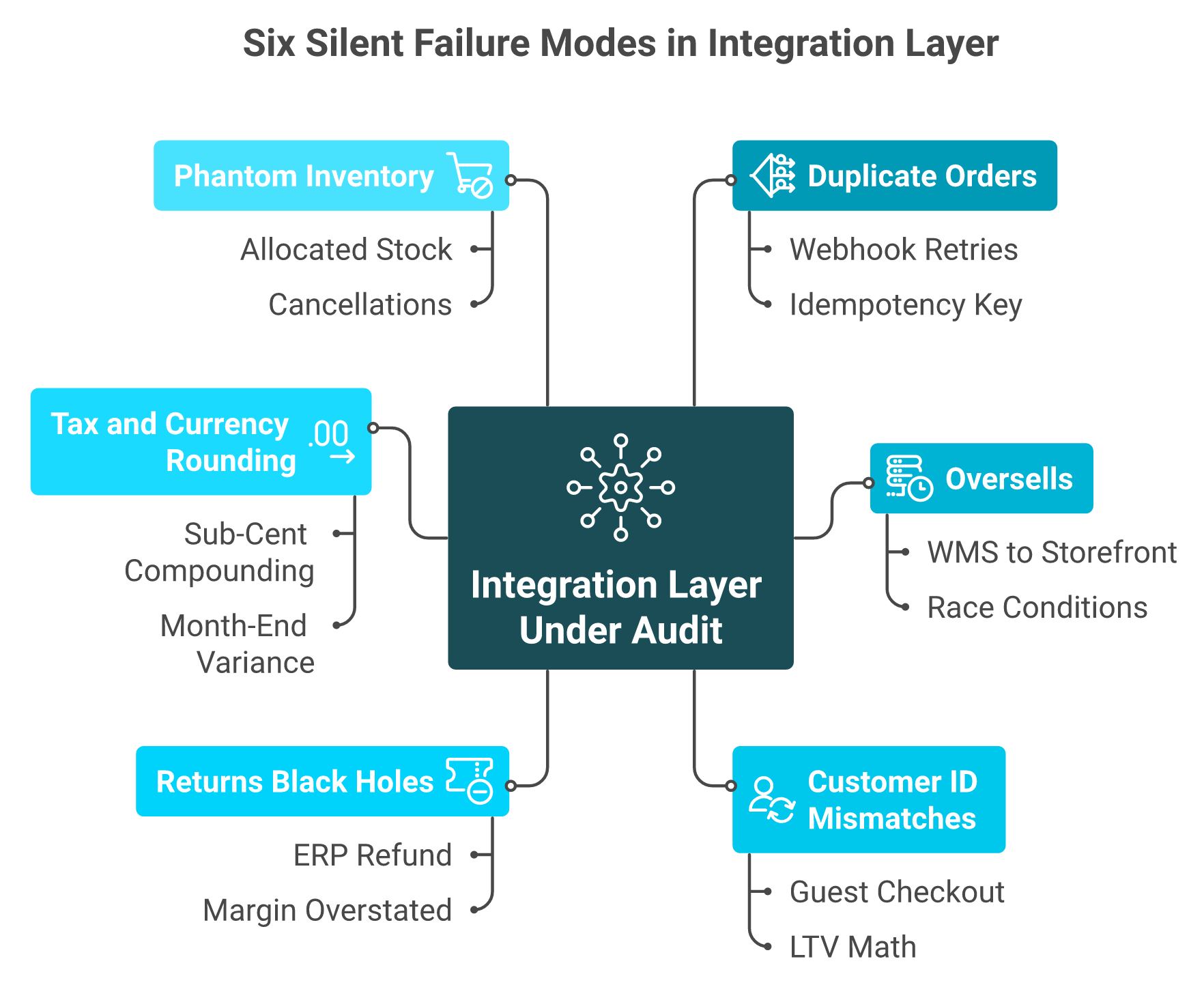
Six silent failure modes drift instead of fail loudly. Observability discipline is what catches them before P&L does.
These are the silent killers I see most often across DTC operators:
Duplicate orders. Webhook retries fire twice when the receiver doesn't ack fast enough. No idempotency key, two records.
Oversells. WMS inventory updates lag storefront cart commits during launches. Race condition, real loss.
Customer ID mismatches. Guest checkout creates a new CRM record. LTV math breaks.
Returns black holes. RMA created in 3PL, refund issued in storefront, but ERP never sees it. Margin overstated.
Tax and currency rounding. Sub-cent rounding compounds across 10K orders and shows up as a month-end variance your accountant flags.
Phantom inventory. Allocated stock not released after cancellations. WMS shows 0, ERP shows 80.
✅ The three observability pillars
You don't need a $200K monitoring stack. You need three disciplines.
1. Event-level logging. Every webhook, every retry, every transformation gets a unique event ID. Idempotency keys on writes. Dead-letter queues for anything that fails three retries.
2. Scheduled reconciliation. A nightly job compares order counts, GMV totals, inventory positions, and refund totals across systems. Variances above tolerance open a ticket automatically.
3. Anomaly alerts. Deltas on key metrics (orders, inventory, refunds, payouts) push to Slack the moment they cross threshold. A 2026 Reddit r/ERP thread on syncing vs integration put the architectural lesson clearly: "Without this layer, ERP and eCommerce systems become increasingly fragile over time." Operators tracking e-commerce unit economics feel this fragility first in their margin reports.
"I have been extremely frustrated with Triple Whale due to the lack of accessible customer support. When issues arise, especially billing concerns, it's nearly impossible to speak with a real person." Team All Fresh Seafood, Operator Triple Whale Trustpilot Verified Review
🛡️ The Sentry layer above the pipes
This is where an AI reasoning layer earns its keep. We built agentic AI for e-commerce founders to act as a 24/7 sentry across whatever pipes you already run.
It scans reconciliation deltas, flags anomalies in plain English, and pings you on Slack with the probable root cause before the customer service tickets pile up. That's the difference between learning about a broken sync from your accountant and catching it Sunday night.
🔁 Before vs after
Before: 11pm CSV exports, three browser tabs, Monday meetings spent debating which number is real. After: one alert, one root cause, one decision.
Q6: What Does the True 3-Year TCO Look Like, and How Do You Audit Your Current Stack in 10 Minutes? [toc=6. 3-Year TCO and Audit]
Year-1 license is the smallest line. The real TCO (total cost of ownership) stack: implementation (€15K to €120K), task-based fees that scale punitively, in-house maintenance (0.25 to 1 FTE), reconciliation labor, and opportunity cost. A €12K/year iPaaS often lands at €180K over 36 months. Audit your stack against eight criteria to spot where the money actually leaks.
💰 Why the headline price misleads
When a vendor quotes you €1,000 a month, that's the smallest line on the bill. The line items that actually compound are implementation, task-based scaling, and the founder's reconciliation time.
📊 The honest 3-year TCO model
Here's the model I run with operators sitting on the fence. Numbers are typical mid-market ranges, not vendor brochures.
3-Year Total Cost of Ownership for a Mid-Market iPaaS Stack
Cost Line
Year 1
Year 2
Year 3
3-Year Total
Platform license
€12K
€14K
€17K
€43K
Implementation + connectors
€40K
€5K
€5K
€50K
In-house maintenance (0.5 FTE)
€30K
€30K
€30K
€90K
Task overage fees
€4K
€8K
€15K
€27K
Reconciliation labor
€12K
€12K
€12K
€36K
Total
€98K
€69K
€79K
€246K
A €12K headline turns into €246K real spend. That's before you count opportunity cost from delayed decisions, which is harder to model but often larger than the line items above.
⚠️ Where the leaks usually hide
Three places eat the budget quietly:
Task-based pricing. iPaaS platforms bill per workflow execution. Every new SKU, every Q4 spike, every promo doubles your invoice.
Maintenance creep. The "low-code" connector becomes a half-time job for someone on the team within 18 months.
Reconciliation labor. The founder or controller spends 5 to 10 hours a week chasing variances. That's the sausage-factory tax.
✅ The 10-minute stack audit
Score yourself yes or no on these eight items. Be honest.
✅ Documented system of record per entity (orders, inventory, customers, returns)
✅ Event-level logs across every sync hop
✅ Scheduled reconciliation jobs with variance alerts
✅ Anomaly alerts on deltas above tolerance
✅ Returns flow back to ERP and CRM
✅ Customer dedupe rules across CRM and storefront
✅ Documented rollback plan per integration
✅ Drift detection on field mappings
🧮 Score interpretation
6 to 8 checks: Your stack is mature. Optimize, don't overhaul.
3 to 5 checks: Critical gaps. You're losing money silently every week.
0 to 2 checks: Fragmentation is the bottleneck. Manual processes dominate your workflow.
💸 The capital cost of integration debt
Here's the part nobody puts on the invoice. Integration debt traps cash in phantom inventory and delayed reorders.
After looking at thousands of DTC P&Ls, what jumps out is that operators with weak observability run a cash-conversion cycle (the time between paying suppliers and collecting from customers) 15 to 30 days longer than peers. That's six figures of working capital frozen for no reason, and it's exactly why calculating working capital for ecommerce business needs matters before you commit to another vendor.
"We worked with Clearco for a couple of years and had a great experience early on. Despite no change in our cash position or risk profile, we started facing stricter cash-on-hand demands that made little sense for a company offering high-cost MCA." Melissa, Operator Clearco Trustpilot Verified Review
🛠️ Where Luca closes the gap
We built Luca for financial management to take the audit failures and turn them into automated coverage. Reconciliation jobs, anomaly alerts, returns visibility, and customer dedupe all run as standard.
Most founders go from 2 to 3 checks to 7 to 8 within the first month, without adding a data engineer. That's the velocity argument, not the feature list.
Q7: How Do You Build a Decision Matrix Scored by Channel Count, GMV Band, ERP Type, and Team Size? [toc=7. Decision Matrix]
Score four axes: channels (1 to 2, 3 to 5, 6+), GMV band (under €5M, €5 to 20M, €20M+), ERP profile (none, mid-market, enterprise), and team capacity (no engineers, 1 to 2, full team). Sub-€5M with 1 to 2 channels and no engineers means native connectors. €5 to 20M with 3+ channels means iPaaS plus a reasoning layer. €20M+ with enterprise ERP means middleware plus selective custom APIs. The matrix removes guesswork and stops founders from over-buying or under-buying.
🎯 The decision dilemma
Choosing an integration architecture is a five-year commitment. Pick wrong, and you're locked into either a fragile spaghetti of connectors or an over-engineered platform you'll never use.
Most founders default to logo familiarity. They buy what their friend at another DTC brand uses. That's how a $4M store ends up paying for enterprise middleware it can't operate, and it's why a structured e-commerce tech stack review matters before signing.
❌ The wrong way to decide
Three flawed criteria show up in almost every shortlist:
Connector count. "It connects to 200+ apps" is irrelevant if you only need 6.
Cheapest license. Headline price is rarely the real cost (see Q6).
Vendor logo. Picking based on who Allbirds or Gymshark uses ignores your actual scale.
✅ The four-axis evaluation framework
Score yourself 0, 1, or 2 on each axis. Then read the prescription.
Axis 1: Channel count
0: 1 to 2 channels (Shopify only or Shopify + Amazon)
1: 3 to 5 channels (add TikTok Shop, Amazon, wholesale)
2: 6+ channels (multi-region, marketplaces, B2B)
Axis 2: GMV band
0: Under €5M
1: €5M to €20M
2: €20M+
Axis 3: ERP profile
0: None or QuickBooks/Xero
1: Mid-market (NetSuite, Dynamics 365, Acumatica)
2: Enterprise (SAP S/4HANA, Oracle Fusion)
Axis 4: Team capacity
0: No engineers
1: 1 to 2 engineers
2: Full engineering team
🧭 Applying the framework
Score your stack on GMV and complexity to find the architecture that fits, not the one your friend bought.
Add your scores. The total prescribes architecture.
Integration Architecture by Total Decision-Matrix Score
Total Score
Profile
Recommended Architecture
0 to 2
Sub-scale, single channel
Native connectors only. Skip iPaaS.
3 to 5
Scaling DTC, 3+ channels
iPaaS plus an AI reasoning layer above
6 to 8
Mid-market multi-channel
iPaaS plus middleware for custom flows
9+
Enterprise omnichannel
Custom middleware plus selective APIs
A 2026 Common Thread Collective benchmark series shows most DTC brands between €5M and €20M overspend on enterprise tooling by 2 to 3x because they skipped this scoring step.
🔍 Reading the matrix correctly
Two profiles get this wrong consistently. Sub-€5M brands buy enterprise middleware they can't staff. Mid-market brands stay on duct-tape native connectors three years past their expiry.
The matrix isn't perfect. My read right now is that it's still better than buying on logo familiarity, especially when you cross-reference it with a serious ecommerce analytics platforms review.
💡 The meta-insight
The right architecture is the one your team can actually operate next Tuesday. Not the most powerful, not the cheapest, the most operable.
If you're scoring 3 to 5 and don't have an engineer on staff, the iPaaS-plus-reasoning-layer combo is where most operators land. We built Luca, the AI Co-Founder for e-commerce, specifically for that profile, where the team needs analyst-grade answers without an analyst.
Q8: How Should You Run an Ecommerce Integration Project, From Discovery to Go-Live in Under 90 Days? [toc=8. 90-Day Project Plan]
A defensible 90-day plan: Days 1 to 15 discovery and SoR mapping; Days 16 to 35 connector build and field mapping; Days 36 to 55 transformation and exception handling; Days 56 to 75 UAT (user acceptance testing) with reconciliation jobs; Days 76 to 90 phased cutover with rollback. Skip discovery and you'll rebuild in production. Skip reconciliation and you'll learn about drift from your accountant six months later.
📅 Here's how a 90-day integration actually runs
Most enterprise projects quote 6 to 9 months. With AI-assisted mapping and disciplined scope, mid-market brands can ship in 90.
⏰ Days 1 to 15: Discovery and system-of-record mapping
Lock down which system owns each entity. Storefront owns the order at creation. ERP owns it post-fulfillment. WMS owns inventory state. CRM owns customer identity.
Document every field, every transformation, every edge case. Skip this and you'll rebuild in production.
⏰ Days 16 to 35: Connector build and field mapping
Stand up the connectors. AI-assisted mapping cuts this phase from weeks to days because it auto-suggests field matches and flags ambiguous ones for human review.
This is where the "death of the data-cleanup year" actually happens. You're not normalizing SKUs in a spreadsheet for 12 months. The reasoning layer normalizes on ingestion, the way AI can actually help you run your e-commerce business.
⏰ Days 36 to 55: Transformation and exception handling
Build your transformation rules, idempotency keys, dead-letter queues, and retry policies. Document what happens when a webhook fails three times.
Bake the exception handling in now. Bolting it on later is how integrations become legacy debt within 18 months.
⏰ Days 56 to 75: UAT with reconciliation jobs
Run reconciliation in parallel with the legacy process for 21 days. Compare counts and totals across systems daily. Variances above tolerance get triaged before cutover.
A HouseBlend NetSuite-Shopify implementation guide makes the case directly: parallel-run UAT is the single highest-leverage gate in the entire project.
⏰ Days 76 to 90: Phased cutover with rollback
Cut over by entity, not big-bang. Orders first, then inventory, then customers, then returns. Keep the rollback path open for 14 days post-cutover.
If anything drifts, you roll back to the last clean state without panicking the warehouse.
✅ The contrast
The typical enterprise build runs 9 months and ships with technical debt baked in. The 90-day plan ships clean because the reasoning layer absorbs the data-normalization work that used to require a data team.
That's the velocity argument in one project plan, and it pairs naturally with forecasting cash flow for e-commerce so the cutover lands without freezing working capital.
Q5: What Are the Failure Modes Nobody Warns You About, and How Do You Build Observability So They Surface Before Revenue Drops? [toc=5. Failure Modes and Observability]
Most integrations don't fail loudly. They drift. Common failure modes: webhook retries creating duplicate orders, race conditions causing oversells, customer ID mismatches breaking LTV (lifetime value, total revenue per customer over their lifecycle), returns not flowing to ERP, and tax rounding errors compounding at month-end. The fix is observability discipline: idempotency keys on every event, dead-letter queues for exceptions, scheduled reconciliation jobs comparing counts and totals across systems, and anomaly alerts on deltas above tolerance.
⏰ The 11pm reconciliation scene
It's 11pm on a Sunday. A founder doing $400K a month on Shopify has three browser tabs open. Shopify says 1,247 orders. NetSuite shows 1,231. The 3PL warehouse shipped 1,219.
Nobody knows which number is real. Tomorrow's Meta budget depends on the answer, and that's exactly the moment e-commerce founders drown in data.
❌ Why most integrations drift instead of fail
The root cause is simple. Your storefront, ERP, CRM, and WMS each emit events on different cadences with different schemas.
A retry policy that looks safe in isolation creates duplicates when paired with another system's idempotency gap. One Triple Whale operator captured the pattern bluntly: "Daily revenue totals are wrong, entire order blocks are missing, and every week we have to open new support tickets just to get our numbers halfway close to what our channel actually reports."
"Daily revenue totals are wrong, entire order blocks are missing, and every week we have to open new support tickets." XTRA FUEL, Operator Triple Whale Trustpilot Verified Review
⚠️ The failure-mode catalog
These are the silent killers I see most often across DTC operators:
Duplicate orders. Webhook retries fire twice when the receiver doesn't ack fast enough. No idempotency key, two records.
Oversells. WMS inventory updates lag storefront cart commits during launches. Race condition, real loss.
Customer ID mismatches. Guest checkout creates a new CRM record. LTV math breaks.
Returns black holes. RMA created in 3PL, refund issued in storefront, but ERP never sees it. Margin overstated.
Tax and currency rounding. Sub-cent rounding compounds across 10K orders and shows up as a month-end variance your accountant flags.
Phantom inventory. Allocated stock not released after cancellations. WMS shows 0, ERP shows 80.
✅ The three observability pillars
You don't need a $200K monitoring stack. You need three disciplines.
1. Event-level logging. Every webhook, every retry, every transformation gets a unique event ID. Idempotency keys on writes. Dead-letter queues for anything that fails three retries.
2. Scheduled reconciliation. A nightly job compares order counts, GMV totals, inventory positions, and refund totals across systems. Variances above tolerance open a ticket automatically.
3. Anomaly alerts. Deltas on key metrics (orders, inventory, refunds, payouts) push to Slack the moment they cross threshold. A 2026 Reddit r/ERP thread on syncing vs integration put the architectural lesson clearly: "Without this layer, ERP and eCommerce systems become increasingly fragile over time." Operators tracking e-commerce unit economics feel this fragility first in their margin reports.
"I have been extremely frustrated with Triple Whale due to the lack of accessible customer support. When issues arise, especially billing concerns, it's nearly impossible to speak with a real person." Team All Fresh Seafood, Operator Triple Whale Trustpilot Verified Review
🛡️ The Sentry layer above the pipes
This is where an AI reasoning layer earns its keep. We built agentic AI for e-commerce founders to act as a 24/7 sentry across whatever pipes you already run.
It scans reconciliation deltas, flags anomalies in plain English, and pings you on Slack with the probable root cause before the customer service tickets pile up. That's the difference between learning about a broken sync from your accountant and catching it Sunday night.
🔁 Before vs after
Before: 11pm CSV exports, three browser tabs, Monday meetings spent debating which number is real. After: one alert, one root cause, one decision.
Q6: What Does the True 3-Year TCO Look Like, and How Do You Audit Your Current Stack in 10 Minutes? [toc=6. 3-Year TCO and Audit]
Year-1 license is the smallest line. The real TCO (total cost of ownership) stack: implementation (€15K to €120K), task-based fees that scale punitively, in-house maintenance (0.25 to 1 FTE), reconciliation labor, and opportunity cost. A €12K/year iPaaS often lands at €180K over 36 months. Audit your stack against eight criteria to spot where the money actually leaks.
💰 Why the headline price misleads
When a vendor quotes you €1,000 a month, that's the smallest line on the bill. The line items that actually compound are implementation, task-based scaling, and the founder's reconciliation time.
📊 The honest 3-year TCO model
Here's the model I run with operators sitting on the fence. Numbers are typical mid-market ranges, not vendor brochures.
3-Year Total Cost of Ownership for a Mid-Market iPaaS Stack
Cost Line
Year 1
Year 2
Year 3
3-Year Total
Platform license
€12K
€14K
€17K
€43K
Implementation + connectors
€40K
€5K
€5K
€50K
In-house maintenance (0.5 FTE)
€30K
€30K
€30K
€90K
Task overage fees
€4K
€8K
€15K
€27K
Reconciliation labor
€12K
€12K
€12K
€36K
Total
€98K
€69K
€79K
€246K
A €12K headline turns into €246K real spend. That's before you count opportunity cost from delayed decisions, which is harder to model but often larger than the line items above.
⚠️ Where the leaks usually hide
Three places eat the budget quietly:
Task-based pricing. iPaaS platforms bill per workflow execution. Every new SKU, every Q4 spike, every promo doubles your invoice.
Maintenance creep. The "low-code" connector becomes a half-time job for someone on the team within 18 months.
Reconciliation labor. The founder or controller spends 5 to 10 hours a week chasing variances. That's the sausage-factory tax.
✅ The 10-minute stack audit
Score yourself yes or no on these eight items. Be honest.
✅ Documented system of record per entity (orders, inventory, customers, returns)
✅ Event-level logs across every sync hop
✅ Scheduled reconciliation jobs with variance alerts
✅ Anomaly alerts on deltas above tolerance
✅ Returns flow back to ERP and CRM
✅ Customer dedupe rules across CRM and storefront
✅ Documented rollback plan per integration
✅ Drift detection on field mappings
🧮 Score interpretation
6 to 8 checks: Your stack is mature. Optimize, don't overhaul.
3 to 5 checks: Critical gaps. You're losing money silently every week.
0 to 2 checks: Fragmentation is the bottleneck. Manual processes dominate your workflow.
💸 The capital cost of integration debt
Here's the part nobody puts on the invoice. Integration debt traps cash in phantom inventory and delayed reorders.
After looking at thousands of DTC P&Ls, what jumps out is that operators with weak observability run a cash-conversion cycle (the time between paying suppliers and collecting from customers) 15 to 30 days longer than peers. That's six figures of working capital frozen for no reason, and it's exactly why calculating working capital for ecommerce business needs matters before you commit to another vendor.
"We worked with Clearco for a couple of years and had a great experience early on. Despite no change in our cash position or risk profile, we started facing stricter cash-on-hand demands that made little sense for a company offering high-cost MCA." Melissa, Operator Clearco Trustpilot Verified Review
🛠️ Where Luca closes the gap
We built Luca for financial management to take the audit failures and turn them into automated coverage. Reconciliation jobs, anomaly alerts, returns visibility, and customer dedupe all run as standard.
Most founders go from 2 to 3 checks to 7 to 8 within the first month, without adding a data engineer. That's the velocity argument, not the feature list.
Q7: How Do You Build a Decision Matrix Scored by Channel Count, GMV Band, ERP Type, and Team Size? [toc=7. Decision Matrix]
Score four axes: channels (1 to 2, 3 to 5, 6+), GMV band (under €5M, €5 to 20M, €20M+), ERP profile (none, mid-market, enterprise), and team capacity (no engineers, 1 to 2, full team). Sub-€5M with 1 to 2 channels and no engineers means native connectors. €5 to 20M with 3+ channels means iPaaS plus a reasoning layer. €20M+ with enterprise ERP means middleware plus selective custom APIs. The matrix removes guesswork and stops founders from over-buying or under-buying.
🎯 The decision dilemma
Choosing an integration architecture is a five-year commitment. Pick wrong, and you're locked into either a fragile spaghetti of connectors or an over-engineered platform you'll never use.
Most founders default to logo familiarity. They buy what their friend at another DTC brand uses. That's how a $4M store ends up paying for enterprise middleware it can't operate, and it's why a structured e-commerce tech stack review matters before signing.
❌ The wrong way to decide
Three flawed criteria show up in almost every shortlist:
Connector count. "It connects to 200+ apps" is irrelevant if you only need 6.
Cheapest license. Headline price is rarely the real cost (see Q6).
Vendor logo. Picking based on who Allbirds or Gymshark uses ignores your actual scale.
✅ The four-axis evaluation framework
Score yourself 0, 1, or 2 on each axis. Then read the prescription.
Axis 1: Channel count
0: 1 to 2 channels (Shopify only or Shopify + Amazon)
1: 3 to 5 channels (add TikTok Shop, Amazon, wholesale)
2: 6+ channels (multi-region, marketplaces, B2B)
Axis 2: GMV band
0: Under €5M
1: €5M to €20M
2: €20M+
Axis 3: ERP profile
0: None or QuickBooks/Xero
1: Mid-market (NetSuite, Dynamics 365, Acumatica)
2: Enterprise (SAP S/4HANA, Oracle Fusion)
Axis 4: Team capacity
0: No engineers
1: 1 to 2 engineers
2: Full engineering team
🧭 Applying the framework
Add your scores. The total prescribes architecture.
Integration Architecture by Total Decision-Matrix Score
Total Score
Profile
Recommended Architecture
0 to 2
Sub-scale, single channel
Native connectors only. Skip iPaaS.
3 to 5
Scaling DTC, 3+ channels
iPaaS plus an AI reasoning layer above
6 to 8
Mid-market multi-channel
iPaaS plus middleware for custom flows
9+
Enterprise omnichannel
Custom middleware plus selective APIs
A 2026 Common Thread Collective benchmark series shows most DTC brands between €5M and €20M overspend on enterprise tooling by 2 to 3x because they skipped this scoring step.
🔍 Reading the matrix correctly
Two profiles get this wrong consistently. Sub-€5M brands buy enterprise middleware they can't staff. Mid-market brands stay on duct-tape native connectors three years past their expiry.
The matrix isn't perfect. My read right now is that it's still better than buying on logo familiarity, especially when you cross-reference it with a serious ecommerce analytics platforms review.
💡 The meta-insight
The right architecture is the one your team can actually operate next Tuesday. Not the most powerful, not the cheapest, the most operable.
If you're scoring 3 to 5 and don't have an engineer on staff, the iPaaS-plus-reasoning-layer combo is where most operators land. We built Luca, the AI Co-Founder for e-commerce, specifically for that profile, where the team needs analyst-grade answers without an analyst.
Q8: How Should You Run an Ecommerce Integration Project, From Discovery to Go-Live in Under 90 Days? [toc=8. 90-Day Project Plan]
A defensible 90-day plan: Days 1 to 15 discovery and SoR mapping; Days 16 to 35 connector build and field mapping; Days 36 to 55 transformation and exception handling; Days 56 to 75 UAT (user acceptance testing) with reconciliation jobs; Days 76 to 90 phased cutover with rollback. Skip discovery and you'll rebuild in production. Skip reconciliation and you'll learn about drift from your accountant six months later.
📅 Here's how a 90-day integration actually runs
Most enterprise projects quote 6 to 9 months. With AI-assisted mapping and disciplined scope, mid-market brands can ship in 90.
⏰ Days 1 to 15: Discovery and system-of-record mapping
Lock down which system owns each entity. Storefront owns the order at creation. ERP owns it post-fulfillment. WMS owns inventory state. CRM owns customer identity.
Document every field, every transformation, every edge case. Skip this and you'll rebuild in production.
⏰ Days 16 to 35: Connector build and field mapping
Stand up the connectors. AI-assisted mapping cuts this phase from weeks to days because it auto-suggests field matches and flags ambiguous ones for human review.
This is where the "death of the data-cleanup year" actually happens. You're not normalizing SKUs in a spreadsheet for 12 months. The reasoning layer normalizes on ingestion, the way AI can actually help you run your e-commerce business.
⏰ Days 36 to 55: Transformation and exception handling
Build your transformation rules, idempotency keys, dead-letter queues, and retry policies. Document what happens when a webhook fails three times.
Bake the exception handling in now. Bolting it on later is how integrations become legacy debt within 18 months.
⏰ Days 56 to 75: UAT with reconciliation jobs
Run reconciliation in parallel with the legacy process for 21 days. Compare counts and totals across systems daily. Variances above tolerance get triaged before cutover.
A HouseBlend NetSuite-Shopify implementation guide makes the case directly: parallel-run UAT is the single highest-leverage gate in the entire project.
⏰ Days 76 to 90: Phased cutover with rollback
Cut over by entity, not big-bang. Orders first, then inventory, then customers, then returns. Keep the rollback path open for 14 days post-cutover.
If anything drifts, you roll back to the last clean state without panicking the warehouse.
✅ The contrast
The typical enterprise build runs 9 months and ships with technical debt baked in. The 90-day plan ships clean because the reasoning layer absorbs the data-normalization work that used to require a data team.
That's the velocity argument in one project plan, and it pairs naturally with forecasting cash flow for e-commerce so the cutover lands without freezing working capital.
Q9: Where Does AI-Assisted Mapping and Agentic Integration Actually Beat Traditional iPaaS? [toc=9. AI-Assisted Mapping Wins]
AI's real wins are narrow but high-leverage: auto-mapping fields between mismatched schemas, classifying exceptions instead of dumping them in a queue, normalizing SKUs and customer records on ingestion, simulating downstream impact of changes, and pushing customized reconciliation reports to Slack and email on a schedule. Native AI inside vertical tools remains underwhelming. A decoupled AI layer over your data warehouse compounds gains across silos.
🤖 The capability statement
Agentic integration is not "iPaaS plus a chatbot." It's a reasoning layer that sits on top of your data warehouse and acts on what it finds.
It maps fields, classifies exceptions, normalizes records, simulates changes, and ships scheduled reports without a human pulling levers. That's a different category from a workflow tool, and it's why agentic AI for ecommerce founders reads as a category, not a feature.
🔧 How it actually works under the hood
The reasoning layer doesn't replace your iPaaS pipes. It sits above the warehouse where Celigo or Workato dumps the data.
It pattern-matches on schema drift, learns which exceptions are real versus noise, and pushes findings to Slack or email on whatever cadence you set. The 2026 r/ERP operator thread on syncing vs. integration captured the architectural shift directly: real integration is workflow, logic, and coordination, not just data movement.
✅ The four durable wins
These are the use cases I see actually pay back on real DTC stacks:
Schema mapping. AI auto-suggests field matches when Shopify renames a property or NetSuite adds a custom field. Cuts mapping time from days to hours.
Exception classification. Instead of dumping 800 dead-letter-queue events on an engineer, the system clusters them by root cause and surfaces the top three.
Ingestion normalization. SKUs, customer emails, and addresses get standardized as they land. The "data-cleanup year" disappears.
Agentic reporting. Customized weekly reconciliation reports pushed to Slack with reasoning, charts, and recommended actions. No dashboard login required.
⚠️ Where native AI keeps falling short
I keep seeing the same pattern with vertical tools that bolt AI onto an existing dashboard. The reasoning is shallow because it only sees one slice of data.
"The integrations are inconsistent, building with the AI tool Moby is very buggy and crashes more than half the time, and support is largely unresponsive." Matt Huttner, Operator Triple Whale Trustpilot Verified Review
"Underwriting team is a joke, looks like kids are working. They rely on some AI software to analyse data, which seemed off." M. Islamovic, Operator Wayflyer Trustpilot Verified Review
🛡️ Why decoupled reasoning compounds
A decoupled layer reads from the warehouse where every silo lands. That's how you get horizontal pattern recognition, the kind deep data analysis and industry research demands.
We built Luca on this principle. It's not a connector or an attribution tool, it's an AI layer over your data warehouse that extracts the relevant data on demand, runs root-cause analysis, simulates scenarios on historical patterns, and pushes customized reports to Slack and email. Most analytics tools added AI. Luca is AI.
That's the difference between asking "what was my CAC last week?" and asking "why did my Tuesday MER drop, and what should I do before the next ad cycle?"
Q10: Analytics-Only Tools vs an AI Reasoning Layer Over Your Integrated Data, Which Wins for Cross-Functional Decisions? [toc=10. Analytics vs Reasoning Layer]
Dashboard tools like Triple Whale and Polar Analytics show what happened in marketing. They don't reason across integrated ERP, WMS, and CRM data. An AI layer over your warehouse extracts relevant data on demand, runs root-cause analysis, simulates scenarios on historical patterns, identifies influencing components, and pushes customized reports to Slack and email. Win criteria: cross-functional reasoning, simulation depth, RCA quality, zero-SQL access, and agentic delivery.
🎯 The comparison context
You're picking between two architectures. One is a dashboard built for marketing attribution. The other is a reasoning layer that reads your full warehouse.
Tools like Triple Whale, Northbeam, and Polar Analytics are strong on marketing attribution. They were built to answer "which channel drove the order."
They were not built to ask "why did Tuesday's MER drop, given Friday's inventory landing and a CS ticket spike on returns." That's a cross-system question, not a marketing question, and operators looking past attribution often start with our Triple Whale alternatives rundown.
"1 STAR. Broken Integrations. Fake Attribution for External Marketplaces. Daily revenue totals are wrong, entire order blocks are missing." XTRA FUEL, Operator Triple Whale Trustpilot Verified Review
"It has been unable to deliver on the promise to provide any insights or accurate data to our business, and we end up reverting back to direct data sources like Meta, Shopify, Recharge." Matt Huttner, Operator Triple Whale Trustpilot Verified Review
✅ What a reasoning layer does differently
A reasoning layer reads from the warehouse where every silo lands. Then it does five things dashboards can't.
Cross-functional reasoning across marketing, finance, ops, and CX in one query
Root-cause analysis that explains the why, not just the what
Simulation on historical patterns ("if I scale Meta 30%, what happens to inventory in 6 weeks?")
Zero-SQL access in plain English
Agentic push of customized reports to Slack, email, or app on a schedule
📊 Side-by-side on analytics metrics only
Dashboard Tools vs AI Reasoning Layer on Cross-Functional Analytics
Criterion
Dashboard Tools (Triple Whale, Polar, Northbeam)
AI Reasoning Layer (Luca, Saaras, Conjura)
Cross-functional reasoning
Marketing only
Marketing + finance + ops + CX
Root-cause analysis
Manual via filters
Automated, plain English
Scenario simulation
No
Yes, on historical patterns
Zero-SQL access
Partial (templates)
Full conversational
Agentic Slack/email push
Limited
Customizable, scheduled
Outlier detection
Threshold alerts
Pattern-based anomaly detection
🔍 Who should choose what
If your only question is "which Meta ad drove which order," a dashboard tool still works. If your questions cross marketing, inventory, returns, and cash, the dashboard ceiling shows up fast.
Most operators I work with around €5M to €20M GMV hit the ceiling within 6 months of scaling channels. That's when a reasoning-grade Shopify analytics app earns its keep.
🛠️ The reasoning layer category
Luca sits at the front of this category as a replacement for a junior data analyst. It's trained on the relationships between ecommerce metrics, so it draws connections that a dashboard can't.
Saaras IQ and Conjura play in the same architectural neighborhood, with heavier dashboard-build complexity. Pick on which feels faster to operate next Tuesday, and pair the choice with serious marketing analysis and automation.
Q11: Capital-Only Providers vs a Capital Layer Embedded in Your Integration Stack, Which Wins on Rate, Disbursal Time, and Terms? [toc=11. Capital Providers Compared]
Compare capital providers on the metrics that decide cash velocity: effective rate (not advertised fee), time to disbursal (hours vs weeks), repayment structure (fixed daily vs revenue share), personal guarantee requirements, ceiling per cycle, and renewal speed. Wayflyer, Clearco, 8fig, and Shopify Capital each trade off differently. A capital layer embedded in your integration stack wins when underwriting uses live integrated data, compressing approval to hours and adjusting limits as performance changes.
💰 The comparison context on capital metrics
Capital is a capital decision. Rate, speed, terms, ceiling, and renewal velocity are the only things that matter when you're picking a provider.
Anything else is noise. This section evaluates options purely on those metrics, the same way an operator weighing Luca AI vs Wayflyer would.
❌ Where standalone RBF providers fall short
Revenue-based financing (RBF, capital repaid as a fixed percentage of daily sales) was a real innovation in 2018. By 2026, the cracks show up consistently in operator reviews.
The pattern is bait-and-switch on terms, slow disbursal, opaque underwriting, and renewals that disappear when you actually need them. If you're shopping Clearco alternatives, the same patterns repeat.
"8fig's offer is basically a 100% APR. That means you'll pay back double what you received in just 12 months." Anonymous, Operator 8fig Trustpilot Verified Review
"We had a signed agreement with 8fig for three preset rounds of funding at pre-agreed rates. They only funded the first round, which was at the highest cost, and then backed out of the rest at the last minute." Melissa, Operator 8fig Trustpilot Verified Review
"After being offered funding in writing with specific amounts, repayment terms, and confirmation that the deal was approved, Wayflyer abruptly reversed their decision at the last minute." Geoff Brand, Operator Wayflyer Trustpilot Verified Review
✅ Where embedded capital wins on the same metrics
A capital layer embedded in your integration stack underwrites against live integrated data. That changes the math on every metric.
Effective rate. Underwriting on live data lets pricing reflect current performance, not a 60-day-old application snapshot.
Disbursal time. Hours, not weeks, because the data is already connected.
Repayment structure. Dynamic, based on real-time performance, not a rigid daily ACH.
Personal guarantees. Often unnecessary when underwriting has live cash and inventory visibility.
Ceiling per cycle. Adjusts as your performance changes, not at quarterly review.
Renewal speed. Same-day if your metrics support it.
📊 Side-by-side on capital metrics only
Standalone RBF vs Embedded Capital on Operator Metrics
Metric
Standalone RBF (Wayflyer, Clearco, 8fig)
Embedded Capital Layer (Luca)
Time to disbursal
5 to 14 days
Hours
Underwriting basis
Application snapshot
Live integrated data
Effective rate
Often hidden in fee structure
Transparent, performance-linked
Repayment
Fixed daily ACH or revenue share
Dynamic to performance
Personal guarantee
Frequently required
Often waived
Renewal
Manual reapplication
Continuous, automatic
Ceiling adjustment
Quarterly
As performance changes
🔁 Who should choose what
If you only need capital once and don't mind a 2-week wait, a standalone RBF can still work. If you need capital that moves at the speed of your ad cycle and inventory turnover, embedded wins on every metric above, especially if you're securing funding to scale e-commerce marketing campaigns.
Luca puts its money where its math is, with disbursal in hours, transparent rate, dynamic repayment, and no personal guarantee on most cycles. That's the embedded-capital category at the front of the listicle, and the thinking behind the intelligence-capital thesis.
Q12: Is the Integration Layer Safe for My PII, Financial, and Customer Data, and What Does a Compliant Data-Flow Map Look Like? [toc=12. PII and Compliance]
A compliant integration layer must be SOC 2 Type II, encrypt with AES-256 in transit and at rest, comply with GDPR data deletion, and never train shared models on your data. Your PII data-flow map should document where customer records originate (storefront), where they're enriched (CRM), where they're stored as system of record (ERP), and which iPaaS hops they cross, with a DPA in place at every hop. Ask any vendor for SOC 2 plus DPA before signing.
🔒 The objection
"I'm not comfortable letting any layer touch my ERP, CRM, and WMS data at the same time."
That hesitation is rational. You've seen the headlines. You've read the bait-and-switch reviews on capital providers. Trust is earned, not assumed, which is why our privacy policy sits one click away on every page.
✅ Validate the concern
The risk is real. Operators have been burned by vendors that pull more data than agreed and act on it in ways the contract didn't cover.
"Clear Co continuously pulls all data from your Amazon Seller account. It controls your earnings, steals your data and uses your personal data." S. Imren, Operator Clearco Trustpilot Verified Review
That's exactly what a proper compliance posture is built to prevent.
🛡️ The technical reality
A defensible integration layer in 2026 ships with these table-stakes:
SOC 2 Type II audited annually
AES-256 encryption at rest and in transit
GDPR compliance with full data-deletion rights
No model training on your data, ever
Signed DPA (Data Processing Agreement) at every hop
Role-based access with least-privilege defaults
🗺️ The PII data-flow map you should document
Map every hop. Customer email enters at the storefront. CRM enriches it with consent and lifecycle data.
ERP holds it as billing system of record. WMS sees only shipment-relevant fields. iPaaS hops carry it briefly with encryption and DPA in place. Document the diagram. Share it with your CFO before signing anything, alongside your HR and compliance management baseline.
📋 The verification path
Don't take any vendor's word. Ask for the SOC 2 report, the DPA, and the sub-processor list before you connect a single API.
If the vendor hesitates or routes you to a sales call instead of a security review, walk. Operators on r/ecommerce keep flagging the same pattern: the lenders and analytics tools that get sketchy with security reviews are the same ones with bait-and-switch reviews on Trustpilot. If you want to talk through your stack's compliance posture, reach out to our team.
FAQ's
What is ecommerce platform integration, and why does it matter in 2026?
We define ecommerce platform integration as the connective tissue syncing orders, inventory, customers, and returns across storefronts, ERP, CRM, and WMS. In 2026, it has evolved past iPaaS pipes into agentic intelligence that reasons across data, not just moves it.
The shift matters because the cost of a broken sync is no longer a duplicate order. It's a Meta campaign that scales into a stockout, a returns batch that never updates LTV, and a Q4 forecast built on phantom inventory.
Pipes handle data movement (iPaaS, native connectors).
Events carry orders, inventory deltas, and customer updates.
Reasoning sits above both and decides what to do.
That reasoning layer is what we built Luca to be: a 24/7 sentry over your warehouse that normalizes on ingestion and surfaces anomalies before they hit P&L.
Which integration architecture should I pick at my scale, native connectors, iPaaS, middleware, or custom APIs?
We score four axes: channel count, GMV band, ERP profile, and team capacity. The total prescribes architecture without guesswork.
Sub-€5M, 1 to 2 channels, no engineers: native connectors only. Skip iPaaS.
€5M to €20M, 3+ channels: iPaaS plus an AI reasoning layer above.
€20M+, enterprise ERP: custom middleware with selective custom APIs.
Most operators we work with around €5M to €20M GMV land on the iPaaS-plus-reasoning combo, because they need analyst-grade answers without an analyst on payroll.
Two failure profiles repeat. Sub-€5M brands buy enterprise middleware they can't staff. Mid-market brands stay on duct-tape native connectors three years past their expiry.
The right architecture is the one your team can operate next Tuesday. For a deeper read on the full stack picture, see our e-commerce tech stack breakdown.
What does the true 3-year TCO of ecommerce integration look like?
We model TCO honestly, not from the vendor brochure. A €12K/year iPaaS license routinely lands near €246K over 36 months once the real lines are counted.
Platform license: €43K over 3 years.
Implementation and connectors: €50K.
In-house maintenance (0.5 FTE): €90K.
Task overage fees: €27K.
Reconciliation labor: €36K.
Three places eat the budget quietly: task-based pricing that doubles during Q4 spikes, maintenance creep that turns a low-code connector into a half-time job, and reconciliation labor that costs the controller 5 to 10 hours a week.
What are the most common ecommerce integration failure modes, and how do I catch them early?
We see the same silent killers repeat across DTC stacks. Most integrations don't fail loudly, they drift.
Duplicate orders from webhook retries with no idempotency key.
Oversells from race conditions between WMS and storefront during launches.
Customer ID mismatches from guest checkout, breaking LTV math.
Returns black holes where ERP never sees the refund.
Tax and currency rounding errors that compound at month-end.
Phantom inventory when allocated stock isn't released after cancellations.
The fix is observability discipline: idempotency keys on every event, dead-letter queues for exceptions, scheduled reconciliation jobs comparing counts and totals across systems, and anomaly alerts on deltas above tolerance.
That sentry layer is exactly the role we built agentic AI for ecommerce founders to play. It scans 24/7 and pings Slack with the probable root cause before tickets pile up.
How does embedded capital compare to standalone RBF providers like Wayflyer, Clearco, or 8fig?
We compare capital purely on capital metrics: effective rate, time to disbursal, repayment structure, personal guarantee requirements, ceiling per cycle, and renewal speed.
Time to disbursal: hours for embedded capital, 5 to 14 days for standalone RBF.
Underwriting basis: live integrated data versus an application snapshot.
Effective rate: transparent and performance-linked versus often hidden in fee structures.
Repayment: dynamic to performance versus rigid daily ACH.
Personal guarantee: often waived versus frequently required.
Trustpilot patterns on Wayflyer, Clearco, and 8fig repeatedly flag bait-and-switch terms, slow disbursal, and disappearing renewals. Embedded capital underwritten on live data sidesteps each of those failure modes.
If you're benchmarking options, our Luca AI vs Wayflyer breakdown covers the head-to-head in detail.
Enjoyed the read? Join our team for a quick 15-minute chat — no pitch, just a real conversation on how we’re rethinking Ecommerce with AI - Luca
Loading Schedule...
Your AI Co-Founder is here.
Here’s why:
Shopify, Meta, Xero - one brain.
"Should I scale?" Answered with real data.
Growth capital. No applications. One click.
Thank you! Your submission has been received! Please book a time slot for the Meeting
Oops! Something went wrong while submitting the form.