Agentic AI Explained: Why E-commerce Founders Are Ditching Dashboards
12
mins read
In this article
TL;DR
The Interpretation Gap: Traditional dashboards show what happened but don't explain why or recommend what to do next, leaving founders to manually synthesize insights across 8-12 disconnected tools.
The Action Gap: Even when founders identify the right move, execution stalls due to manual processes, disconnected systems, and capital constraints, causing insights to die in spreadsheets.
Agentic AI Defined: Unlike pull-based dashboards requiring manual queries, agentic AI continuously scans data 24/7, proactively surfacing risks and opportunities with diagnosis and recommended action.
The Data → Insight → Decision → Action Framework: Successful founders complete all four stages; traditional tools only address stages 1-2, forcing founders to manually bridge the rest.
Progressive Autonomy Model: Modern AI earns trust over time, starting with recommendations only (Level 1) and advancing to autonomous action with notification (Level 3) as accuracy is demonstrated.
ROI Benchmarks: Founders typically save 10-15 hours weekly on reporting, catch margin leaks worth €5K-20K per incident, and achieve 5-10x subscription ROI within 90 days.
Q1. Why Do Most E-commerce Founders Struggle to Make Data-Driven Decisions? [toc=Why Founders Struggle]
The modern e-commerce founder operates in an era of unprecedented data abundance, yet experiences unprecedented decision paralysis. A typical Shopify store generating €1M+ revenue relies on 8-12 disconnected tools: Shopify for commerce data, Meta Ads Manager for acquisition, Google Analytics for behavior, Klaviyo for retention, Xero for accounting, and spreadsheets for everything else. Data is everywhere, but understanding is nowhere.
This fragmentation creates what might be called the "paralysis of fragmentation." A marketing director optimizes ROAS without visibility into cash flow implications. A founder asks "Should I scale this campaign?" but can't answer without opening five different dashboards and manually triangulating data in a spreadsheet. The result isn't a lack of data, it's a lack of synthesis.
Where Most E-commerce Founders Get Stuck
The struggle isn't laziness or lack of sophistication. It's architectural. Traditional tools were designed to solve isolated problems: marketing analytics here, financial reporting there, inventory management somewhere else. None were built to reason across functional boundaries.
"I spend more time making reports than actually using the insights. By the time I understand what happened last week, the opportunity is already gone." — u/dtc_founder_uk, r/ecommerce Reddit Thread
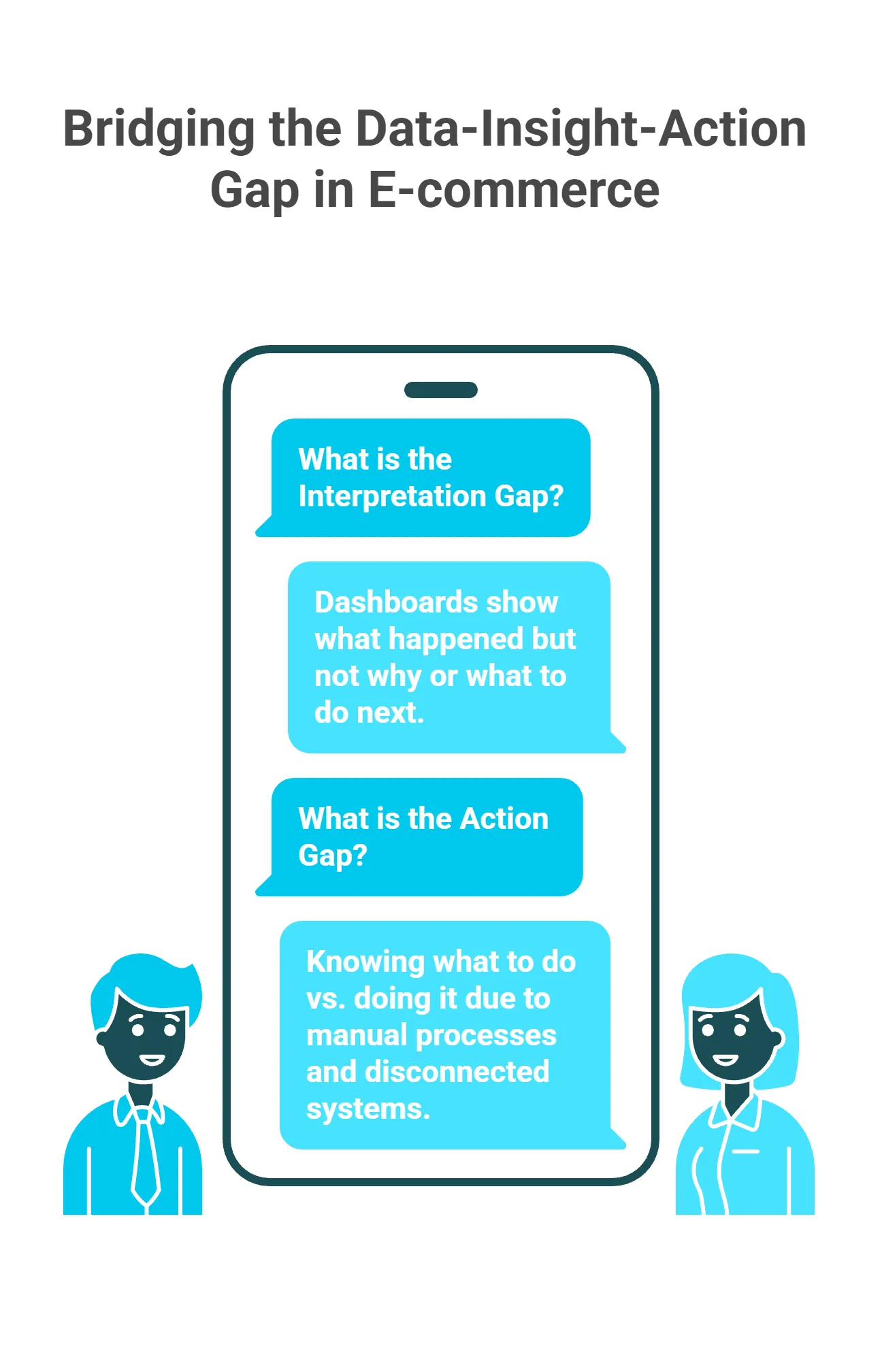
Infographic illustrating two critical gaps e-commerce founders face: the interpretation gap where dashboards show data without explaining why, and the action gap between knowing and doing due to disconnected systems.
The Interpretation Gap: Dashboards Don't Tell You What to Do
⚠️ Traditional analytics dashboards like Triple Whale, GA4, and Northbeam function as passive reporting tools. They display what happened: ROAS dropped 15%, CAC increased €4, conversion rate declined 0.3%. But they don't explain why it happened or what to do next.
This is the Interpretation Gap. Founders stare at charts showing declining metrics but receive no diagnosis. The dashboard shows symptoms without prescribing treatment. A marketing manager sees creative fatigue indicators but can't connect that to inventory implications or cash flow timing. The "insight" remains abstract, a number on a screen rather than a decision catalyst.
❌ The result: 40% of team time spent on reporting rather than action. Founders become "dashboard doom-scrollers," hunting for meaning across disconnected interfaces.
The Action Gap: Knowing What to Do vs. Doing It
Even when founders correctly interpret data and identify the right move, execution stalls. This is the Action Gap, the friction between decision and implementation.
Manual processes create drag. Disconnected systems require duplicate data entry. Lack of working capital prevents scaling proven campaigns. The insight dies in a spreadsheet, waiting for approvals, budget reallocation, or the next planning cycle. Meanwhile, the market moves on.
"We identified a winning Meta campaign but couldn't scale it fast enough. By the time we reallocated budget manually and secured additional inventory funding, CPMs had increased 30%." — u/growth_ops_lead, r/PPC Reddit Thread
The Scale of the Problem
⏰ Research indicates that 85% of successful businesses leverage data analytics for strategic decisions. Yet most e-commerce founders report lacking confidence in their data-driven choices. The disconnect isn't capability, it's architecture. Founders spend 10-15 hours weekly consolidating data manually, yet still operate with incomplete pictures.
The solution isn't more dashboards or additional point solutions. It's systems designed to bridge both gaps simultaneously, interpreting data and enabling action in one motion. This requires moving from fragmented tools to unified intelligence that understands the complete business context.
Q2. What Is the Data → Insight → Decision → Action Framework? [toc=Insight to Action Framework]
Successful e-commerce founders don't just collect data, they complete a journey from raw information to executed strategy. Understanding this framework reveals where traditional tools fail and why most founders remain stuck despite abundant analytics.
The Data → Insight → Decision → Action Journey
The complete journey consists of four sequential stages, each dependent on the previous:
Four-stage framework showing how successful e-commerce founders transform raw data into executed strategy: data collection, AI analysis for insights, cross-functional decision-making, and automated action execution.
The Four-Stage Decision Journey
Stage
Description
Traditional Tool Coverage
1. Data Collection
Raw inputs from commerce, marketing, finance systems
✅ Most tools handle this
2. AI Analysis (Insight)
Transform data into understanding: the "why" and "what's next"
⚠️ Partial: dashboards show, don't explain
3. Founder Decision
Human judgment informed by cross-functional context
❌ Requires manual synthesis
4. Automated Action
Execute the decision: pause ads, reallocate budget, deploy capital
❌ Traditional tools can't act
Most analytics platforms address only Stage 1 and partially Stage 2. The founder becomes the manual bridge for everything else.
Stage 1: Data Collection
Raw inputs flow from Shopify (orders, customers, inventory), Meta and Google (ad spend, impressions, conversions), Stripe (payments, fees), and Xero (accounting, cash position). The challenge isn't data availability, it's data fragmentation.
❌ Formats don't match. Time zones differ. Attribution windows conflict. A founder asking "What's my true contribution margin by channel?" must export from three platforms, normalize timestamps, reconcile currency conversions, and build formulas manually.
Stage 2: AI Analysis (Insight)
This stage should transform raw data into actionable understanding. Traditional dashboards stop here, and stop short. They visualize what happened (ROAS = 2.3x) without explaining causality (creative fatigue + audience saturation + seasonal CPM inflation) or recommending response (pause Creative Set B, shift €5K to TikTok test).
⚠️ The Interpretation Gap lives in Stage 2. Analytics tools present symptoms without diagnosis.
Where Traditional Tools Break Down
Stage 3 requires cross-functional context that siloed tools cannot provide. A decision to scale a campaign requires understanding:
Traditional analytics see only the first bullet. Financial tools see only the second. Neither provides the synthesis required for confident decisions.
"Every analytics platform tells me my ROAS is healthy. None of them can tell me if I'll have cash for inventory if I scale that campaign 50%." — u/shopify_ceo_eu, r/shopify Reddit Thread
Closing the Loop: From Framework to Reality
Stage 4, Automated Action, represents the ultimate gap. Traditional tools report; they cannot act. A dashboard showing declining campaign performance cannot pause the underperforming ad set. A financial report identifying a scaling opportunity cannot deploy capital to fund it.
✅ True AI co-founders close this loop entirely. They connect data sources into unified context, generate cross-functional insights proactively, support informed decisions with scenario modeling, and execute actions, including unlocking capital, without requiring founders to leave the interface.
Luca AI was architected specifically to complete all four stages. By unifying commerce, marketing, and financial data into a single reasoning layer, Luca transforms the fragmented journey into a seamless flow from insight to action.
Q3. What Is Agentic AI and How Does It Differ from Traditional E-commerce Analytics? [toc=Agentic AI Defined]
Agentic AI refers to autonomous artificial intelligence systems that continuously scan business data, identify opportunities and risks, and recommend or execute actions without waiting to be asked. Unlike traditional dashboards displaying static reports, agentic AI reasons cross-functionally and proactively surfaces insights, representing a fundamental shift from passive tools to active partners.
From "Pull Insights" to "Push Insights"
The architectural difference between traditional analytics and agentic AI comes down to one word: direction.
Traditional Analytics vs Agentic AI Comparison
Dimension
Traditional Analytics
Agentic AI
Information Flow
Pull-based (you query)
Push-based (AI alerts you)
Scope
Siloed by function
Cross-functional reasoning
Timing
Historical reporting
Real-time monitoring + prediction
Output
Metrics and charts
Diagnosis + recommended action
Capability
Display data
Execute decisions
❌ Traditional dashboards require founders to know what questions to ask, navigate to the correct report, and interpret results without context. The founder initiates every interaction.
✅ Agentic AI inverts this relationship. The system monitors business data 24/7, detects anomalies against learned thresholds, and proactively alerts founders when attention is required, complete with diagnosis and recommended response.
"I switched from checking dashboards 10 times daily to receiving 2-3 meaningful alerts per week. Each alert includes context and suggested actions. It's like having an analyst who never sleeps." — u/ecom_ops_director, r/analytics Reddit Thread
Key Capabilities That Define Agentic AI
Visual breakdown of agentic AI capabilities for e-commerce including autonomous data scanning, proactive alerting for risks and opportunities, cross-functional reasoning connecting marketing to cash flow, and action execution.
⭐ Autonomous Scanning: Continuously monitors all connected data sources without manual queries
⭐ Cross-Functional Reasoning: Connects marketing performance to cash flow to inventory in single analysis
⭐ Action Execution: Can implement decisions, pause campaigns, generate reports, request capital, not just recommend them
BigCommerce defines agentic AI as "the next evolution in e-commerce automation," enabling "smarter decisions and experiences" through systems that understand context rather than simply processing queries.
How Luca AI Implements Agentic Intelligence
Luca AI's proactive intelligence continuously scans connected data sources, Shopify, Meta, Google Ads, Stripe, Xero, against performance thresholds defined by business context, not arbitrary benchmarks.
When CAC spikes beyond sustainable levels, ROAS drops below profitable thresholds, or inventory approaches stockout velocity, Luca generates alerts with three components: ✅ What happened, ✅ Why it happened, and ✅ What to do next.
💰 Critically, Luca doesn't stop at recommendations. When the AI identifies a scaling opportunity and the founder approves, Luca can deploy instant capital to fund execution, closing the loop from insight to action without leaving the chat interface. Learn more about how Luca AI works.
This represents the shift from tool to partner. Traditional analytics require founders to do the thinking; agentic AI thinks alongside them.
Q4. How Can AI Help Me Run My E-commerce Business More Efficiently? [toc=AI Use Cases for E-commerce]
AI transforms e-commerce operations by eliminating manual data reconciliation, surfacing insights proactively, and enabling faster decisions across marketing, inventory, pricing, and customer experience. The highest-ROI implementations target seven core use cases where AI replaces hours of manual work with instant, unified analysis.
Core Use Cases: Ad Optimization, Inventory, Pricing, Personalization
"We were manually tracking contribution margin in a 47-tab spreadsheet updated weekly. AI unified our Shopify, Meta, and Xero data. Now I see real-time margin by product-channel combination without exporting anything." — u/dtc_brand_cfo, r/ecommerce Reddit Thread
The Before and After: Manual vs. AI-Enabled Workflows
Consider the question: "What's my true contribution margin by channel?"
❌ Before (Manual Process):
Export revenue data from Shopify (15 min)
Export ad spend from Meta Ads Manager (10 min)
Export COGS from inventory system (10 min)
Reconcile in spreadsheet, normalize dates (45 min)
Calculate margin, cross-reference with Xero (30 min)
Total: 2+ hours, outdated by completion
✅ After (AI-Enabled):
Ask: "Show me contribution margin by channel for last 30 days"
Receive answer with breakdown, trend comparison, anomaly flags
Total: 12 seconds, real-time data
⏰ Across all seven use cases, founders report saving 10-15 hours weekly on data consolidation alone, time redirected to strategy, customer relationships, and growth initiatives.
How Luca AI Delivers Unified Intelligence
Luca AI eliminates manual reconciliation by connecting commerce, marketing, finance, and operations data into a single reasoning layer. Ask complex, cross-functional questions in natural language:
"Which August cohort has the highest 90-day LTV, and what channel acquired them?"
"If I scale Meta spend 30%, what's my cash position in 60 days?"
"Which products have margin below target, and what's driving the compression?"
Luca synthesizes answers in seconds, not hours. And when the analysis reveals a scaling opportunity, Luca can surface instant capital options to fund execution, transforming insight into action without friction. Explore more about how AI can help run your e-commerce business.
Q5. How Can AI Analyze My Ad Campaigns and Suggest Improvements? [toc=AI Campaign Analysis]
It's 11 PM on Thursday. You've spent 3 hours bouncing between Meta Ads Manager, Google Analytics, and Shopify, trying to figure out which product-channel combination is actually profitable. Your CPAs rose 22% this month. ROAS is declining. Creative performance looks inconsistent. And you still don't know why.
This scenario isn't exceptional, it's the default experience for e-commerce founders managing paid acquisition at scale.
Why Platform-Reported ROAS Lies to You
The fundamental problem isn't your campaigns. It's your analytics architecture.
Your marketing platform sees ad spend and attributed conversions. Your accounting tool sees revenue and costs. Neither can reason across both. You become the manual integration layer, the human spreadsheet connecting disconnected data sources.
⚠️ Platform-reported ROAS is particularly misleading because it excludes:
Fulfillment and shipping costs
Returns and refunds (often 15-30% for apparel)
Payment processing fees
Operational overhead allocation
A campaign showing 3.5x ROAS in Meta Ads Manager might deliver 1.8x true contribution margin, or negative margin entirely, depending on product mix and return rates. Without unified data, founders optimize for vanity metrics while actual profitability erodes.
"I thought my Meta campaigns were crushing it at 4x ROAS. Then I calculated true contribution margin including returns and fulfillment, it was barely 1.5x. I'd been scaling a money-losing channel for months." — u/dtc_founder_reality, r/ecommerce Reddit Thread
The Hidden Costs of Manual Campaign Analysis
❌ Time cost: 10-15 hours/week on data consolidation and interpretation
❌ Opportunity cost: Delayed optimization means lost revenue during peak windows
❌ Error risk: Manual calculations introduce variance; decisions based on flawed data
⏰ By the time most founders understand what happened last week, the scaling window has closed. CPMs shifted. Competitor creative saturated the audience. The insight arrived too late to matter.
What AI-Powered Campaign Analysis Actually Looks Like
Effective AI campaign analysis connects all data sources, understands relationships between metrics, and surfaces actionable recommendations with full context.
✅ Diagnosis over display: "Creative Set C showing fatigue, CTR dropped 40% vs. Week 1. Audience overlap with Set A at 68%. Recommend pausing and reallocating €5K to Creative Set A which shows 3.8x true ROAS with room to scale."
✅ Cross-functional context: "Scaling Campaign Y requires €15K additional inventory investment. Current cash runway supports this with 45-day buffer. Proceed?"
✅ Scenario modeling: "If you shift €20K from Meta to TikTok testing, projected cash position end of month: €127K (vs. €142K current trajectory). Break-even on TikTok test requires 2.1x ROAS within 21 days."
"The difference between dashboards and AI analysis is diagnosis. Dashboards show me ROAS dropped. AI tells me why, what to do, and what happens if I do it." — u/performance_marketing_lead, r/PPC Reddit Thread
How Luca AI Transforms Campaign Optimization
Luca AI connects Meta, Google Ads, TikTok, Shopify, and Stripe into a single reasoning layer, calculating true contribution margin by campaign, creative, and product in real-time.
Ask "Why is my ROAS declining?" and receive diagnosis in seconds: creative fatigue, audience saturation, seasonal CPM inflation, or competitive pressure, with recommended response.
💰 Ask "If I shift €20K to TikTok, what's my cash position end of month?" and receive instant scenario modeling that connects marketing decisions to financial outcomes. When the analysis reveals a scaling opportunity, Luca can surface capital options to fund execution immediately, closing the loop from insight to action.
Q6. Why Does Proactive Intelligence Change the Game for Founders? [toc=Proactive AI Alerts]
Proactive Intelligence represents an always-on monitoring system that surfaces risks and opportunities before they impact your P&L, without waiting to be asked. This capability marks the fundamental shift from "pull insights" (founder queries dashboard) to "push insights" (AI alerts founder).
From "Pull Insights" to "Push Insights"
Traditional analytics operate on a pull model. Founders must know what questions to ask, navigate to the correct dashboard, and interpret results without cross-functional context. If you don't check, you don't know.
⚠️ The pull model fails for three reasons:
Time constraints: Founders can't monitor every metric continuously
Unknown unknowns: You can't query for problems you don't know exist
Delayed discovery: Issues compound while waiting to be noticed
✅ Proactive AI inverts this relationship. The system continuously scans connected data sources against performance thresholds, learned from your business patterns, not arbitrary benchmarks. When metrics deviate significantly, it generates alerts with diagnosis and recommended action.
Pattern recognition distinguishes meaningful signals from noise. A 5% ROAS fluctuation might be normal variance; a 15% sustained decline with rising frequency warrants attention.
"I used to spend Monday mornings hunting through dashboards for problems. Now I get 2-3 alerts per week that actually matter, each with context and suggested action. It's like having a night-shift analyst." — u/ecom_ops_director, r/ecommerce Reddit Thread
Why Proactive Intelligence Changes the Game
⏰ Founders using proactive alerts catch margin leaks 2-3 weeks earlier than manual monitoring, translating to €5,000-20,000 in preserved profit per incident. The difference between reactive and proactive is firefighting versus prevention.
Consider a creative fatigue scenario:
❌ Reactive discovery: ROAS drops 30% over two weeks. Founder notices during weekly review. Campaign already burned €8K in inefficient spend.
✅ Proactive detection: AI detects CTR decline on Day 3, projects continued deterioration, alerts founder with recommendation to refresh creative. Total inefficient spend: €1.2K.
"Proactive alerts caught a margin leak from a shipping rate change I'd missed. Saved us roughly €12K over what would have been 3 weeks of bleeding before I noticed manually." — u/shopify_cfo_eu, r/shopify Reddit Thread
The Cost Comparison
⭐ Think of proactive intelligence as a CFO + analyst + operations manager watching your dashboards 24/7. Except it costs €499/month, not €25,000/month in salaries. The system never sleeps, never misses a metric, and never gets distracted by other priorities.
Luca AI's proactive scanning monitors all connected data sources continuously, surfacing the 2-3 insights per week that actually require founder attention, complete with diagnosis, context, and recommended action. Learn more about how Luca thinks.
Q7. When Should AI Act Autonomously, And When Should It Ask Permission? [toc=Progressive Autonomy Model]
The most common objection founders raise about AI-powered systems: "I don't want software making decisions without my approval." This concern is entirely valid, but it misunderstands how sophisticated AI systems are designed. The answer isn't binary (all autonomy or none). It's progressive.
The Progressive Autonomy Model: Earning Trust Over Time
Modern AI systems implement graduated autonomy levels that founders control per action type:
Progressive Autonomy Levels
Level
Description
Example Actions
Level 0
Insight only, tell me what's happening
Performance reports, metric summaries
Level 1
Recommendation, tell me what to do
"Consider pausing Creative Set C"
Level 2
Approval-gated, do it if I say yes
Budget reallocation, capital deployment
Level 3
Autonomous with notification, do it, then tell me
Pause overspending ads overnight
Level 4
Full autonomy, do it, no notification needed
Automated report generation
✅ Users control the autonomy level for each action type independently. Generate weekly reports? Level 4. Deploy €50K capital? Level 2 always.
Earning Trust Through Demonstrated Competence
AI systems should start at Level 1 (recommendations only) and earn higher autonomy through demonstrated accuracy. When the system correctly identifies problems, suggests actions that work, and proves its judgment reliable, founders naturally grant expanded permissions.
"I started with AI on recommendation-only mode for two months. It was right 90%+ of the time. Now I let it auto-pause underperforming ads overnight, I review in the morning but haven't overridden it once." — u/growth_lead_dtc, r/PPC Reddit Thread
When AI Should Act Autonomously (And When It Shouldn't)
✅ Good candidates for autonomous action:
Time-sensitive issues (ad overspend continuing overnight)
Strategic pivots (new channel entry, product changes)
Brand-affecting actions (ad creative changes, messaging shifts)
Customer experience impacts (pricing, promotions)
The goal isn't maximum automation, it's appropriate automation. Some decisions benefit from AI speed; others require human judgment and context that algorithms can't fully capture.
How Luca AI Implements Progressive Autonomy
Luca implements progressive autonomy by default. The system begins in advisory mode, earning trust through demonstrated competence before requesting expanded permissions.
💰 For capital deployment specifically, Luca always operates at Level 2 (approval-gated). The AI surfaces opportunities, models scenarios, and presents terms, but founders make the final call. You stay in control, but you're not doing all the analytical work to get there. Explore the full range of Luca AI use cases.
Q8. What Does a Typical Day Look Like Using AI-Powered Business Intelligence? [toc=Day in the Life]
Here's how a €3M DTC founder uses AI-powered intelligence on a typical Monday, moving from insight to action in minutes, not hours.
A Founder's Monday: From Overwhelmed to Data-Driven
⏰ 7:30 AM, Morning Briefing (Mobile)
Open Luca on phone while drinking coffee. Overnight alert waiting:
"Meta CPM up 18% on Campaign Alpha, ROAS dropped below 2.5x threshold. Diagnosis: Creative fatigue on top 3 ads (CTR down 34% vs. Week 1 average). Recommendation: Pause fatigued creatives, shift €4K to Creative Set B which maintains 3.1x ROAS."
No dashboard login required. No manual data pull. Decision-ready insight delivered.
⏰ 8:15 AM, Quick Scenario Analysis
Before team standup, quick question: "What's the cash impact if I pause Campaign Alpha and shift €20K to our proven TikTok creative?"
Answer in 12 seconds:
"Projected cash position end of month: €134K (vs. €142K maintaining current allocation). TikTok scaling requires 2.3x ROAS to match Alpha's contribution. Historical TikTok ROAS: 2.8x. Confidence: High."
💰 10:00 AM, Scaling Opportunity Surfaced
Proactive alert during deep work block:
"Campaign Beta showing 4.2x ROAS with significant scaling headroom, current spend €8K/day, estimated ceiling €25K/day before diminishing returns. €30K growth capital available at 5.1% fee to accelerate. Model shows 47-day payback at current performance."
One click to review terms. Capital decision made with full context, not a separate application process.
⏰ 2:00 PM, Team Sync
Share auto-compiled weekly report with Head of Growth. Cross-channel performance, cohort analysis, contribution margin by product-channel, cash runway projection, all in one document generated automatically.
"Our Monday syncs used to start with 45 minutes of 'let me pull up the numbers.' Now we start with 'here's what the data says we should discuss.' Completely different energy." — u/ecom_founder_scaled, r/ecommerce Reddit Thread
⏰ 5:00 PM, End of Day Tally
Before vs After AI Implementation
Metric
Before AI
After AI
Time in analytics tools
4+ hours
22 minutes
Decisions made
2 (delayed pending data)
3 (with confidence)
Spreadsheet reconciliation
2 hours
0
Capital deployed
Separate 3-day process
Same-day with modeling
The Transformation Summary
❌ Before: 4 hours across 6 disconnected tools. 2 decisions delayed pending "more data." Scaling opportunity missed due to capital application friction.
✅ After: 22 minutes total. 3 confident decisions. Capital deployed same-day to capture the opportunity window.
This is the shift from insight to action, systems that don't just show you what happened, but help you decide and execute in one motion. Discover how to meet Luca AI and transform your daily workflow.
Q9. How Do Successful E-commerce Founders Make Data-Driven Decisions? [toc=Successful Founder Decisions]
Most founders managing €1M-€5M revenue make decisions based on gut instinct supplemented by spreadsheet snapshots. They know they should be more data-driven, they've read the articles, attended the webinars, but lack the time and tools to synthesize insights across their fragmented stack. The result is reactive firefighting: responding to problems after they've impacted revenue, missing scaling windows because data arrived too late, and making strategic bets based on incomplete information.
This isn't a knowledge gap. It's an infrastructure gap.
The Mindset Shift: From Tool User to AI Partner
⭐ Research indicates that 85% of successful businesses rely on data analytics for strategic decisions. But "data-driven" doesn't mean "dashboard-obsessed." The distinction matters.
Dashboard-obsessed founders spend hours hunting through reports, manually triangulating data, and still lack confidence in their conclusions. Data-driven founders have systems that translate data into confident action quickly, where the insight and the decision happen in the same motion.
"I used to think being data-driven meant checking more dashboards. Now I realize it means having a system that tells me what matters without me having to go looking." — u/dtc_founder_scaled, r/ecommerce Reddit Thread
The Successful Founder Framework
Five characteristics of data-driven e-commerce founders: unified visibility across KPIs, cross-functional reasoning, scenario modeling before committing resources, proactive alerts, and decisions made in minutes not days.
The most effective e-commerce decision-makers share five characteristics:
Unified visibility: All KPIs in one view, marketing, finance, operations connected
Scenario modeling: Testing "what if" before committing resources
Proactive alerts: Staying ahead of problems rather than reacting to crises
Speed: Decisions in minutes, not days of analysis
❌ Traditional tool stacks fail on every dimension. Marketing dashboards provide visibility without cross-functional context. Financial reports lack marketing causality. Spreadsheets attempt synthesis but are always outdated.
What "AI Co-Founder" Actually Means
The most forward-thinking founders stopped treating AI as "another tool" and started treating it as a co-founder, a partner that's cross-functional, contextually aware, proactive, and invested in outcomes.
A human co-founder doesn't wait to be asked. They scan for opportunities. They raise concerns proactively. They understand how marketing decisions affect finance affect operations. They're available at 7 AM and 11 PM.
✅ An AI co-founder mirrors these traits architecturally: continuous monitoring, cross-functional reasoning, proactive alerts, and the ability to act, not just advise.
"The shift for me was realizing I didn't need another analytics tool. I needed something that would think about my business alongside me, catch things I'd miss, connect dots I couldn't see." — u/ecom_ceo_reflection, r/startups Reddit Thread
The Category Shift
💰 The difference between passive reporting and active partnership defines the next era of e-commerce operations. Dashboards tell you what happened. AI co-founders help you decide what to do, and can fund the decision instantly.
Stop renting disconnected tools. Start hiring an AI Co-Founder. This is the shift from insight to action. Learn more about the intelligence capital thesis.
Q10. What Features Make AI Business Intelligence Truly Founder-Friendly? [toc=Evaluation Framework]
Choosing an e-commerce intelligence platform means committing to a data architecture that shapes decisions for years. Most founders evaluate tools based on feature checklists, number of integrations, dashboard aesthetics, pricing tiers, without asking the fundamental question: Can this system reason across my data, or does it just display it?
The wrong framework leads to the wrong choice.
The 7-Point Evaluation Framework
Score each platform 0-2 on these criteria. Tools scoring 12+ represent genuine architectural advancement. Below 8 means you're buying a dashboard, not intelligence.
AI Platform Evaluation Criteria
Criterion
What to Evaluate
Score Range
1. Cross-Functional Synthesis
Does it connect marketing + finance + operations in single queries?
0-2
2. Proactive vs. Reactive
Does it surface insights automatically, or only when asked?
0-2
3. Action Capability
Can it execute decisions, or just report?
0-2
4. Progressive Autonomy
Can you control what it does automatically per action type?
0-2
5. Conversational Interface
Natural language queries, or dashboard navigation required?
0-2
6. Capital Integration
If opportunity identified, can it fund execution?
0-2
7. Setup Complexity
Data team required, or 10-minute no-code integration?
0-2
"I evaluated 6 platforms before realizing most were just prettier dashboards. The question isn't 'what data can I see', it's 'what questions can I ask and get answered without manual work.'" — u/growth_ops_evaluator, r/ecommerce Reddit Thread
Scoring Luca AI Against the Framework
Luca AI Evaluation Scorecard
Criterion
Luca AI Score
Why
Cross-Functional Synthesis
✅ 2
Unified data layer connecting commerce, marketing, finance, operations
Proactive Intelligence
✅ 2
24/7 automated scanning for risks and opportunities
Action Capability
✅ 2
Can execute decisions: pause ads, generate reports, deploy capital
Progressive Autonomy
✅ 2
User-controlled autonomy levels per action type
Conversational Interface
✅ 2
Natural language replaces SQL and dashboard navigation
Capital Integration
✅ 2
Only platform that can fund opportunities it identifies
Setup Complexity
✅ 2
10-minute no-code OAuth integration
Total
14/14
-
❌ Traditional analytics tools typically score 4-6/14, strong on data display, weak on synthesis, action, and capital.
The Meta-Insight
⭐ The real evaluation question isn't "Which tool has the most features?" It's "Which system reasons about my business the way a co-founder would?"
Features are table stakes. Cross-functional intelligence that translates insight to action, that's the differentiator. Explore all Luca AI use cases to see the full capability set.
Q11. How Do I Measure ROI from AI-Powered Business Intelligence? [toc=Measuring AI ROI]
Measuring AI intelligence ROI requires tracking four distinct categories: Time Saved, Decisions Accelerated, Revenue Captured, and Costs Avoided. Each category captures different value dimensions that compound over time.
The Four Categories of AI Intelligence ROI
Category 1: Time Saved
☐ Hours/week previously spent on manual data consolidation (benchmark: 10-15 hours)
☐ Time from question to answer (before: hours/days, after: seconds)
☐ Report generation time (manual: 2-4 hours, automated: instant)
☐ Dashboard navigation eliminated (5+ tools to 1 interface)
Category 2: Decisions Accelerated
☐ Days from insight to action (benchmark: 3-5 days to same day)
☐ Number of confident decisions per week (not delayed pending "more data")
☐ Scenario modeling time (manual: hours, AI: seconds)
Category 3: Revenue Captured
☐ Scaling opportunities identified and acted on within optimal window
☐ Revenue from campaigns scaled before CPM inflation
☐ New channel tests executed faster due to instant analysis
Category 4: Costs Avoided
☐ Margin leaks caught by proactive alerts (typical: €5K-20K per incident)
☐ Overspend prevented on underperforming campaigns
☐ Stockout losses avoided through demand forecasting
☐ Over-inventory carrying costs prevented
"I calculated ROI conservatively: 12 hours/week saved at €50/hour = €600/week. Plus one margin leak caught worth €11K. The platform paid for itself in 3 weeks." — u/dtc_cfo_roi_focused, r/ecommerce Reddit Thread
Benchmarks: What Founders Typically See
Typical AI Intelligence ROI Benchmarks
ROI Category
Typical Impact
90-Day Value
⏰ Time Saved
10-15 hours/week
€6,000-9,000
✅ Decisions Accelerated
4 days to 22 minutes
Opportunity cost varies
💰 Revenue Captured
1-2 scaling windows seized
€10,000-50,000
⚠️ Costs Avoided
2-3 margin leaks caught
€10,000-40,000
Conservative 90-day ROI typically ranges 5-10x subscription cost for platforms priced €300-500/month.
Automatic ROI Tracking
Luca AI surfaces ROI metrics automatically, showing time saved, alerts generated, opportunities identified, and capital deployed. Founders don't have to calculate impact manually; the system demonstrates its value through transparent reporting.
💸 The question shifts from "Is this worth it?" to "How much value am I leaving on the table without it?" Check Luca AI pricing to understand the investment required.
Q12. Frequently Asked Questions About AI for E-commerce Decision-Making [toc=FAQ]
Is My Data Secure?
"I'm not comfortable giving an AI access to all my financial data."
This is the most common concern, and it's entirely valid. You've built your business on data that competitors would pay to access. Headlines about AI companies training on user data don't help.
✅ Resolution: Modern AI platforms implement bank-grade encryption (AES-256) for all data at rest and in transit. Look for SOC 2 Type II certification and GDPR compliance. Critically, verify that your data is never used to train models or shared with third parties. Luca AI meets all these standards. Review the Luca AI privacy policy for complete details, and request security documentation before committing.
How Long Does Integration Take?
"I don't have time for a 6-week implementation project."
You're running a business, not an IT department. Complex integrations with data engineering requirements are non-starters for most founders.
✅ Resolution: Modern platforms offer no-code integration in 10-15 minutes. Connect Shopify, Meta, Google Ads, Stripe, and Xero through OAuth authentication, no developer required. Most founders are asking their first business question within 30 minutes of signup.
How Accurate Are AI Recommendations?
"Bad advice is worse than no advice. How do I know the AI is right?"
⚠️ Valid concern. AI accuracy improves with data volume and business-specific learning. The system needs context to provide relevant recommendations.
✅ Resolution: Start with recommendations only (Level 1 autonomy). Validate AI suggestions against your judgment for 2-4 weeks. Grant higher autonomy as trust builds through demonstrated accuracy. Progressive autonomy means the AI earns your trust, you're never forced to accept recommendations blindly. Learn more about how Luca thinks.
What If I Already Use Analytics Tools?
"We already have Triple Whale and GA4. Do we need another platform?"
Those tools solve part of the problem, marketing analytics and web behavior tracking. They don't solve the synthesis problem.
✅ Resolution: AI co-founders connect marketing data to finance data to operations data. They answer questions spanning multiple domains. Most founders find AI platforms complement existing tools initially, then often replace point solutions as the unified system proves its value. See why e-commerce founders are drowning in data with fragmented tool stacks.
How Do I Get Started?
Book a 15-minute assessment to score your current stack against the 7-point framework. Identify gaps. Start with one focused use case, campaign optimization or cash forecasting. Expand as you see results.
💰 The goal isn't replacing everything at once. It's proving value fast, then building from there. Contact Luca AI to schedule your assessment.
FAQ's
How does AI help e-commerce founders move from insight to action faster?
We designed Luca AI to bridge the two critical gaps that slow down e-commerce decision-making: the Interpretation Gap and the Action Gap.
The Interpretation Gap exists because traditional dashboards show what happened (ROAS dropped 15%) without explaining why or recommending what to do next. We solve this by providing cross-functional reasoning that connects marketing performance to cash flow to inventory in a single analysis.
The Action Gap exists because even when founders identify the right move, execution stalls due to manual processes and capital constraints. We close this loop by enabling:
Instant scenario modeling ("If I scale this campaign 50%, what's my cash position in 60 days?")
Proactive alerts that surface opportunities before they expire
Integrated capital deployment to fund decisions without separate applications
The result transforms decision cycles from 3-5 days to same-day execution. Learn more about how Luca AI works as your unified intelligence layer.
What is agentic AI and how is it different from traditional e-commerce analytics dashboards?
Agentic AI refers to autonomous AI systems that continuously scan business data, identify opportunities and risks, and recommend or execute actions without waiting to be asked. This represents a fundamental architectural shift from traditional analytics.
Traditional dashboards operate on a "pull" model: you must know what questions to ask, navigate to the correct report, and interpret results without cross-functional context. If you don't check, you don't know.
We built Luca AI on a "push" model where:
The system monitors all connected data sources 24/7
Pattern recognition distinguishes meaningful signals from noise
Alerts include diagnosis AND recommended action
Cross-functional reasoning connects marketing to finance to operations
The key difference is direction of information flow. Dashboards display; agentic AI reasons and acts. We don't wait to be asked because we understand that time-sensitive opportunities don't wait for your next dashboard login. Explore our data analysis capabilities to see agentic AI in action.
Can AI actually analyze my ad campaigns and suggest specific improvements?
Yes, but the quality of suggestions depends entirely on whether your AI has cross-functional context or only sees marketing data in isolation.
Traditional marketing analytics tools can tell you ROAS dropped or CAC increased. They cannot tell you:
Whether platform-reported ROAS reflects true contribution margin (it usually doesn't)
How scaling a campaign affects your cash runway
Which creative sets show fatigue based on CTR trajectory
Whether you have inventory capacity to support increased demand
We built Luca AI to provide diagnosis, not just display. When you ask "Why is my ROAS declining?", we analyze creative fatigue, audience saturation, seasonal CPM patterns, and competitive pressure, then recommend specific actions with projected outcomes.
For example: "Creative Set C showing fatigue, CTR dropped 40% vs. Week 1. Recommend pausing and reallocating €5K to Creative Set A which shows 3.8x true ROAS with room to scale."
This is the difference between seeing numbers and understanding your business. Discover our full marketing analysis and automation capabilities.
How do we measure ROI from AI-powered business intelligence?
We track ROI across four categories that compound over time:
Time Saved:
Hours/week eliminated from manual data consolidation (benchmark: 10-15 hours)
Time from question to answer reduced from hours to seconds
Stockout losses avoided through demand forecasting
Conservative 90-day ROI typically ranges 5-10x subscription cost. We surface these metrics automatically within Luca AI so you don't have to calculate impact manually. Check our pricing to understand the investment required.
Is my business data secure when using AI business intelligence platforms?
This is the most common concern we hear, and it's entirely valid. You've built your business on data that competitors would pay to access.
We implement bank-grade security at every level:
Encryption: AES-256 encryption for all data at rest and in transit
Compliance: SOC 2 Type II certified and GDPR compliant
Data Isolation: Your data is never used to train models or shared with third parties
Access Control: Role-based permissions and audit logging
Beyond technical security, we believe transparency builds trust. We publish our security practices openly and provide documentation upon request. Your data exists solely to serve your business intelligence needs, never to benefit other customers or improve general models.
Integration happens through OAuth authentication, meaning we never see or store your platform passwords. Most founders complete setup in 10-15 minutes without developer involvement.
Review our complete privacy policy for detailed security documentation, or contact us with specific security questions.
Enjoyed the read? Join our team for a quick 15-minute chat — no pitch, just a real conversation on how we’re rethinking Ecommerce with AI - Luca
Loading Schedule...
Your AI Co-Founder is here.
Here’s why:
Shopify, Meta, Xero - one brain.
"Should I scale?" Answered with real data.
Growth capital. No applications. One click.
Thank you! Your submission has been received! Please book a time slot for the Meeting
Oops! Something went wrong while submitting the form.

.svg)
.svg)

.png)
.webp)
.webp)
.webp)



.svg)
.webp)

.png)