AI-Powered Cash Flow Forecasting for E-commerce: What Actually Works
12
mins read
TL;DR
AI forecasting achieves 85-92% accuracy at 30 days vs. 60-70% for manual spreadsheets—but only with complete data integration across commerce, marketing, and finance.
E-commerce has four unique cash flow variables traditional tools miss: marketing timing gaps ($10K/day spend = $70K reserve needed), inventory pre-purchase cycles, payout processor variance, and seasonal amplification.
Maintain minimum 6 months runway for scaling brands. Below 6 months, you lose negotiating leverage and can't capitalize on opportunities. Below 3 months is crisis territory.
Better forecasting = better capital pricing. Lenders price risk based on visibility—full data transparency can reduce capital costs from 8% to 5-6%.
Forecasting without action is incomplete. The best systems identify cash gaps AND provide capital access in the same workflow—eliminating the insight-to-action gap.
Q1. Why Do Traditional Cash Flow Forecasts Fail E-commerce Founders? [toc=Why Traditional Forecasts Fail]
It's 11 PM on a Thursday. You have four spreadsheets open: Shopify sales exports, Meta Ads Manager spend reports, Stripe payout schedules, and a Xero cash flow statement that's already two weeks stale. The question burning in your mind: if you place that $80K Q4 inventory order tomorrow, will you have enough cash to cover next month's ad spend?
You've been at this for three hours. The numbers still don't reconcile.
⏰ The Timing Gap Nobody Talks About
This scenario plays out in thousands of e-commerce businesses every week. The root cause isn't poor financial discipline; it's architectural fragmentation. Your accounting software (Xero, QuickBooks) sees historical transactions after they settle. Your marketing tools (Triple Whale, Google Analytics) see campaign metrics but have zero visibility into cash implications. Your payment processors each operate on different payout schedules.
💸 The math is brutal: spending $10K/day on Meta ads means cash leaves your account immediately. But revenue from those ads? It arrives 7 to 14 days later after the order, fulfillment, and payout cycle completes. That's a structural $70K to $140K cash gap that no single tool in your stack actually models.
❌ The Hidden Cost of Manual Reconciliation
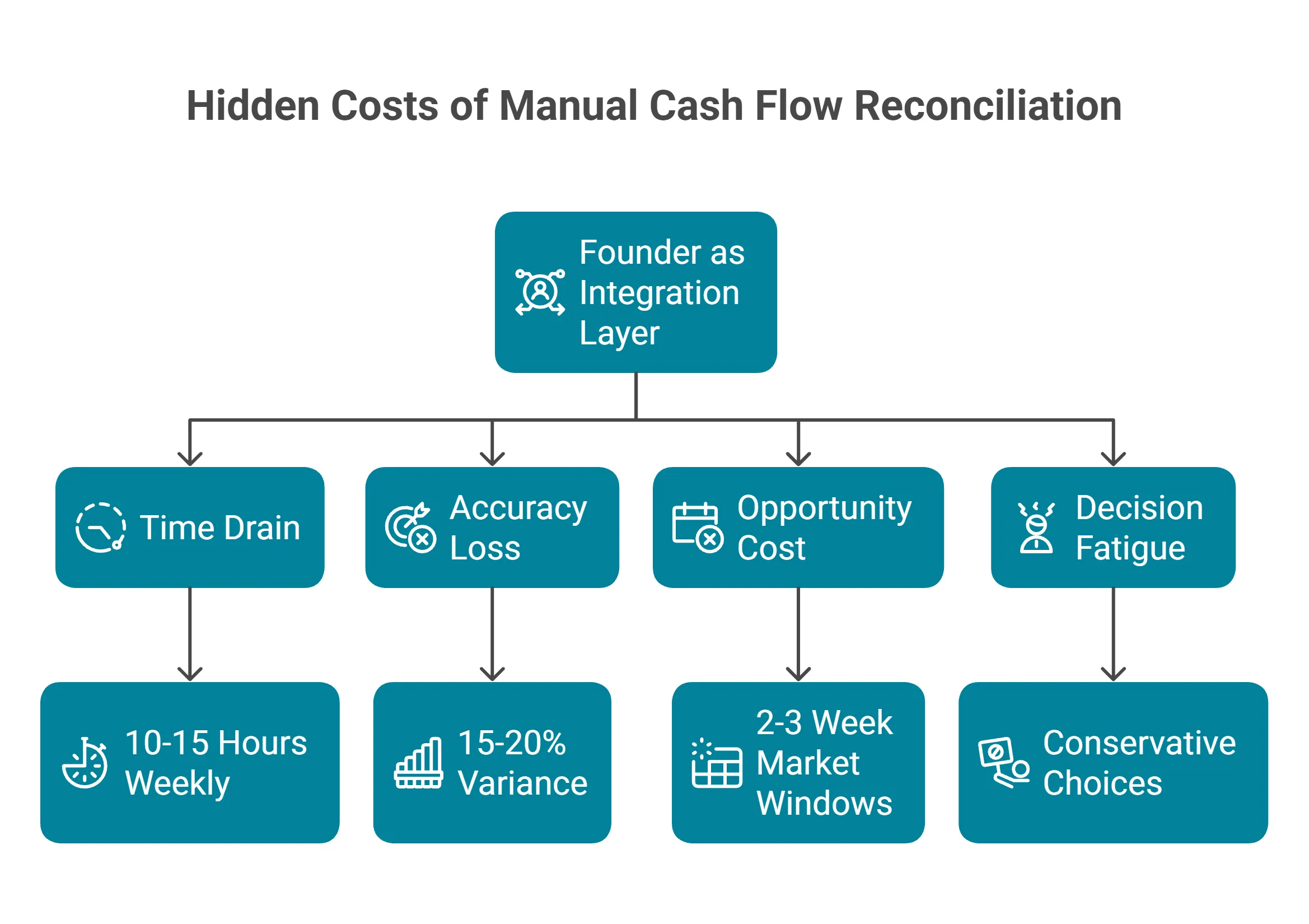
Flowchart illustrating how founders become the integration layer for cash flow data, resulting in 10-15 hours weekly time drain, 15-20% forecast variance, and missed market windows.
The founder becomes the integration layer, manually triangulating data across platforms to answer questions that should take seconds. The costs compound quickly:
Time drain: 10 to 15 hours weekly spent on manual data consolidation and spreadsheet maintenance
Accuracy loss: Manual forecasts carry 15 to 20% variance, making scaling decisions unreliable
Opportunity cost: Delayed decisions miss 2 to 3 week market windows when campaigns are performing
Decision fatigue: Uncertainty leads to conservative choices that leave growth on the table
"I was spending every Sunday afternoon updating my cash flow spreadsheet. By Tuesday, it was already wrong because ad spend had shifted." — u/dtc_founder_life, r/ecommerce Reddit Thread
✅ What Should Actually Work
The solution isn't better spreadsheets; it's eliminating the need for manual reconciliation entirely. An effective cash flow system for e-commerce must:
Connect all data sources (commerce, marketing, finance, operations) into a unified view
Understand timing relationships between spend and revenue automatically
Answer cross-functional questions instantly: "Will I have cash for inventory if I scale this campaign 50%?"
Update in real-time as transactions occur, not after monthly closes
The Shift From Fragmentation to Unified Intelligence
Luca AI was built specifically to solve this architectural problem. By connecting Shopify, Meta Ads, Stripe, Xero, and 20+ data sources into one reasoning layer, Luca eliminates the manual triangulation that consumes founder time. Ask "What's my cash position in 45 days if I increase ad spend by $5K/day?" and receive an integrated answer in seconds, accounting for payout delays, inventory commitments, and seasonal patterns automatically.
From 3-hour manual forecasting sessions to 5-second answers: that's the shift from fragmented tools to unified intelligence.
Q2. What Is AI Cash Flow Forecasting and How Does It Actually Work? [toc=How AI Forecasting Works]
AI cash flow forecasting uses machine learning algorithms to analyze historical patterns across revenue, expenses, and timing cycles to predict future cash positions. Unlike spreadsheet formulas that apply static assumptions, AI systems identify non-obvious correlations such as seasonal fluctuations, payment processor timing variations, and marketing spend lag effects, then adjust predictions dynamically as new data arrives.
Industry benchmarks show AI-powered forecasting achieves 85 to 92% accuracy at 30-day horizons when trained on sufficient historical data, compared to 60 to 70% accuracy for manual spreadsheet methods.
How AI Forecasting Differs From Traditional Methods
Traditional forecasting applies rule-based formulas: last month's revenue multiplied by expected growth rate, minus fixed expenses. This approach fails e-commerce businesses for three reasons:
Forecasting Approaches Compared
Approach
Method
Limitation
Spreadsheet
Static formulas (last month x growth)
Cannot model timing gaps or seasonal patterns
Accounting software
Historical transaction analysis
Only sees completed transactions, not pending flows
AI forecasting excels because it processes variables simultaneously, recognizing that a Meta CPM increase in September predicts cash pressure in October, or that Shopify's 7-day payout delay during high-volume periods creates predictable weekly cash troughs.
✅ Core Benefits of AI-Powered Forecasting
The operational advantages compound across five dimensions:
Accuracy: 85 to 92% at 30 days vs. 60 to 70% for manual methods, reducing forecast variance by 25 to 30%
Automation: Eliminates 10 to 15 hours/week of spreadsheet reconciliation and CSV exports
Real-time visibility: Live cash position updates vs. month-end snapshots that arrive too late
Scenario modeling: Instant "what if" analysis: "What happens to runway if I take this $50K capital offer?"
Proactive alerts: Surfaces risks before they impact operations
📊 Data Inputs That Drive Accuracy
Forecast accuracy directly correlates with data completeness. Effective AI financial planning and forecasting requires integration across four categories:
Commerce data: Shopify/WooCommerce orders, inventory levels, fulfillment status
Marketing data: Ad spend timing, platform charges, campaign performance metrics
Accounting data: AP/AR from Xero/QuickBooks, fixed expenses, loan obligations
The more connected sources feeding the model, the higher the forecast accuracy. Single-source forecasting (bank data only) typically achieves 65 to 75% accuracy; full-stack integration pushes accuracy above 85%.
How Luca AI Simplifies the Technical Complexity
Luca AI unifies 20+ data sources into one reasoning layer, automatically reconciling timing differences between platforms without manual data preparation. The system continuously ingests transactions from Shopify, syncs with Stripe payout schedules, and pulls marketing spend from Meta and Google Ads to generate real-time cash position forecasts.
No data engineering required. No CSV exports. No monthly reconciliation rituals. Connect your platforms via OAuth, and Luca begins generating forecasts immediately.
E-commerce cash flow operates differently than traditional retail or SaaS businesses. Four interconnected variables create complexity that generic forecasting tools consistently miss, and understanding these variables is essential before evaluating any forecasting solution.
The fundamental problem: each variable lives in a different system, and no traditional tool connects them into a unified cash picture.
Visual breakdown of four critical e-commerce cash flow variables that traditional forecasting tools miss, including marketing spend timing gaps, inventory cycles, payout delays, and seasonal amplification patterns.
💸 Variable 1: Marketing Spend Timing
Ad platforms charge immediately. Meta and Google process charges within 24 hours of spend. But revenue from those ads arrives 7 to 14 days later, after the customer orders, you fulfill, and the payment processor releases funds.
At $10K/day ad spend, this creates a structural $70K to $140K cash gap that accounting software doesn't model. Xero sees the ad charge when it clears your bank. It sees the revenue when Shopify's payout arrives. It has no mechanism to connect these as cause and effect, or to predict the gap before it happens.
📦 Variable 2: Inventory Cycles
E-commerce requires capital commitment 60 to 90 days before revenue materializes. August inventory orders for November sales mean cash leaves in Q3 for Q4 revenue. This timing mismatch destroys runway calculations that don't account for it.
"My spreadsheet showed 8 months runway. Then I placed my Q4 inventory order and suddenly had 11 weeks. The spreadsheet was technically accurate; it just couldn't model future commitments." — u/ecom_cfo_struggles, r/ecommerce Reddit Thread
⏰ Variable 3: Payment Processor Timing
Not all revenue arrives at the same speed:
Payment Processor Payout Timing
Processor
Typical Payout
Impact on $100K Revenue Month
Stripe
2 days
$93K available by month-end
Shopify Payments
7 days
$75K available by month-end
PayPal
Variable holds
$60 to $80K available by month-end
A $100K revenue month might show $100K in Shopify but only $60 to $75K in actual bank balance due to payout timing. Cross-platform reconciliation is essential for accurate runway calculations.
🎄 Variable 4: Seasonality Amplification
DTC brands typically generate 40 to 60% of annual revenue in Q4. But cash needs spike 2 to 3 months earlier: inventory must be ordered in August/September, marketing budgets must scale in October. Linear forecasting fails completely because it can't model the cash-out-before-cash-in pattern of seasonal businesses.
✅ How Luca AI Connects All Four Variables
Luca AI synthesizes marketing, inventory, payout, and seasonality data simultaneously. Ask: "If I scale Q4 marketing spend 50%, order 2x inventory, and account for Shopify's 7-day payout delay, what's my October cash position?"
You receive an integrated answer in seconds, not four separate spreadsheets requiring manual reconciliation. This cross-functional reasoning is what separates unified intelligence from fragmented dashboards.
Q4. Real-Time vs. Monthly Forecasting: Why Cadence Changes Everything [toc=Real-Time vs Monthly Forecasting]
Monthly cash flow forecasting is a rearview mirror for e-commerce. By the time you see the problem, it's too late to act. E-commerce decisions happen daily: scale this campaign, accept this purchase order, reorder inventory. But monthly forecasts only update after those decisions are already made and their cash impact has materialized.
Real-time forecasting closes this gap by maintaining continuous visibility into cash position as transactions occur.
⏰ Forecasting Cadence Comparison
The speed of your forecast determines the quality of decisions it can support:
Forecasting Cadence Impact
Cadence
Best Use Case
Critical Limitation
Monthly
Board reporting, investor updates
30-day lag makes operational decisions impossible
Weekly
Planning cycles, team alignment
Misses intra-week cash swings from ad spend
Daily/Real-time
Scaling decisions, capital timing
Requires automated data integration
"We ran monthly forecasts religiously. Still got blindsided by a cash crunch because our Meta spend spiked mid-month and we didn't see it until close." — u/dtc_ops_manager, r/ecommerce Reddit Thread
💰 The Business Case for Real-Time Visibility
Consider the difference in practice: A founder using monthly forecasts discovers a cash crunch on October 1st for a problem that actually started September 15th. That's two weeks of compounding issues: continued ad spend, additional inventory commitments, missed opportunities to adjust.
Real-time forecasting surfaces the same issue on September 16th, providing two full weeks to:
✅ Adjust marketing spend before the gap widens
✅ Accelerate collections or delay payables
✅ Access capital proactively at better terms
✅ Make the decision with current data, not stale assumptions
The difference isn't just operational; it's strategic. Proactive cash management from real-time financial visibility means accessing capital when you have leverage, not when you're desperate.
✅ How Luca AI Maintains Continuous Visibility
Luca AI maintains real-time cash position visibility by continuously syncing with Shopify, Stripe, Meta Ads, and Xero. No monthly close required. No CSV exports. Your cash forecast updates automatically as transactions occur, enabling decisions at the speed your business actually operates.
When your forecast shows runway dropping below your threshold, Luca doesn't just alert you. It can model solutions ("What if I reduce spend 20%?" or "What if I access $30K capital?") and execute the capital deployment instantly if the math supports it.
Q5. How Accurate Is AI Cash Flow Forecasting? (Real Benchmarks) [toc=Accuracy Benchmarks]
AI cash flow forecasting typically achieves 85 to 92% accuracy at 30-day horizons when trained on 6+ months of historical data with complete data integration across commerce, marketing, and finance systems. Accuracy declines to 70 to 80% at 90-day projections due to compounding uncertainty in market conditions, campaign performance, and seasonal factors.
Manual spreadsheet forecasting, by comparison, typically achieves 60 to 70% accuracy under similar conditions, a 20 to 25% gap that translates directly into decision confidence and capital efficiency.
⚠️ Factors That Determine Forecast Accuracy
Accuracy isn't guaranteed; it depends on specific conditions that many tools fail to mention:
Data completeness: Forecasts using only bank data are 15 to 20% less accurate than those integrating commerce + marketing + accounting. Each missing data source introduces blind spots.
Business volatility: Steady subscription models forecast more reliably than flash-sale DTC brands with unpredictable revenue spikes.
Historical depth: Minimum 6 months of data required for seasonal pattern recognition. New businesses face an inherent accuracy ceiling until patterns emerge.
Integration quality: Manual CSV uploads introduce 5 to 10% variance vs. live API connections that capture real-time transactions.
"We tested three forecasting tools. The one connected to all our platforms was consistently closer to actual results. The spreadsheet-based one missed our Q4 cash crunch entirely." — u/ecom_finance_director, r/ecommerce Reddit Thread
✅ How Luca AI Maximizes Forecast Accuracy
Luca AI maintains live connections to 20+ data sources: Shopify, Stripe, Meta Ads, Google Ads, Xero, and banking APIs. This ensures forecasts reflect real-time business state rather than stale snapshots from last month's close. The system continuously recalibrates as new data arrives: your 30-day forecast today incorporates yesterday's actual performance, last week's payout timing, and this morning's ad spend.
This architectural approach, unified data, live connections, and continuous recalibration, is why Luca consistently achieves the upper range of forecast accuracy.
"Most forecasting tools claim accuracy but don't specify conditions. We're transparent: 85%+ accuracy requires complete data integration, which is why we built Luca to connect everything, not just the easy parts." — Eric Bidinger, Luca AI Founder
📊 Setting Realistic Expectations
No forecasting system achieves 100% accuracy; external shocks, market shifts, and competitive moves remain unpredictable. The goal isn't perfect prediction; it's reducing uncertainty enough to make confident decisions. Moving from 65% to 88% accuracy means the difference between guessing and planning.
Q6. How Do You Calculate Cash Runway for E-commerce? (The 6-Month Threshold) [toc=Cash Runway Calculation]
Cash runway measures how long your business can operate before running out of cash at current burn rates. The formula is straightforward, but e-commerce businesses require specific adjustments that generic calculators miss.
💰 The Cash Runway Formula
Runway (months) = Total Available Cash ÷ Average Monthly Burn Rate
For e-commerce, burn rate must include all cash outflows:
Calculate average monthly expenses over the past 3 to 6 months from your accounting system
Add planned marketing spend increases (especially for Q4 scaling)
Subtract expected gross profit from revenue projections to get net burn
Divide current cash by this net burn rate
Adjust for known timing events: inventory orders, seasonal spikes, large payables
⚠️ The 6-Month Runway Threshold
Industry best practice recommends maintaining minimum 6 months runway for scaling e-commerce brands. This threshold isn't arbitrary; it reflects operational reality:
Cash Runway Status Indicators
Runway
Status
Implications
6+ months
Healthy
Full negotiating leverage, can capitalize on opportunities
3 to 6 months
Caution
Limited flexibility, should actively seek capital options
Less than 3 months
Crisis
Emergency mode, decisions driven by survival not strategy
Below 6 months, you lose negotiating leverage with suppliers, can't capitalize on sudden opportunities (viral product, competitor exit), and face pressure that leads to suboptimal decisions: accepting unfavorable capital terms or cutting profitable marketing spend.
Inventory pre-purchase cycles: August orders for November sales mean cash leaves Q3 for Q4 revenue
Payout timing delays: $100K in Shopify orders ≠ $100K in bank due to 7-day payout schedules
Seasonal marketing inflation: Q4 ad costs often run 2 to 3x Q1 levels; your "average" burn understates peak periods
✅ How Luca AI Automates Runway Tracking
Luca AI calculates runway in real-time, pulling data from Shopify, Xero, and banking integrations automatically. Set a 6-month alert threshold and receive proactive notifications when runway compression begins, not after it becomes a crisis. The system accounts for pending inventory commitments, payout timing, and seasonal patterns that static spreadsheets miss.
Q7. What Features Actually Matter in Cash Flow Forecasting Software? [toc=Essential Software Features]
Choosing cash flow forecasting software is a 2 to 3 year commitment to a data architecture. Pick wrong, and you're locked into fragmented reporting or expensive migrations precisely when you need cross-functional visibility most: during scaling, capital raises, or cash crunches.
❌ The Wrong Way to Evaluate
Most founders choose based on flawed criteria:
Integration count: "Does it connect to Shopify?" (Every tool does; the question is what it does with that data)
Price: "Cheapest wins" (Ignores the cost of bad decisions from incomplete forecasts)
Feature checklists: Long lists that obscure whether the tool can actually answer your questions
These criteria miss the critical question: Can it reason across your data, connecting marketing spend to cash impact, or just display historical numbers in prettier charts?
✅ The Right Evaluation Framework
Score each platform 0 to 2 on these seven criteria:
Cash Flow Tool Evaluation Framework
Criterion
What to Look For
Why It Matters
Cross-functional synthesis
Commerce + marketing + finance unified
Answers questions spanning multiple domains
Timing intelligence
Models payout delays and spend timing
Predicts actual cash position, not theoretical
Scenario modeling
"What if I scale 50%?" capability
Enables confident decisions before committing
Proactive alerts
Surfaces risks automatically
Catches problems before they compound
Forecasting cadence
Real-time vs. monthly updates
Matches decision speed to forecast freshness
Setup complexity
10 minutes vs. 6 weeks
Time-to-value matters for scaling businesses
Capital integration
Can fund gaps it identifies
Closes the loop from insight to action
📊 Applying the Framework
Tools scoring 10+ represent genuine forecasting advancement: systems that reason across your business rather than display isolated metrics. Below 7 means you're buying a dashboard, not intelligence.
"I evaluated five tools using a scoring framework. Only one could actually answer 'What happens to cash if I scale this campaign?'; the others just showed historical data in different visualizations." — u/dtc_founder_evaluating, r/ecommerce Reddit Thread
✅ Where Luca AI Scores on This Framework
Luca AI scores 14/14: purpose-built as an AI Co-Founder that connects all data sources, reasons across timing relationships, models scenarios instantly, alerts proactively, updates in real-time, and provides instant capital when forecasts identify gaps or opportunities. The architecture was designed for synthesis from day one, not retrofitted onto a dashboard product.
Q8. How Does Scenario Modeling Work for E-commerce Cash Planning? [toc=Scenario Modeling Explained]
Scenario modeling simulates cash outcomes under different assumptions before you commit capital or resources. For scaling founders, the key question is concrete: "If I take $100K and deploy it to Meta, what's my cash position in 90 days?"
Answering this requires modeling ad spend timing, expected ROAS, fulfillment costs, and payout delays, not just adding $100K to a spreadsheet cell.
⚙️ How Effective Scenario Modeling Works
When you model a $100K Meta deployment, the system must calculate interconnected variables:
Visual timeline demonstrating how AI scenario modeling calculates cash position after $100K capital deployment, tracking ad spend outflow, projected orders, fulfillment costs, and revenue payout timing.
Capital inflow: +$100K on day 1
Ad spend outflow: $33K/month charged immediately to your card
Projected orders: Based on historical ROAS (e.g., 3x = $100K revenue/month)
COGS and fulfillment: 40% of revenue = $40K/month cash out
Payout timing: Revenue arrives 7 to 14 days after orders, not immediately
Capital repayment: If applicable, factor in revenue-share deductions
The output is actual cash position, not theoretical revenue. A $100K capital deployment with 3x ROAS doesn't mean $300K profit; it means a specific cash trajectory that accounts for timing and costs.
📊 Common Scenarios to Model
E-commerce Scenario Types
Scenario Type
Assumptions
Purpose
Best case
ROAS holds, +20% creative efficiency
Upside planning
Base case
Current metrics continue
Realistic expectation
Worst case
ROAS -20%, CPMs +15%
Risk assessment
Capital sizing
$50K vs. $100K deployment
Optimal amount determination
Channel comparison
Meta vs. TikTok vs. Google
Allocation decisions
"I wish I'd modeled scenarios before taking that $150K advance. Turns out I only needed $80K; paid fees on $70K that sat in the bank." — u/dtc_overcapitalized, r/ecommerce Reddit Thread
💰 The ROI of Scenario Modeling
Founders using scenario analysis identify cash crunches 4 to 6 weeks earlier than those relying on bank balances alone. That lead time is the difference between strategic capital access at favorable terms and emergency fundraising when you have no leverage.
✅ Luca AI's Scenario Modeling in Action
Ask Luca: "If I take $100K, deploy 70% to Meta and 30% to inventory, what's my cash position in 90 days assuming current ROAS?"
Luca models all variables simultaneously: marketing performance, fulfillment costs, payout timing, capital repayment, and shows three scenarios (best/base/worst) with specific cash positions and runway impacts. Seconds, not hours. And if the scenario shows opportunity, Luca can fund it in the same conversation that modeled it.
Q9. Working Capital Optimization: How to Know Exactly How Much You Need [toc=Working Capital Optimization]
Here's the dirty secret of cash flow forecasting tools: they're excellent at showing you problems, terrible at solving them. Your dashboard alerts you that runway is dropping below 6 months. Now what? Most tools stop at the alert, leaving you to guess how much capital you need and scramble through separate applications while the gap widens.
The insight-to-action gap is where most forecasting solutions fail founders.
Identify the gap: What's the shortfall between projected cash and required runway?
Understand the timing: When does the gap occur and for how long?
Calculate optimal amount: Enough to bridge the gap plus buffer, not more
Model the cost: What's the ROI of taking capital vs. cutting spend or delaying inventory?
Most founders over-borrow because they can't model precisely. Taking $100K when you actually need $50K means paying fees on $50K of capital sitting idle in your bank account.
"Applied for $200K because I wasn't sure. Turns out I needed $75K. Paid almost $15K in unnecessary fees on capital I never deployed." — u/dtc_capital_mistake, r/ecommerce Reddit Thread
❌ Why the Fragmented Approach Fails
The typical workflow when forecasts show a gap:
Forecasting tool identifies shortfall, you guess an amount
Apply to Wayflyer/Clearco, 72-hour approval process
Capital arrives, you discover you asked for too much (or too little)
Worse: lender offers more than you need (their incentive is larger advances)
You accept, overpay, and capital sits idle earning nothing
Traditional capital providers have structural incentives to maximize advance size; they earn fees on deployed capital regardless of whether you needed it. Your forecasting tool can't intervene because it doesn't connect to your capital decisions.
ROI comparison vs. alternative actions (reduce spend, delay inventory)
Then provides instant capital access, priced dynamically based on real-time business health, not a static application from two weeks ago.
Ask Luca: "How much capital do I actually need for Q4?" and receive a number backed by cross-functional analysis across marketing plans, inventory commitments, and payout timing, not guesswork.
💸 Intelligence + Capital in One Motion
The difference is architectural: Wayflyer and Clearco will give you capital. Luca will tell you if you should take capital, exactly how much you need, when you need it, and what the downstream cash impact will be. Then fund it instantly if the math works.
"The ability to model capital needs AND access it in the same conversation changed how I think about growth planning entirely." — u/scaling_dtc_founder, r/ecommerce Reddit Thread
Q10. How Does Accurate Forecasting Affect Your Capital Pricing? [toc=Forecasting and Capital Pricing]
Here's something most founders don't realize: the accuracy of your cash flow forecasting directly affects how much you pay for capital. Lenders price risk based on visibility; the less they understand about your business, the higher the fee they charge to compensate for uncertainty.
Better forecasting doesn't just help you plan. It can literally reduce your cost of capital.
💸 How Traditional Capital Pricing Works
Wayflyer, Clearco, and similar providers assess your business through a point-in-time application. They see a snapshot:
They price based on this static view, adding risk premium for everything they can't see. Your fee reflects their uncertainty about your business health, not your actual performance trajectory.
A founder with improving unit economics pays the same rate as one with deteriorating margins if both applications look similar on paper.
⚠️ The Visibility Premium
When a capital provider has real-time visibility into your complete business, current cash position, marketing efficiency, inventory turnover, customer LTV trends, they can price based on actual risk rather than assumed risk.
"I was paying 9% through our old RBF provider. Same business metrics, but with better data visibility, our effective rate dropped to under 6%." — u/dtc_finance_optimized, r/ecommerce Reddit Thread
✅ How Luca AI's Dynamic Pricing Works
Luca AI's capital pricing reflects real-time business health directly. Because Luca has continuous access to your complete business data, commerce, marketing, finance, operations, pricing updates dynamically based on actual performance.
Improve your ROAS this month? Your capital pricing improves next month. Extend your runway through better inventory management? Rates adjust accordingly. This continuous recalibration isn't possible with application-based lenders who only see static snapshots every 90 days.
💰 The Real-World Difference
A founder with strong but invisible metrics might pay 8% through Wayflyer, priced on limited visibility. The same founder using Luca, with full data transparency showing 3.5x ROAS, 8-month runway, and improving unit economics, might access capital at 5 to 6%.
The difference isn't the business. It's the visibility. Better forecasting = better data = better capital terms.
The cash flow forecasting market has three tiers: spreadsheet templates (free, manual), standalone forecasting tools ($50 to 200/month), and AI-native platforms with integrated capabilities. Each solves part of the problem through fundamentally different architectures.
Understanding these differences matters because the tool you choose determines what questions you can answer, and what actions you can take when forecasts reveal problems.
❌ No marketing data integration; can't model ad spend to cash impact
❌ Rely on accounting sync, not real-time updates
❌ No action capability when forecasts show problems
❌ No capital access; identifying a gap doesn't help you fill it
These tools work well for businesses with predictable cash flows where marketing spend isn't a major variable. For e-commerce with significant ad spend, they miss critical timing relationships.
"Float is great for basic forecasting but it doesn't see our Meta spend until it hits the bank. By then the cash impact already happened." — u/ecom_float_user, r/ecommerce Reddit Thread
Choose standalone tools if you only need accounting-based forecasts, have predictable cash flows without major marketing spend variability, and already have separate capital relationships.
Choose Luca AI if you need cross-functional intelligence connecting marketing decisions to cash impact, want real-time visibility rather than monthly accounting sync, and want the system that identifies opportunities to also fund them.
"Float and CashFlowFrog are solid for accounting-based forecasting. But when a founder asks 'Should I scale this campaign?', they can't answer; they don't see marketing data. Luca can answer AND fund it in the same conversation." — Eric Bidinger, Luca AI Founder
Q12. How to Set Up AI Cash Flow Forecasting for Your Shopify Store [toc=Shopify Setup Guide]
Effective AI cash flow forecasting requires proper data foundations. Before evaluating tools, ensure your business meets these prerequisites; missing any reduces forecast accuracy by 10 to 20%.
📋 Prerequisites for Accurate Forecasting
6+ months of sales history in Shopify (seasonal patterns require historical depth)
Connected payment processor (Stripe or Shopify Payments with complete transaction history)
Accounting software (Xero or QuickBooks) with categorized transactions
Documented marketing spend by channel (Meta, Google, TikTok if applicable)
📝 Step-by-Step Implementation
Step-by-step implementation guide for setting up automated cash flow forecasting on Shopify, covering data audits, API integrations, transaction categorization, and forecast parameter configuration.
Step 1: Audit data sources Ensure Shopify, payment processor, and accounting software have complete historical data with no gaps. Check for missing months, uncategorized transactions, or disconnected periods.
Step 2: Connect integrations via API OAuth connections preferred over CSV uploads. Live API connections ensure real-time accuracy; manual uploads introduce 5 to 10% variance and become stale immediately.
Step 3: Categorize transaction types In your accounting system, separate COGS, marketing spend, fixed costs (rent, salaries, software), and one-time expenses. Miscategorization directly impacts burn rate calculations.
Step 4: Define forecast parameters Set time horizon (30/60/90 days), runway alert thresholds (6-month minimum recommended), and scenario assumptions (growth rate, seasonal factors).
⚠️ Common Setup Mistakes
Incomplete historical data: Garbage in, garbage out; forecasts can't model patterns that don't exist in data
Missing marketing spend: Can't model scaling scenarios without ad spend visibility
Incorrect categorization: Classifying inventory as COGS inflates burn rate; one-time expenses in recurring distorts projections
No payment processor connection: Misses payout timing, the difference between orders and cash
Manual uploads: Become stale immediately; live integrations required for accuracy
⏰ Ongoing Maintenance
Review forecast vs. actual weekly to catch model drift early
Recalibrate after significant business changes (new channels, pricing updates, major campaigns)
Update growth assumptions quarterly
Expand integrations as you add platforms or channels
✅ How Luca AI Simplifies Setup
Luca AI reduces setup to 10 minutes: connect Shopify, Stripe, Meta Ads, and Xero via OAuth; no data engineering required. The system automatically categorizes transactions, identifies timing patterns between platforms, and begins generating forecasts immediately.
Set your 6-month runway alert threshold and start receiving proactive insights the same day. No consultants, no implementation project, no waiting for monthly close cycles.
FAQ's
How accurate is AI cash flow forecasting compared to spreadsheets?
We've found that AI cash flow forecasting typically achieves 85-92% accuracy at 30-day horizons when properly integrated with complete business data—compared to 60-70% accuracy for manual spreadsheet methods. This 20-25% improvement translates directly into decision confidence.
The accuracy gap exists because AI systems:
Process variables simultaneously (marketing spend, payout timing, seasonality)
Identify non-obvious patterns humans miss
Continuously recalibrate as new data arrives
However, accuracy depends on data completeness. Forecasts using only bank data are 15-20% less accurate than those integrating commerce, marketing, and accounting sources. We built Luca AI's unified data layer to connect 20+ sources specifically because accuracy requires complete visibility.
What's the minimum cash runway e-commerce brands should maintain?
We recommend maintaining minimum 6 months cash runway for scaling e-commerce brands. This threshold isn't arbitrary—it reflects operational reality:
Above 6 months: Full negotiating leverage with suppliers, ability to capitalize on sudden opportunities
3-6 months: Caution zone—limited flexibility, actively seek capital options
Below 3 months: Crisis territory where survival overrides strategy
E-commerce runway calculations require specific adjustments most generic tools miss:
Inventory pre-purchase cycles (August orders for November revenue)
Why do traditional cash flow tools fail e-commerce businesses?
Traditional forecasting tools—Float, CashFlowFrog, generic accounting software—were built for businesses with predictable cash flows. E-commerce breaks their assumptions in four ways:
Marketing timing gap: Ad platforms charge immediately; revenue arrives 7-14 days later. At $10K/day spend, that's a $70K-$140K structural gap accounting tools can't see.
Inventory capital cycles: Cash leaves 60-90 days before revenue arrives. August inventory orders for November sales create timing mismatches linear forecasting can't model.
Payout processor variance: Stripe (2-day), Shopify Payments (7-day), PayPal (variable) all release funds differently. $100K in orders rarely equals $100K in bank.
Seasonal amplification: 40-60% of revenue in Q4, but cash needs spike 2-3 months earlier.
How does real-time forecasting differ from monthly forecasting?
Monthly forecasting is a rearview mirror—by the time you see the problem, it's too late to act. E-commerce decisions happen daily (scale this campaign, accept this PO, reorder inventory), but monthly forecasts only update after those decisions have already impacted cash.
A founder using monthly forecasts discovers cash crunches 2 weeks after they started. Real-time forecasting surfaces the same issue within 24 hours—giving you time to adjust spend, accelerate collections, or access capital proactively.
Can AI forecasting help me get better capital pricing?
Yes—and this is something most founders don't realize. Lenders price risk based on visibility. The less they understand your business, the higher the fee to compensate for uncertainty.
Here's how it works:
Traditional capital pricing (Wayflyer, Clearco): They assess your business through point-in-time applications—last 6 months revenue, current bank balance, basic metrics. They add risk premium for everything they can't see. Your fee reflects their uncertainty, not your actual business health.
Dynamic pricing with full visibility: When a capital provider has real-time access to your complete data—cash position, marketing efficiency, inventory turnover, customer LTV—they price based on actual risk, not assumed risk.
The difference can be significant: a founder might pay 8% through application-based lenders but access capital at 5-6% through Luca AI's intelligence-led capital, where pricing reflects real-time performance rather than static snapshots.
Better forecasting = better data = better capital terms.
Enjoyed the read? Join our team for a quick 15-minute chat — no pitch, just a real conversation on how we’re rethinking Ecommerce with AI - Luca
Loading Schedule...
Your AI Co-Founder is here.
Here’s why:
Shopify, Meta, Xero - one brain.
"Should I scale?" Answered with real data.
Growth capital. No applications. One click.
Thank you! Your submission has been received! Please book a time slot for the Meeting
Oops! Something went wrong while submitting the form.

.jpg)
.webp)
.webp)
.webp)