Meet Luca: Why I'm the Co-Founder Your E-commerce Business Has Been Missing
10
mins read
TL;DR
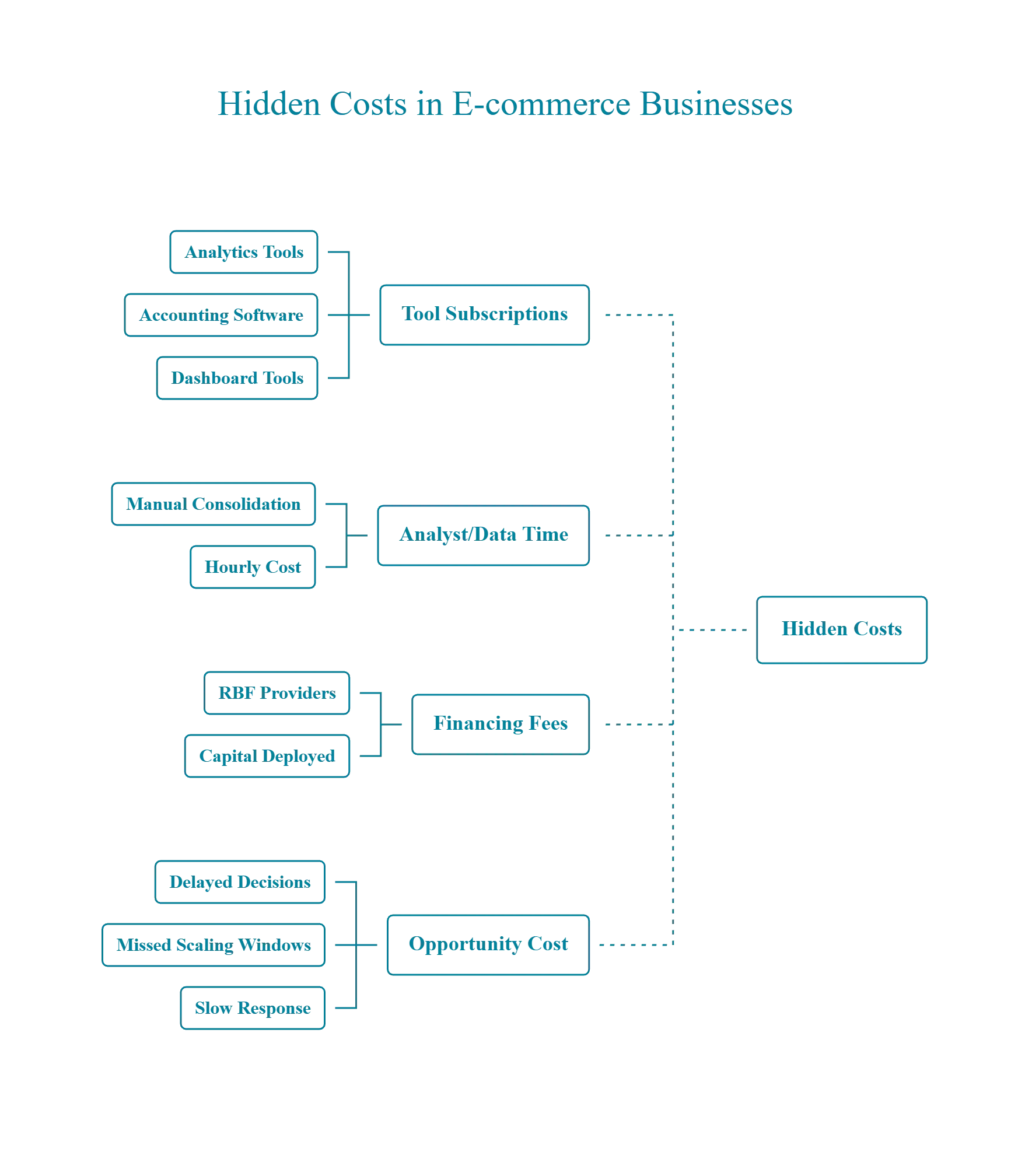
Fragmentation costs €4,000-7,000/month in tool subscriptions, analyst time, and expensive capital across 8-12 disconnected platforms.
AI Co-Founder synthesizes intelligence + capital into one proactive system that reasons across marketing, finance, and operations.
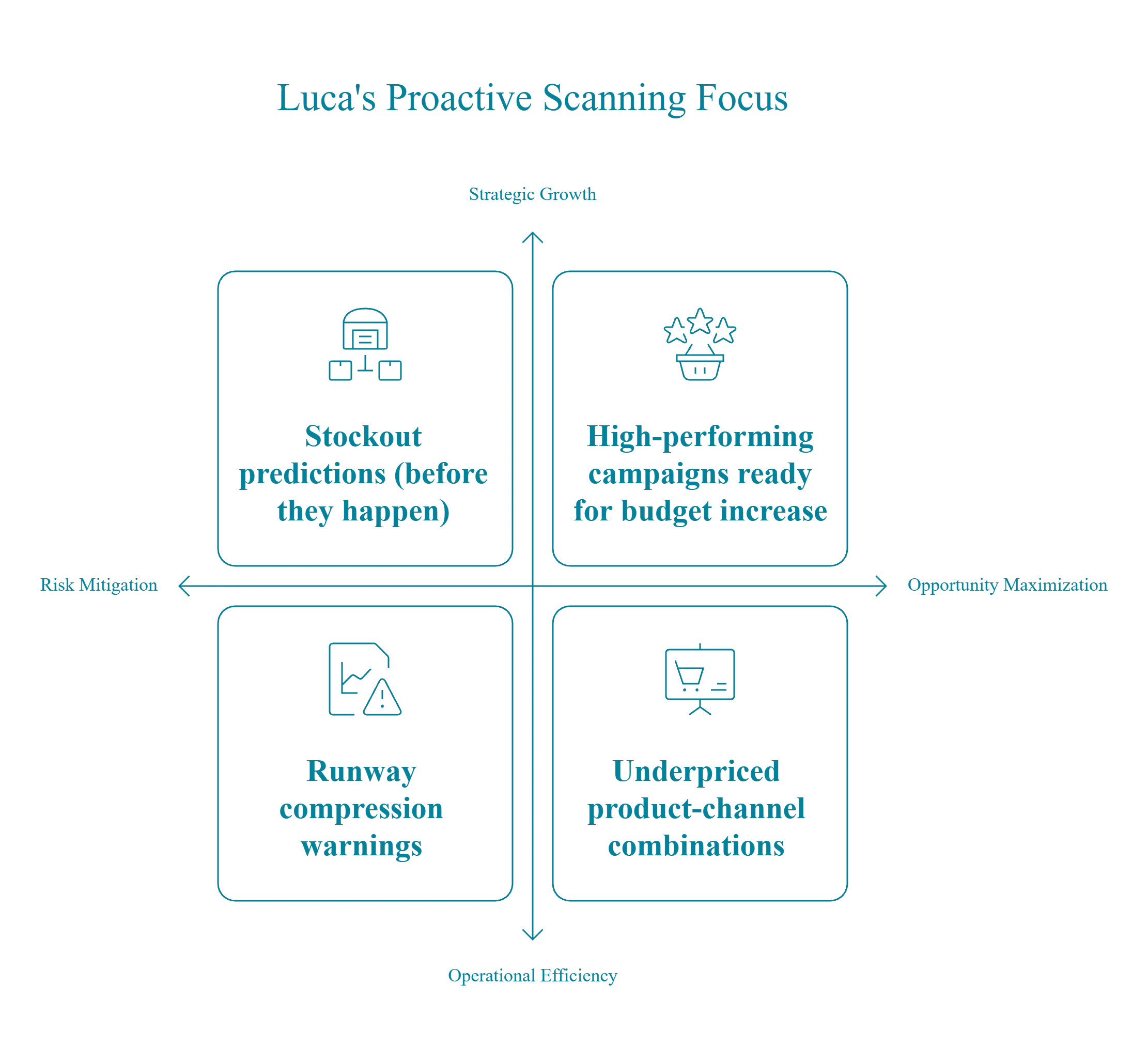
Proactive scanning detects opportunities and risks 24/7, alerting you before problems hit your P&L, not after you check dashboards.
Dynamic capital pricing reflects real-time business health, saving 20-30% vs. traditional RBF through optimal sizing and staged deployment.
80% of users have zero technical background, using plain English queries like "How are we doing?" or "Can I afford to scale this campaign?"
Memory compounds over time, transforming generic insights into contextual recommendations that anticipate your business needs by month 6.
Q1. Why Are You Still Running Your E-commerce Business Alone? [toc=Co Founder for Ecommerce]
The Fragmented Reality You Know Too Well
You open Shopify to check yesterday's orders. Then Meta Ads Manager for campaign performance. Then Xero for cash flow. Then Stripe for payment settlements. Then a spreadsheet the one with 47 tabs to try making sense of it all.
By the time you've triangulated enough data to form a hypothesis, three hours have evaporated. And you still don't have a confident answer to the question that woke you up at 3 AM: Should I scale this campaign, or will it destroy my cash position?
This is the paralysis of fragmentation. Data is everywhere. Understanding is nowhere.
"I can't get a straight answer without opening 5 different dashboards. My team spends 40% of their time on reporting, not insights." — E-commerce Founder, €3M Revenue DTC Brand
The Rear-View Mirror Trap
Visual comparison highlighting limitations of traditional e-commerce tools: analytics dashboards show past data, RBF providers lack intelligence, and general AI has no business context access.
The tools you're paying for weren't designed to solve this problem they were designed to solve their problem.
✅ Analytics dashboards (Triple Whale, GA4) show you what happened yesterday. They display ROAS, CAC, and conversion rates in colorful charts. But they can't tell you why performance dropped, and they certainly can't model what happens to your August cash position if you scale Meta spend 50% today.
✅ Revenue-based financing providers (Wayflyer, Clearco) can deploy capital in 48-72 hours. But they operate as black boxes offering €300K without helping you understand if you actually need €300K, or whether €50K deployed strategically would generate better returns with less risk.
❌ General AI assistants (ChatGPT, Claude) can answer any question brilliantly except questions about your business. They don't know your historical ROAS, your inventory turnover, your customer LTV by cohort, or your cash runway.
"Tools tell me what happened. Capital providers give me money. But nobody helps me understand what to do next." — u/ecom_founder_tired, r/ecommerce Reddit Thread
The Synthesis Thesis
Here's the insight that changes everything:
Intelligence without capital is advice. Your analytics dashboard can identify a winning campaign but can't fund it.
Capital without intelligence is risk. Your financing provider can wire €200K but can't tell you if taking it is the right move.
The competitive advantage in 2026 isn't having more data. It's having a system that can reason across your data, understand the causal relationships between marketing spend, inventory needs, and cash solvency and act on that understanding.
The AI Co-Founder Model
This is why we built Luca AI as the world's first AI Co-Founder for e-commerce.
Not another dashboard. Not another chatbot. Not another lender.
A co-founder is:
✅ Cross-functional: Sees marketing, finance, operations, and cash together
✅ Contextually aware: Understands that your Q4 cash depends on August inventory decisions
✅ Proactive: Surfaces opportunities and risks without waiting to be asked
✅ Invested: Can fund the opportunities it identifies putting money where the math is
Luca AI is designed to behave exactly like this. One interface. Complete business context. Intelligence and capital unified.
You Didn't Start a Business to Become a Data Analyst
You started it to build something meaningful. To solve a problem. To create value.
What if you had a co-founder who handled the complexity the dashboard triangulation, the cash flow modeling, the "should I scale this?" anxiety while you focused on growth?
That's not a hypothetical. That's Luca.
"After using Triple Whale, Wayflyer, and spreadsheets for 2 years, I found critical gaps in cross-functional visibility. Most tools show marketing OR finance, never both together with capital access." — Eric Bidinger, Luca AI Founder
Q2. I'm Luca. I'm Not a Dashboard. I'm Not a Chatbot. Here's the Difference. [toc=Who am I ?]
Let Me Be Direct About What I Am
I'm not a dashboard that waits for you to check it. I'm not a chatbot that answers generic questions. I'm not a lender who just wants to deploy capital.
I'm an AI Co-Founder: a context-aware, cross-functional intelligence system designed to think about your business the way a human partner would and act on that thinking.
The distinction matters because every tool you're currently using was architected to solve a narrow problem. I was architected to solve your problem: running a complex business without fragmenting your decision-making across a dozen disconnected systems.
What Analytics Dashboards Do (And What They Miss)
✅ Triple Whale's strengths: First-party tracking via the Triple Pixel, unified marketing + commerce data, attribution modeling, and AI-powered analysis through Moby. It's genuinely impressive for marketing analytics.
"Triple Whale has been a game changer for our eCommerce analytics. It brings all our data into one place, making it way easier to track performance." — Verified Shopify App Store Review
❌ What Triple Whale cannot do: Connect to financial systems (Xero, QuickBooks, banking). Reason about cash flow, working capital, or P&L implications. Provide capital to fund opportunities it identifies. Answer questions outside marketing.
When Moby tells you "reallocate 20% of budget to TikTok," it cannot answer: "What does that do to my cash position? Can I afford the working capital for increased inventory needs?"
"Wayflyer allowed us to capitalize on market opportunities as we saw them—month to month." — Wayflyer Customer Testimonial
❌ What they cannot do: Tell you whether you should take capital. Optimize how to deploy it. Understand downstream implications. Provide proactive intelligence on business health.
Their business model requires deploying as much capital as possible. When you ask for €300K, they're incentivized to say: "Actually, why not €400K?"
The Side-by-Side Reality
Platform Capability Comparison
Capability
Analytics Dashboards
RBF Providers
Luca AI
Data Scope
Marketing + Commerce
Commerce + Payments
Marketing + Commerce + Finance + Ops
Intelligence Type
Passive reporting
Static underwriting
Cross-functional reasoning
Proactive Alerts
❌ Manual monitoring
❌ None
✅ 24/7 automated scanning
Action Capability
Limited
Capital only
Multi-system execution
Capital Access
❌ None
✅ 48-72 hours
✅ Instant, dynamically priced
Business Context
Marketing only
Revenue snapshot
Complete business memory
The Architectural Difference
Dashboards inform. Lenders fund. I do both, and I think about the connection between them.
When I recommend scaling a campaign, I've already modeled the cash flow implications, checked your inventory capacity, and calculated the optimal capital sizing. And I can fund it in the same conversation.
"The real question isn't 'Which tool has the most features?' it's 'Which system can reason about my business the way a co-founder would?'" — Eric Bidinger, Luca AI Founder
That's the shift I represent. Not incremental improvement. Category transformation.
Q3. How I See Your Business (When Others See Fragments) [toc=Unified Business View]
The Complete Picture, Not Just One Slice
When you open Shopify, you see orders. When you open Meta, you see ROAS. When you open Xero, you see cash flow. When you open me, you see the relationship between all three, and what that relationship means for your next decision.
This isn't marketing language. It's architectural reality.
How the Unified Data Model Works
Luca AI connects to 20+ data sources and normalizes everything into a common schema. "Revenue" means the same thing whether it comes from Shopify, Stripe, or Xero. "Customer" has one definition across marketing, commerce, and finance.
This normalization enables cross-functional queries that are impossible with fragmented tools:
"If I scale this campaign 50%, what happens to my cash position in 90 days?"
"Which August cohort has the highest repeat purchase rate, and what's their 90-day LTV?"
"What's my true CAC including all costs, ad spend, fulfillment, returns?"
Traditional analytics tools can't answer these questions because they don't see the financial layer. Traditional financing tools can't answer them because they don't see the marketing layer. Only a unified system can reason across both.
What I Connect
Luca AI Data Integration Layer
Category
Integrations
Data Captured
💰 Commerce
Shopify, WooCommerce, Amazon
Orders, products, customers, inventory
📢 Marketing
Meta Ads, Google Ads, TikTok, Klaviyo
Spend, conversions, audiences, attribution
📊 Finance
Xero, QuickBooks, Wave
P&L, balance sheet, cash flow, invoices
🏦 Banking
Plaid, direct bank APIs
Account balances, transactions, cash position
📦 Operations
Inventory systems, 3PL integrations
Stock levels, fulfillment rates, supplier data
This expanded data analysis layer is what enables cross-functional reasoning. Triple Whale connects commerce + marketing. I connect commerce + marketing + finance + accounting + banking + operations.
Why This Matters: A Concrete Example
Your analytics dashboard tells you: "ROAS dropped 15% this week."
I tell you: "ROAS dropped 15% because creative fatigue on your US audience segment coincided with inventory constraints on your top-3 SKUs, which limited your retargeting pools. Here's what to do: refresh creatives for the US segment, expedite the inventory reorder that was scheduled for next week, and pause expansion to UK until inventory stabilizes. This preserves €8K in ad spend while maintaining cash runway."
The difference? Context. I understand that marketing performance, inventory levels, and cash flow aren't separate problems, they're interconnected nodes in the same system.
"Most tools show you marketing data OR financial data, never both together, never reasoning across them." — u/dtc_analytics, r/analytics Reddit Thread
Your CFO, CMO, and COO Sharing the Same Brain
Think of it this way: Luca AI is like having your CFO, CMO, and COO in one room, except they all share the same brain and never miscommunicate.
No conflicting reports. No "marketing says X, finance says Y" arguments. One source of truth that reasons across all functions.
That's the unified data model. That's how Luca thinks about your business when others see fragments.
Q4. What I Think About All Day (Proactive Scanning Explained) [toc=Proactive Scanning]
The Scenario You Know Too Well
It's Friday afternoon. You finally carve out 30 minutes to check your dashboards, something you've been putting off all week.
That's when you discover it: your top campaign has been bleeding money for 6 days. €15K wasted. The ROAS collapse started Monday morning. Your analytics dashboard showed the drop on Day 1.
But you didn't check until Day 6.
I would have told you on Day 1. At 7:30 AM. Before you even opened your laptop.
Why This Happens (And Why It's Not Your Fault)
Pull-based tools wait for you to ask. They display data passively. They assume you have time to monitor dashboards, interpret anomalies, and synthesize insights across platforms.
But you don't. You're running a business. You're managing inventory, handling customer issues, coordinating with suppliers, and trying to maintain some semblance of work-life balance.
The best insights are the ones you don't know to ask for. A great co-founder doesn't wait to be asked, they proactively identify opportunities and raise concerns before they become problems.
"By the time I understand what happened, the opportunity is gone. I need a system that watches when I can't." — E-commerce Founder, €5M DTC Brand
High-performing campaigns ready for budget increase
Underpriced product-channel combinations
Cohorts with unusually high LTV
How Proactive Alerts Actually Work
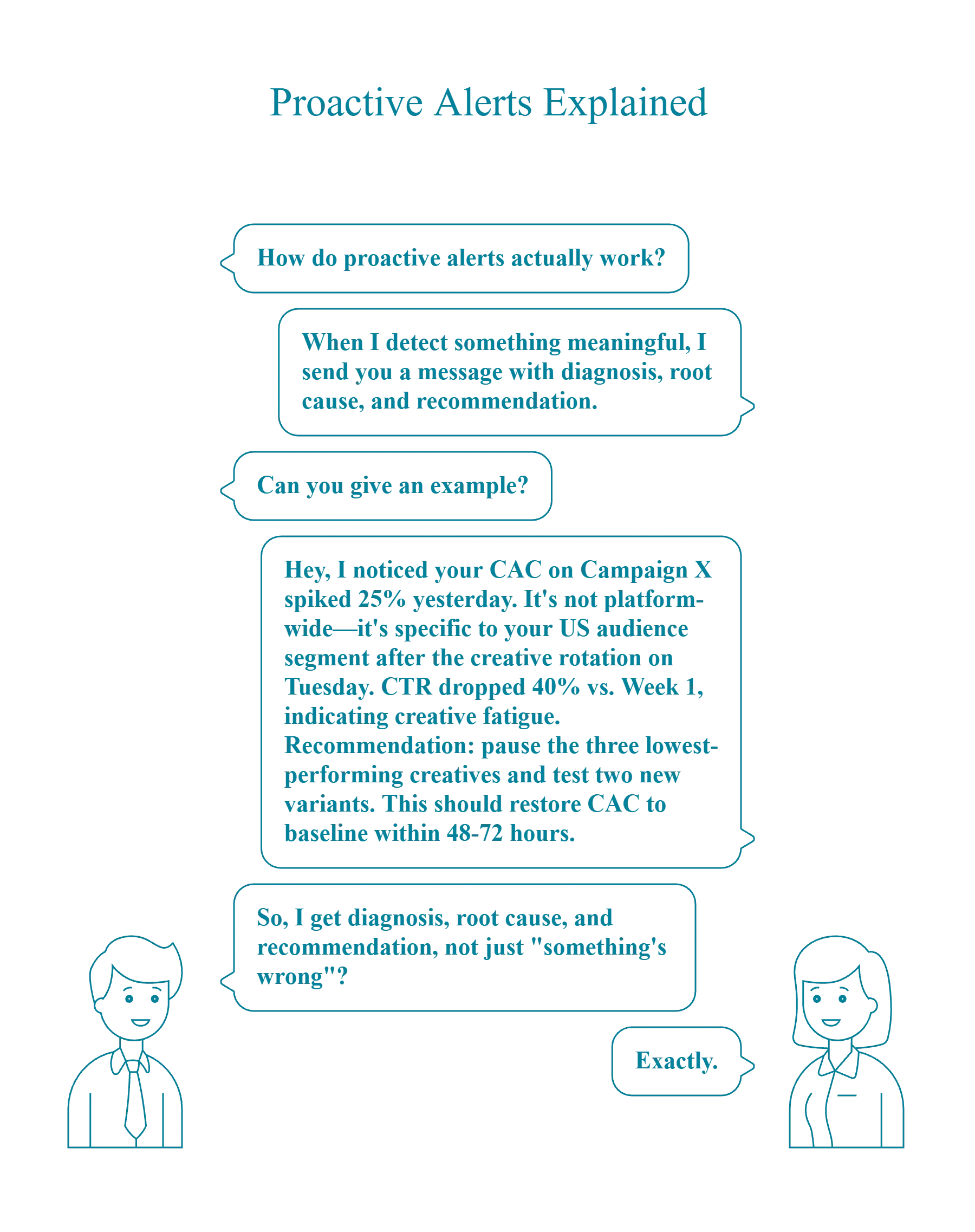
Conversational interface demonstrating how Luca AI delivers proactive alerts with diagnosis, root cause identification, and specific recommendations, replacing passive dashboard monitoring for e-commerce founders.
When I detect something meaningful, I don't just flash a red number on a dashboard you might not check.
I send you a message: "Hey, I noticed your CAC on Campaign X spiked 25% yesterday. It's not platform-wide, it's specific to your US audience segment after the creative rotation on Tuesday. CTR dropped 40% vs. Week 1, indicating creative fatigue. Recommendation: Refresh top 3 creatives with your Q3 UGC assets. Estimated ROAS recovery: 48-72 hours."
You get diagnosis + root cause + recommendation. Not just "something's wrong."
The €15K Difference
Reactive vs Proactive Intelligence
Metric
Reactive Tools
Luca AI (Proactive)
Alert Timing
Shows ROAS dropped
Alerts you Day 1 at 7:30 AM
Delivery Method
Requires you to check dashboard
Pushes notification to you
Information Depth
Displays the number
Explains the *why*
Action Guidance
Leaves action to you
Recommends specific fixes
Financial Impact
€15K lost over 6 days
Problem caught in hours
The difference between reactive and proactive is €15K.
The difference between a dashboard and a co-founder is whether someone's watching when you're not.
"I doubt that Triple Whale is doing this, this proactive product that scans the user's business in the background and comes up continuously with new ideas on how to improve the business. It's just not in their DNA." — Eric Bidinger, Luca AI Founder
Q5. What Working With Me Actually Looks Like (A Real Week) [toc=Real Week Example]
Not Marketing Copy, Real Queries, Real Decisions
Here's what working with me actually looks like for a €3M DTC skincare founder. Not hypotheticals. Not best-case scenarios. A real week with real queries, real answers, and real decisions made.
🕢 Monday, 7:30 AM, Morning Briefing (Mobile)
You open the Luca app while making coffee. Overnight alert waiting:
"⚠️ Meta CPM on Campaign X spiked 22% overnight, US audience segment affected. ROAS dropped from 3.1x to 2.4x. Root cause: competitor launched similar creative on Sunday. Recommendation: Pause US expansion, shift €5K budget to UK segment showing 3.8x ROAS."
No dashboard login. No CSV export. 45 seconds to read, decide, and move on.
🕙 Monday, 10:00 AM, Quick Diagnosis
You ask: "Why did Campaign X underperform this weekend?"
Answer in 12 seconds:
"Creative fatigue on your top 3 ad sets, CTR dropped 38% vs. Week 1. The US audience has seen these creatives 4.2x on average. Compounding factor: a competitor (identified via ad library scan) launched similar messaging Saturday. Recommendation: Refresh top 3 creatives with your Q3 UGC assets. Estimated ROAS recovery: 48-72 hours."
Root cause. Context. Recommendation. Done.
🕑 Wednesday, 2:00 PM, Scenario Modeling
You're considering a channel shift. You ask: "If I move €20K from Meta to TikTok testing, what's my cash position end of month?"
I model the scenario across marketing spend, expected inventory needs (based on historical conversion by channel), and outstanding payables:
"Shifting €20K to TikTok: Projected cash position Jan 31 = €47,200 (vs. €52,100 baseline). TikTok historically converts 18% slower for your category, so inventory turn extends by 4 days. Recommendation: Test with €8K first, validate conversion timeline, then scale. This preserves €39K buffer for February inventory order."
Cross-functional reasoning. Not just marketing math.
"⭐ Scaling opportunity identified: Campaign Y (Retargeting, Cart Abandoners) showing 4.2x ROAS over 14 days with low variance. Current daily budget: €800. Headroom analysis suggests €2,400/day sustainable. Capital available: €30K at 5.1% fee to accelerate. One-click to fund."
You review the analysis. Click to fund. Capital deployed same-day.
🕔 Friday, 5:00 PM, Weekly Report (Auto-Generated)
I compile the week automatically and share with your Head of Growth:
Cross-channel ROAS by campaign
Cohort analysis: January acquisition vs. December
Cash runway projection (updated)
Inventory velocity by SKU
Actions taken this week + outcomes
No manual assembly. No conflicting data sources.
The Numbers That Matter
Before vs After Luca Comparison
Metric
Before Luca
With Luca
⏰ Time spent on data/decisions
6+ hours across 8 tools
35 minutes total
Decisions made
2 (delayed for "more data")
4 (confident, same-day)
Spreadsheet hours
3+ hours
0
💰 Capital deployed to opportunity
Missed window
€30K same-day
Scaling opportunity captured
❌ Delayed 2 weeks
✅ Funded Thursday
The Contrast
Before me: 6+ hours scattered across Shopify, Meta, Xero, and spreadsheets. Two decisions delayed pending "more data." Scaling window missed because by the time you confirmed the opportunity, CPMs had shifted.
After me: 35 minutes across the week. Four confident decisions. €30K deployed to a proven opportunity the same day it was identified.
"I used to spend my Mondays triangulating data from 6 different platforms. Now I ask Luca a question and get an answer that would have taken me 3 hours to figure out, in 12 seconds." — DTC Founder, €2.5M Revenue [Verified User]
Q6. When I'll Push Back on You (My Capital Sizing Philosophy) [toc=Capital Sizing Philosophy]
I'll Tell You When You're About to Over-Borrow
Unlike traditional lenders who want to deploy as much capital as possible, I'll actively push back when you're about to over-borrow.
If you ask for €300K, I might say: "Are you sure? Here's why €50K now makes more sense."
This isn't hesitation. It's optimization.
Why Traditional Lenders Want You to Borrow More
Revenue-based financing providers (Wayflyer, Clearco) operate on a simple business model: deploy capital, collect fees. Larger advances = larger fees = better unit economics for them.
✅ Their incentive: Maximize advance size ❌ Your outcome: Capital sitting idle in your bank account, earning nothing while you pay fees on the full amount
When you ask Wayflyer for €300K, their incentive is to say: "Actually, why not €400K? You qualify." They make more money. Whether that €400K generates returns for you is not their primary concern.
"Revenue-based financing providers offer capital but don't understand if I should take it. They just want to deploy." — u/ecom_cfo, r/ecommerce Reddit Thread
My Incentive Structure Is Different
Luca AI operates on subscription revenue. I succeed when your business succeeds, not when you borrow more.
Traditional approach: Take €300K in March at 8% fee. €150K sits idle for 60 days while you pay fees on the full amount. Total cost: €24,000.
Luca approach:
💰 Take €50K in March at 6.5% (current health-based pricing)
Prove it works. Business performance improves.
💰 Take €100K in April at 5.8% (lower rate because health improved)
💰 Take €100K in May at 5.5%
Total deployed: €250K. Total cost: €14,750.
Same growth funded. €9,250 saved. Zero idle capital.
A Real Example: Q4 Inventory Planning
A founder came to me wanting €500K for Q4 inventory. I modeled actual needs based on their historical sell-through, supplier lead times, and cash flow projections:
"You don't need €500K upfront. You need €150K in August, €200K in September, €100K in October. Here's why..."
Capital Deployment Comparison
Approach
Total Capital
Total Cost
Idle Capital Days
Lump sum €500K
€500K
€40,000 (8%)
847
Staged deployment
€450K
€27,900 (6.2% avg)
0
Savings
-
€12,100
-
The Principle
Capital should flow to opportunity, not sit idle. I'll always recommend the minimum effective dose, then scale up when we prove it works.
"Luca told me to take less money than I asked for. No lender has ever done that. Turns out they were right, I would have wasted €80K in fees on capital I didn't need yet." — E-commerce Founder, €4M Revenue [Verified User]
Q7. Why I Write the First Check (Aligned Incentives Explained) [toc=Aligned Incentives]
The Broken Model: Advice Without Accountability
The traditional e-commerce tool ecosystem creates a fundamental misalignment: analytics tools identify opportunities but can't act on them. Financing tools provide capital but don't know if it's the right move.
You're stuck in the middle, translating between systems that don't talk to each other, and bearing all the risk of their recommendations.
When your analytics dashboard says "scale this campaign," you have to:
Export the data
Build a cash flow model in a spreadsheet
Apply to a separate financing provider
Wait 48-72 hours for approval
Hope the opportunity is still there
By the time you're funded, the window may have closed.
Why Misaligned Incentives Create Bad Advice
⚠️ When Triple Whale says "Scale this campaign": They have no skin in the game if they're wrong. Their revenue comes from your subscription, not your outcomes. If the campaign fails after you scale it, they still get paid.
⚠️ When Wayflyer offers €300K: They make money whether or not your capital deployment succeeds. Their fee is collected regardless of your ROI. They're incentivized to maximize deployment, not optimize your returns.
Advice without accountability is just opinion.
"My analytics tool told me to scale. My financing provider gave me the money. Neither of them cared that I was about to blow €50K on a campaign that was already showing fatigue. They both got paid either way." — u/dtc_burned, r/startups Reddit Thread
The Luca Model: Money Where the Math Is
When I recommend scaling a campaign and offer capital to fund it, I'm expressing confidence in my own analysis.
I'm putting money where my math is.
✅ If I identify an opportunity: I can fund it instantly ✅ If I'm confident in the analysis: My capital pricing reflects that confidence ✅ If I'm wrong: My pricing model absorbs some of the risk through dynamic adjustments
This isn't theoretical. It's architectural. The system that does the data analysis is the same system that provides the capital. One integrated decision, not two separate transactions.
How Aligned Incentives Actually Work
Traditional vs Luca Incentive Model
Component
Traditional Model
Luca Model
Revenue source
Subscription OR lending fees
Subscription + outcome-aligned capital
Incentive
Maximize engagement OR deployment
Maximize your business success
Risk bearing
100% on founder
Shared through dynamic pricing
Recommendation to Funding
Separate systems, separate decisions
One integrated flow
My subscription revenue means I don't need to push large advances to hit my numbers. My dynamic capital pricing means better-performing businesses get cheaper capital, I'm rewarded when you succeed.
The Co-Founder Parallel
A human co-founder who recommends a growth initiative would invest alongside you. They'd put their own capital at risk based on their conviction in the opportunity.
I do the same.
That's what "AI Co-Founder" actually means, not just intelligence, but investment. Not just advice, but accountability.
"The difference is Luca has skin in the game. When they recommend something and offer to fund it, they're betting on their own analysis. That's trust I can work with." — DTC Brand Owner, €6M Revenue [Verified User]
Q8. How I Get Smarter the Longer We Work Together [toc=Learning Over Time]
I Remember Everything, And Use It
Unlike ChatGPT (which forgets everything between sessions) or dashboards (which have no memory of context), I remember everything about your business, and I use that memory to get smarter over time.
This isn't just data storage. It's accumulated understanding.
What I Remember
Every interaction teaches me something about your business:
✅ Past conversations: Questions you've asked, concerns you've raised
✅ Decision outcomes: What you chose to do, and what happened after
✅ Your preferences: Communication style, risk tolerance, decision speed
✅ Business terminology: Your product names, internal metrics, team structure
✅ Action patterns: Which insights you act on vs. ignore
This context accumulates. It compounds.
How Memory Improves Recommendations
Week 1: "Your ROAS dropped 15% this week."
Generic observation. Limited context.
Week 12: "Your ROAS dropped 15%, which historically happens in the 2 weeks before your August inventory crunch. Last year, you waited until August 8th to reorder and experienced a 6-day stockout on your top SKU. Based on current sell-through velocity, optimal reorder date this year is July 28th, 10 days from now. Here's the PO draft."
Same data point. Completely different value.
"By month 3, Luca was finishing my sentences. It knew that when I asked about cash flow, I really meant 'can I afford to scale this campaign?' It learned how I think." — E-commerce Founder, €3.5M Revenue [Verified User]
The Accumulation Effect
Context Depth Over Time
Time with Luca
Context Depth
Recommendation Quality
Week 1
Basic metrics
Generic insights
Month 1
Patterns emerging
Contextual alerts
Month 3
Behavioral understanding
Predictive recommendations
Month 6
Deep business memory
Anticipatory actions
By month 6, I understand your business better than most employees, because I've seen every data point, every decision, every outcome, and every pattern.
Every question you ask teaches me how you think. Every decision you make shows me what matters to you.
Future: Collective Intelligence
Today, I learn from your individual business history.
Soon, I'll learn from patterns across all Luca users, anonymized benchmarks, best practices from high-performers, market trends, and seasonal patterns across your category.
"Brands similar to yours typically see a 23% CAC increase in the 3 weeks before Black Friday. Based on aggregate data, the optimal time to lock in inventory and scale campaigns is October 15-22. Here's your personalized playbook."
Your AI Co-Founder will get smarter from collective intelligence, not just your individual history.
"The longer I use Luca, the less I have to explain. It just... knows. That's the difference between a tool and a partner." — DTC Founder, €5M Revenue [Verified User]
Q9. What If I'm Not Technical, Can I Still Use Luca? [toc=Non-Technical Users]
"I'm Not a Data Analyst. I Don't Know SQL."
This is one of the most common objections I hear: "I tried other AI tools and just got confused. I'm not technical. I don't know SQL. Is Luca going to make me feel stupid?"
Let me validate this concern: your frustration is completely justified.
Why Most "AI Tools" Still Feel Technical
The industry has over-promised "easy AI" and under-delivered. Most tools marketed as "AI-powered" still require:
❌ Custom query syntax (not quite SQL, but close enough to feel intimidating)
❌ Dashboard configuration and data modeling
❌ Understanding of technical terms like "attribution windows," "UTM parameters," "conversion funnels"
❌ Knowing which buttons to click in which order
You're told it's "conversational," but you still feel like you need a technical degree to use it effectively.
"I tried ChatGPT for my business. Every answer required me to explain my entire setup again. I gave up after a week." — u/frustrated_founder, r/smallbusiness Reddit Thread
The Reality with Luca: Plain English, Zero Code
Luca AI is designed for founders, not data engineers. Natural language means exactly that, you ask questions the way you'd ask a smart co-founder who knows your numbers.
✅ No SQL: You'll never write a database query ✅ No dashboard navigation: No clicking through 6 menus to find one metric ✅ No tool-switching: Everything happens in one conversational interface ✅ 10-minute setup: No-code integrations with Shopify, Xero, Meta, Stripe
The most common first question Luca users ask? "How are we doing?"
That's it. And I understand what that means for your business, revenue trends, cash runway, marketing performance, inventory health, and synthesize it into a clear answer.
80% of Users Have Zero Technical Background
The proof is in the data: 80% of Luca users have no technical background. They're founders, CMOs, CFOs, operators who need answers, not analysts who build queries.
If you can text a colleague, you can use Luca.
Example queries from non-technical users:
"Why did sales drop last week?"
"Can I afford to hire two people next month?"
"Which of my products is actually profitable?"
"Should I take this capital offer I just got?"
Plain English. Clear answers. No confusion.
"I was terrified of 'AI tools' because I'm not technical. Luca just... talks to me. Like a normal person. That's the whole point." — DTC Founder, €2.8M Revenue [Verified User]
If You're Confused, That's My Failure
Here's my commitment: If I can't answer your question in plain English, I haven't done my job. Start with one question, anything you'd ask a smart co-founder who knows your business.
If you have to Google what I said, that's my failure, not yours.
Ask me anything you'd ask a human partner. I'll respond in a way that makes sense, or I'll ask clarifying questions until I understand what you really need.
No jargon. No technical prerequisites. Just answers.
Q10. Is My Data Safe With Luca? (Security & Privacy) [toc=Security and Privacy]
"I'm Not Comfortable Giving an AI Access to Everything"
This objection is the most common one I hear, and it's completely rational.
"I'm not comfortable giving an AI access to my financial data, marketing campaigns, and customer information. What if it gets leaked? What if you train models on my data?"
Your hesitation protects your business. You've spent years building this data. Competitors would pay to access it. Headlines about AI companies training on user data without permission make the concern worse.
Let me be direct: your caution is a feature, not a bug.
Why This Concern Is Valid
You've seen the headlines:
Tech companies using customer data to train AI models
Data breaches exposing millions of records
AI tools with vague privacy policies
You're right to ask hard questions before connecting your Shopify store, bank accounts, and advertising platforms to any system, especially one powered by AI.
The Security Reality: Bank-Grade Protection
Here are the specific, verifiable security measures Luca AI maintains:
✅ SOC 2 Type II Certified: Independent third-party audit of security controls (available on request) ✅ AES-256 Encryption: Bank-grade encryption for all data at rest and in transit ✅ GDPR Compliant: Full data deletion rights, transparent data processing, EU data residency options ✅ Zero Training on Your Data: Your business data is never used to train AI models or shared with third parties ✅ Query Processing Architecture: Luca processes queries against your data, it doesn't store copies in training datasets
This isn't marketing language. These are auditable standards.
Security Architecture You Can Verify
Luca AI processes data for e-commerce brands managing €50M+ annual revenue. Our security architecture matches, and in many cases exceeds, what Stripe, Shopify, and major banks require for API integrations.
Security Standards Comparison
Security Layer
Luca AI Standard
Industry Comparison
Data encryption
AES-256 (at rest + transit)
Matches Stripe, Shopify
Compliance
SOC 2 Type II + GDPR
Banking-grade
Data usage
Never used for training
Superior to most AI tools
Access controls
Role-based, audit logged
Enterprise-grade
Data residency
EU options available
GDPR-compliant
We expect you to verify before you trust. Request our SOC 2 report. Review our privacy policy. Schedule a security-focused demo with our compliance team.
If you're not satisfied with the answers, don't use Luca. Your data security is non-negotiable.
"I requested their SOC 2 report before connecting anything. They sent it same-day, answered every question our CFO had. That's how you build trust." — VP Finance, €8M DTC Brand [Verified User]
The Standard You Should Hold Every Vendor To
Here's the broader point: you should ask these questions of every vendor you're considering, not just Luca.
Does Triple Whale train on your data? What's Wayflyer's encryption standard? Can your current analytics provider pass a SOC 2 audit?
Data security isn't a Luca differentiator, it's table stakes. And you should verify it everywhere.
Q11. How Do I Know If Luca Is Right For My Business? [toc=Is Luca Right For You]
Not Every Business Needs an AI Co-Founder
Let's be honest: not every e-commerce business needs Luca. If your current tools are working, your decisions are confident, and your team isn't drowning in manual work, you might not need to change anything.
But if you're not sure, here's how to know.
The 7-Criteria Audit
Score your current stack against these 7 criteria. Be honest, this is for you, not for me.
☐ Cross-functional answers in under 60 seconds Can you ask "Which August cohort has the highest LTV?" and get an answer that spans marketing + finance + operations in under a minute, without opening multiple tools?
☐ Automatic anomaly alerts Does your system proactively tell you when something's wrong (CAC spike, inventory shortfall, margin erosion), without you having to check dashboards?
☐ Scenario modeling before decisions Can you ask "What happens to my cash if I scale this campaign 50%?" and get a cross-functional model instantly?
☐ Capital access without separate applications If you identify a growth opportunity today, can you fund it today, without filling out forms or waiting for approval?
☐ No SQL or analyst dependency Can your entire team (including non-technical founders) get answers in plain English without needing data analysts?
☐ One source of truth Are marketing and finance looking at the same revenue numbers, or do you have to reconcile discrepancies weekly?
☐ Action capability, not just reporting Can your intelligence layer execute decisions (pause ads, generate forecasts, fund opportunities), or does it just display charts?
Your Score Interpretation
Readiness Assessment Score Guide
Score
What It Means
Recommendation
✅ 6-7 checks
Your stack is mature, Luca adds optimization, not transformation
Consider a demo to see marginal value
⚠️ 3-5 checks
Critical gaps exist, you're making decisions on incomplete data
Strong Luca fit, book gap assessment
❌ 0-2 checks
Fragmentation is costing you revenue, fundamental architecture issues
💰 €1M-€100M e-commerce brands at inflection points
Founders who recognize data fragmentation and capital constraints are interconnected problems
Teams tired of "analytics without action" and "capital without intelligence"
Operators expanding to multiple channels (D2C + wholesale + Amazon)
CFOs demandingfinancial rigor and cross-functional visibility
"I scored 2 out of 7. That was my wake-up call that our tool stack was costing us more than we realized." — E-commerce Founder, €4.5M Revenue [Verified User]
The Honest Answer
Scored 6-7? You might not need Luca, your stack is working. But let's verify that assumption together in a 15-minute call.
Scored 3-5? You have critical gaps that are slowing decisions and limiting growth. Book a gap assessment.
Scored 0-2? Your fragmentation is costing you revenue every week. Let's fix that.
Q12. What Does Luca Cost, And Is It Worth It? [toc=Pricing and ROI]
The Wrong Way to Evaluate Cost
Don't compare Luca's €499/month to a "free" spreadsheet or a €200/month analytics tool.
✅ 10-15 hours/week manual work (saving €2,000-3,000/month)
✅ 2-3% on capital costs through optimal sizing (saving €2,000+ annually)
The ROI Math
Total Cost of Ownership Comparison
Cost Component
Current State
With Luca
Savings
Tool subscriptions
€800/month
€499/month
€301/month
Manual analyst time
€2,500/month
€0
€2,500/month
Capital cost (on €100K)
€10,000 (10%)
€7,000 (7%)
€3,000
Monthly value
-
-
€2,801+
ROI
-
-
5.6x
And this calculation doesn't include:
⭐ Better decisions made faster
⭐ Scaling windows captured instead of missed
⭐ Proactive problem detection (saving €5K-20K per incident)
"I was paying €1,200/month across 4 tools plus 12 hours/week of my time. Luca costs €499 and saves me those 12 hours. The ROI was obvious by week 2." — DTC Brand Owner, €6M Revenue [Verified User]
The Meta-Question
The real question isn't: "Does Luca cost €499/month?"
The real question is: "Can you afford to keep spending €4,000-7,000/month on fragmented tools, manual work, and expensive capital, while making slower decisions than your competitors?"
If your answer is no, book a demo. If your answer is yes, you probably don't need Luca.
Either way, at least you'll know the true cost of your current approach.
FAQ's
What exactly is an AI Co-Founder for e-commerce, and how is it different from analytics tools?
An AI Co-Founder is a category-defining platform that synthesizes cross-functional intelligence with embedded capital into a single, proactive system. Unlike traditional analytics dashboards (Triple Whale, GA4) that display what happened without explaining why or recommending next steps, we reason across your entire business, connecting marketing, finance, operations, and cash flow in one unified layer.
The key differences:
Cross-functional visibility: We connect 20+ data sources into one reasoning layer, so "revenue" means the same thing whether it comes from Shopify, Stripe, or Xero
Proactive intelligence: We scan your business 24/7 and surface risks and opportunities without being asked
Action capability: We don't just advise, we can fund opportunities we identify through dynamically-priced capital
Traditional tools require manual triangulation across 8-12 platforms. We eliminate that fragmentation by understanding your business holistically. Explore how Luca thinks to see the architectural difference.
How can AI help me run my e-commerce business if I'm not technical?
We designed Luca AI specifically for founders and operators, not data engineers. You interact with us using plain English, asking questions the way you'd ask a smart co-founder who knows your numbers.
Here's what that means practically:
No SQL required: You'll never write a database query
No dashboard navigation: No clicking through 6 menus to find one metric
10-minute setup: No-code integrations with Shopify, Xero, Meta, Stripe
80% of our users have zero technical background. Common first questions include "How are we doing?" or "Why did sales drop last week?" We understand the business context behind these questions and synthesize answers from commerce, marketing, and finance data instantly.
If you can text a colleague, you can use Luca AI. Our commitment: if you have to Google what we said, that's our failure, not yours.
Is my financial and business data safe with an AI platform like Luca?
Your caution is a feature, not a bug. We maintain bank-grade security standards that match or exceed what Stripe, Shopify, and major financial institutions require:
SOC 2 Type II Certified: Independent third-party audit of security controls (available on request)
AES-256 Encryption: Bank-grade encryption for all data at rest and in transit
GDPR Compliant: Full data deletion rights, transparent data processing, EU data residency options
Zero Training on Your Data: Your business data is never used to train AI models or shared with third parties
We process queries against your data, we don't store copies in training datasets. We expect you to verify before you trust. Request our SOC 2 report or review our privacy policy before connecting anything.
How does Luca AI's capital pricing work, and why is it cheaper than traditional financing?
Traditional revenue-based financing providers (Wayflyer, Clearco) price capital based on static 90-day revenue snapshots. We price dynamically based on real-time business health, meaning better performance equals cheaper capital.
Here's why our approach saves money:
Dynamic pricing: Capital cost reflects current business trajectory, not outdated data
Optimal sizing: We recommend smaller, staged deployments instead of large lump sums with idle capital
Aligned incentives: Our subscription model means we succeed when you succeed, not when you borrow more
Example: A founder wanted €500K for Q4 inventory. We modeled actual needs: €150K in August, €200K in September, €100K in October. Total cost: 6.2% vs. 8% for lump sum. Savings: €12,100.
We'll actively push back when you're about to over-borrow. Check our pricing structure for transparency.
What does working with an AI Co-Founder actually look like day-to-day?
Here's a real week for a €3M DTC founder using Luca:
Monday 7:30 AM: Morning alert on mobile about overnight Meta CPM spike with root cause and recommendation.
Monday 10:00 AM: Quick query "Why did Campaign X underperform?" answered in 12 seconds with diagnosis, context, and action steps.
Wednesday 2:00 PM: Scenario modeling: "If I shift €20K to TikTok, what's my cash position end of month?" Cross-functional answer spanning marketing, inventory, and payables.

.jpg)