ChatGPT 4% Fee Starting Jan 2026: What Smart Merchants Do Now?
12
mins read
TL;DR
ChatGPT charges 4% on Instant Checkout sales starting January 26, 2026, automatically deducted before Shopify payouts reach your account.
Total effective take rate is ~9.2% when combined with Shopify Payments fees, positioning ChatGPT between direct sales (~4%) and Amazon (~25-30%).
ChatGPT traffic converts at 15.9% vs 1.8% for Google Organic, representing nearly 9x higher conversion rates that may justify the fee structure.
Major analytics gap exists: merchants can track completed orders but NOT impressions, CTR, or query visibility. OpenAI Merchant Dashboard expected Q2-Q4 2026.
AI-native product optimization requires natural language titles, conversational descriptions, and strong reviews rather than traditional keyword-focused SEO.
Decision framework: enable for high-margin SKUs (>40%) with strong reviews (4.2+ stars); wait if margins are thin or product data quality is poor.
Q1. What Is ChatGPT Instant Checkout and Why Is OpenAI Charging 4%? [toc=ChatGPT Instant Checkout Explained]
The way consumers discover products is fundamentally changing. Instead of navigating through Google search results or scrolling through Amazon listings, shoppers increasingly ask AI assistants direct questions: "What's the best sleep mask under $50?" or "Find me sustainable running shoes for beginners." ChatGPT has evolved from a conversational chatbot into a full transactional commerce channel and OpenAI is now monetizing this shift with a 4% transaction fee starting January 26, 2026.
ChatGPT Instant Checkout allows users to complete purchases entirely within the chat interface. When a product supports this feature, users see a "Buy" button, click through to a checkout window, and complete the transaction without ever leaving ChatGPT. Order confirmations arrive via email from the seller and appear in the chat history. It's frictionless, intent-driven commerce.
The Traditional E-commerce Discovery Problem
For years, merchants relied on a fragmented approach: SEO to rank on Google, paid ads on Meta and Google, and marketplace listings on Amazon. Discovery happened in one place; purchase in another. This created attribution nightmares, cart abandonment, and sky-high customer acquisition costs. A shopper might discover your product via Instagram, research it on Google, and finally buy through Amazon leaving you guessing which touchpoint actually drove the sale.
Traditional analytics dashboards like Triple Whale or Google Analytics could show you pieces of this journey, but never the full picture. You'd spend hours exporting CSVs, cross-referencing data sources, and still lack confidence in your attribution models. Meanwhile, the consumer moved on to the next brand.
The AI-Era Commerce Shift
ChatGPT Instant Checkout collapses the discovery-to-purchase funnel into a single interaction. The user asks, the AI recommends, and the purchase happens all within seconds. For merchants, this represents both opportunity and complexity.
The 4% fee is OpenAI's monetization of this new commercial layer. Importantly, this rate is significantly lower than Amazon's typical 8-15% referral fees. As Max Sinclair, CEO of Azoma.ai, noted: "This is a land grab for the future of commerce. While Amazon charges for access to customers, OpenAI is positioning itself as the trusted advisor that controls the purchasing decision itself."
"When will instant checkout expand beyond the US? I'm seeing massive potential here but need clarity on timeline." — u/ecom_scaling, r/OpenAIDev Reddit Thread
What This Means for Data-Driven Merchants
For e-commerce operators already struggling with 8-12 disconnected tools, ChatGPT adds another data silo. Orders will flow into Shopify, but the pre-purchase journey how many users saw your product, which queries triggered recommendations remains invisible. OpenAI currently provides no merchant dashboard equivalent to Google Search Console.
This creates an urgent need for unified intelligence. Platforms like Luca AI that connect commerce, marketing, and financial data into a single reasoning layer become critical for understanding true channel performance. When you can ask, "What's my real CAC on ChatGPT orders versus Meta campaigns, factoring in the 4% fee?" and receive an instant, accurate answer you've transformed fragmentation into competitive advantage.
💰 The Bottom Line: At 4%, ChatGPT Checkout offers a lower-friction alternative to Amazon. But without unified analytics and financial management, you're flying blind on whether this channel truly delivers profitable growth.
Q2. How Does ChatGPT Shopping Work From the User's Perspective? [toc=User Shopping Journey]
Understanding the user experience is essential for merchants optimizing their presence on ChatGPT. Here's the complete end-to-end journey from product query to completed purchase.
The Discovery Phase
User initiates a product query The shopper asks ChatGPT a natural language question, such as "What's the best weighted blanket for anxiety?" or "Find me wireless earbuds under $100 with good bass."
ChatGPT analyzes and recommends The AI processes the query, considering factors like relevance, reviews, pricing, and product descriptions. It presents a curated list of recommendations, not paid placements ranking is organic based on relevance.
Product cards appear Each recommended product displays with an image, title, price, and merchant name. Products that support Instant Checkout show a "Buy" button directly on the product card.
The Checkout Phase
User clicks "Buy" A secure checkout window opens within ChatGPT. The user sees:
Order confirmation After completing payment, the user receives:
In-chat confirmation with order details
Email receipt from the merchant (not OpenAI)
Standard tracking information once shipped
Key User Experience Details
ChatGPT Shopping Current Status
Aspect
Current Status
Cart type
Single-item only (multi-item coming soon)
Geographic availability
US users only
Plan eligibility
All plans (Free, Go, Plus, Pro, Team, Enterprise)
Merchant relationship
Customer buys from merchant, not OpenAI
Returns/refunds
Handled by merchant directly
"How to allow ChatGPT to execute a purchase on my Shopify store? I keep seeing the feature mentioned but can't find clear documentation." — u/shopify_dev_question, r/shopify Reddit Thread
Conversion Performance Benchmarks
Early data suggests ChatGPT traffic converts at 2-4x higher rates than traditional channels. One study found a 15.9% conversion rate for ChatGPT-referred traffic versus 1.8% for Google Organic. Fashion and apparel categories show particularly strong performance.
The implication for merchants: users arriving via ChatGPT have high purchase intent. They've asked a specific question and received a targeted recommendation there's minimal browsing or comparison shopping.
Luca AI simplifies: Rather than manually tracking ChatGPT order attribution across Shopify and Google Analytics, Luca AI automatically synthesizes channel performance calculating true conversion rates and CAC across AI-driven and traditional commerce channels in real-time.
Q3. Who Can Use ChatGPT Shopping And Where Is It Available? [toc=Availability and Eligibility]
Geographic and plan eligibility are the two primary gatekeepers for ChatGPT Shopping access. Here's the current status and projected expansion timeline.
Current Geographic Availability (January 2026)
⚠️ US-Only for Transactions: ChatGPT Instant Checkout is currently available exclusively for:
US-based shoppers (all ChatGPT plans)
US-based merchants on Shopify and Etsy
Even if you're a merchant outside the US, you cannot currently participate in the checkout program. Your products may appear in ChatGPT recommendations globally, but users outside the US will be redirected to your website rather than completing in-chat checkout.
Plan Eligibility
ChatGPT Shopping Access by Plan
ChatGPT Plan
Shopping Research
Instant Checkout
Free
✅ Yes
✅ US only
Go
✅ Yes
✅ US only
Plus
✅ Yes
✅ US only
Pro
✅ Yes
✅ US only
Team
✅ Yes
✅ US only
Enterprise
✅ Yes
✅ US only
Key insight: Plan type doesn't restrict shopping access location does. All six ChatGPT tiers can use shopping features, but only US-based users can complete purchases directly in chat.
International Rollout Timeline (Projected)
ChatGPT Shopping International Expansion Timeline
Phase
Timeline
Markets
Q1 2026
Jan-Mar
🇬🇧 UK, 🇨🇦 Canada, 🇦🇺 Australia
Q2 2026
Apr-Jun
🇩🇪 Germany, 🇫🇷 France, 🇪🇸 Spain, 🇮🇹 Italy, 🇳🇱 Netherlands
Q3-Q4 2026
Jul-Dec
🇯🇵 Japan, Southeast Asia, Latin America
What Non-US Merchants Can Do Now
Prepare your product data Optimize titles, descriptions, and images for AI discoverability
Register interest Submit your application at chatgpt.com/merchants to join the waitlist
Monitor robots.txt Ensure OAI-SearchBot isn't blocked from indexing your site
Build review velocity Strong ratings will matter when checkout launches in your market
The January 26, 2026 Date Clarification
⚠️ Common misconception: January 26, 2026 is NOT the international expansion date. It's when the 4% transaction fee begins for US Shopify merchants. The checkout functionality has been operational since September 2025 for select merchants.
Luca AI insight: For brands operating across multiple markets, tracking when ChatGPT checkout becomes available and projecting its revenue impact requires unified forecasting. Luca AI helps model "What happens to our channel mix when UK checkout launches?" without manual spreadsheet scenarios.
Q4. How Do I Enroll as a Shopify Merchant? (Step-by-Step Guide) [toc=Shopify Enrollment Guide]
The enrollment process differs based on your e-commerce platform. Here's the complete guide for Shopify merchants the primary integration path for ChatGPT Instant Checkout.
Prerequisites Checklist
Before starting, confirm you meet these requirements:
✅ US-based Shopify merchant (any Shopify plan)
✅ Operational store with products listed
✅ Shopify Payments enabled (or willingness to add it)
✅ Products in supported categories
Step-by-Step Enrollment Process
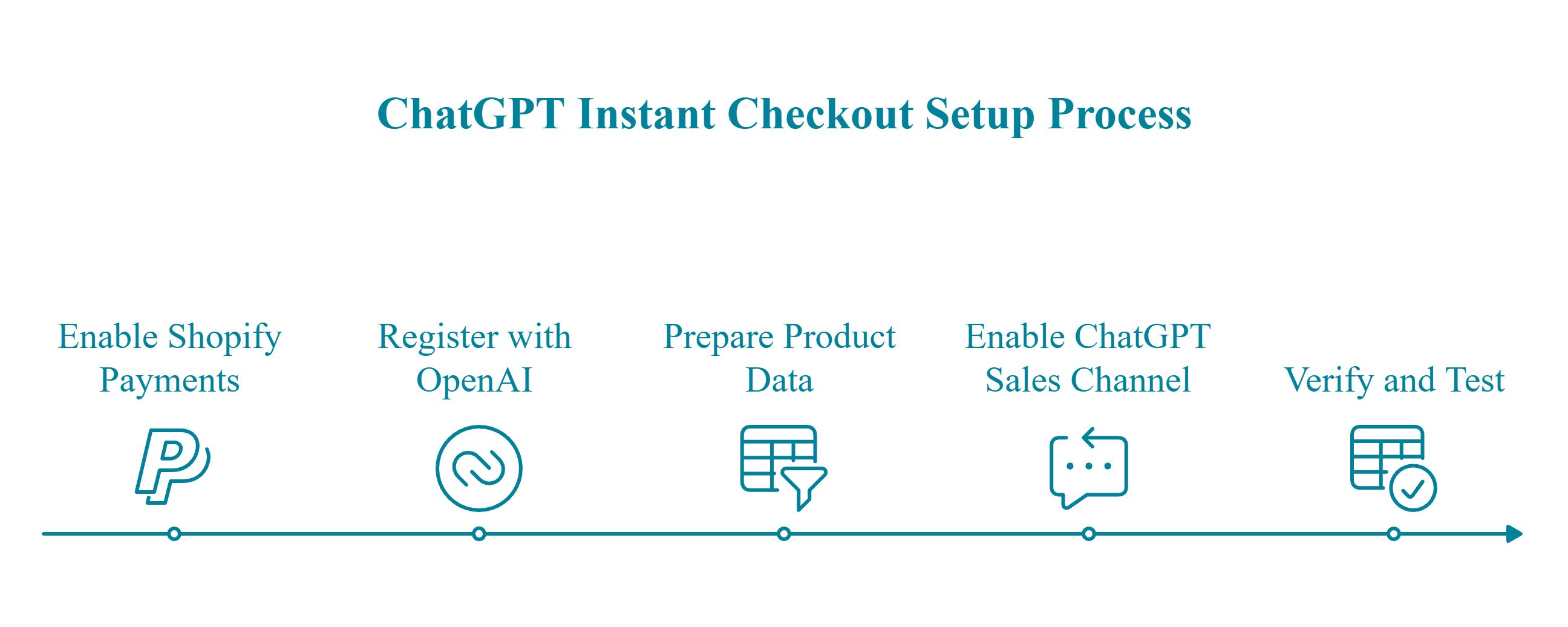
Visual flowchart showing the five-step ChatGPT Instant Checkout enrollment process for Shopify merchants: enabling payments, OpenAI registration, product data preparation, sales channel activation, and final verification testing.
Step 1: Enable Shopify Payments
ChatGPT Instant Checkout requires Stripe-based payment processing. For Shopify merchants, this means using Shopify Payments (which runs on Stripe infrastructure).
Navigate to Settings → Payments in your Shopify admin
Click Activate Shopify Payments
Complete the verification process (10-15 minutes)
💡 Tip: You can run Shopify Payments alongside your existing processor. Use Shopify Payments for ChatGPT orders while keeping PayPal or another provider for regular website orders.
Step 2: Register with OpenAI
Go to chatgpt.com/merchants and submit your application with:
Your name and contact email
Merchant/store name
Store URL (your Shopify website address)
Main product category (e.g., Fashion, Electronics, Beauty)
⚠️ Important: This is an application, not automatic approval. OpenAI reviews submissions and approves merchants on a rolling basis.
Step 3: Prepare Your Product Data
While awaiting approval, optimize your catalog for AI discoverability:
Product Data Optimization Guide
Element
Best Practice
Product titles
Clear, descriptive names (e.g., "Men's Blue Running Shoes - Size 10" not "SKU-12345")
Descriptions
Natural language explaining features, benefits, and use cases
Images
High-quality product photos with clean backgrounds
Pricing
Accurate, competitive pricing updated regularly
Inventory
Real-time stock levels to avoid out-of-stock embarrassments
Reviews
Actively encourage customer reviews critical trust signal
Step 4: Enable ChatGPT Sales Channel
Once approved, you'll receive onboarding instructions:
A toggle switch will appear in your Shopify admin under Settings → Sales Channels
Switch it ON to activate ChatGPT checkout
Select which products to make available (you can opt in/out per product)
Step 5: Verify and Test
After enabling:
Orders from ChatGPT appear in your standard Shopify admin dashboard
Orders are tagged with "ChatGPT" as the source for attribution
Fulfillment, shipping, and returns work exactly as your normal orders
"The setup was surprisingly simple just toggled it on in Shopify. Now I'm seeing ChatGPT-attributed orders coming through." — Verified Shopify merchant
For Non-Shopify Merchants (WordPress/WooCommerce)
If you're on WordPress with WooCommerce:
Install a WooCommerce ACP plugin (e.g., "Instant Checkout via ACP")
Add Stripe as a payment processor (can run alongside PayPal)
Apply separately at chatgpt.com/merchants
Select products for ChatGPT checkout via bulk actions
Luca AI simplifies: Rather than manually monitoring ChatGPT order attribution across your Shopify admin and analytics tools, Luca AI automatically tracks this new channel alongside your existing data sources providing unified visibility without the spreadsheet gymnastics.
Q5. What Should I Optimize to Rank in ChatGPT Product Recommendations? [toc=Product Optimization Tips]
Forget everything you know about traditional SEO. ChatGPT doesn't crawl meta tags, count backlinks, or reward keyword density. Instead, it evaluates products based on semantic relevance, trust signals, and structured data quality. When a user asks "What's the best travel pillow for long flights?", ChatGPT isn't matching keywords it's understanding intent and finding products whose attributes genuinely answer that question.
This represents a fundamental shift in how products get discovered. Your product title, description, images, reviews, and inventory accuracy now directly determine whether ChatGPT recommends you or your competitor.
The Keyword-Stuffing Era Is Over
Traditional e-commerce SEO optimized for Google's algorithm: stuff product descriptions with keywords, build backlinks, optimize page load speed. Product titles often prioritized search terms over clarity ("Best Weighted Blanket Cooling Anxiety Relief 20lb Queen Size Premium").
❌ This approach fails with LLMs. ChatGPT reads your product description like a human would and keyword-stuffed gibberish hurts rather than helps. The AI is trying to match user language with product attributes, not count keyword frequency.
"OpenAI open-sourced ACP in September, Google just announced UCP. We're watching the agent commerce protocol war unfold in real-time." — u/agent_commerce_watcher, r/OpenAI Reddit Thread
AI-Native Product Optimization
ChatGPT evaluates products on these key dimensions:
ChatGPT Product Evaluation Criteria
Element
What ChatGPT Looks For
Title
Clear, descriptive, natural language (e.g., "Women's Leather Ankle Boots - Black - Size 8")
Description
Conversational copy that answers who it's for, what it does, and key benefits
Images
High-quality photos from multiple angles
Reviews
Volume, recency, and rating average critical trust signals
Pricing
Accurate, competitive, and current
Inventory
Real-time stock levels to prevent out-of-stock embarrassments
⚠️ Critical insight: Reviews are non-negotiable. ChatGPT protects its own credibility as a shopping advisor it won't recommend poorly-reviewed products because that erodes user trust in ChatGPT itself.
The Intelligence-Layer Advantage
For brands managing hundreds or thousands of SKUs, manual optimization is unsustainable. Which products are being recommended? Which descriptions correlate with higher visibility? Is inventory accurate across all channels during demand surges?
Luca AI addresses this by connecting your product catalog, order data, and marketing performance into a unified intelligence layer. We can identify which product attributes correlate with ChatGPT conversions, flag descriptions that need conversational rewrites, and maintain real-time inventory sync that prevents stockouts during AI-driven traffic spikes.
✅ Luca AI capability: Cross-reference ChatGPT order attribution with product data quality scores to identify optimization priorities automatically.
❌ Traditional approach: Manually audit each product, guess which attributes matter, and hope you updated inventory before the sale surge.
The Trust Signal Imperative
Early data shows ChatGPT traffic converts at 15.9% versus 1.8% for Google Organic. Why? Users arriving via ChatGPT have already been pre-qualified they asked a specific question and received a targeted recommendation. But this only works if ChatGPT trusts your product enough to recommend it.
💰 Bottom line: Optimize for AI understanding, not algorithms. Write descriptions that answer user questions naturally. Maintain pristine product data. Build review velocity. The merchants who treat ChatGPT as a trusted advisor relationship rather than another channel to game will capture disproportionate share.
Q6. What Is the Agentic Commerce Protocol (ACP) and Why Does It Matter? [toc=ACP Protocol Explained]
Behind ChatGPT's "Buy" button lies a sophisticated infrastructure called the Agentic Commerce Protocol (ACP) an open-source standard developed by OpenAI and Stripe that enables AI agents to facilitate transactions. Understanding ACP matters because it's the technical foundation determining how your products get discovered, purchased, and paid for in the emerging AI commerce era.
ACP standardizes how AI assistants communicate with merchants and payment processors, creating a unified layer for conversational commerce that previously required custom integrations per channel.
The Pre-ACP Payment Fragmentation
Before ACP, merchants needed separate integrations for every checkout channel: website (Shopify), mobile app (custom), Amazon (Seller Central), Instagram Shop (Meta Commerce Manager). Each had different APIs, fee structures, and reconciliation requirements. Adding a new channel meant weeks of development work and ongoing maintenance headaches.
❌ This fragmentation created operational chaos. Finance teams spent hours reconciling orders across platforms. Marketing couldn't attribute conversions cleanly. Operations managers juggled multiple dashboards without a unified view of inventory or cash flow.
How ACP Unifies Commerce
ACP introduces "Shared Payment Tokens" secure credentials that can be passed between AI agents, merchants, and payment processors. Here's the simplified flow:
User requests to buy a product in ChatGPT
Stripe creates a Shared Payment Token (SPT) representing the transaction
Token is passed to your existing payment processor
Your processor charges the customer
Money flows to your account (minus fees)
ACP vs UCP Protocol Comparison
Protocol
Payment Methods
Implementation
Status
ACP (OpenAI/ChatGPT)
Stripe, Apple Pay, Google Pay, PayPal (2026)
Stripe-first, open to others
Live
UCP (Google/Gemini)
Google Pay, PayPal (soon)
Google Pay-first
Controlled rollout
⚠️ Key clarification: While ACP is "open-source," Stripe remains the reference implementation. PayPal support is confirmed for 2026, but other processors must implement the protocol themselves.
Data Intelligence Implications
For operations managers, ACP creates a new data stream requiring unified tracking. Orders from ChatGPT need attribution, reconciliation with existing channels, and margin analysis including the 4% fee.
Luca AI treats ChatGPT as another connected data source automatically pulling order attribution, calculating true margin after ACP fees, and correlating performance with your Shopify, Meta, and financial data. We answer questions like "What's my blended CAC including ChatGPT's 4% fee versus Meta's variable ROAS?" without manual spreadsheet work.
✅ Luca AI advantage: Unified order reconciliation across ACP-enabled channels and traditional commerce.
❌ Traditional dashboards: Require manual export and triangulation across multiple systems.
💡 The open-source controversy: Google launched its competing Universal Commerce Protocol (UCP) in January 2026, explicitly to avoid dependence on OpenAI's infrastructure. Expect a protocol war merchants may need to support both ACP and UCP to maximize AI commerce coverage.
Q7. How Does Money Flow And When Do I Actually Get Paid? [toc=Payment Flow and Fees]
Understanding the payment flow for ChatGPT Instant Checkout is essential for accurate margin calculations and cash flow forecasting. Here's the complete breakdown from customer payment to your bank account.
Complete Fee Structure
For a $100 order through ChatGPT Checkout:
ChatGPT Checkout Fee Breakdown ($100 Order)
Fee Component
Amount
Deducted By
Item + Shipping + Tax
$100.00
-
ChatGPT Service Fee (4%)
-$4.00
OpenAI (via Stripe)
Shopify Payments Fee (2.9% + $0.30)
-$3.20
Shopify
Shopify Platform Fee (Basic plan: 2%)
-$2.00
Shopify
Net Proceeds to You
$90.80
-
⚠️ Important: All fees are automatically deducted before payout you never receive an invoice from OpenAI or make a separate payment. The 4% is subtracted at the transaction level, then Shopify takes its standard fees from the remainder.
Payment Timeline
Customer completes purchase Payment processed through Stripe
Shopify processing Standard Shopify/Stripe fees deducted
Payout to your bank Per your existing Shopify Payments schedule (typically 2-3 business days)
Key Financial Details
30-Day Free Trial: The 4% fee only begins after your first 30 days of ChatGPT sales. Early adopters get a month to test the channel fee-free.
Refunds: If a customer returns an item, the 4% fee is reversed proportionally. You're not penalized for returned merchandise.
Chargebacks: If a customer disputes a charge, the 4% fee is NOT reversed. Standard chargeback rules apply.
Stacked Fees: The 4% is IN ADDITION TO your existing Shopify and payment processing fees not instead of them.
Practical Example: Monthly Calculation
Monthly ChatGPT Revenue Calculation Example
Metric
Value
ChatGPT Gross Sales
$10,000
ChatGPT Fee (4%)
-$400
Shopify Payments (2.9% + $0.30 x orders)
-$320 (estimated)
Shopify Platform Fee (2%)
-$200
Net Revenue
$9,080
Effective Take Rate
9.2%
Comparison Context
Channel Fee Comparison
Channel
Typical Fee Structure
ChatGPT Checkout
~9.2% total (4% + payment + platform)
Amazon
8-15% referral + FBA fees
Direct Website
~5-6% (payment processing only)
💰 Luca AI simplifies: Rather than manually calculating effective margin per channel, Luca AI automatically computes true contribution margin across ChatGPT, Amazon, direct web, and all other sales channels factoring in the 4% fee, payment processing, and fulfillment costs in real-time.
Q8. What Analytics Can I Track for ChatGPT Sales And What's Missing? [toc=Analytics and Tracking Gaps]
ChatGPT is now a legitimate sales channel but unlike Google or Amazon, OpenAI provides virtually zero pre-purchase visibility metrics. This creates a dangerous blind spot for data-driven merchants: you know who bought, but not how many saw your products, which queries triggered recommendations, or why you weren't selected for other searches.
As one analytics expert bluntly stated: "ChatGPT is now a sales channel. Nobody knows how to track yet."
What Traditional Channels Provide
Google and Amazon built robust merchant analytics ecosystems:
Traditional Channel Analytics Comparison
Platform
Available Metrics
Google Search Console
Impressions, CTR, average position, query reports
Amazon Seller Central
Search rank, impressions, conversion by keyword, Buy Box percentage
Meta Ads Manager
Reach, frequency, CTR, conversion attribution
These tools let merchants diagnose problems and optimize systematically. Low CTR? Fix your creative. High impressions but low conversions? Improve your listing. Losing Buy Box? Adjust pricing.
The ChatGPT Analytics Void
Currently, OpenAI provides merchants with post-purchase metrics only:
✅ What You CAN Track:
Orders with ChatGPT attribution (appears in Shopify admin)
Revenue from ChatGPT sales
Referral traffic to your website (via Google Analytics)
Basic order data (customer info, shipping address)
❌ What You CANNOT Track:
Impressions (how often your products are shown)
CTR (clicks / impressions)
Query visibility (which searches trigger your products)
Position/ranking data (where you rank vs. competitors)
Competitor comparison (your share of voice)
"How do they charge for the API calls to ChatGPT? The tracking situation is completely opaque right now." — u/api_tracking_question, r/ChatGPTPro Reddit Thread
Why This Matters for Decision-Making
Without pre-purchase data, you're optimizing blind. You might see ChatGPT sales increasing but is that because you're being recommended more often, or because overall ChatGPT shopping volume is growing? You can't diagnose underperformance without knowing your baseline visibility.
Traditional dashboards like Triple Whale or GA4 can track the orders but they can't fill the visibility gap because OpenAI simply doesn't expose that data.
The Unified Intelligence Solution
Luca AI addresses this by aggregating ChatGPT order attribution with your existing Shopify, Meta, and Google data to calculate metrics OpenAI won't provide:
True CAC per channel including the 4% fee impact
Margin analysis comparing ChatGPT contribution vs. other channels
Cannibalization detection identifying if ChatGPT is expanding reach or stealing from direct traffic
✅ Luca AI capability: Cross-functional reasoning that connects ChatGPT revenue to cash flow implications automatically.
❌ Traditional approach: Manual spreadsheet reconciliation with incomplete data.
⏰ Future outlook: Industry expects OpenAI to launch a Merchant Dashboard (similar to Google Search Console) in Q2-Q4 2026. Until then, early-mover brands need unified intelligence platforms to compete effectively in AI commerce.
Q9. How Does ChatGPT's 4% Compare to Amazon, Google, and Traditional Channels? [toc=Fee Comparison Analysis]
The 4% transaction fee has ignited fierce debate among e-commerce operators. Some call it steep; others argue it's a bargain compared to customer acquisition costs. The truth lies in how you frame the comparison and whether ChatGPT drives genuinely incremental sales or cannibalizes your existing channels.
Understanding this fee in context requires examining the full landscape of commerce economics, from traditional marketplaces to emerging AI platforms.
Traditional Marketplace Economics
Amazon remains the dominant comparison point. Sellers pay referral fees ranging from 8-15% depending on category, plus FBA fulfillment fees that can add another 10-15%. A typical Amazon seller retains 70-75% of their sale price after all fees.
Commerce Channel Fee Comparison
Channel
Fee Structure
Typical Take Rate
Amazon
8-15% referral + FBA fees
25-30% total
ChatGPT
4% + payment processing
~9.2% total
Direct Website
Payment processing only
~3-4%
Google Shopping Ads
CPC (variable)
15-25% of revenue (CAC)
Meta Ads
CPM/CPC (variable)
20-30% of revenue (CAC)
❌ The comparison trap: Comparing 4% to Amazon's 15% misses the point. Amazon provides warehousing, shipping, customer service, and a massive built-in audience. ChatGPT provides discovery that's it. You still handle fulfillment, returns, and customer support.
The AI Commerce Competitive Landscape
Here's where it gets interesting: Google AI Mode and Microsoft Copilot currently charge zero fees for checkout through their platforms. This creates competitive pressure on OpenAI's 4% take rate.
"Breaking: OpenAI just put a price on the future of commerce 4%. This is a land grab, not a fee structure." — Industry analyst via LinkedIn
However, ChatGPT's significantly larger user base (300M+ weekly active users) may justify the premium. Early data shows ChatGPT traffic converts at 15.9% versus 1.8% for Google Organic a nearly 9x conversion advantage.
Intelligence-Driven Fee Evaluation
The real question isn't "Is 4% expensive?" but "What's my true cost to acquire a customer through this channel?"
For CFOs and Heads of Growth, the calculation should factor:
4% ChatGPT fee + 5.2% Shopify/payment fees = ~9.2% total take rate
Compare against: Current blended CAC across Meta, Google, and organic channels
✅ Luca AI enables this analysis by connecting your Shopify orders, ad spend data, and financial metrics to calculate true CAC per channel including the 4% fee impact in real-time. We answer questions like "What's my contribution margin on ChatGPT orders versus Meta-acquired customers?" without manual spreadsheet reconciliation.
❌ Traditional approach: Export data from multiple platforms, manually calculate effective CAC, and hope your attribution model is accurate.
The Strategic Perspective
Max Sinclair, CEO of Azoma.ai, framed it best: "This is a land grab for the future of commerce. While Amazon charges for access to customers, OpenAI is positioning itself as the trusted advisor that controls the purchasing decision itself."
💰 Bottom line: At 9.2% total (including payment processing), ChatGPT sits between direct website sales (~4%) and Amazon (~25-30%). If it delivers incremental high-intent customers at higher conversion rates, the fee structure is defensible. If it cannibalizes existing direct traffic, it's an expensive toll road.
Q10. What Is Google's UCP and How Does It Compete with ACP? [toc=Google UCP vs ACP]
Google's Universal Commerce Protocol (UCP) is the search giant's direct response to OpenAI's Agentic Commerce Protocol (ACP). Announced on January 11, 2026 at NRF's Retail Big Show, UCP creates a competing standard for AI-powered commerce that will power checkout in Google AI Mode and Gemini.
Timeline Comparison
ACP vs UCP Protocol Timeline
Protocol
Announcement
Status
Primary Platform
ACP (OpenAI/Stripe)
September 28, 2025
Live
ChatGPT
UCP (Google)
January 11, 2026
Controlled rollout
Google AI Mode, Gemini
OpenAI's 4-month head start gave ACP meaningful first-mover advantages: live merchant integrations, PayPal partnership, and real transaction data informing protocol refinements.
"OpenAI open-sourced ACP in September, Google just announced UCP. We're watching the agent commerce protocol war unfold in real-time." — u/agent_commerce_watcher, r/OpenAI Reddit Thread
Key Technical Differences
ACP vs UCP Technical Comparison
Aspect
ACP (OpenAI)
UCP (Google)
Payment focus
Stripe-first
Google Pay-first
Data source
Merchants must integrate
Google Merchant Center (existing)
Discovery
Centralized (OpenAI controls)
Decentralized (merchants publish on domain)
Checkout flow
Inside ChatGPT
Inside Google AI Mode/Gemini
Current fees
4% transaction fee
No fees announced
Why Google Built UCP
Despite ACP being "open-source," Google identified architectural concerns:
Stripe dependency ACP is tightly optimized around Stripe's role in the payment flow
OpenAI centralization Merchant listing and discovery controlled by OpenAI
Existing infrastructure Google Merchant Center already has millions of product feeds; ACP requires separate integration
Business model conflict ACP benefits OpenAI's commerce revenue; Google prefers driving traffic to its ad ecosystem
Supported platforms: Shopify, Wix, WooCommerce, plus major retailers (Walmart, Target, Wayfair)
What Shopify Merchants Should Do
Merchant Action Guide for ACP and UCP
Protocol
Your Action
Difficulty
ACP (ChatGPT)
Register with OpenAI, optimize product data
Easy (Shopify handles most)
UCP (Google)
Await rollout, ensure Google Shopping feed ready
Moderate (requires API endpoints)
Luca AI simplifies: Rather than managing separate integrations and tracking performance across ACP and UCP channels, Luca AI unifies order attribution from both AI commerce protocols calculating true margin contribution per platform automatically.
Q11. Should You Enable ChatGPT Checkout? A Decision Framework for E-commerce Leaders [toc=Enable Checkout Decision Framework]
Enabling ChatGPT Checkout isn't mandatory and it isn't automatically beneficial. Merchants can opt out entirely, enable it selectively for certain products, or block AI indexing altogether. The decision should be data-driven and strategic, not a reactive fear of missing out.
The key question: Does ChatGPT represent incremental growth opportunity, or margin erosion on sales you would have captured anyway?
The Historical Pattern of Channel Expansion
Merchants historically joined every new marketplace Amazon, eBay, Walmart, Etsy to maximize reach. This "be everywhere" approach often backfired. Many discovered too late that certain channels destroyed margin through fees, returns, or price competition that cannibalized direct sales.
❌ The traditional mistake: Optimizing for top-line revenue growth without channel-level profitability analysis. A 20% revenue increase means nothing if it comes with 25% higher costs.
Why ChatGPT Is Different
ChatGPT isn't a marketplace you "list on." It's an AI that recommends based on relevance, trust signals (reviews), and product data quality. This creates a different risk profile:
Upside: High-intent traffic with 2-4x better conversion rates
Downside: Being present but poorly optimized could harm brand perception (bad recommendations = frustrated customers = negative reviews)
"How to allow ChatGPT to execute a purchase on my Shopify store? I keep seeing the feature mentioned but can't find clear documentation." — u/shopify_dev_question, r/shopify Reddit Thread
✅ Luca AI enables this analysis by modeling the decision across your entire catalog: current margin by SKU, projected ChatGPT volume based on category benchmarks, fee impact, and cannibalization risk. We identify which products have the review quality and margin headroom to succeed before you enable anything through our product management capabilities.
❌ Traditional approach: Enable everything, hope for the best, discover margin problems 90 days later in your P&L.
Recommended Rollout Strategy
Start small: Enable 10-15 top-performing SKUs with strong reviews and healthy margins
Leverage the free trial: Use the 30-day fee-free period to gather baseline data
Monitor cannibalization: Track whether ChatGPT orders replace or add to direct website sales
Scale selectively: Expand based on actual performance, not assumptions
💡 Luca AI philosophy: Stop making channel decisions based on FOMO. Make them based on data margin impact, cash flow implications, and genuine growth potential. That's what an AI Co-Founder enables.
FAQ's
What exactly is the ChatGPT 4% transaction fee and when does it start?
Starting January 26, 2026, OpenAI charges a 4% service fee on all completed transactions through ChatGPT Instant Checkout for Shopify merchants. This fee is automatically deducted from your payout before funds reach your bank account. You never receive an invoice or make separate payments to OpenAI.
Key details we want you to understand:
The 4% is IN ADDITION to your existing Shopify and payment processing fees (not instead of them)
Total effective take rate is approximately 9.2% when combined with Shopify Payments fees
A 30-day free trial period lets you test the channel before fees begin
Refunds trigger proportional fee reversals, but chargebacks do not
We help merchants calculate true channel profitability by automatically factoring in all fee layers across ChatGPT, Amazon, and direct sales channels.
How do I enroll my Shopify store for ChatGPT Instant Checkout?
Enrollment requires five straightforward steps that we recommend completing in sequence:
Enable Shopify Payments in Settings → Payments (required for Stripe-based processing)
Register with OpenAI at chatgpt.com/merchants with your store URL and product category
Prepare product data with clear titles, detailed descriptions, high-quality images, and accurate inventory
Await approval as OpenAI reviews applications on a rolling basis
Enable the sales channel via a toggle switch in Shopify admin once approved
Important prerequisites:
US-based Shopify merchant (any plan)
Operational store with products listed
Products in supported categories
Orders from ChatGPT appear in your standard Shopify admin dashboard tagged with "ChatGPT" attribution. We simplify sales performance tracking by unifying ChatGPT order data with your existing channels automatically.
Is ChatGPT's 4% fee worth it compared to Amazon and Google Shopping?
The value depends entirely on whether ChatGPT drives incremental customers or cannibalizes existing sales. Here's how the economics compare:
ChatGPT Checkout: ~9.2% total (4% + payment fees)
Amazon: 25-30% (referral + FBA)
Direct Website: ~3-4% (payment only)
Google/Meta Ads: 15-30% (variable CAC)
Critical context: Amazon provides warehousing, fulfillment, and customer service. ChatGPT provides discovery only. However, ChatGPT traffic converts at 15.9% versus 1.8% for Google Organic, representing nearly 9x higher conversion rates.
Google AI Mode and Microsoft Copilot currently charge zero fees, creating competitive pressure on OpenAI's pricing.
We enable CFOs to model true financial impact by calculating blended CAC across all channels, factoring in ChatGPT's higher conversion rates against its fee structure.
What is the Agentic Commerce Protocol (ACP) and how does it affect my payments?
ACP is the open-source infrastructure developed by OpenAI and Stripe that powers ChatGPT Instant Checkout. It standardizes how AI assistants communicate with merchants and payment processors, enabling transactions to complete entirely within the chat interface.
How ACP affects your payments:
Uses "Shared Payment Tokens" for secure credential passing
Works with your existing Stripe/Shopify Payments setup
Supports Apple Pay, Google Pay, and cards (PayPal coming 2026)
Automatically deducts the 4% fee before payout
Google launched a competing Universal Commerce Protocol (UCP) in January 2026. While both are "open-source," ACP is Stripe-centric and UCP is Google Pay-centric. Merchants may eventually need both for maximum AI commerce coverage.
We treat ChatGPT as another connected data source through our unified analytics platform, automatically reconciling ACP orders with your existing Shopify, Meta, and financial data.
What analytics and tracking data can I access for ChatGPT sales?
This is currently the biggest gap in ChatGPT commerce. OpenAI provides virtually zero pre-purchase visibility metrics, creating significant blind spots for data-driven merchants.
What you CAN track:
Orders with ChatGPT attribution in Shopify admin
Revenue from ChatGPT sales
Referral traffic via Google Analytics
Basic order data (customer info, shipping)
What you CANNOT track:
Impressions (how often products are shown)
CTR (clicks divided by impressions)
Query visibility (which searches trigger your products)
Ranking position versus competitors
Share of voice metrics
Industry expects OpenAI to launch a Merchant Dashboard similar to Google Search Console in Q2-Q4 2026. Until then, merchants are "flying blind" on discovery metrics.
We solve this by aggregating ChatGPT order attribution with existing channel data to calculate true CAC per channel, margin impact, and cannibalization detection automatically.
Enjoyed the read? Join our team for a quick 15-minute chat — no pitch, just a real conversation on how we’re rethinking Ecommerce with AI - Luca
Loading Schedule...
Your AI Co-Founder is here.
Here’s why:
Shopify, Meta, Xero - one brain.
"Should I scale?" Answered with real data.
Growth capital. No applications. One click.
Thank you! Your submission has been received! Please book a time slot for the Meeting
Oops! Something went wrong while submitting the form.

.jpg)