How AI Can Actually Help You Run Your E-commerce Business (Beyond ChatGPT)
12
mins read
TL;DR
ChatGPT lacks database integration, business memory, and real-time data - making it unsuitable for actual e-commerce decisions requiring your specific numbers.
Cross-functional AI connects marketing, finance, and operations - answering questions like "Should I scale this campaign?" that siloed dashboards architecturally cannot.
Proactive intelligence surfaces risks and opportunities without being asked - catching margin leaks 2-3 weeks earlier than manual monitoring, preserving €5K-€20K per incident.
AI-powered cash flow forecasting synthesizes commerce, marketing, accounting, and banking data - generating dynamic 30/60/90-day projections that update automatically.
The AI Co-Founder model combines intelligence with capital - the system that identifies a scaling opportunity can also fund it instantly with dynamic pricing.
Implementation takes 10 minutes, not 6 weeks - no-code OAuth connections to Shopify, Meta, Stripe, and Xero with immediate cross-functional question answering.
Q1. The AI Opportunity for E-commerce: What's Actually Possible Beyond Chatbots and Content? [toc=AI Opportunity Beyond Chatbots]
Most conversations about AI in e-commerce start and end with the same two applications: chatbots answering customer questions and ChatGPT writing product descriptions. These are legitimate use cases - customer service automation reduces ticket volume, and generative AI accelerates content production. But if this is where your AI strategy stops, you're capturing maybe 10% of the actual opportunity.
The real question isn't "How can AI help my customers?" It's "How can AI help me make better decisions about my business?"
The Gap Between Customer-Facing AI and Decision-Making AI
Chatbots handle customer inquiries, but they don't answer the questions keeping founders awake at 2 AM: Why did revenue increase but profit decrease last month? Should I scale this campaign or will it create a cash crunch? Which product-channel combinations are actually profitable after all costs?
Content AI generates copy at scale, but it can't tell you which products deserve that copy, whether you have the inventory to support a promotion, or if your cash position can handle the resulting demand spike.
The gap is architectural. Customer-facing AI operates on general knowledge and scripted workflows. Decision-making AI requires something fundamentally different: access to your specific business data across every function - commerce, marketing, finance, operations - synthesized into actionable intelligence.
✅ The Real AI Opportunity: Cross-Functional Intelligence
The genuine transformation happens when AI moves from isolated tasks to unified reasoning:
Connected data layer: AI that integrates Shopify, Meta Ads, Google Analytics, Stripe, Xero, and your banking data into a single context
Cross-functional reasoning: Answering questions that span marketing performance, cash flow impact, and inventory capacity simultaneously
Proactive monitoring: Surfacing risks (CAC inflation, creative fatigue, stockout predictions) and opportunities (high-LTV cohorts, scaling-ready campaigns) without being asked
Dynamic forecasting: Modeling "what if" scenarios across all business functions before you commit capital
Action capability: Moving beyond insights to execution - pausing underperforming campaigns, generating reports, unlocking capital
Visual pyramid illustrating the four layers of AI transformation for e-commerce: connected data foundation, cross-functional reasoning, proactive monitoring alerts, and dynamic forecasting capabilities that enable unified business intelligence.
This is the "AI Co-Founder" model: a system that doesn't just display data but reasons across your entire business the way a strategic partner would.
What This Article Will Cover
We'll explore each layer of this AI opportunity in depth:
Why general AI (ChatGPT) architecturally cannot solve business decision problems
How conversational business intelligence replaces dashboard navigation with plain-English questions
The value of cross-functional analysis connecting marketing, finance, and operations
Proactive monitoring that finds what you don't know to ask
AI-powered forecasting and scenario planning
Intelligent capital access that funds opportunities the AI identifies
What an AI-native e-commerce stack actually looks like
The Fundamental Shift
The transformation isn't adding AI features to your existing stack - it's replacing fragmented tools with unified intelligence. From AI as a writing assistant to AI as a strategic partner. From renting 12 disconnected tools to hiring one system that understands your business as deeply as a co-founder would.
The e-commerce operators winning in 2026 aren't those with the most dashboards. They're those with systems that can answer: "Given everything happening in my business right now, what should I do next?"
Q2. Why General AI (ChatGPT) Isn't Enough for Real Business Decisions [toc=ChatGPT Limitations]
ChatGPT is genuinely impressive for general knowledge, brainstorming, content creation, and research tasks. But when you ask it "Should I scale my Meta campaign this month?" - it cannot give you a real answer. Not because it's not smart enough, but because the question requires YOUR data, not general knowledge.
The limitation isn't intelligence. It's architecture.
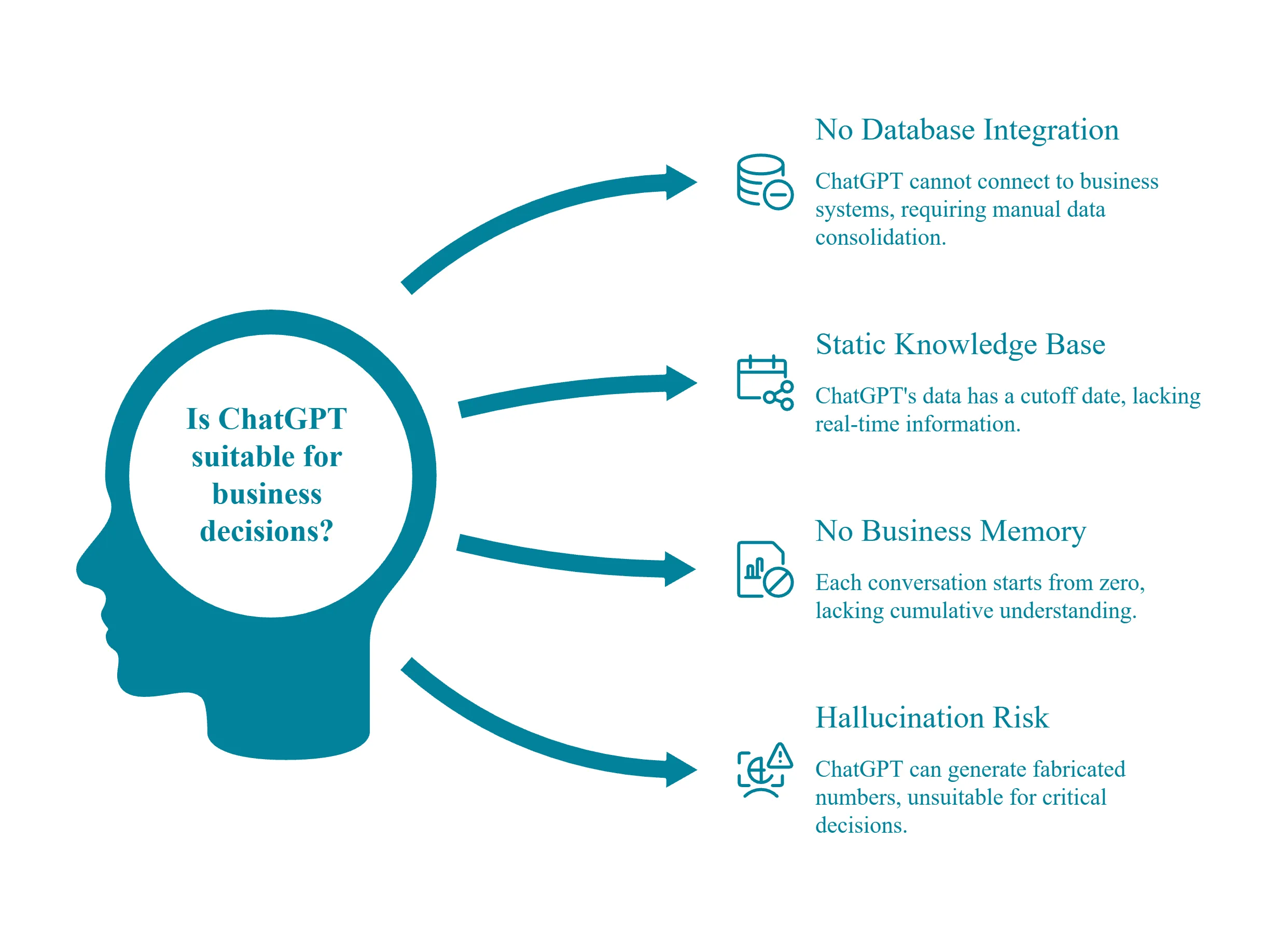
❌ Four Architectural Gaps That Make ChatGPT Unsuitable for Business Decisions
1. No Database Integration ChatGPT cannot connect to Shopify, Meta Ads Manager, Stripe, or Xero. When you ask about your ROAS, it can only work with numbers you manually provide - which means you're still doing the data consolidation work yourself.
2. Static Knowledge Base ChatGPT's training data has a cutoff date. It doesn't know your Q4 2025 performance, current inventory levels, or yesterday's campaign results. Real business decisions require real-time data.
3. No Business Memory Every conversation starts from zero. You must re-explain your business model, revenue scale, margin structure, and strategic context each time. There's no cumulative understanding of YOUR specific business patterns.
4. Hallucination Risk on Specifics ChatGPT can confidently generate plausible-sounding but fabricated numbers. When you're making €50K decisions, "plausible-sounding" isn't acceptable - you need verified data from your actual systems.
Infographic highlighting why ChatGPT is unsuitable for business decisions: no database integration, static knowledge base, no business memory, and hallucination risk when generating specific numbers.
✅ How Purpose-Built Business AI Differs Architecturally
ChatGPT vs Business-Specific AI Comparison
Capability
ChatGPT
Business-Specific AI
Data Integration
❌ None - works only with what you paste
✅ Connected to Shopify, Meta, Xero, Stripe, 20+ sources
Real-Time Data
❌ Static training cutoff
✅ Live queries against current business data
Business Memory
❌ Resets each conversation
✅ Persistent context - learns your patterns over time
Action Capability
❌ Can only advise
✅ Can execute (pause campaigns, generate reports)
Financial Intelligence
❌ General frameworks only
✅ Your actual unit economics, cash flow, margins
Hallucination Risk
⚠️ High on specific numbers
✅ Answers grounded in verified data
The Right Tool for the Right Job
This isn't about ChatGPT being "bad" - it's about matching tools to problems:
✅ Use ChatGPT for:
Content generation and copywriting
General research and brainstorming
Learning frameworks and best practices
Tasks requiring broad knowledge, not specific data
✅ Use purpose-built business AI for:
Cross-functional questions spanning marketing, finance, and operations
Decisions requiring your actual business data
Proactive monitoring and anomaly detection
Scenario modeling with real numbers
Any question where "it depends on your specific situation" is the honest answer
The shift from general AI to business-specific AI is the shift from "here's what companies generally do" to "here's what YOUR data shows you should do."
Q3. AI for Business Intelligence: Asking Questions in Plain English [toc=Conversational Business Intelligence]
Conversational business intelligence means asking "What was our contribution margin by channel last month?" and getting an accurate answer in seconds - no SQL queries, no dashboard navigation, no waiting for an analyst to build a report. The AI queries your connected data sources and synthesizes the answer in plain language.
This is the difference between navigating data and interrogating it.
Questions You Should Be Able to Ask (And Get Answered in Seconds)
"What's driving the CAC increase this week?"
"Which product-SKU combinations are actually profitable after shipping costs?"
"Show me revenue by cohort and acquisition source for Q4"
"Why did revenue increase but profit decrease last month?"
"Compare this month's performance to the same period last year"
"Which customer segment has the highest repeat purchase rate?"
"What's my true ROAS including returns and refunds?"
These questions currently require 3-5 hours of manual work: exporting data from multiple platforms, building spreadsheets, cross-referencing numbers, and hoping your formulas are correct. With conversational AI connected to your data stack, the same questions resolve in seconds.
⏰ The Time Savings Are Measurable
The operational impact is significant. E-commerce founders report spending 10-15 hours weekly on manual data consolidation and analysis. Conversational AI compresses this to minutes - not by automating reports, but by eliminating the need for them entirely.
"I used to spend my Sunday evenings building weekly performance spreadsheets. Now I just ask Luca what happened and get a better answer than my spreadsheet ever gave me." — u/dtc_founder_life, r/ecommerce Reddit Thread
"The game-changer wasn't the AI itself - it was not needing to context-switch between 6 different admin panels to answer one question." — u/shopify_scale, r/shopify Reddit Thread
✅ How Luca AI Delivers Conversational Intelligence
Luca AI connects to 20+ data sources - Shopify, WooCommerce, Meta Ads, Google Ads, Stripe, PayPal, Xero, QuickBooks - and synthesizes them into a single reasoning layer. Unlike dashboards that display pre-built views, Luca answers questions dynamically by querying across all connected systems in real-time.
The result: questions that span marketing, finance, and operations - previously impossible without manual triangulation - become instantly answerable. Ask "Which August cohort has the highest 90-day LTV, and what channel did they come from?" and receive a synthesized answer in seconds, not a task for your analyst's backlog.
Q4. AI for Cross-Functional Analysis: Connecting Marketing, Finance, and Operations [toc=Cross-Functional Analysis]
It's 11 PM on Thursday. You've spent 3 hours exporting CSVs from Shopify, Meta Ads Manager, and Stripe - trying to figure out if scaling Campaign X will create a cash crunch in 90 days. Your spreadsheet has 47 tabs. You still don't have a confident answer.
This scenario plays out weekly in e-commerce businesses at every revenue level. The problem isn't lack of data - it's that data lives in silos that don't communicate.
❌ Why This Problem Exists
Your analytics tool (Triple Whale, Northbeam) sees marketing data - ROAS, CAC, attribution. Your accounting tool (Xero, QuickBooks) sees financial data - cash position, payables, receivables. Your commerce platform (Shopify) sees orders and inventory.
None of these systems reason across the others. Triple Whale cannot answer "If I scale this campaign, what happens to my cash position?" because it doesn't see your cash position. Xero cannot predict inventory needs because it doesn't see your marketing pipeline.
You become the manual integration layer - the human API connecting systems that should talk to each other automatically.
💸 The Hidden Costs of Fragmentation
Hidden Costs of Data Fragmentation
Cost Type
Impact
⏰ Time Cost
10-15 hours/week on manual reconciliation and analysis
Manual data entry creates 15-20% variance in reporting accuracy
😓 Decision Fatigue
Uncertainty leads to conservative choices or analysis paralysis
"I literally have a 'data consolidation day' every Monday. Four hours just getting numbers to match across platforms before I can even start analyzing anything." — u/ecom_ops_manager, r/ecommerce Reddit Thread
✅ How Cross-Functional AI Changes the Equation
The question "Should I scale this campaign?" actually requires data from 3+ systems:
Marketing: Current ROAS, creative performance, audience saturation
Operations: Inventory levels, supplier lead times, fulfillment capacity
A unified AI system connects all three, enabling questions like:
"If I increase Meta spend 30%, what's my cash position in 90 days?"
"Given my current inventory and supplier lead times, how much can I scale before stockout risk?"
"Which campaigns are profitable on a fully-loaded contribution margin basis?"
Luca AI unifies Shopify, Meta, Google Ads, Stripe, and Xero into one reasoning layer - answering cross-functional questions that are architecturally impossible with siloed tools.
"The first time I asked a question that combined ad spend, inventory, and cash flow - and got a real answer - I realized how broken my old workflow was." — u/dtc_cfo_insights, r/ecommerce Reddit Thread
From 3-hour manual analysis to 5-second cross-functional answers: that's the shift from fragmented tools to unified intelligence.
Q5. AI for Proactive Monitoring: Finding What You Don't Know to Ask [toc=Proactive Monitoring]
Proactive intelligence is an always-on monitoring system that surfaces risks and opportunities before they impact your P&L - without you asking. Unlike dashboards that wait for your queries, proactive AI continuously scans for anomalies, patterns, and opportunities across your entire business.
This is the difference between firefighting and prevention.
⚙️ How Proactive Monitoring Actually Works
The AI monitors your connected data sources - Shopify, Meta, Google Ads, Stripe, Xero - against performance thresholds. These thresholds can be manually defined (alert me if CAC exceeds €25) or automatically learned from your historical patterns.
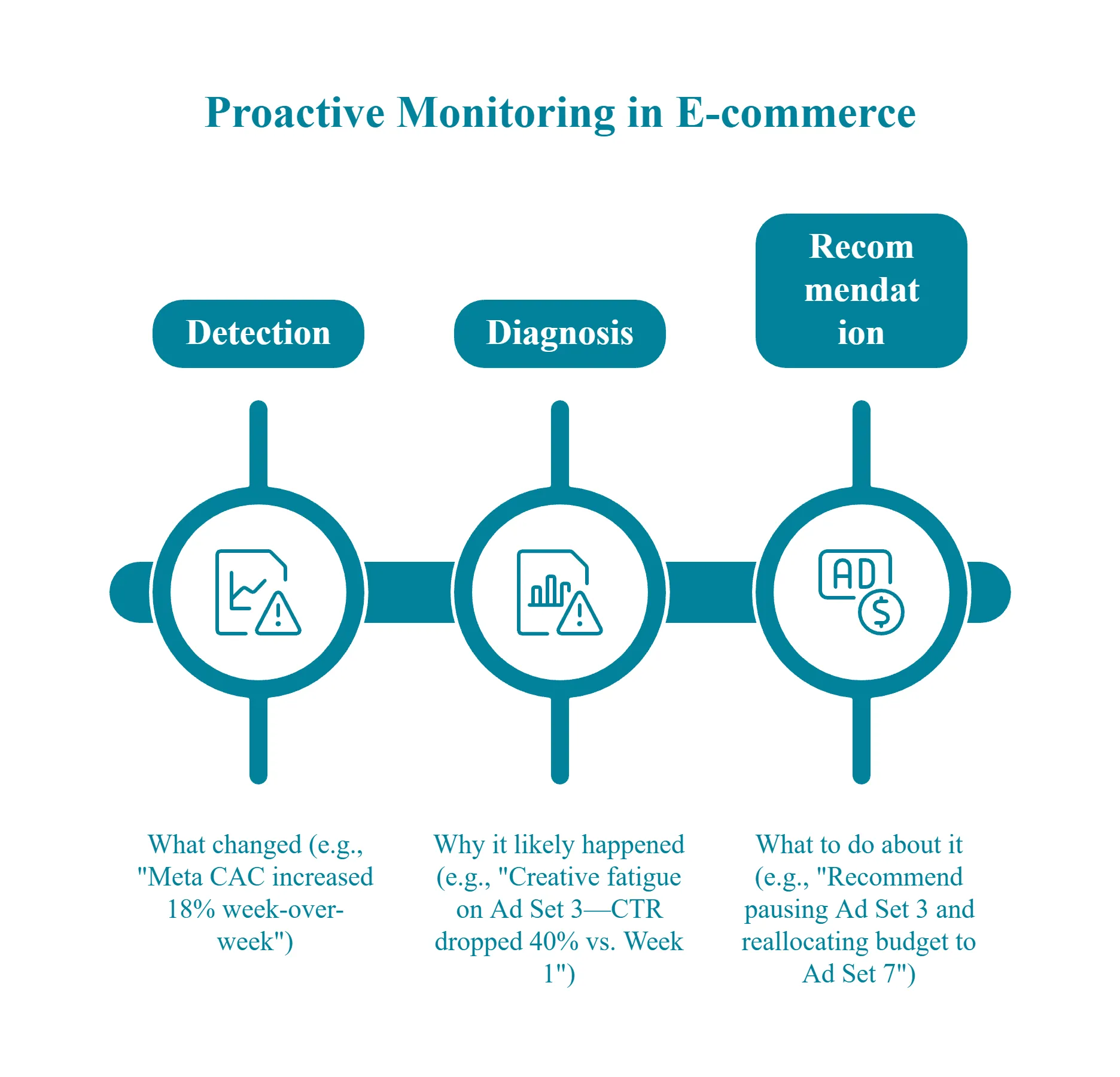
When metrics deviate from expected ranges, the system generates an alert with three components:
Detection: What changed (e.g., "Meta CAC increased 18% week-over-week")
Diagnosis: Why it likely happened (e.g., "Creative fatigue on Ad Set 3 - CTR dropped 40% vs. Week 1")
Recommendation: What to do about it (e.g., "Recommend pausing Ad Set 3 and reallocating budget to Ad Set 7")
Three-step proactive monitoring process for e-commerce AI: detection identifies metric changes like CAC increases, diagnosis explains root causes, and recommendation suggests actionable budget reallocation decisions.
Pattern recognition distinguishes signal from noise. Not every metric fluctuation warrants attention - the AI learns what constitutes a meaningful deviation for your specific business.
⏰ Why This Matters: Early Detection = Preserved Profit
The difference between catching a margin leak in week 1 versus week 4 is often €5,000-€20,000 in preserved profit. Proactive monitoring compresses detection time from "whenever you happen to check" to "the moment it becomes statistically significant."
"I caught a payment processor issue that was silently failing 3% of transactions. Would have taken me weeks to notice in Shopify - Luca flagged it in 2 days." — u/dtc_payments_lesson, r/shopify Reddit Thread
"The proactive alerts feel like having a really attentive analyst watching everything 24/7. Except it actually works on weekends." — u/ecom_founder_eu, r/ecommerce Reddit Thread
✅ How Luca AI Delivers Proactive Intelligence
Luca AI's proactive intelligence doesn't just alert - it initiates conversations:
"Hey [Name], I've been scanning your business and identified a promising opportunity - your TikTok campaign is showing 4.2x ROAS but only getting 8% of budget. Want to explore scaling?"
This push intelligence is the AI Co-Founder behavior that passive dashboards can't replicate. ❌ Traditional analytics tools wait for you to ask the right question. ✅ Luca AI surfaces the questions you didn't know to ask - and the opportunities you would have missed.
The shift: from manually monitoring 8 dashboards hoping to catch problems, to receiving synthesized intelligence that surfaces what actually matters.
Q6. AI for Forecasting and Scenario Planning: Modeling 'What If' Before You Commit [toc=Forecasting and Scenario Planning]
Traditional e-commerce planning is backwards-looking. Spreadsheet forecasts are built from last quarter's numbers, manually updated, and often outdated by the time decisions need to be made. The result: founders commit capital based on assumptions rather than dynamic projections.
AI-powered forecasting inverts this model - synthesizing real-time data to project forward and test scenarios before you commit.
📊 How AI Cash Flow Forecasting Works
Effective cash flow forecasting for e-commerce requires synthesizing data across four domains:
AI-powered forecasting connects these sources to generate 30/60/90-day projections that update automatically as underlying data changes. Unlike static spreadsheets, the forecast reflects today's reality - not last month's assumptions.
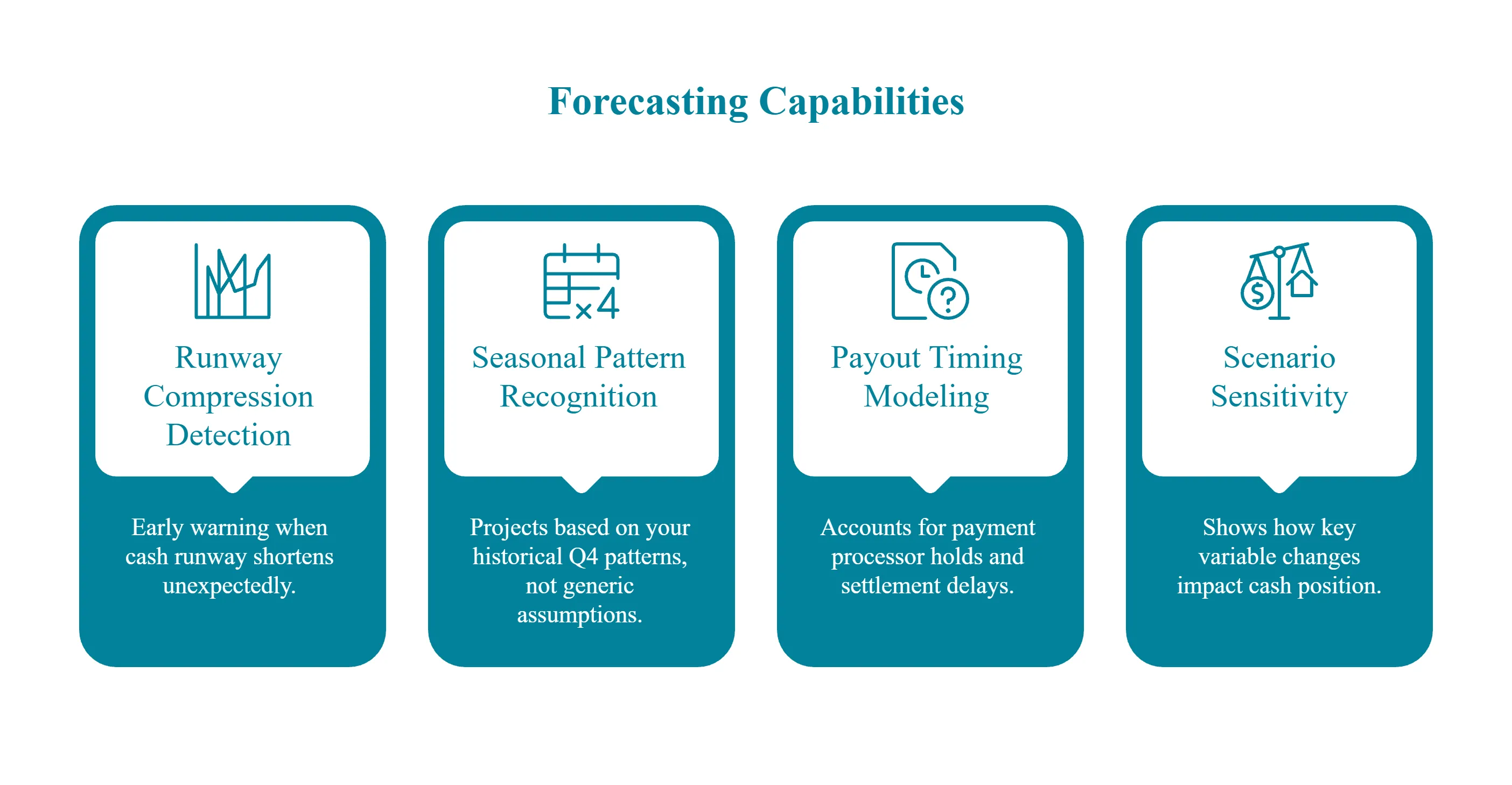
🔮 Key Forecasting Capabilities
Runway compression detection: Early warning when cash runway shortens unexpectedly
Seasonal pattern recognition: Projects based on your historical Q4 patterns, not generic assumptions
Payout timing modeling: Accounts for payment processor holds and settlement delays
Scenario sensitivity: Shows how key variable changes (ROAS, AOV, return rate) impact cash position
Four key AI forecasting features for e-commerce cash flow management: runway compression detection, seasonal pattern recognition, payout timing modeling, and scenario sensitivity analysis for informed decisions.
💡 Scenario Planning: Test Decisions Before Making Them
The real power emerges when forecasting combines with scenario modeling. Instead of guessing, founders can ask:
"If I scale Meta spend 40% and take €50K capital, what's my cash position in 90 days?"
"What happens to my runway if ROAS drops 20% from current levels?"
"Can I afford to place this inventory order without bridging capital?"
The AI models each scenario considering marketing response curves, inventory turnover rates, payment timing, and operational costs - returning a probabilistic range of outcomes, not a single point estimate.
✅ How Luca AI Integrates Forecasting with Action
Luca AI's forecasting isn't isolated from decision-making. When Luca identifies a cash gap or scaling opportunity through scenario modeling, it can:
Surface the insight proactively
Model the impact across multiple scenarios
Recommend optimal capital sizing
Provide instant funding access - all within the same conversation
This integration eliminates the gap between "knowing you need capital" and "having capital deployed." The AI that forecasts the opportunity can fund the opportunity - without separate applications, approvals, or waiting periods.
Q7. AI for Capital Access: Why Intelligent Underwriting Changes the Game [toc=Intelligent Capital Access]
Traditional revenue-based financing providers - Wayflyer, Clearco, Uncapped - solved a real problem: fast, non-dilutive capital without bank bureaucracy. But they operate with a fundamental architectural limitation: capital without intelligence.
They see your commerce data, calculate a fee, and deploy capital. What they can't do: tell you whether you should take that capital, how to deploy it optimally, or what happens to your cash flow in 90 days if you do.
❌ The Limitations of Traditional RBF
Wayflyer and Clearco excel at fast deployment - 72-hour approvals are genuinely impressive compared to 6-8 week bank timelines. But their model has structural constraints:
Static pricing: Based on a snapshot application, not real-time business health
Incentive misalignment: Larger advances = more fees, creating pressure to push bigger amounts
No deployment guidance: Capital arrives without strategic context on how to use it
Disconnected intelligence: The financing decision is separated from the business intelligence that should inform it
"Got approved for €200K from Wayflyer but had no idea if I actually needed that much or how to deploy it. Felt like being handed a loaded weapon without training." — u/rbf_regrets, r/ecommerce Reddit Thread
💡 The Synthesis Thesis: Intelligence + Capital
What if the system that identifies a scaling opportunity could also fund it? What if capital pricing reflected your business health today, not a 60-day-old application?
Intelligence without capital is advice. Analytics tools can tell you Campaign X is working - but can't help you scale it.
Capital without intelligence is risk. RBF providers can fund your growth - but can't tell you if that growth will be profitable.
The combination is what founders actually need.
✅ How Luca AI Delivers Intelligent Capital
Luca AI's capital access is architecturally different:
Traditional RBF vs Luca AI Capital Access
Capability
Traditional RBF
Luca AI
Pricing Basis
90-day historical snapshot
Real-time business health
Sizing Guidance
"How much do you want?"
"Here's the optimal amount for your goal"
Deployment Intelligence
None
Integrated scenario modeling
Access Speed
72 hours
Same-day
Repayment
Fixed schedule or %
Automated revenue-share
"Luca actually told me I was over-capitalizing. Suggested €30K instead of €100K, showed me the math, and I trusted it. That's not something Clearco would ever do." — u/capital_efficiency, r/ecommerce Reddit Thread
The Fundamental Shift
Traditional RBF asks: "How much capital do you want?"
Luca AI asks: "What are you trying to achieve, and what's the optimal capital structure to get there?"
That's the shift from transactional lending to intelligent partnership - from capital as commodity to capital as strategic tool.
Q8. What Does an AI-Native E-commerce Stack Actually Look Like? [toc=AI-Native E-commerce Stack]
Here's how a €3M DTC founder's Monday looks with an AI-native stack versus the fragmented reality most founders currently live in.
The question "Should I scale Campaign X?" remains unanswered because it requires synthesizing data across all these platforms - and the spreadsheet reconciliation revealed discrepancies that need investigation first.
✅ The AI-Native Stack (After)
AI-Native Stack Monday Morning Workflow
Time
Activity
Duration
7:30 AM
Open Luca - see overnight alert: "Meta CPM up 18% on Campaign X"
2 min
7:35 AM
Ask: "Why did Campaign X underperform this weekend?"
12 sec answer
7:40 AM
Ask: "If I shift €20K to TikTok, what's my cash position in 90 days?"
Modeled answer
7:45 AM
Luca surfaces: "Campaign Y at 4.2x ROAS - €30K capital available at 5.1%"
One-click deploy
8:00 AM
Done. Move on to product development meeting.
-
Total: 30 minutes. Decisions made: 3 confident ones. Capital deployed.
"My Monday mornings went from 'data reconciliation hell' to 'strategic decision time.' I actually have time to think about the business instead of just measuring it." — u/monday_transformed, r/ecommerce Reddit Thread
🔄 What This Shift Enables
The AI-native stack isn't about adding another tool to your existing 12-tool chaos. It's about replacing fragmented point solutions with one unified intelligence layer that:
Reasons across your entire business - marketing, finance, operations in one context
Surfaces insights proactively - no more hoping you ask the right question
Models decisions before you commit - scenario planning, not gut feel
Acts when confidence is high - pause campaigns, deploy capital, generate reports
Founders spend time on strategy, not data reconciliation. Decisions are made with confidence, not anxiety. Opportunities are seized in real-time, not delayed by analysis paralysis.
"It's not that I work less - I just work on different things now. Important things." — u/founder_leverage, r/startups Reddit Thread
Q9. How Do You Evaluate and Choose the Right AI Assistant for Your Business? [toc=Evaluation and Selection Guide]
Choosing an e-commerce intelligence platform means committing to a data architecture that will shape your decision-making for years. Pick wrong, and you're locked into fragmented reporting, expensive migrations, or - worse - another tool that creates more noise than clarity.
Most founders choose based on integration count ("Does it connect to Shopify?") or price ("Which is cheapest?"). This ignores the critical question: Can it reason across your data, or just display it?
Can it answer questions spanning marketing + finance + operations in one query?
Single-domain tools can't answer "Should I scale this campaign?"
✅ Proactive vs. Reactive
Does it surface insights automatically, or only when you ask?
You can't ask questions you don't know to ask
✅ Action Capability
Can it execute (pause campaigns, generate reports), or just advise?
Insights without action = more work for you
💰 Capital Integration
Can it fund opportunities it identifies?
Intelligence without capital is advice
⏰ Setup Complexity
10-minute integration or 6-week implementation?
Time-to-value matters
💸 Pricing Model
Flat rate, or charges by seats/data volume?
Seat-based pricing punishes growth
🧠 Intelligence Architecture
AI reasoning engine, or pre-built dashboard views?
Static dashboards can't reason
✅ Self-Assessment: Is Your Current Stack Working?
Score your existing analytics setup (1 point for each "Yes"):
Can you answer cross-functional questions in under 60 seconds?
Does your system alert you to anomalies proactively?
Can you model "what if" scenarios across marketing, finance, and operations?
Are all your data sources unified in one view?
Can your team get answers without SQL knowledge or analyst dependency?
Does your analytics tool take action, or just display data?
Can you access capital without a separate application process?
Score Interpretation:
⭐ 6-7: Your stack is mature - focus on optimization
⚠️ 3-5: Critical gaps exist - you're making decisions on incomplete data
❌ 0-2: Fragmentation is costing you revenue - manual processes dominate
"I scored myself a 2. Thought I had a sophisticated stack - turns out I had sophisticated fragmentation." — u/analytics_reality_check, r/ecommerce Reddit Thread
✅ Where Luca AI Scores on This Framework
Luca AI Evaluation Scorecard
Criterion
Luca AI
Why
Cross-Functional Reasoning
✅ 2/2
Unified data layer across all functions
Proactive Intelligence
✅ 2/2
24/7 automated scanning for risks/opportunities
Action Capability
✅ 2/2
Can execute decisions, not just recommend
Capital Integration
✅ 2/2
Only platform that can fund opportunities it identifies
Setup Complexity
✅ 2/2
10-minute no-code integration
Pricing Model
✅ 2/2
Flat rate + outcome-aligned capital pricing
Intelligence Architecture
✅ 2/2
AI reasoning engine, not static dashboards
Total
14/14
Purpose-built as AI Co-Founder
"I evaluated Triple Whale, Northbeam, and a bunch of BI tools against this kind of framework. Luca was the only one that could actually answer questions across domains without me doing the synthesis work." — u/tool_evaluator, r/shopify Reddit Thread
The Meta-Insight
The real question isn't "Which tool has the most features?" It's "Which system can reason about my business the way a co-founder would?"
That's the shift Luca AI represents: from renting tools to hiring intelligence.
Q10. Common Concerns: Data Security, Implementation, and Getting Started [toc=Common Concerns Addressed]
Before adopting any AI platform with access to business data, founders rightfully ask hard questions. Here are the three most common concerns - and direct answers.
🔒 Concern 1: "Is My Data Safe?"
"I'm not comfortable giving an AI access to all my financial data."
This is the most common concern - and it's valid. You've built your business on data that competitors would pay to access. Headlines about AI companies training on user data don't help.
The Reality:
✅ Luca AI is SOC 2 Type II certified - the same security standard required by enterprise software
✅ Bank-grade encryption (AES-256) for all data at rest and in transit
✅ GDPR compliant with full data deletion rights
✅ Your data is never used to train models or shared with third parties
✅ Security architecture matches or exceeds what Stripe, Shopify, and major banks require
Verification: Request the SOC 2 report directly, or schedule a security-focused demo. We expect you to verify before you trust. Review our complete privacy policy for detailed information.
⏰ Concern 2: "How Long Does Implementation Take?"
"I don't have 6 weeks for onboarding or a data team to manage integrations."
Traditional BI platforms require data engineering resources, weeks of configuration, and ongoing maintenance. That's not the model here.
The Reality:
✅ 10-minute no-code integration for Shopify, Meta, Google Ads, Stripe, Xero
✅ No data team required - connect your accounts via OAuth, and Luca handles the rest
✅ No 6-week implementation - start asking questions immediately after connection
✅ Luca begins learning your specific business patterns from day one
"I was skeptical about the '10 minutes' claim. Timed myself - it was actually 8 minutes to connect Shopify, Meta, and Stripe. Asked my first real question at minute 12." — u/implementation_timer, r/ecommerce Reddit Thread
📊 Concern 3: "How Do I Know It's Actually Helping?"
"How do I measure ROI on yet another analytics tool?"
Fair question. Here's how to think about it:
Immediate & Measurable:
⏰ Time saved: Hours of manual analysis to seconds (track your Monday morning routine before/after)
✅ Decision confidence: Qualitatively obvious within the first week
💰 ROI calculation: If Luca saves 10 hours/week at €100/hour opportunity cost = €4,000/month value vs. €499 subscription
Scaling opportunities identified and funded = measurable revenue impact
Reduced analyst headcount or reallocated analyst time to higher-value work
🚀 Getting Started
Two paths forward:
Book a 15-minute demo to see your actual data synthesized in real-time - not a generic product walkthrough, but your Shopify, your Meta campaigns, your cash position
Start a free trial and ask your first cross-functional question today
The fastest way to evaluate whether Luca AI works for your business is to connect your data and ask a question you've never been able to answer quickly before. Check our pricing to see available plans or visit our FAQ for additional questions.
FAQ's
Why isn't ChatGPT enough for running my e-commerce business?
We understand the appeal of ChatGPT - it's powerful for general knowledge, brainstorming, and content creation. However, ChatGPT has four architectural limitations that make it unsuitable for real business decisions:
No database integration: ChatGPT cannot connect to Shopify, Meta Ads, Stripe, or Xero - it only works with data you manually paste
Static knowledge: It doesn't know your Q4 performance or yesterday's campaign results
No business memory: Every conversation starts from zero - you must re-explain context each time
Hallucination risk: It can generate plausible-sounding but fabricated numbers
When you ask "Should I scale my Meta campaign?", ChatGPT can only provide general frameworks. We built Luca AI to answer with YOUR actual data - connecting to 20+ sources and maintaining persistent business context so you get specific recommendations, not generic advice.
How can AI help with e-commerce cash flow forecasting?
AI-powered cash flow forecasting synthesizes data across four domains that traditional spreadsheets cannot connect:
Commerce data (Shopify): Sales velocity, order trends, seasonal patterns
Marketing data (Meta, Google): Planned spend, campaign performance, acquisition costs
Accounting data (Xero, QuickBooks): Payables, receivables, operating expenses
Banking data: Current cash position, pending transactions
Unlike static spreadsheets built from last quarter's numbers, AI forecasting generates 30/60/90-day projections that update automatically as underlying data changes. We enable you to ask scenario questions like "If I scale Meta spend 40% and take €50K capital, what's my cash position in 90 days?" and receive modeled answers considering marketing response curves, inventory turnover, and payment timing.
What questions should an AI business intelligence tool be able to answer for e-commerce?
A truly useful AI business intelligence tool should answer cross-functional questions that span marketing, finance, and operations in a single query. Here are questions your current tools likely cannot answer:
"What's my true CAC including all costs (not just ad spend)?"
"Which product-channel combination is actually profitable after COGS and shipping?"
"If I take €50K capital and deploy to Meta, what's my cash position in 90 days?"
"Why did revenue increase but profit decrease last month?"
"Should I scale Campaign X or invest in inventory for Q4?"
These questions require data synthesis across 3+ systems - something siloed dashboards architecturally cannot do. We designed Luca AI's data analysis capabilities specifically to answer these cross-functional questions in seconds, not the 3-5 hours of manual spreadsheet work they currently require.
What's the difference between AI dashboards and an AI Co-Founder for e-commerce?
Traditional AI dashboards (Triple Whale, Northbeam, GA4) operate as passive reporting tools - they display what happened without explaining why or recommending what to do next. They show metrics in isolation: ROAS here, cash position there, inventory levels somewhere else.
An AI Co-Founder is architecturally different:
Cross-functional reasoning: Connects marketing spend → cash flow impact → inventory implications in one query
Proactive intelligence: Surfaces risks and opportunities without being asked
Action capability: Can execute decisions (pause campaigns, generate reports), not just advise
Capital integration: Can fund the opportunities it identifies
We built Luca AI as the world's first AI Co-Founder because we believe intelligence without capital is advice, and capital without intelligence is risk. The combination - a system that can both analyze an opportunity AND fund it - is what founders actually need.
How long does it take to implement an AI business intelligence platform?
Traditional BI platforms require data engineering resources, weeks of configuration, and ongoing maintenance. That's not our model.
10-minute no-code integration for Shopify, Meta, Google Ads, Stripe, Xero
No data team required - connect your accounts via OAuth, and we handle the rest
No 6-week implementation - start asking questions immediately after connection
Immediate learning - we begin understanding your specific business patterns from day one
One founder reported: "I was skeptical about the '10 minutes' claim. Timed myself - it was actually 8 minutes to connect Shopify, Meta, and Stripe. Asked my first real question at minute 12."
The fastest way to evaluate whether we work for your business is to connect your data and ask a question you've never been able to answer quickly before. Check our pricing to get started.
Enjoyed the read? Join our team for a quick 15-minute chat — no pitch, just a real conversation on how we’re rethinking Ecommerce with AI - Luca
Loading Schedule...
Your AI Co-Founder is here.
Here’s why:
Shopify, Meta, Xero - one brain.
"Should I scale?" Answered with real data.
Growth capital. No applications. One click.
Thank you! Your submission has been received! Please book a time slot for the Meeting
Oops! Something went wrong while submitting the form.

.jpg)
%20-%20visual%20selection.webp)