Prove fundability first: Maintain 2.5x+ ROAS for 30 days, positive contribution margin, and 2x LTV:CAC ratio before seeking capital.
AI-powered capital closes the gap: Platforms like Luca AI provide same-day funding with dynamic pricing based on real-time business health, not static applications.
Q1. Why Do Winning E-commerce Campaigns Run Out of Fuel? [toc=Why Campaigns Run Out of Fuel]
⏰ The Thursday Afternoon Dilemma
It's Thursday afternoon. Your Meta campaign is returning 4.2x ROAS, the best performance you've seen in 18 months. Your creative is resonating, your audience is converting, and the algorithm is finally working in your favor. But your ad account is capped at €5K/week because that's all the cash runway you can risk.
You watch competitors flood the auction while your winning campaign starves. The algorithm that finally favours you will move on by Monday. Your creative momentum, built over weeks of testing, will fade. And the market share you could have captured? Gone to competitors who had capital ready to deploy.
💸 Why This Cash Flow Gap Exists
This scenario happens because e-commerce cash flow is structurally misaligned with growth opportunity timing:
Revenue lag: Cash arrives 14-30 days after ad spend hits your account
Inventory lock-up: Capital tied in stock for 60-90 days before conversion to cash
Historical underwriting: Traditional lenders evaluate last quarter's financials, not today's proven performance
Payout delays: Shopify and Stripe hold funds for 2-14 days depending on account history
The result? Your business proves product-market fit on Tuesday, but your bank account doesn't reflect it until next month. This is where marketing analysis and automation becomes critical for identifying opportunities before they pass.
❌ The Hidden Cost of Waiting
The impact of capital-constrained scaling extends beyond missed revenue:
Hidden Costs of Delayed Scaling
Cost Type
Impact
Opportunity cost
Competitors capture 30-40% of available market share during performance windows
Margin compression
Inefficient spend pacing increases average CAC by 15-25%
Creative decay
Winning ads fatigue within 7-14 days; delayed scaling means shortened runway
Algorithm penalty
Pausing or throttling campaigns resets learning phases
"Found a winning ad but can't scale because cash is tied up in inventory. By the time I have budget, the creative is dead." — u/dtc_scaling, r/ecommercefuel Reddit Thread
✅ How Funding Should Actually Work
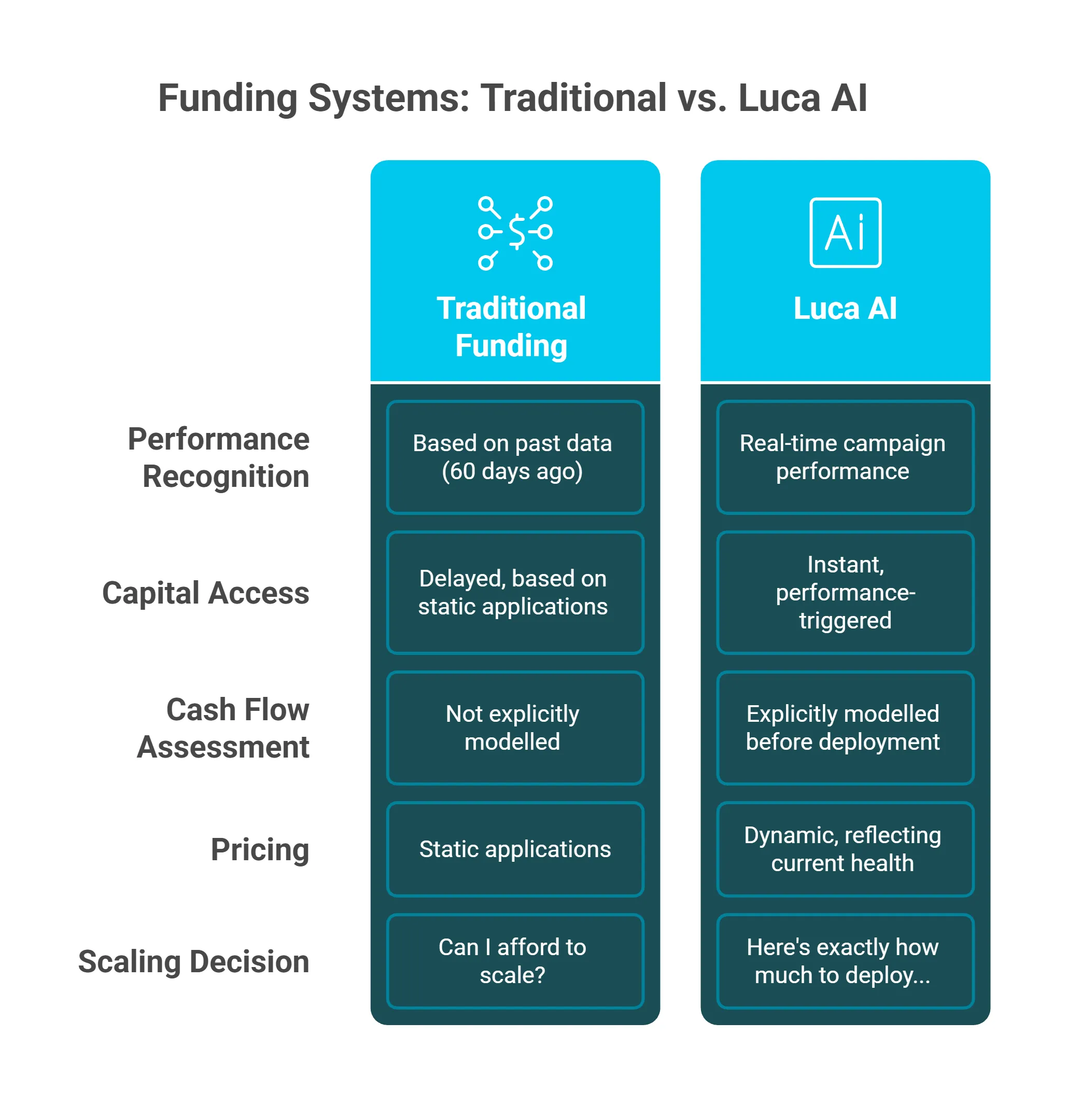
The right system would recognise your campaign performance in real-time, assess your cash flow implications, and unlock capital instantly, before the opportunity window closes. Not funding based on what you were doing 60 days ago, but what you're proving today.
This means:
Performance-triggered capital access (ROAS threshold → funding unlocked)
Cash flow modelling before deployment (scaling impact on runway)
Dynamic pricing reflecting current health (not static applications)
How Luca AI Bridges This Gap
Luca AI monitors your campaign performance continuously across Meta, Google, and TikTok. When ROAS crosses your defined threshold, Luca doesn't just alert you. It models the cash impact of scaling, calculates optimal deployment amounts, and offers instant capital at a rate reflecting your real-time business health.
The conversation shifts from "Can I afford to scale?" to "Here's exactly how much to deploy and what it costs based on what you've proven today."
Comparative infographic contrasting traditional funding limitations with Luca AI's intelligence-led capital approach, showing differences in real-time performance recognition, instant access, and dynamic pricing.
Q2. Why Doesn't Traditional Funding Work for Marketing Campaigns? [toc=Traditional Funding Limitations]
⏰ The Speed Mismatch Problem
E-commerce marketing operates on hourly cycles. Algorithms optimise in real-time, creative fatigue sets in within days, and auction dynamics shift continuously. A winning campaign today might be mediocre by next week, not because anything changed in your business, but because the competitive landscape moved.
Yet traditional funding operates on quarterly timelines: 6-8 week bank approvals, static credit assessments, and pricing based on historical financials that don't reflect current performance. This creates a fundamental architectural incompatibility.
🏦 Bank Loans: The 60-Day Delay
Bank loans require extensive documentation, personal guarantees, and 45-60 day processing. The typical requirements include:
2-3 years of audited financial statements
Personal credit checks and guarantees
Business plans and use-of-funds documentation
Collateral assessment and legal review
By the time funds arrive, your winning campaign has plateaued, creative has fatigued, and the algorithm has moved on. Banks evaluate your 2024 tax returns to fund your January 2026 opportunity, a fundamental timing mismatch that no amount of relationship banking can solve. Proper financial management requires capital solutions that match the speed of modern e-commerce.
💳 Credit Lines: Insufficient Scale
Business credit lines offer faster access but come with structural limitations:
Variable interest rates that spike during economic uncertainty
Credit score dependencies that penalise growth-stage businesses
Limits misaligned with need: A €50K credit line doesn't help when you need €150K to capture a seasonal window
Personal liability: Most require personal guarantees for sub-€500K facilities
"Applied for a business line of credit to scale Q4 campaigns. Approved for €30K when I needed €100K. The limit was based on last year's revenue, not current performance." — u/ecom_cfo, r/shopify Reddit Thread
📉 Venture Capital: Disproportionate Solution
VC funding provides scale but requires 3-6 month fundraising processes, equity dilution (typically 15-25% for seed rounds), and strategic constraints including board oversight and growth expectations.
Taking equity investment to fund a marketing campaign is like buying a house to get a parking spot, disproportionate to the actual need. You sacrifice long-term ownership for short-term cash flow, creating a structural misalignment between capital type and capital use.
The Architectural Gap
The gap is clear: marketing opportunities move in days, but traditional capital moves in months. This timing mismatch isn't a feature limitation. It's a fundamental architectural incompatibility between how capital markets were designed (for physical assets, predictable cash flows, long time horizons) and how e-commerce marketing works (digital, variable, immediate).
This gap created the market for revenue-based financing and, more recently, AI-powered capital platforms that understand business context.
Q3. What Are Your Options for Funding E-commerce Marketing Campaigns? [toc=Funding Options Overview]
The Modern Funding Landscape
The e-commerce funding landscape has evolved significantly beyond traditional bank loans. Modern options are designed for the speed and flexibility that digital businesses require, but each comes with distinct trade-offs in cost, speed, flexibility, and intelligence.
Understanding these options is essential for making informed capital decisions. Effective data analysis and deep industry research can help identify which funding model best fits your specific situation.
Infographic comparing three funding options for scaling e-commerce marketing campaigns: revenue-based financing for consistent revenue, merchant cash advances for urgent needs, and AI-powered capital platforms with dynamic pricing.
💰 Revenue-Based Financing (RBF)
Revenue-based financing provides capital in exchange for a percentage of future revenue until a predetermined amount is repaid.
Revenue-Based Financing Overview
Feature
Typical Terms
Providers
Wayflyer, Clearco, Uncapped, 8fig
Approval time
24-72 hours
Advance amounts
10-30% of monthly revenue
Fee structure
6-12% flat fee
Repayment
5-15% of daily/weekly revenue
Requirements
No personal guarantees, 6+ months trading history
✅ Best for: Businesses with consistent revenue seeking non-dilutive capital for proven campaigns
❌ Limitation: Static pricing based on application snapshot; no guidance on deployment strategy
💳 Merchant Cash Advances (MCA)
Merchant cash advances provide an advance against future card sales with automatic daily repayment through your payment processor.
Factor rates: 1.2-1.5x (translating to 40-80% APR equivalent)
Approval: Often same-day
Repayment: Automatic daily deduction from card sales
✅ Best for: Urgent short-term needs when other options unavailable
❌ Limitation: Expensive; daily repayment can strain cash flow during slow periods
"Took an MCA to scale a campaign. The factor rate looked reasonable until I calculated the APR, it was 65%. Never again." — u/dtcfounder, r/ecommerce Reddit Thread
⚡ AI-Powered Capital Platforms
The newest category combines business intelligence with embedded financing. Unlike traditional RBF, these platforms provide:
Dynamic pricing based on real-time performance, not static applications
Optimal sizing recommendations to avoid over/under-capitalisation
Integrated analytics that help determine IF you should take capital, not just whether you qualify
Scenario modelling showing cash flow impact before deployment
How Luca AI Fits This Category
Luca AI represents the AI-powered capital category: the only platform that can analyse your campaign opportunity AND fund it in the same conversation, with pricing that reflects your current business health, not a 60-day-old application snapshot.
Traditional RBF answers: "Do you qualify for capital?" Luca AI answers: "Should you take capital, how much, and what happens to your business if you do?"
Q4. How Does Revenue-Based Financing Work for Marketing Spend? [toc=RBF Mechanics Explained]
Understanding RBF Mechanics
Revenue-based financing provides capital in exchange for a percentage of future revenue until a predetermined amount is repaid. Unlike loans with fixed monthly payments, RBF repayment flexes with your sales volume, paying more during strong months, less during slow periods.
This structure aligns particularly well with marketing spend, where revenue generation is directly tied to campaign performance.
📊 Typical RBF Structures for E-commerce
Standard RBF Terms for E-commerce
Component
Typical Range
Example
Advance amount
10-30% of monthly revenue
€50K on €200K/month revenue
Fee structure
6-12% flat fee
€4K fee on €50K advance
Repayment %
5-15% of daily/weekly revenue
10% of daily sales
Repayment period
4-9 months
~6 months at typical velocity
Personal guarantee
None required
-
✅ Why RBF Fits Marketing Spend
Revenue-based financing aligns structurally with marketing campaign economics:
Immediate deployment: Capital available for proven campaigns without 6-week approval cycles
Revenue-aligned repayment: Matches the ad spend → revenue timing gap naturally
Performance correlation: Repayment accelerates during successful periods (when you can afford it) and slows during testing phases
No equity dilution: Maintain full ownership while accessing growth capital
Understanding your sales performance metrics is essential for determining whether RBF makes sense for your specific situation.
"RBF was the only option that made sense for scaling our Q4 campaigns. Fixed loan payments would have killed us in January when sales dropped." — u/shopify_seller, r/FulfillmentByAmazon Reddit Thread
💸 Calculating True Cost
Understanding true cost requires comparing RBF fees against alternatives:
Example calculation:
€50K advance with 8% fee = €54K total repayment
Repaid over 6 months = ~16% APR equivalent
Compare against:
❌ Opportunity cost of NOT scaling a 4x ROAS campaign (potentially €100K+ in missed contribution margin)
❌ Credit card financing at 20%+ APR
❌ Equity dilution value (€50K at 20% dilution = valuing company at €250K)
RBF often represents the lowest total cost for short-term marketing capital when opportunity cost is factored in.
How Luca AI Simplifies This Calculation
Luca AI automates this cost-benefit analysis instantly. Ask: "What's the true cost of taking €50K to scale my Meta campaign versus waiting until I have cash?"
Luca returns a comparison factoring in:
Projected ROAS based on current campaign performance
Repayment timeline against your revenue forecast
Opportunity cost of delayed scaling
Cash runway impact across the repayment period
The answer isn't just "here's what RBF costs." It's "here's whether RBF makes sense for YOUR specific situation."
Q5. The Intelligence Gap: Are You Getting Capital Without Knowing If You Should? [toc=The Intelligence Gap]
⚠️ What Capital Providers Don't Tell You
Here's what Wayflyer, Clearco, and traditional RBF providers don't tell you: they have no idea if you should take the capital they're offering. Their business model is deploying capital and collecting fees. The more you borrow, the more they earn. They're not incentivised to ask "Is this actually the right move for your business?"
These platforms excel at one thing: determining whether you qualify. But qualification and wisdom are different questions entirely. You might qualify for €200K while only needing €50K, and the provider benefits from the larger deployment.
💸 Capital Without Intelligence Is Risk
When you take €100K to scale a Meta campaign, do you know:
How this affects your Q4 inventory cash needs?
Whether your margins hold at 3x current volume?
If your creative will fatigue before you recoup the capital cost?
What happens if ROAS drops 30% mid-deployment?
Traditional funders don't model these scenarios. They just write checks. The downstream implications of your capital decision remain invisible until they hit your P&L. This is where proper financial management becomes essential for protecting your business.
"Took €75K from [RBF provider] to scale campaigns. Nobody asked if my inventory could support the increased demand. Ran out of stock in week 3, wasted €20K on ads driving to out-of-stock pages." — u/dtc_inventory_fail, r/ecommercefuel Reddit Thread
❌ The Structural Incentive Misalignment
The conflict is architectural, not accidental. When a founder asks Wayflyer for €100K, Wayflyer's incentive is to say "Actually, why not €150K?" More capital deployed equals more fee revenue. There's no mechanism in their model to say "Are you sure you need this much? Why not take €30K, prove it works, then scale up?"
This isn't criticism of individual providers. It's recognition that their business model creates inherent misalignment between their revenue optimisation and your capital efficiency.
✅ The Synthesis Thesis
The future belongs to systems that can reason about your opportunity AND provide the funding, where the entity recommending the move has skin in the game.
❌ Intelligence without capital = advice (dashboards that show problems but can't solve them)
❌ Capital without intelligence = risk (funding that ignores downstream implications)
✅ Intelligence + Capital = partnership (systems that only fund what they believe will work)
"The RBF space feels like payday lending for businesses. They'll approve you for max amount regardless of whether it makes sense. Nobody's looking out for optimal deployment." — u/ecom_cfo_skeptic, r/smallbusiness Reddit Thread
How Luca AI Closes This Gap
Luca AI is designed to fuse intelligence with capital. Before offering funding, Luca models: "If you deploy €50K to this campaign, here's your cash position in 30/60/90 days, your inventory implications, your margin sensitivity, and your optimal deployment cadence."
Luca puts its money where its math is, expressing confidence in its own analysis by funding what it recommends. When Luca suggests taking €40K instead of €100K, it's because the model shows that's what your opportunity actually requires.
Q6. How Much Capital Do You Actually Need to Scale? [toc=Optimal Capital Sizing]
💰 The Over/Under Capitalisation Problem
Most founders either request too little capital (constraining scaling potential) or too much (paying fees on money sitting idle). Traditional RBF providers incentivise larger advances because larger advances generate larger fees. Your optimisation goal is different: deploy exactly what you need, no more.
Optimal capital sizing requires modelling your specific opportunity, not accepting whatever you qualify for. Understanding your sales performance patterns is critical to getting this calculation right.
📊 The Capital Sizing Formula
Calculate your actual requirement using this framework:
In this example, the optimal advance is €132K, not the €200K you might qualify for. That €68K difference costs 8-12% in fees for capital sitting idle.
✅ Capital Sizing Checklist
Score your scaling readiness:
☐ What's your proven sustainable ROAS at current spend level?
☐ At what spend level does performance typically degrade?
☐ What's your revenue-to-cash collection timing (Shopify/Stripe payout delays)?
☐ Do you have inventory/COGS requirements tied to scaling?
☐ What's your existing cash runway without additional capital?
☐ What repayment percentage can your cash flow sustain (5%, 10%, 15%)?
❌ Common Over-Capitalisation Mistakes
Founders frequently take too much by:
Accepting maximum approved amounts without modelling actual need
Ignoring revenue timing gaps (21-30 days from spend to cash)
Forgetting inventory cash requirements for increased demand
Not accounting for creative testing phases within campaign duration
Using "round numbers" (€100K, €200K) instead of calculated requirements
Every euro of unused capital costs 8-12% in fees for nothing. A €50K over-advance at 10% fee = €5,000 wasted on idle money.
How Luca AI Optimises Capital Sizing
Luca AI calculates optimal capital sizing automatically through data analysis and deep industry research. Ask: "How much capital do I actually need to scale my Meta campaign to €3K/day?"
Luca returns a precise recommendation factoring in:
Your specific revenue timing and payout schedules
Current margin structure and volume sensitivity
Existing cash runway and burn rate
Inventory requirements based on historical conversion data
The answer is a calculated amount, not a generic "you qualify for up to €200K" offer designed to maximise lender revenue.
Q7. What Metrics Do You Need to Prove Before Getting Marketing Funding? [toc=Fundability Metrics]
📋 Understanding Fundability Criteria
Capital providers, whether traditional RBF or AI-powered platforms, evaluate risk based on specific performance metrics. Understanding these criteria helps you both qualify for better terms and make smarter decisions about when to seek funding.
Not all campaigns deserve capital. Scaling a losing campaign faster just loses money faster. Proper marketing analysis and automation helps identify which campaigns are truly ready for scaling.
✅ Campaign Fundability Checklist
Score yourself against these seven criteria:
Campaign Fundability Assessment
Metric
Threshold
Your Score
☐ ROAS consistency
Above 2.5x for 30+ days
0-1
☐ CAC efficiency
Below 30% of first-order AOV
0-1
☐ Contribution margin
Positive after ad spend + COGS + fulfillment
0-1
☐ LTV:CAC ratio
60-day LTV exceeds 2x CAC
0-1
☐ Scalability evidence
Performance holds at 1.5-2x current spend
0-1
☐ Attribution clarity
Clear model connecting spend to revenue
0-1
☐ Repayment capacity
Cash flow forecast shows sustainable repayment
0-1
📊 Score Interpretation
Score 6-7: ⭐ High fundability. Focus on optimising capital terms and sizing. You're ready to scale.
Score 3-5: ⚠️ Moderate fundability. Address attribution or margin gaps before scaling. Capital might accelerate problems.
Score 0-2: ❌ Low fundability. Prioritise unit economics optimisation. Scaling now amplifies losses; fix fundamentals first.
💸 The Data Assembly Challenge
The challenge: calculating these metrics accurately requires unifying data across multiple platforms:
Visual diagram illustrating how e-commerce metrics from Shopify, Meta/Google advertising, and Xero/QuickBooks financial data combine to determine marketing campaign fundability and capital eligibility.
Shopify: Revenue, orders, product margins
Meta/Google: Ad spend, attribution, ROAS
Xero/QuickBooks: True costs, contribution margins, cash position
Most founders spend 10+ hours manually assembling this picture across disconnected systems, and still lack confidence in accuracy. Attribution discrepancies between platforms create uncertainty that undermines funding decisions.
How Luca AI Automates Fundability Assessment
Luca AI calculates all seven metrics automatically by unifying your commerce, marketing, and accounting data into a single reasoning layer. Learn more about how Luca thinks to understand this unified approach.
Ask: "Am I ready to seek marketing funding?"
Luca returns an instant fundability assessment with:
Specific scores across all seven criteria
Gaps identified with improvement recommendations
Projected timeline to reach fundability thresholds
Comparison against benchmarks for your category and scale
In seconds, not spreadsheet hours.
Q8. Instant vs. Application-Based Funding: What's the Time Cost? [toc=Time Cost Comparison]
⏰ Time-to-Capital as Opportunity Cost
Time-to-capital isn't just a convenience factor. It's an opportunity cost calculation. Every day between identifying a scaling opportunity and deploying capital is a day your competitors are capturing market share you could have owned.
Marketing windows close. Creative momentum fades. Algorithm favour shifts. The question isn't just whether you can get funding. It's whether you can get it before the opportunity passes.
Side-by-side comparison of application-based funding versus instant capital models, highlighting key differences in time-to-capital, pricing basis, application requirements, and core decision questions for e-commerce founders.
📋 Traditional Application Timeline
Application-Based Process (Wayflyer, Clearco, Banks):
Traditional RBF Application Timeline
Stage
Timeline
Activity
Day 1-2
Application
Complete forms, connect data sources
Day 3-5
Underwriting
Historical performance review
Day 5-7
Offer
Terms presentation and negotiation
Day 7-10
Legal
Contract review and acceptance
Day 10-14
Deployment
Funds transfer to account
Total: 10-14 days from opportunity identification to capital deployment.
💸 Calculating the Time Cost
Example scenario:
Meta campaign returning 4x ROAS at €1K/day
Goal: Scale to €3K/day
Application process: 14 days
Opportunity cost during waiting period:
Missed additional spend: €2K × 14 days = €28K
Missed revenue at 4x ROAS: €112K
Missed contribution margin (after COGS): €40-50K
The opportunity cost of the 14-day delay likely exceeds the total fee cost of the capital itself. You're paying twice: once in fees, once in missed margin. Effective product management requires capital that moves at the speed of opportunity.
⚡ Instant Capital Model
Performance-Based Access (Luca AI):
No application process required
Capital availability continuously calculated based on real-time health
When opportunity identified, capital already unlocked
Pricing reflects current performance, not historical snapshot
Time-to-deployment: Same day
📊 Head-to-Head Comparison
Application-Based vs Instant Capital Comparison
Factor
Application-Based
Instant/Earned
Time to capital
10-14 days
Same day
Pricing basis
Application snapshot
Real-time health
Sizing logic
Maximise lender revenue
Optimise founder ROI
Intelligence layer
Separate system
Unified with funding
Opportunity cost
High (missed windows)
Minimal
The architectural difference: application-based systems treat funding as a discrete transaction separate from business operations. Instant capital models treat funding as a continuous capability earned through demonstrated performance.
The question shifts from "Can I get approved?" to "My capital is ready. Should I deploy it now?"
Q9. How Does Dynamic Pricing Reflect Your Business Health? [toc=Dynamic Pricing Explained]
💰 What Dynamic Capital Pricing Means
Dynamic capital pricing means your funding cost reflects your business health at the moment of deployment, not a snapshot from weeks ago. As your performance improves, your capital gets cheaper. As risk decreases, rates decrease.
This inverts the traditional model where pricing locks at application time, regardless of subsequent business performance. Understanding this distinction is crucial for effective financial management.
⚙️ How Traditional vs. Dynamic Pricing Works
Traditional RBF prices capital at application time. If you apply in January during a slow month, your 10% fee reflects January performance, even if February ROAS doubles. You're paying for risk that no longer exists.
Dynamic pricing operates differently:
Dynamic Pricing Factors
Factor
Update Frequency
Impact on Rate
Revenue trends
Daily
Higher growth → lower rate
Margin stability
Weekly
Stable margins → lower rate
Cash position
Daily
Stronger runway → lower rate
Marketing efficiency
Daily
Better ROAS → lower rate
Repayment history
Per payment
On-time → lower rate
Each capital deployment prices to your current state, not historical snapshots.
📊 Practical Impact Example
Scenario: Founder A's capital journey
Dynamic Pricing in Action
Deployment
Timing
Business State
Rate
First €50K
January
Slow season, 2.8x ROAS
9%
Second €50K
March
Q1 exceeded projections, 3.8x ROAS
7%
Third €50K
May
Sustained performance, strong margins
6%
Same founder, same platform, better terms because performance earned it. Traditional RBF would charge 9% for all three deployments based on the original January application.
"Applied to [RBF provider] in our slow season. Got stuck with high rates for 6 months even though Q2 was our best quarter ever. The pricing didn't reflect our actual business." — u/dtc_finance_director, r/ecommerce Reddit Thread
✅ Why This Creates Better Incentive Alignment
Dynamic pricing aligns provider and founder incentives:
✅ Provider benefits when you improve: Better performance means sustainable capital deployment at higher volumes
✅ Founder rewarded for growth: Strong execution earns cheaper capital
❌ Traditional model penalises growth: Static rates ignore performance improvements
❌ Risk premium persists: You pay for January risk in June
The system rewards performance rather than penalising growth-stage volatility. This approach aligns with how Luca thinks about capital deployment.
How Luca AI Implements Dynamic Pricing
Luca AI's dynamic pricing is powered by continuous analysis across your full data stack:
Shopify: Revenue trends, order velocity, product mix
Your "capital rate" is visible in real-time within Luca, updating as your business evolves. Better performance = cheaper capital = stronger alignment between Luca's success and yours.
Q10. How Do You Decide Whether to Fund a Scaling Campaign? [toc=Capital Decision Framework]
⚠️ The Decision Dilemma
Taking capital to scale a campaign isn't automatically the right move. The decision depends on performance sustainability, cash flow timing, margin sensitivity, and opportunity window duration. Get it wrong, and you've added debt burden to a campaign that was already plateauing.
Approval and wisdom are different things. Just because you can get funding doesn't mean you should. Proper data analysis and deep industry research helps inform this critical decision.
❌ The Wrong Way to Decide
Most founders decide based on:
"Can I get approved?" (qualification ≠ wisdom)
"Is this cheaper than alternatives?" (ignores downstream impact)
"Do I have a proven campaign?" (past performance ≠ future scalability)
This ignores the critical question: What happens to my business AFTER I deploy this capital and start repaying it?
"Took funding to scale a campaign that was working at €1K/day. At €3K/day, ROAS dropped 40%. Now I'm repaying capital on a campaign that barely breaks even." — u/scaling_mistake, r/PPC Reddit Thread
✅ The Capital Decision Framework
Score each criterion 0-2 before taking capital:
Capital Decision Scoring Framework
Criterion
Question
Score
Performance Confidence
Has ROAS held stable for 30+ days at current scale?
0-2
Scalability Evidence
Does performance hold when spend increases 20-30%?
0-2
Cash Flow Timing
Will revenue arrive before repayment strains cash?
0-2
Margin Protection
Does contribution margin stay positive at higher volume?
0-2
Opportunity Window
Is this time-sensitive (seasonal, competitive)?
0-2
ROI Threshold
Does projected return exceed capital cost by 3x+?
0-2
📊 Score Interpretation
Total Score 10-12: ⭐ Strong candidate. Proceed with optimised sizing. Your fundamentals support scaling.
Score 6-9: ⚠️ Moderate candidate. Address specific gaps before deploying full amount. Consider starting with 50% of planned capital.
Score 0-5: ❌ Weak candidate. Focus on performance optimisation. Capital amplifies problems at this stage; fix fundamentals first.
"Wish someone had given me a framework like this before I took €100K to scale. Would have realised my margins couldn't support the volume increase." — u/dtc_lessons_learned, r/ecommercefuel Reddit Thread
How Luca AI Automates This Evaluation
Luca AI runs this decision framework continuously against your real-time data through marketing analysis and automation. Ask: "Should I take €50K to scale my Meta campaign?"
Luca returns a scored assessment covering all six criteria, with specific projections for:
Cash flow impact across 30/60/90 day horizons
Margin sensitivity at scaled volume
ROI scenarios (base case, upside, downside)
Optimal deployment cadence
The decision framework isn't something you apply manually. It's built into the intelligence layer.
Q11. Step-by-Step: How to Fund Your Next Winning Campaign [toc=Funding Roadmap]
🗺️ The Funding Roadmap
Whether you pursue traditional RBF or AI-powered capital, the path from proven performance to deployed funding follows a predictable sequence. Here's the roadmap, with timelines for both approaches.
Step-by-step funding roadmap for e-commerce marketing campaigns showing three phases: prove performance over 30+ days, prepare and calculate funding needs, then secure and deploy capital.
📅 Phase 1: Prove Performance (Weeks 1-4)
Before seeking capital, build the track record that de-risks deployment:
Run campaigns at current budget with rigorous tracking across all metrics
Traditional RBF: Begin application process (expect 10-14 days)
AI-powered platforms: Connect data sources for continuous evaluation
⚡ Phase 3: Secure and Deploy (Week 6+)
Traditional RBF Path:
Days 1-5: Application and underwriting
Days 5-10: Offer review and negotiation
Days 10-14: Deployment
AI-Powered Path:
Capital already unlocked based on proven performance
Same-day deployment at dynamic rate
No application waiting period
Deployment strategy (both paths):
Start with conservative deployment (50% of approved amount)
Validate performance holds at increased scale
Scale to full allocation once stability confirmed
"The traditional RBF process took 12 days. By the time I got funded, my creative was fatiguing. Next time I'd want something faster." — u/time_kills_deals, r/shopify Reddit Thread
How Luca AI Compresses This Timeline
Luca AI eliminates the application bottleneck entirely:
Connect your Shopify, Meta, and Xero in 10 minutes
Continuous evaluation: Luca monitors your fundability score 24/7
Automatic surfacing: Capital offers appear when performance thresholds are met
Instant deployment: Same-day capital at dynamic pricing
When your campaign proves itself, capital is already available, priced to your real-time health, sized to your actual opportunity. The question shifts from "How do I get funding?" to "My funding is ready. Should I deploy it now?"
Check our pricing to understand how Luca AI's intelligence-led capital model can work for your business.
FAQ's
What is the fastest way to get funding for e-commerce marketing campaigns?
We've found that the fastest path to marketing capital depends on your current infrastructure and performance data. Traditional bank loans take 6-8 weeks with extensive documentation requirements. Revenue-based financing providers like Wayflyer and Clearco typically process applications in 10-14 days.
However, AI-powered capital platforms represent the fastest option available today. These platforms continuously evaluate your business health based on real-time performance data, meaning capital is pre-approved based on what you've already proven. When you identify a scaling opportunity, funding is already unlocked.
At Luca AI, we enable same-day capital deployment because we're continuously monitoring your Shopify, Meta, and financial data. There's no application process. Your fundability score updates daily, and capital offers surface automatically when your campaigns hit performance thresholds.
The key difference: traditional funding requires you to apply when you need capital, while intelligence-led capital is already available because you've earned it through demonstrated performance.
How much funding do I actually need to scale my marketing campaigns?
We recommend using a precise calculation rather than accepting whatever amount you qualify for. Traditional RBF providers incentivise larger advances because larger advances generate more fees. Your goal is different: deploy exactly what you need, no more.
For example, scaling Meta from €500/day to €2,000/day for 60 days requires €90K in additional spend. Add a 21-day revenue timing buffer (€42K) and you need approximately €132K, not the €200K you might qualify for.
Every euro of unused capital costs 8-12% in fees for nothing. A €50K over-advance at 10% fee wastes €5,000 on idle money.
We built Luca AI's financial management capabilities specifically to automate this calculation. Ask us "How much capital do I actually need?" and receive a precise recommendation based on your specific revenue timing, margin structure, and cash runway.
What metrics do capital providers look at before funding marketing campaigns?
We've identified seven key metrics that determine campaign fundability across all capital providers:
ROAS consistency: Above 2.5x for 30+ days (not just peak performance)
CAC efficiency: Below 30% of first-order AOV
Contribution margin: Positive after ad spend + COGS + fulfillment
LTV:CAC ratio: 60-day customer LTV exceeds 2x CAC
Scalability evidence: Performance holds at 1.5-2x current spend
Attribution clarity: Clear model connecting spend to revenue
Scoring 6-7 indicates high fundability. Scoring 3-5 suggests addressing gaps before seeking capital. Scoring 0-2 means prioritising unit economics first.
The challenge is that calculating these metrics requires unifying data across Shopify, Meta/Google, and Xero/QuickBooks. Most founders spend 10+ hours manually assembling this picture. We built Luca AI's marketing analysis to calculate all seven metrics automatically by unifying your commerce, marketing, and accounting data.
What is revenue-based financing and how does it work for marketing spend?
Revenue-based financing (RBF) provides capital in exchange for a percentage of future revenue until a predetermined amount is repaid. Unlike loans with fixed monthly payments, RBF repayment flexes with your sales volume, paying more during strong months and less during slow periods.
Typical RBF structures for e-commerce:
Advance amounts: 10-30% of monthly revenue (€10K-€500K typical)
Fee structure: 6-12% flat fee
Repayment: 5-15% of daily/weekly revenue
Timeline: 4-9 months depending on revenue velocity
Requirements: No personal guarantees, 6+ months trading history
RBF fits marketing spend because repayment naturally aligns with the ad spend → revenue timing gap. Repayment accelerates during successful campaign periods (when you can afford it) and slows during testing phases.
Calculating true cost: A €50K advance with 8% fee equals €54K total repayment. Repaid over 6 months, that's approximately 16% APR equivalent.
We help founders evaluate whether RBF makes sense through our data analysis capabilities, comparing opportunity cost of delayed scaling against capital fees.
Why don't traditional bank loans work for scaling marketing campaigns?
We've identified a fundamental architectural incompatibility between traditional lending and e-commerce marketing dynamics.
The timing mismatch:
E-commerce marketing operates on hourly cycles. Algorithms optimise in real-time, creative fatigue sets in within days, and auction dynamics shift continuously.
Bank loans require 45-60 day processing, extensive documentation, and personal guarantees. By the time funds arrive, your winning campaign has plateaued.
Specific limitations:
Banks evaluate your 2024 tax returns to fund your January 2026 opportunity
Personal guarantees expose founders to individual liability
Credit limits rarely match marketing scaling needs
Business credit lines offer faster access but typically cap at €50K-€100K, insufficient for capturing seasonal windows requiring €150K+.
Venture capital provides scale but requires 3-6 month fundraising, equity dilution (15-25%), and strategic constraints disproportionate to a marketing campaign need.
The gap is clear: marketing opportunities move in days, but traditional capital moves in months. This is why we built Luca AI to provide instant, performance-based capital that matches e-commerce speed.
Enjoyed the read? Join our team for a quick 15-minute chat — no pitch, just a real conversation on how we’re rethinking Ecommerce with AI - Luca
Loading Schedule...
Your AI Co-Founder is here.
Here’s why:
Shopify, Meta, Xero - one brain.
"Should I scale?" Answered with real data.
Growth capital. No applications. One click.
Thank you! Your submission has been received! Please book a time slot for the Meeting
Oops! Something went wrong while submitting the form.

.jpg)
.webp)
.webp)
.webp)
.webp)