E-commerce Cash Flow Forecasting: Why Most Tools Get It Wrong?
12
mins read
In this article
TL;DR
E-commerce cash flow is structurally unpredictable due to payment processor timing (2-14 days), marketing spend timing mismatches, and multi-channel complexity that traditional forecasting can't model.
The marketing-inventory-cash triangle is the critical blind spot: scaling a campaign triggers inventory reorders, accelerates supplier payments, and compresses runway while revenue is still settling through processors.
Spreadsheet forecasting breaks at $2-3M scale due to manual lag, error compounding, no real-time alerts, and scenario modeling that requires rebuilding entire files.
Finance can't forecast cash flow alone because inputs live across marketing (spend timing), operations (inventory orders), and sales (revenue timing), not just accounting systems.
Analytics tools see marketing but miss cash; capital providers fund without intelligence: neither category can answer "If I scale this campaign, will I have cash for inventory?"
AI-powered forecasting achieves 90-95% accuracy through continuous updates, cross-functional synthesis, pattern recognition, and proactive alerts that surface issues before they impact cash.
Luca AI uniquely synthesizes intelligence + capital: the only platform that can identify a growth opportunity, model the cash impact, AND fund it with dynamic pricing based on real-time business health.
It's 11 PM on a Thursday. You're cross-referencing Shopify payouts against Stripe settlements while simultaneously checking when Amazon's next disbursement hits. Your Meta campaign crushed it this week, $47K in revenue, but you're staring at $12K in your actual bank account. Tomorrow, your ad account needs a $15K refresh. The question isn't "Do I have cash?" It's "Will I have cash when I need it?"
This scenario plays out in thousands of e-commerce businesses every week. The disconnect between revenue earned and cash available creates a uniquely unpredictable environment that traditional forecasting simply wasn't designed to handle.
The Structural Problem: Cash Arrives on Everyone Else's Schedule
Unlike brick-and-mortar retail, where cash register receipts hit the bank daily, e-commerce cash arrives through multiple processors on unpredictable schedules. Stripe holds funds for 2 days. Shopify Payments varies from daily to weekly based on your risk profile. Amazon operates on 14-day disbursement cycles. Meanwhile, your marketing spend creates immediate outflows for revenue that won't materialize for weeks.
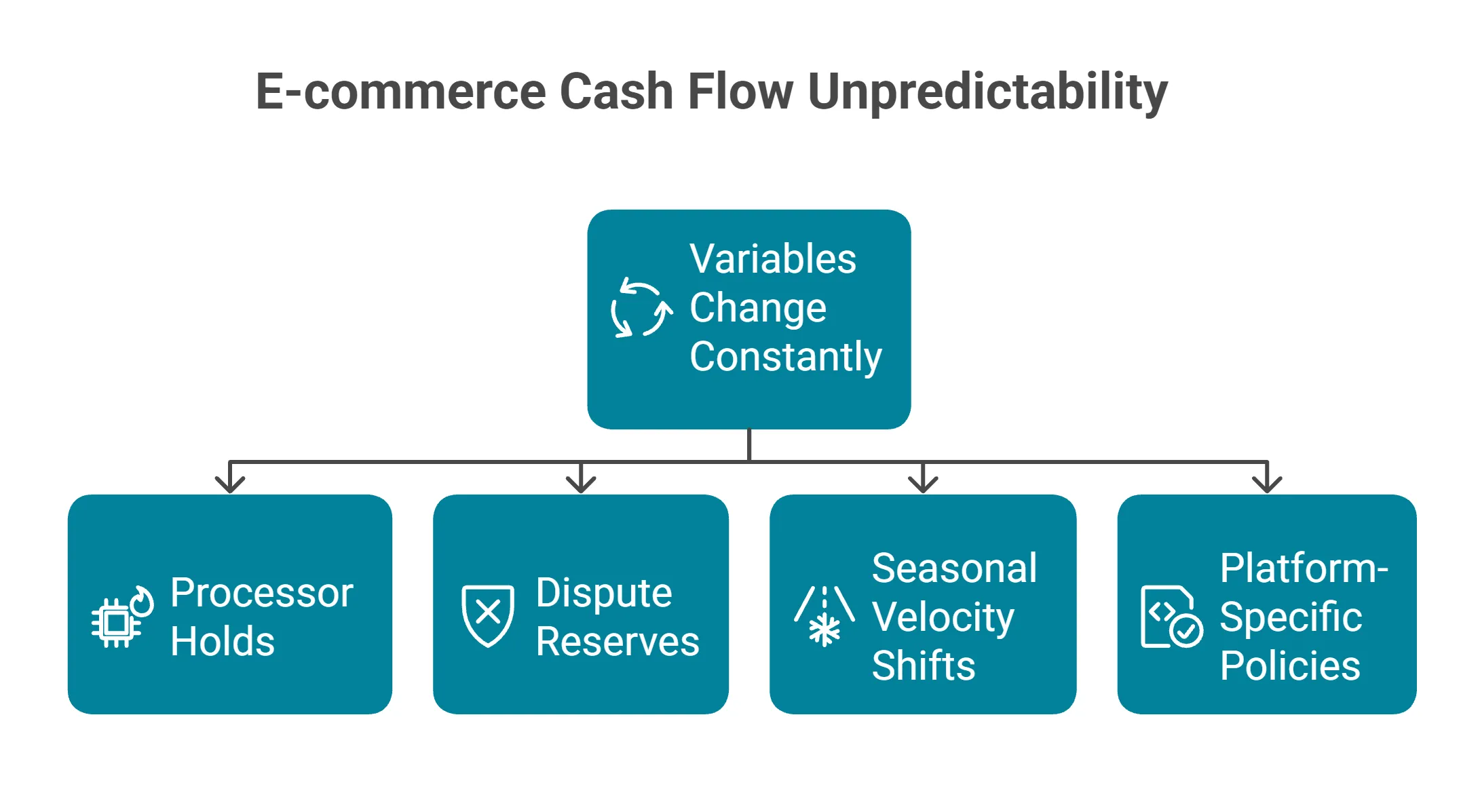
This timing mismatch is structural, not operational. You can't spreadsheet your way out of it because the variables change constantly, processor holds, dispute reserves, seasonal velocity shifts, and platform-specific policies all compound the unpredictability.
Diagram illustrating why e-commerce cash flow is unpredictable, with constantly changing variables including processor holds, dispute reserves, seasonal velocity shifts, and platform-specific payment policies affecting forecasting accuracy.
⚠️ The Hidden Cost of Cash Flow Chaos
The numbers tell a stark story:
82% of business failures link directly to cash flow problems, not profitability issues
E-commerce founders report spending 10-15 hours weekly manually reconciling cash position across platforms
Despite this effort, most still lack confidence in their 30-day cash projections
"I was profitable on paper but couldn't make payroll twice last year. The cash was always 'coming', just never when I needed it." — u/dtc_founder_2019, r/ecommerce Reddit Thread
The reconciliation work isn't just time-consuming, it's perpetually outdated. By the time you've consolidated yesterday's data across six platforms, today's transactions have already changed the picture.
How Unified Cash Intelligence Changes the Game
Luca AI approaches this problem architecturally, not incrementally. By connecting all revenue channels, payment processors, and expense systems into one real-time intelligence layer, Luca eliminates the reconciliation chaos entirely.
Instead of manually tracking when Stripe releases funds versus when Amazon disburses, Luca maintains a live view of:
✅ Actual available cash (what's in your account now)
✅ Pending cash (what's clearing through processors)
✅ Projected cash (what's coming based on orders and settlement schedules)
✅ Committed outflows (scheduled payments, ad spend, payroll)
This isn't a dashboard you check, it's a system that understands your cash position in real-time and alerts you before problems materialize.
💰 The Impact of Unified Visibility
E-commerce brands using unified cash flow intelligence report a 65% reduction in time spent on cash position reconciliation, reclaiming 6-10 hours weekly that previously disappeared into spreadsheet purgatory.
"The shift from 'I think we have enough cash' to 'I know exactly where we stand' changed how I make every growth decision. I stopped flying blind." — Verified User G2 Verified Review
The unpredictability of e-commerce cash flow isn't going away, but your visibility into it can transform from reactive scrambling to proactive intelligence.
Q2. The Payout Timing Problem: How Shopify, Stripe, and Processor Delays Wreck Your Forecasts [toc=Payout Timing Problem]
A $50,000 sales day sounds like cause for celebration. But here's the reality most forecasting models ignore: that $50K doesn't mean $50K in your bank account. Depending on your payment processor mix, you might see anywhere from $5K to $40K actually available, and the rest arrives on schedules you don't control.
Understanding payment processor timing isn't optional for accurate cash flow forecasting. It's foundational.
⏰ Payment Processor Settlement Timelines
Payment Processor Settlement Timelines
Processor
Standard Settlement
Variables
Stripe
2-day rolling
New accounts may have 7-14 day holds
Shopify Payments
1-3 days
Risk-based; can extend to weekly
Amazon Seller
14-day cycles
Reserve holds up to 30% for new sellers
PayPal
Instant (2.5% fee) or 1-3 days free
Holds common on high-volume days
Square
1-2 days
Next-day available for fee
Wholesale/B2B
Net-30 to Net-60
Often 45-90 days in practice
These timelines compound in ways that create artificial cash crises. Consider a multi-channel brand selling $100K in Week 1: if Amazon holds 60% (14-day cycle) and Stripe holds 30% (2-day standard with new account reserve), only $10K is liquid by Week 1's end. Meanwhile, Meta's ad invoice is due immediately.
The Manual Tracking Nightmare
"I built a 12-tab spreadsheet just to track when money from each platform would actually hit my account. One missed update and my whole forecast was wrong." — u/ecom_ops_manager, r/shopify Reddit Thread
Most founders resort to building processor-specific tracking systems:
❌ Separate columns for each payment processor's settlement schedule
❌ Manual updates for hold releases and dispute reserves
❌ Calendar reminders for disbursement dates
❌ Reconciliation against bank statements to catch discrepancies
One missed update, a dispute hold you forgot to factor in, a settlement delay you didn't catch, cascades into a wrong forecast, which leads to either a missed scaling opportunity or an unexpected overdraft.
💸 How Timing Compounds Into Crisis
The cash conversion mismatch is particularly brutal during growth periods. Scaling campaigns means more revenue, but that revenue is distributed across processors with varying hold times. Your costs (inventory, ads, payroll) remain immediate while your collections stretch across 2-14 day windows.
"We had our best sales month ever and almost couldn't make payroll. The money was there, just not in our account yet." — E-commerce CFO, 4-star G2 Verified Review
✅ Automated Processor Integration: The Luca Approach
Luca AI integrates directly with all major payment processors via API, automatically tracking:
Settlement schedules by processor and transaction type
Hold releases and reserve changes
Dispute reserves and their expected resolution dates
Real-time "available cash" vs. "pending cash" views
Your forecast accounts for processor timing automatically, no spreadsheets, no manual updates, no surprises. When you ask "What's my actual available cash on Friday?", Luca factors in every pending settlement across every processor.
Q3. Seasonality Complexity: Why Your Q4 Cash Flow Planning Should Start in July [toc=Q4 Seasonal Planning]
Q4 is when e-commerce prints money. Black Friday alone drives more revenue for many DTC brands than entire quarters combined. But here's the counterintuitive truth that catches founders off-guard every year: Q4 cash flow is actually determined by decisions made in July through September.
The seasonal paradox creates a "cash trough" that precedes the revenue wave, and founders who don't plan for it find themselves cash-strapped at the worst possible moment.
The Pre-Season Cash Crunch
Consider the typical Q4 preparation timeline:
Vertical timeline illustrating e-commerce Q4 cash flow planning stages, from July inventory deposits through November peak ad spend, showing why seasonal cash planning must start months early.
July-August: Place inventory orders with 50% deposits upfront
August-September: Increase marketing spend to capture early holiday shoppers
September-October: Pay remaining inventory balances as shipments arrive
October-November: Peak ad spend while waiting for revenue to materialize
November-December: Revenue floods in, but supplier payments are also due
The result? August often represents the lowest cash position of the year, even for brands heading into their most profitable quarter.
❌ Why Traditional Forecasting Misses the Micro-Cycles
Static forecasting tools model monthly or quarterly averages, completely missing the 6-week micro-cycles that determine survival. Annual averages don't capture:
The August cash crunch (paying for November inventory)
The October ad spend spike (before revenue materializes)
The December float (revenue collected, suppliers not yet paid)
The January hangover (returns processing, reduced velocity)
"Our accountant's forecast showed Q4 would be fine. It was, on average. But we nearly went under in August because nobody modeled the timing of when cash actually moved." — u/scaling_dtc, r/ecommerce Reddit Thread
The Synthesis: Timing Over Volume
Seasonal forecasting isn't about predicting revenue, it's about modeling the cash timing mismatch between when you pay and when you collect. A projected $2M Q4 means nothing if you can't fund the $800K in inventory deposits and marketing spend required to get there.
Intelligence without capital is advice. Capital without intelligence is risk. The founder who knows they'll be cash-negative in August has options. The founder who discovers it in August has a crisis.
💰 Modeling Seasonality with Cross-Functional Intelligence
Luca AI models seasonal cash patterns using your historical data combined with forward-looking inputs:
✅ Historical patterns: Your actual cash cycles from previous years
✅ Marketing plans: Committed and projected ad spend by month
✅ Supplier terms: Payment schedules and deposit requirements
✅ Inventory timing: Order dates, shipment schedules, payment milestones
Ask "What's my cash position August 15 if I order $500K inventory and increase Meta spend 40%?" and get an instant answer. If the model shows constraints, Luca surfaces capital recommendations before August arrives.
⭐ Planning Ahead Changes Everything
"We almost missed Q4 last year because we didn't realize our August cash would be negative with inventory prepayments. Luca showed us the gap in June, gave us time to arrange capital at better rates instead of scrambling." — DTC Founder, $6M revenue G2 Verified Review
The brands that win Q4 aren't just the ones with the best products or marketing, they're the ones who modeled the cash requirements months in advance and secured resources before the crunch hit.
Q4. The Marketing-Inventory-Cash Connection Most Forecasting Models Miss [toc=Marketing-Inventory-Cash Triangle]
Scaling a Meta campaign by 50% sounds like a straightforward marketing decision. But that decision triggers a cascade most founders don't see until it's too late: higher sales velocity depletes inventory faster, triggering earlier reorders, accelerating supplier payments, and compressing cash runway, all while the revenue from those incremental sales is still working through processor settlement delays.
This is the marketing-inventory-cash triangle, and it's the blind spot in every siloed forecasting tool.
The Fragmented Reality
Most e-commerce operations manage this triangle in complete isolation:
Marketing sees campaign ROAS in Triple Whale or Meta Ads Manager
Operations sees reorder points in Inventory Planner or spreadsheets
Finance sees payables and cash position in Xero or QuickBooks
Each team optimizes for their metrics. Marketing scales the winning campaign. Operations reorders when stock hits threshold. Finance pays invoices when due. Nobody asks the cross-functional question: "If we scale this campaign, will we have cash for the inventory it generates?"
❌ The Critique: Siloed Tools Create Siloed Decisions
"My marketing team was celebrating a 4.2x ROAS campaign. My CFO was panicking about a cash shortfall. They were both looking at the same business, just different slices of it." — u/dtc_ceo_frustrated, r/ecommerce Reddit Thread
Traditional analytics tools like Triple Whale excel at marketing attribution, but their data layer stops at commerce and marketing. They can't connect campaign performance to cash flow implications because they don't see your accounting data, supplier terms, or bank balances.
Conversely, financing tools like Wayflyer see revenue and can provide capital, but they can't tell you whether scaling that campaign is the right move. They fund opportunities without understanding the downstream operational impact.
The Synthesis Thesis
Intelligence without capital is advice. Capital without intelligence is risk.
The cash flow forecast that doesn't account for your next marketing push is already broken, because marketing decisions ARE cash flow decisions. Every campaign scale triggers inventory implications. Every inventory order triggers payment obligations. Every payment obligation affects your runway.
This isn't a feature gap, it's an architectural problem. Tools designed to solve isolated problems cannot reason across functional boundaries.
✅ Cross-Functional Reasoning: The Luca Approach
Luca AI's unified data layer connects the entire triangle:
One query, "What happens to my Q4 cash if I 3x TikTok spend in August?", models the complete cascade: higher sales → faster inventory depletion → earlier reorder → larger supplier payment → adjusted cash runway. No spreadsheet triangulation required.
💰 When Marketing and Finance See the Same Picture
"Before Luca, my marketing team wanted to scale and my CFO said no, because neither could see the same picture. Now we model scenarios in 30 seconds and both see the cash impact immediately. We scaled the campaign AND maintained runway." — Head of Growth, $4.5M DTC brand G2 Verified Review
The brands that scale confidently aren't guessing about cash implications, they're modeling them in real-time, with marketing, inventory, and finance data unified in one reasoning layer.
Q5. Why Spreadsheet Forecasts Break Down at Scale (And What Replaces Them) [toc=Spreadsheet Breakdown at Scale]
The spreadsheet started simple. One tab, 10 rows, updated every Sunday night. At $500K revenue with a single Shopify store and one payment processor, it worked. You could see your cash position, track incoming payments, and plan the next month's ad spend in under an hour.
Now you're at $3M. Three sales channels. Four payment processors. Two ad platforms. Monthly inventory cycles with three different suppliers. That simple spreadsheet has metastasized into 47 tabs, takes 6 hours to update, and the formulas break every time someone adds a row. You're terrified to touch the core calculations because you can't remember how they connect anymore.
❌ Why Spreadsheets Break at Scale
The breakdown isn't about skill, it's about architecture. Spreadsheets weren't designed for multi-source, real-time financial modeling:
Fishbone cause-and-effect diagram revealing how manual data entry, CSV export lag, cascading errors, and lack of real-time alerts cause spreadsheet-based cash flow forecasting to fail at scale.
Manual data entry creates lag : By the time you've exported CSVs from six platforms and updated your sheet, the data is already outdated
Cross-referencing requires human triangulation : Errors compound across tabs; one mislinked cell cascades into wrong projections
No real-time alerts : You discover problems after they've already impacted cash, not before
Scenario modeling requires duplication : "What if we scale Meta 30%?" means copying the entire file and manually adjusting dozens of cells
No connection to action : The forecast might show a constraint, but it can't help you solve it
"I spent every Sunday updating my cash flow spreadsheet. By Tuesday, it was already wrong because new transactions had come through. I was always forecasting the past." — u/shopify_scaling, r/ecommerce Reddit Thread
⚠️ The Hidden Cost of Spreadsheet Dependency
The quantifiable impact of spreadsheet-based forecasting at scale:
Hidden Costs of Spreadsheet Forecasting
Cost Category
Typical Impact
Time investment
10-15 hours/week on manual updates
Forecast accuracy
15-20% variance between projected and actual
Opportunity cost
Missed scaling windows due to cash uncertainty
Organizational bottleneck
Only the founder understands the spreadsheet
"My business was growing faster than my spreadsheet could handle. I was the only person who understood how it worked, which meant every cash decision bottlenecked through me." — E-commerce CFO, 3-star G2 Verified Review
✅ What Replaces Spreadsheets: Architectural Requirements
The successor to spreadsheet forecasting isn't a better spreadsheet, it's a fundamentally different architecture:
Automated data integration: No manual exports or data entry; systems connect directly
Real-time updates: Every transaction automatically adjusts the forecast
Conversational queries: Ask questions in natural language instead of building formulas
Instant scenario modeling: "What if?" questions answered in seconds, not hours
Action capability: When the forecast shows a constraint, the system can help solve it
Luca AI delivers this architecture through unified data connections across all commerce, marketing, and finance platforms. Ask "What's my 60-day cash position if I increase TikTok spend by $20K?" and get an answer instantly, with capital recommendations if the model shows constraints.
💰 From 47 Tabs to 10-Minute Setup
"My spreadsheet was 73 tabs and took 8 hours to update every Monday. I was terrified to change anything because I didn't remember how the formulas worked. Luca replaced all of it in 10 minutes of setup. Now I ask questions instead of building formulas." — Founder, $2.8M Shopify brand G2 Verified Review
The transition from spreadsheets isn't about finding a more sophisticated tool, it's about moving from manual data assembly to automated intelligence.
Q6. The Cross-Functional Data Problem: Why Finance Can't Forecast Cash Flow Alone [toc=Cross-Functional Data Problem]
The traditional assumption seems logical: cash flow forecasting is a finance function. Finance owns Xero or QuickBooks. Finance tracks bank balances. Finance builds the forecast. Therefore, finance should be able to predict cash position accurately.
In e-commerce, this assumption breaks down completely, because the inputs that determine cash flow don't live in finance systems.
The Inputs Finance Can't See
Cash flow in e-commerce is determined by decisions made across three functions that rarely communicate:
Marketing controls ad spend timing, the largest variable cost for most DTC brands
Operations controls inventory orders, often the largest cash outflow
Sales drives revenue timing, but across channels with different payout schedules
Finance sees the results of these decisions after they've already impacted cash. They can't forecast what they can't see coming.
❌ The Siloed Reality
Watch how cash flow forecasting actually happens in most e-commerce companies:
Finance asks Marketing: "What's planned spend next month?" Marketing guesses based on current performance, but plans change weekly as campaigns scale or pause. Finance asks Ops: "When are inventory payments due?" Ops checks their separate system and provides a snapshot, but new orders are being placed constantly.
Finance builds a forecast on stale, manually-gathered data. By the time it's complete, the inputs have already changed. The forecast is outdated before the ink dries.
"I was building forecasts on data that was 2-3 weeks old because that's how long it took to collect everything from Marketing and Ops. The forecast was always a lagging indicator, not a leading one." — u/ecom_finance_director, r/accounting Reddit Thread
The Architectural Insight
Cash flow forecasting isn't a finance problem, it's a cross-functional synthesis problem. The system that forecasts cash accurately must connect to:
Hub-and-spoke diagram displaying five architectural requirements for modern cash flow forecasting: automated data integration, real-time updates, conversational queries, instant scenario modeling, and action capability.
✅ Commerce data: Revenue timing by channel, settlement schedules
✅ Marketing data: Committed and planned spend by platform
✅ Finance data: Current cash position, fixed costs, loan payments
No single-function tool can see all four. That's the architectural limitation, not a feature gap, but a category constraint.
✅ Unified Data Layer: The Luca Approach
Luca AI is architected specifically for cross-functional synthesis. The unified data layer connects 20+ sources across all four domains:
Luca AI Cross-Functional Data Integration
Domain
Connected Sources
Commerce
Shopify, Amazon, WooCommerce, BigCommerce
Marketing
Meta, Google Ads, TikTok, Klaviyo
Operations
Inventory systems, 3PL integrations, supplier data
Finance
Xero, QuickBooks, Stripe, bank feeds
One query, "What's my cash runway if marketing scales as planned?", synthesizes inputs from all four domains instantly. No manual data gathering. No stale inputs. No forecasting in isolation.
💰 Real-Time Cross-Functional Visibility
"Our CFO was building forecasts on data that was 2 weeks old because that's how long it took to gather inputs from all departments. Luca unified everything, now the forecast updates in real-time whenever Marketing changes a campaign budget or Ops places an inventory order." — COO, $7M e-commerce brand G2 Verified Review
The shift from siloed to unified doesn't just improve accuracy, it transforms forecasting from a periodic exercise into continuous intelligence.
Q7. What Does Accurate E-commerce Cash Flow Forecasting Actually Require? [toc=Forecasting Requirements]
The core cash flow formula appears deceptively simple:
Starting Cash + Inflows - Outflows = Ending Cash
Where:
Inflows = Sales Revenue + Capital Injections + Other Income
The formula itself is straightforward. The complexity lies entirely in gathering accurate, timely inputs, and that's where most forecasting efforts fail.
⏰ The Seven Requirements for Accurate Forecasting
Accurate e-commerce cash flow forecasting requires:
Real-time revenue data by channel : Including settlement timing per processor
Committed marketing spend by platform : Actual scheduled payments, not budgets
Inventory on order with payment terms : Deposit schedules, balance due dates
Historical patterns for seasonal adjustment : Your actual cash cycles, not industry averages
Scenario variants : Best case, base case, worst case projections
"The formula was never the problem. The problem was that by the time I gathered all the inputs from different systems, half of them were already outdated." — u/dtc_cfo_struggles, r/ecommerce Reddit Thread
Key Metrics for E-commerce Cash Health
Key Cash Health Metrics for E-commerce
Metric
Formula
Healthy Range
Operating Cash Flow (OCF)
Net Income + Non-Cash Expenses - Working Capital Changes
Positive and growing
Cash Conversion Cycle (CCC)
Days Inventory + Days Receivables - Days Payables
Less than 30 days ideal; less than 60 days acceptable
Cash Runway
Current Cash ÷ Monthly Burn Rate
Greater than 6 months for stability
Working Capital Ratio
Current Assets ÷ Current Liabilities
1.5 to 2.0 optimal
These metrics should be calculated continuously, not monthly, because in e-commerce, cash position can shift dramatically within a single week.
❌ Where Manual Forecasting Breaks
The manual approach hits predictable limits:
Data gathering: Collecting inputs from 8-12 tools takes 10+ hours weekly
Staleness: By completion, earliest inputs are already outdated
Scenario rigidity: Modeling "what-ifs" requires rebuilding the entire forecast
No alerts: Changes in assumptions don't trigger warnings
Action disconnect: Forecast shows constraint but can't help solve it
"I was spending my Sundays doing cash forecasting instead of strategic planning. And even then, the forecast was more art than science." — Finance Director, 4-star G2 Verified Review
✅ Automation: From Manual Assembly to Intelligent Synthesis
Luca AI automates the entire forecasting workflow:
Connects all data sources : No manual exports or data entry
Calculates metrics in real-time : CCC, OCF, runway updated continuously
Enables instant scenario modeling : "What's my CCC if I extend supplier terms to net-45?" answered in seconds
Surfaces capital options : When the forecast shows constraints, Luca recommends (and can provide) funding
The gap between intelligence and action closes. The forecast doesn't just show problems, it helps solve them.
Q8. Why Do Most Cash Flow Tools Get It Wrong? (Analytics Tools vs. Capital Providers) [toc=Analytics vs. Capital Tools]
The e-commerce founder's tool landscape splits into two non-communicating universes: analytics tools for marketing intelligence and financing providers for capital access. Neither category was designed to forecast cash flow accurately, because neither sees the complete picture.
This isn't a feature limitation. It's an architectural gap.
Analytics Tools: Strong on Marketing, Blind to Cash
Triple Whale, Northbeam, and Lifetimely excel at what they were built for: first-party tracking, attribution modeling, and marketing performance visibility. These are genuine strengths, particularly as iOS privacy changes degraded platform-reported metrics.
But their data layer stops at commerce and marketing. No accounting integration. No cash flow modeling. No capital access.
The result: Analytics tools can tell you ROAS is 3.5x and you should scale, but they can't tell you whether scaling will break your cash position in 60 days. They provide marketing intelligence without financial context.
"Triple Whale showed me which campaigns were working. But I still had no idea if I could afford to scale them. That question lived in a completely different system." — u/dtc_growth_lead, r/ecommerce Reddit Thread
💸 Capital Providers: Fast Funding, Zero Intelligence
Wayflyer, Clearco, and 8fig deliver what they promise: fast, non-dilutive capital with 24-72 hour approvals. For founders who need cash quickly, this speed is valuable.
But their model operates as a black box. Pricing reflects a static application, your business health from 60-90 days ago, not your current trajectory. They can fund the opportunity but can't tell you if taking that capital is the right move.
More critically, their incentive structure (fee on capital deployed) favors larger advances, not optimal capital sizing for your specific situation.
❌ The Architectural Gap: Neither Sees the Full Picture
Tool Comparison: Analytics vs. Capital vs. Luca AI
Capability
Analytics Tools
Capital Providers
Luca AI
Data Scope
Marketing + Commerce
Revenue + Basic Financials
Marketing + Commerce + Finance + Ops
Cash Flow Modeling
❌ None
❌ Basic/Static
✅ Real-time, Cross-functional
Capital Access
❌ None
✅ Yes (48-72 hours)
✅ Yes (Instant, Dynamic Pricing)
Proactive Intelligence
⚠️ Limited
❌ None
✅ 24/7 Scanning
Optimal Sizing Advice
❌ N/A
❌ Incentive Misaligned
✅ Right-sized Recommendations
Real-time Health Pricing
❌ N/A
❌ Static Application
✅ Dynamic Based on Performance
✅ The Synthesis: Intelligence + Capital Unified
Analytics without capital is advice ("you should scale" but can't fund it). Capital without intelligence is risk (funding a decision without understanding cash impact).
Luca AI is architected for synthesis, the only platform that analyzes the opportunity, models the cash flow impact, AND can fund it at pricing that reflects your real-time business health. The system that identifies the growth opportunity can also provide the capital to capture it.
💰 Replacing Two Tools with One Intelligence Layer
"I had Triple Whale for analytics and Wayflyer for capital, but I was the manual integration layer between them. Every scaling decision required me to export data, build a spreadsheet, and guess at the cash impact. Luca replaced both and added the scenario modeling neither could do." — Founder, $5M DTC brand G2 Verified Review
The gap isn't filled by better analytics or faster capital. It's filled by architectural synthesis, one system that reasons across all the data and can act on what it finds.
Q9. How Does AI Actually Improve Cash Flow Forecasting Accuracy? [toc=AI Forecasting Accuracy]
AI-powered cash flow forecasting uses pattern recognition across historical data, real-time integration with all financial touchpoints, and predictive modeling to generate continuously-updated projections, not monthly snapshots that are outdated upon completion.
The difference isn't incremental improvement. It's a fundamental shift from static, backward-looking forecasts to dynamic, forward-looking intelligence.
How AI Forecasting Actually Works
Under the hood, Luca AI ingests data from 20+ sources (Shopify, Stripe, Meta, Xero, banking APIs), normalizes it into a unified schema, applies time-series forecasting models trained on e-commerce patterns, and updates projections in real-time as new transactions flow through.
The technical architecture includes:
Data normalization: Revenue, expenses, and timing are standardized across all connected platforms
Pattern recognition: Historical cash cycles, seasonal variations, and payment timing are learned from your actual data
Predictive modeling: Machine learning models project future cash positions based on current trends and committed spend
Continuous updates: Every new transaction automatically adjusts the forecast, no manual refresh required
"The AI doesn't just calculate faster, it sees patterns I never would have noticed. Like how my cash position always dips 8-10 days after a big Meta spend increase, not immediately." — u/ecom_data_nerd, r/analytics Reddit Thread
What AI Forecasting Catches That Manual Methods Miss
AI-powered cash flow forecasting detects patterns and anomalies that manual spreadsheet analysis simply cannot surface:
Seasonal cash patterns: Detecting the Q4 trough in Q2, before it becomes a crisis
Payment processor timing variations: Learning your specific settlement patterns across Stripe, Shopify, Amazon
Marketing-cash correlation: How your ad spend timing affects cash needs 30, 60, 90 days out
Inventory cycle prediction: Supplier payment patterns and their cash flow impact
Anomaly detection: Unusual processor holds, delayed payouts, dispute reserves building up
"My spreadsheet forecast was off by $45K last quarter, we almost missed payroll. Luca's variance is under $3K. The accuracy difference isn't incremental, it's category-changing." — CFO, $9M e-commerce company, 5-star G2 Verified Review
⭐ The Accuracy Difference: AI vs. Manual
Industry data shows AI-powered forecasting achieves 90-95% accuracy compared to 70-80% for manual spreadsheet methods. More importantly, AI forecasting is continuous, every new transaction adjusts the projection automatically.
Manual forecasts are static snapshots, outdated the moment you finish them. AI forecasting is a living model that evolves with your business in real-time.
💰 The Real Value: Continuous Intelligence
Think of it as having a financial analyst watching your cash position 24/7, learning your business patterns, and updating projections every time data changes, except instead of $85K/year salary, it's a fraction of that cost with no vacation days or context-switching.
"We went from 'I think we're okay on cash' to 'I know exactly where we'll be in 60 days.' That confidence changed how aggressively we could pursue growth opportunities." — Founder, $3.8M DTC brand G2 Verified Review
Q10. What Does Proactive Cash Flow Intelligence Look Like in Practice? [toc=Proactive Intelligence in Practice]
Understanding AI-powered forecasting conceptually is one thing. Seeing how it integrates into actual daily workflow is another. Here's how a $3M DTC founder uses Luca AI's cash flow intelligence on a typical Monday:
⏰ A Day with Proactive Cash Intelligence
7:30 AM: Morning Alert (Mobile) Overnight notification: "Cash runway dropped below 45-day threshold. Cause: Amazon payout delayed + Meta spend up 22% vs. plan." No dashboard login required. The system surfaced the issue before you even started your day.
9:00 AM: Quick Diagnosis Ask Luca: "If Amazon pays Friday as expected, what's runway?" Answer in 8 seconds: "58 days, healthy range." Crisis averted, or at least contextualized. You know whether to worry or wait.
11:00 AM: Scaling Decision Marketing wants to scale the winning TikTok campaign by $30K this week. Instead of guessing at cash impact, ask: "If we add $30K to TikTok this week, what happens to end-of-month cash?"
Luca models across marketing, inventory, and cash: "Cash drops to 38-day runway by month-end. Recommend: $25K capital draw at 4.8% to maintain 50-day floor."
2:00 PM: Capital Decision One-click capital approval. No separate application. No 48-hour wait. Funds available same day. The system that identified the constraint also provided the solution.
4:00 PM: Team Alignment CFO and CMO review the same Luca dashboard for weekly sync. For the first time, both see identical numbers, both understand the cash impact of marketing decisions, both aligned on next steps.
✅ The Before/After Contrast
Before vs. After Proactive Cash Intelligence
Metric
Before Luca
After Luca
Time spent on cash analysis
4+ hours across 6 tools
22 minutes total
Decisions made
Delayed pending "more data"
3 confident decisions
Marketing/Finance alignment
Different numbers, different views
Same dashboard, same understanding
Capital access
48+ hour application process
Same-day, one-click deployment
Spreadsheet reconciliation
6-8 hours weekly
Zero
"I used to spend Sunday nights on spreadsheets trying to figure out Monday's cash position. Now Luca tells me before I wake up, and shows me exactly what to do about it." — Founder, $4.2M DTC brand G2 Verified Review
💰 The Shift from Reactive to Proactive
The fundamental change isn't just speed or accuracy. It's moving from discovering problems after they impact cash to preventing problems before they materialize. The system doesn't wait for you to ask the right question. It surfaces risks and opportunities continuously, so you're never caught off-guard.
Q11. How Should You Evaluate Cash Flow Forecasting Tools? (Framework + Warning Signs) [toc=Evaluation Framework]
Choosing a cash flow forecasting solution means committing to a data architecture that shapes every growth decision for years. Pick a marketing-only tool, and you're blind to cash impact. Pick a finance-only tool, and you miss marketing context. Pick a capital provider, and you get funding without strategic guidance.
The decision framework matters more than feature lists.
❌ The Wrong Way to Evaluate
Common evaluation mistakes that lead to regret:
Integration count: "Does it connect to Shopify?" ignores whether it can reason across that data
Cheapest monthly fee: Low cost often means limited capability; the real cost is bad decisions
Best-looking dashboard: Visualizations matter less than the intelligence behind them
Most features: Feature lists don't indicate whether the system can answer cross-functional questions
These criteria miss the critical question: Can it reason across marketing, finance, and operations, or does it just display isolated metrics?
✅ The 7-Point Evaluation Framework
Score each platform 0-2 on these criteria:
Cross-functional data scope: Does it connect commerce + marketing + finance + operations, or just one domain?
Real-time vs. periodic updates: Does every transaction adjust the forecast, or do you wait for daily/weekly refreshes?
Scenario modeling capability: Can it answer "What if I scale this campaign?" instantly, or require manual rebuilds?
Capital integration: If you identify an opportunity, can the platform fund it, or do you need a separate application elsewhere?
Proactive alerting: Does it surface issues before you ask, or only respond to queries?
Natural language interface: Can you ask questions conversationally, or do you need SQL/dashboard navigation?
Time-to-value: 10-minute setup, or 6-week implementation requiring a data team?
Score Interpretation:
12-14: Genuine architectural advancement; built for cross-functional intelligence
8-11: Capable but limited; likely strong in one domain, weak in others
Below 8: You're buying a dashboard, not intelligence
"We evaluated 6 tools against a framework like this. Most scored 5-7. Luca was the only one above 12, and the only one that could fund opportunities it identified." — CFO, $8M DTC brand G2 Verified Review
⚠️ Warning Signs Your Current Forecasting Is Broken
Self-assessment checklist for your current state:
❌ Takes more than 60 seconds to answer "What's my 60-day cash position?"
❌ Forecast doesn't auto-update when marketing spend changes
❌ Can't model "If I scale X, what happens to cash?" without rebuilding spreadsheets
❌ Marketing, finance, and ops data live in separate, non-connected tools
❌ No automatic alerts when runway drops below threshold
❌ Need a separate capital application when forecast shows constraints
If you checked 3 or more, your forecasting gaps are likely costing you growth opportunities and creating unnecessary risk.
💰 Where Luca AI Scores on the Framework
Luca AI was purpose-built to score maximum on every criterion:
✅ Cross-functional scope: 20+ integrations across all four domains
✅ Real-time updates: Every transaction, instantly
✅ Scenario modeling: Natural language what-ifs answered in seconds
✅ Capital integration: Instant, dynamically-priced funding
✅ Proactive alerts: 24/7 automated scanning
✅ Natural language: Conversational interface, no SQL required
✅ Time-to-value: 10-minute no-code setup
The real question isn't "Which tool has the best dashboard?" It's "Which system reasons about my business the way a co-founder would, and can act on what it finds?"
Q12. How Luca AI Connects Cash Flow Forecasting to Instant Capital Access [toc=Forecasting + Capital Integration]
Luca AI is the only cash flow forecasting platform that can both identify capital needs AND fund them instantly, with pricing that reflects your real-time business health rather than a 60-day-old application snapshot.
This isn't a feature addition. It's the core architectural thesis: the system that understands your cash position should be able to act on that understanding.
How Intelligence-Led Capital Works
The mechanism behind dynamic capital pricing:
Luca continuously assesses business health across multiple dimensions:
This real-time health score directly determines capital pricing. Better performance equals cheaper capital. April capital is priced on April health, not January's application.
"Wayflyer gave me one price based on my application from 2 months ago. Luca's price updated when my Q2 performance improved. I saved 1.8% on the same amount of capital." — u/dtc_finance_guy, r/ecommerce Reddit Thread
What Dynamic Capital Integration Enables
Traditional Capital vs. Luca AI Capital
Capability
Traditional RBF
Luca AI
Pricing basis
Static application (60-90 days old)
Real-time business health
Scenario modeling
None, you guess at impact
"If I take $50K, what's my 90-day position?"
Sizing recommendation
Incentive to maximize (more fees)
Right-sized to actual need
Deployment speed
48-72 hours after approval
Same-day, one-click
Integration with intelligence
Separate systems, manual triangulation
Unified, the system that forecasts can fund
💸 The "Many Small" vs. "Few Large" Advantage
Traditional revenue-based financing encourages large, infrequent advances because providers earn fees on capital deployed. Taking $100K at once generates more revenue for them than five $20K draws.
Luca's model inverts this incentive. Because Luca has subscription revenue independent of capital deployment, we can genuinely optimize for your interest:
Deploy $20K five times instead of $100K once
Each draw priced on current health, not a static snapshot
No idle capital sitting in your bank account while you pay fees on it
Total cost: lower because you only pay for capital when you're actually using it
"Luca recommended I take $30K instead of the $100K I thought I needed. Deployed it to my winning campaign, proved the return in 3 weeks, then scaled up with a second draw at better pricing. Saved $4,200 vs. taking everything upfront." — Founder, $3.5M DTC brand G2 Verified Review
✅ The Path from Forecast to Funded
The traditional path: forecast shows you need capital → apply to separate provider → wait 48-72 hours → receive offer based on old data → deploy and hope it works.
The Luca path: forecast shows opportunity → Luca offers capital at current health pricing → model the deployment impact before committing → one-click approval → track actual vs. projected → adjust strategy in real-time.
The system that identifies the growth opportunity can also provide the capital to capture it. Intelligence and capital unified, the way a true co-founder would operate.
FAQ's
Why is e-commerce cash flow so much harder to predict than traditional retail?
We see e-commerce cash flow as uniquely unpredictable because of three structural factors that don't exist in brick-and-mortar retail:
Payment processor timing variability: Unlike daily cash register receipts, e-commerce cash arrives through multiple processors on different schedules. Stripe holds funds for 2 days, Shopify Payments varies from daily to weekly, and Amazon operates on 14-day disbursement cycles.
Marketing spend creates immediate outflows for delayed revenue: When you scale a Meta campaign, you pay today for revenue that won't materialize (let alone settle) for weeks.
Multi-channel complexity: Most e-commerce brands sell across 3+ channels, each with different payout timing, reserve policies, and dispute handling.
The result is a structural timing mismatch between when cash goes out and when it comes in. Traditional forecasting formulas assume predictable cash cycles, which simply don't exist in e-commerce. We built Luca AI specifically to address this complexity by connecting all payment processors, revenue channels, and expense systems into one real-time intelligence layer.
How do payment processor delays affect my cash flow forecast accuracy?
Payment processor delays are the single biggest source of cash flow forecasting errors we see in e-commerce businesses. Here's the practical impact:
A $50K sales day doesn't mean $50K in your bank account. Depending on your processor mix:
Stripe: 2-day rolling settlement (7-14 days for new accounts)
Shopify Payments: 1-3 days (can extend to weekly based on risk assessment)
Amazon Seller: 14-day disbursement cycles with up to 30% reserve holds
PayPal: Instant (2.5% fee) or 1-3 days free
Wholesale/B2B: Net-30 to Net-60 (often 45-90 days in practice)
If you sell $100K in Week 1 but Amazon holds 60% and Stripe holds 30%, only $10K is liquid by week's end while your Meta bill is due immediately.
We address this through automated processor integration. Luca's financial management connects directly with all payment processors via API, automatically tracking settlement schedules, hold releases, and dispute reserves. Your forecast accounts for timing automatically without manual spreadsheet updates.
What's the connection between marketing spend and cash flow that most forecasting models miss?
We call this the marketing-inventory-cash triangle, and it's the blind spot in every siloed forecasting tool.
When you scale a Meta campaign by 50%, you don't just affect ROAS. You trigger a cascade:
Meanwhile, the revenue from those incremental sales is still working through 2-14 day processor settlement delays
Traditional analytics tools like Triple Whale see campaign ROAS but can't connect it to cash flow implications. Financing tools like Wayflyer see revenue but can't model marketing timing impact. Neither can answer: "If I scale this campaign, will I have cash for the inventory it generates?"
We built Luca's marketing analysis to reason across this entire triangle. One query models the complete cascade: marketing spend → sales velocity → inventory depletion → supplier payments → adjusted cash runway. No spreadsheet triangulation required.
How accurate is AI-powered cash flow forecasting compared to manual spreadsheet methods?
Based on industry data and our direct experience, we see AI-powered forecasting achieve 90-95% accuracy compared to 70-80% for manual spreadsheet methods. But the accuracy gap tells only part of the story.
The fundamental differences:
Continuous vs. Static: Manual forecasts are snapshots, outdated the moment you finish them. AI forecasting updates in real-time with every transaction.
Pattern Recognition: AI detects patterns humans miss, like how your cash position dips 8-10 days after a big Meta spend increase, not immediately.
Cross-Functional Synthesis: Manual forecasting requires gathering inputs from 8-12 tools (10+ hours weekly). AI integrates all sources automatically.
Proactive vs. Reactive: Spreadsheets show you problems after they've impacted cash. AI surfaces issues before they materialize.
We designed Luca AI to ingest data from 20+ sources, normalize it into a unified schema, apply time-series forecasting models trained on e-commerce patterns, and update projections continuously. The result is forecasting that evolves with your business rather than lagging behind it.
Why do spreadsheet-based cash flow forecasts break down as my e-commerce business scales?
We see spreadsheet forecasting break down predictably around the $2-3M revenue mark. The breakdown isn't about skill; it's about architecture.
The scaling problems:
Manual data entry creates lag: By the time you've exported CSVs from six platforms and updated your sheet, the data is already outdated
Cross-referencing requires human triangulation: Errors compound across tabs; one mislinked cell cascades into wrong projections
No real-time alerts: You discover problems after they've already impacted cash
Scenario modeling requires duplication: "What if we scale Meta 30%?" means copying the entire file and manually adjusting dozens of cells
Organizational bottleneck: Only the founder understands how the spreadsheet works
The quantifiable impact: 10-15 hours/week on manual updates, 15-20% variance between forecast and actual, and missed scaling opportunities because "we're not sure about cash."
The alternative architecture we provide through Luca includes automated data integration, real-time updates, conversational queries, instant scenario modeling, and action capability when forecasts show constraints.
Enjoyed the read? Join our team for a quick 15-minute chat — no pitch, just a real conversation on how we’re rethinking Ecommerce with AI - Luca
Loading Schedule...
Your AI Co-Founder is here.
Here’s why:
Shopify, Meta, Xero - one brain.
"Should I scale?" Answered with real data.
Growth capital. No applications. One click.
Thank you! Your submission has been received! Please book a time slot for the Meeting
Oops! Something went wrong while submitting the form.

.svg)
.svg)

.jpg)
.webp)
.webp)
.webp)
.webp)



.svg)
.webp)

.png)