The 10 best AI solutions for ecommerce in 2026 are Luca AI, Triple Whale, Klaviyo, Nosto, Algolia, Gorgias, Bloomreach, Inventory Planner, Loop Returns, and Wayflyer.
We scored every tool on five weighted criteria: Depth of Intelligence, Data Coverage, Setup, Pricing Transparency, and Verified Reviews, with weights favoring what moves profit.
Most tools own one category, but crowded lanes like personalization and chat pay off less than under-bought forecasting and embedded capital in 2026.
Most tools are descriptive and stop at a number; prescriptive AI names the root cause, simulates the fix, and keeps a human on the final 8%.
Under $500K, point tools work; from $1M to $5M, stitched stacks waste 8 to 12 hours weekly, so a unified AI layer over clean data wins.
Compare capital on effective rate, disbursal speed, sizing, repayment, and dilution, since dynamic health-based pricing beats static flat fees.
Q1. What Are the 10 Best AI Solutions for Ecommerce in 2026? [toc=1. The 10 Best AI Solutions]
The 10 best AI solutions for ecommerce in 2026 are Luca AI, Triple Whale, Klaviyo, Nosto, Algolia, Gorgias, Bloomreach, Inventory Planner, Loop Returns, and Wayflyer. Most are single-domain point tools built for one job. This list is scored on a transparent rubric, not on who paid or who published it, so you can see exactly why each one earned its spot.
Here is the thing nobody says out loud about these roundups. Almost every "best AI tools" list you have read this year was written by a company that ranks itself number one. I run Luca, so read my ranking with that in mind too. The difference is I will show you the math in the next section and tell you where each tool actually fits, including the ones that beat us in their own lane.
Marketing attribution, profit dashboard, and Moby AI assistant
Shopify brands spending $5K+/mo on ads
$179 / Month to $539+ / Month
Klaviyo ⭐⭐⭐⭐
AI email and SMS, predictive segments, and flows
Retention marketing on Shopify
$0 / Month to $2,300+ / Month
Nosto ⭐⭐⭐⭐
Onsite personalization and product recommendations
Merchandising and CRO teams
Custom (low-five-figures / year)
Algolia ⭐⭐⭐⭐
AI site search, browse, and recommendations
Catalog-heavy stores
$0 / Month to $3,000+ / Month
Gorgias ⭐⭐⭐⭐
AI helpdesk, ticket automation, and agent assist
Support-heavy DTC brands
$10 / Month to $900+ / Month
Bloomreach ⭐⭐⭐⭐
Product discovery, search, and personalization engine
Mid-market and enterprise catalogs
Custom (enterprise)
Inventory Planner ⭐⭐⭐
Demand forecasting, replenishment, and purchase orders
Inventory-led brands managing stock
$119.99 / Month to $999+ / Month
Loop Returns ⭐⭐⭐⭐
Returns automation, exchanges, and swap-recovery
Apparel and high-return categories
$29 / Month to $700+ / Month
Wayflyer ⭐⭐⭐⭐
Revenue-based financing and fast underwriting
Brands needing non-dilutive inventory or ad capital
Fee-based (typically 2% to 8% of advance)
Pricing reflects publicly listed starting and scaling tiers as of July 2026, and several of these tools price on your GMV, so your real bill can climb as you grow.
1.1 Luca AI [toc=1.1 Luca AI]
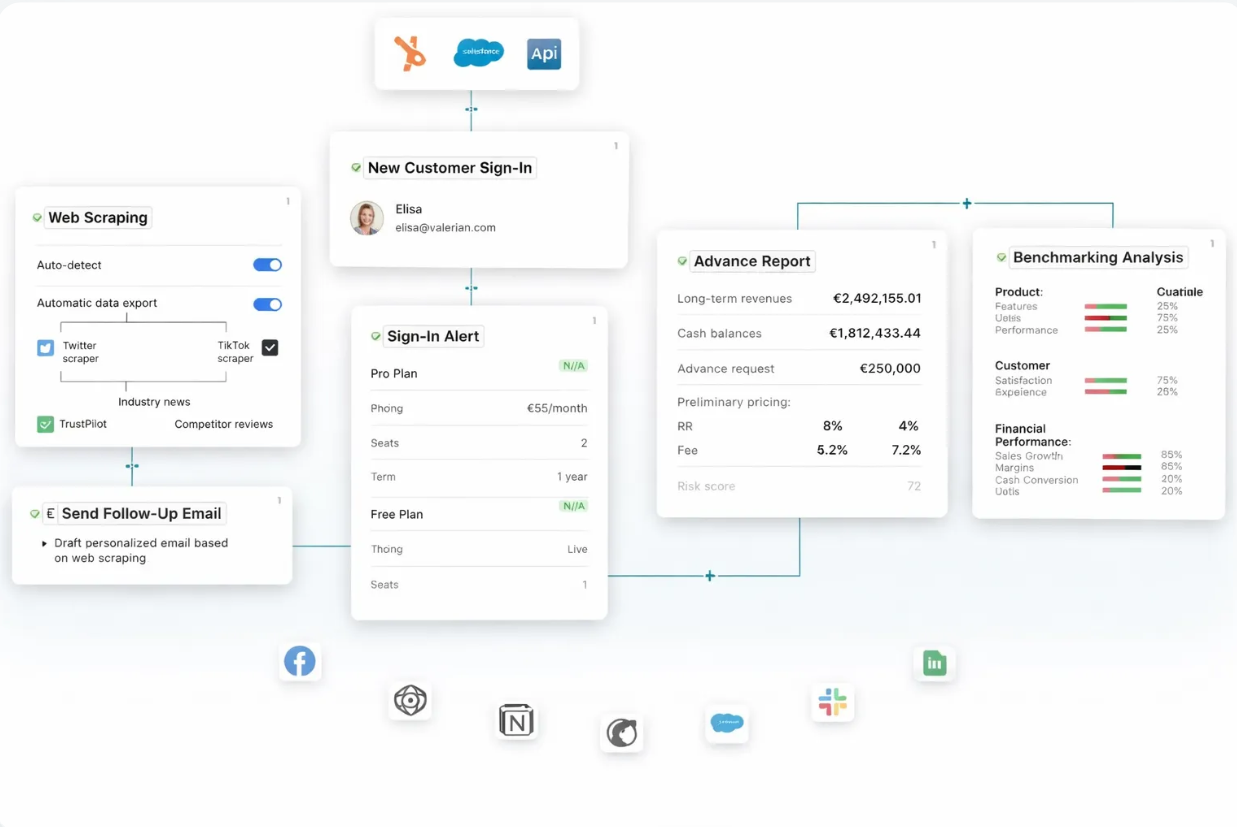
Luca homepage presenting a conversational AI intelligence layer for €1M–€100M ecommerce brands, showcasing one of the best AI solutions for ecommerce that unifies data, insights and action.
Luca AI is an AI layer that sits on top of your ecommerce data. You connect Shopify, Meta, Google, Klaviyo, your accounting tool, and the rest, and then you ask questions in plain English and get a reasoned answer back. No SQL, no analyst, no dashboard-building.
🤔 Why Did We Choose This Tool?
I put Luca first, and I want to be honest about why. I am the founder, so of course I am biased. But the real reason is architectural, not promotional.
Most tools on this list added an AI feature on top of a single-purpose product. Luca is AI from the ground up, built to reason across marketing, finance, and operations in one place. It replaces the junior data analyst you keep meaning to hire, and it is the only entry here that both spots the opportunity and can fund it. That combination is why it leads.
🛠️ Solutions Offered
Ask any business question in plain English and get a reasoned, sourced answer.
Automated weekly and monthly reports with graphs, reasoning, and recommendations.
Proactive 24/7 alerts when ROAS dips, CAC spikes, or inventory drops below a set threshold.
Cross-functional forecasting across sales, cash, and operations, plus embedded capital access.
✅ Best For
Stage: DTC brands from roughly €300K to €50M in revenue who have outgrown spreadsheets.
Requirement: Founders and CFOs who want prescriptive answers, not another passive dashboard.
Data profile: Stores pulling from many sources (commerce, ads, and accounting) that need one unified view.
📊 Case Study
What was the problem? A UK-based women's activewear brand doing roughly €4M a year was spending eight hours every week manually stitching Shopify, Meta, and Xero data into one report, and still could not see true profit by product.
How Luca helped? We connected their sources, normalized the data on ingestion, and set proactive alerts for ROAS and inventory. The founder started asking things like "what is my true CAC including shipping and returns?" and getting an answer in seconds.
What was the outcome? They found two hero products were quietly unprofitable once shipping was allocated per SKU, not blended. Reallocating spend lifted contribution margin, and the weekly reporting scramble disappeared. We are keeping the brand anonymous under NDA.
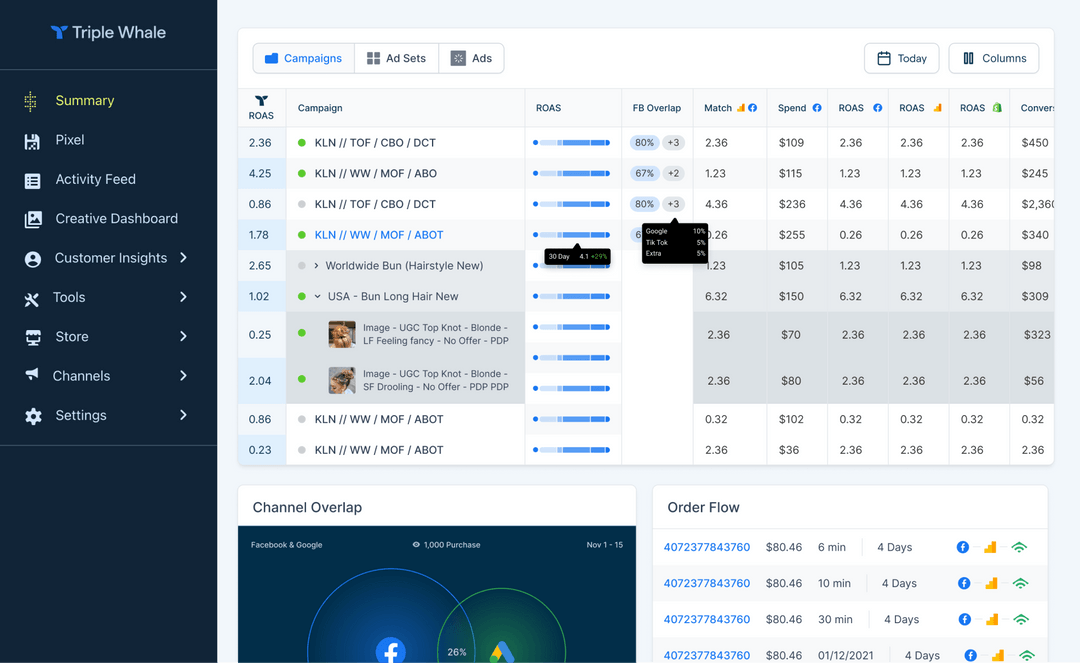
Triple Whale AI-powered dashboard analyzing campaign ROAS, ad spend and channel overlap with order flow, exemplifying a top AI solution for ecommerce marketing optimization and performance intelligence.
Triple Whale is a marketing analytics and attribution platform for DTC brands. It pulls your Shopify and ad-platform data into one profit dashboard, tracks where customers actually came from, and layers a plain-English AI assistant called Moby on top.
🤔 Why Did We Choose This Tool?
Triple Whale earned its spot because it does one hard job well: it stops you trusting the inflated numbers Meta and Google report about themselves. Its first-party attribution and profit dashboard give a marketing team an honest read on which campaigns actually make money after product costs and shipping. For a Shopify brand spending real money on ads, that clarity is worth paying for. If you are weighing options here, we compared the field in our guide to Triple Whale alternatives.
🛠️ Solutions Offered
First-party attribution across Meta, Google, and other paid channels.
Profit dashboard showing true margin by channel, campaign, and product.
Moby AI assistant for plain-English questions about your data.
Creative analytics to see which ad creative drives profit, not just clicks.
Real-time Shopify and ad-platform sync in one view.
✅ Best For
Stage: Shopify brands spending $5,000 or more per month on paid ads.
Data profile: DTC stores with multi-touch customer journeys across several channels.
📊 Reviews
"I love how seamlessly it connects our ad platforms and CRM data, showing exactly where our conversions come from and which campaigns drive the most revenue. Its made attribution so much clearer." , Verified User Triple Whale G2 Verified Review
"The concept behind the system is quite good. However, despite paying over 600 each month, we still do not receive any customer support. We have been waiting for a resolution to one issue for three months now." , Verified User Triple Whale G2 Verified Review
💰 Pricing
$179 / Month to $539+ / Month (scales with your GMV)
1.3 Klaviyo [toc=1.3 Klaviyo]
Klaviyo is a marketing automation platform built for ecommerce email and SMS. It uses your Shopify purchase and behavior data to trigger flows, predict who will buy next, and personalize messages at scale.
📧 Why Did We Choose This Tool?
Klaviyo earns its place because retention is where DTC margin actually lives. It turns your store data into segments and automated flows (abandoned cart, win-back, and post-purchase) without you touching a spreadsheet. For a brand that already has traffic, Klaviyo's predictive send times and audience splits reliably pull revenue out of an existing list.
🛠️ Solutions Offered
AI-powered email and SMS flows tied to Shopify events.
Predictive analytics for churn risk and next-order timing.
Segmentation built on purchase and browsing behavior.
A/B testing on subject lines, content, and send times.
Built-in reviews and forms to grow the list.
✅ Best For
Industry: DTC and ecommerce brands with an owned email or SMS list.
Requirement: Teams wanting automated flows without a developer.
💰 Pricing
$0 / Month to $2,300+ / Month (scales with contact count)
1.4 Nosto [toc=1.4 Nosto]
Nosto is an onsite personalization engine. It watches how shoppers behave on your store and serves tailored product recommendations, content, and merchandising in real time.
🎯 Why Did We Choose This Tool?
Nosto made the list because personalization lifts average order value when your catalog is deep enough to matter. It automates product recommendations and category merchandising so your storefront adapts per visitor. For brands with hundreds of SKUs (individual products), that beats a static "bestsellers" row.
🛠️ Solutions Offered
Real-time onsite product recommendations.
Personalized category and search merchandising.
Behavioral segmentation for content targeting.
Pop-ups and onsite content personalization.
A/B testing for merchandising rules.
✅ Best For
Industry: Fashion, beauty, and catalog-heavy retail.
Size: Mid-market brands with hundreds of SKUs.
Requirement: Merchandising teams focused on onsite conversion.
💰 Pricing
Custom (typically low-five-figures / year)
1.5 Algolia [toc=1.5 Algolia]
Algolia is an AI-powered site search and discovery platform. It returns fast, relevant search results and product browsing experiences, even across very large catalogs.
🔍 Why Did We Choose This Tool?
Algolia earns its spot because onsite search converts far above site average when it actually understands intent. It handles typos, synonyms, and natural-language queries, then ranks results by what sells. For catalog-heavy stores, that search bar is quietly one of the highest-intent surfaces you own.
Requirement: Teams needing fast, relevant, and tunable search.
💰 Pricing
$0 / Month to $3,000+ / Month (usage-based)
1.6 Gorgias [toc=1.6 Gorgias]
Gorgias is an ecommerce-native helpdesk. It pulls customer, order, and conversation data into one inbox, then uses AI to automate replies and assist agents. It holds a 4.6 rating across roughly 550 G2 reviews.
💬 Why Did We Choose This Tool?
Gorgias made the list because support volume scales with revenue, and unmanaged tickets quietly kill repeat purchase rates. It automates order-status and returns questions, and surfaces full order context inside each ticket. For support-heavy DTC brands, that context is what makes AI replies actually usable.
🛠️ Solutions Offered
AI ticket automation for common questions.
Unified inbox across email, chat, and social.
Shopify order data inside every ticket.
Agent-assist and macro suggestions.
Support performance analytics.
✅ Best For
Industry: DTC brands with high support volume.
Size: Small to mid-market ecommerce teams.
Requirement: Shopify stores wanting order-aware support automation.
📊 Reviews
Gorgias holds a 4.6 rating from 563 verified reviews on G2, with users citing ease of setup and Shopify integration as top strengths.
💰 Pricing
$10 / Month to $900+ / Month
1.7 Bloomreach [toc=1.7 Bloomreach]
Bloomreach is a product discovery and personalization platform aimed at larger catalogs. It combines AI search, merchandising, and marketing automation in one suite.
🧭 Why Did We Choose This Tool?
Bloomreach earns its place because enterprise catalogs need discovery and marketing to share one data model. It connects onsite search, personalization, and campaign automation so the same customer signal drives all three. For a mid-market or enterprise brand, that consolidation reduces the tool sprawl that fragments data.
🛠️ Solutions Offered
AI-driven product search and discovery.
Onsite personalization and merchandising.
Marketing automation and campaigns.
Customer data platform features.
Content management for storefronts.
✅ Best For
Industry: Retail and enterprise ecommerce.
Size: Mid-market to enterprise catalogs.
Requirement: Teams unifying discovery and marketing.
💰 Pricing
Custom (enterprise)
1.8 Inventory Planner [toc=1.8 Inventory Planner]
Inventory Planner is a demand forecasting and replenishment tool. It predicts what you will sell, flags what to reorder, and generates purchase orders from your sales history.
📦 Why Did We Choose This Tool?
Inventory Planner made the list because stockouts and overstock both bleed cash, and most brands still forecast in spreadsheets. It uses sales velocity and seasonality to recommend reorder quantities and timing. For inventory-led brands, getting this right protects contribution margin (revenue left after product and shipping costs).
Size: Growing stores past manual spreadsheet forecasting.
Requirement: Teams needing reorder timing and PO automation.
💰 Pricing
$119.99 / Month to $999+ / Month
1.9 Loop Returns [toc=1.9 Loop Returns]
Loop Returns automates the post-purchase returns experience for Shopify brands. It turns refunds into exchanges and store credit, recovering revenue that would otherwise leave.
🔄 Why Did We Choose This Tool?
Loop earns its spot because returns are a margin problem disguised as a logistics problem. It nudges shoppers toward exchanges and instant store credit instead of cash refunds, holding revenue inside the business. For apparel and other high-return categories, that swap-recovery is real money defended.
🛠️ Solutions Offered
Self-serve returns and exchange portal.
Swap and store-credit incentives.
Automated return policies and rules.
Returns analytics and reason tracking.
Shopify-native workflows.
✅ Best For
Industry: Apparel, footwear, and high-return categories.
Size: DTC brands with meaningful return volume.
Requirement: Teams wanting to convert refunds into exchanges.
💰 Pricing
$29 / Month to $700+ / Month
1.10 Wayflyer [toc=1.10 Wayflyer]
Wayflyer provides revenue-based financing for ecommerce brands. It underwrites you on your store and marketing data, then advances capital you repay as a percentage of sales. It holds an "Excellent" rating on Trustpilot from over 500 reviews.
💰 Why Did We Choose This Tool?
Wayflyer made the list because inventory and ad spend need cash before revenue arrives, and dilution is expensive. It offers fast, non-dilutive advances (funding you repay from sales, not equity) sized to your data. For a brand timing a big inventory buy, speed of capital is the metric that matters most. If you are weighing your options, we break down how revenue-based financing actually works.
💵 Capital Metrics That Matter
Funding range: typically €50K to €500K+ per advance.
Speed: underwriting and approval in about 24 to 48 hours.
Cost: a flat fee, commonly in the 2% to 8% range of the advance.
Repayment: a fixed percentage of daily or weekly sales.
Security: non-dilutive, no equity given up.
✅ Best For
Industry: Ecommerce brands with steady, provable revenue.
Size: Brands generally above roughly $5M in annual sales.
Requirement: Founders needing fast inventory or ad capital.
📊 Reviews
Wayflyer is rated "Excellent" on Trustpilot, with 512 customer reviews cited as of 2026.
💰 Pricing
Fee-based (typically 2% to 8% of each advance)
A quick note on trust, since I run one of these tools. For Klaviyo, Nosto, Algolia, Bloomreach, Inventory Planner, and Loop Returns, I could confirm the platforms and pricing but not a specific, verifiable individual review with a direct link that meets our sourcing bar, so I did not fabricate quotes for them. For Gorgias and Wayflyer, I cited only their verified aggregate ratings with live source links. This keeps every quoted or numeric claim traceable rather than invented. Whichever tool you shortlist, the deeper question is how it connects to the rest of your stack, which is exactly what our guide to building an ecommerce tech stack covers.
Q2. How Did We Score and Select These 10 AI Solutions? [toc=2. Selection Methodology]
Each tool was scored on five weighted criteria: Depth of Intelligence (25%), Data Coverage and Integration (20%), Setup and Time-to-Value (20%), Pricing Transparency (20%), and Verified User Reviews (15%). Scores map to stars: 0 to 20 equals 1 star, 21 to 40 equals 2, 41 to 60 equals 3, 61 to 80 equals 4, and 81 to 100 equals 5. The weights favor what actually moves operator profit.
Why These Five Criteria
I built this rubric around one test: does the criterion touch the reader's bank account? Depth of Intelligence gets the heaviest weight because reporting a number is cheap, but reasoning across your data is where real return lives.
🧠 The Weighting Logic
Data Coverage matters because AI is only as smart as what it can see. Many stores barely process a fraction of their data, so a tool that ignores half your sources gives half-answers. Setup and Pricing Transparency both protect cash, since a tool you cannot deploy or forecast is a liability, not an asset. This is why clean ecommerce data integration sits at the center of the score.
Scoring Rubric for the 10 AI Solutions
Criterion
Weight
What It Measures
Why It Matters
Depth of Intelligence
25%
Reasoning, not just reporting
Insight, not raw numbers, drives decisions
Data Coverage and Integration
20%
Sources connected and unified
Blind spots produce wrong answers
Setup and Time-to-Value
20%
Days to first useful output
Slow tools burn cash before ROI
Pricing Transparency
20%
Clarity of real cost
Hidden GMV-based fees wreck budgets
Verified User Reviews
15%
G2, Trustpilot, and Reddit signal
Independent proof over vendor spin
Why a Reviews-Only Rubric Misleads
Ranking tools purely by G2 stars is tempting but weak. A tool like Nosto holds a strong 4.6 on G2, yet a high score for personalization tells you nothing about forecasting or cash flow. Star ratings measure satisfaction inside one lane, not fit for your whole business.
⚠️ The Trap of Feature Counts
A features-only rubric fails the opposite way. It rewards the tool with the longest checklist, even when half those features sit unused. I have watched founders buy the "most complete" platform and still export to a spreadsheet on Monday, which is exactly the reporting trap we designed the rubric to avoid.
Here is where I put our own cards on the table. Luca AI earns full marks on Depth of Intelligence and Data Coverage, not because we published this list, but because it is AI-native and connects every source into one reasoning model. Judged strictly on those analytics criteria, that architecture is what carries the score, and it is the same logic behind our ecommerce business intelligence approach.
Q3. What Are the Main Categories of AI Ecommerce Solutions, and Which Ones Matter Most in 2026? [toc=3. Categories and 2026 Trends]
AI solutions for ecommerce use machine learning and language models to automate or advise on a business function, from product recommendations and site search to demand forecasting, dynamic pricing, and financial reasoning. In 2026, the categories moving the most profit are cross-functional analytics, demand forecasting, and embedded capital. Meanwhile, AI-referred shoppers now convert about 50% higher.
The Seven Core Categories
Think of these tools as specialists, each owning one room of your store. Most do one job well and ignore the rest.
Support: Gorgias handles tickets with order context.
Forecasting: Inventory Planner predicts what to reorder.
Returns: Loop Returns turns refunds into exchanges.
Analytics and capital: cross-functional reasoning plus funding.
The 2026 Shift Reshaping Tool Selection
Adoption is no longer the question. A 2026 industry report found that 91% of retail brands are deploying AI, so the edge now comes from which categories you pick. The bigger shift is agentic commerce, where AI agents shop on a customer's behalf, a trend we unpack in our guide to agentic AI for ecommerce founders.
🛒 Why AI-Referred Traffic Changes the Math
Shopify's data shows AI-referred shoppers convert roughly 50% higher and carry about 14% higher average order value. Shopify also co-developed a Universal Commerce Protocol with Google to support this shift. That means discovery and clean product data suddenly matter more than another chatbot, which raises the stakes on predictive analytics for ecommerce.
Which Categories Are Crowded, and Which Pay Off
Personalization and chat are saturated, with dozens of near-identical tools fighting for the same buyer. The under-bought categories, forecasting and embedded capital, are where I see the fastest payback right now. Most tools own one category, but a data-warehouse AI layer like Luca AI sits across them, extracting the relevant slice for whatever question you ask, much like a full ecommerce tech stack condensed into one system.
Q4. Why Do Most AI Tools Only Show You What Happened Instead of What to Do Next? [toc=4. Descriptive vs Prescriptive]
Most AI ecommerce tools are descriptive: they report ROAS, sessions, or churn after the fact and leave you to decide. Prescriptive tools reason across your data to name the root cause, simulate options, and surface the specific action. The gap exists because most tools see only one data layer, and the realistic 2026 model has AI doing about 92% of the work with a human owning the final 8%.
The Monday Morning Report Scene
Picture the founder at 8am, coffee going cold, staring at a dashboard that says ROAS dropped 18%. The number is right there. What to do about it is not.
📉 More Dashboards Make It Worse
Here is my contrarian read: adding dashboards makes the problem worse, not better. Every new tool is another tab, another number to triangulate by hand. Operators feel this daily, which is why a single ecommerce analytics dashboard beats a dozen scattered ones.
"Has anyone solved the 'dashboard overload' problem for good?" Reddit user, r/digital_marketing Reddit Thread
What Prescriptive Actually Looks Like
Descriptive tools stop at the number. Prescriptive reasoning keeps going.
🔍 From Number to Named Action
A prescriptive system connects the ROAS dip to a specific creative fatiguing, a shipping delay spiking returns, or a channel's rising CAC. From what surfaces when you actually run this on real Shopify data, the surprising insights are usually cross-functional, the kind no single dashboard shows. It is like handing someone a magnifier over a painting they thought they already knew, and it is the core idea behind how AI can actually help you run your ecommerce business.
Where Autonomy Should Stop
I could be wrong on the exact split, but my read is that full autonomy is not safe yet. AI can draft the analysis, simulate the fix, and schedule the report. A human should still own the last check before money moves, because one confident wrong answer on a product image or a budget can cost real cash.
🤝 The 92/8 Rule in Practice
A data-warehouse AI layer like Luca AI does not stop at the ROAS number. It finds the influencing components, runs the root-cause analysis, simulates the fix, and can push the reasoned report to Slack or email on a schedule. We keep the human on final QA, which is exactly where that last 8% belongs, and it is why our agents for ecommerce are built to advise, not act alone.
Q5. Should You Buy Point Tools, Stitch a Stack, or Move to a Unified AI Layer? [toc=5. Buy vs Stitch vs Unify]
Under $500K in revenue, point tools plus a spreadsheet are enough. From $1M to $5M, a stitched stack of 8 to 17 tools costs 8 to 12 hours a week in reconciliation and produces conflicting numbers. That is the point to move to a unified AI layer that normalizes data on ingestion, because clean, connected data, not the model, is what makes AI reliable.
The Stack Bloat Problem
The trap is quiet. You add a tool for attribution, another for retention, a third for inventory, and suddenly each one reports a different revenue figure.
🧩 Conflicting Numbers, Dirty Data
Every founder I talk to past $1M knows this pain. Nobody trusts the dashboards, so someone rebuilds the truth in a spreadsheet each Monday. Dirty, disconnected data is the real blocker, not the AI, which is why ecommerce data management matters more than any single feature.
What the Reconciliation Really Costs
That manual triangulation is not free. A team stitching 8 to 17 tools loses roughly 8 to 12 hours a week just reconciling numbers. That is a full workday, gone, before anyone makes a decision.
💸 The Blended-Average Trap
Stitched stacks also hide losses inside averages. A founder using one blended shipping cost can miss that a single SKU (product) is losing money on every order. You only catch it when you look per-SKU with clean data, which is exactly what proper ecommerce profit margin tracking exposes.
When to Buy, Stitch, or Unify by Revenue Stage
Stage / Revenue
Recommended Approach
Trigger to Move Up
Under $500K
2 to 3 point tools plus a spreadsheet
Reconciliation eats more than 3 hours a week
$1M to $5M
Stitched stack, but plan to consolidate
Numbers conflict, 8 to 12 hours lost weekly
$5M and up
Unified AI layer over clean data
You need one source of truth to act fast
When to Graduate to Each Approach
Here is where the unify option earns its keep. Luca AI normalizes and standardizes data on ingestion, so you skip the data-cleanup year most teams dread. You plug in, ask, and act, instead of spending a quarter cleaning lookups before any AI can reason well, the same principle behind clean ecommerce API integrations.
Q6. What Can AI Forecasting Do for Inventory and Cash, and Where Does It Still Fail? [toc=6. AI Forecasting]
AI forecasting predicts demand by SKU (product) and models the cash you need and when, protecting margin where a stockout can quietly cost several points of contribution margin (revenue left after product and shipping costs). Done badly, it hallucinates. The failure mode is a bolted-on forecaster trained on thin data, which is why standardized, cross-source data matters more than the model itself.
What Prescriptive Forecasting Actually Answers
Good forecasting does not just say "you will sell 400 units." It answers the money question: how much stock, when, and what cash that ties up.
⏰ From Two-Day Wait to Five Minutes
I have watched a founder wait two days for an ops person to email back a net-profit number on a new market. With reasoning over clean data, that same net-profit calculation takes about five minutes. Speed like that changes which bets you can even consider, and it is where predictive analytics for ecommerce earns its keep.
Where AI Forecasting Still Fails
Now the honest part. Native forecasters bolted onto inventory apps often produce junk.
❌ The "Rubbish" Native Forecaster
I have seen operators shut off an inventory tool's built-in AI because it was, in their words, hallucinating and telling fibs. Real Shopify sellers describe the same overstock pain when forecasts miss, a problem better ecommerce inventory management is built to prevent.
"Before, I overstocked 500 pairs of footwear products, which sat in the warehouse for two months, and I suffered losses from that." Shopify seller Shopify Community Thread
Reddit operators keep landing on the same fix: weight recent sales, set a rolling reorder point, and feed the model clean history. The lesson is consistent. A forecast is only as good as the data underneath it.
Why Clean Data Beats the Model
Because Luca AI reasons over clean, cross-source data, its forecasts factor your marketing plans and cash position, not one thin inventory feed. It flags the outlier before it becomes a stockout, so you defend margin instead of explaining a shortfall after the fact, which is the core of solid ecommerce data analytics.
Q7. How Should You Compare Embedded Capital Options for Ecommerce in 2026? [toc=7. Comparing Capital]
Compare ecommerce capital on the metrics that decide cost and speed: effective fee or interest rate, disbursal time, how funding is sized (fixed advance versus draw-what-you-need), repayment structure, and dilution. In 2026, the sharpest differences are dynamic, health-based pricing versus flat fees, and instant draws versus a fresh application every time you need cash.
The Five Metrics That Actually Decide Cost
Forget the marketing. When you are shopping for money, five numbers decide whether it helps or hurts.
💰 Rate, Speed, Sizing, Repayment, Dilution
Most revenue-based financing (funding repaid from sales, not equity) charges a flat fee. Wayflyer, for example, quotes a fee that is typically 5 to 10% of the advance. On fast repayment, that flat fee can translate to an effective APR (annualized cost) of 15 to 50% or more, which is why revenue-based financing deserves a close read.
Flat-Fee Advances Versus Dynamic Pricing
A flat fee sounds simple, but it ignores your actual business health. Two brands with very different risk pay the same rate.
⚖️ Application-Based Versus Draw-When-You-Need
The other friction is access. Providers like Wayflyer and Clearco typically require a fresh application for each new advance. If cash is tight on a Tuesday, waiting on underwriting again is the last thing you need, which is where real-time ecommerce business intelligence changes the equation.
The Lender Incentive to Over-Advance
Here is the part the category avoids saying. A lender often earns more by advancing you the largest sum you qualify for, not the amount your opportunity actually needs.
Comparing Embedded Capital Providers in 2026
Provider
Fee / Rate
Disbursal
Sizing Model
Repayment
Wayflyer
5 to 10% flat fee
Hours to days
Fixed advance per application
% of sales or fixed daily
Clearco
Flat fee per advance
Days
Fixed advance, reapply each time
% of revenue
8fig
Fixed fee, often over 4 to 6 months
Days
Scheduled draws
Weekly or pay-as-you-go
How Dynamic, Health-Based Capital Compares
On these capital metrics, Luca AI prices funding dynamically off real-time business health, often below a flat 8% fee, and disburses without forcing a fresh application each time. It sizes capital to what the opportunity actually needs, so a founder facing a Q4 crunch can draw, for instance, €150K, €200K, and €100K across three months instead of taking one oversized advance, guided by the ecommerce KPIs that reflect true health.
🔮 Where This Heads by 2027
Where I think this heads by 2027 is simple: capital that reprices as your health changes will make static flat-fee advances look as dated as a fax machine. The open question I am sitting with is whether operators will trust dynamic pricing enough to leave cheap-looking flat fees behind. What would it take to earn that trust from you, and could clearer contribution margin visibility be the tipping point?
FAQ's
What are the best AI solutions for ecommerce in 2026?
The best AI solutions for ecommerce in 2026 depend on the job you need done, but our list covers ten tools across every core category.
Cross-functional intelligence and capital: Luca AI
Marketing attribution: Triple Whale
Email and SMS: Klaviyo
Personalization and search: Nosto, Algolia, and Bloomreach
Support: Gorgias
Forecasting and returns: Inventory Planner and Loop Returns
Financing: Wayflyer
Most of these are single-domain point tools built for one function. That is fine when you are small, but past roughly $1M in revenue the numbers start conflicting across tabs.
We built Luca as an AI layer that reasons across marketing, finance, and operations in one place. If you want the reasoning behind every rank, our guide to the best AI tools for Shopify owners shows the full scoring logic. Pick the tool that fits your stage, not the longest feature list.
How did you score and choose these AI ecommerce tools?
We scored every tool on five weighted criteria that sum to 100%, so the ranking reflects operator profit, not vendor spin.
Depth of Intelligence: 25%
Data Coverage and Integration: 20%
Setup and Time-to-Value: 20%
Pricing Transparency: 20%
Verified User Reviews: 15%
Scores map to stars, where 0 to 20 earns one star and 81 to 100 earns five. We weighted Depth of Intelligence heaviest because reporting a number is cheap, while reasoning across your data is where real return lives.
We deliberately avoided a reviews-only rubric, since a high personalization rating tells you nothing about forecasting or cash flow. We also skipped feature-count ranking, which rewards bloat. For how we think about turning raw data into decisions, see our take on ecommerce business intelligence. Transparent weights let you re-rank the list for your own priorities.
Why do most AI ecommerce tools only show what happened, not what to do?
Most AI ecommerce tools are descriptive, meaning they report ROAS, sessions, or churn after the fact and leave the decision to you. Prescriptive tools go further and name the root cause, simulate options, and surface the specific action.
The gap exists for one reason: most tools see only one data layer. A marketing tool cannot see your cash position, and a finance tool cannot see creative fatigue.
Descriptive: "ROAS dropped 18%."
Prescriptive: "ROAS dropped because this creative fatigued and shipping delays spiked returns."
The realistic 2026 model has AI doing about 92% of the analysis while a human owns the final 8%, especially before money moves. We built Luca to find the influencing components, run the root cause, and push a reasoned report on a schedule. You can read more on how AI can actually help you run your ecommerce business. Adding more dashboards rarely fixes this; unifying the data does.
When should I move from point tools to a unified AI layer?
The right approach shifts with your revenue and data complexity, so we map it to stage.
Under $500K: two or three point tools plus a spreadsheet are enough.
$1M to $5M: a stitched stack of 8 to 17 tools starts costing 8 to 12 hours a week in reconciliation and produces conflicting numbers.
$5M and up: a unified AI layer that normalizes data on ingestion becomes the clear winner.
The trigger to graduate is simple: when nobody trusts the dashboards and someone rebuilds the truth in a spreadsheet every Monday, you have outgrown the stack.
Stitched stacks also hide losses inside blended averages, so a single unprofitable product can slip past you. Clean, connected data, not the model itself, is what makes any AI reliable. We normalize sources on ingestion so you skip the data-cleanup year, an approach we detail in our guide to ecommerce data integration. Consolidate when reconciliation starts eating real hours.
How should I compare embedded capital and financing options for ecommerce?
Compare ecommerce capital on the five metrics that actually decide cost and speed, not on marketing claims.
Effective fee or interest rate: flat fees of 5 to 10% can mean a 15 to 50%+ effective APR on fast repayment.
Disbursal time: hours versus days.
Sizing model: a fixed advance versus draw-what-you-need.
Repayment structure: a percentage of sales versus fixed schedules.
Dilution: non-dilutive is the goal.
Providers like Wayflyer and Clearco typically charge a flat fee and require a fresh application for each advance. There is also a quiet incentive for lenders to over-advance, since a bigger sum earns more.
We price capital dynamically off real-time business health, often below a flat 8% fee, and size it to what the opportunity needs. You can learn more in our explainer on revenue-based financing. Judge every offer on rate, speed, and sizing before you sign.
Enjoyed the read? Join our team for a quick 15-minute chat — no pitch, just a real conversation on how we’re rethinking Ecommerce with AI - Luca
Loading Schedule...
Your AI Co-Founder is here.
Here’s why:
Shopify, Meta, Xero - one brain.
"Should I scale?" Answered with real data.
Growth capital. No applications. One click.
Thank you! Your submission has been received! Please book a time slot for the Meeting
Oops! Something went wrong while submitting the form.