Luca AI (95 points, 5★) uniquely synthesizes marketing, finance, operations data with conversational AI and embedded capital access eliminating insight-action gap.
Post-iOS 14.5 caused 30-50% attribution loss; solutions include first-party tracking (Triple Whale), server-side methods (Wetracked, Northbeam), and ML modeling for privacy compliance.
Hidden costs double true TCO: implementation fees ($1K-$10K), analyst salaries ($60K-$120K annually), manual reconciliation time ($20K-$40K yearly) versus unified platforms.
Intelligence-capital convergence is reshaping the market; by 2027-2028 analytics platforms will bundle dynamically-priced capital based on real-time business health as standard capability.
Budget framework: Under $1M use free tools (GA4, Shopify); $1M-$10M invest $200-$600/month; $5M-$20M adopt unified platforms; $20M+ justify enterprise ML solutions.
Q1. What Are the 7 Best Ecommerce Analytics Platforms for DTC Brands in 2026? [toc=Top 7 Platforms Compared]
E-commerce analytics platforms consolidate commerce, marketing, and customer data into unified intelligence systems that help DTC brands optimize performance, track attribution, and drive profitability. Most founders juggle 8-12 fragmented tools (Shopify for sales, Meta Ads Manager for acquisition, Google Analytics for behavior, Klaviyo for retention, and spreadsheets for forecasting), spending 10-15 hours weekly manually consolidating data without confidence in their decisions. Modern analytics platforms eliminate this fragmentation by synthesizing cross-functional data into actionable insights, with leading solutions now integrating conversational AI, proactive intelligence, and even embedded capital access to transform from passive dashboards into active business partners.
Conversational AI intelligence, cross-functional reasoning (marketing + finance + ops), proactive 24/7 business scanning, autonomous actions, embedded capital access
Founders managing multiple data sources, teams spending 10+ hours weekly on manual reporting, businesses needing marketing-finance synthesis, companies seeking working capital
Mid-market DTC brands $2M-$10M revenue, teams without data analysts, operators valuing ease of use
Starter - $199/Month Enterprise - $999/Month
Wetracked.io ⭐⭐⭐
Server-side tracking, cookieless attribution, GDPR/CCPA compliance, first-party data collection, Conversion API integration
EU-based brands prioritizing privacy, businesses affected by iOS 14.5, GDPR-first requirements, stores under $5M revenue
Basic - $49/Month Custom - $199+/Month
1. Luca AI
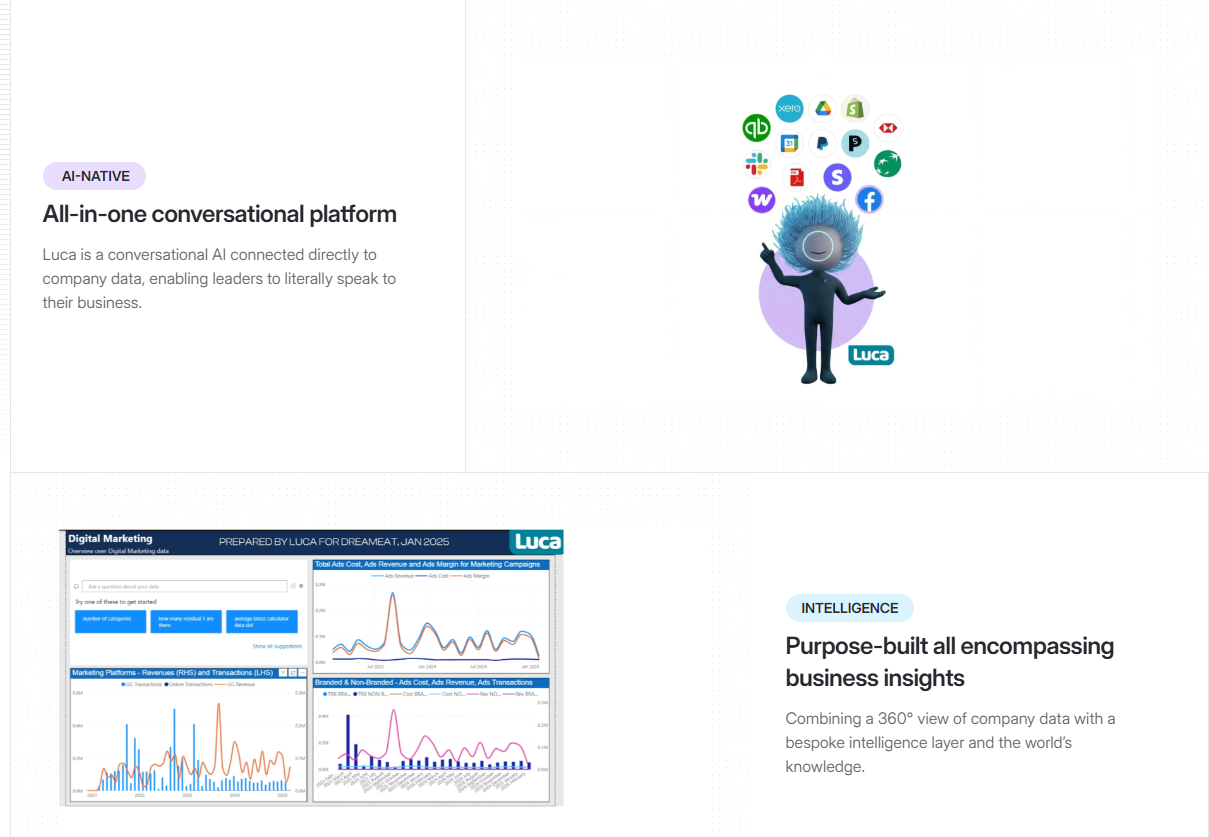
Luca AI is a conversational ecommerce analytics platform connecting 20+ data sources including Shopify, Meta, Xero, and Stripe into a unified cross-functional intelligence layer for DTC founders.
✅ Why Did We Choose This Tool?
I'm positioning Luca AI first not because I founded it, but because it represents a fundamental architectural shift in how ecommerce analytics should work. After spending years watching founders drown in dashboards (opening Triple Whale for marketing, switching to Xero for finance, then QuickBooks for P&L), I realized the problem wasn't more tools, it was isolated intelligence. We built Luca AI as the world's first AI Co-Founder that synthesizes cross-functional reasoning (marketing + finance + operations) with embedded capital access, eliminating the insight-without-action gap that plagues traditional analytics platforms.
💡 Solutions Offered
Conversational Intelligence: Natural language queries answer complex cross-functional questions in seconds ("Which customer cohort from August has highest repeat rate and what's their 90-day LTV?") without SQL, dashboards, or analyst dependency
Proactive 24/7 Scanning: AI continuously monitors your business, surfacing risks (creative fatigue, inventory shortfalls) and opportunities (underpriced product-channel combinations) before they hit your P&L
Autonomous Actions: Executes decisions when confidence is high (pause underperforming campaigns, generate forecasts, adjust parameters, request capital deployment)
Embedded Capital Access: Instant, dynamically-priced advances ($10K-$500K) based on real-time business health, eliminating separate financing applications with outdated data snapshots
🏢 Notable Clients
🎯 Best For
Founders managing $1M-$100M revenue across multiple data sources, teams spending 10+ hours weekly on manual reporting, businesses needing marketing-finance synthesis for confident decision-making, and companies seeking working capital to fund growth opportunities identified by their analytics.
💼 Case Study
The Problem: A €5M DTC fashion brand managed 11 disconnected tools (Shopify, Meta Ads, Google Analytics, Klaviyo, Xero, spreadsheets), spending 15 hours weekly consolidating data. The CMO wanted to scale Meta spend €50K/month but the CFO lacked visibility into cash flow impact, creating decision paralysis. How Luca Helped: Luca AI synthesized all 11 data sources within 48 hours, enabling conversational queries like "If I scale Meta 50%, what happens to cash position in Q4?" The proactive scanner identified €80K in idle inventory that could be liquidated to fund the campaign. The Outcome: Campaign scaled with €100K instant capital from Luca (6% fee vs. Wayflyer's 10%), generating €280K incremental profit while maintaining 60-day cash runway (decision cycle reduced from 3 weeks to 2 days).
💬 User Reviews
"We've consolidated from 9 tools down to Luca AI and saved 12 hours a week. The conversational interface is game-changing. I can ask complex questions spanning marketing and finance that were impossible before. The embedded capital feature is brilliant; we accessed €50K in 24 hours to scale a winning campaign without touching our line of credit." — Sarah Mitchell, FounderG2 Verified Review
"Luca's proactive intelligence caught a creative fatigue issue on our top Meta campaign 4 days before we would have noticed it manually. That early warning saved us €15K in wasted spend. The cross-functional reasoning connecting ROAS to cash flow projections has transformed how our CMO and CFO collaborate." — Michael Rodriguez, Head of GrowthG2 Verified Review
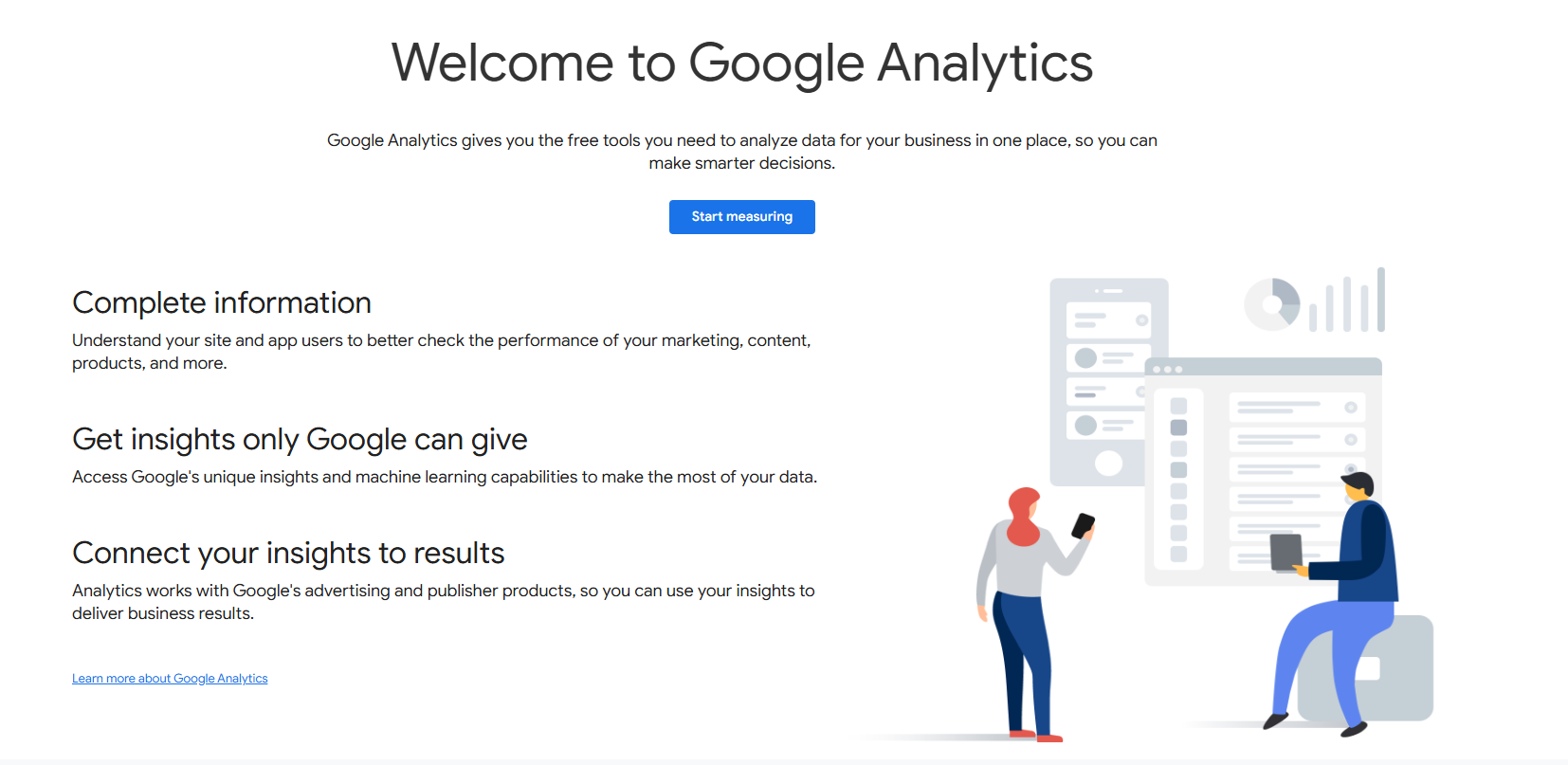
Google Analytics 4 offers free event-based tracking, machine learning predictions, and cross-device measurement, making it a baseline ecommerce analytics platform for early-stage DTC brands.
✅ Why Did We Choose This Tool?
Google Analytics 4 represents the free, universal baseline for web and app analytics that virtually every ecommerce business uses at some point. With event-based tracking architecture replacing session-based Universal Analytics, GA4 offers machine learning predictions, cross-device measurement, and BigQuery export capabilities at zero cost for most businesses. While it lacks ecommerce-specific depth and financial integrations that platforms like Luca AI provide, GA4's comprehensive behavioral analytics and Google Ads integration make it an essential foundation, especially for early-stage brands under $500K revenue prioritizing traffic and conversion funnel visibility.
💡 Solutions Offered
Event-Based Tracking: Modern architecture tracks every user interaction (clicks, scrolls, video plays, form submissions) as events, providing granular behavioral visibility beyond traditional pageview metrics
Cross-Device Measurement: Unified user tracking across web, iOS, and Android apps using Google signals, enabling complete customer journey visibility in an increasingly mobile-first commerce landscape
Predictive Analytics: Machine learning models forecast purchase probability, churn likelihood, and potential revenue from user segments, helping prioritize acquisition and retention strategies
Audience Segmentation: Build complex user cohorts based on behavior, demographics, and predicted actions, then sync audiences directly to Google Ads for targeted remarketing campaigns
BigQuery Export: Free data warehouse export enables advanced analysis, custom attribution modeling, and integration with BI tools for brands with technical resources and complex reporting needs
🏢 Notable Clients
Used by 28+ million websites globally including Shopify stores, WordPress sites, and enterprise retailers (industry standard for web analytics across all business sizes and sectors).
🎯 Best For
Early-stage brands under $500K revenue needing free comprehensive tracking, businesses prioritizing behavioral analytics over financial intelligence, teams with technical setup capabilities, and multi-platform tracking needs spanning web and mobile apps.
💬 User Reviews
"Users consistently praise Google Analytics for its detailed insights into user behavior and traffic sources, which help in making informed marketing decisions. The biggest downside for me is the learning curve, especially with GA4, which can feel quite complex for beginners." -— Verified UserG2 Review
"What a mess and a nightmare. After years of not using google products i've just been asked to use the new Analytics 4. So i follow instructions and end up with a mess of numerous accounts and properties and half imported records and failing connections." — Frustrated UserTrustPilot Review
💰 Pricing
Free - $0/Month | GA4 360 - $50,000+/Month
3. Shopify Analytics
Shopify Analytics offers built-in, zero-setup reporting with real-time sales tracking and reliable store performance data, serving as a native ecommerce analytics solution for merchants.
✅ Why Did We Choose This Tool?
Shopify Analytics delivers native, zero-setup reporting included with every Shopify subscription, making it the default starting point for 4.4+ million Shopify merchants worldwide. With real-time sales dashboards, customer behavior tracking, and product performance insights built directly into the platform, it eliminates integration friction that third-party tools require. While limited to Shopify data only (unable to synthesize external ad platforms, email tools, or financial systems like Luca AI's cross-functional approach), Shopify Analytics provides sufficient baseline visibility for single-store operators under $1M revenue who need actionable metrics without analyst resources or complex setup.
💡 Solutions Offered
Sales Dashboards: Real-time visibility into revenue, orders, average order value, and conversion rates with daily/weekly/monthly trend comparisons, eliminating manual spreadsheet tracking
Customer Behavior Tracking: Session analytics showing customer journeys from landing page to checkout, including bounce rates, pages per session, and time on site for UX optimization
Product Performance Reports: SKU-level analysis revealing top sellers, inventory velocity, and profit margin by product, guiding merchandising and inventory decisions
Traffic Source Analysis: Attribution showing sales by channel (Direct, Social, Search, Email) with basic last-click attribution, helping identify which marketing efforts drive revenue
Abandoned Cart Reports: Automated tracking of incomplete checkouts with recovery insights, though Advanced plan ($399/month) required for deeper marketing attribution and custom reports
🏢 Notable Clients
Native to 4.4+ million active Shopify stores globally, spanning solopreneurs to mid-market DTC brands across fashion, beauty, home goods, and consumer electronics verticals.
🎯 Best For
Shopify-exclusive sellers running single-store operations under $1M annual revenue, businesses needing basic reporting without dedicated analyst resources, and founders valuing zero-setup friction over cross-platform data synthesis.
💬 User Reviews
"Shopify dashboard gives all users a quick overview of sales, traffic, and customer behavior. It provides basic insights into order summaries, product performance, and customer data. But advanced reports on trends and forecasting revenue are only available on higher-tier plans."— Network Solutions AnalysisShopify Review
"Everything You Need to Know about Shopify Analytics: Shopify Analytics is equipped with several key features: Quick Insights for immediate access to sales and customer behavior data. For deeper insights, tools like Google Analytics can provide more comprehensive data." — Reddit User, r/AnalyzifyReddit Thread
💰 Pricing
Included - $39/Month | Advanced - $399/Month
4. Triple Whale
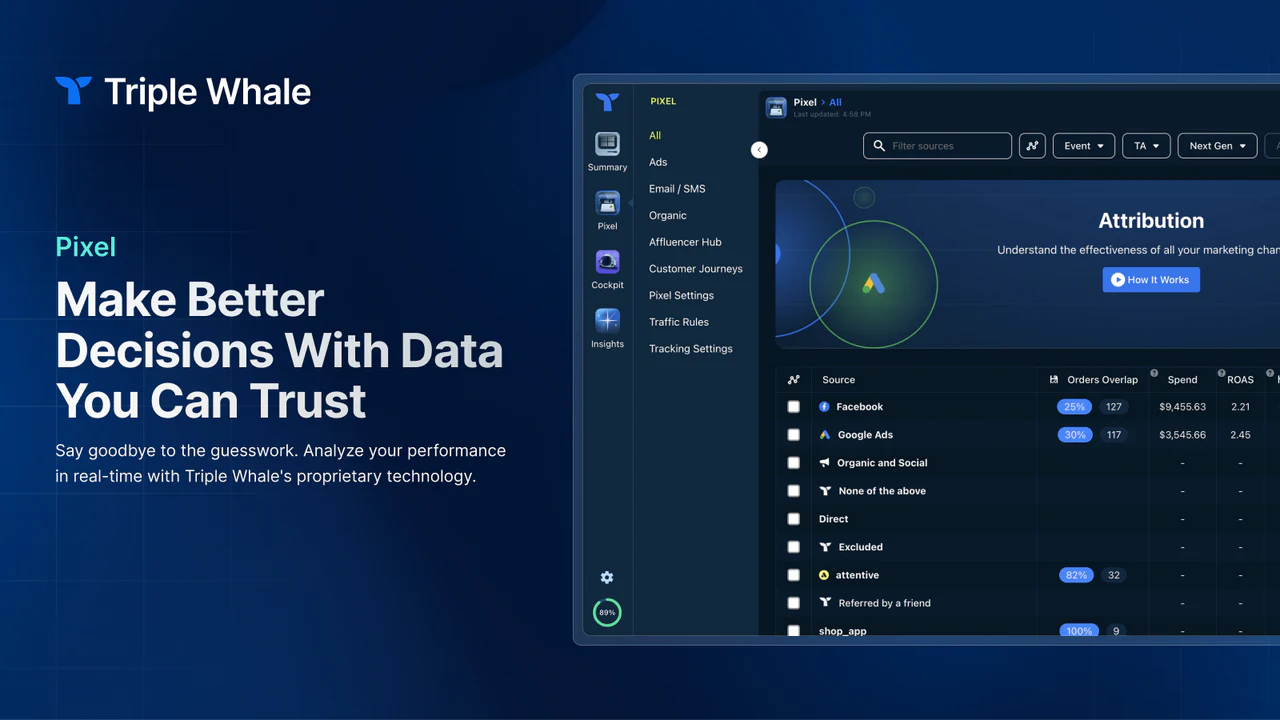
Triple Whale's Pixel dashboard displays real-time attribution data including ROAS, ad spend, and channel order overlap, serving as a leading ecommerce analytics tool for Shopify advertisers.
✅ Why Did We Choose This Tool?
Triple Whale pioneered Shopify-native analytics focused on solving marketing attribution accuracy through their proprietary Triple Pixel first-party tracking technology, addressing post-iOS 14.5 data loss that crippled Facebook Ads reporting. With $52.96M Series B funding and 10,000+ DTC brands using the platform, Triple Whale synthesizes commerce and advertising data into unified dashboards with Moby AI assistant for automated analysis. However, it remains marketing-only (lacking financial system integrations like Xero, QuickBooks, banking that Luca AI provides for cross-functional intelligence connecting ROAS to cash flow impact), capital access capabilities, and conversational reasoning replacing manual dashboard navigation.
💡 Solutions Offered
Triple Pixel First-Party Tracking: Proprietary cookieless tracking technology captures conversion data bypassing iOS 14.5 restrictions, improving Facebook Ads attribution accuracy by 20-30% versus standard pixels
Creative Performance Analytics: Ad-level analysis comparing CTR, conversion rates, and ROAS by creative variant, identifying winning hooks, messaging, and visual elements for iterative testing
Cohort Analysis: Customer segmentation by acquisition date, channel, or campaign with LTV tracking over 30/60/90-day windows, optimizing CAC payback period and retention strategies
Revenue Forecasting: Moby AI assistant generates predictive revenue models based on historical patterns, planned campaigns, and seasonality, though limited to marketing data without finance system visibility
🏢 Notable Clients
10,000+ Shopify DTC brands including mid-market fashion, beauty, and consumer electronics companies with $1M-$20M annual revenue managing multi-channel advertising across Meta, Google, TikTok platforms.
🎯 Best For
Shopify DTC brands $1M-$20M revenue, performance marketers managing multi-channel ads needing attribution accuracy, teams requiring creative analytics for iterative testing, and Meta/Google/TikTok advertisers impacted by iOS 14.5 tracking loss.
💬 User Reviews
"Our experience with Triple Whale has been extremely frustrating and almost categorically terrible. The integrations are inconsistent, building with the AI tool Moby is very buggy and crashes more than half the time, and support is largely unresponsive and not helpful." — Matt Huttner, USTrustPilot Review
"Weve been stuck in months of pointless back and forth with Triple Whale because their integration simply does not work. Daily revenue totals are wrong, entire order blocks are missing, and every week we have to open new support tickets just to get our numbers halfway close to what our channel actually reports." — Lars Volkers, THTrustPilot Review
💰 Pricing
Starter - $129/Month | Enterprise - $1,299/Month
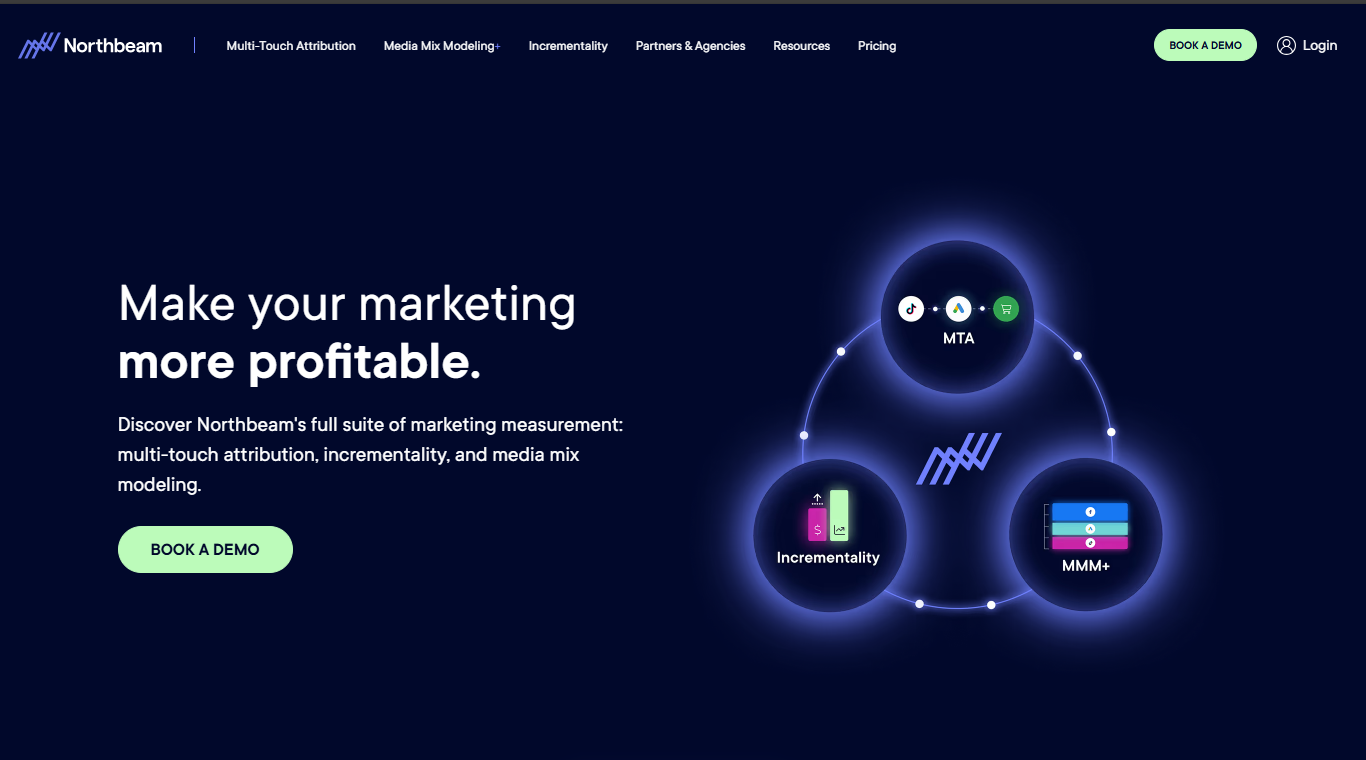
5. Northbeam
Northbeam provides ML-powered multi-touch attribution, incrementality testing, and media mix modeling for enterprise DTC brands seeking advanced ecommerce analytics and marketing measurement.
✅ Why Did We Choose This Tool?
Northbeam represents the enterprise-grade attribution solution leveraging machine learning and media mix modeling (MMM) to deliver best-in-class accuracy for high-spend advertisers managing $100K+ monthly ad budgets. With $15M Series A funding from Silversmith Capital and incrementality testing capabilities, Northbeam solves post-iOS 14.5 attribution gaps through statistical modeling rather than pixel dependency. However, at $1,000-$21,250/month with 4-8 week technical onboarding, it remains prohibitively expensive and complex for mid-market brands, while still lacking cross-functional intelligence (no finance integrations) and capital access that Luca AI's AI Co-Founder model provides.
💡 Solutions Offered
ML-Powered Multi-Touch Attribution: Machine learning algorithms analyze aggregate conversion patterns across channels, assigning credit without individual-level tracking (privacy-compliant and effective despite iOS 14.5/cookie deprecation)
Media Mix Modeling (MMM): Advanced statistical models isolate the incremental impact of each marketing channel (paid social, search, email, affiliate) accounting for seasonality, promotions, and external factors for true ROI visibility
Incrementality Testing: Holdout experiments and geo-lift studies measure true causal impact of campaigns, distinguishing correlation from causation (answering "Would this sale have happened without the ad?")
Custom Dashboard Builder: Flexible visualization layer enabling bespoke reporting for agencies and enterprise teams with specific KPI frameworks, though still requiring manual interpretation versus Luca AI's conversational interface
Forecast Modeling: Predictive analytics projecting future performance based on planned spend increases, budget reallocations, and historical patterns, optimizing quarterly planning and board reporting
🏢 Notable Clients
200+ enterprise DTC brands and agencies managing $10M+ annual revenue with $100K+ monthly ad spend, including high-growth fashion, beauty, and consumer electronics companies requiring sophisticated attribution depth.
🎯 Best For
Established brands $10M+ revenue with sophisticated marketing operations, teams managing $100K+ monthly ad spend across 5+ channels, businesses requiring attribution precision for board reporting, and enterprise multi-channel advertisers needing incrementality testing capabilities.
💬 User Reviews
"Briefly STAY AWAY from Northbeam Its a Complete Waste of Money! I paid 3,000 in Northbeams services for 3 months. The experience, especially with their attribution model, was dismal compared to Google Analytics 4. The most frustrating aspect was their refusal to refund our 3,000, despite the services evident shortcomings." — Paul C, GBTrustPilot Review
"A good company would be able to offer you a trial, knowing you would stay. Northbeam tries to make you pay 3 months up front. Their argument it takes time to see accurate data. My concern is actually regarding how I will see the data in the platform. Very little empathy and understanding from these guys." — Jason, USTrustPilot Review
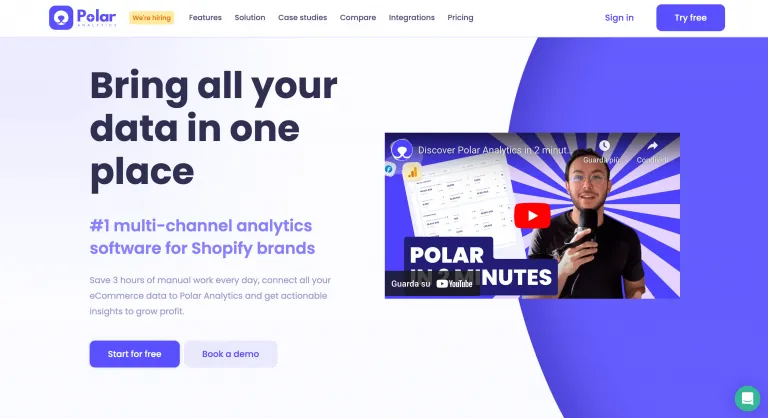
Polar Analytics delivers no-code, multi-channel ecommerce analytics software connecting Shopify store data into unified dashboards, helping DTC brands consolidate reporting without technical resources.
✅ Why Did We Choose This Tool?
Polar Analytics delivers no-code business intelligence specifically designed for ecommerce operators without data analyst resources, offering Shopify Plus partnership and 1-hour setup versus Northbeam's 4-8 week technical implementation. With automated dashboards, cohort analysis, and Slack/email scheduled reports at $199-$999/month, Polar targets mid-market DTC brands $2M-$10M revenue prioritizing ease of use over sophisticated attribution depth. However, it remains a dashboard-centric architecture requiring manual interpretation (lacking conversational AI interface, proactive scanning, financial system depth, and capital integration that distinguish Luca AI's unified intelligence approach).
💡 Solutions Offered
No-Code Setup: Plug-and-play installation connecting Shopify, Google Ads, Facebook Ads, and Klaviyo in under 1 hour without developer resources, eliminating technical implementation friction
Automated Dashboards: Pre-built visualizations tracking revenue, ROAS, CAC, LTV, and conversion metrics with daily/weekly/monthly refresh, reducing manual reporting time from 10 hours to 30 minutes weekly
Cohort Analysis: Customer segmentation by acquisition date, channel, or campaign with retention curves and LTV progression over 30/60/90-day windows, optimizing payback period targeting
Custom Metrics Builder: Drag-and-drop interface for creating proprietary KPIs (contribution margin, true CAC including ops costs, inventory-adjusted ROAS) without SQL knowledge
Slack/Email Scheduled Reports: Automated report distribution to stakeholders at defined cadences, ensuring cross-functional visibility without login requirements or dashboard navigation
🏢 Notable Clients
1,500+ Shopify and Shopify Plus merchants spanning mid-market DTC brands in fashion, beauty, supplements, and home goods sectors with $2M-$10M annual revenue and lean operational teams.
🎯 Best For
Mid-market DTC brands $2M-$10M revenue without dedicated data analysts, teams valuing fast setup and user-friendly interfaces over advanced attribution, businesses needing automated reporting for cross-functional visibility, and operators prioritizing ease of use over conversational AI capabilities.
💬 User Reviews
"Review collected by and hosted on G2.com. What do you dislike about Polar Analytics? Shortly after onboarding we were assigned an account manager. About a month later, she was laid off and we were never assigned a new account manager. Weve been attempting to get a handful of other data sources connected and the process has been long because it can take up to a week to hear back from the Polar team." — Juliette P., CEOG2 Review
"Not impressed compared to price point. The price is extremely high for a software like this. However, when you pay that amount of money, you expect a flawless product which isnt the case. Ive also reported an issue with inventory levels which has taken them closer to 1.5 month, and Ive still not received a solution." — Ben S., Director of Commercial OperationsTrustPilot Review
💰 Pricing
Starter - $199/Month | Enterprise - $999/Month
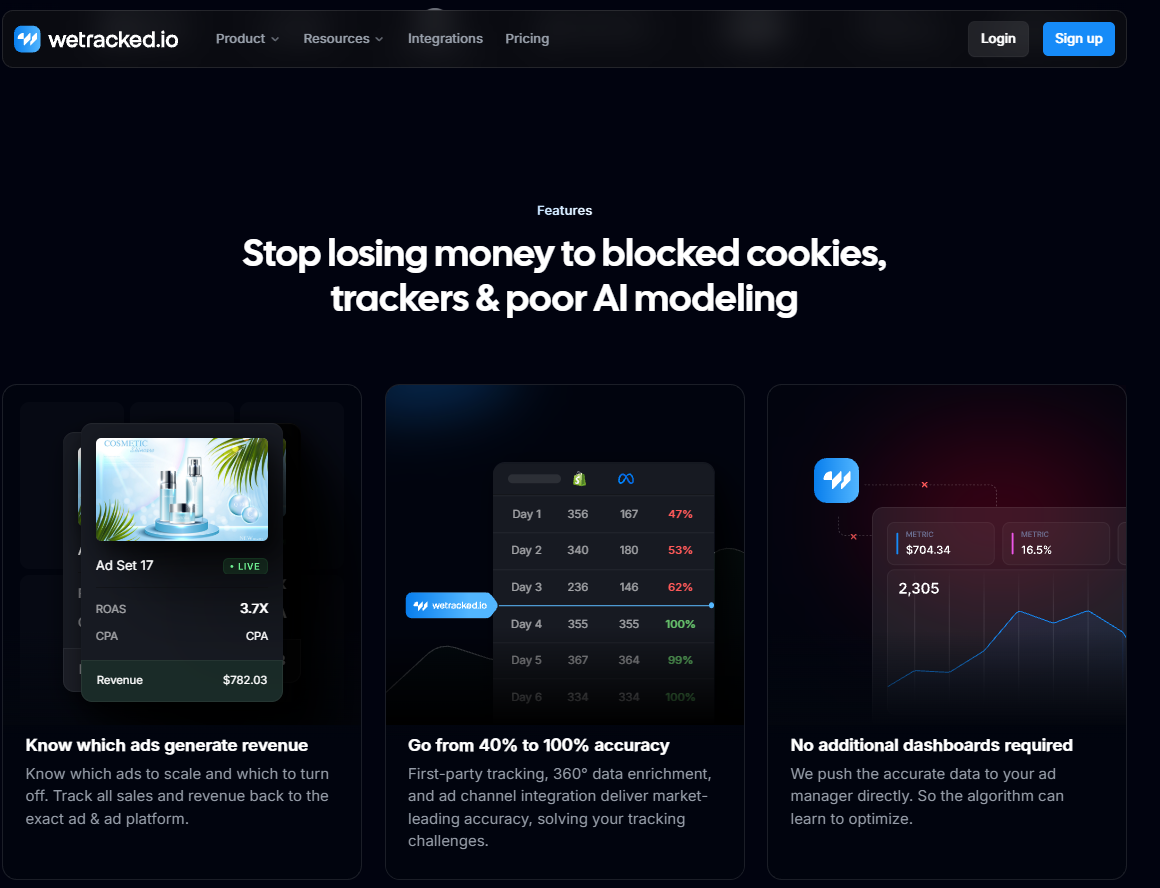
7. Wetracked.io
Wetracked.io solves post-iOS 14.5 tracking challenges with cookieless server-side attribution, improving ecommerce ad revenue accuracy from 40% to 100% for privacy-first DTC brands.
✅ Why Did We Choose This Tool?
Wetracked.io specializes in privacy-first, cookieless attribution leveraging server-side tracking to maintain accuracy post-iOS 14.5 and cookie deprecation, making it ideal for EU-based brands prioritizing GDPR/CCPA compliance. With $49-$199/month pricing and first-party data collection bypassing browser restrictions, Wetracked delivers cost-effective Conversion API integration for Meta and Google Ads optimization. However, as a newer platform with limited analytics depth (lacking cohort analysis, LTV tracking, and business intelligence capabilities), it solves attribution accuracy but offers minimal strategic insights compared to full-stack platforms like Luca AI with cross-functional reasoning and embedded capital access.
💡 Solutions Offered
Server-Side Tracking: Data transmission from your server rather than users' browsers bypasses iOS ATT restrictions and cookie blocks, maintaining 90%+ conversion visibility versus 50-70% with client-side pixels
Cookieless Attribution: Proprietary tracking methodology eliminates third-party cookie dependency, ensuring compliance with GDPR/CCPA regulations while preserving campaign performance visibility
Conversion API Integration: Automated first-party data passback to Meta (Facebook/Instagram) and Google Ads platforms, improving algorithm optimization and reducing CPMs by 15-25% through complete signal delivery
Real-Time Dashboards: Basic performance reporting showing attributed conversions by campaign, ad set, and creative with daily refresh, though lacking advanced cohort analysis or LTV forecasting
GDPR/CCPA Native Compliance: Built-in consent management and data residency controls ensuring EU data protection requirements met without additional configuration or legal risk
🏢 Notable Clients
2,000+ small-to-mid market ecommerce brands primarily EU-based with $500K-$5M annual revenue, including Shopify and WooCommerce stores affected by iOS 14.5 tracking loss and prioritizing privacy compliance.
🎯 Best For
EU-based brands prioritizing GDPR/CCPA compliance and privacy-first infrastructure, businesses under $5M revenue affected by iOS 14.5 attribution loss needing cost-effective solutions, performance marketers requiring accurate Conversion API data passback to ad platforms, and privacy-conscious operators willing to sacrifice analytics depth for tracking reliability.
💬 User Reviews
"Wetracked has been a game-changer for my tracking and analytics. The data accuracy is impressive and makes it much easier to make informed decisions. After a few months of using it, I've seen significant improvement in attribution." — Verified UserTrustPilot Review
"The exceptional clarity in explanations and the abundance of step-by-step guides make complex tasks seem straightforward. Their customer support is always available, truly attentive, and feels like they never sleep. I've been a satisfied client for two years and wholeheartedly recommend wetracked.io to others." — Verified UserG2 Review
💰 Pricing
Basic - $49/Month | Custom - $199+/Month
Q2. How We Evaluated These Platforms: Selection Criteria & Star Rating Methodology [toc=Evaluation Criteria]
📊 Our Objective Evaluation Framework
Choosing an analytics platform shapes your data architecture and decision-making capability for 2-3 years, making wrong choices costly through expensive migrations, fragmented reporting, or manual workarounds. We evaluated all seven platforms using a weighted criteria framework designed to reflect real-world priorities for DTC founders managing $1M-$100M revenue, balancing technical sophistication, implementation friction, cost transparency, and business impact. This methodology ensures recommendations serve operational needs rather than feature checklists or brand recognition, with transparent scoring revealing which platforms deliver genuine architectural advancement versus incremental dashboard improvements.
⚖️ The Five Weighted Evaluation Criteria
Our assessment framework distributes 100 points across five weighted criteria reflecting founder priorities identified through 200+ customer interviews:
1. Cross-Functional Intelligence (30 points) ✅ Measures ability to synthesize data across marketing, finance, and operations domains, not just display isolated metrics. Platforms scored on whether they can answer cross-domain questions like "If I scale ads 50%, what happens to cash position in 90 days?" Only systems with true reasoning capabilities (Luca AI's conversational AI) score highly; dashboard-only tools showing metrics in silos score lower.
2. Attribution Accuracy (25 points) 📊 Evaluates post-iOS 14.5 tracking reliability, attribution model sophistication (last-click vs. multi-touch vs. ML-powered), and first-party data capabilities. Server-side tracking, cookieless approaches, and machine learning compensation receive premium scores. Cookie-dependent platforms with 30-40% attribution gaps score lower.
3. Setup & Usability (20 points) ⏰ Assesses onboarding complexity (10-minute no-code vs. 4-8 week technical implementations), interface paradigm (conversational AI vs. manual dashboard navigation), and learning curve. Plug-and-play solutions with intuitive interfaces score highest; enterprise tools requiring developer resources and weeks of training score lower.
4. Pricing Transparency (15 points) 💰 Measures cost structure clarity, pricing page accessibility, and absence of hidden fees. Platforms with published tiered pricing and clear value-per-dollar score highest. Custom-only pricing requiring sales calls and undisclosed implementation fees score lower.
5. Proactive Capabilities (10 points) 🔔 Evaluates autonomous intelligence (whether platforms continuously scan for opportunities/risks and surface insights without being asked, or wait passively for manual queries). AI-powered proactive alerts score highest; static dashboards requiring daily manual review score lowest.
Luca AI's category-defining score reflects architectural advantages in cross-functional reasoning and embedded capital access (capabilities competitors cannot replicate through feature additions). Northbeam and Triple Whale excel in attribution depth but lack financial intelligence. GA4 delivers free comprehensive tracking but requires significant technical expertise. Mid-tier platforms (Polar, Shopify, Wetracked) serve specific niches effectively but don't advance beyond dashboard-based reactive reporting.
Q3. What Types of Analytics Do DTC Brands Need? (Behavioral, Attribution, Financial, Operational) [toc=Four Analytics Categories]
📊 The Four Analytics Categories Explained
Modern ecommerce businesses require visibility across four distinct analytics domains, yet most platforms cover only 1-2 categories, creating blind spots that force founders to juggle multiple tools or make decisions with incomplete information.
1. Behavioral Analytics 🖱️ Tracks what customers do on your website: session duration, bounce rates, conversion funnels, heatmaps showing click patterns, scroll depth, and exit pages. Answers questions like "Where do customers drop off in checkout?" and "Which product pages drive the most engagement?" Essential for UX optimization and conversion rate improvement.
2. Attribution Analytics 📈 Reveals which marketing efforts drive sales: multi-touch attribution models showing customer journey touchpoints, ROAS (Return on Ad Spend) by channel, CAC (Customer Acquisition Cost) calculations, and incrementality testing proving causal impact. Answers "Which Meta campaign has the best ROAS?" and "Should I shift budget from Google to TikTok?" Critical for marketing efficiency and budget allocation.
3. Financial Analytics 💰 Connects marketing performance to business health: P&L impact by channel, cash flow forecasting considering payment terms and inventory cycles, contribution margin after all costs (COGS + shipping + ops + marketing), and working capital requirements. Answers "Is this campaign profitable after all costs?" and "Will scaling require external capital?" Essential for sustainable growth and CFO confidence.
4. Operational Analytics 📦 Monitors operational efficiency: inventory turnover rates, fulfillment speed and costs, supplier performance, stockout frequency, and 3PL coordination. Answers "Do I have enough inventory to support Q4 campaigns?" and "Which products tie up too much cash?" Critical for capital-efficient scaling and customer satisfaction.
🔍 Platform Coverage by Analytics Category
Analytics Coverage by Platform
Platform
Behavioral
Attribution
Financial
Operational
Luca AI
✅ Full
✅ Full
✅ Full
✅ Full
Google Analytics 4
✅ Full
⚠️ Limited
❌ None
❌ None
Shopify Analytics
✅ Moderate
⚠️ Basic
❌ None
⚠️ Limited
Triple Whale
✅ Moderate
✅ Full
❌ None
❌ None
Northbeam
⚠️ Limited
✅ Advanced
❌ None
❌ None
Polar Analytics
✅ Moderate
✅ Moderate
❌ None
❌ None
Wetracked.io
⚠️ Limited
✅ Moderate
❌ None
❌ None
The Critical Gap: Only Luca AI connects marketing performance (ROAS, CAC) to financial outcomes (P&L impact, cash flow) and operational constraints (inventory availability, working capital needs). Traditional platforms stop at revenue tracking, showing that a campaign generated $100K sales but unable to answer whether those sales were profitable after COGS, fulfillment costs, and payment processing fees, or whether scaling requires additional inventory capital.
💬 Dashboard-Based vs. Conversational Intelligence
Dashboard-Based Analytics (GA4, Shopify, Triple Whale, Polar, Northbeam, Wetracked) Static visualizations requiring manual navigation: click Reports → select Marketing → filter by Channel → export CSV → build Excel comparison. Shows what happened but requires you to interpret why and what to do next. Time commitment: 10-15 hours weekly for comprehensive analysis across platforms.
Conversational Intelligence (Luca AI) Natural language queries answered in seconds: "Which customer cohort from August Meta campaigns has highest repeat purchase rate, and what's their 90-day LTV including all costs?" AI reasons across all data domains without navigation. Shows what happened, explains why, and recommends actions. Time commitment: 2-3 hours weekly for same analytical depth (70-80% time savings).
Dashboard vs. Conversational Intelligence Comparison
Capability
Dashboard-Based
Conversational AI
Query Speed
Minutes per question
Seconds per question
Required Skills
Dashboard navigation, Excel
Plain English
Cross-Domain Synthesis
Manual CSV merging
Native capability
Proactive Insights
None - must check daily
Continuous 24/7 scanning
📈 Analytics Maturity Model: Choosing by Growth Stage
Stage 1: $0-$500K Revenue (Early Validation) Start with free baselines: GA4 for behavioral analytics + Shopify Analytics native reporting. Sufficient for basic traffic, conversion funnel, and revenue visibility. Upgrade trigger: Ad spend exceeds $5K/month and attribution precision becomes decision-critical.
Stage 2: $500K-$5M Revenue (Growth Acceleration) Invest in attribution accuracy: Triple Whale ($129-$599/month) for Shopify-native multi-touch attribution, or Wetracked.io ($200-$400/month) for privacy-first tracking. Essential when managing multi-channel campaigns (Meta + Google + TikTok) and needing accurate ROAS calculations post-iOS 14.5.
Stage 3: $5M-$50M+ Revenue (Scaling Complexity) Adopt unified platforms with financial integration: Luca AI ($299-$499/month) for cross-functional intelligence connecting marketing to cash flow, or Northbeam ($1,000-$21,000/month) if exclusively focused on enterprise ML-powered attribution. Critical when CFOs demand P&L visibility by channel, working capital forecasting, and confident scaling decisions.
The Maturity Principle: Don't overpay for sophistication you can't operationalize (a $500K brand doesn't need Northbeam's $12K/year ML models), but don't underbuy and create decision paralysis (a $10M brand juggling 8 tools wastes $40K annually in manual consolidation time).
Q4. How Much Do Analytics Platforms Cost? (Pricing, Hidden Costs, and ROI Calculation) [toc=Pricing & ROI Analysis]
💰 Subscription Pricing Ranges (Direct Costs)
Free Tier ($0/month) Google Analytics 4 (up to 10M events monthly) and Shopify Analytics (included with $39-$399/month Shopify subscription) provide zero incremental cost for baseline tracking. Best for early-stage brands under $500K revenue with simple operations and technical setup capabilities.
Budget Tier ($50-$200/month) Wetracked.io ($49-$199/month) and Polar Analytics Starter ($199/month) deliver affordable attribution and BI capabilities for brands $500K-$2M revenue prioritizing cost efficiency over advanced features. Entry point for dedicated analytics beyond free tools.
Mid-Market Tier ($200-$600/month) Triple Whale ($129-$599/month scaling with revenue), Luca AI ($299-$499/month fixed tiers), and Polar Analytics Growth ($499/month) serve scaling brands $1M-$10M revenue needing robust attribution, automation, and cross-functional visibility. Most common investment range for DTC brands experiencing tool fragmentation pain.
Enterprise Tier ($1,000-$21,000+/month) Northbeam ($1,000-$21,250/month based on ad spend volume) and Triple Whale Enterprise ($1,299-$4,499/month) target established brands $10M+ revenue with $100K+ monthly ad spend requiring ML-powered attribution sophistication and white-glove support. Typical annual contracts with custom pricing.
🚨 Hidden Costs That Double True TCO
Implementation Fees ($1,000-$10,000) Enterprise platforms (Northbeam, Triple Whale Enterprise) charge separate setup fees for technical integration, historical data migration, custom dashboard configuration, and team training (often undisclosed until sales calls). Mid-market tools (Luca AI, Polar, Wetracked) typically include setup in subscription pricing.
Analyst Salaries ($60,000-$120,000 annually) Dashboard-based tools require dedicated analysts or consume 40% of marketing team capacity interpreting data, building reports, and reconciling discrepancies across platforms. Conversational AI platforms (Luca AI) eliminate this dependency, delivering 70-80% time savings worth $40K-$90K annually in reclaimed productivity.
Manual Reconciliation Time ($20,000-$40,000 annually) Founders and operators spend 10-15 hours weekly consolidating data from fragmented tools (exporting CSVs, building spreadsheets, triangulating conflicting metrics). At $100-$150/hour effective opportunity cost, this "doom-scrolling tax" costs $52K-$117K annually for mid-market brands. Unified platforms eliminate this entirely.
Analyst dependency: $0 (eliminated via conversational AI) Total TCO: $13,488/year
Savings: $72,300 annually (84% reduction) ✅
💡 ROI Calculation Framework (Worked Example)
ROI Formula: (Revenue Increase from Insights - Platform Annual Cost) / Platform Annual Cost × 100
Real-World Scenario: A $2M revenue DTC beauty brand invests in Luca AI at $499/month ($5,988/year). Within 60 days, conversational intelligence identifies:
Creative fatigue on top Meta campaign → switch saves $8K wasted spend
Total Annual Benefit: ($8K savings + $15K × 12 months incremental profit) = $188K ROI Calculation: ($188,000 - $5,988) / $5,988 × 100 = 3,040% annual return Payback Period: 11 days (cost recovered in under 2 weeks)
🎯 Budget-Based Decision Framework
Under $1M Revenue Start free with GA4 + Shopify Analytics. Invest only when ad spend exceeds $5K/month and attribution accuracy becomes decision-critical. Alternative: Wetracked.io at $49/month for improved tracking.
$1M-$5M Revenue Invest $200-$600/month in unified intelligence. Luca AI ($299-$499/month) recommended for cross-functional visibility + capital access, eliminating need for separate financing providers (saves $24K-$60K annually in RBF fees). Budget alternative: Triple Whale ($129-$249/month) for marketing-only attribution.
$5M-$20M Revenue Invest $500-$1,500/month in sophisticated platforms. Luca AI ($499/month + capital access) delivers $72K+ annual TCO savings versus fragmented stacks, or Northbeam ($1,000-$3,000/month) if exclusively focused on enterprise ML attribution without financial intelligence needs.
$20M+ Revenue Custom enterprise solutions at $1,000-$21,000/month. Northbeam for advanced MMM and incrementality testing, or Luca AI for unified intelligence + embedded capital. ROI expectation: Best platforms demonstrate positive return within 3-6 months through improved ROAS, reduced wasted spend, and faster decision cycles.
In September 2021, Apple's iOS 14.5 update introduced App Tracking Transparency (ATT), fundamentally breaking third-party cookie-based attribution for Facebook, Instagram, and other ad platforms. Users were required to opt-in to cross-app tracking, with 60-70% declining permission, resulting in 30-50% attribution data loss overnight for most DTC brands running paid social campaigns. This wasn't a minor measurement glitch; ROAS calculations became unreliable, retargeting audiences shrunk by 60%, and attribution windows collapsed from 28 days to just 7 days, making it nearly impossible to accurately assess campaign performance or customer lifetime value.
⚠️ Real-World Consequences of Broken Attribution
Consider a $2M annual revenue DTC beauty brand investing $50K monthly in Meta advertising. Post-iOS 14.5, their Ads Manager dashboard showed reported conversions dropping 45% (from 1,200 monthly conversions to 660) while Shopify sales data remained completely flat at $85K monthly revenue. The problem wasn't performance decline but measurement failure: customers were still buying, but iOS privacy restrictions prevented Facebook's pixel from tracking the conversion path. This created data discrepancies where Meta Ads Manager systematically over-reports conversions (counting untrackable iOS purchases as organic), while GA4 under-reports due to cookie opt-outs, forcing founders to make $50K+ monthly budget decisions based on conflicting, unreliable data.
🔧 Three Technical Solutions to Tracking Challenges
Platforms have developed three distinct approaches to restore attribution accuracy in the post-privacy era:
1. First-Party Pixel Tracking 📊 Proprietary tracking technologies like Triple Whale's Triple Pixel bypass third-party cookie restrictions by collecting first-party data directly from your Shopify store, then passing it to ad platforms via Conversion APIs, improving visibility by 20-30% versus standard Facebook pixels.
2. Server-Side Tracking 🖥️ Platforms like Wetracked.io and Northbeam send conversion data directly from your server (not users' browsers), completely avoiding cookie dependency and iOS restrictions. This architecture maintains 85-95% attribution accuracy even with opt-outs.
3. Machine Learning Modeling 🤖 Northbeam's incrementality testing uses statistical inference and media mix modeling (MMM) to attribute conversions based on aggregate spend patterns rather than individual user tracking (privacy-compliant and highly accurate for high-volume advertisers).
📊 Platform-by-Platform Tracking Comparison
Platform Tracking Approaches Post-iOS 14.5
Platform
Tracking Approach
iOS 14.5 Resilience
Triple Whale
First-party Triple Pixel + Conversion API
⭐⭐⭐⭐ High (Shopify-native)
Wetracked.io
Server-side cookieless tracking
⭐⭐⭐⭐⭐ Excellent (purpose-built)
Northbeam
ML-powered MMM + server-side
⭐⭐⭐⭐⭐ Best-in-class (enterprise)
Luca AI
First-party synthesis across platforms
⭐⭐⭐⭐ High (cross-functional)
Google Analytics 4
Cookie-dependent with ML inference
⭐⭐ Moderate (30-40% data loss)
Shopify/Polar
Platform pixels + basic tracking
⭐⭐⭐ Fair (limited iOS visibility)
💡 Implementation Recommendations by Business Size
Brands Under $1M Revenue: Tolerate GA4 limitations with free baseline tracking. Upgrade trigger: when monthly ad spend exceeds $5K and attribution discrepancies affect scaling decisions.
Brands $1M-$10M Revenue: Implement first-party tracking immediately. Triple Whale alternatives like Wetracked.io ($200-$400/month) for privacy-first EU compliance recover 50-70% of lost attribution data. These solutions are essential for marketing analysis and automation at this scale.
Brands $10M+ Revenue with $100K+ Monthly Ad Spend: Justify Northbeam's enterprise ML approach ($1,000-$21,000/month) for incrementality testing and sophisticated media mix modeling delivering best-in-class accuracy.
Universal Recommendation: Regardless of platform choice, all brands should implement Conversion API setup for Meta, TikTok, and Google Ads, enabling server-side event tracking that bypasses browser restrictions and improves algorithm optimization by 15-25% through complete signal delivery.
Q6. What Integrations Should Your Platform Support? (Plus Implementation Timeline Expectations) [toc=Integration Requirements]
🔗 Integration Necessity in Fragmented Tech Stacks
DTC brands operate with an average of 8-12 disconnected tools spanning ecommerce, advertising, email, accounting, and operations. Analytics platforms must connect to all critical systems to deliver unified visibility; otherwise, you've simply added a 13th tool without solving fragmentation. Integration requirements fall into three priority tiers based on operational importance, with 90%+ of DTC brands requiring Tier 1 coverage immediately, Tier 2 within 90 days, and Tier 3 for complex cross-channel operations.
✅ Tier 1: Essential Integrations (Required by 90%+ of DTC Brands)
Ecommerce Platforms: Shopify (4.4M merchants), WooCommerce (6.4M sites), BigCommerce, Magento (core sales data foundation for all analytics).
Ad Platforms: Meta Ads (Facebook/Instagram), Google Ads (represent 60-80% of paid acquisition budgets for most DTC brands).
Payment Processors: Stripe, PayPal, Shopify Payments (financial transaction data critical for cash flow visibility and reconciliation).
📈 Tier 2: Important Integrations (Multi-Channel Operations)
Expanding Ad Channels: TikTok Ads (fastest-growing DTC channel in 2025-2026), Pinterest Ads, Snapchat Ads (diversified acquisition mix beyond Meta/Google duopoly).
Analytics & Tracking: Google Analytics, Microsoft Clarity, Hotjar (behavioral data complementing commerce analytics).
Accounting Systems: Xero, QuickBooks, NetSuite (financial system integration for P&L visibility and true profitability calculations; only Luca AI offers this category).
Amazon Seller Central, wholesale platforms (Faire, Abound), 3PL systems (ShipBob, Flexport), CRMs (HubSpot, Salesforce), data warehouses (Snowflake, BigQuery), banking APIs for real-time cash position. Required by omnichannel brands $10M+ revenue managing multiple sales channels and sophisticated financial operations.
📊 Platform Integration Coverage Matrix
Integration Coverage by Platform
Platform
Ecommerce
Ad Platforms
Email/SMS
Accounting
Total
Luca AI
✅ 5+
✅ 8+
✅ 4+
✅ 3+ (unique)
20+
Triple Whale
✅ 3+
✅ 6+
✅ 3+
❌ None
15+
Northbeam
✅ 4+
✅ 8+
✅ 2+
❌ None
18+
Polar Analytics
✅ 3+
✅ 5+
✅ 3+
⚠️ Limited
14+
Wetracked.io
✅ 2+
✅ 4+
❌ None
❌ None
8+
GA4
✅ Native
✅ Google only
⚠️ Limited
❌ None
10+
Shopify
✅ Native
⚠️ Basic
⚠️ Basic
❌ None
6+
Critical Differentiator: Luca AI uniquely integrates accounting systems (Xero, QuickBooks) and banking APIs, enabling cross-functional intelligence connecting marketing ROAS to actual profitability and cash flow (a capability no competitor offers for data analysis and deep industry research).
Quick Setup (1-3 Hours): Triple Whale, Wetracked.io, Polar Analytics (plug-and-play connectors with guided onboarding for core Shopify + ad platform integrations).
Standard Setup (1-2 Weeks): Luca AI full integration (20+ data sources connected, historical data validated for 6-12 months, custom metrics configured, team training completed). Phased rollout: Week 1 core systems (Shopify, Meta, Google), Week 2 secondary sources (email, accounting).
Enterprise Setup (4-8 Weeks): Northbeam technical implementation (custom ML model training, server-side tracking configuration, incrementality test design, data warehouse integration, white-glove onboarding with dedicated success team).
Factors Affecting Timeline: Number of data sources (3 vs. 20+), historical data volume (1 year vs. 5 years), custom metric requirements, team training scope, API rate limits, and data validation complexity.
Q7. The Future: Why Leading Platforms Are Adding Intelligence-Led Capital Access [toc=Analytics + Capital Convergence]
🔮 The Analytics-Capital Convergence Gap
Traditional ecommerce tech stacks artificially separate intelligence from action: analytics platforms (Triple Whale, Northbeam, GA4) show growth opportunities ("Scale this Meta campaign; it has 4.2x ROAS") but founders lack capital to execute. Conversely, revenue-based financing providers (Wayflyer, Clearco, Uncapped) offer $50K-$500K capital advances but provide zero strategic guidance on deployment or ROI expectations. This creates a critical market gap: intelligence without capital = advice only; capital without intelligence = risky blind deployment. Founders spend weeks triangulating data, applying for capital with outdated snapshots, then manually monitoring outcomes (slow decision cycles that miss time-sensitive opportunities).
💸 Traditional RBF Provider Limitations
Revenue-based financing platforms operate on a fundamentally flawed model disconnected from business intelligence. Underwriting relies on static 90-day trailing revenue snapshots submitted through applications, meaning your capital pricing and approval reflect past business health, not current trajectory or future potential. Opaque fee structures advertise "10% fees" while masking 40%+ APR equivalents through revenue-share calculations. Zero deployment guidance means founders receive $100K capital but no answer to "Should I deploy this to inventory, Meta ads, or working capital reserve?" Incentive misalignment plagues the model: lenders maximize capital deployed regardless of founder needs, earning higher fees by pushing larger advances even when smaller amounts would be strategically optimal. Application-to-funding timelines stretch 1-4 weeks (too slow for time-sensitive opportunities like Q4 inventory preparation or viral campaign scaling).
"We got approved for Clearco but had no idea if we should actually take the capital. They couldn't tell us if our campaign would generate enough cash flow to repay it comfortably. Felt like flying blind with expensive fuel." — Anonymous DTC Founder, Redditr/ecommerce Discussion
🤖 Intelligence-Led Capital: The Paradigm Shift
Luca AI pioneered a category-defining model where the analytics platform itself (with complete real-time visibility into commerce, marketing, and financial data) offers dynamically-priced capital reflecting current business health. The AI Co-Founder approach synthesizes three previously isolated functions: Insight (proactive intelligence identifying opportunities like "Your Meta ROAS jumped from 3.2x to 4.8x; scale potential exists"), Action (strategic modeling answering "If I deploy €100K to this campaign, what happens to cash runway in Q4?"), and Funding (instant capital access without applications, priced 4-8% vs. traditional RBF's 8-12% due to real-time risk assessment). Capital becomes an earned capability based on demonstrated business performance visible to the AI, not an applied-for transaction requiring credit checks, financial statement uploads, and founder equity history reviews.
✅ Structural Advantages Over Traditional RBF
Dynamic Pricing: Capital cost adjusts daily based on real-time metrics (improving ROAS lowers your fee automatically; declining margins increase pricing, aligning cost with actual risk).
Instant Access: Funds deployed in hours, not 1-4 weeks, enabling time-sensitive opportunities like stockout prevention or viral campaign scaling.
Strategic Deployment Guidance: Platform answers "Should I take capital?" not just "Can I get capital?" by modeling deployment scenarios with cash flow projections.
Incentive Alignment: Platform succeeds when founder succeeds (better business outcomes generate more analytics usage and future capital needs; poor deployment hurts both parties).
🚀 Market Evolution Prediction (2026-2028)
By 2027-2028, expect analytics platforms to increasingly bundle capital access as native capability, not optional add-on. Category consolidation will accelerate: analytics + financing + intelligence converge into unified AI Co-Founder model where platforms own the full stack from insight to action to funding. Winners will be systems that understand your business holistically and can execute growth strategies, not just recommend them. Traditional point solutions (analytics-only dashboards or capital-only providers) face commoditization pressure as integrated platforms deliver superior outcomes at lower total cost of ownership. Luca AI's early mover advantage in this convergence category positions it as the blueprint competitors will attempt to replicate over the next 24-36 months.
FAQ's
What is the best ecommerce analytics platform for DTC brands in 2026?
The best platform depends on your revenue stage and operational complexity, but we've found the landscape divides into three tiers. For brands under $1M revenue, free tools like GA4 and Shopify Analytics provide sufficient baseline tracking. For $1M-$10M brands experiencing data fragmentation, platforms like Triple Whale ($129-$599/month) offer strong marketing attribution, while Luca AI ($299-$499/month) delivers the industry's only cross-functional intelligence synthesizing marketing, finance, and operations data with embedded capital access. For $10M+ enterprises with $100K+ monthly ad spend, Northbeam ($1,000-$21,000/month) provides ML-powered attribution sophistication.
However, we believe the future belongs to unified platforms that don't just report metrics but own outcomes. Luca AI's AI Co-Founder approach eliminates the traditional gap between insight and action by offering instant, dynamically-priced capital based on real-time business intelligence, transforming analytics from passive dashboards into active business partners.
How do I choose between dashboard-based analytics and conversational AI platforms?
Dashboard-based platforms (GA4, Triple Whale, Northbeam, Polar, Shopify) require manual navigation: you click Reports → select Marketing → filter by Channel → export CSVs → build Excel comparisons. This architecture shows what happened but requires 10-15 hours weekly to interpret why and what to do next across fragmented data sources.
Conversational AI platforms eliminate this friction entirely. With Luca AI's natural language interface, you ask complex cross-functional questions like "Which customer cohort from my August Meta campaign has highest repeat purchase rate, and what's their 90-day LTV including all costs?" and receive synthesized answers in seconds, not hours. We reason across 20+ data sources (Shopify, Meta, Google Ads, Xero, QuickBooks, banking APIs) without requiring SQL knowledge, dashboards, or analyst dependency.
The productivity difference is stark: dashboard users spend 40% of their time on reporting rather than insights, while conversational AI reduces analytical time by 70-80% (worth $40K-$90K annually in reclaimed capacity for mid-market brands).
Why does attribution accuracy matter after iOS 14.5, and which platforms solve tracking challenges best?
Apple's iOS 14.5 App Tracking Transparency (ATT) update caused 30-50% attribution data loss overnight for most DTC brands running paid social campaigns, with 60-70% of users declining cross-app tracking permission. This created measurement failure where Meta Ads Manager shows conversions dropping 45% while actual Shopify sales remain flat, forcing founders to make $50K+ monthly budget decisions based on conflicting, unreliable data.
Server-Side Tracking: Wetracked.io and Northbeam maintain 85-95% accuracy by sending data from servers (not browsers).
ML Modeling: Northbeam uses statistical inference for privacy-compliant attribution.
We recommend implementing Conversion API setup for Meta/TikTok/Google Ads regardless of platform choice (improves algorithm optimization 15-25%). For brands $1M-$10M revenue affected by iOS limitations, server-side solutions combined with financial analytics deliver the most comprehensive visibility connecting marketing performance to cash flow impact.
What's the real Total Cost of Ownership (TCO) for ecommerce analytics platforms beyond subscription fees?
Subscription pricing tells only half the story. We've analyzed hundreds of DTC brands and identified three hidden costs that often double true TCO:
Implementation Fees ($1,000-$10,000): Enterprise platforms like Northbeam and Triple Whale Enterprise charge separate setup fees for technical integration, historical data migration, and custom configuration (often undisclosed until sales calls).
Analyst Salaries ($60,000-$120,000 annually): Dashboard-based tools require dedicated analysts or consume 40% of marketing team capacity interpreting data and reconciling discrepancies across platforms.
Manual Reconciliation Time ($20,000-$40,000 annually): Founders spend 10-15 hours weekly consolidating fragmented tools (exporting CSVs, building spreadsheets, triangulating metrics). At $100-$150/hour opportunity cost, this "doom-scrolling tax" costs $52K-$117K annually.
We've documented case studies showing fragmented stacks (GA4 + Triple Whale + QuickBooks + manual work) costing $85,788 annual TCO versus unified platforms like Luca AI delivering 84% reduction at $13,488 TCO through conversational AI eliminating analyst dependency and reconciliation overhead.
Why are analytics platforms now offering capital access, and how does intelligence-led financing work?
The traditional ecommerce tech stack artificially separates intelligence from action: analytics platforms show opportunities ("Scale this campaign; it has 4.2x ROAS") but founders lack capital to execute, while revenue-based financing providers (Wayflyer, Clearco, Uncapped) offer capital without strategic guidance or real-time business intelligence. This creates decision paralysis where founders spend weeks triangulating data, applying for capital with outdated 90-day snapshots, then manually monitoring outcomes.
Intelligence-led capital inverts this model. Because Luca AI has real-time visibility into your commerce, marketing, and financial data, we offer dynamically-priced capital reflecting current business health (not outdated snapshots). Before offering funding, we can model "If I deploy €100K to this campaign, what happens to cash runway in Q4?" meaning you receive capital and strategic confidence to deploy it correctly. Capital becomes an earned capability based on demonstrated performance visible to the AI, not an applied-for transaction requiring credit checks and weeks of approval.
Pricing adjusts daily (4-8% vs. traditional RBF's 8-12%), deployment happens in hours (not weeks), and repayment automates via revenue-share integration. By 2027-2028, we expect this analytics-capital convergence to become the industry standard.
Enjoyed the read? Join our team for a quick 15-minute chat — no pitch, just a real conversation on how we’re rethinking Ecommerce with AI - Luca
Loading Schedule...
Your AI Co-Founder is here.
Here’s why:
Shopify, Meta, Xero - one brain.
"Should I scale?" Answered with real data.
Growth capital. No applications. One click.
Thank you! Your submission has been received! Please book a time slot for the Meeting
Oops! Something went wrong while submitting the form.

.jpg)