Ecommerce API Integrations Decoded: Auth Models, Rate Limits, Data Sync, and Failure Patterns
13
mins read
TL;DR
Ecommerce API integrations are the plumbing that moves data across storefront, ads, retention, payments, ops, and intelligence layers. Shopify mandates GraphQL for new public apps from April 1, 2025; REST still fits back-office scripts but is on notice. Rate limits, token rotation gaps, scope drift, and webhook spoofing quietly break more stores than bad code does. Webhooks need idempotency keys, dead-letter queues, and nightly reconciliation; CDC is the gold standard above 7M. Build only when integration logic is your moat; buy connectors and own the prompts plus the reasoning layer. Luca AI sits over the warehouse with agentic reports and dynamically priced capital under 24-hour disbursal.
Q1: What Are Ecommerce API Integrations and Why Is the Plumbing the Product? [toc=1. API Integrations Defined]
Ecommerce API integrations are the programmatic contracts that move data between your storefront, ad platforms, email, payments, finance, inventory, and 3PLs. They run on REST, GraphQL, webhooks, or event streams. Each call is authorized with a token. The seven core data types, storefront, cart, catalog, order, inventory, customer, and content, are table stakes. The real edge is whether your stack can reason horizontally across them, not just sync vertically.
The seven data types, in plain English
Most BigCommerce, Shopify, and Strapi explainers categorize APIs by function, and the categories matter because they map to your daily ops.
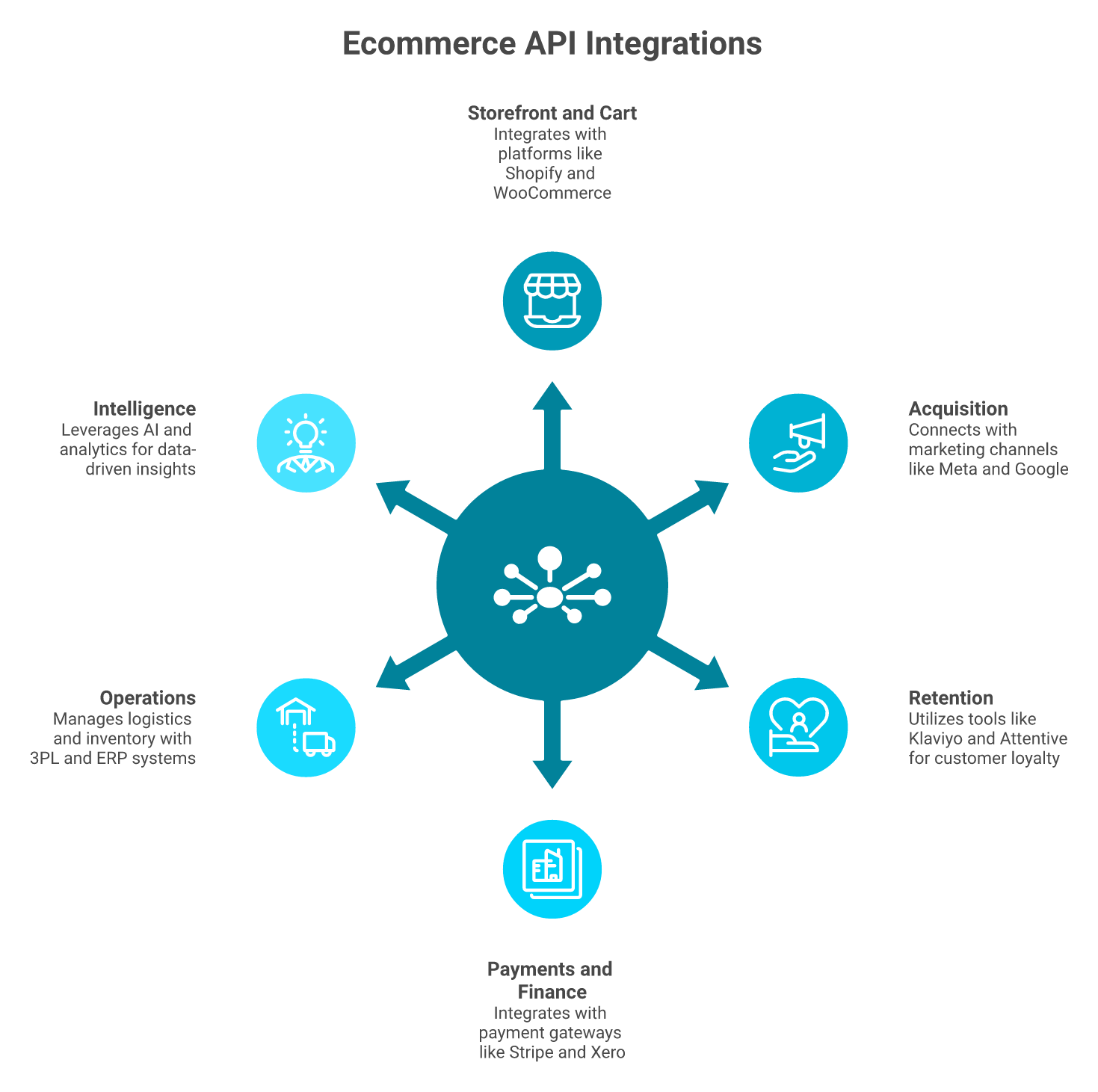
The six functional categories every DTC API stack needs, mapped to canonical vendors and the gaps where margin leaks.
✅ Storefront and Cart APIs power the buyer-facing experience and checkout
✅ Catalog APIs sync products, variants, and pricing across channels
✅ Order APIs push order state across 3PL, ERP, and accounting
✅ Inventory APIs keep stock numbers honest across Shopify, Amazon, and retail
✅ Customer APIs feed Klaviyo, Postscript, and your CRM
✅ Content APIs move blog, CMS, and product descriptions
✅ Payment and finance APIs wire Stripe, banking, and accounting
Vertical sync is the floor, horizontal reasoning is the ceiling
Most stacks integrate vertically. Meta data lives in Meta. Shopify data lives in Shopify. Xero data lives in Xero. The horizontal magic happens when one layer can correlate Meta CPMs with inventory velocity and Stripe payouts in the same query, which is exactly the gap a true e-commerce tech stack needs to close.
Why bad plumbing silently torches margin
When schemas drift and tokens expire, you do not get a loud failure. You get a 3% reporting variance, a slightly off CAC number, and a Tuesday meeting where nobody trusts the deck. Scaling past 7 figures with messy SKU naming is what operators call the "data-cleanup year." We built Luca's normalization layer to skip that year by standardizing schemas on ingestion, not after, a pattern explored further in why e-commerce founders are drowning in data.
Q2: REST, GraphQL, Webhooks, or Event-Driven, Which Architecture Should Your Stack Use? [toc=2. Choosing API Architecture]
REST suits low-frequency reads. GraphQL wins surgical pulls and is now mandatory for new public Shopify apps as of April 1, 2025. Webhooks deliver near-real-time events. Event-driven streams like Kafka or EventBridge fit multi-channel brands above €7M. Most DTC stacks need a hybrid, GraphQL for catalog, webhooks for orders, and REST for back-office, with idempotency everywhere. Pick architecture by latency tolerance, not by what your last agency built.
The 2025 GraphQL mandate changed the default
Shopify's changelog is explicit. Starting April 1, 2025, all new public apps submitted to the App Store after this date must only use GraphQL. Public apps that did not migrate to the new GraphQL product APIs were temporarily demoted in the App Store. If your dev partner is still pitching a REST-first build for a new public app, that is a red flag.
REST is not dead, but it is on notice
REST still works for custom apps below 100 variants and for back-office scripts. It is simple, well documented, and easy to debug. The trade-off is verbosity. A single product page can require 5 REST calls where one GraphQL query would do.
Webhooks and event-driven for the real-time tier
Webhooks fire on order paid, fulfillment created, or inventory updated. They are the cheapest way to feel real-time. Event-driven streams add durability, replay, and ordering guarantees, which matter when you run Shopify, Amazon, and a 3PL together.
A 4-way snapshot for picking architecture
Architecture Comparison for Ecommerce API Integrations
Architecture
Latency
Cost
Complexity
Best fit
REST
Seconds to minutes
Low
Low
Back-office scripts, low-volume reads
GraphQL
Seconds
Low to medium
Medium
Catalog, surgical field pulls, new Shopify apps
Webhooks
Sub-second to seconds
Low
Medium
Order, fulfillment, inventory events
Event-driven
Sub-second
Medium to high
High
Multi-channel >€7M, durable replay
Who should choose what
⭐ Sub-€1M Shopify single-channel stores can ship 90% of value on GraphQL plus webhooks. Brands above €7M selling on Shopify, Amazon, and retail should add an event bus. ❌ Do not let a vendor sell you Kafka if you are doing €600K a year. The complexity tax will eat you, as discussed in ecommerce management software.
A real Black Friday fix
I watched a brand running 47 polling jobs per minute against Shopify get 429'd every Black Friday at noon. They moved catalog reads to GraphQL bulk operations and order events to webhooks. The 429s went to zero. The fix was architectural, not infrastructural, the kind of move that pairs well with agentic AI for ecommerce founders.
Q3: How Should You Choose an Auth Model and Avoid Token Rotation, Scope Drift, and Webhook Spoofing? [toc=3. Auth Models and Risks]
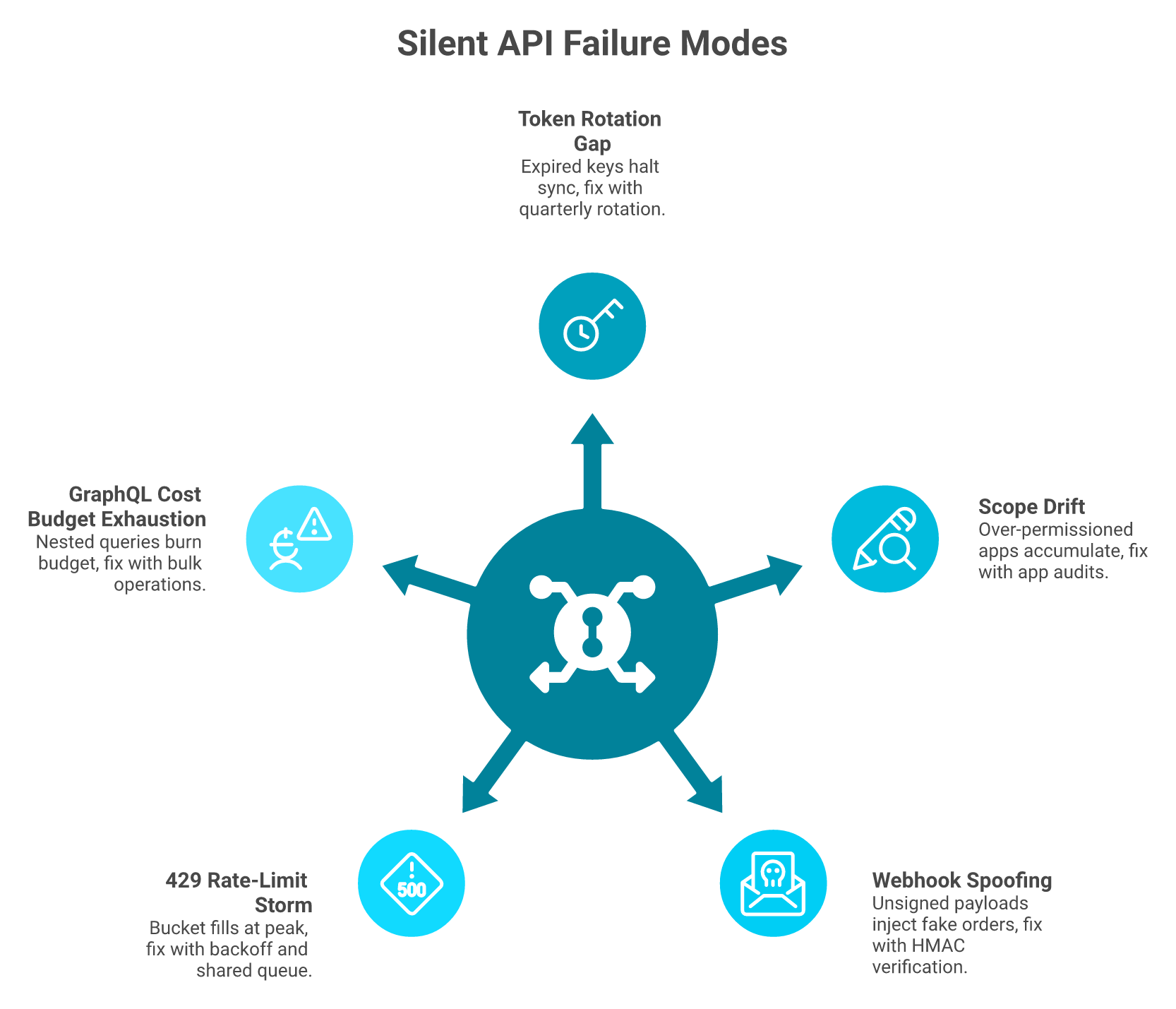
API keys suit internal scripts. OAuth 2.0 is mandatory for any third-party app touching customer data. JWTs handle stateless service-to-service flows. mTLS guards ERP, banking, and PCI-scope traffic. The three killers are token rotation gaps, where expired keys break sync silently, scope drift, where apps accumulate over-permissioned access, and webhook spoofing, where unverified payloads inject fake orders. Rotate quarterly, scope narrowly, and verify HMAC signatures on every webhook. No exceptions.
The four auth models, ranked by where they fit
The five silent failure modes that quietly break Shopify stacks, with the canonical fix beside each.
✅ API keys, fine for internal cron jobs and back-office scripts. Risk: a leaked key in a public repo is a customer-list scrape waiting to happen.
✅ OAuth 2.0, the default for any third-party app. Shopify, Klaviyo, and Stripe all standardize here. Scopes are the unit of safety.
✅ JWT, best for stateless service-to-service auth with short-lived tokens. Pair with key rotation.
✅ mTLS, reserved for ERP, banking integrations, and PCI-scope flows where certificate-based mutual auth is required.
Failure mode 1: token rotation gaps
A token quietly expires on a Sunday night. Your Klaviyo flow sync stops. Nobody sees a red banner. By Wednesday, you have lost 4 days of subscriber sync and your win-back flow is firing on stale segments. The fix is a calendar, a secrets manager, and an alert on auth failures, separate from your application alerts.
The 90-day rule
⏰ Rotate every 90 days. Store secrets in a vault, not Notion. Wire a Slack alert on any 401 from a critical endpoint. This is one Monday morning of work that pays off forever, and it dovetails with the operational discipline covered in best shopify analytics apps.
Failure mode 2: scope drift
You install an app to "sync orders." Six months later that app still has write_customers, write_inventory, and write_orders enabled. Nobody pruned. This is the single most common breach surface I see in DTC audits.
The quarterly app audit
⚠️ Once a quarter, open every connected app and ask, "what is the minimum scope this needs today?" Revoke the rest. Shopify's app permission model lets you do this in the admin without breaking the app, in most cases.
Failure mode 3: webhook spoofing
Webhooks are HTTP endpoints on the open internet. Anyone who finds your endpoint can post a fake "order paid" event. The fix is HMAC signature verification on every inbound webhook, using the shared secret Shopify provides. If your dev partner is not verifying signatures, that is a Tuesday-morning ticket, not a roadmap item.
The audit story
I had a founder show me a Shopify app that had retained write_orders for 14 months without a single use. We revoked it in 30 seconds. That is the audit, and that mindset shows up across Luca AI use cases.
Q4: Why Do Rate Limits Quietly Break More Stores Than Bad Code? [toc=4. Rate Limits and Drift]
Shopify enforces 2 calls per second on REST with a 40-request bucket on standard plans, and a 1000-point cost budget on GraphQL. Meta throttles per app and per user. Klaviyo caps bursts to protect deliverability. Hit a 429 and naive retry loops amplify the problem into silent data gaps and attribution drift, the Meta-says-€100K-Shopify-says-€60K mismatch. The fix is exponential backoff, request batching, GraphQL bulk operations, and a centralized rate-limit middleware, not a while-loop retry.
11:47 AM, Black Friday, the dashboard goes blank
Picture this. Your Triple Whale tile that says "today's revenue" goes blank. Your CTO says it is "an API issue." Your CFO refreshes. Nothing. You are 6 hours into the biggest sales day of the year, flying blind. This is not theoretical. It happens because three integrations are hammering Shopify at the same minute and the bucket is full.
The leaky bucket math, in operator terms
Shopify uses a leaky-bucket algorithm. The bucket holds 40 requests. It drains at 2 per second on standard plans, 4 per second on Advanced, with bucket size doubling on Plus. If you exceed capacity, you get a 429 with an X-Shopify-Shop-Api-Call-Limit header and a Retry-After value telling you when to try again.
Why naive retries make it worse
A while-loop retry without backoff sends another request the moment the first fails. It refills the bucket immediately, and you stay throttled. Multiple integrations doing this simultaneously is what operators on r/shopifyDev call a "429 storm." One developer described it bluntly:
"Public apps that do not migrate to the GraphQL product APIs by 2025-04-01 will be temporarily demoted in the Shopify App Store." u/Shopify dev community, r/shopifyDev Reddit Thread
The hidden cost is attribution drift
When 429s drop a few hundred order events, Triple Whale and Shopify diverge by 3 to 8% on a peak day. That is the source of the "Meta says €100K, Shopify says €60K" panic. The orders eventually reconcile, but the in-the-moment decision you made at noon was based on a number that was wrong, a problem we unpack in declining platform ROAS vs true profitability.
What good looks like
✅ Exponential backoff with jitter, never a fixed sleep
✅ GraphQL bulk operations for large reads, which run async and bypass per-call limits
✅ A centralized rate-limit middleware so all your integrations share one queue
✅ A separate alert channel for 429 spikes, distinct from app errors
I worked with a brand whose Triple Whale and Shopify reports were €40K apart on a single Black Friday. The cause was a peak-hour 429 storm from three integrations polling at the same minute. We moved them to a shared queue with backoff, and the gap closed to under 1% the next month, the same kind of fix that powers ecommerce analytics platforms done right.
"I can perform REST API requests very slowly, such as 1 request every 5 to 10 seconds, and will get... HTTP Status: 429 (Too Many Requests)... My call limit usage is '1/40'." u/Shopify community member, Shopify Community Reddit Thread
That thread captures the operator confusion perfectly. The bucket is not full, but the 429 still fires, because rate limits are layered, app-level, store-level, and endpoint-level.
When we built Luca's ingestion layer, we put a single queue in front of every Shopify, Meta, and Klaviyo call so the founder never has to think about buckets. The plumbing is the product, and that philosophy shapes marketing analysis and automation across Luca's stack.
Q5: What Are the Functional Connector Categories Every DTC Stack Needs and Who Are the Vendors? [toc=5. Connector Categories Map]
Six categories define the modern DTC API stack. Storefront (Shopify, BigCommerce), Acquisition (Meta, Google, TikTok), Retention (Klaviyo, Postscript), Payments and Finance (Stripe, Xero, banking APIs), Operations (3PL, ERP, Shippo, TaxJar, Akeneo), and Intelligence (Luca AI, Triple Whale, Polar Analytics). Most €1M to €20M brands have categories 1 to 4 covered, and they bleed margin in 5 and 6. Use the map below to spot blind spots before your next ad-spend cycle.
Score your stack against these 6 categories
⭐ Run this audit on a Monday morning. Score each category 0, 1, or 2 based on coverage and integration depth.
✅ Storefront: Is your store API talking to every other tool in real time, or only on schedule?
✅ Acquisition: Do Meta, Google, and TikTok costs flow into one view with order data attached?
✅ Retention: Does Klaviyo or Postscript get clean customer and order events without manual CSV uploads?
✅ Payments and Finance: Are Stripe payouts, Xero entries, and bank balances reconciled automatically?
✅ Operations: Are 3PL stock counts, Shippo rates, and TaxJar filings synced through API, not email?
✅ Intelligence: Can you ask one tool a cross-functional question and get a numbered answer?
10 to 12: Mature stack. Focus on optimization, not overhaul.
6 to 9: You have storefront and ads wired, but ops or intelligence is leaking.
0 to 5: You are the manual integration layer. Every Monday morning is a CSV shudder.
Where most founders bleed
After watching dozens of brands onboard, the pattern is consistent. Most start with categories 1 to 4 covered through native Shopify apps. Categories 5 and 6, ops and intelligence, are where margin goes missing, a pattern detailed in e-commerce tech stack.
The intelligence-layer gap
Triple Whale, Polar Analytics, and Lifetimely sit cleanly in the marketing-analytics slot. ❌ They do not see Xero, banking, or inventory at the same time. Operators feel that gap on Tuesday-morning leadership syncs, which is why we built ecommerce analytics platforms guidance for cross-functional reasoning.
"The integrations are inconsistent, building with the AI tool Moby is very buggy and crashes more than half the time, and support is largely unresponsive." Matt Huttner, Operator Triple Whale Trustpilot Verified Review
✅ A unified intelligence layer like Triple Whale alternatives reads across all six categories and reasons across them in plain English, no SQL required.
What to do this week
⏰ Pull your stack list. Map every tool to one of the six categories. If a category has zero vendors, that is your next integration. If a category has three vendors doing the same job, that is your next audit. The goal is not more tools, it is fewer blind spots.
I have watched founders run Triple Whale plus Polar plus a Google Sheet, and still miss the cash side. The fix is rarely another marketing tool. It is closing the ops and intelligence gap so the data is finally reasoning together, the same lesson behind why e-commerce founders are drowning in data.
Q6: How Should Data Sync Actually Work, Polling, Webhooks, or Change-Data-Capture? [toc=6. Data Sync Patterns]
Polling is reliable but stale and expensive. Webhooks are real-time but fail silently when endpoints 500 or networks blip. Change-data-capture (CDC) is the gold standard for >€7M brands. Whichever you pick, idempotency keys, dead-letter queues, and nightly reconciliation jobs are non-negotiable. Without them, you will fulfill orders twice or lose 0.5% of revenue to silently dropped events, a €15K leak on a €3M store.
How each pattern actually works
Polling means your integration asks Shopify, "anything new?" every 5 minutes. Webhooks flip the model. Shopify pings you when something happens. CDC streams every database change into a durable log like Kafka or Debezium.
The 3-pattern snapshot
✅ Polling: simple to build, easy to debug, but burns API quota and runs 5 to 60 minutes stale
✅ Webhooks: near real-time, low API cost, but silent on failure unless you log every receipt
✅ CDC: durable, ordered, replayable, but adds infrastructure cost and complexity
The failure modes nobody warns you about
Webhooks fire multiple times by design. Shopify's own docs say "subscribers might receive the same webhook more than once" and recommend idempotent processing using the X-Shopify-Webhook-Id header. Skip this and you will fulfill the same order twice on a busy Friday, the kind of failure that wrecks best way to track e-commerce unit economics overnight.
Reddit threads tell the same story
"You need to deduplicate and sort them by timestamp. Easiest way: write them into a db table with event ID, read them out sorted when they are some seconds old." u/shopifyDev community, r/shopifyDev Reddit Thread
"Don't process the web hook as it comes. Make sure it goes into a queue system. And make sure your queue system can recover in the event of a failed attempt to process a web hook." u/r/shopify community, r/shopify Reddit Thread
⚠️ Three rules separate professional sync from a Tuesday outage.
✅ Idempotency keys on every write, so a duplicate webhook is a no-op
✅ Dead-letter queues for failed events, so nothing silently disappears
✅ Nightly reconciliation jobs that compare source-of-truth to your warehouse and flag drift
The 187-order story
A brand I worked with had a 3PL webhook outage during a Tuesday spike. Without a DLQ, 187 orders were re-fired when service came back, and they double-shipped. The total damage was €34K in returns and refunds, not counting brand trust, the exact scenario explored in ecommerce management software.
Pick by latency tolerance, not vendor pitch
If your business runs on real-time inventory across Shopify, Amazon, and a 3PL, you need webhooks plus CDC. If you are a single-store Shopify brand under €1M, polling plus webhooks is enough. ❌ Do not let an iPaaS vendor sell you Kafka if you are doing €600K a year, a trade-off we unpack in best Shopify analytics apps.
Q7: What Does a Reference Stack Look Like for a Multi-Channel Retailer Doing €5M to €50M? [toc=7. Reference Stack Architecture]
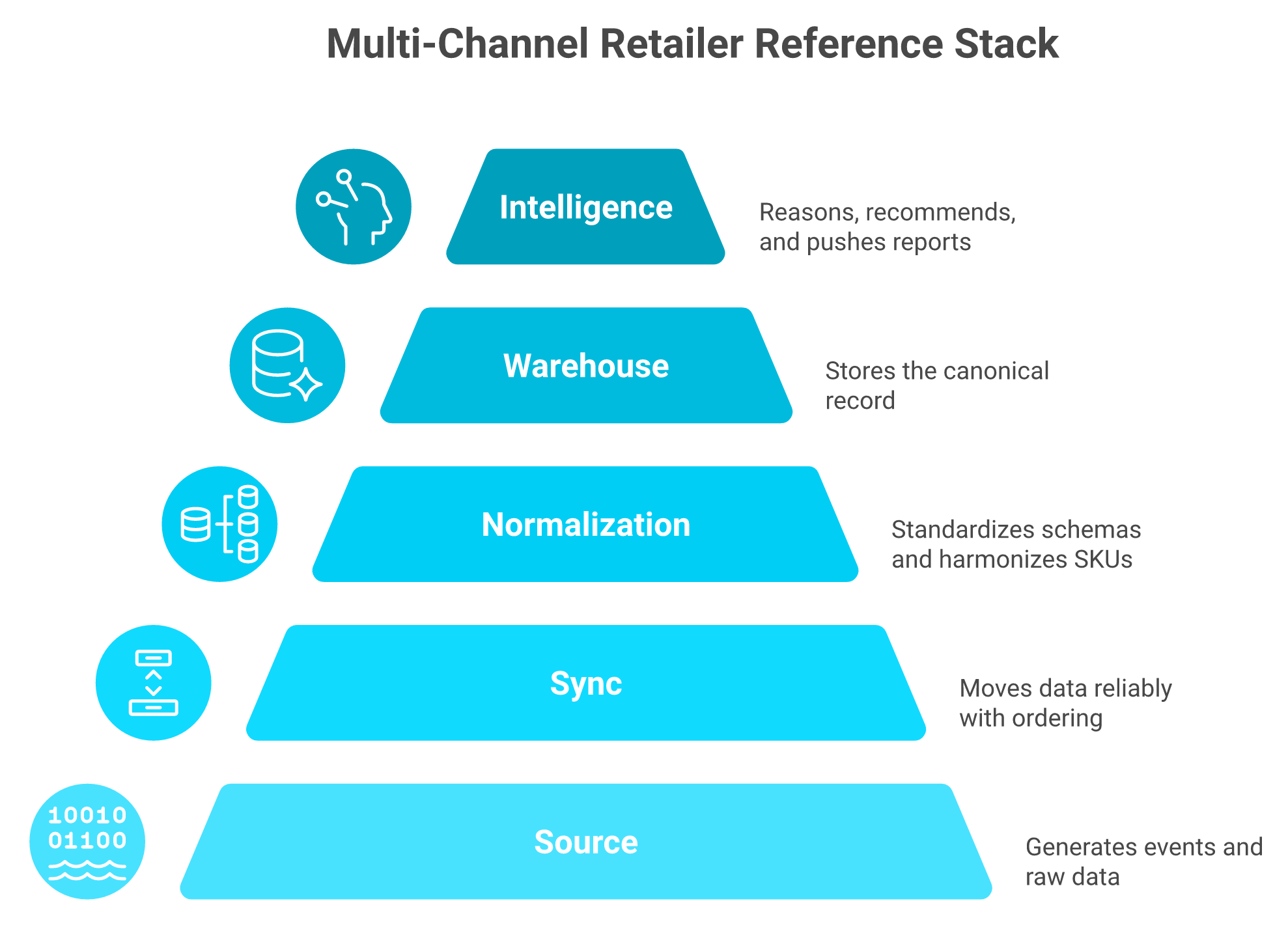
A modern €5M to €50M multi-channel stack has five layers. Source systems (Shopify, Amazon, Meta, Klaviyo, Stripe, Xero, 3PL); a sync layer (webhooks, GraphQL bulk, CDC); a normalization layer (schema standardization, SKU harmonization); a warehouse (BigQuery, Snowflake, or managed); and an intelligence layer (AI reasoning, agentic reports). The skip-the-data-cleanup-year move is normalizing on ingestion, not after.
The 5-layer model
The five-layer reference stack for multi-channel retailers, from source systems at the base to agentic intelligence at the top.
⭐ Think of it as plumbing in your house. Source systems are the city water mains. The sync layer is the pipe. Normalization is the filter. The warehouse is the tank. Intelligence is the tap your team actually drinks from.
The 5-Layer Reference Stack for Multi-Channel Retailers
Layer
What it does
Common tools
1. Source
Generates events and data
Shopify, Amazon, Meta, Klaviyo, Stripe, Xero, 3PL
2. Sync
Moves data reliably
Webhooks, GraphQL bulk, Kafka, Fivetran
3. Normalization
Standardizes schemas
Custom dbt, Rutter, Luca AI ingestion layer
4. Warehouse
Stores the canonical record
BigQuery, Snowflake, managed Postgres
5. Intelligence
Reasons and recommends
Luca AI, Triple Whale, Looker, Tableau
Source and sync layers
The source layer is whatever your team already touches every day. The sync layer's job is durability, ordering, and replay. ✅ Use webhooks plus GraphQL bulk for Shopify, native connectors for Meta and Google, and CDC for anything writing to your own database.
Why the sync layer fails first
Most brands skip the sync layer entirely and rely on point-to-point integrations between every tool. ❌ With 12 tools, that is 66 possible connections and a maintenance nightmare. ✅ A central sync hub turns it into 12 connections, period, the kind of architecture covered in ecommerce website analytics.
The normalization layer is the skip-cleanup-year move
Every Shopify brand has SKU drift. "BLK-LRG-V2" in Shopify, "blk_l_v2" in 3PL, and "Black Large" in Xero. ❌ Letting it propagate guarantees a 6-month "data-cleanup year" when you hit 7 figures. ✅ Normalizing on ingestion, harmonizing SKUs, units, currencies, and timestamps as data lands kills the problem at the source.
What "normalize on ingestion" actually means
It means a deterministic mapping layer that sees every new row, applies a canonical schema, and rejects anything that does not fit. We built this into Luca's ingestion pipeline so brands plug in, ask, and act, without paying for a year of cleanup later, an approach detailed in what is Luca AI, the AI Co-Founder for e-commerce explained.
Warehouse and intelligence layers
The warehouse is your canonical record. BigQuery and Snowflake are fine. The intelligence layer is where the operator actually lives. ✅ It needs to answer plain-English questions, push proactive alerts to Slack and email, and run scheduled reports without anyone writing SQL, a workflow we explore in agentic AI for ecommerce founders.
What good looks like
A founder asks, "why did Q4 contribution margin dip in DACH?" and gets a charted answer in 8 seconds, with the influencing components ranked. That is the bar. Anything less is a dashboard pretending to be intelligence.
Q8: Build vs. Buy, When Does a Custom Integration Cost You $10M and Two Lost Years? [toc=8. Build vs Buy Economics]
Build when integration logic is your moat (rare for DTC). Buy when it is commodity plumbing (almost always). Operators in the LLM era have flipped the math. The new playbook is two senior devs on a Shopify, Amazon, and LLM-integrated stack, replacing teams that spent millions on custom data platforms before reasoning engines existed. Buy the connectors, own the prompts.
The benchmark hook: ELO Health and the rewrite question
Ari Tulla, CEO of ELO Health, raised $10M Series A in 2023 to scale a personalized protein subscription. In a 2026 Ecommerce Leader Series interview, he framed the lesson clearly. Brands that connect product, data, and finance outperform those operating in silos, and the future belongs to "vertically integrated intelligence," not custom plumbing.
What changed in 18 months
In 2024, building proprietary middleware looked smart. By 2026, general-purpose LLM reasoning engines do most of the analytical heavy lifting that custom data platforms used to do. The capital that went into custom builds is now better spent on managed connectors plus a reasoning layer, a thesis we expand in the intelligence capital thesis.
The TCO math, in plain euros
Build vs. buy vs. hybrid for ecommerce API integrations, with year-one and year-three cost, time to value, and ideal fit per path.
Operators are rebuilding sync layers monthly because their first attempt missed idempotency or retries.
"Avoiding duplicate webhook calls. Handling retries safely without breaking fulfillment workflow. If anyone has experience with order sync apps that scaled past 500 orders/day." u/r/ShopifyeCommerce community, r/ShopifyeCommerce Reddit Thread
"What I like best about Celigo is its flexibility and ease of integration, particularly for mid-sized businesses looking to automate workflows across multiple platforms. The platform's prebuilt integration templates for common systems like NetSuite, Salesforce, and various ecommerce solutions allow for faster and more efficient setup." Verified user, Mid-Market Operator Celigo G2 Verified Review
"I'm running into a weird issue, my user is getting a lot of orders, but I'm not receiving webhooks for all of them. There are no webhook errors logged." u/r/shopifyDev community, r/shopifyDev Reddit Thread
The pattern, distilled
❌ Building a custom integration platform in-house in 2026 rarely pays back inside 24 months
✅ Buying managed connectors closes 80% of needs in under a quarter
✅ Owning the prompts and the reasoning layer is where defensibility lives
⚠️ Hybrid is the realistic answer for €5M to €50M brands
When building still makes sense
If your integration logic is your product (you are an iPaaS, a connector vendor, or you have a legitimately unique workflow with no off-the-shelf option), build. Otherwise, buy. 💰 The €350K you save in year one funds inventory or ad spend, which is what actually grows the brand, the same priority logic explored in funding to scale e-commerce marketing campaigns.
I could be off on this, but after looking at how brands deploy capital, the consistent regret is the in-house build that took 18 months to ship 60% of what an iPaaS does on day one. Buy the plumbing. Spend the engineering budget on the parts of your business no vendor can replicate, a discipline reinforced across financial management use cases.
Q9: What Production Failure Patterns Should You Pre-Mortem Before Your Next Peak Season? [toc=9. Peak Season Failures]
Five failure patterns repeat across DTC stacks. A 429 storm at peak collapses reporting. A webhook outage causes duplicate fulfillment. A token rotation gap silently halts Klaviyo sync. SKU drift between Shopify and 3PL inflates overstock. GraphQL cost-budget exhaustion blocks catalog updates. Each has a known fix, backoff, dead-letter queues, key rotation calendars, ingestion-time normalization, and bulk operations, but only if you pre-mortem before Black Friday, not during.
Failure 1: the 429 storm at peak
It is 11:47 AM on a Friday. Three integrations hit Shopify at the same second and collide. ⚠️ The bucket fills, every poll returns 429, and your reporting tile freezes for 90 minutes.
Dollar impact and fix
A 90-minute outage on a peak day costs €15K to €60K in delayed decisions, plus attribution drift that lingers for a week. ✅ Fix: shared queue, exponential backoff with jitter, and GraphQL bulk operations for large reads. The kind of pre-mortem we run inside agentic AI for ecommerce founders sessions catches this before peak.
Failure 2: the webhook outage and double fulfillment
Your endpoint returns 500 for 11 minutes during a deploy. Shopify retries every event. When service comes back, 187 orders re-fire and your 3PL picks them twice.
"How to handle Shopify webhooks firing multiple times in a Remix app... You need to deduplicate and sort them by timestamp." u/r/shopifyDev community, r/shopifyDev Reddit Thread
Fix
✅ Idempotency keys on every write. Dead-letter queue for failed events. Nightly reconciliation that compares Shopify orders to 3PL shipments and flags drift, the discipline behind ecommerce management software that actually scales.
Failure 3: token rotation gap halts Klaviyo sync
A Klaviyo OAuth token expires on a Sunday night. ❌ No banner. ❌ No alarm. By Wednesday, your win-back flow has fired against stale segments for four days. The cost is real revenue, not just dirty data.
"I'm running into a weird issue, my user is getting a lot of orders, but I'm not receiving webhooks for all of them. There are no webhook errors logged." u/r/shopifyDev community, r/shopifyDev Reddit Thread
Fix
⏰ Rotate every 90 days. Store secrets in a vault. Wire a Slack alert on any 401 from a critical endpoint, separate from app errors. A four-day Klaviyo blackout on a $4M ARR Shopify store typically costs €18K to €30K in foregone email revenue, a hit we surface inside best way to track e-commerce unit economics.
Failure 4: SKU drift between Shopify and 3PL
"BLK-LRG-V2" in Shopify, "blk_l_v2" in your 3PL, and "Black Large" in Xero. ❌ Replenishment math runs against the wrong SKU and you reorder 800 units of the wrong variant. For a $40M omnichannel brand, that is a €120K stuck-in-3PL mistake the Head of Finance has to explain on Tuesday.
Fix
✅ Normalize on ingestion, not after. Apply a canonical schema as data lands. We built this into Luca's pipeline so brands skip the cleanup year entirely, a pattern we explore in why e-commerce founders are drowning in data.
Failure 5: GraphQL cost-budget exhaustion
Shopify's GraphQL Admin API uses a calculated cost, not request count, with a 1000-point budget. ❌ A nested query that pulls 250 products with variants and metafields can burn 900 points in one call. When this fails on a Tuesday, your ad-platform sync stalls for hours.
"This has become a massive waste of time and trust... If youre a serious seller, especially if you sell on multiple channels Avoid Triple Whale. Their integration is broken." XTRA FUEL, Multi-Channel Seller Triple Whale Trustpilot Verified Review
Fix
✅ Use bulk operations for large reads. They run async and bypass per-call cost limits. Page small. Cache aggressively, the same playbook that powers best Shopify analytics apps.
One Friday afternoon of pre-mortem saves a Q4
I have watched founders lose a full Black Friday because nobody ran a tabletop on these five patterns in October. The fix is one Friday afternoon with your dev partner. ✅ Walk each pattern. Confirm the fix is in production. Do not wait for the on-call ticket at 2am.
Q10: How Will Agentic Commerce Change Which APIs You Expose and How They Are Consumed? [toc=10. Agentic Commerce APIs]
Agentic commerce flips the consumer of your APIs from human-coded apps to autonomous LLM agents executing checkout, refunds, and inventory rebalancing. This breaks three assumptions. Per-user OAuth becomes per-agent OAuth with delegation chains. Rate limits assume bursty agent traffic, not steady polling. Schemas must be self-describing through standards like MCP and OpenAPI 3.1 for agents to call them safely. Brands that expose agent-ready APIs in 2026 win the 2027 reorder.
What "agentic" actually means for your APIs
An agent is an LLM with tools. You give it your APIs as tool schemas, and it decides which to call. ✅ The customer asks, "reorder my last protein bundle and ship to my office." The agent reads your catalog, your customer record, and your shipping API, then executes. No human dashboard required, the workflow we explore in what is an AI co-founder for e-commerce.
The three assumptions that break
❌ Per-user OAuth. Agents act on behalf of users, sometimes across multiple sessions. You need delegation tokens and audit trails.
❌ Steady polling. Agents are bursty. They batch reads in milliseconds, then go quiet. Your rate-limit policies have to adapt.
❌ Implicit schemas. Agents fail silently when fields are ambiguous. Self-describing schemas (MCP, OpenAPI 3.1) are non-negotiable.
The agent-readiness checklist
⭐ Do this audit before mid-2026, because the brands that ship agent-ready APIs first will get reordered first.
✅ Publish an OpenAPI 3.1 spec for every public endpoint
✅ Add MCP-compatible tool descriptions for catalog, order, customer, and inventory
✅ Move from per-user OAuth to delegated agent tokens with scoped, time-boxed permissions
✅ Re-tune rate limits for bursty traffic with token-bucket smoothing
✅ Log every agent call with the user it acted for, the prompt that triggered it, and the result
The intelligence layer goes from passive to agentic
Most analytics tools added AI features in 2024 to 2025. The next shift is intelligence layers that act, not just answer. ✅ A reasoning layer over your warehouse should run scheduled root-cause queries, push exceptions to Slack and email, and simulate scenarios on demand, exactly the philosophy behind Meet Luca AI.
Where Luca fits
Luca AI sits on top of your warehouse and behaves agentically. It pushes weekly CAC reports with charts and reasoning, scans 24/7 for ROAS dips and inventory thresholds, and answers cross-functional questions in plain English. The reader's job is to ask. The system's job is to deliver, a model expanded in Shopify's Winter 26 AI sidekick.
I could be off on this, but my read for 2026 to 2027 is that brands without agent-ready APIs and an agentic intelligence layer will look like the Excel-only stores of 2018 looked by 2022. The shift is bigger than the move from paper to digital.
Q11: How Does Luca AI Sit on Top of Your Data Warehouse to Replace SQL, Dashboards, and Junior Analysts? [toc=11. Luca Warehouse Layer]
Luca AI is an AI layer over your data warehouse. It extracts the right slice of data for any business question, predicts from historicals, simulates scenarios, runs root-cause analysis, surfaces influencing components, and pinpoints optimization areas, all in natural language with zero SQL. Its agentic engine pushes customized reports to Slack, email, and other channels on a cadence you set, replacing the manual Monday-morning CSV shudder.
What the warehouse AI layer actually does
Most analytics tools added AI in 2024. Luca is AI-native from the ground up. ✅ It sits on top of BigQuery, Snowflake, or a managed warehouse. ✅ It reasons across marketing, finance, operations, and customer data in one query, the unified approach we describe in what is Luca AI, the AI Co-Founder for e-commerce explained.
The query types it handles
✅ Extraction: "show me contribution margin by SKU and channel for Q4 2025"
✅ Prediction: "forecast next 90 days of cash position if Meta CPM stays flat"
✅ Simulation: "what happens to MER if I shift 30% of Meta to TikTok?"
✅ Root-cause: "why did Q4 contribution margin dip in DACH?"
✅ Influencing components: "which inputs moved CAC the most last month?"
✅ Optimization: "where am I overpaying on shipping versus revenue per zone?"
Agentic scheduled reports replace the Monday CSV shudder
⏰ Set Luca a goal once. It executes on cadence. Every Monday at 8 AM, you get a CAC report in Slack with charts, the reasoning behind the numbers, and three recommended actions ranked by expected impact, the kind of automation operators rely on inside marketing analysis and automation.
Customizable channels
✅ Slack for daily exception alerts. ✅ Email for weekly executive briefs. ✅ App push for ROAS dips and inventory thresholds. The founder picks the channel. The agent picks the moment.
How it compares to dashboard tools
Triple Whale, Polar, and Lifetimely earn their seat in the marketing analytics slot. Operators are vocal about the limits, which is why Triple Whale alternatives get researched so often.
"Our experience with Triple Whale has been extremely frustrating and almost categorically terrible. The integrations are inconsistent, building with the AI tool Moby is very buggy and crashes more than half the time, and support is largely unresponsive." Matt Huttner, Operator Triple Whale Trustpilot Verified Review
"Disappointed with Customer Support... When issues arise, especially billing concerns, its nearly impossible to speak with a real person." Team All Fresh Seafood, Customer Triple Whale Trustpilot Verified Review
The cost-of-replacement math
💰 A junior ecommerce data analyst costs €45K to €70K per year, plus benefits, plus tooling. ✅ Luca handles the same extraction, reporting, and exception scanning at a fraction of that cost, working 24/7 without holidays, a workflow detailed in data analysis and deep industry research.
When Luca is not the right fit
⚠️ Honest call. Luca is built for €1M to €100M DTC brands running multi-source data. ❌ If you are sub-€100K annual revenue, single-channel, or pure B2B with no Shopify, traditional dashboards or a spreadsheet are still cheaper. We say that openly.
Q12: How Does Luca AI Compare to Wayflyer, Clearco, and 8fig on Capital Rate, Disbursal Time, and Flexibility? [toc=12. Capital Head-to-Head]
On capital metrics that matter, Luca AI offers dynamically priced rates that reflect real-time business health, disbursal in under 24 hours, no personal guarantees, and repayment that flexes with revenue, against revenue-based financing competitors that often rely on static 60-day-old applications, slow disbursal, opaque fees, and rigid repayment. Fees are transparent. Early repayment is not penalized.
The capital decision context
You are not picking a brand. You are picking how expensive your money will be, how fast it lands, and what happens if your sales dip in month three, the framework we lay out in calculating working capital for ecommerce business needs.
What to grade on
💰 Effective rate or APR
⏰ Disbursal time
✅ Personal guarantee or UCC requirements
💸 Repayment flexibility
⚠️ Repricing on real-time data versus a stale application
Wayflyer, the approach and the receipts
Wayflyer is a known revenue-based financing brand. Operator receipts on Trustpilot show recurring issues with rate transparency, last-minute reversals, and contract terms, which is why Wayflyer alternatives are a hot search.
"After being offered funding in writing with specific amounts, repayment terms, and confirmation that the deal was approved Wayflyer abruptly reversed their decision at the last minute." Geoff Brand, Operator Wayflyer Trustpilot Verified Review
"Read their terms and contract carefully... they can deem you in default for any reason at their discretion... they can redirect your Shopify funds to their account." Zachary Piech, Founder ValuePetSupplies.com Wayflyer Trustpilot Verified Review
Clearco and 8fig, the approach and the receipts
Clearco operators flag effective APRs that creep into 35 to 40% territory and weekly repayment schedules that compress real working capital, the trade-offs explored further in Clearco alternatives.
"Pretty expensive product at 35-40% APR... 6% for 4 months extension does not sound like a lot. Since you have to pay back weekly immediately, you will have less than half of the money on average available over the 4 months. That puts you to 12% / 4 months × 12 months = 36% APR." Julian Fernau, Operator Clearco Trustpilot Verified Review
"8fig's offer is basically a 100% APR... that means you'll pay back double what you received in just 12 months." Anonymous, Operator 8fig Trustpilot Verified Review
"They trick you into signing a low APR contract, and then one month into the term, they hike up the rates by offering more funds." Khalid, Operator 8fig Trustpilot Verified Review
Luca's capital approach, plain numbers
✅ Dynamically priced rates from approximately 5 to 8%, repriced on real-time business health, not a 60-day-old application. ✅ Disbursal in under 24 hours once eligibility is confirmed. ✅ No personal guarantees. ✅ Repayment that flexes with revenue. ✅ No early-repayment penalty. ✅ Fees disclosed up front, no last-minute hikes, an approach we expand in Luca AI vs Wayflyer.
Side-by-side on the metrics that matter
Capital Comparison: Luca AI vs Wayflyer vs Clearco vs 8fig
Metric
Wayflyer
Clearco
8fig
Luca AI
Effective rate
6 to 12% flat fee
35 to 40% APR observed
Up to ~100% APR observed
~5 to 8% dynamic
Disbursal time
72 hours to 2 weeks
Variable, weeks of back-and-forth
Multi-cycle, often delayed
Under 24 hours
Personal guarantee
UCC filing observed
UCC observed
UCC observed
None
Repayment
Fixed schedule
Weekly fixed
Cycle-based, often hiked
Flexes with revenue
Repricing
Static application
Static
Re-priced upward
Real-time, downward-eligible
Who should choose what
⭐ Choose Wayflyer or Clearco if you are over €5M GMV with predictable cash flow and can absorb fixed-fee structures. Choose Luca capital if you want sub-24-hour disbursal, transparent dynamic pricing, no personal guarantees, and repayment that bends with your sales curve, the same priorities discussed in funding to scale e-commerce marketing campaigns.
FAQ's
What are ecommerce API integrations and why does the plumbing matter more than the dashboard?
We define ecommerce API integrations as the programmatic contracts that move data between storefront, ad platforms, retention tools, payments, finance, inventory, and 3PLs. They run on REST, GraphQL, webhooks, or event streams, and each call is authorized by a token.
Seven core data types: storefront, cart, catalog, order, inventory, customer, and content.
Vertical sync is the floor: Meta data in Meta, Shopify in Shopify.
Horizontal reasoning is the ceiling: correlating Meta CPMs with inventory velocity and Stripe payouts in one query.
When schemas drift and tokens expire, you do not get a loud failure. You get a 3% reporting variance and a Tuesday meeting where nobody trusts the deck. That is the silent margin leak. We cover the broader stack architecture in our e-commerce tech stack guide, and we built Luca's normalization layer so brands can skip the data-cleanup year by standardizing schemas on ingestion, not after.
Should we use REST, GraphQL, webhooks, or event-driven architecture for our Shopify stack?
We recommend picking architecture by latency tolerance, not by what your last agency built. Shopify mandates GraphQL for new public apps as of April 1, 2025, which changes the default for any new build.
REST: low-frequency reads, back-office scripts, easy to debug.
GraphQL: surgical pulls, catalog work, and bulk operations for large reads.
Webhooks: near real-time order, fulfillment, and inventory events.
Most DTC stacks need a hybrid. Sub-1M single-channel stores can ship 90% of value on GraphQL plus webhooks. Brands above 7M selling on Shopify, Amazon, and retail should add an event bus. We unpack the operator-level fixes inside best Shopify analytics apps. The biggest mistake we see is paying a Kafka complexity tax on 600K of revenue.
How do we prevent rate limit storms, token rotation gaps, and webhook spoofing in production?
We harden three layers: rate limits, auth, and webhook verification. Shopify enforces 2 calls per second on REST with a 40-request bucket on standard plans, and a 1000-point cost budget on GraphQL. Hit a 429 with a naive retry loop, and the storm amplifies into silent attribution drift.
Rate limits: exponential backoff with jitter, GraphQL bulk operations, and a centralized rate-limit middleware shared across integrations.
Token rotation: rotate every 90 days, store secrets in a vault, and wire a Slack alert on any 401 from a critical endpoint.
Webhook spoofing: verify HMAC signatures on every inbound webhook using Shopify's shared secret.
Scope drift is the silent killer. Apps accumulate write_customers, write_inventory, and write_orders permissions over months. We run a quarterly app audit that revokes anything unused. The same proactive scanning logic powers Luca's exception alerts inside agentic AI for ecommerce founders.
Should we build a custom integration platform or buy managed connectors plus a reasoning layer?
We say build only when integration logic is your moat, which is rare for DTC. Buy when it is commodity plumbing, which is almost always. The LLM era flipped the math: two senior devs on a Shopify, Amazon, and LLM-integrated stack now outperform teams that spent millions on custom data platforms.
Build in-house: ~400K year-1, 12 to 18 months to value, high attrition risk.
Buy iPaaS: ~30K to 80K per year, 4 to 12 weeks to value, well-supported.
Hybrid: managed connectors plus a reasoning layer, 1 to 4 weeks to value.
The 350K saved in year one funds inventory or ad spend, the things that actually grow the brand. Buy the plumbing, own the prompts, and put the engineering budget on what no vendor can replicate. We expand the capital allocation logic in the intelligence capital thesis.
How does Luca AI compare to Triple Whale, Polar, Wayflyer, Clearco, and 8fig on intelligence and capital?
We position Luca as a unified AI Co-Founder that reasons across marketing, finance, and operations, plus disburses capital, in one chat. Most analytics tools added AI; Luca is AI-native, sitting over your warehouse to answer plain-English questions, push agentic reports to Slack, and run root-cause analysis without SQL.
Versus Triple Whale and Polar: marketing analytics only; cannot see Xero, banking, or inventory in one query.
Versus Wayflyer, Clearco, 8fig: revenue-based financing with flat fees, slow disbursal, UCC filings, and rigid repayment.
Luca capital: dynamically priced 5 to 8% rates, under-24-hour disbursal, no personal guarantees, and revenue-flexed repayment.
If you need a head-to-head on terms, we keep a live comparison in Luca AI vs Wayflyer and operator-vetted alternatives in Triple Whale alternatives. The differentiator is that intelligence and capital live in the same conversation.
Enjoyed the read? Join our team for a quick 15-minute chat — no pitch, just a real conversation on how we’re rethinking Ecommerce with AI - Luca
Loading Schedule...
Your AI Co-Founder is here.
Here’s why:
Shopify, Meta, Xero - one brain.
"Should I scale?" Answered with real data.
Growth capital. No applications. One click.
Thank you! Your submission has been received! Please book a time slot for the Meeting
Oops! Something went wrong while submitting the form.