9 Best Tools for Customer Segmentation in Ecommerce in 2026
12
mins read
TL;DR
We ranked nine tools on one honest question: after building a segment, can the tool tell you whether that segment actually makes money, or does it stop at open rates?
Klaviyo, Braze, and MoEngage tell you a segment engages; Amplitude and Hightouch tell you how it behaves and where it lives, but none tie a segment to contribution margin.
Gross margin is a lie on its own; a "hero" segment can quietly run an 8% contribution margin once real shipping, returns, and support costs land on it.
Watch the success tax: MTU and MAU pricing quietly climbs as your list grows, and pricing escalation was among the most common review complaints, cited over 1,190 times.
Match the tool to your stage; brands under about $1M rarely need a CDP, and the real upgrade trigger is when segments stop answering money questions.
We built Luca AI to close that seam, reasoning across commerce, marketing, and finance data so a "best" segment is never secretly a money pit.
Q1. What Are the 9 Best Tools for Customer Segmentation in Ecommerce in 2026? [toc=1. Best Segmentation Tools]
The nine best customer segmentation tools for ecommerce in 2026 are Luca AI (segments tied to margin and cash), Klaviyo (Shopify email and SMS), Maestra (all-in-one CDP), Insider (enterprise AI), MoEngage (mobile lifecycle), Braze (real-time events), Bloomreach (omnichannel), Amplitude (behavioral analytics), and Hightouch (warehouse-native). Most rank segments by engagement. The real differentiator is whether a tool connects a segment to profit.
Here is the thing most "best tools" lists skip. A founder told me last quarter she was barely processing 5% of the data her store generated, and the rest sat scattered across programs she had to stitch together by hand every Monday. That is the actual job here, not "pick a tool with nice dashboards." So I ranked these nine on one honest question. After the tool builds a segment, can it tell you whether that segment makes you money, or does it stop at open rates? The tools below are ordered by how well they answer that. If you want the deeper mechanics first, our guide to ecommerce customer segmentation breaks it down.
The 9 tools at a glance
Luca AI, best for tying segments to margin and cash
Klaviyo, best for Shopify email and SMS segmentation
Maestra, best all-in-one CDP
Insider, best enterprise AI personalization
MoEngage, best mobile-first lifecycle
Braze, best real-time event segmentation
Bloomreach, best omnichannel retail
Amplitude, best behavioral analytics
Hightouch, best warehouse-native segmentation
Quick comparison table
9 Best Customer Segmentation Tools for Ecommerce in 2026
Tool (Rating)
Key Capabilities
Best For
Pricing
Luca AI ⭐⭐⭐⭐⭐
Plain-English querying over your full data warehouse; cross-functional segments tied to margin; predictive and root-cause analysis; scheduled agentic reports to Slack and email
Founders who want segments connected to profit, not just engagement
CDP plus AI search and merchandising; omnichannel segments
Omnichannel retailers unifying marketing and discovery
Custom to Custom
Amplitude ⭐⭐⭐
Product and behavioral cohorts; funnel and retention analysis
Teams segmenting on product behavior
$49 / Month to Custom
Hightouch ⭐⭐⭐⭐
Warehouse-native audiences; reverse ETL; syncs segments to any channel
Data-mature teams whose data lives in a warehouse
Custom to Custom
Now let me break down the top two in detail. The rest follow in the next section.
1.1 Luca AI, Best for Tying Segments to Margin and Cash [toc=1.1 Luca AI]
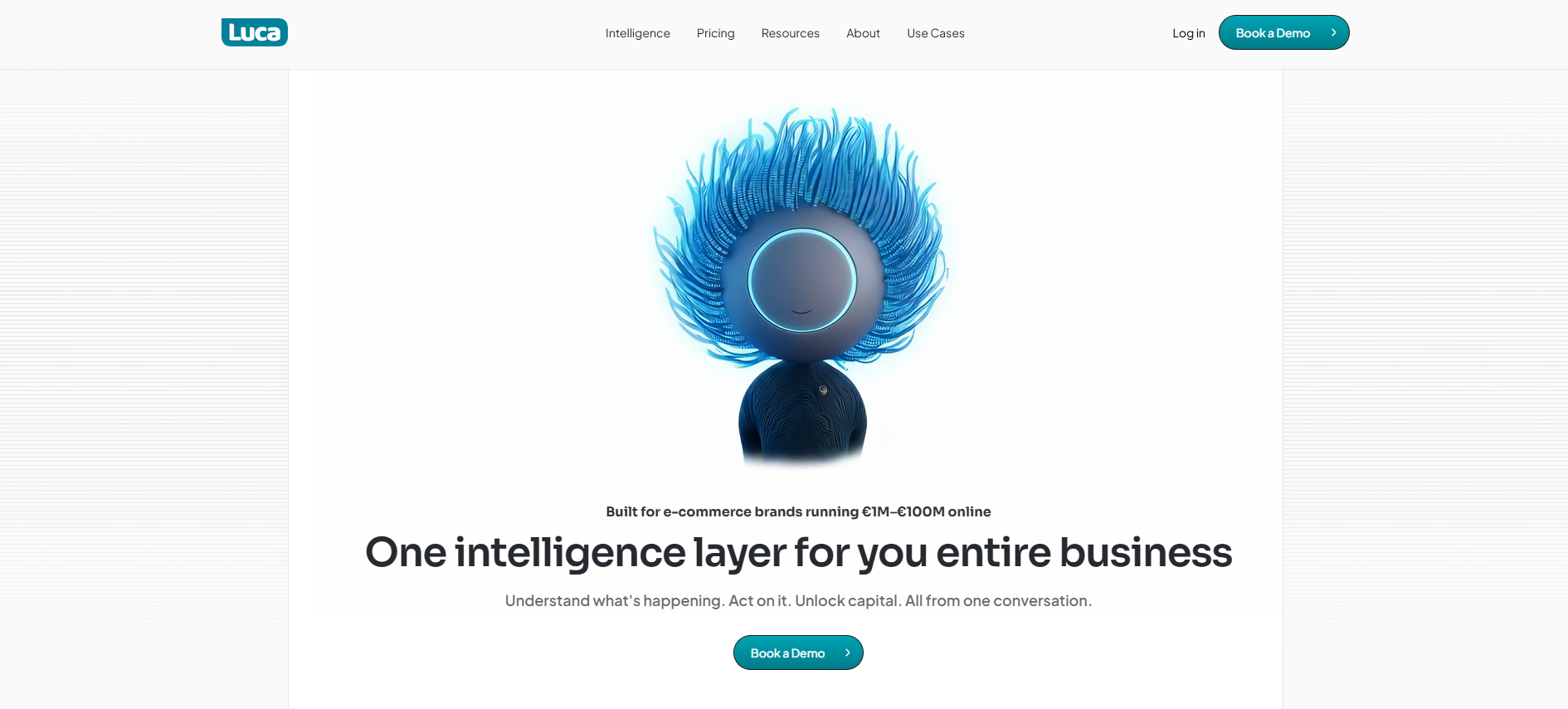
Luca homepage presenting a single AI intelligence layer for €1M–€100M ecommerce brands, reflecting how modern customer segmentation tools unify data, insights and action from one conversation.
Luca AI is an AI layer that sits on top of your store's full data warehouse. You ask a question in plain English, and it pulls the relevant segment out of a pool of scattered data, predicts and simulates on your history, and tells you which customers are actually profitable. No SQL, no analyst, no dashboard-building. You can see the full picture on the Luca AI use cases page.
💡 Why did we choose this tool?
I am Eric, founder of Luca AI, so read this with that in mind. I put us first for one reason I can defend. Most segmentation tools show you which customers open emails. We built Luca to answer the question that actually moves the bank account, which segments make money after shipping, returns, and support costs. Most analytics tools bolted AI on later. Luca is AI from the ground up, trained on how ecommerce metrics relate, so it reads across marketing, finance, and operations instead of one silo. If you want the deeper reasoning, see how Luca thinks.
📊 Solutions offered
Ask questions in plain English and get a reasoned answer, not a dashboard to build yourself.
Segments tied to contribution margin, so a "best" segment is not secretly a money pit.
Predictive and simulation analysis on your own historical data.
Root-cause analysis when a high-engagement segment quietly loses money.
Scheduled agentic reports pushed to Slack or email, with graphs and reasoning.
⚠️ One honest limitation
Luca is built for stores with enough data to reason against. If you are sub-$10K MRR, pure B2B, or marketplace-only, you will get more value from a simpler email tool first. I would rather tell you that now than sell you a seat you cannot use.
❤️ Case study
What was the problem? A women's apparel brand doing mid-seven figures believed its bestseller carried a 72% gross margin and "couldn't make them fast enough." The founder was scaling it hard on the strength of that number.
How Luca helped? In about 20 minutes, Luca pulled shipping data, return rates, and support tickets against that SKU and rebuilt the real unit economics. Gross margin is a lie on its own. It hides the eight costs between the supplier invoice and actual profit.
What was the outcome? The "bestseller" was running an 8% contribution margin. She had spent two years scaling a money pit. Luca flagged it, and she rebuilt the assortment around genuinely profitable segments. 💰 It is the kind of insight our writeup on ecommerce profit margins digs into.
I will be honest about what this is. It is cohort-level vigilance without the cohort-level dashboard. That is the whole pitch.
💰 Pricing
Starter, €299 / Month | Growth, €499 / Month | Scale, Custom Pricing. Full details live on the Luca AI pricing section.
1.2 Klaviyo, Best for Shopify Email and SMS Segmentation [toc=1.2 Klaviyo]
Klaviyo is the default segmentation and messaging engine for Shopify brands. It syncs purchase and browsing data natively, then lets you build RFM, behavioral, and predictive segments to fire email and SMS at the right moment. For most DTC stores under a few million in revenue, it is the honest first pick.
✅ Why did we choose this tool?
Klaviyo earns its spot because the Shopify integration is genuinely native, not a bolted-on connector. It reads real customer behavior, browsing, add-to-cart, and purchase, and turns it into segments you can act on the same day. Predictive CLV and churn scoring come built in, so smaller teams get real segmentation power without a data analyst. On G2 it holds a 4.6 rating across more than 1,300 reviews. If you are weighing options, our roundup of the best Shopify analytics apps adds useful context.
📊 Solutions offered
Native Shopify sync of purchase and browsing events.
RFM and behavioral segment building with an intuitive editor.
Predictive analytics for CLV, churn risk, and next-order date.
Email and SMS activation from the same segment.
Prebuilt flows and templates for faster setup.
😊 Best for
Shopify and WooCommerce DTC brands running email and SMS together.
Small teams without a dedicated data analyst.
Stores under roughly $5M that need fast, native segmentation.
⚠️ The honest trade-off
Klaviyo prices on active profiles, so your bill climbs as your list grows. That "success tax" is the single most common complaint I see, and it stops at marketing data. It will tell you a segment opens and clicks. It will not tell you that segment costs you money after returns and shipping, which is exactly why true profitability matters more than platform metrics.
💬 Reviews
"I like how Klaviyo combines powerful segmentation with real-time customer data, making it easy to send highly personalized messages at the right moment. Klaviyo can feel complex and overwhelming at first, especially when setting up advanced flows or managing large numbers of segments." Verified User, Small-Business Klaviyo G2 Verified Review
"Getting very expensive, the new billing model is very unfair and getting out of hand. Billing based on profiles has doubled our billing in the past 12 months and stalled our growth as it is getting very expensive. The only reason we will leave Klaviyo will be due to this pricing." Verified User, Small-Business Klaviyo G2 Verified Review
1.3 Maestra, Best All-in-One CDP [toc=1.3 Maestra]
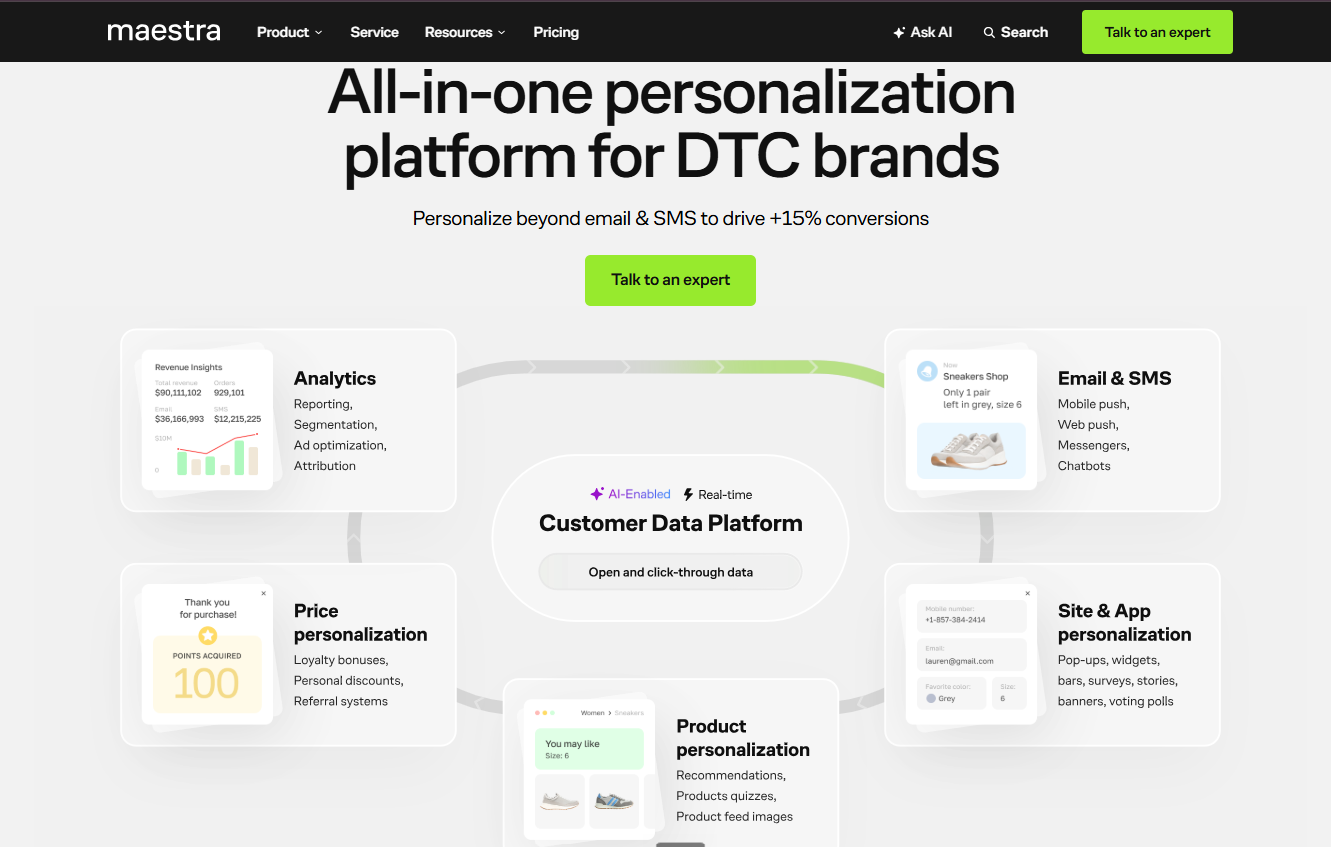
Maestra personalization platform homepage showing its customer data platform, analytics and price and product modules, illustrating a leading ecommerce customer segmentation tool for DTC brands driving conversions.
Maestra is a customer data platform (CDP), which means it stitches every customer touchpoint into one profile you can segment. It handles identity resolution, so a shopper who buys on web and app is treated as one person, not two. For brands tired of gluing tools together, that single-profile approach is the draw.
✅ Why did we choose this tool?
Maestra earns its spot because it collapses several tools into one layer. You get data collection, unified profiles, segmentation, and omnichannel activation without a separate CDP bill on top. That consolidation is rare, and it is why ranking pages tag it as the "all-in-one" pick. If you are weighing how sources connect, our guide to ecommerce data integration is a useful companion.
📊 Solutions offered
Full CDP with identity resolution across web, app, and offline.
Real-time behavioral and RFM segment building.
Omnichannel activation across email, SMS, and push.
Prebuilt automations for retention and winback.
Reporting on segment revenue and campaign lift.
😊 Best for
Mid-market brands consolidating scattered data into one profile.
Teams that want a CDP and messaging in a single contract.
Retailers running web, app, and offline together.
⚠️ The honest trade-off
An all-in-one CDP usually means a real implementation lift and enterprise pricing. It shows you every touchpoint. It still stops at marketing data, so it will not tie a segment back to contribution margin after shipping and returns.
💬 Reviews
"Maestra brought all our customer data into one place and the segmentation is genuinely powerful. Setup took longer than we expected and needed help from their team." Verified User, Marketing Maestra G2 Verified Review
"Strong platform for omnichannel campaigns, though the learning curve is real for a smaller team like ours." Verified User, Retail Maestra G2 Verified Review
1.4 Insider, Best Enterprise AI Personalization [toc=1.4 Insider]
Insider (branded Insider One) is an enterprise platform that pairs a built-in CDP with AI personalization across web, app, email, SMS, and WhatsApp. It holds a 4.8 rating across more than 1,400 G2 reviews, and it is a Leader in the Gartner Magic Quadrant for Personalization Engines. For large brands, the pull is deep AI-driven segments plus omnichannel journeys in one place.
✅ Why did we choose this tool?
Insider earns its spot on breadth and proven scale. Reviewers report segmentation across tens of millions of profiles returning results in under a second, which matters for enterprise volume. Its predictive segments and native channel support are genuinely strong for teams with the resources to run them. For a broader view, see our roundup of ecommerce analytics platforms.
📊 Solutions offered
AI predictive segments (likelihood to buy, churn, discount affinity).
On-site and in-app personalization.
Cross-channel journey orchestration (Architect).
Native CDP for unified profiles.
Smart product recommendations.
😊 Best for
Enterprise brands across many channels and regions.
Teams with IT support for a heavier CDP setup.
Retailers needing deep on-site personalization.
⚠️ The honest trade-off
Insider is powerful, but reviewers flag a heavy initial setup that leans on clean data and IT time. It is built for marketing outcomes, so it does not reason across finance or cash flow.
💬 Reviews
"Since Insider relies entirely on your CDP to work its magic, the initial implementation is notoriously heavy. If your company's internal data is messy or if you don't have clean APIs, getting Insider One up and running can take months." Gabriel A., CRM Analyst Insider G2 Verified Review
"The AI-driven suggestions are a great concept, but they sometimes lack local context and require manual tweaking before we can use them." Natasya Z., CRM Manager Insider G2 Verified Review
1.5 MoEngage, Best Mobile-First Lifecycle [toc=1.5 MoEngage]
MoEngage is a lifecycle engagement platform built with mobile at the center. Its AI engine (Merlin) powers segmentation, push, in-app, email, and SMS journeys. For app-led brands where most revenue happens on a phone, that mobile focus is the reason it lands here.
✅ Why did we choose this tool?
MoEngage earns its spot because it treats mobile as the primary surface, not an afterthought. Push, in-app, and uninstall tracking are first-class, and the AI segmentation ships out of the box. For a brand where the app is the store, that alignment matters. Retention teams may also find our piece on ecommerce customer lifetime value handy.
📊 Solutions offered
AI-driven behavioral and predictive segments.
Mobile push, in-app, and on-site messaging.
Lifecycle journey builder (Flows).
Uninstall and re-engagement tracking.
Cross-channel email and SMS.
😊 Best for
Mobile-first and app-led ecommerce brands.
Teams focused on retention and re-engagement.
Businesses in high-volume push markets.
⚠️ The honest trade-off
MoEngage shines on mobile lifecycle, but reviewers note reporting and analytics can feel limited for deeper analysis. It engages customers well. It does not connect that engagement to unit economics.
💬 Reviews
"MoEngage makes it easy to run push and in-app campaigns and the segmentation is solid for a mobile-heavy business. Reporting could be deeper for the kind of analysis we want." Verified User, Marketing MoEngage G2 Verified Review
"Good lifecycle tool, but there is a learning curve and support response times vary." Verified User, Consumer Services MoEngage G2 Verified Review
1.6 Braze, Best Real-Time Event Segmentation [toc=1.6 Braze]
Braze is a customer engagement platform known for real-time, event-triggered segments. It fires a message the moment a customer takes an action, across push, email, SMS, and in-app. It holds a 4.5 rating across roughly 1,495 G2 reviews. For high-volume brands, that speed is the differentiator.
✅ Why did we choose this tool?
Braze earns its spot on real-time power and its visual Canvas journey builder. Reviewers praise how it lets marketing move without leaning on engineering for every send. For brands running live, behavior-triggered messaging at scale, it is hard to beat. Teams comparing the wider stack can review our guide to the e-commerce tech stack.
Teams that want marketing independence from engineering.
App and web businesses running multi-channel journeys.
⚠️ The honest trade-off
Braze is powerful but carries a steep learning curve and a premium price tag, per reviewers. Reporting and analytics also draw repeated complaints. It orchestrates messaging brilliantly. It does not tie segments to margin or cash.
💬 Reviews
"There are some limitations in targeting, for example, that make it a little bit more difficult, and it's a pretty pricey service for us." Lindsey S. Braze G2 Verified Review
"It's quite a steep learning curve, so it's quite difficult for people who haven't used Braze before to get up to speed with how it works." Louise D. Braze G2 Verified Review
1.7 Bloomreach, Best Omnichannel Retail [toc=1.7 Bloomreach]
Bloomreach pairs a CDP with AI-powered search and merchandising, so segmentation and product discovery live under one roof. That combination is aimed squarely at omnichannel retailers who want marketing and on-site experience aligned. For catalog-heavy brands, that is the standout.
✅ Why did we choose this tool?
Bloomreach earns its spot because few tools connect segmentation to on-site search and merchandising this tightly. A segment can shape both the email a shopper gets and the products they see on-site. For large retailers, that unified discovery layer is genuinely differentiated. Our overview of ecommerce omnichannel analytics goes deeper here.
📊 Solutions offered
CDP with unified customer profiles.
AI-powered site search and merchandising.
Omnichannel segmentation and campaigns.
Email, SMS, and web personalization.
Product recommendations tied to segments.
😊 Best for
Omnichannel and catalog-heavy retailers.
Brands unifying marketing with on-site discovery.
Mid-market to enterprise teams.
⚠️ The honest trade-off
Bloomreach is broad, which means real implementation effort and enterprise pricing. It aligns marketing and merchandising. It still does not reason across finance to tell you which segment actually earns money.
💬 Reviews
"Bloomreach ties our search and email data together really well, which improved our on-site experience. It is a big platform, so onboarding took real effort." Verified User, Retail Bloomreach G2 Verified Review
"Powerful for omnichannel, but pricing and complexity mean it fits larger teams better than lean ones." Verified User, Ecommerce Bloomreach G2 Verified Review
1.8 Amplitude, Best Behavioral Analytics [toc=1.8 Amplitude]
Amplitude is a product analytics platform that builds segments from behavior, including clicks, funnels, retention, and cohorts. It holds a 4.5 rating across roughly 2,895 G2 reviews. For teams that segment on what users do inside a product, not just what they buy, it is the sharpest pick.
✅ Why did we choose this tool?
Amplitude earns its spot on depth of behavioral insight. Reviewers say it surfaces exactly where users drop off and which features drive retention, with strong cohort tools. Its newer AI agent lets non-technical teammates ask questions in plain language, which widens access. If prediction is your goal, our guide to predictive analytics for ecommerce pairs well with this.
📊 Solutions offered
Behavioral cohorts and event segmentation.
Funnel, retention, and journey analysis.
AI assistant for plain-language queries.
Anomaly alerts on key events.
Integrations that sync cohorts to tools like Braze.
😊 Best for
Product and growth teams segmenting on behavior.
App and SaaS-style ecommerce experiences.
Data-savvy teams wanting deep funnel analysis.
⚠️ The honest trade-off
Amplitude is powerful, but reviewers repeatedly cite a steep learning curve and costs that climb fast as event volume grows. It reads product behavior beautifully. It does not connect that behavior to profit or cash flow.
💬 Reviews
"As your data grows, costs can increase quite fast, which makes it less friendly for startups or teams trying to stay lean." Yogesh M., Software Engineer Amplitude G2 Verified Review
"The interface can feel overwhelming for new team members, making the learning curve for advanced analysis quite steep." Digvijay C., Management Trainee Amplitude G2 Verified Review
1.9 Hightouch, Best Warehouse-Native Segmentation [toc=1.9 Hightouch]
Hightouch builds segments directly on your data warehouse (Snowflake, BigQuery, and similar) and syncs them to any channel using reverse ETL, which just means pushing warehouse data back out to tools. For data-mature teams whose truth already lives in the warehouse, this avoids a duplicate copy of customer data.
✅ Why did we choose this tool?
Hightouch earns its spot because it treats the warehouse as the single source of truth. You model a segment once, on your own governed data, then activate it anywhere. For teams that already invested in a warehouse, that is the cleanest architecture on this list. Our primer on ecommerce API integrations explains how these syncs hold together.
📊 Solutions offered
Warehouse-native audience building.
Reverse ETL to sync segments to any channel.
No duplicate customer data store.
SQL and no-code audience builder.
Broad destination catalog for activation.
😊 Best for
Data-mature teams with a cloud warehouse.
Companies wanting one governed source of truth.
Engineering-supported ecommerce operations.
⚠️ The honest trade-off
Hightouch assumes you already have a working warehouse and someone to model data. It activates segments anywhere. It stays a plumbing layer, so it will not reason about margin or fund the growth a segment reveals.
💬 Reviews
"Hightouch lets us build audiences straight off our warehouse and sync them everywhere, which removed a lot of duplicate data work. You do need a solid warehouse setup to get value." Verified User, Data Hightouch G2 Verified Review
"Great reverse ETL tool, but it assumes real data maturity, so a non-technical team will struggle at first." Verified User, Technology Hightouch G2 Verified Review
Where this list nets out
Eight of these nine tools answer the same question well, which is to build a segment and message it. That is table stakes now. The gap that still surprises founders is what happens after the segment exists. Klaviyo, Braze, and MoEngage tell you a segment engages. Amplitude and Hightouch tell you how it behaves and where it lives. None of them tell you that your "best" segment quietly runs an 8% contribution margin once shipping and returns land. That is the seam Luca AI was built to close, and it is why it sits at 1.1. If you want the founder-level view, our take on how AI can actually help you run your e-commerce business continues the thread.
Q2. How Did We Score These Tools? Our Selection Criteria [toc=2. Selection Criteria]
We scored each tool on five weighted criteria totalling 100%, which are Segmentation Depth and Predictive Power (30%), Data Integration and Standardization (25%), Actionability and Automation (20%), Setup and Usability (15%), and Pricing Transparency (10%). Tools scoring 0 to 20 earn one star, 21 to 40 earn two, and so on up to five. Luca AI earns five stars for depth, standardization on ingestion, and agentic action.
Why these five criteria matter to your bank account
I did not pick these criteria to look neutral. I picked the five things that decide whether a segmentation tool actually pays for itself. Depth and prediction come first, because a segment you cannot act on early is just a report. Integration comes second, and it is the one most listicles ignore. Our guide to ecommerce data integration explains why.
Here is the operator truth behind that 25% weight. Feed any AI messy, un-standardized data and it hallucinates, which means it invents numbers that look real. I have watched a native forecasting feature get shut down because it was, in plain terms, telling fibs. Standardizing data on ingestion is not housekeeping. With agentic shopping coming, it is the difference between trustworthy segments and confident nonsense. Solid ecommerce data management is the foundation.
The weighting and star logic
Usability and Pricing Transparency round out the list, because operators feel both fast. Maestra is a good example. Its G2 reviews mention a learning curve about 1,430 times and pricing escalation about 1,192 times, which is exactly why both earn real weight here.
Tool Scoring Criteria and Weighting
Criteria
Weight
What it measures
Segmentation Depth and Predictive Power
30%
Behavioral, RFM, and predictive segments (churn, CLV, next order)
Data Integration and Standardization
25%
Source coverage and clean, standardized data on ingestion
Actionability and Automation
20%
Turning a segment into an action, alert, or scheduled report
Setup and Usability
15%
Time to value without an analyst or heavy IT lift
Pricing Transparency
10%
Clear, predictable cost as data and lists grow
Star bands run in twenties. 0 to 20 is one star, 21 to 40 is two, 41 to 60 is three, 61 to 80 is four, and 81 to 100 is five.
⭐ Why Luca AI lands at five stars
Luca AI clears the two heaviest criteria, depth and integration, inside one system. It normalizes and standardizes data on ingestion, so you skip the data-cleanup year that quietly wrecks every AI tool fed dirty data. That is the honest reason it sits at the top, not marketing, but the two things weighted highest here. You can see the reasoning behind how Luca thinks.
Q3. What Is Customer Segmentation in Ecommerce, and Is RFM Still Worth It? [toc=3. Segmentation & RFM]
Customer segmentation in ecommerce groups shoppers by behavior, purchase history, and value, so you target each group instead of blasting everyone. RFM (Recency, Frequency, Monetary) is the fastest baseline, and Klaviyo reports 3x more revenue per recipient on targeted sends. For small, single-product catalogs, though, RFM often uncovers nothing new, and product-category diversity can matter more.
What segmentation really is
Think of segmentation like sorting mail instead of shouting in a stadium. You put the right message in the right hands. The catch most founders miss is that your "best" customers on paper may be misidentified. Our deep dive on ecommerce customer segmentation covers the fixes.
Amperity analyzed real retail brands and found they misidentify 23% of their best customers, the people responsible for 52% of revenue. So the segment you trust most might be built on wrong data. That is why clean data comes before clever segments.
How RFM works
RFM scores every customer on three simple questions. When did they last buy (Recency), how often do they buy (Frequency), and how much do they spend (Monetary)? You score each on a scale, usually 1 to 5, then group the scores into named cohorts.
Common cohorts include Champions (recent, frequent, high spend), Loyal Customers, At-Risk (used to buy, now quiet), and Lost. A typical threshold flags a Champion as someone in the top scoring band across all three. It is quick, it is cheap, and it beats sending everyone the same email. If you want the money view, see our take on ecommerce customer lifetime value.
The honest counterpoint
Here is where I break with the RFM gospel. For a brand selling one hero product, RFM often tells you what you already knew. One operator put it bluntly.
"RFM is basically segmentation for people who want to feel like data scientists. For most small catalogs, nothing new is usually uncovered." u/throwaway, r/ecommerce Reddit Thread
The lever people miss
The most useful thing I ever found running cohort analysis by hand was counterintuitive. Product-category diversity, not purchase frequency, was the leading driver of lifetime value. I would have never guessed that. Pay attention to what people do, not what they say they will do.
That is the discovery Luca AI surfaces for you. Ask, in plain English, what actually drives your LTV, and it finds the influencing components instead of making you build the cohort by hand. Our primer on predictive analytics for ecommerce goes further.
Q4. How Do Modern Segmentation Tools Actually Work? [toc=4. How They Work]
Modern tools work in four ways. Rule-based filters catch only what you define, while AI segmentation finds patterns and predicts churn, CLV, and next-order date. Natural-language builders let you skip SQL, real-time activation fires segments across email, SMS, and push, and deep Shopify or WooCommerce integration keeps data synced. AI on messy data hallucinates, so standardize first.
Rule-based versus AI segmentation
Rule-based segmentation is a filter you write, such as "customers who spent over $100 in the last 30 days." It is precise, but it only finds what you already thought to look for. AI segmentation flips that.
AI reads patterns across thousands of orders and predicts what happens next, like who will churn or what a customer is worth over time (CLV, or customer lifetime value). The problem is that prediction is only as good as the data underneath. Feed it dirty data and it invents numbers. That is why agentic AI for ecommerce founders only works on clean inputs.
Natural-language builders
The biggest shift is that you no longer need SQL or an analyst to build a segment. Tools like MoEngage (Merlin AI) and Klaviyo (Segments AI) let you describe a segment in plain English. Bloomreach's AutoSegments goes further and proposes segments for you.
This matters more than it sounds. One team told me they went from ten developers to two, because the tooling absorbed the manual work, a real unlock for profitability. The best tools stop showing off technical capability and just answer the question. See our roundup of the best AI tools for Shopify owners.
Real-time versus batch, and integration
Timing decides whether a segment is useful. Batch tools update segments on a schedule, often overnight. Real-time tools like Braze fire the moment a customer acts, which matters for cart abandonment and live triggers.
Integration depth is the quiet decider. A tool that syncs cleanly with Shopify or WooCommerce keeps segments accurate. But here is the caveat I keep repeating. Standardize lookups to a common template first, or your fancy AI just hallucinates faster. Clean ecommerce API integrations make that possible.
⚠️ How Luca AI handles the mechanics
Luca AI sits as an AI layer over your data warehouse. You ask in plain English, and it extracts the segment, predicts on your history, simulates scenarios, and runs root-cause analysis when a number looks off. Then it pushes customized segment reports to Slack or email on a schedule, so the work happens whether or not you log in. Explore the full range on the Luca AI use cases page.
Q5. Why Do Most Segmentation Tools Stop at Insight Instead of Profit? [toc=5. Insight vs Profit]
Most segmentation tools tell you which customers open emails, not which ones are actually profitable. They stop at engagement because they only see marketing data, not shipping, returns, or contribution margin (the money left after all variable costs). Segmenting on profit means blending commerce, marketing, and finance data into one view, so a "best" segment is not secretly a money pit.
The engagement ceiling
Here is the trap I keep watching smart operators fall into. Your highest open-rate segment feels like your best segment. It is not always true.
A segment can open every email, click, and buy, and still lose you money on every order. Open rate lives in your email tool. Profit lives somewhere your email tool cannot see. Klaviyo itself pushes brands to segment on purchase behavior over open-based lists, which is a step in the right direction. It still cannot tell you the order lost money after returns. Our guide to ecommerce customer segmentation unpacks this further.
Why blended averages lie
Gross margin is a lie on its own. The eight costs between the supplier invoice and actual profit are where businesses quietly bleed.
Most tools apply blended shipping cost across all products, not the real cost for one specific SKU. So a heavy, bulky item looks as profitable as a light one. The averages smooth over exactly the thing that decides whether a segment earns money. I have seen a "hero" cohort turn out to be the worst margin group once real shipping and return costs landed on it. That is why we separate contribution margin from gross margin.
What profit-aware segmentation needs
Think of it like two train tracks running in parallel, inventory on one rail and cash on the other. Read only one, and you go off the tracks.
Profit-aware segmentation needs both rails in one place. This is where Luca AI reasons across commerce, marketing, and finance data to tell you which segments are truly profitable. When a high-engagement segment quietly loses money, it finds the root cause and pings you before you pour ad spend into scaling it. See how it plays out in our take on platform ROAS versus true profitability.
Q6. How Much Do Customer Segmentation Tools Cost in 2026? [toc=6. Pricing & Success Tax]
Segmentation tools range from Klaviyo at roughly $20/month to enterprise CDPs like Maestra starting near $2,990/month, with Insider, MoEngage, and Braze priced "custom" behind a demo. Watch the success tax, which is MTU or MAU pricing (monthly tracked or active users) that quietly climbs as your list grows. Pricing escalation was among the most common review complaints, cited over 1,190 times.
Why the sticker price misleads
The number on the pricing page is the number you never actually pay. Most tools bill on how many contacts or active users you track.
So growth becomes a tax. Add 20,000 email subscribers, and your bill jumps whether or not those subscribers ever buy. That is the "success tax," and it is the quiet reason founders switch tools mid-scale. Our overview of ecommerce analytics platforms compares these models.
Starting prices at a glance
Customer Segmentation Tool Pricing in 2026
Tool
Pricing Model
Starting Price
Klaviyo
Active profiles
~$20 / Month
Amplitude
Event volume
~$49 / Month
Maestra
CDP tier
~$2,990 / Month
Insider, MoEngage, Braze, Bloomreach, Hightouch
Custom (demo required)
Custom
Luca AI
Flat tier
€299 / Month
How to model total cost
Do not compare starting prices. Model the cost at 10,000 contacts, then at 100,000, and watch the curve.
One team told me their migration from Klaviyo to Bloomreach was both expensive and genuinely difficult, the kind of move you only make once. Luca AI prices on the value you use, not on how big your contact list happens to grow, so scaling your audience does not quietly inflate your segmentation bill. Check the plans on our pricing page.
💬 Reviews
"Getting very expensive, the new billing model is very unfair and getting out of hand. Billing based on profiles has doubled our billing in the past 12 months and stalled our growth as it is getting very expensive." Verified User, Small-Business Klaviyo G2 Verified Review
"Its incredibly convenient, useful and simple. It gets the job done in most cases, despite them being very slow to add new features." Verified User, D2C Supermetrics G2 Verified Review
Q7. Which Segmentation Tool Is Right for Your Store's Stage? [toc=7. Right Tool by Stage]
Match the tool to your stage. Early Shopify brands under roughly $1M usually get everything they need from Klaviyo's native RFM. Scaling brands that need segments answering margin and cash questions outgrow single-channel tools fast. Enterprise teams with a data warehouse should look at Hightouch. The trigger to upgrade is when your segments stop answering money questions.
Early stage: keep it lean
If you are under about $1M in revenue, you do not need a CDP. I will say that plainly, because most listicles will not.
Klaviyo's native RFM and predictive segments cover you. A small brand is a jet ski, not a cargo ship, and agility is the whole advantage. Spending on enterprise tooling now just burns cash you need in inventory. Skip it. Our roundup of the best Shopify analytics apps covers the lean options.
Scaling stage: the money questions arrive
Somewhere past $1M, your segments start raising questions your email tool cannot answer. Which segment is actually profitable? Which one drains cash?
That is the real upgrade trigger. Not a revenue number, but the moment "best customers" and "most profitable customers" stop being the same list. Shopify's own 2026 guidance pushes brands toward individualized personalization built on first-party data, which raises the bar on knowing your customers cold. That shift is why agentic AI for ecommerce founders matters now.
Enterprise stage: warehouse-native
If your truth already lives in a cloud data warehouse, a warehouse-native tool like Hightouch keeps one governed source of data. You model a segment once and activate it everywhere. Strong ecommerce data management makes this stage work.
Here is my honest close, founder to founder. When your segments start raising margin and cash questions your current tool cannot answer, that is the moment to see what an AI layer over your whole data warehouse actually does. I would trust that layer before I would trust a generalist consultant guessing at your numbers. Tell us what you are building, and let us pressure-test it against your real data on the Luca AI use cases page.
FAQ's
What is the best customer segmentation tool for ecommerce in 2026?
There is no single winner for every store, so we ranked nine tools by how well they connect a segment to profit, not just engagement.
Luca AI for tying segments to margin and cash.
Klaviyo for native Shopify email and SMS.
Maestra for an all-in-one CDP.
Hightouch for warehouse-native teams.
Most tools stop at engagement because they only see marketing data, not shipping, returns, or contribution margin. That gap is why a top open-rate segment can secretly lose money on every order.
We built Luca AI to reason across commerce, marketing, and finance data in one place, so a "best" segment is never a money pit. If you want the fundamentals first, our guide to ecommerce customer segmentation walks through the frameworks. The honest answer is that the right tool depends on your stage and whether your segments need to answer money questions yet.
How much do customer segmentation tools cost in 2026?
Prices range widely, so the sticker number rarely reflects what you actually pay as you scale.
Klaviyo starts around $20 per month on active profiles.
Amplitude starts near $49 per month on event volume.
Maestra starts near $2,990 per month for its CDP tier.
Insider, MoEngage, Braze, Bloomreach, and Hightouch price custom behind a demo.
Watch the success tax, which is MTU or MAU pricing that quietly climbs as your list grows. Add 20,000 subscribers and your bill jumps, whether or not those subscribers ever buy. Pricing escalation was among the most common review complaints we saw, cited over 1,190 times.
We price Luca AI on the value you use, not on how big your contact list happens to grow. Before committing, model the cost at 10,000 contacts, then at 100,000, and watch the curve. Our roundup of ecommerce analytics platforms compares these billing models in more detail.
Is RFM segmentation still worth it for small ecommerce brands?
RFM is the fastest baseline, but its value depends heavily on your catalog and stage.
RFM scores every customer on three questions: when they last bought (Recency), how often they buy (Frequency), and how much they spend (Monetary). Klaviyo reports 3x more revenue per recipient on targeted sends, so it clearly beats blasting everyone.
For multi-category catalogs, RFM surfaces real cohorts like Champions, Loyal, and At-Risk.
For single-product stores, RFM often tells you what you already knew.
Here is our honest counterpoint. Running cohort analysis by hand, we found product-category diversity, not purchase frequency, was often the leading driver of lifetime value. That is the kind of hidden lever Luca AI's predictive analytics surfaces automatically. Clean data matters too, since brands misidentify a meaningful share of their best customers. Our deeper explainer on customer lifetime value shows how to move beyond basic RFM into profit-aware cohorts.
Why do most segmentation tools stop at insight instead of profit?
Most tools stop at engagement because they only see marketing data, never the costs that decide whether a segment earns money.
A segment can open every email, click, and buy, and still lose you money on every order. Open rate lives in your email tool, but profit lives somewhere that tool cannot see.
Blended shipping costs hide the real cost of a heavy, bulky SKU.
Returns and support costs rarely reach the segmentation layer.
Gross margin alone masks the costs between the supplier invoice and actual profit.
Think of it as two train tracks: inventory on one rail, cash on the other. Read only one and you go off the tracks. This is exactly where Luca AI reasons across marketing and finance to tell you which segments are truly profitable, then pings you before you scale a money pit. To understand the accounting behind this, see our breakdown of contribution margin versus gross margin.
How do modern AI segmentation tools actually work?
Modern tools work in four overlapping ways, and the difference matters for how much you can trust the output.
Rule-based filters catch only what you define, like customers who spent over $100 in 30 days.
AI segmentation reads patterns across thousands of orders to predict churn, CLV, and next-order date.
Natural-language builders let you describe a segment in plain English, no SQL needed.
Real-time activation fires segments across email, SMS, and push the moment a customer acts.
The catch is that prediction is only as good as the data underneath. Feed AI messy, un-standardized data and it hallucinates, inventing numbers that look real. That is why we standardize data on ingestion.
Luca AI sits as a layer over your data warehouse, extracts the segment, predicts on your history, and runs root-cause analysis when a number looks off. Solid ecommerce API integrations keep that data clean enough to trust.
Enjoyed the read? Join our team for a quick 15-minute chat — no pitch, just a real conversation on how we’re rethinking Ecommerce with AI - Luca
Loading Schedule...
Your AI Co-Founder is here.
Here’s why:
Shopify, Meta, Xero - one brain.
"Should I scale?" Answered with real data.
Growth capital. No applications. One click.
Thank you! Your submission has been received! Please book a time slot for the Meeting
Oops! Something went wrong while submitting the form.