Ecommerce Customer Segmentation: RFM Analysis, Lifetime Value Tiers, and Win-Back Campaigns That Target the Right People
12
mins read
TL;DR
Ecommerce customer segmentation replaces batch-and-blast with targeted campaigns, delivering 17x more revenue for merchants using segmented lists.
RFM scoring using Recency, Frequency, and Monetary data is the gold standard, but must be enriched with financial margin data for accuracy.
Five to eight actionable segments is optimal; over-segmenting without campaign capacity negates the effort entirely.
CLV tiers (Platinum, Gold, Silver, Bronze) demand differentiated strategies: never discount VIPs, always nurture the second-purchase window.
Win-back campaigns should trigger at 1.5x individual purchase intervals, not arbitrary 30/60/90-day windows, mapped to RFM + CLV tiers.
The Shopify + Klaviyo stack covers basic segmentation but remains blind to financial data, ad attribution, and proactive churn detection, leaving critical gaps.
Unified intelligence platforms like Luca AI collapse 4-hour manual workflows into 22-minute sessions by connecting commerce, marketing, and finance data with embedded capital access.
Q1. What Is Ecommerce Customer Segmentation and Why Are Most DTC Founders Still Batch-and-Blasting? [toc=What Is Customer Segmentation]
The Fragmented Reality Behind Every "Send All" Campaign
Shopify shows purchase data. Klaviyo shows email engagement. Meta shows acquisition cost. Google Analytics shows on-site behaviour. But no single system connects these into a unified customer view.
Ecommerce customer segmentation is the practice of grouping customers by shared traits, including purchase behaviour, monetary value, and lifecycle stage, to deliver targeted experiences instead of generic blasts. The data is unambiguous: segmented email campaigns generate 30% more opens and 50% more click-throughs than non-segmented broadcasts, and merchants using two or more segmented lists earn 17x more revenue than those without. Yet the overwhelming majority of DTC founders still send the same promotion to their entire list, because stitching together customer intelligence across 8 to 12 disconnected tools is operationally brutal.
❌ Why Traditional Tools Keep You Stuck in "Batch-and-Blast" Mode
Analytics dashboards like Triple Whale or GA4 can show you who your customers are, but they stop at the insight layer. They can't trigger campaigns, score lifetime value across financial data, or connect marketing segments to cash-flow impact.
"Our experience with Triple Whale has been extremely frustrating and almost categorically terrible. The integrations are inconsistent, building with the AI tool Moby is very buggy and crashes more than half the time… it has been unable to deliver on the promise to provide any insights or accurate data to our business, and we end up reverting back to direct data sources like Meta, Shopify, Recharge, etc." — Matt Huttner, Trustpilot Verified Review
Similarly, Klaviyo segments based on email behaviour but remains blind to contribution margin, inventory levels, or true customer profitability. The result: founders build segments in one tool, export CSVs, and manually stitch together actions in another, a workflow that breaks the moment you try to scale.
The Shift: Intelligence Must Span Commerce, Marketing, and Finance
Effective segmentation demands a system that reasons across all three data domains simultaneously:
RFM scoring needs purchase data (Shopify) + engagement data (Klaviyo) + margin data (Xero)
CLV tiers need revenue history + acquisition cost + retention patterns
Win-back campaigns need all of the above plus timing intelligence based on individual purchase intervals
Fragmented tools produce fragmented segments. And fragmented segments produce the exact batch-and-blast campaigns you're trying to escape.
The typical DTC founder uses 8–12 disconnected tools for segmentation. Unified intelligence collapses the entire workflow into a single reasoning layer — from 4+ hours to 22 minutes.
✅ How Luca AI Unifies the Entire Segmentation Stack
Luca AI connects all data sources, including Shopify, Meta, Google Ads, Stripe, Xero, Klaviyo, and 20+ others, into a single context-aware reasoning engine. Instead of exporting CSVs between platforms and reconciling in spreadsheets, founders ask natural-language questions like "Which customer segment has the highest 90-day LTV but declining purchase frequency?" and get cross-functional answers in seconds.
Luca doesn't just identify segments. It understands the financial implications and can surface capital to act on opportunities. The system that spots a high-value segment ready for a VIP campaign can also model the cash-flow impact and fund it instantly.
The Difference in One Sentence
While traditional tools tell you that Segment A has a 2.3x higher AOV, Luca tells you why, predicts their next purchase window, and alerts you when they're about to churn, before it hits your P&L. What follows is the operational playbook for founders ready to stop treating every customer the same.
Q2. What Are the Core Customer Segmentation Models That Actually Matter for Ecommerce? [toc=Core Segmentation Models]
Not all segmentation models carry equal weight for DTC brands. Four core models dominate, but only two consistently move the revenue needle.
The Four Segmentation Models at a Glance
Core Ecommerce Customer Segmentation Models
Model
Best Data Source
DTC Use Case
Limitation
Demographic
Shopify customer profiles, surveys
Product-line targeting by age, gender, income
Low predictive power, knowing someone is 28 doesn't tell you if they'll buy again
Behavioural
Shopify orders, GA4, Klaviyo
Cart abandonment flows, browse-based retargeting, purchase frequency campaigns
Requires cross-platform data stitching to be complete
Limited revenue impact unless logistics is a core differentiator
Why Behavioural and Value-Based Segmentation Move the Needle
Segmented email campaigns achieve a 7.04% average conversion rate, effectively doubling the rate of non-segmented broadcasts. But the segmentation model you choose matters enormously.
Behavioural and value-based segments are predictive, not just descriptive. They answer the questions that actually drive revenue:
⏰ When will this customer buy again? (Recency + purchase frequency patterns)
💰 How much are they worth over their lifetime? (Monetary value + repeat rate)
⚠️ Are they about to churn? (Declining engagement + lengthening purchase intervals)
Most Shopify stores over-index on demographic data because it's easy to collect during checkout. Meanwhile, they ignore purchase-frequency and monetary-value signals, the exact data points that predict churn and LTV. The next three sections deep-dive into the frameworks that matter: RFM (the scoring engine), CLV (the value tiers), and Lifecycle (the journey map).
"The downside of GA is its learning curve, especially with GA4. The interface and reporting structure are not very intuitive at first, and finding specific metrics or building custom reports can take time." — Aman S., Performance Marketing Head, G2 Verified Review
"It requires a lot of setup and manual work to get what you really need… It has pretty substantial limitations for ecommerce tracking and often isn't close to accurate for conversion rate, number of orders, or revenue." — Verified User in IT, G2 Verified Review
How Luca AI Automates Multi-Model Segmentation
Luca AI synthesises commerce data (Shopify), engagement data (Klaviyo/Meta), and financial data (Xero/Stripe) into a unified customer profile, eliminating the manual cross-referencing that makes value-based segmentation impractical for lean DTC teams. One query spans all four models simultaneously, without a single CSV export.
Q3. How Does RFM Analysis Work in Ecommerce and How Do You Score It for a DTC Brand? [toc=RFM Analysis Scoring Guide]
RFM analysis segments customers using three purchase-behaviour dimensions: Recency (days since last order), Frequency (total orders in a period), and Monetary value (total spend). It's the gold standard for ecommerce customer segmentation because it relies on actual transaction data, not self-reported preferences or vanity engagement metrics.
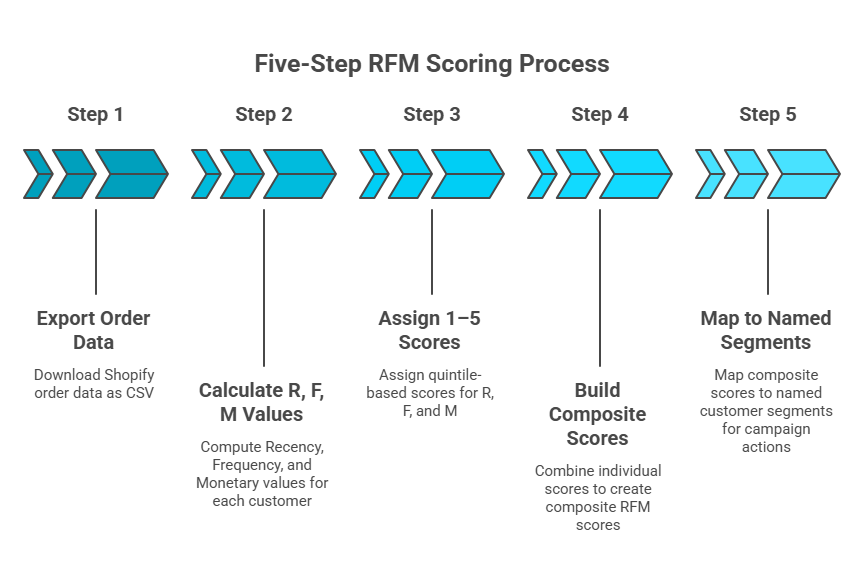
The 5-Step RFM Scoring Process
Export order data from Shopify (Customer > Orders > Export CSV)
Calculate R, F, M values per customer, last purchase date, total order count, total spend
Assign 1 to 5 scores using quintiles or custom thresholds based on your brand's purchase cycle
Combine into composite RFM score (e.g., a customer scoring 5-4-5 is high-recency, strong-frequency, top-spend)
Map composite scores to named segments with specific campaign actions tied to each
RFM scoring is only as good as its execution. This five-step process transforms raw Shopify order data into named segments with specific campaign actions — enriched with margin data for profitability-based scoring.
DTC-Specific Scoring Thresholds
For a brand with a 45-day average purchase cycle, thresholds should reflect that rhythm, not arbitrary universal benchmarks:
RFM Scoring Thresholds for DTC Brands
Dimension
Score 5
Score 4
Score 3
Score 2
Score 1
Recency
15 days or less
16 to 30 days
31 to 60 days
61 to 120 days
120+ days
Frequency
10+ orders
6 to 9 orders
3 to 5 orders
2 orders
1 order
Monetary
Top 20% spend
60th to 80th percentile
40th to 60th percentile
20th to 40th percentile
Bottom 20%
From Scores to Named Segments
RFM Segments Mapped to Campaign Actions
Segment Name
RFM Score Range
Campaign Action
⭐ Champions
444 to 555
Early access, referral programme, VIP exclusives, never discount
Win-back trigger at 1.5x average purchase interval
❌ Hibernating
111 to 122
Sunset flow or deep reactivation, evaluate if reacquisition cost is justified
This direct segment-to-action mapping is the bridge most competitor articles miss. They explain RFM theory but never connect scores to specific campaign execution.
Real-world results confirm the value: one ecommerce company using RFM-based targeting achieved a 40% increase in customer retention and a 20% increase in revenue. Another DTC brand saw a 20% boost in conversions and 15% reduction in ad spend by directing campaigns at their most engaged RFM clusters.
"Triple Whale shows orders from external marketplaces as if they were real conversions even though these orders never go through our Shopify store and could not possibly be tracked… Completely fake data." — XTRA FUEL, Trustpilot Verified Review
How Luca AI Enriches RFM With Financial Data
Luca AI calculates RFM scores automatically by pulling order data from Shopify and enriching it with margin data from Xero, so you're scoring by actual contribution margin, not just top-line revenue. A customer who spends £500 on low-margin products is fundamentally different from one who spends £400 on high-margin products, but standard RFM treats them the same. Ask Luca "Show me my RFM segments ranked by profitability" and get a cross-functional answer that no siloed tool can produce.
Q4. How Do You Build Customer Lifetime Value Tiers That Drive Real Margin Decisions? [toc=Building CLV Tiers]
RFM tells you what customers have done. Customer lifetime value (CLV) tells you what they're worth going forward, and that distinction changes every marketing decision you make.
Historic vs. Predictive CLV
Historic vs. Predictive CLV Comparison
Type
Definition
Formula
Limitation
Historic CLV
Total revenue generated by a customer to date
Sum of all past order values
Backward-looking, a £1,000 customer who churned 6 months ago still looks "valuable"
Most DTC founders only track historic CLV because it's a simple Shopify export. But historic CLV without predictive modelling is a rear-view mirror, it tells you where value was, not where it's going.
The stakes are significant: increasing customer retention by just 5% can boost profits by 25 to 95%, according to research by Bain & Company. That uplift compounds when you know which customers to retain and how much to invest in retaining them.
Building Four Actionable CLV Tiers
CLV Tier Strategy Framework
Tier
CLV Range (Example)
% of Customers
% of Revenue
Strategy
⭐ Platinum
£2,000+
~5%
~30%
White-glove service, exclusive early access, personal outreach, protect at all costs, never discount
Second-purchase campaigns, product education, upgrade incentives to move toward Gold
Bronze
Under £200
~50%
~10%
Cost-efficient acquisition flows, evaluate if CAC is justified, potential sunset
The Pareto reality is stark: Platinum + Gold typically represent 20% of your customer base but drive 60 to 70% of revenue. Treating all four tiers with the same email cadence, the same discount structure, and the same campaign frequency actively destroys margin, you're over-investing in Bronze and under-serving Platinum.
💸 Differentiated Strategies by Tier
Platinum: These customers don't need discounts, they need access. First look at new products, handwritten thank-you notes, concierge-level support. Every percentage point of discount you give this tier is pure margin destruction.
Gold: The growth engine. Loyalty programmes, curated cross-sell bundles, referral incentives. The goal is increasing purchase frequency while maintaining or growing AOV.
Silver: The opportunity tier. Second-purchase nurture sequences, product education content, and modest upgrade incentives. These customers have shown intent, they need a reason to come back.
Bronze: Evaluate ruthlessly. If CAC exceeds the projected CLV of a Bronze customer, you're paying to lose money. Cost-efficient single-touch flows or sunset entirely.
"I run a small ecommerce store and I'm trying to improve conversions. I've been looking at analytics product recommendation apps but honestly, Hard to tell which ones are actually good, Pricing feels expensive long-term, Reviews are mixed and sometimes feel fake." — r/ShopifyeCommerce, Reddit Thread
"I just noticed it gets very very slow after a few prompts, also it forgets things, like this new stupid feature that it wants to change things for you as default with no way of reverting." — u/o4ej5gv, r/shopify, Reddit Thread
How Luca AI Builds Predictive CLV Tiers Automatically
Luca AI computes predictive CLV by combining Shopify order history with Xero financial data and Klaviyo engagement signals, giving you tiers that account for actual profitability, not just revenue. A Silver-tier customer with accelerating purchase frequency and high-margin product preferences may be worth more than a Gold-tier customer showing churn signals. Ask Luca "Which Silver-tier customers are most likely to upgrade to Gold this quarter?" and get a prioritised list with recommended actions, something no analytics dashboard or spreadsheet can deliver in real time.
Q5. How Does Lifecycle Segmentation Map the Journey from First-Time Buyer to VIP to Lapsed? [toc=Lifecycle Segmentation Framework]
RFM scores tell you where customers stand today. CLV tiers tell you what they're worth. Lifecycle segmentation tells you where they're heading, and that's what determines which campaign they should receive next.
Why "New" vs. "Returning" Isn't a Lifecycle Strategy
Most DTC founders have a vague mental model of their customer journey but no formalised stages. Shopify labels customers as "new" or "returning," and that's the extent of it. A first-time buyer who spent £120 gets the same email cadence as a 5x repeat customer who's spent £900. That's not segmentation, it's guesswork.
The binary breaks down further when you consider trajectory. A "returning" customer who bought twice in 10 days is fundamentally different from one who bought twice in 18 months. Traditional tools can't distinguish between them because they lack the cross-functional data, including purchase velocity, engagement trends, and financial value, needed to place customers on a dynamic lifecycle map.
"Isn't able to do anything complex, I've asked can you take 10% off the prices of this collection, it says it did but nothing happens, I've asked for inventory value, gives me an incorrect figure." — u/ntjgikz, r/shopify Reddit Thread
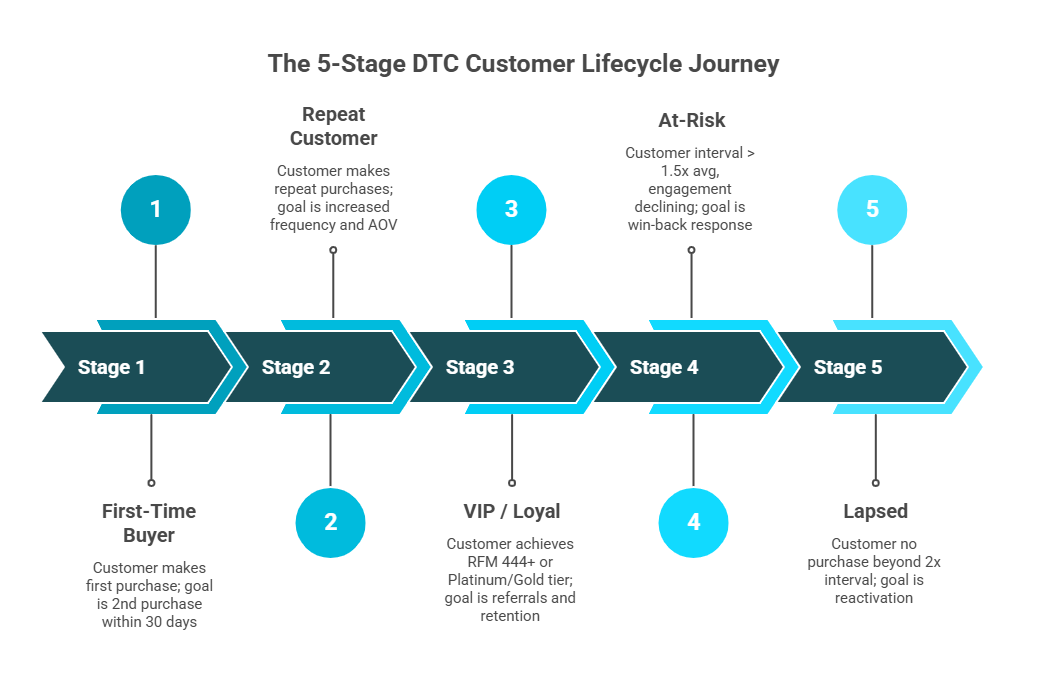
The 5-Stage Lifecycle Framework for DTC Brands
Each stage has a specific entry trigger, driven by RFM scores and CLV tiers, and a distinct marketing goal:
5-Stage DTC Customer Lifecycle Framework
Stage
Entry Trigger
Goal
Key Metric
⭐ First-Time Buyer
First purchase completed
Convert to 2nd purchase within 30 days
Second-purchase conversion rate
✅ Repeat Customer
2nd purchase
Increase frequency + AOV
Purchase frequency, AOV trend
💰 VIP / Loyal
RFM score 444+ OR CLV in Platinum/Gold tier
Maximise LTV, activate referrals
Referral rate, retention rate
⚠️ At-Risk
Purchase interval exceeds 1.5x average AND engagement declining
Re-engage before lapse
Win-back response rate
❌ Lapsed
No purchase beyond 2x average interval
Win-back or sunset
Reactivation rate, cost per reactivation
This is the unified framework no competitor article provides: RFM scores and CLV tiers feed directly into lifecycle stage placement, which then triggers the right campaign at the right moment.
RFM scores and CLV tiers feed directly into lifecycle stage placement. This dynamic framework determines which campaign each customer should receive next — and shifts them in real-time as behaviour changes.
Repeat Customer > Loyalty programme invitation + cross-sell bundles based on purchase history
VIP / Loyal > Exclusive early access + personal outreach + never discount, these customers buy for the experience, not the deal
At-Risk > Pre-churn sequence triggered by velocity deceleration (detailed in Q6)
Lapsed > Segmented win-back campaign or sunset flow
The critical point: this framework is dynamic. Customers move between stages in real-time based on behaviour, not on static lists that decay within weeks.
"It has potential, but so far it can't do much. Often it comes up with broken advice that does not work which it also admits when you challenge it. Very ChatGPT like." — u/ntmt42a, r/shopify Reddit Thread
✅ How Luca AI Automates Stage Transitions in Real Time
Luca AI automates lifecycle stage assignment by continuously monitoring purchase velocity, engagement trends, and financial signals across all connected platforms. When a Gold-tier customer's purchase frequency decelerates, Luca proactively surfaces the alert, "Customer moved from Repeat to At-Risk," before they hit the lapsed threshold. The system that detects the transition can also recommend the intervention and model the revenue impact of acting now versus waiting.
Q6. How Do You Design Win-Back Campaigns That Target the Right Segment at the Right Time? [toc=Win-Back Campaign Design]
The Blanket Discount Trap
It's the end of Q2. Repeat purchase rate has dropped 12% over two quarters. The instinct kicks in: blast a "20% off, we miss you!" email to everyone who hasn't bought in 60+ days.
The result is margin destruction disguised as re-engagement. You discount Champions who would have bought anyway. You annoy Bronze-tier customers who weren't profitable to begin with. And you miss At-Risk VIPs who needed a different message entirely. Blanket win-back discounts erode 8 to 15% of margin on customers who didn't need the incentive.
⚠️ The Hidden Costs of "One-Size-Fits-All" Win-Backs
💸 Margin erosion: Discounting high-CLV customers who would have converted organically
⏰ Timing mismatch: Using arbitrary 30/60/90-day windows instead of individual purchase intervals
❌ List fatigue: Emailing low-value lapsed customers who cost more to re-acquire than they'll ever return
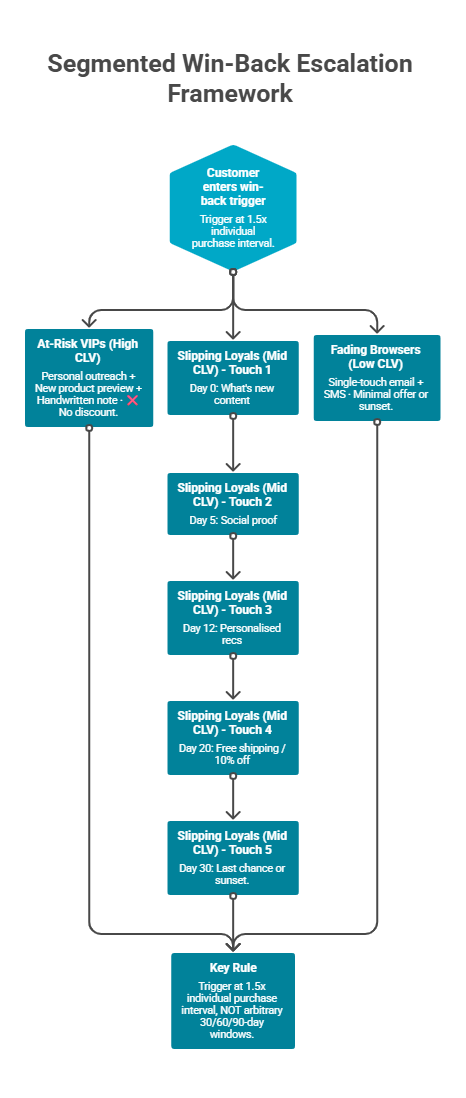
The Segmented Win-Back Framework
The fix is mapping win-back campaigns directly to RFM + CLV tiers:
Segmented Win-Back Strategy by Customer Tier
Segment
RFM + CLV Profile
Strategy
Discount?
⭐ At-Risk VIPs
High CLV, declining recency
Personal outreach, new product preview, handwritten note
❌ No
Slipping Loyals
Mid CLV, declining recency
5-touch escalating sequence
Only on Touch 4 to 5
Fading Browsers
Low CLV, low recency
Cost-efficient single-touch email + SMS
Minimal or sunset
Timing rule: Trigger win-back at 1.5x the customer's individual average purchase interval, not arbitrary calendar windows. A customer who buys every 25 days should enter a win-back flow at day 38, not day 60.
Touch 5 (Day 30) Final "last chance" offer or sunset warning
Blanket win-back discounts erode 8–15% of margin on customers who didn't need the incentive. This framework maps the right message to the right tier at the right time — protecting margins on every touch.
Win-back campaigns achieve success rates of 14 to 29% depending on targeting and timing. The escalation structure prevents over-discounting early while giving multiple conversion chances without incentive, protecting margins on the first three touches.
"Sidekick straight up lied to me at one point. I spent AGES following its instructions before eventually talking to a real agent who told me what I was trying to do wasn't possible." — u/ntyelac, r/shopify Reddit Thread
✅ How Luca AI Catches Churn Before It Happens
Luca AI identifies at-risk customers proactively, before they hit the win-back threshold, by monitoring purchase frequency deceleration and engagement drop-offs across Shopify and Klaviyo simultaneously. Instead of reacting after a customer has lapsed, Luca surfaces an alert: "47 Gold-tier customers showing declining purchase velocity, recommend triggering pre-churn sequence." The system that spots the risk can also model the revenue impact of a 10% discount versus a free-shipping offer for that specific segment, in seconds.
Q7. Shopify, Klaviyo, or a CDP, Which Segmentation Tool Stack Do You Actually Need? [toc=Segmentation Tool Stack]
The Decision Most Founders Get Wrong
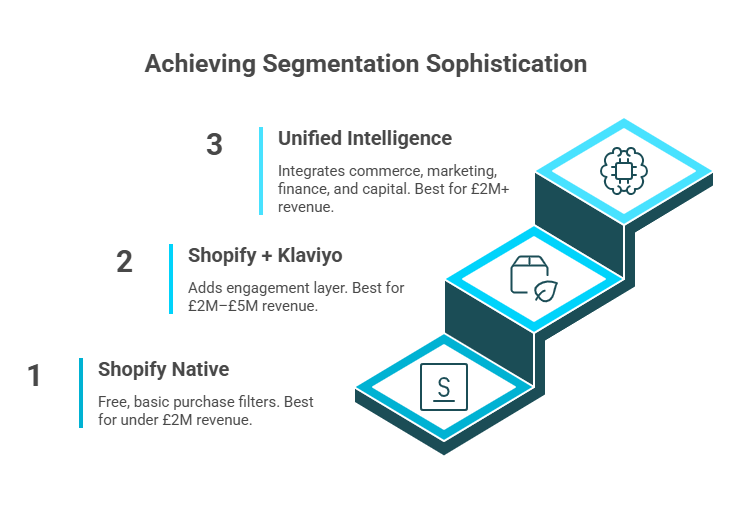
Choosing a segmentation stack isn't a feature comparison, it's an architecture decision that determines what questions you can answer for years to come. Pick wrong, and you're locked into fragmented reporting or expensive migrations.
Most founders either under-invest (stuck on Shopify native past the point it works) or over-invest (buying an enterprise CDP when Klaviyo would suffice). The right tier depends on revenue stage and segmentation complexity.
Orders > 3 AND Last order < 30 days = Active Repeat Buyers
Total spent > £200 AND Orders = 1 = High-Value One-Timers
Last order > 90 days AND Total spent > £150 = Win-Back Candidates
⚠️ Limitation: Can only filter on data Shopify owns, no email engagement, no ad channel attribution, no profitability data.
Tier 2, Shopify + Klaviyo (~£150 to 500/month) Adds engagement-layer segmentation: open rates, click patterns, predicted CLV scoring, and purchase likelihood. Syncs with Shopify for combined behavioural + engagement segments.
⚠️ Limitation: Blind to financial data, contribution margin, COGS, cash-flow impact. Pricing starts around £150/month and scales with contact volume.
Choosing a segmentation stack is an architecture decision. Most founders either under-invest (stuck on Shopify native) or over-i
📊 Capability Comparison
Segmentation Capability by Tool Tier
Capability
Shopify Native
Shopify + Klaviyo
What's Still Missing
Purchase history filters
✅
✅
-
Email engagement data
❌
✅
-
Predicted CLV scoring
❌
✅ (basic)
Cross-functional financial data
Ad channel attribution
❌
❌
Meta/Google spend per segment
Contribution margin by segment
❌
❌
Xero/accounting integration
Proactive churn alerts
❌
❌
Real-time monitoring across all sources
Capital to act on segment insights
❌
❌
Embedded funding
"We had something that said 'your sales are down this week' and when I clicked it, it said you had no sales at all last week, which was incorrect. More useless junk on my dashboard at this point." — u/ntn63rj, r/shopify Reddit Thread
The 6 Evaluation Criteria for Tier 3
When should you graduate beyond Shopify + Klaviyo? Score your needs against these criteria:
Cross-functional data synthesis Do segments need financial margins or ad spend data?
Segmentation intelligence Rule-based filters or predictive/AI-driven?
Action capability Trigger campaigns, or just export lists?
Setup complexity Weeks of implementation, or plug-and-play?
Total cost of ownership Platform fee + analyst time + opportunity cost
Capital integration If a segment reveals a scaling opportunity, can the platform fund it?
Enterprise CDPs (Salesforce, Insider, Bloomreach) start at $12,500 to $48,000+/year and require dedicated data engineering staff. For most DTC brands under £10M, that's architectural overkill.
"The downside of GA is its learning curve, especially with GA4. The interface and reporting structure are not very intuitive at first, and finding specific metrics or building custom reports can take time." — Aman S., Performance Marketing Head, G2 Verified Review
✅ Where Luca AI Fits
Choose Shopify + Klaviyo if you're under £2M and segmentation needs are email-only. Choose an enterprise CDP if you have a data team and complex identity resolution needs. Choose Luca AI if you want cross-functional intelligence, segments enriched with financial data from Xero, ad spend from Meta, and inventory signals, plus embedded capital access, without hiring a data engineer.
Q8. What Does a Full Segmentation-to-Campaign Workflow Look Like in Practice? [toc=Segmentation Workflow in Practice]
Here's how a £3M DTC skincare founder runs her monthly segmentation review, first the old way, then with unified intelligence.
❌ The Old Workflow: Monday, 4+ Hours Across 5 Tools
8:00 AM Export Shopify order data to CSV. 14,000 rows. Filter by date range, remove test orders manually.
9:00 AM Open Google Sheets. Calculate RFM scores using VLOOKUP formulas. Recency column breaks because date formatting differs between Shopify UK and Shopify US stores.
10:30 AM Log into Klaviyo. Export engagement data (opens, clicks, last email interaction). Attempt to match customer IDs with the Shopify CSV. 12% of records don't match due to email aliases.
11:30 AM Try to build CLV tiers. Realise margin data lives in Xero, open a third tab, export another CSV. Abandon the effort because reconciling product-level COGS across 200 SKUs will take another two hours.
1:00 PM Build a win-back flow in Klaviyo using an arbitrary 60-day window because calculating per-customer purchase intervals at scale is impossible in a spreadsheet.
2:00 PM Guess at discount levels because profitability data lives in a different system. Send 20% off to 5,000 lapsed customers and hope for the best.
"I tried getting it to build some category sales analytics, but it failed miserably." — u/nv1x5p0, r/shopify Reddit Thread
"Not finding it very useful beyond saving me when I need to find specific Shopify documentation from within support tbh." — u/ntkaxet, r/shopify Reddit Thread
✅ The New Workflow With Luca AI: Monday, 22 Minutes
8:00 AM Open Luca. Ask: "Show me updated RFM segments with contribution margin by tier." Answer in 12 seconds, pulling Shopify order data + Xero margin data in a single query.
8:05 AM ⚠️ Luca proactive alert: "38 Gold-tier customers moved from Repeat to At-Risk, purchase frequency declining over the past 3 weeks."
8:10 AM Ask: "If I offer 15% off to the At-Risk segment, what's the margin impact vs. a free-shipping offer?" Luca models both scenarios across revenue, COGS, and shipping costs.
8:15 AM Ask: "Which Silver-tier customers have the highest predicted CLV upgrade probability?" Prioritised list returned with recommended next-best-action per customer.
8:18 AM Ask: "What's my projected Q2 cash position if I fund a VIP early-access campaign?" Luca models across marketing spend, inventory commitments, and cash flow.
8:22 AM 💰 Luca surfaces: "£25K capital available at 4.8% to fund the VIP campaign based on current business health." One-click approval.
The Contrast in Numbers
Manual Workflow vs. Luca AI Workflow Comparison
Metric
Old Workflow
With Luca AI
⏰ Time spent
4+ hours
22 minutes
Tools used
5 (Shopify, Sheets, Klaviyo, Xero, email)
1
Decisions made
2 (delayed, incomplete data)
4 (data-backed, real-time)
Discount strategy
Uniform 20% to all lapsed
Segmented by tier, modelled by margin
Capital deployed
None (separate application required)
£25K, one-click, same session
From 4-hour manual reconciliation to 22-minute intelligent execution, that's the shift from fragmented tools to a unified AI Co-Founder.
Q9. Segmentation Maturity Audit: Is Your Customer Data Actually Working for You? [toc=Segmentation Maturity Audit]
Most DTC founders believe they're segmenting. In reality, they're filtering. There's a difference between applying a "purchased more than 3 times" tag in Shopify and running a segmentation engine that scores, tiers, and triggers actions across commerce, marketing, and finance data simultaneously.
This 8-point audit separates operational segmentation from surface-level filtering.
📋 The 8-Point Segmentation Maturity Checklist
Score yourself honestly, one point per check:
Segmentation Maturity Checklist
#
Capability
✅ or ❌
1
Can you identify your top 10% customers by profitability (not just revenue) in under 60 seconds?
-
2
Do your RFM scores update automatically, or do you recalculate manually in spreadsheets?
-
3
Are your win-back campaigns triggered by individual purchase intervals, or generic 30/60/90-day windows?
-
4
Can your segmentation tool incorporate financial data (margins, COGS, cash impact)?
-
5
Do you have separate CLV tiers with differentiated strategies for each?
-
6
Can you model the revenue impact of a discount on a specific segment before sending it?
-
7
Does your system alert you proactively when high-value customers show churn signals?
-
8
Can you access growth capital to act on segment-specific opportunities without a separate application?
-
🔍 What Your Score Means
⭐ 7 to 8 checks: Mature stack, focus on optimisation and micro-segmentation. You're in the top 5% of DTC operators.
⚠️ 4 to 6 checks: Critical gaps, you're leaving revenue on the table with generic campaigns and reactive workflows. The tools are there, but they're not connected.
❌ 0 to 3 checks: Segmentation is effectively manual and reactive. Every campaign is a guess, and your highest-value customers are getting the same treatment as one-time browsers.
Most founders land between 2 and 4. The typical Shopify + Klaviyo stack covers items 2 (partially) and 5 (partially), leaving six critical capabilities unaddressed.
"Really disappointing experience. I have used Wayflyer on a number of occasions to help with Q4 stock purchasing and working capital requirements only to be told we no longer fit their criteria. Given we have used them multiple years running with no issues this was incredibly disappointing." — Joshua Hannan, Trustpilot Verified Review
"I was not sure about the exact payment terms or how everything works. NOT BEGINNERS FRIENDLY AT ALL, they probably spend all their time with HIGH SALES businesses and no time for the small guys." — shakib mustafa, Trustpilot Verified Review
✅ How Luca AI Closes Every Gap
Luca AI turns every unchecked box into a check. Cross-functional data synthesis (items 1, 4), automated RFM scoring enriched with margin data (item 2), individual purchase-interval triggers (item 3), differentiated CLV tiers (item 5), pre-send scenario modelling (item 6), proactive churn alerts (item 7), and embedded capital access (item 8), all via natural language, all from one interface.
💰 Scored below 5? You're not segmenting, you're guessing. Book a 15-minute gap assessment to see where unified intelligence closes the holes in your customer data stack.
What are the 4 types of customer segmentation in ecommerce?
The four core types are demographic (age, gender, income), behavioural (purchase history, browsing patterns, cart abandonment), psychographic (values, lifestyle, motivations), and geographic (region, climate, shipping zones). For ecommerce, behavioural segmentation consistently delivers the highest ROI because it's based on actual customer actions rather than assumptions.
How many customer segments should an ecommerce store have?
Five to eight actionable segments is the sweet spot for most DTC brands. Fewer than five means you're treating fundamentally different customers the same. More than ten creates operational complexity, campaigns become impossible to manage without a dedicated team. The key rule: every segment must have a distinct campaign action tied to it. If two segments receive the same email, they should be merged.
⭐ RFM and Segment Updates
What is RFM analysis and why does it matter for ecommerce?
RFM stands for Recency (days since last purchase), Frequency (total orders), and Monetary value (total spend). It's considered the gold standard for ecommerce segmentation because it uses actual transaction data, not surveys or self-reported preferences, to score and rank customers by value and engagement. RFM directly maps scores to campaign actions, making it immediately operational.
How often should you update customer segments?
Behavioural segments should be dynamic and auto-updating in real-time, every new purchase, browse, or email interaction should shift a customer's segment placement automatically. CLV tiers should be recalculated monthly. Static lists decay within 30 days as customer behaviour changes, making any campaign built on them progressively less accurate.
💡 Segmentation vs. Personalisation
What's the difference between customer segmentation and personalisation?
Segmentation groups customers by shared traits (e.g., "high-value repeat buyers"). Personalisation tailors the experience within each group (e.g., recommending specific products based on individual browse history). Segmentation is the strategy, it defines who gets what type of message. Personalisation is the execution, it customises the message for each individual within that group.
When should a DTC brand start segmenting customers?
From Day 1, but sophistication scales with your customer base. At 0 to 500 customers, Shopify native filters are sufficient. At 500 to 5,000, add Klaviyo for engagement-layer segmentation. At 5,000+, evaluate unified intelligence platforms that incorporate financial and cross-channel data for true value-based segmentation.
🛠️ Tools and Technical Requirements
Can you do customer segmentation without a data team?
Yes. Shopify native and Klaviyo require no technical skills for basic segmentation. For cross-functional segmentation that incorporates financial data (margins, COGS, cash impact) alongside marketing and commerce data, Luca AI's natural-language interface eliminates the need for SQL knowledge or analyst hires, ask questions in plain English and get segment-level answers in seconds.
What is the best customer segmentation tool for Shopify?
It depends on your stage and needs:
Best Segmentation Tools for Shopify by Stage
Tool
Best For
Limitation
Shopify Native
Stores under £2M; basic purchase filters
No engagement data, no financial context
Klaviyo
Adding email/SMS engagement segmentation
Blind to margins, COGS, and cash impact
Luca AI
Unified intelligence across commerce, marketing, and finance + embedded capital
Designed for brands ready to move beyond siloed tools
Q11. Common Segmentation Mistakes That Silently Destroy DTC Margins [toc=Common Segmentation Mistakes]
Segmentation done wrong is worse than no segmentation at all, it gives you false confidence while actively eroding margins. Here are the five mistakes that cost DTC brands the most.
❌ Mistake 1: Segmenting by Revenue Instead of Profitability
The most common and most expensive error. A customer who spends £500 but only buys during 40%-off sales, returns 30% of orders, and requires three support tickets per purchase is not a high-value customer. They're a margin destroyer wearing a "VIP" label. Yet most segmentation tools, including Klaviyo's predicted CLV, use revenue as the primary signal because they don't have access to COGS, return rates, or support costs.
"1 STAR. Broken Integrations. Fake Attribution for External Marketplaces. We've been stuck in months of pointless back and forth with Triple Whale because their integration simply does not work. Since day one, the data has been inaccurate." — XTRA FUEL, Trustpilot Verified Review
❌ Mistake 2: Using Static Lists That Decay in Days
Building a "VIP" segment in January and running campaigns against that same list in March. Customer behaviour shifts constantly, a Champion in January can be At-Risk by March if purchase velocity decelerates. Segments must auto-update based on real-time behavioural signals, not quarterly manual rebuilds.
❌ Mistake 3: Over-Segmenting Without Campaign Capacity
Creating 15 segments sounds sophisticated. Running 15 differentiated campaigns monthly requires a team most DTC brands don't have. The result: half the segments receive generic campaigns anyway, negating the segmentation effort entirely. Five to eight segments with distinct, executable actions beats 15 segments with identical treatment.
⚠️ Mistake 4: Ignoring the Second-Purchase Window
The highest-leverage moment in any customer lifecycle is the window between first and second purchase. Yet most DTC founders focus segmentation on high-value repeat buyers while neglecting the massive first-time buyer cohort sitting in limbo. The second-purchase conversion rate is the single best predictor of long-term customer value.
⚠️ Mistake 5: Discounting VIPs
Sending discount codes to your highest-value segment is actively training your best customers to wait for deals. Champions and Platinum-tier customers buy for the product, the brand, and the experience, not the 15% off. Differentiated strategies mean VIPs get exclusive access, personal service, and early launches, never blanket discounts.
"Our experience with Wayflyer has been extremely disappointing and professionally damaging. After being offered funding in writing with specific amounts, repayment terms, and confirmation that the deal was approved, Wayflyer abruptly reversed their decision at the last minute." — Geoff Brand, Trustpilot Verified Review
✅ How Luca AI Eliminates These Mistakes by Design
Luca AI architecturally prevents each of these errors. Profitability-based segmentation is default because Luca connects Xero margin data to Shopify purchase data. Segments are dynamic and auto-updating. The system recommends 5 to 8 actionable segments based on your data, not arbitrary rules. Second-purchase windows are monitored proactively. And VIP tiers are flagged as "protect, no discount" by default.
Q12. From Fragmented Dashboards to a Unified Second Brain, The Segmentation Shift DTC Brands Can't Ignore [toc=Unified Second Brain Shift]
The Era of "Dashboard Doom-Scrolling" Is Over
For the past decade, DTC founders have accepted a painful reality: segmentation means opening five tabs, exporting three CSVs, and spending Monday mornings in spreadsheet purgatory. Shopify for purchase data. Klaviyo for engagement data. Xero for margin data. GA4 for behaviour data. Meta for acquisition data. Each tool sees one slice. None sees the whole customer.
This fragmented approach was tolerable at £500K in revenue. At £3M, it's operationally unsustainable. At £10M, it's actively losing you money, because the insights that matter most (which segments are profitable, which are churning, which should receive capital for scaling) require data synthesis that no single point solution can provide.
💸 The Hidden Cost of Tool Fragmentation
The cost isn't just the subscription fees. It's the compounding opportunity cost:
10 to 15 hours/week spent on manual data consolidation instead of strategic decision-making
Delayed decisions because cross-functional answers require cross-tool reconciliation
Uniform campaigns sent to differentiated segments because the effort to personalise exceeds available bandwidth
Capital disconnected from intelligence you spot an opportunity in your analytics tool but need to apply separately for funding, losing days of momentum
"Funding should take the stress off your business, by providing a cash flow solution, but using Clearco has caused more stress for us." — Scott Butler, Trustpilot Verified Review
"We genuinely thought they would be our partner, and that's what they've stated. As our business has gotten better in terms of growth and profitability, they had guaranteed we would lend us at a certain time only to let us down." — M, Trustpilot Verified Review
✅ The Unified Intelligence Model
The shift isn't from one tool to another, it's from a tool collection to an intelligence layer. Luca AI represents this architectural change: a single reasoning engine that connects Shopify, Meta, Google Ads, Klaviyo, Xero, Stripe, and 20+ sources into one context-aware system.
Instead of building segments in one tool and acting in another, founders ask:
"Which RFM segment has the highest contribution margin but declining purchase frequency?"
"If I fund a VIP early-access campaign, what's the projected cash-flow impact over 90 days?"
"Show me Silver-tier customers most likely to upgrade to Gold this quarter."
Each query spans commerce, marketing, and finance data, answered in seconds, not hours.
💰 Intelligence Meets Capital
The final frontier that no traditional tool stack addresses: when your segmentation reveals a scaling opportunity, Luca AI can fund it instantly, with dynamically-priced, non-dilutive capital based on the AI's real-time confidence in your business trajectory. The system that identifies the opportunity is the same system that finances it. That's not a dashboard. That's a second brain.
FAQ's
What is ecommerce customer segmentation and why does it matter for DTC brands?
Ecommerce customer segmentation is the practice of grouping customers by shared characteristics, such as purchase behaviour, monetary value, engagement patterns, and lifecycle stage, to deliver targeted experiences rather than generic broadcasts.
For DTC brands, it matters because:
Segmented campaigns generate 30% more opens and 50% more click-throughs than non-segmented blasts
Merchants using two or more segmented lists earn 17x more revenue than those relying on a single list
It prevents margin destruction from uniform discounting across fundamentally different customer tiers
The challenge is that most segmentation requires stitching together data from 8 to 12 disconnected tools. We built Luca AI to unify commerce, marketing, and financial data into a single reasoning layer, so founders can segment by true profitability, not just surface-level purchase history, without exporting a single CSV.
How do you calculate RFM scores for a Shopify store?
RFM scoring assigns each customer a 1 to 5 rating across three dimensions:
Recency: Days since last purchase
Frequency: Total number of orders in a given period
Monetary: Total spend
To calculate:
Export order data from Shopify (Customers > Orders > Export CSV)
Calculate R, F, and M values per customer
Assign scores using quintiles calibrated to your brand's purchase cycle (e.g., a 45-day cycle means "Score 5" for Recency is 15 days or less)
Combine into a composite score (e.g., 5-4-5 = high recency, strong frequency, top spend)
Map scores to named segments with specific campaign actions
Standard RFM scoring treats all revenue equally. We enrich RFM with margin data from Xero through Luca AI's financial management layer, so a customer spending £500 on low-margin products is scored differently from one spending £400 on high-margin lines.
How many customer segments should an ecommerce store have?
Five to eight actionable segments is the optimal range for most DTC brands.
Fewer than five means you are treating fundamentally different customers the same, missing revenue from personalised campaigns
More than ten creates operational complexity that most lean teams cannot sustain with differentiated campaigns for each segment
The critical rule: every segment must have a distinct campaign action tied to it. If two segments receive identical emails, they should be merged. Over-segmenting without the campaign capacity to serve each group is one of the most common mistakes we see, and it negates the segmentation effort entirely.
We designed Luca AI to recommend the optimal number of segments based on your actual data and team bandwidth, not arbitrary benchmarks.
What is the difference between customer segmentation and personalisation?
Segmentation and personalisation are complementary but distinct:
Segmentation groups customers by shared traits (e.g., "high-value repeat buyers" or "at-risk VIPs"). It is the strategy that defines who gets what type of message.
Personalisation tailors the experience within each group (e.g., recommending specific products based on individual browse history). It is the execution layer.
You cannot personalise effectively without segmentation as the foundation. A personalisation engine without segments treats every customer as an individual without understanding their value tier, lifecycle stage, or profitability, leading to irrelevant recommendations and wasted spend.
We built Luca AI's data analysis layer to handle both: segmenting customers by cross-functional data (purchase behaviour + financial margins + engagement signals) and enabling personalised actions within each segment through natural-language queries.
When should a DTC brand upgrade from Klaviyo to a unified intelligence platform?
Klaviyo is excellent for engagement-layer segmentation (open rates, click patterns, predicted CLV scoring). However, it has architectural blind spots that become costly as you scale:
No financial data integration: Klaviyo cannot see contribution margin, COGS, or cash-flow impact
No ad channel attribution: It cannot connect Meta or Google spend to specific customer segments
No proactive alerts: It reports on segments but does not monitor for churn signals or scaling opportunities in real-time
Consider upgrading when:
Revenue exceeds £2M and segmentation decisions require financial context
You need to answer questions spanning marketing and finance (e.g., "Which segment is most profitable after COGS?")
Your team spends more than 10 hours per week manually reconciling data across tools
We built Luca AI as the natural next tier: it connects Shopify, Klaviyo, Xero, Meta, and 20+ sources into one reasoning engine, enriching segments with financial data without requiring a data engineering team.
Enjoyed the read? Join our team for a quick 15-minute chat — no pitch, just a real conversation on how we’re rethinking Ecommerce with AI - Luca
Loading Schedule...
Your AI Co-Founder is here.
Here’s why:
Shopify, Meta, Xero - one brain.
"Should I scale?" Answered with real data.
Growth capital. No applications. One click.
Thank you! Your submission has been received! Please book a time slot for the Meeting
Oops! Something went wrong while submitting the form.

.png)