10 Best Cash Flow Forecasting Tools for Ecommerce (2026): Features, Pricing, and Real-World Use Cases
11
mins read
TL;DR
We ranked 10 cash flow forecasting tools using five ecommerce-weighted criteria including payout cycle awareness and inventory-cash linkage.
Shopify payout delays, Amazon biweekly settlements, and 20-30% return rates make generic forecasting tools dangerously inaccurate for online sellers.
Our 7-step implementation guide and 13-week template help founders move from reactive spreadsheets to structured forecasting within one week.
The 7 costliest forecasting mistakes all trace back to disconnected data across marketing, finance, and inventory systems.
Luca AI is the only platform that unifies cross-functional intelligence with embedded capital to forecast, alert, and fund in one system.
Q1. 10 Best Cash Flow Forecasting Tools for Ecommerce in 2026 [toc=Best Forecasting Tools 2026]
Ecommerce cash flow forecasting is fundamentally different from general business forecasting. Between Shopify payout cycles, Amazon's biweekly settlements, 60 to 90-day inventory pre-purchase windows, volatile ad spend, and return rates averaging 20 to 30%, generic accounting tools simply can't capture the timing gaps that determine whether your store survives peak season. The 10 tools below were selected specifically for how well they handle ecommerce cash dynamics, from payout cycle awareness to inventory-cash bridge modeling, so you can stop guessing and start forecasting with confidence.
The 10 Tools at a Glance
Luca AI - Best for unified cash flow intelligence + embedded capital
Float - Best for visual scenario-based cash flow forecasting
Inventory Planner by Sage - Best for inventory-to-cash-flow bridge on Shopify
Cash Flow Frog - Best for simple, affordable cash flow forecasting
Fathom - Best for three-way forecasting and accountant collaboration
Centime - Best for AI-driven AP/AR automation with cash forecasting
Drivetrain - Best for AI financial modeling in B2B-heavy ecommerce
Mosaic - Best for strategic finance in scaling startups
LivePlan - Best for business planning with integrated cash flow module
Google Sheets / Excel - Best for bootstrapped DIY cash flow tracking
10 Best Cash Flow Forecasting Tools for Ecommerce in 2026
Tool Name
Key Capabilities
Best For
Pricing
Luca AI ⭐⭐⭐⭐⭐
Cross-functional cash flow intelligence, proactive alerts, scenario modeling, embedded capital
Scaling ecommerce brands (€1M to €100M) needing unified intelligence + capital
Starter - €299/Month
Float ⭐⭐⭐⭐
Visual forecasting, scenario layers, Xero/QBO auto-sync, budget vs. actuals
Bootstrapped sellers under €500K who want full control
Free to $12.99/mo
🏆 1. Luca AI
✅ Why Did We Choose This Tool?
Full disclosure: I'm Eric Bidinger, founder of Luca AI, so naturally we lead this list. But there's a reason beyond authorship. Luca AI is the only platform on this list that combines cross-functional cash flow intelligence with embedded capital deployment. Every other tool here shows you a cash gap. Luca identifies it, models the downstream impact across marketing, inventory, and operations, then offers dynamically-priced capital to bridge it. That's the AI Co-Founder model: a unified second brain that doesn't just forecast cash, it acts on the forecast.
Luca AI's cash flow intelligence dashboard serves as an AI Co-Founder for ecommerce, unifying sales analytics, ad spend modeling, inventory visibility, and embedded capital access in one conversational interface.
📊 Core Ecommerce Cash Flow Metrics
⏰ Forecast Horizon: Real-time rolling forecasts with unlimited forward-looking scenarios
🔗 Ecommerce Integrations: Shopify, Amazon, Stripe, Meta, Google Ads, Xero, all in one reasoning layer
🤖 AI Capabilities: Cross-functional reasoning across commerce, marketing, finance, and operations
💰 Capital Integration: Instant, dynamically-priced embedded capital based on real-time business health
⚡ Setup Time: 10-minute no-code integration
💡 Solutions Offered
Unified cash flow intelligence that connects Shopify payout data, ad spend timing, inventory cycles, and supplier terms into a single forecast
Natural language scenario planning - ask "If I scale Meta spend by €30K and order 5,000 units, what's my cash position on December 15?" and get an answer in seconds
Proactive alerts that surface cash flow risks (payout delays, margin erosion, inventory shortfalls) before they impact your P&L
Capital-as-a-Feature - when the forecast reveals a cash gap, Luca offers instant, non-dilutive funding without a separate application
Cross-functional reasoning that connects marketing ROAS to inventory velocity to cash runway in one query
🎯 Best For
Scaling ecommerce founders and CFOs (€1M to €100M) who need a single system that forecasts cash, identifies risks, and funds growth, without toggling between disconnected dashboards and financing applications.
📋 Case Study
🔍 The Problem: A €4.2M European DTC skincare brand was running a 47-day cash conversion cycle heading into Q4. They had a proven Meta campaign at 3.8x ROAS but couldn't scale because €120K in inventory deposits would create a 3-week cash gap before Black Friday revenue arrived.
🛠️ How Luca Helped: Luca modeled the full scenario, ad spend increase, supplier payment timeline, Shopify/Stripe payout delays, and projected conversion rates, in one cross-functional forecast. It identified the exact €65K gap window and offered dynamically-priced capital within hours.
📈 The Outcome: The brand scaled their winning campaign 2.4x, reduced their cash conversion cycle to 31 days through optimized supplier terms Luca recommended, and generated €380K in incremental Q4 revenue, with capital repaid within 6 weeks from campaign proceeds.
Float is one of the most visually intuitive cash flow forecasting tools available, with deep integration into Xero, QuickBooks Online, and FreeAgent. For ecommerce operators who already run their accounting through these platforms, Float turns raw accounting data into visual, scenario-layered cash flow forecasts automatically, no manual spreadsheet work required.
Float's cash flow forecasting dashboard provides visual weekly cash flow projections, scenario modeling for what-if planning, and a multi-company overview with real-time accounting sync from Xero and QuickBooks.
📊 Core Ecommerce Cash Flow Metrics
⏰ Forecast Horizon: Up to 3 years forward-looking
🔗 Ecommerce Integrations: Indirect via Xero/QBO (no native Shopify connection)
🤖 AI Capabilities: Limited, rule-based forecasting, no AI/ML predictions
💰 Capital Integration: ❌ None
⚡ Setup Time: Under 1 hour with accounting software connected
💡 Solutions Offered
Automated cash flow forecasting that syncs daily with your accounting software, pulling invoices, bills, and expected payment dates
Scenario layers to model best-case, worst-case, and what-if situations like adding new hires or losing a major client
Visual cash flow timelines on daily, weekly, or monthly views for fast decision-making
Budget vs. actuals tracking that overlays your forecasted cash against real-time accounting data
Team collaboration with shareable cash flow reports for banks, investors, or board presentations
🎯 Best For
Small-to-mid ecommerce businesses (€200K to €5M) already using Xero or QuickBooks who want beautiful, automated cash flow visibility without complex setup.
💬 Reviews
"The fact that Float integrates with Xero, our accounts software, means we get a pretty much automatic cash flow generated. All of our data from Xero such as invoices and bills are all added straight to Float including any updates to planned to pay dates. The use of scenario layers is a life saver." Julie R., Head of Finance Float - G2 Verified Review
"Float does require you to always keep your accounting software reconciled and up to date to allow it to forecast properly. Float is quite expensive compared to the accounting software itself, but I can easily justify this with the time saved compared to spreadsheet entries." Ewan O., Director/Founder Float - G2 Verified Review
💰 Pricing
$59/mo to $329/mo
🏆 3. Inventory Planner by Sage
✅ Why Did We Choose This Tool?
Inventory Planner is the only tool on this list built specifically to bridge the gap between inventory management and cash flow impact. For ecommerce sellers, cash doesn't vanish into thin air, it gets locked in inventory. Inventory Planner forecasts demand, generates purchase orders, and directly connects stock decisions to cash runway, a critical capability most generic cash flow tools completely miss.
📊 Core Ecommerce Cash Flow Metrics
⏰ Forecast Horizon: Demand-driven (varies by SKU velocity and lead times)
🤖 AI Capabilities: Algorithmic demand forecasting based on historical sales, seasonality, and trends
💰 Capital Integration: ❌ None
⚡ Setup Time: 1 to 2 days with ecommerce platform connected
💡 Solutions Offered
Demand forecasting that predicts future sales by SKU using historical data, seasonality, and trend detection
Automated replenishment recommendations with supplier-specific purchase orders generated instantly
Overstock and dead stock alerts to free up cash locked in slow-moving inventory
Cash flow impact reporting that shows exactly how much capital is tied up in stock and what's recoverable
Multi-location and multi-channel inventory visibility across Shopify, Amazon, and wholesale
🎯 Best For
Shopify and multi-channel ecommerce sellers (€500K to €20M) whose biggest cash flow challenge is inventory purchasing decisions and timing.
💬 Reviews
"Inventory Planner gives us a clear, data-driven foundation for purchasing decisions. The forecasting logic is reliable, the interface is intuitive, and the platform makes it easy to understand demand, sell-through, and replenishment needs at a glance." Verified User Inventory Planner - G2 Verified Review
"We have noticed tangible improvements in cash flow, since we can minimize excess inventory and prevent unnecessary purchases. We highly recommend Inventory Planner to any growing business seeking to improve stock control, simplify purchasing, and eliminate operational inefficiencies." Verified User Inventory Planner - G2 Verified Review
💰 Pricing
$249.99/mo to $499.99/mo
🏆 4. Cash Flow Frog
✅ Why Did We Choose This Tool?
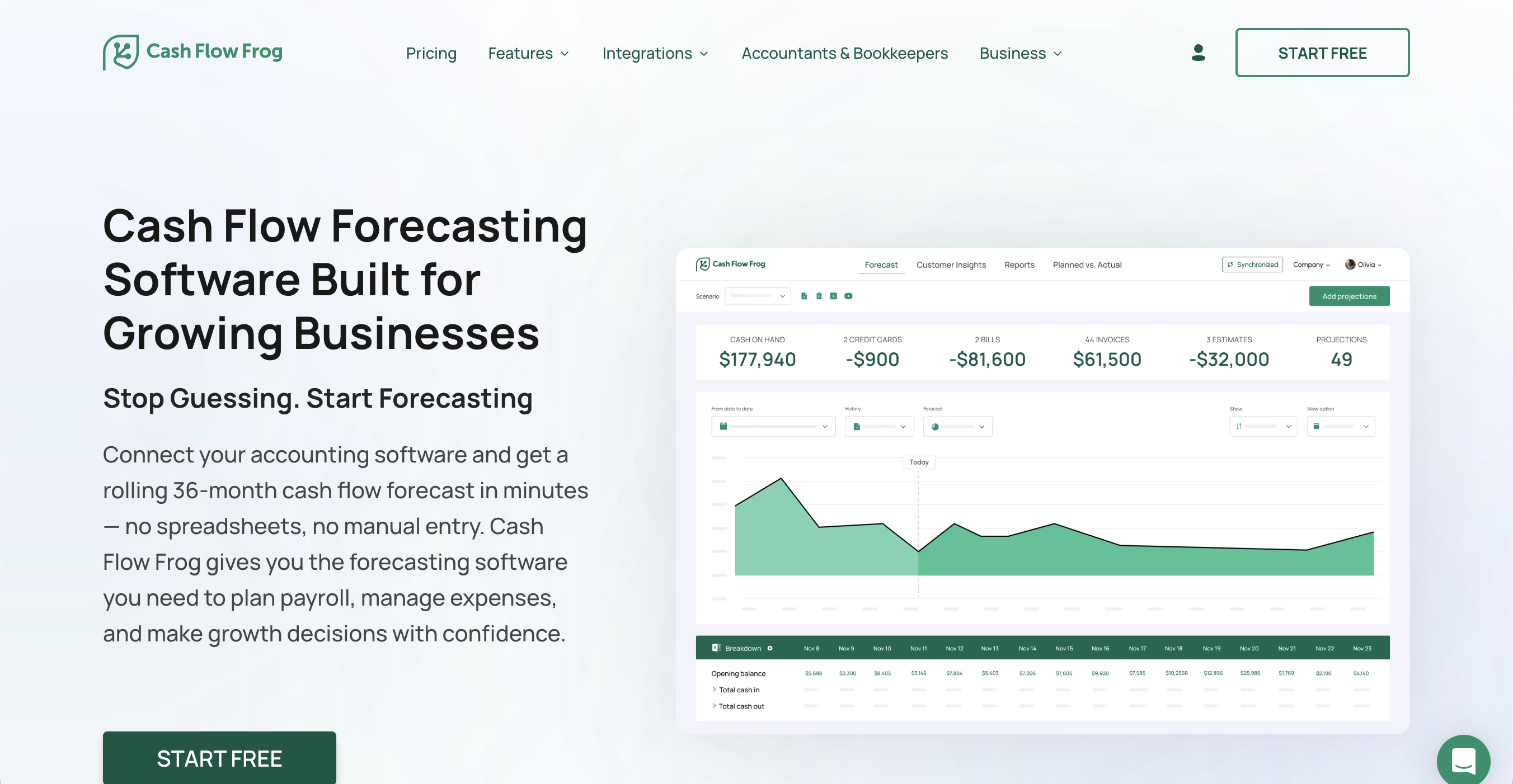
Cash Flow Frog is the most accessible entry point on this list. At $19/month, it connects to QuickBooks or Xero and generates visual cash flow forecasts in minutes, not hours. For solo ecommerce operators or early-stage sellers who need to stop guessing and start seeing where their cash is heading, it delivers exactly what it promises without complexity.
Cash Flow Frog's cash flow forecasting dashboard auto-generates rolling projections from your accounting data, with scenario toggles, AP/AR breakdowns, and a visual cash forecast timeline for quick decision-making.
📊 Core Ecommerce Cash Flow Metrics
⏰ Forecast Horizon: Up to 12 months forward
🔗 Ecommerce Integrations: Indirect via QBO/Xero (no native Shopify/Amazon)
🤖 AI Capabilities: Auto-generated forecasts from accounting data; basic scenario creation
💰 Capital Integration: ❌ None
⚡ Setup Time: Under 15 minutes
💡 Solutions Offered
Instant cash flow forecasting that auto-generates from your QuickBooks or Xero data within minutes of connecting
Scenario modeling to test revenue changes, expense increases, or delayed payments
Visual cash flow graphs and branded reports for sharing with partners or investors
AP/AR tracking with customer and payment details to enhance collections visibility
Multi-entity support for sellers managing multiple business units
🎯 Best For
Solopreneurs and early-stage ecommerce sellers (under €500K) who want affordable, instant cash flow visibility without a steep learning curve.
💬 Reviews
"I liked the easy set up. I thought it would be time-consuming, but it was a breeze. It does exactly what it says - in a few minutes, I had a forecast of my cash flow. The pricing is more than fair." Verified User Cash Flow Frog - G2 Verified Review
"Takes some effort to get it up to speed, but once it's implemented it's brilliant for cash flow management and realistic forecasting." Edward Cottle Xero App Store Review
💰 Pricing
$19/mo to $49/mo
🏆 5. Fathom
✅ Why Did We Choose This Tool?
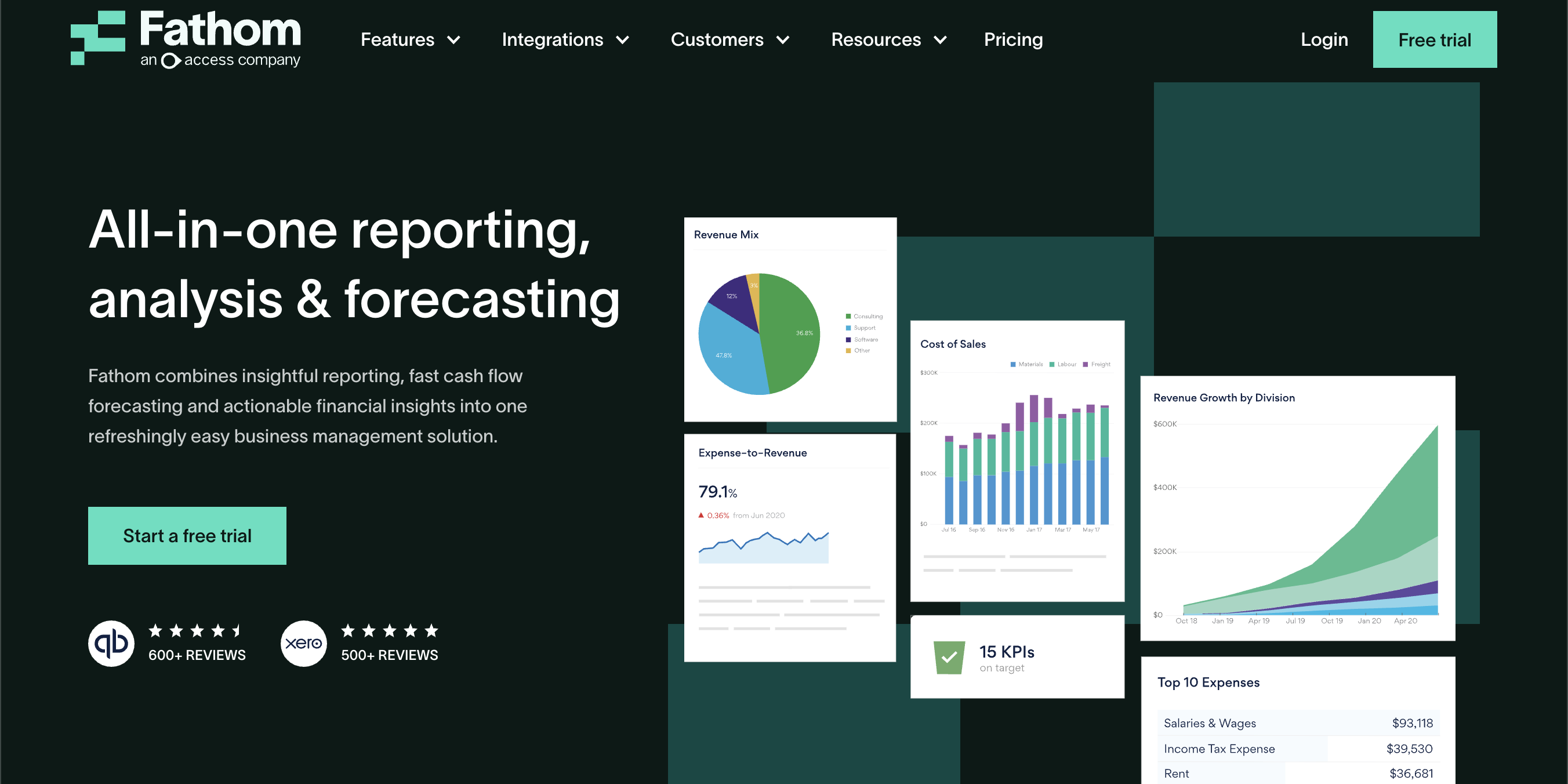
Fathom is the gold standard for three-way forecasting, integrating P&L, balance sheet, and cash flow into a unified financial model. For ecommerce CFOs and accountants who need to produce professional financial reports and forecasts that tie all three statements together, Fathom delivers a level of financial rigor that simpler cash flow tools can't match.
Fathom's cash flow forecasting and reporting dashboard combines three-way financial forecasting with visual KPI dashboards, revenue mix analysis, and expense tracking for accountants and ecommerce CFOs.
📊 Core Ecommerce Cash Flow Metrics
⏰ Forecast Horizon: Multi-year forecasting with rolling reforecasting capability
🔗 Ecommerce Integrations: Indirect via Xero/QBO/MYOB (no native Shopify/Amazon)
🤖 AI Capabilities: AI-powered report commentary; smart predictions for future periods
💰 Capital Integration: ❌ None
⚡ Setup Time: Under 2 hours with accounting software
💡 Solutions Offered
Three-way forecasting that synchronizes income statement, balance sheet, and cash flow projections
Multi-scenario modeling with driver-based assumptions you can toggle on and off without rebuilding from scratch
Visual KPI dashboards tracking financial and non-financial metrics with customizable charts
Consolidated reporting across multiple entities, ideal for multi-brand ecommerce operators
Professional branded reports ready for investors, boards, and lending institutions
🎯 Best For
Ecommerce CFOs, accountants, and finance teams (€2M to €50M) who need three-way integrated forecasting and professional financial reporting.
💬 Reviews
"I love Fathom's Forecast tool; it's very accurate and useful for making business decisions with confidence. The reports are great, filled with charts and graphs that are visually appealing. Using Fathom is way more efficient compared to building my own spreadsheets." Scott F., CEO Fathom - G2 Verified Review
"I don't think Fathom handles and forecasts accruals very well. It struggles with things like revenue recognition and prepaid expenses, basically anything that needs to be accrued over time." Dan G. Fathom - G2 Verified Review
💰 Pricing
$53/mo to $280/mo
🏆 6. Centime
✅ Why Did We Choose This Tool?
Centime stands out by combining AP and AR automation with built-in 13-week cash flow forecasting. For mid-market ecommerce businesses struggling with collections, supplier payments, and cash visibility simultaneously, Centime automates the operational side of cash management while projecting future cash positions, a practical combination that most pure forecasting tools lack.
📊 Core Ecommerce Cash Flow Metrics
⏰ Forecast Horizon: 13-week rolling cash flow forecasts
🔗 Ecommerce Integrations: Indirect via QBO/NetSuite/Sage Intacct (no native Shopify)
🤖 AI Capabilities: AI-assisted payment predictions and collections prioritization
💰 Capital Integration: ✅ Centime Credit, built-in business credit access
⚡ Setup Time: Approximately 1 month for full AP/AR + forecasting implementation
💡 Solutions Offered
AP automation that captures invoices, routes approvals, and executes payments, reducing manual processing by up to 75%
AR automation with automated payment reminders, statements, and collections tracking to shrink DSO
13-week cash flow forecasting using actual AP/AR data for higher accuracy than manual projections
KPI dashboards for cash-related insights including DSO, DPO, and working capital trends
Centime Credit, streamlined access to working capital when forecasts reveal cash shortfalls
🎯 Best For
Mid-market ecommerce operations (€2M to €30M) running on QuickBooks or NetSuite who need AP/AR automation and cash flow forecasting in one platform.
💬 Reviews
"We went from a manual AR/AP process to fully automated through Centime in very little time. We've cut the time of outstanding invoices down dramatically. The support team has also been very attentive to our needs." Lowry C., Director Centime - G2 Verified Review
"Predictions are not always accurate and cannot change history." Verified User in Accounting Centime - G2 Verified Review
💰 Pricing
$50/mo to $500/mo
🏆 7. Drivetrain
✅ Why Did We Choose This Tool?
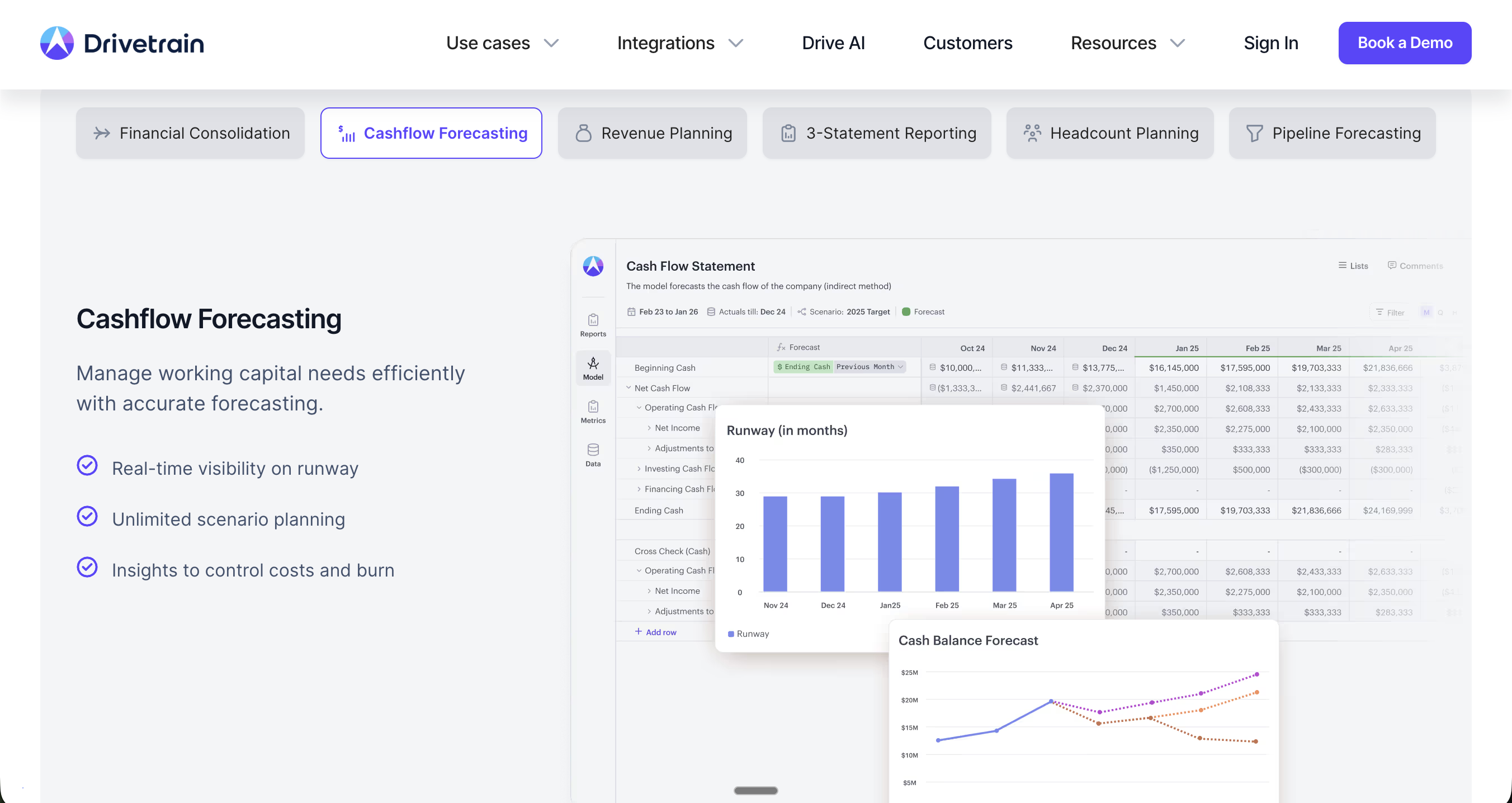
Drivetrain is built for finance teams that need AI-powered financial modeling across multiple data sources. For B2B-heavy ecommerce businesses with complex revenue models, subscription + wholesale + marketplace, Drivetrain's driver-based planning engine connects CRM, ERP, and billing data into unified financial forecasts that capture cash flow nuances traditional tools miss.
Drivetrain's cashflow forecasting dashboard delivers real-time visibility on runway, cash balance projections, and multi-scenario cash flow statements powered by driver-based financial modeling across 200+ data sources.
🔗 Ecommerce Integrations: API connections to 200+ data sources including Shopify, Stripe, and HubSpot
🤖 AI Capabilities: AI-powered variance analysis, automated forecasting, and natural language queries
💰 Capital Integration: ❌ None
⚡ Setup Time: 2 to 4 weeks for full implementation
💡 Solutions Offered
Driver-based financial modeling that connects operational metrics (orders, AOV, churn) directly to cash flow projections
Multi-source data integration pulling from Shopify, Stripe, QuickBooks, HubSpot, and 200+ sources
AI variance analysis that automatically identifies why actuals diverged from forecasts
Scenario planning with unlimited what-if models for testing strategic decisions
Collaborative planning with role-based access for finance, marketing, and operations teams
🎯 Best For
B2B-heavy ecommerce and hybrid DTC/wholesale brands (€5M to €100M) with complex, multi-channel revenue models requiring sophisticated financial modeling.
💬 Reviews
"Drivetrain's ability to pull data from multiple sources and create unified models is impressive. The driver-based approach makes our forecasts much more dynamic than static spreadsheets." Verified User Drivetrain - G2 Verified Review
"Implementation took longer than expected and requires a finance team member to maintain. Not ideal for lean teams without dedicated FP&A resources." Verified User Drivetrain - G2 Verified Review
💰 Pricing
$400/mo to Custom
🏆 8. Mosaic
✅ Why Did We Choose This Tool?
Mosaic positions itself as a strategic finance platform for startups and mid-market companies, offering real-time financial dashboards, automated reporting, and scenario modeling. For VC-backed ecommerce brands preparing for fundraising rounds, Mosaic delivers the investor-ready financial visibility that generic tools can't, including real-time burn rate, runway, and departmental budget tracking.
📊 Core Ecommerce Cash Flow Metrics
⏰ Forecast Horizon: Real-time with multi-year projections
🤖 AI Capabilities: AI-powered metric analysis and automated financial reporting
💰 Capital Integration: ❌ None
⚡ Setup Time: 2 to 4 weeks
💡 Solutions Offered
Real-time financial dashboards with automated metric tracking across revenue, expenses, and cash
Departmental budgeting that breaks cash outflows by team (marketing, ops, product) for accountability
Investor-ready reporting with one-click board packs and fundraising-specific financial views
Burn rate and runway analysis updated in real-time as transactions flow through
Scenario modeling to test hiring plans, expansion costs, or market entry strategies against cash impact
🎯 Best For
VC-backed ecommerce startups and mid-market brands (€3M to €50M) needing strategic finance dashboards and investor-ready cash flow reporting.
💬 Reviews
"Mosaic gives us the real-time financial visibility our board demands. The automated dashboards save our finance team hours every month-end compared to building everything in Excel." Verified User Mosaic - G2 Verified Review
"Onboarding requires a dedicated finance resource and the platform can feel overwhelming for non-finance founders. Pricing isn't transparent until you talk to sales." Verified User Mosaic - G2 Verified Review
💰 Pricing
Custom pricing (contact sales)
🏆 9. LivePlan
✅ Why Did We Choose This Tool?
LivePlan is the most accessible business planning tool that includes a built-in cash flow forecasting module. For early-stage ecommerce founders who need to create investor-ready business plans with financial projections, LivePlan provides structured templates and guided workflows that turn blank-page anxiety into a clear financial roadmap, including cash flow forecasts.
📊 Core Ecommerce Cash Flow Metrics
⏰ Forecast Horizon: Up to 5 years (designed for business plan projections)
🔗 Ecommerce Integrations: QBO and Xero for actuals syncing; no native Shopify/Amazon
🤖 AI Capabilities: AI-assisted financial forecasting prompts and plan generation
💰 Capital Integration: ❌ None (designed to support loan/investor applications)
⚡ Setup Time: 1 to 3 hours with guided templates
💡 Solutions Offered
Guided business plan builder with financial projection templates for revenue, expenses, and cash flow
Cash flow forecasting module that auto-generates monthly cash projections based on your plan assumptions
Actuals vs. forecast dashboard syncing with QuickBooks to compare projections against real performance
Milestone tracking for monitoring key business objectives alongside financial health
Pitch-ready financial exports formatted for bank loan applications and investor decks
🎯 Best For
Early-stage ecommerce founders (pre-revenue to €1M) building business plans for banks, investors, or SBA loan applications.
💬 Reviews
"LivePlan makes creating a business plan incredibly straightforward. The financial forecasting templates are perfect for someone who isn't a finance expert but needs professional-looking projections." Verified User LivePlan - G2 Verified Review
"It's great for planning, but the cash flow module is quite basic compared to dedicated forecasting tools. Once you're past the startup phase, you'll likely outgrow it." Verified User LivePlan - G2 Verified Review
💰 Pricing
$20/mo to $40/mo
🏆 10. Google Sheets / Excel
✅ Why Did We Choose This Tool?
Google Sheets and Excel remain the most widely used cash flow "tools" in ecommerce, and for good reason. They're free (or nearly free), fully customizable, and require zero vendor lock-in. For bootstrapped sellers under €500K, a well-built 13-week cash flow template in Google Sheets is genuinely sufficient, as long as you're willing to invest the manual time to keep it updated.
📊 Core Ecommerce Cash Flow Metrics
⏰ Forecast Horizon: Unlimited (limited only by your patience for manual updates)
⚡ Setup Time: 2 to 8 hours to build a proper template from scratch
💡 Solutions Offered
Full customization, build exactly the cash flow model your business needs with no feature limitations
Zero recurring cost with Google Sheets (or minimal with Microsoft 365)
Template availability, dozens of free ecommerce cash flow templates available to customize
Collaboration via Google Sheets' real-time sharing for team input
No vendor dependency, your data stays in your control with zero lock-in risk
🎯 Best For
Bootstrapped ecommerce sellers (under €500K) who want total control over their cash flow model and are willing to invest 10 to 15 hours/week in manual updates.
💬 Reviews
"We were profitable on paper but couldn't fund our next inventory order. Nobody told us our cash conversion cycle was 58 days. I finally built a spreadsheet to track it, but it took hours every week to maintain." u/ecomcfo_throwaway, r/ecommerce Reddit Thread
"Google Sheets works fine until you're juggling Shopify, Amazon, and wholesale. Then you spend more time updating the spreadsheet than actually making decisions." u/dtcfounder, r/shopify Reddit Thread
💰 Pricing
Free (Google Sheets) to $12.99/mo (Microsoft 365 Business Basic)
Q2. How Were These Cash Flow Forecasting Tools Evaluated and Ranked? [toc=Evaluation Criteria]
Most software review sites evaluate cash flow tools using generic criteria, UI quality, customer support responsiveness, and accounting integrations. That approach works for general-purpose businesses, but it completely misses what matters for ecommerce operators: payout cycle awareness, inventory-cash linkage, ad spend impact modeling, and cross-functional reasoning across marketing, finance, and operations.
⚙️ Our Ecommerce-Weighted Evaluation Criteria
We designed five criteria that reflect the real operational challenges ecommerce founders face when forecasting cash flow, not software feature checklists, but business outcome drivers. Each criterion was weighted based on its relative impact on cash flow accuracy for online sellers.
Ecommerce-Weighted Evaluation Criteria
Criterion
Weight
What It Measures
Ecommerce Integration Depth
25%
Native connections to Shopify, Amazon, Stripe, PayPal, and multi-channel sync capability
Forecasting Accuracy & Scenario Planning
25%
What-if modeling, seasonal spike forecasting, three-way forecasting support
Inventory-Cash Cycle Visibility
20%
DIO/DSO/DPO modeling, supplier term tracking, inventory velocity linked to cash runway
Clear pricing tiers, total cost of ownership, stage-appropriate plans without hidden fees
⭐ Star Rating Assignments
Each tool was scored across all five criteria on a 0 to 100 scale. Star ratings were then assigned based on the aggregate score. The scale: ⭐ = 0 to 20 | ⭐⭐ = 21 to 40 | ⭐⭐⭐ = 41 to 60 | ⭐⭐⭐⭐ = 61 to 80 | ⭐⭐⭐⭐⭐ = 81 to 100.
Tool Star Ratings
Tool
Star Rating
Luca AI
⭐⭐⭐⭐⭐
Float
⭐⭐⭐⭐
Inventory Planner by Sage
⭐⭐⭐⭐
Cash Flow Frog
⭐⭐⭐⭐
Fathom
⭐⭐⭐
Centime
⭐⭐⭐
Drivetrain
⭐⭐⭐
Mosaic
⭐⭐⭐
LivePlan
⭐⭐⭐
Google Sheets / Excel
⭐⭐
🏆 Why Luca AI Scored ⭐⭐⭐⭐⭐
Luca AI is the only tool on this list that scored in the top tier across all five criteria. It offers native ecommerce platform integration with Shopify, Amazon, and Stripe, not indirect accounting-software passthrough. Its scenario planning operates cross-functionally, connecting ad spend decisions to inventory requirements to cash position in a single query. Inventory-cash cycle visibility is built into the reasoning layer, not bolted on as a secondary report. Setup takes 10 minutes with no-code configuration, and pricing is flat-rate with no per-seat escalation. Most critically, Luca AI is the only platform where intelligence and capital are unified. When the forecast reveals a cash gap, embedded funding bridges it instantly without a separate application process.
Amazon runs a cash conversion cycle of approximately -28 to -40 days. That means Amazon collects customer payments immediately, holds minimal inventory through just-in-time logistics, and pays suppliers up to 90 days later. The result: every sale generates working capital instead of consuming it. Most ecommerce founders operate in the exact opposite reality, paying for inventory 60 to 90 days before revenue lands in their bank account.
⏰ The Ecommerce Cash Cycle: Click to Cash
The journey from ad click to cash-in-bank reveals why generic forecasting tools fall short. Here's what a typical DTC brand's cash timeline looks like:
The ecommerce cash cycle spans 15 to 45 days from ad spend deployment to net cash realization, with payment processor holds and return windows creating invisible gaps that generic forecasting tools miss entirely.
Day 0: Ad spend deployed on Meta/Google (cash out immediately)
Day 1 to 3: Customer acquisition and order placed
Day 2 to 5: Payment processor hold (Shopify Payments initiates payout next business day, but ACH adds 2 to 3 days to reach your bank)
Day 3 to 7: Fulfillment, picking, and shipping costs incurred
Day 14 to 30: Returns window opens (online return rates average 16.9 to 24.5% depending on category)
Day 15 to 45: Net cash realization after refunds, chargebacks, and processing fees
The Cash Conversion Formula
The formula that governs this: DIO + DSO - DPO = Cash Conversion Cycle. For most ecommerce sellers, DIO is high (inventory purchased weeks or months before sale), DSO is moderate (payment processor delays), and DPO is low (suppliers demand payment upfront or on short terms). The result is a positive CCC that traps cash and constrains growth.
⚠️ Why Spreadsheets Break Down
Founders consistently describe the same breaking point.
"Ecommerce revenue looks great on paper but all my cash is tied up in inventory." r/ecommerce Reddit Thread
"My primary challenge lies in determining what to purchase, the timing of those purchases, and the appropriate quantities. With my suppliers having long lead times and the products being costly, each order becomes a crucial decision." r/ecommerce Reddit Thread
Where Manual Tracking Falls Apart
Spreadsheets are where most founders start, and where accuracy goes to die. Manual data entry introduces 15 to 20% variance. Updates become inconsistent within 2 to 3 weeks. There's no real-time sync with Shopify, Stripe, or Amazon. Scenario modeling requires rebuilding entire sheets. And multi-channel reconciliation across DTC, marketplace, and wholesale becomes a full-time job consuming 10 to 15 hours per week.
💡 The Architecture Decision Most Brands Make by Accident
The founders who understand and deliberately control their cash conversion cycle consistently outpace those who don't. This isn't a strategy reserved for Amazon-scale enterprises with treasury departments. It's a data architecture decision that most €1M to €20M ecommerce brands make passively by defaulting to spreadsheets and disconnected tools.
Luca AI gives founders the same cash conversion visibility that Amazon's treasury team operates with, without the treasury team. By synthesizing Shopify order data, Stripe payout timing, Xero payables, and inventory velocity into one reasoning layer, Luca transforms the CCC from a metric you calculate quarterly into a real-time signal you act on daily. And when that signal reveals a cash gap, embedded capital bridges it instantly, no separate application, no 6-week wait.
Q4. What Features, Integrations, and Pricing Should You Prioritize in an Ecommerce Cash Flow Tool? [toc=Features and Pricing Guide]
Choosing a cash flow tool is a data architecture commitment. The most common mistake founders make is selecting based on price or accounting software compatibility alone, overlooking ecommerce-specific requirements like payout cycle tracking, inventory lead time modeling, and the ability to connect ad spend decisions to their cash impact.
🔗 Must-Have Integration Categories
Any tool you evaluate should connect natively or via reliable sync to four integration layers:
Ecommerce platforms: Shopify, WooCommerce, BigCommerce, Amazon Seller Central
Payment processors: Stripe, PayPal, Shopify Payments (payout timing data is critical)
Financing sources: Shopify Capital, Wayflyer, Clearco, tools that understand your capital stack can model repayment impact on cash flow
✅ 7 Feature Criteria That Matter for Ecommerce
Ecommerce platform integration depth, Does it pull order-level data, or only accounting summaries?
Scenario planning & what-if modeling, Can you test "What if Meta CPMs rise 40% in Q4?" against cash position?
AI/ML forecasting vs. manual rules, Algorithmic predictions improve with historical data; rule-based models require constant manual tuning
Three-way forecasting capability, P&L + balance sheet + cash flow integration matters for fundraising and lending
Real-time sync vs. batch updates, Daily or real-time data keeps forecasts accurate; weekly batch updates create blind spots
Collaboration for finance + ops teams, Role-based access prevents data silos between your CFO and marketing lead
Capital integration, Can the tool bridge the gap it identifies, or does it just report it?
💰 Pricing by Business Stage
Recommended Tools by Business Stage
Business Stage
Revenue Range
Recommended Tools
Monthly Cost
Bootstrapped / Starter
Under €500K
Google Sheets, Cash Flow Frog
Free to $49/mo
Scaling
€500K to €5M
Float, Fathom, Inventory Planner
$53/mo to $499/mo
Growth / Enterprise
€5M+
Luca AI, Mosaic, Drivetrain
€299/mo to Custom
⚠️ Hidden Cost Warning
Free tools like Google Sheets cost 10 to 15 hours/week in manual maintenance. Per-seat pricing models (common in enterprise tools) punish growing teams. Always calculate total cost of ownership, not just subscription price.
📊 Visual Comparison Matrix: 10 Tools x 7 Criteria
10 Tools x 7 Feature Criteria Comparison
Tool
Ecommerce Integration
Scenario Planning
AI/ML Forecasting
Three-Way Forecasting
Real-Time Sync
Collaboration
Capital Integration
Luca AI
✅
✅
✅
✅
✅
✅
✅
Float
Partial
✅
❌
❌
✅
✅
❌
Inventory Planner
✅
Partial
✅
❌
✅
Partial
❌
Cash Flow Frog
Partial
✅
Partial
❌
✅
❌
❌
Fathom
❌
✅
Partial
✅
✅
✅
❌
Centime
❌
Partial
✅
❌
✅
✅
✅
Drivetrain
Partial
✅
✅
Partial
✅
✅
❌
Mosaic
❌
✅
✅
Partial
✅
✅
❌
LivePlan
❌
Partial
Partial
❌
Partial
Partial
❌
Google Sheets
❌
❌
❌
❌
❌
✅
❌
Luca AI is the only platform that scores ✅ across all seven criteria, combining ecommerce-native integration, cross-functional scenario modeling, AI-driven forecasting, proactive alerts, team collaboration, and embedded capital in one system. The real question isn't which tool has the most features. It's which system can reason about your cash flow the way a CFO would, and then act on it.
Q5. How Do You Implement Cash Flow Forecasting? Case Studies, Templates, and Step-by-Step Guide [toc=Implementation Guide]
Theory is worthless without execution. Below are three real-world ecommerce scenarios that illustrate how different business stages approach cash flow forecasting, followed by a step-by-step implementation guide and a 13-week template framework you can deploy this week.
📋 Case Study 1: Seasonal DTC Brand Surviving Q4
A €2M European skincare brand needed €80K in inventory deposits 60 days before Black Friday while simultaneously scaling Meta campaigns. With Q4 CPMs spiking over 60% and Shopify Payments taking 2 to 3 business days to settle, their spreadsheet couldn't model the cash gap between ad spend deployment and revenue collection. Using a dedicated forecasting tool, they mapped the exact 18-day window where cash would dip below their safety threshold and secured bridge financing before the crunch hit.
📋 Case Study 2: Multi-Channel Seller Consolidating Cash Visibility
A €5M brand selling across Shopify, Amazon, and wholesale operated on three different payout schedules: Shopify (2 to 3 days), Amazon (biweekly), and wholesale (net-30). Each channel's cash was tracked in separate spreadsheets. As one Reddit user described a nearly identical situation: "A brand can show positive profitability on paper while its cash flow is broken. Cash is tied up in inventory." By consolidating all channels into a single forecasting platform, they gained unified visibility into when cash actually lands, not when revenue is recognized.
📋 Case Study 3: Pre-Fundraise Brand Building Investor Confidence
A €8M DTC brand preparing for a Series A needed scenario models showing how different growth trajectories would impact cash runway over 12 months. Investors wanted to see three-way forecasts (P&L, balance sheet, and cash flow) with sensitivity analysis on key variables like CAC, return rates, and supplier terms. A strategic finance tool replaced their patchwork of Excel models with automated, audit-ready projections.
⚙️ 7-Step Implementation Guide
Audit your data sources, Map every cash inflow and outflow: Shopify, Amazon, Stripe, PayPal, advertising platforms, supplier invoices, and payroll
Define your forecasting horizon, Weekly for operations (13-week rolling), monthly for planning, and quarterly for strategy
Select a tool based on business stage, Bootstrapped? Google Sheets. Scaling? Float or Cash Flow Frog. Growth-stage? Luca AI, Mosaic, or Drivetrain
Connect your data sources, Ecommerce platform, payment processors, and accounting software. Prioritize real-time sync over batch imports
Build a baseline forecast using 6 to 12 months of historical data to capture seasonality patterns
Run scenarios, Best-case, worst-case, seasonal spike, and promotional campaign models. Test "What if return rates hit 25% in Q4?" before it happens
Establish a review cadence, Weekly check-ins to update actuals; monthly deep dives to adjust assumptions and recalibrate
📊 13-Week Template: Key Row Categories
If you're building a template from scratch, structure it with these ecommerce-specific rows:
Shopify payouts (by channel/store)
Amazon settlement deposits (biweekly)
Wholesale receivables (net-30/60 terms)
Supplier payments with lead time offsets
Ad spend by platform (Meta, Google, and TikTok)
Payroll and contractor payments
Inventory deposits and pre-orders
Returns/refund reserves (% of trailing revenue)
Minimum cash buffer threshold
🚀 The Ecommerce Cash Flow Maturity Model
Most brands progress through four stages, and many stall at Level 1 or 2 far longer than they should:
Most ecommerce brands stall at Level 1 or 2. The leap from Connected to Predictive plus Capital-Enabled replaces 3 to 4 disconnected tools with one system that forecasts, alerts, and funds growth instantly.
Ecommerce Cash Flow Maturity Model
Level
Stage
Tool Example
Capability
1
Reactive
Google Sheets
Manual tracking, backward-looking, breaks under complexity
AI-driven forecasting, proactive alerts, embedded capital
The leap from Level 3 to Level 4 is the most significant. Before unified intelligence: 3 to 4 disconnected tools, manual reconciliation, and delayed decisions. After Luca AI: one system that forecasts cash, surfaces risks before they hit your P&L, and funds growth opportunities instantly, without a separate application or a 6-week wait.
Q6. What Are the Costliest Cash Flow Forecasting Mistakes Ecommerce Founders Make? [toc=Costliest Forecasting Mistakes]
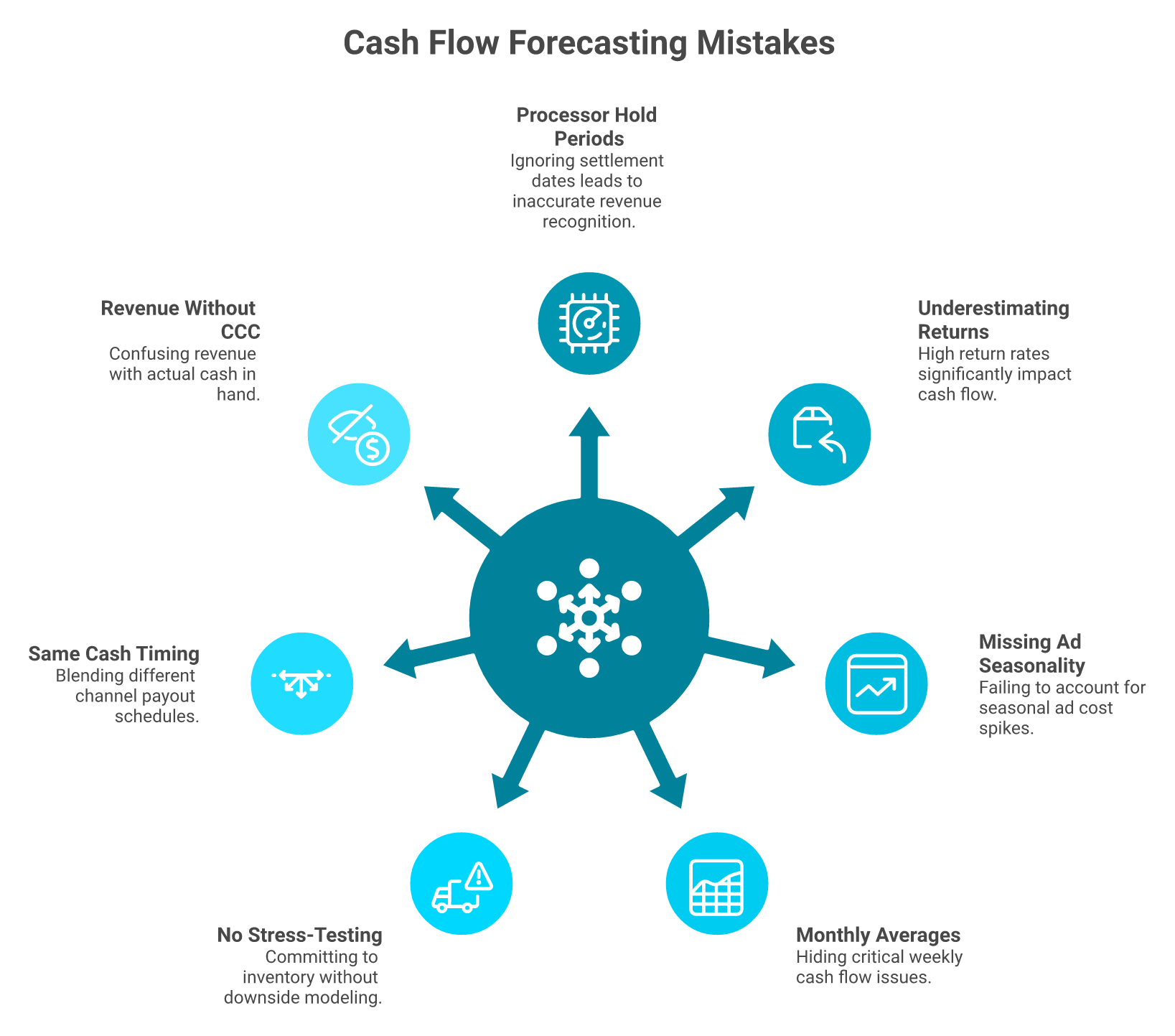
Most ecommerce cash flow forecasts fail not from bad math, but from missing variables that generic tools don't capture. These seven mistakes are responsible for the majority of preventable cash crises in scaling online businesses.
All seven costliest forecasting mistakes trace back to one root cause: disconnected data across marketing, finance, and inventory systems. Eliminating the architectural disconnect solves all seven simultaneously.
⚠️ The 7 Mistakes That Drain Cash
Ignoring payment processor hold periods, Shopify Payments settles in 2 to 3 business days; Amazon holds funds for up to 14 days. Most forecasts record revenue on order date, creating phantom cash that doesn't exist yet
Underestimating return and refund rates, Online return rates average 16.9% overall but spike to 24.5% in categories like apparel. Forecasting at 5 to 8% when reality hits 20%+ creates a massive cash gap
Missing ad spend seasonality, Q4 Meta CPMs spike over 60% due to holiday competition, with some ecommerce niches seeing 30 to 50% CPC increases. Forecasts using annual-average ad costs dramatically understate Q4 cash outflows
Using monthly averages instead of weekly granularity, Cash flow crises happen within weeks, not months. A €50K monthly forecast might hide a €20K shortfall in week 2 that causes missed payroll or stockouts
No stress-testing before major inventory purchases, Committing €100K to a supplier without modeling "What if this campaign underperforms by 30%?" is the single most common cash trap for scaling brands
Treating all revenue channels as having the same cash timing, Shopify (2 to 3 days), Amazon (biweekly), and wholesale (net-30+). Blending these into a single "revenue" line creates dangerous visibility gaps
Forecasting revenue without modeling the cash conversion cycle, Revenue does not equal cash. As one Shopify seller put it: "I found myself anxious about payroll, advertising costs, and stock levels, questioning what was amiss. It became clear that the revenue reported by Shopify and the cash in hand are worlds apart"
✅ How Unified Intelligence Eliminates These Mistakes
Every costly forecasting mistake traces back to disconnected data. Unified intelligence connects marketing, finance, inventory, and payment systems into one reasoning layer that forecasts, alerts, and funds from a single interface.
✅ Payout cycle awareness built into every forecast, Shopify, Stripe, and Amazon settlement timing modeled automatically
✅ Real-time return rate tracking connected to cash projections, not static assumptions
✅ Ad spend scenario modeling that connects CPM fluctuations directly to cash runway impact
✅ Daily granularity across all channels, not monthly averages that hide intra-month crises
✅ Cross-channel differentiation that treats each revenue source's cash timing independently
"The delay in payment isn't the primary concern here; the real issue is likely your lack of insight into when cash flow shortages might occur before they actually happen." u/Alternative-Peach644, r/shopify Reddit Thread
The shift from fragmented forecasting to unified intelligence doesn't just fix individual mistakes. It eliminates the architectural disconnect that causes all seven.
What is ecommerce cash flow forecasting and how does it differ from general forecasting?
Ecommerce cash flow forecasting projects the timing and amount of cash moving in and out of an online business over a defined period. It differs from general business forecasting because ecommerce introduces unique timing variables: payment processor hold periods (2 to 14 days), inventory pre-purchase cycles (30 to 90 days before sale), platform-specific payout schedules, advertising spend that precedes revenue by days or weeks, and return rates averaging 16.9 to 24.5%. General forecasting tools miss these ecommerce-specific cash timing gaps entirely.
How far ahead should an ecommerce business forecast cash flow?
Use a 13-week rolling forecast for operational cash management. This covers one full quarter with weekly granularity, allowing you to spot shortfalls 2 to 3 months before they hit. Layer a 6 to 12 month strategic forecast on top for inventory planning, fundraising preparation, and seasonal budgeting. During peak periods like Q4/BFCM, increase to daily granularity for the 4 to 6 weeks surrounding major promotional events.
What is the best free cash flow forecasting tool for Shopify sellers?
For sellers under €500K revenue, a well-structured Google Sheets template with ecommerce-specific rows (Shopify payouts, ad spend, inventory deposits, and returns reserves) is genuinely sufficient. Shopify's built-in analytics provide basic revenue visibility but lack forward-looking cash projections. Once you cross €500K and multi-channel complexity increases, graduating to a dedicated tool like Cash Flow Frog ($19/mo) or Float ($59/mo) saves 10 to 15 hours/week of manual spreadsheet maintenance.
What is three-way forecasting and do ecommerce businesses need it?
Three-way forecasting integrates three financial statements, Profit & Loss, Balance Sheet, and Cash Flow, into a single, interconnected model. When one assumption changes (e.g., higher inventory purchases), all three statements update automatically. Ecommerce businesses need three-way forecasting primarily when preparing for fundraising, applying for bank loans, or onboarding a CFO who requires full financial rigor. For day-to-day cash management below €5M revenue, a direct cash flow forecast is typically sufficient.
How do payment processor delays affect ecommerce cash flow forecasts?
Payment processor delays create a gap between when you recognize revenue and when cash actually arrives in your bank account. The typical delays:
Shopify Payments: 2 to 3 business days after order
Stripe: 2 business days (standard) to 7 days (new accounts)
PayPal: Instant to 3 business days depending on account status
Amazon: Biweekly settlements (every 14 days)
Forecasts that record revenue on the order date instead of the settlement date consistently overstate available cash, sometimes by 10 to 20% at any given moment.
Can AI accurately predict ecommerce cash flow?
AI excels at pattern recognition, identifying seasonal trends, correlating ad spend with revenue timing, and detecting inventory velocity changes that affect cash runway. However, accuracy depends entirely on data quality and integration depth. AI models trained only on accounting data miss marketing causality; models connected only to Shopify miss payment processor timing. Luca AI combines AI forecasting with real-time data sync across Shopify, Stripe, Meta, Xero, and 20+ sources, giving the algorithm the full cross-functional picture needed for reliable predictions.
How often should I update my cash flow forecast?
Weekly at minimum for active ecommerce businesses. Update actuals every Monday, compare against projections, and adjust assumptions for the rolling 13-week window. During peak seasons (Q4, BFCM, and major sales events), shift to daily updates. CPMs can spike overnight, return rates fluctuate dramatically, and inventory decisions happen in real-time. Tools with automatic accounting sync (Float, Fathom, and Luca AI) reduce update time from hours to minutes by pulling live data instead of requiring manual entry.
FAQ's
Why do ecommerce businesses need a specialized cash flow forecasting tool instead of generic accounting software?
We see this question constantly from founders who assume their Xero or QuickBooks setup covers forecasting. The reality is that ecommerce introduces cash timing variables that generic accounting tools were never designed to handle.
Payout processor delays: Shopify Payments settles in 2 to 3 business days, Stripe takes 2 to 7 days, and Amazon holds funds for up to 14 days. Generic tools record revenue on the order date, not when cash actually arrives.
Inventory pre-purchase cycles: Most DTC brands pay suppliers 60 to 90 days before a product sells, creating a cash gap that accounting software doesn't model.
Return rates: Online returns average 16.9% to 24.5% depending on category, far higher than the 8 to 10% that general tools assume.
Ad spend timing: Meta and Google charge immediately, but revenue from those campaigns arrives days or weeks later through staggered processor payouts.
These timing gaps mean your accounting software can show positive revenue while your bank account is empty. We built Luca AI's financial management layer specifically to model these ecommerce-specific cash dynamics in real time, connecting ad spend to payout timing to inventory cycles in one unified forecast.
How much does an ecommerce cash flow forecasting tool cost in 2026?
We analyzed pricing across all 10 tools in our ranking, and costs vary dramatically based on your business stage and complexity. Here is how we break it down:
Bootstrapped sellers (under €500K): Google Sheets is free, and Cash Flow Frog starts at $19/mo. These work for single-channel operators who can invest the manual hours.
Scaling brands (€500K to €5M): Float ($59 to $329/mo), Fathom ($53 to $280/mo), and Inventory Planner ($249.99 to $499.99/mo) cover this range with varying degrees of automation and scenario planning.
Growth-stage and enterprise (€5M+): Drivetrain starts at $400/mo, Mosaic uses custom pricing, and Luca AI starts at €299/mo with flat-rate plans that include embedded capital access.
One hidden cost most founders miss: free tools like Google Sheets consume 10 to 15 hours per week in manual maintenance. Per-seat pricing models in enterprise tools also punish growing teams. We always recommend calculating total cost of ownership, not just the subscription price, before committing to any platform.
What is a 13-week cash flow forecast and how do ecommerce sellers build one?
A 13-week cash flow forecast is a rolling, week-by-week projection of every cash inflow and outflow for the next quarter. We recommend it as the operational backbone for any ecommerce business above €200K in revenue because it provides the weekly granularity needed to catch cash shortfalls before they become crises.
To build one for your ecommerce business, we recommend structuring these row categories:
Shopify payouts by channel or store
Amazon settlement deposits (biweekly)
Wholesale receivables (net-30/60 terms)
Supplier payments with lead time offsets
Ad spend by platform (Meta, Google, and TikTok)
Payroll and contractor payments
Inventory deposits and pre-orders
Returns and refund reserves as a percentage of trailing revenue
Minimum cash buffer threshold
For bootstrapped sellers, a Google Sheets template works. For scaling brands, we recommend connecting your Shopify, Stripe, and accounting data into a tool that auto-populates actuals. Our cash flow forecasting guide walks through the full implementation process, including scenario modeling and review cadence best practices.
Can AI accurately predict ecommerce cash flow?
Yes, but accuracy depends entirely on data quality and integration depth. We have seen AI forecasting deliver strong results when it has access to the full cross-functional picture, and produce dangerously misleading projections when it operates on partial data.
Here is what determines AI forecasting accuracy:
Data breadth matters: AI models trained only on accounting data miss marketing causality. Models connected only to Shopify miss payment processor timing. The algorithm needs commerce, marketing, finance, and operations data together.
Pattern recognition is the strength: AI excels at identifying seasonal trends, correlating ad spend with revenue timing, and detecting inventory velocity changes that affect cash runway.
Historical depth drives reliability: We recommend at least 6 to 12 months of historical data before trusting AI-generated scenarios.
The key differentiator is integration architecture. Most tools connect to one or two data sources. Luca AI connects to Shopify, Stripe, Meta, Xero, and 20+ sources simultaneously, giving the AI the full context it needs to generate reliable, cross-functional cash flow predictions rather than siloed guesswork.
What are the biggest cash flow forecasting mistakes ecommerce founders make?
We have identified seven forecasting mistakes that are responsible for the majority of preventable cash crises in scaling ecommerce businesses. They all trace back to one root cause: disconnected data.
Ignoring payment processor hold periods: Recording revenue on order date instead of settlement date creates phantom cash.
Underestimating return rates: Forecasting at 5 to 8% when ecommerce averages 16.9 to 24.5% creates massive cash gaps.
Missing Q4 ad spend spikes: Meta CPMs surge over 60% during the holiday season, but forecasts using annual averages dramatically understate Q4 cash outflows.
Using monthly averages instead of weekly granularity: Cash crises happen within weeks, not months.
No stress-testing before inventory purchases: Committing €100K to a supplier without modeling campaign underperformance is the most common cash trap.
Each of these failures stems from tools that cannot see across marketing, finance, and inventory simultaneously. We designed Luca AI's unified data layer specifically to eliminate these blind spots by connecting every data source into one cross-functional reasoning system that forecasts, alerts, and funds from a single interface.
Enjoyed the read? Join our team for a quick 15-minute chat — no pitch, just a real conversation on how we’re rethinking Ecommerce with AI - Luca
Loading Schedule...
Your AI Co-Founder is here.
Here’s why:
Shopify, Meta, Xero - one brain.
"Should I scale?" Answered with real data.
Growth capital. No applications. One click.
Thank you! Your submission has been received! Please book a time slot for the Meeting
Oops! Something went wrong while submitting the form.