Wayflyer Pricing & Reviews: Honest Breakdown of Fees, Pros, Cons & Top Competitors
13
mins read
TL;DR
Wayflyer charges a 2–8% fixed fee on funding from $5K–$20M with no interest or equity dilution. Trustpilot rating sits at 4.7/5 from 500+ reviews, but negative reviews flag UCC filings and underwriting inconsistencies. Effective APR can reach 25–70% when annualized, far exceeding what the flat fee percentage suggests. Competitors like Clearco, Shopify Capital, and Luca AI offer alternative fee structures and intelligence layers. Eligibility requires just 6 months in business and $10–20K monthly revenue with no personal credit score check.
Q1: What Is Wayflyer? Business Model, Products and Who It Serves [toc=Business Model and Products]
Wayflyer is a revenue-based financing (RBF) platform, not a SaaS product, that provides non-dilutive growth capital to ecommerce businesses. Founded in 2019 and headquartered in Dublin, the company has deployed over $3.5 billion across 6,000+ businesses, with individual funding offers ranging from $5,000 to $20 million.
How the Model Works
Instead of charging interest like a traditional lender, Wayflyer applies a single flat fee, typically 2 to 10% of the funded amount, to every advance. You repay that fixed total through automatic deductions from your daily sales or via scheduled payments. There are no monthly subscriptions, no equity stakes, and no recurring software fees. You only pay when you take capital.
Five Funding Products
Wayflyer offers five distinct mechanisms for deploying capital, each designed for a different growth scenario:
Wayflyer Funding Products Overview
Product
Repayment Model
Term
Best For
Revenue-Based Cash Advance
6 to 15% of daily sales
Flexible (scales with revenue)
Variable-revenue brands needing flexible payback
Term Loan
Fixed daily, weekly, or biweekly payments
6 to 24 months
Defined growth plans with predictable repayment
Rolling Finance
Sales-tied or fixed; multiple draw-downs
12-month revolving facility
Recurring inventory cycles and ongoing capital needs
Brands scaling proven ad channels without fund diversion
Where Wayflyer Operates
Wayflyer currently serves businesses in 11 countries: the United States, Canada, United Kingdom, Australia, Ireland, Spain, Netherlands, Belgium, Denmark, Germany, and Sweden. Notably absent: India, Southeast Asia, Latin America, and the broader APAC region.
Who Qualifies and Who Doesn't
Wayflyer serves DTC ecommerce brands, Amazon sellers, wholesale businesses, and retail brands operating on supported platforms. However, the exclusion list is not prominently disclosed in Wayflyer's marketing. Founders typically discover these during the application process:
❌ Dropshippers without physical inventory
❌ Pure service businesses (consulting, agencies, freelancers)
❌ SaaS and subscription-only companies
❌ Pure brick-and-mortar without an ecommerce presence
The eligibility threshold is $10,000+ in monthly sales, 6+ months in business, and physical product sales in a supported country.
Luca AI: A Different Capital Model
Luca AI serves the same ecommerce founder profile but removes the application bottleneck entirely. Capital is unlocked automatically based on real-time business performance data, with offers dynamically priced and sized to actual need, not a one-time risk snapshot. Disbursal happens same-day, and eligibility is continuous rather than binary.
Q2: How Much Does Wayflyer Actually Cost? Full Fee Breakdown, Factor Rates and Effective APR [toc=Pricing and Effective APR]
Wayflyer charges a single flat fee of 2 to 10% on the funded amount, which translates to a factor rate of 1.02 to 1.09. There are no origination fees, application fees, maintenance fees, or documentation charges. The flat fee is your only cost.
⚠️ The Headline 2% Is Rare
The 2% floor applies almost exclusively to large enterprises with $200M+ annual revenue and proven multi-round repayment history. For most approved businesses, the realistic median fee sits between 5 to 7%. Wayflyer reported an average fee of 4.2% in 2023, but that figure is weighted heavily by high-volume enterprise deals.
💰 Pricing Scenario Table
Wayflyer Pricing by Funding Amount
Funding Amount
Low Fee (3%)
Mid Fee (5%)
High Fee (7%)
Total Repayment (Low)
Total Repayment (Mid)
Total Repayment (High)
$10,000
$300
$500
$700
$10,300
$10,500
$10,700
$50,000
$1,500
$2,500
$3,500
$51,500
$52,500
$53,500
$100,000
$3,000
$5,000
$7,000
$103,000
$105,000
$107,000
$250,000
$7,500
$12,500
$17,500
$257,500
$262,500
$267,500
$500,000
$15,000
$25,000
$35,000
$515,000
$525,000
$535,000
$1,000,000
$30,000
$50,000
$70,000
$1,030,000
$1,050,000
$1,070,000
Effective APR: The Number Wayflyer Doesn't Show
The flat fee stays fixed regardless of how fast you repay, but the effective APR changes dramatically:
Effective APR by Repayment Period
Funding Amount
Fixed Fee
6-Month Repayment (APR)
12-Month (APR)
18-Month (APR)
24-Month (APR)
$100,000
5% ($5,000)
~10%
~5%
~3.3%
~2.5%
$100,000
7% ($7,000)
~14%
~7%
~4.7%
~3.5%
$500,000
4% ($20,000)
~8%
~4%
~2.7%
~2%
A $50K advance at 8% fee repaid in 90 days produces an effective APR of approximately 32.4%. The same 8% fee repaid over 12 months drops to roughly 8% APR. Shorter repayment dramatically inflates the annualized cost, even though the total dollar amount stays identical.
Wayflyer's 2-10% flat fee appears simple, but the effective APR hidden below the surface can reach 70%+ depending on how fast your store repays the advance.
💸 Three Worked Examples
$50K at 8% fee (revenue-based): Total repayment $54,000. At 10% daily revenue share on $150K/month revenue = ~$500/day, repaid in ~108 days. Effective APR: ~29.6%.
$200K at 5% fee (fixed daily debit): Total repayment $210,000. Fixed $1,167/day over 180 days. Effective APR: ~10%.
$500K at 7% fee (rolling finance, inventory): Total repayment $535,000. Repaid over 12 months. Effective APR: ~7%.
How Wayflyer Compares on Cost
Wayflyer Cost vs. Alternative Financing
Provider Type
Typical Cost
vs. Wayflyer
Traditional MCA (factor 1.25 to 1.40)
25 to 40% of advance
Wayflyer is 60 to 75% cheaper
Uncapped (1 to 2%/month)
12 to 24% annualized
Comparable on short terms; Wayflyer cheaper long-term
SBA Loans (7 to 10% APR)
7 to 10% APR
Wayflyer is 2 to 6x more expensive
Business Credit Cards
18 to 25% APR
Overlaps with Wayflyer on fast repayment
Tax note: Wayflyer's flat fee is typically deductible as a business expense (cost of capital), not interest. Consult your accountant for jurisdiction-specific guidance.
Luca AI's Pricing Approach
Luca AI's dynamic pricing model averages 5.2% total cost because capital is deployed in 10K to 50K tranches as opportunities arise, eliminating idle capital that accrues fees on unused funds. Each tranche is priced independently based on real-time business health, meaning your second draw can be cheaper than your first if performance improves.
Q3: How Does Wayflyer Repayment Actually Work Day-to-Day? [toc=Daily Repayment Mechanics]
It's your first Monday after accepting Wayflyer's $100K advance. Your Shopify store does $4,200 in sales, and $420 is automatically deducted before it hits your bank account (10% revenue share). By Friday, you've repaid $2,100. The math works. Then a slow week hits: $800/day, $80 deducted daily. The math still works, but the feeling changes when you watch cash dwindle while your inventory invoice is due Thursday.
Three Repayment Options
Wayflyer offers daily, weekly, and biweekly repayment depending on the product:
Daily (most common for Cash Advance): Automatic percentage of daily sales deducted from your payment processor
Weekly: Fixed payment debited each week, typical for Term Loans
Biweekly: Fixed payment debited every two weeks, also available for Term Loans
The revenue share percentage, typically 6 to 15% of daily sales, is set algorithmically by Wayflyer's underwriting model and is non-negotiable. As one verified reviewer put it:
"Wayflyer set my revenue share at 12% and would not negotiate it down. I asked for 8% (would mean longer repayment but better daily cash flow) and was told the percentage is algorithmically determined and non-negotiable." Verified User, Zogby Review
⚠️ Cash Flow Impact: Small Seller vs. Large Seller
Revenue Share Impact by Seller Size
Metric
$30K/Month Seller
$200K/Month Seller
Daily Sales (avg.)
~$1,000
~$6,667
10% Revenue Share
$100/day
$667/day
Days to Repay $105K
~1,050 days (~2.9 years)
~158 days (~5.3 months)
Cash Flow Severity
High: 10% of thin daily revenue
Manageable: rapid payoff
On days with $0 in sales, $0 is deducted. Repayment pauses, but the total owed doesn't decrease. This flexibility is the core advantage over term loans with fixed obligations regardless of revenue.
The Early Repayment Trap
Unlike traditional loans where early repayment saves interest, Wayflyer's fixed-fee model means you owe the same $105K whether you repay in 3 months or 12 months. Paying faster doesn't save money; it just increases your effective APR. A second reviewer captured the daily psychological reality:
"Wayflyer takes a fixed percentage of daily revenue. Sounds flexible until you realize the percentage applies to EVERY day without exception. On my Shopify bakery store doing $2,000/day, 12% means $240 daily going to Wayflyer. Every. Single. Day." Verified User, Zogby Review
This is the single most misunderstood aspect of Wayflyer's model and the primary source of regret in negative reviews.
How Luca AI Approaches Repayment Differently
Luca AI's repayment model is designed to minimize cash flow disruption: smaller, more frequent tranches (10K to 50K) mean lower daily deductions per advance, and each tranche's repayment timeline is modeled against your upcoming obligations, including inventory orders, payroll dates, and ad spend commitments, before you accept. You see the exact daily cash impact in advance, not after you've signed.
From hoping your cash flow survives repayment to knowing it will before you commit: that's the difference between static capital and dynamically-sized capital.
Q4: Who Qualifies for Wayflyer? Eligibility, Application Process and Exclusions [toc=Eligibility and Exclusions]
Wayflyer's eligibility criteria are straightforward on paper, but the rejection patterns reveal a more nuanced reality.
✅ Core Eligibility Requirements
Wayflyer Eligibility Criteria
Requirement
Details
Minimum Monthly Revenue
$10,000 (US); 20,000 EUR (select EU markets)
Time in Business
6 months (physical products or software); 2 years (other business types)
Personal Credit Score
Not required: approval based on business revenue and sales data
Ecommerce Platform
Shopify, Amazon, WooCommerce, BigCommerce, or Magento
Payment Processors
Stripe, PayPal, or Square (must connect via OAuth)
Connect ecommerce platform + payment processor via OAuth (~5 minutes)
Wayflyer's algorithm analyzes 6+ months of sales data, revenue patterns, and cash flow velocity
Receive a customized funding offer within 24 hours
Accept and receive funds same-day or next-day via bank transfer
Business verification follows standard KYC: government ID, business registration, and bank account verification. No tax returns, no financial statements, and no business plan required.
❌ Who Gets Excluded
Wayflyer's marketing emphasizes accessibility, but several business categories are excluded outright. Most founders discover these only during the application process:
Dropshippers without physical inventory
Pure service businesses (consulting, agencies, freelancers)
SaaS and subscription-only companies
Pure brick-and-mortar without ecommerce sales
⚠️ Common Rejection Scenarios from Real Users
Beyond the category exclusions, verified Trustpilot reviews reveal patterns that Wayflyer's website doesn't disclose:
"Really disappointing experience. I have used Wayflyer on a number of occasions to help with Q4 stock purchasing and working capital requirements only to be told we no longer fit their criteria. Given we have used them multiple years running with no issues, this was incredibly disappointing." Joshua Hannan Wayflyer Trustpilot Verified Review
"After being offered funding in writing with specific amounts, repayment terms, and confirmation that the deal was approved, Wayflyer abruptly reversed their decision at the last minute. This caused significant disruption to our operations and cash flow." Geoff Brand Wayflyer Trustpilot Verified Review
Common rejection triggers include: seasonal revenue with 3+ months below the minimum threshold, multi-store operators where underwriting can't interpret combined data, businesses with declining revenue trends (even if above minimum), and repeat customers suddenly denied after internal criteria changes without notice.
Luca AI's Continuous Eligibility
Luca AI's eligibility is continuous, not binary. Because the system monitors your business health in real time, funding availability adjusts dynamically with your performance. No surprise rejections after successful repayment cycles, no opaque criteria changes, and no exclusion of seasonally variable businesses whose off-months temporarily dip below static thresholds.
Wayflyer offers a free marketing analytics dashboard to all applicants, even those who don't get approved or take funding. It's a genuine standalone analytics tool, not a gated lead-gen hook. For ecommerce founders already evaluating paid analytics platforms, this bundled offering deserves serious consideration on its own merits.
What the Dashboard Actually Does
The platform connects to your ecommerce store (Shopify, Amazon) and ad accounts (Meta, Google, TikTok) to provide six core capabilities:
Cohort analysis: Group customers by acquisition date or channel, then track repeat purchase behavior and retention curves over time
CAC tracking by channel: Meta, Google, and TikTok spend mapped against conversion data to show true acquisition cost per channel
LTV tracking and ROAS trend analysis: Rolling averages and channel-level profitability showing whether your marketing is getting more or less efficient
Cash flow forecasting: Forward-looking projections based on revenue velocity and current sales trajectory
Unit economics: Contribution margin breakdown by product and channel after ad spend and fulfillment costs
Industry benchmarking: Anonymized comparison against similar-stage businesses in Wayflyer's portfolio of 6,000+ funded brands
💰 What It Detects and What It Misses
One verified reviewer credited the dashboard with preventing a $50K mistake:
"Wayflyer's dashboard showed me that my Q3 customer cohorts had 40% lower LTV than Q1 cohorts. I was about to scale Q3 ad spend aggressively. The data stopped me from throwing $50K at low-value customers." Verified User, Zogby Review
Limitations are equally important to note: The dashboard covers marketing and commerce data only. There is no accounting integration (Xero, QuickBooks), no operations data, no cross-functional reasoning, no proactive alerting, no simulation or scenario modeling, no root cause analysis, and no agentic reporting.
⚠️ Head-to-Head: Wayflyer vs. Paid Analytics Tools
Wayflyer Dashboard vs. Paid Analytics Tools
Dimension
Wayflyer Dashboard
Triple Whale ($100+/mo)
Lifetimely ($149+/mo)
Shopify Analytics (Free)
Data Sources
Shopify, Amazon, Meta, Google, TikTok
Shopify + 10+ ad platforms + pixel
Shopify + email platforms
Shopify only
Attribution Model
Platform-reported
Proprietary pixel + triple attribution
Platform-reported
Last-click
Cohort Depth
Acquisition date/channel
Acquisition + product + behavior
Acquisition + product
Basic monthly
LTV Accuracy
Moderate (commerce data)
High (pixel-enhanced)
High (Shopify-native)
Low (surface-level)
Proactive Insights
❌ None
❌ Limited (Moby AI has bugs)
❌ None
❌ None
Scenario Modeling
❌ None
❌ None
❌ None
❌ None
Benchmarking
✅ 6,000+ brand pool
❌ None
❌ None
❌ None
Cost
Free
$100 to $400+/mo
$149+/mo
Free
Wayflyer's dashboard is competitive with Lifetimely and superior to Shopify Analytics for cohort and LTV analysis. However, it lacks Triple Whale's proprietary pixel tracking and multi-touch attribution depth. Triple Whale itself faces reliability issues, as one Trustpilot reviewer noted:
"The integrations are inconsistent, building with the AI tool Moby is very buggy and crashes more than half the time, and support is largely unresponsive." Matt Huttner, Triple Whale Trustpilot Verified Review
Luca AI: Beyond the Rearview Mirror
Luca AI operates as an AI reasoning layer over your complete data warehouse, not just marketing metrics. It extracts and presents relevant data from your entire pool (Shopify, Meta, Xero, Stripe, inventory) for any specific situation; predicts outcomes based on historical patterns; simulates what-if scenarios; identifies root causes when metrics shift; and surfaces areas of improvement alongside already-optimized areas. Luca's agentic capabilities periodically push customized reports to Slack, email, or other communication channels, so insights find you, rather than requiring you to open a dashboard.
Think of Wayflyer's dashboard as a rearview mirror showing where you've been. Luca AI is a reasoning engine that tells you why you went there, what's coming next, and what to do about it, pushed to your Slack every morning before you open a single tab.
Q6. What Do Real Users Say? Trustpilot, Reddit and G2 Sentiment Analysis [toc=User Reviews and Sentiment]
Wayflyer holds a 4.9/5 rating on Trustpilot across 500+ reviews, one of the highest scores in the ecommerce financing category. But aggregate ratings obscure important patterns. We categorized every negative review into themes to identify systematic issues that the headline score doesn't surface.
Sentiment Distribution
Wayflyer Trustpilot Rating Breakdown
Rating
Est. Share
Typical Review Length
Pattern
⭐⭐⭐⭐⭐ (5-star)
~78%
1 to 2 sentences
Quick praise for speed, service, clarity
⭐⭐⭐⭐ (4-star)
~13%
2 to 4 sentences
Positive with minor caveats
⭐⭐⭐ (3-star)
~4%
3 to 5 sentences
Mixed: appreciated product, frustrated by process
⭐⭐ (2-star)
~2%
5+ sentences
Detailed complaints, specific contract references
⭐ (1-star)
~3%
5 to 10+ sentences
Highly detailed, cite clause numbers, name individuals
Most positive reviews are brief ("Great experience!"), while most negative reviews are detailed, cite specific contract terms, and name individuals. This suggests satisfied customers leave quick praise while dissatisfied customers document experiences thoroughly.
✅ Positive Review Themes
Speed of funding consistently confirmed across 75%+ of reviews: "The funding process was straightforward... funds were deployed as expected"
Account manager quality: "A special mention to Dara, who has been outstanding, always responsive and helpful"
Dashboard utility: "The analytics alone made it worth applying... killed a channel with negative ROI I didn't know about"
Flexibility: Revenue-based repayment praised during slow months
Positive reviews skew toward businesses with $100K to $500K funding amounts and 12+ months of operating history.
Wayflyer's 4.9-star Trustpilot rating masks five recurring complaint themes that founders should evaluate before applying for funding.
❌ Negative Review Deep-Dive: Five Core Themes
Theme 1: Underwriting Opacity and Broken Promises
"I have used Wayflyer on a number of occasions to help with Q4 stock purchasing... only to be told we no longer fit their criteria. Given we have used them multiple years running with no issues, this was incredibly disappointing." Joshua Hannan, Wayflyer Trustpilot Verified Review
"After being offered funding in writing, with specific amounts, repayment terms, and confirmation that the deal was approved, Wayflyer abruptly reversed their decision at the last minute." Geoff Brand, Wayflyer Trustpilot Verified Review
Theme 2: Contract vs. Marketing Claim Gaps
"They said their offer is not secured, which is false, they still will file UCC... there were no less than 17 horrible unacceptable clauses or issues in your contract." Zachary Piech, Wayflyer Trustpilot Verified Review
Theme 3: Broken Repeat Funding Promises
"They gave our firm a $90,000 loan in June. They mentioned that once we paid off 50% of the loan, we would be eligible for additional financing... That was one big lie." Adam Zackman, Wayflyer Trustpilot Verified Review
Theme 4: Support Failures and Communication Breakdowns
"0 customer service whatsoever, I've done 2 loans with these people and can't get ahold of a real person." Anonymous, Wayflyer Trustpilot Verified Review
Theme 5: Narrow Underwriting Lens
"Our marketing metrics weren't up to par on Facebook. What's funny is that they have no idea what our profitability looks like on our almost dozen other channels." Mike M, Wayflyer Trustpilot Verified Review
Reddit and Community Sentiment
On r/ecommerce and r/shopify, Wayflyer is generally viewed positively for speed and non-dilutive structure. One Reddit thread noted Wayflyer as a "more respectful and genuinely supportive" alternative compared to aggressive competitors. Recurring concerns across Reddit include effective APR being higher than founders initially expected and frustration that the revenue share percentage is algorithmically set and non-negotiable.
Segmentation by Business Size
Smaller businesses (<$50K funding) report higher satisfaction with speed but lower satisfaction with fee percentages (6 to 8% range). Larger businesses ($250K+) report better fee rates (3 to 5%) but more frustration with underwriting opacity on repeat funding rounds, the exact scenario described by Joshua Hannan and Mike M above.
Q7. Wayflyer Pros and Cons: The Complete, Evidence-Based List [toc=Pros and Cons]
Wayflyer is a strong option for established ecommerce brands needing fast, non-dilutive capital between $50K and $2M, but its effective APR, non-negotiable revenue share, and contract fine print create real risks that the 4.9-star Trustpilot rating doesn't fully surface. Here's every advantage and disadvantage, backed by evidence.
✅ Pros
Fast funding: 24-hour disbursal confirmed in 75%+ of Trustpilot reviews: "the funding process was incredibly quick and seamless"
Non-dilutive: No equity stakes, no board seats, and no warrants
No personal credit check: Approval based entirely on business revenue and sales data
Transparent flat fee: Single cost of 2 to 10%, no hidden charges or compounding interest
Revenue-based repayment flexibility: Pay less on slow days, $0 on zero-sales days, a genuine advantage over fixed-payment term loans
Free analytics dashboard: Cohort analysis, LTV, and CAC tracking available even without taking funding
No origination, maintenance, or documentation fees
Rolling finance option: 12-month revolving facility for ongoing capital needs without reapplying
Large funding ceiling: Up to $20M per advance for enterprise-scale brands
Multi-country availability: 11 countries across North America, Europe, and Australia
❌ Cons
Effective APR ranges from 10 to 60%+ depending on repayment speed; a $50K advance at 8% repaid in 90 days = ~32.4% APR
Revenue share percentage is non-negotiable and algorithmically set (6 to 15% of daily sales)
Early repayment does NOT reduce total fee; paying faster just increases your effective APR
UCC-1 lien filed despite "no collateral" marketing language: "they said their offer is not secured, which is false"
No phone support: email and chat only, with Dublin HQ creating 8 to 16 hour response delays for US customers
Repeat funding not guaranteed: criteria can change without notice, leaving funded businesses stranded mid-growth
Excludes dropshippers, SaaS, and service businesses, discovered during application, not prominently disclosed
Confession of judgment clause in certain jurisdictions allows court judgment without trial
Recession/downturn risk: Revenue share obligations continue even as margins compress; if COGS rise but revenue stays flat, you're paying the same share on thinner margins
"The underwriters are behind the scenes. If they come back with something nonsensical, which they did, you can't prove them otherwise." Mike M, Wayflyer Trustpilot Verified Review
Luca AI: Addressing the Core Cons
Luca AI addresses the structural disadvantages: dynamically-priced capital that gets cheaper as your business improves (vs. static flat fees), same-day disbursal, no UCC filings, transparent terms that match what's marketed, and continuous eligibility that doesn't vanish between funding rounds.
Q8. What Are the Hidden Risks in Wayflyer's Contract? [toc=Contract Risks]
"Wayflyer says no personal guarantee and no collateral, but founders who read the contract found a different story."
This concern comes directly from verified Trustpilot reviews by named business owners who documented specific contract clauses. The gap between marketing claims and contractual terms is a legitimate risk factor worth examining before you sign.
Wayflyer markets no-collateral, transparent terms -- but the contract includes UCC filings, property seizure clauses, and discretionary default triggers that founders should review carefully.
⚠️ Six Contract and Operational Risks
1. UCC-1 Lien Filing
Despite marketing "unsecured" capital, Wayflyer files a UCC-1 lien on your business assets. This public filing can affect your ability to secure other financing, as future lenders will see the existing lien during due diligence.
"They said their offer is not secured, which is false, they still will file UCC... the worst bank agreement I have read in 25 years." Zachary Piech, Wayflyer Trustpilot Verified Review
2. Shopify Fund Redirection
Upon default, Wayflyer can redirect your Shopify payouts directly to their account, cutting off your primary revenue stream before any dispute resolution occurs.
3. Confession of Judgment Clause
In certain jurisdictions, this clause allows Wayflyer to obtain a court judgment without a trial. Zachary Piech documented "no less than 17 horrible unacceptable clauses" in his detailed contract review.
⚠️ Discretionary and Structural Risks
4. Discretionary Default Triggers
Wayflyer can deem you in default at their discretion, not just for missed payments, but for "anything they believe you said that wasn't fully correct in their opinion".
5. Property Seizure Clause
Per Piech's contract analysis: "They can enter your building and take your property in excess of the value of what is owed".
6. No Phone Support + Time Zone Gap
All support is email and chat only. With headquarters in Dublin, US founders report 8 to 16 hour response delays on time-sensitive issues. One reviewer summarized:
"0 customer service whatsoever, I've done 2 loans with these people and can't get ahold of a real person." Anonymous, Wayflyer Trustpilot Verified Review
💸 Stacking and Recession Risk
These clauses are not unique to Wayflyer. Most MCA and RBF providers include similar protections. The issue is the gap between marketing language ("no collateral, no personal guarantee, transparent terms") and contractual reality.
Two additional structural risks deserve attention:
Stacking risk: If you take multiple advances, revenue share percentages compound. A 10% share from Advance #1 plus 10% from Advance #2 means 20% of your daily revenue goes to repayment, a cash flow squeeze that accelerates if sales dip.
Recession risk: Revenue-share obligations continue regardless of margin compression. If your revenue stays flat but COGS increase 15%, you're paying the same revenue share on significantly thinner margins.
"After being offered funding in writing... Wayflyer abruptly reversed their decision at the last minute. This caused significant disruption to our operations and cash flow, as we had already made critical business decisions based on their confirmed commitment." Geoff Brand, Wayflyer Trustpilot Verified Review
Always have a business attorney review the funding agreement before signing.
Luca AI: Transparent Terms by Design
Luca AI's funding terms are fully transparent and match the marketing: no UCC filings, no fund redirection clauses, and no confession of judgment provisions. Capital is sized in smaller tranches specifically to prevent the stacking problem, and dynamic pricing adjusts to your real-time business health rather than locking in terms based on a snapshot that may not reflect next quarter's reality.
Q9. Wayflyer vs 7 Competitors: Full Pricing and Feature Comparison [toc=Competitor Pricing Comparison]
You're evaluating non-dilutive growth capital providers because you need funding without giving up equity. All eight providers below solve that problem, but through different fee structures, repayment models, funding speeds, and eligibility criteria. This comparison uses capital-specific metrics only: what you pay, how fast you get it, how you pay it back, and what contractual strings are attached.
💰 Master Comparison Table
Non-Dilutive Capital Providers: Full Feature and Pricing Comparison
Dimension
Luca AI
Wayflyer
Clearco
Shopify Capital
8fig
Settle
Uncapped
CrediLinq
Fee Range
Dynamic (real-time)
5 to 10% flat
6 to 12% flat
6 to 15% rev share
6 to 10% flat
12 to 24% APR
1 to 2%/month
1.5%/month (18% APR)
Max Funding
$10K to $500K
$20M
$10M
$2M
$10M
$15M
$10M
$2M
Min Revenue
Varies (real-time)
$10K/mo
$10K/mo
Shopify-determined
$100K/mo
$500K/yr
$10K/mo
Lower minimums
Disbursal Speed
Same-day
24 hours
24 to 48 hours
Instant (if invited)
48 to 72 hours
3 to 5 days
24 to 48 hours
1 business day
Repayment
Revenue-share, dynamic
Daily rev share or fixed
Weekly % of revenue
% of Shopify sales
Staged per supply chain
Fixed monthly
Monthly fee + principal
Monthly fee + principal
Personal Guarantee
❌ No
❌ No
❌ No
❌ No
❌ No
❌ No
❌ No
❌ No
UCC Filing
❌ No
⚠️ Yes
⚠️ Yes
❌ No
⚠️ Yes
Varies
Varies
❌ No
Platform Required
Shopify + others
Shopify, Amazon, WooCommerce
Shopify, Amazon
Shopify only
Amazon, Shopify
Shopify, Amazon, NetSuite
Shopify, Amazon
Amazon, Shopify, Lazada, Shopee
Geographic Reach
Global (expanding)
11 countries
US, CA, UK, AU
Shopify markets
US, IL
US
US, UK, EU
Singapore, APAC
Analytics Included
✅ Full AI reasoning layer
✅ Free dashboard
❌ Basic
✅ Shopify-native
✅ Supply chain tools
✅ AP/AR visibility
❌ Limited
❌ None
Early Repayment Savings
✅ Yes (tranche-based)
❌ No
❌ No
❌ No
❌ No
❌ No
Varies
Varies
Repeat Funding Reliability
✅ Continuous
⚠️ Variable
⚠️ Poor (restructured)
⚠️ Invite-only
⚠️ Unreliable
✅ Consistent
⚠️ Unreliable
✅ Consistent
Head-to-Head Breakdowns
Luca AI vs Wayflyer
Luca's dynamic pricing means each tranche reflects real-time health versus Wayflyer's static snapshot pricing. Same-day disbursal vs. 24 hours. No UCC vs. UCC filed. Continuous eligibility vs. binary approval with surprise rejections.
Wayflyer vs Clearco
Wayflyer offers higher max funding ($20M vs $10M) and three product types. Clearco charges 6 to 12% versus Wayflyer's 5 to 10%, with Wayflyer's average fee slightly lower at ~7%. Clearco ceased direct UK operations in 2022, partnering with Outfund.
Wayflyer vs Shopify Capital
Shopify Capital is frictionless (in-app, no application) but Shopify-only, smaller amounts, and higher fees (6 to 15%). Wayflyer works across platforms with a larger funding ceiling.
Wayflyer vs 8fig
8fig differentiates with AI supply chain planning and staged capital release. However, multiple Trustpilot reviewers report bait-and-switch tactics: "We had a signed agreement for three preset rounds of funding... they only funded the first round at the highest cost".
Wayflyer vs Settle
Settle focuses on AP/AR management with embedded capital ($20K to $15M), fixed monthly payments, and no daily percentage of sales to repay. Better for inventory-heavy CPG brands managing supplier payments.
Wayflyer vs Uncapped
Uncapped uses a monthly fee model (1 to 2%/month). Cheaper on longer terms, but multiple restructuring concerns and poor repeat-funding reliability.
Wayflyer vs CrediLinq
CrediLinq charges 1.5%/month with faster approval (1 business day) and strong APAC presence (Lazada, Shopee integration). Better for Southeast Asia sellers; Wayflyer has broader Western reach and a higher funding ceiling.
✅ Best-For Matrix
Luca AI → Founders who want capital sized and priced to real-time performance with same-day access
Wayflyer → Established brands needing $250K+ with flexible repayment across 11 countries
Clearco → Brands wanting direct vendor payments in US/CA/AU
Shopify Capital → Shopify-only stores under $500K needing zero-friction access
Q10. Should You Use Wayflyer? Decision Framework, Case Studies and Ideal-Fit Profiles [toc=Decision Framework]
Choosing your growth capital provider means committing to a repayment structure that shapes your cash flow for 6 to 18 months. The wrong choice isn't just expensive; it constrains your next inventory order, your next campaign scale, and your next hiring decision.
⚠️ The Wrong Way to Decide
Most founders choose based on approval speed or headline fee. This ignores the questions that actually determine whether the funding helps or hurts:
What's the effective APR at my likely repayment speed?
Can I model the cash flow impact before signing?
Will repeat funding be available when I need it again?
As one Trustpilot reviewer learned the hard way:
"Business turned out better than usual, and when we came back we were rejected. Despite every indication and a past offer that pointed towards us getting another respectable offer." Mike M, Wayflyer Trustpilot Verified Review
A UK supplement brand launching on US Amazon takes $400K at a 5% fee, repaid via 10% daily revenue share over 8 months. Effective APR: ~7.5%. Strong revenue history and a multi-year relationship unlock lower fees.
Profile 2: International Expansion
An Australian fashion brand expanding to EU takes $300K at 7% fee via supply chain financing (direct-to-supplier). Repaid in 11 months. The direct-to-supplier model ensures capital goes to inventory, not distracted spending.
Profile 3: Proven Ad Spend Scaling
Marketing-heavy brands scaling proven ad spend with 3x+ ROAS who need capital deployed within 48 hours. Wayflyer's marketing financing pays ad platforms directly.
❌ Wayflyer Is NOT Right For You If...
SaaS or subscription-only businesses (excluded)
Dropshippers without physical inventory (excluded)
Businesses under $10K monthly revenue (below minimum)
Businesses needing terms longer than 12 months (RBF's fixed fee makes long terms expensive)
Businesses in revenue decline (criteria may change mid-relationship)
Founders who need phone support or same-timezone responsiveness
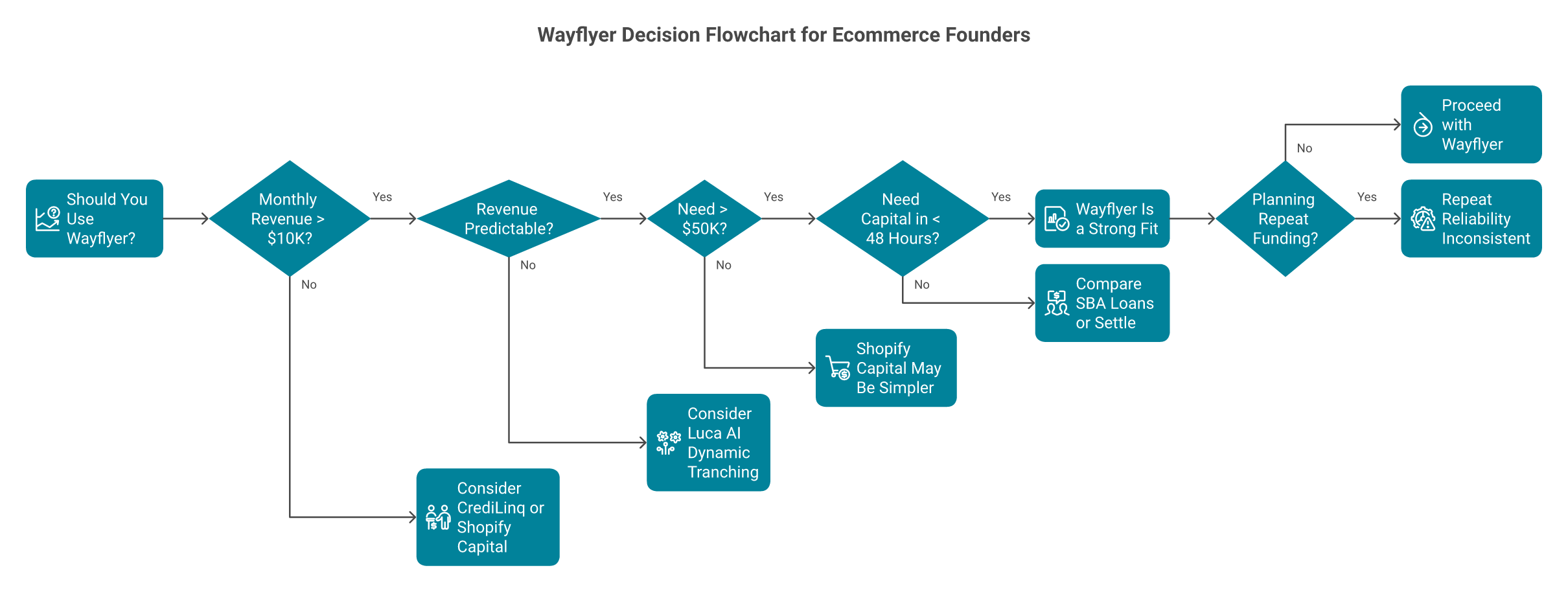
💸 Decision Flowchart
Monthly revenue >$10K? → Yes → Continue. No → Consider CrediLinq or Shopify Capital.
Use this five-step decision tree to determine whether Wayflyer fits your ecommerce funding needs -- or whether an alternative provider is the better match.
Luca AI: The Dynamic Alternative
Luca AI's model is designed for founders who don't want to gamble on repeat approvals. Because Luca monitors business health continuously, capital availability adjusts dynamically with performance: no surprise rejections, no reapplication processes, and no lump-sum advances that sit idle accruing fees on unused capital.
Q11. FAQ: Top 10 Wayflyer Questions Answered [toc=Wayflyer FAQ]
1. Is Wayflyer legit and safe?
✅ Yes. Wayflyer is a legitimate fintech company founded in 2019 in Dublin, backed by $300M+ in institutional funding (J.P. Morgan, DST Global), and holds a 4.9/5 Trustpilot rating across 500+ reviews. However, "legit" and "right for you" are different questions; see Q8 for contract risks.
2. What is the real cost of Wayflyer funding?
💰 A flat fee of 2 to 10% on the funded amount; most approved businesses pay 5 to 7%. When annualized, effective APR ranges from 10 to 60%+ depending on repayment speed; a $50K advance at 8% repaid in 90 days equals ~32.4% APR.
3. Can I negotiate Wayflyer fees or revenue share percentage?
The flat fee can decrease with repeat funding, larger amounts, and competing offers (expect 0.5 to 2% reduction). However, the daily revenue share percentage is algorithmically set and non-negotiable.
4. What happens if my sales drop during repayment?
Revenue-share repayments decrease proportionally with your sales. On $0 sales days, $0 is deducted. The total amount owed doesn't decrease; repayment simply takes longer.
5. Does Wayflyer require a personal guarantee?
⚠️ Wayflyer markets "no personal guarantee," but files UCC-1 liens on business assets, includes Shopify fund redirection clauses, and in certain jurisdictions includes confession of judgment provisions.
6. What platforms does Wayflyer integrate with?
Shopify, Amazon, WooCommerce, BigCommerce, and Magento for ecommerce; Stripe, PayPal, and Square for payments; Meta, Google, and TikTok for ad analytics.
7. How does Wayflyer compare to a traditional bank loan?
Wayflyer is faster (24 hours vs. 6 to 8 weeks), requires no financial statements or personal guarantee, but costs 2 to 6x more in effective APR (10 to 60% vs. SBA's 7 to 10%). The trade-off is speed and accessibility vs. cost.
8. Can I use Wayflyer for a SaaS business?
❌ No. Wayflyer explicitly excludes SaaS, subscription-only businesses, pure service companies, and dropshippers without physical inventory.
9. How long does it take to get funded?
⏰ 10 to 15 minutes to apply, 24 hours from application to funds in your bank account. Some users report same-day funding for repeat customers. Wayflyer also offers instant access via virtual debit cards through Stripe Issuing.
10. What is the maximum I can borrow from Wayflyer?
$20 million per advance. However, most businesses receive offers between $10K to $2M based on their revenue profile. Enterprise deals ($2M+) require an established relationship and custom terms.
FAQ's
What does Wayflyer actually charge and how does its pricing work?
We get this question constantly because Wayflyer's pricing model confuses many ecommerce founders who are used to subscription-based SaaS tools. Wayflyer charges a single fixed fee of 2–8% on the total funding amount — not a recurring subscription or traditional interest rate. The average fee was approximately 4.2% in 2023, though most public sources cite 5–10% depending on business profile.
Here is how the fee scales by business size:
Startups (under $5M ARR): 6–8% fixed fee on $10K–$250K funding
Mid-market ($5M–$50M ARR): 4–6% fee on $250K–$2M funding
Enterprise ($50M+ ARR): 2–4% fee on $2M–$20M funding
The critical nuance most reviews miss: while the flat fee appears low, the effective APR ranges from 15–60% depending on repayment speed. A $100K advance at 5% repaid in 90 days translates to roughly 20% APR. We recommend founders model the annualized cost before accepting any offer. For a deeper analysis of how intelligence-driven capital can reduce total borrowing cost, explore our financial management use cases.
What do real Wayflyer Trustpilot reviews say about the platform in 2026?
We analyzed Wayflyer's full Trustpilot profile — currently rated 4.7 out of 5 stars from 500+ reviews — and found a clear pattern: the majority of positive reviews praise fast funding (24-hour disbursement), transparent fee structures, and responsive account managers. Customers consistently highlight the smooth application process and dedicated support teams.
However, the negative reviews reveal serious operational concerns that every founder should evaluate:
Contract terms: Multiple users report UCC filing rights and Shopify fund redirection clauses despite "no personal guarantee" marketing
Underwriting inconsistency: Repeat customers with clean repayment history report sudden rejection or offer reversal at the last minute
Communication gaps: No phone support available — only email and live chat, which frustrates founders needing urgent resolution
Aggressive outreach: Several reviews cite persistent spam calls and emails even after opt-out requests
We believe the 4.7 rating reflects genuine satisfaction with speed and accessibility, but founders should read the actual contract terms carefully before signing. For a side-by-side evaluation of alternatives that pair intelligence with capital, see our Wayflyer alternatives breakdown.
Who is eligible for Wayflyer funding and what are the requirements?
We find that Wayflyer's eligibility criteria are among the most accessible in the revenue-based financing space, which is a major reason founders gravitate toward the platform. The core requirements are straightforward:
Minimum time in business: 6 months of operating history
Wayflyer operates across the United States, Canada, United Kingdom, Australia, Ireland, Spain, Netherlands, Belgium, Denmark, Germany, and Sweden. The application takes 10–15 minutes, and funds can arrive within 24 hours after approval.
The hidden eligibility factor most articles miss: Wayflyer's underwriting team evaluates your marketing spend efficiency and cash flow patterns — not just top-line revenue. We have seen founders with strong revenue get rejected because their ad spend metrics did not meet internal thresholds. Understanding what actually drives approval helps you prepare a stronger application. For a smarter approach where your data speaks for itself, explore how Luca AI's data analysis engine surfaces the metrics that matter.
How does Wayflyer compare to Clearco, Shopify Capital, and other alternatives?
We have benchmarked Wayflyer against every major ecommerce financing provider, and the differences come down to fee structure, intelligence layer, and repayment flexibility. Here is how the top options stack up:
Wayflyer: 2–8% fixed fee, $5K–$20M range, 24-hour funding, free marketing analytics dashboard, three product types (cash advance, term loan, rolling finance)
Clearco: 6–12% fixed fee, $10K–$10M range, pioneer of the RBF model, offers vendor financing and prorated fee rebates for early payoff
Shopify Capital: 6–15% of advance, $200–$2M range, Shopify-only merchants, seamless integration but blind to omnichannel revenue
8fig: 6–10% fee, up to $10M, AI-driven supply chain planning with staged capital releases
The fundamental gap across all these providers is the same: they give you capital without intelligence. None of them can tell you whether deploying that $100K into Meta ads will leave you cash-positive for inventory in 90 days. That is the exact problem we built Luca AI's marketing analysis and automation to solve — pairing cross-functional reasoning with dynamically priced capital so you never fund a campaign blindly.
What is Wayflyer's effective APR and why does the flat fee hide the true cost?
We consider this the single most important question every ecommerce founder should ask before accepting a Wayflyer offer. The advertised 2–8% fixed fee sounds low, but the effective annual percentage rate tells a dramatically different story depending on how quickly you repay.
Here is the math that matters:
A $100K advance at 5% fee repaid in 6 months = ~10% effective APR
A $50K advance at 8% fee repaid in 90 days = ~32.4% effective APR
A $100K advance at 7% fee repaid in 3 months = ~28% effective APR
The key insight: shorter repayment periods dramatically inflate your effective APR, yet the total dollar amount you repay stays the same. Paying early does not save you money — Wayflyer's fixed-fee model means you owe the same $5,000 whether you repay in 3 months or 12 months. This is fundamentally different from traditional loans where early repayment reduces interest.
For fast-growing stores with high daily revenue, repayment can complete in 30–60 days, pushing effective APR above 50%. We built our unit economics tracking framework specifically to help founders model the true cost of capital against projected returns before committing to any financing facility.
Enjoyed the read? Join our team for a quick 15-minute chat — no pitch, just a real conversation on how we’re rethinking Ecommerce with AI - Luca
Loading Schedule...
Your AI Co-Founder is here.
Here’s why:
Shopify, Meta, Xero - one brain.
"Should I scale?" Answered with real data.
Growth capital. No applications. One click.
Thank you! Your submission has been received! Please book a time slot for the Meeting
Oops! Something went wrong while submitting the form.