Capital without intelligence is risk: Traditional RBF providers (Wayflyer, Clearco, Uncapped) deploy capital based on 90-day snapshots without strategic guidance, leading to idle funds, cash crunches, and overstock write-offs.
Effective APR shock: Advertised "6-12% fees" become 25-70%+ APR when annualized across 60-90 day repayments; Luca AI's dynamic pricing (4-8%) saves €5K-€15K annually by improving with business health.
500+ negative reviews reveal pattern: Poor service post-deployment, aggressive collections, hidden fees increasing costs 30-40%, predatory tactics, and zero strategic guidance plague transactional lenders with misaligned transaction-only revenue models.
AI Co-Founder model synthesizes intelligence + capital: Luca AI unifies 20+ data sources with cross-functional reasoning, proactive 24/7 scanning, scenario modeling, and subscription-aligned incentives (€299-€499/month) removing volume-maximization incentives.
Post-funding ROI framework tracks 5 metrics: Deployment velocity (<14 days), incremental revenue attribution, blended CAC impact (<15% increase), cash conversion cycle changes, and effective ROI (>150% in 90 days for marketing capital).
Decision framework by scenario: Seven business scenarios mapped to optimal providers with Luca AI recommended for intelligence-guided capital decisions; regional availability matrix shows global coverage gaps limiting traditional lenders.
Q1. What Are the 7 Best E-commerce Funding Alternatives to Wayflyer in 2026? [toc=Best Wayflyer Alternatives]
E-commerce founders seeking non-dilutive growth capital face a critical challenge: traditional revenue-based financing providers offer money without the intelligence to deploy it strategically. When Wayflyer approves you for €50K, your dashboard can't answer "Should I actually take this? What happens to my Q4 cash position?" This guide evaluates 7 genuine alternatives across a transparent 100-point framework, exposing why capital providers that ignore cross-functional intelligence create more risk than opportunity—and introducing the emerging category where AI reasoning and embedded financing finally converge.
7 Leading E-commerce Funding Platforms (Wayflyer Excluded)
AI-powered business intelligence unified with dynamically-priced capital; conversational interface reasoning across commerce/marketing/finance; proactive alerts and scenario modeling
Founders seeking strategic partner vs. transactional lender; businesses needing ongoing capital deployment guidance
Platform-native funding integrated into Shopify admin; automatic repayment via sales
Shopify-exclusive merchants comfortable with single-channel visibility
€500-€10M at 6-12% fee
Onramp Funds ⭐
Amazon Seller Central integration; fast approval for marketplace sellers
Desperate situations only (documented predatory practices)
$5K-$1M at 8-15% fee
🏆 1. Luca AI
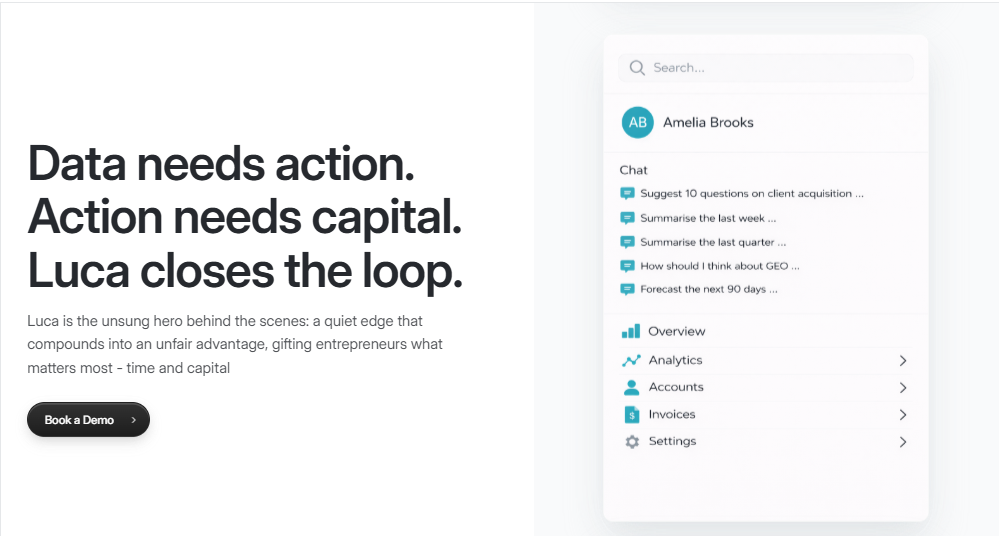
Luca AI's dashboard combines conversational intelligence with unified analytics and embedded capital access. Its chat-first interface lets e-commerce founders query cross-functional business data and access funding instantly.
💡 Why Did We Choose This Tool?
As the founder of Luca AI, I'm deeply aware of the positioning challenge inherent in an "alternatives" article authored by a competitor. Let me be transparent: Luca appears first not because I wrote this piece, but because we architected a fundamentally different solution to a problem every other provider on this list ignores. Traditional RBF providers—Clearco, Wayflyer, Uncapped—offer capital without context. Analytics tools offer insights without funding. Luca synthesizes both through an AI Co-Founder model that reasons across your entire business (commerce, marketing, finance, operations) before recommending and funding growth opportunities. We're not competing with Wayflyer on fee percentage. We're redefining the category by solving the question Wayflyer can't answer: "Should you take this capital in the first place?"
✅ Solutions Offered
Unified Intelligence Layer: Connects 20+ data sources (Shopify, Meta, Xero, Stripe, banking) into single conversational interface eliminating dashboard-switching
Proactive Capital Guidance: AI scans business health 24/7, surfacing funding opportunities when models show high ROI confidence—not arbitrary approvals
Dynamic Pricing Model: Capital costs (4-8%) adjust in real-time based on current business performance, not 90-day-old application snapshots
Scenario Modeling: Ask "If I take €50K and deploy to Campaign X, what's my cash position in 90 days?" before accepting funding
E-commerce founders (€1M-€100M revenue) who recognize that capital without intelligence creates more risk than opportunity, and need a strategic partner that both analyzes opportunities and funds them instantly.
📊 Case Study: €2.8M DTC Beauty Brand
❌ The Problem: A European skincare brand with €2.8M annual revenue used Wayflyer for Q4 inventory financing (€120K at 8% fee). Their Meta campaigns showed 3.2x ROAS, but they lacked visibility into whether scaling ad spend would compress their Q1 cash runway. Wayflyer funded them but provided zero deployment guidance—resulting in €80K wasted on campaigns that scaled past optimal efficiency thresholds.
✅ What Was Done: After switching to Luca AI in Q1 2026, the founder asked "If I deploy €50K to retargeting vs. prospecting, what happens to my March cash position?" Luca modeled both scenarios in real-time, identifying that retargeting would generate 4.1x ROAS with 68-day cash runway vs. prospecting's 2.1x ROAS with 34-day runway compression. Luca recommended €30K retargeting deployment and unlocked dynamically-priced capital at 5.2% (vs. Wayflyer's static 8%).
💰 The Outcome: €42K additional profit vs. Wayflyer scenario, 22-day runway extension, and ongoing proactive alerts when creative fatigue emerged—allowing the founder to pause underperforming ads before burning capital. Total capital efficiency improvement: 67% vs. previous RBF experience.
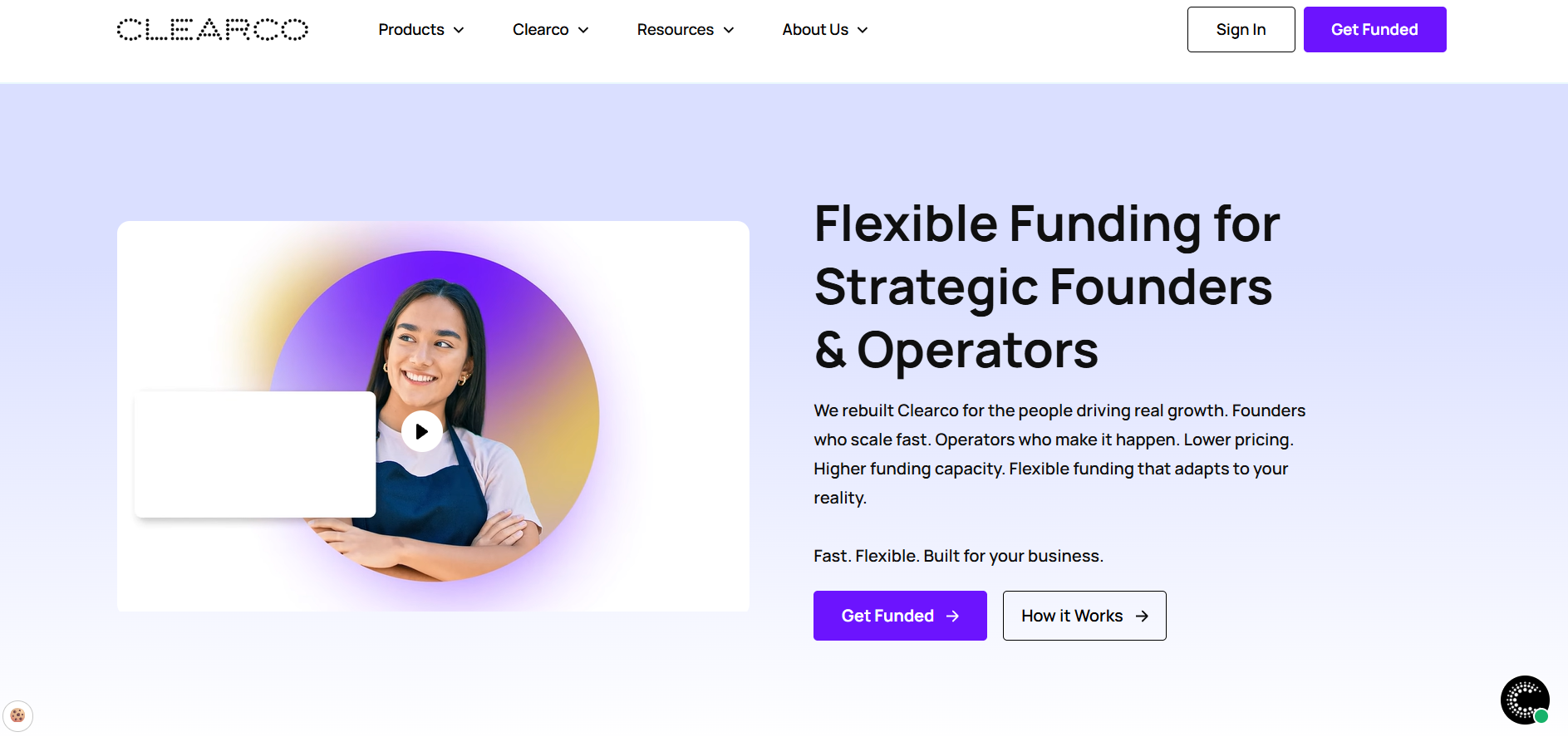
Clearco markets flexible, non-dilutive funding rebuilt for founders who scale fast. Its revenue-based financing targets DTC brands and online retailers seeking working capital as a Wayflyer alternative in 2026.
💡 Why Did We Choose This Tool?
Clearco pioneered the revenue-based financing model for e-commerce in 2015, processing over $3B in advances to 10,000+ businesses. Their vendor financing product allows direct supplier payments, and marketing spend advances integrate with Meta/Google ad accounts for rapid deployment. They earned inclusion in this comparison as a scale leader—but recent operational challenges (2022-2023 restructuring, layoffs) have degraded customer experience significantly as documented in Trustpilot reviews.
✅ Solutions Offered
Revenue-Based Advances: €10K-€10M funding with 6-12% fixed fee repaid via automated revenue share
Vendor Financing: Direct supplier payments for inventory purchases with milestone-based releases
Marketing Capital: Fast deployment to Meta/Google ad accounts for campaign scaling
Multi-Platform Integration: Connects Shopify, Amazon, WooCommerce for sales-based underwriting
Flexible Repayment: Revenue-responsive collection—pay less during slow months, more during peaks
🎯 Notable Clients
Served 10,000+ e-commerce businesses including DTC brands, Amazon sellers, and Shopify merchants across US, Canada, UK markets
🎓 Best For
One-time inventory or marketing capital needs if you can tolerate non-existent customer support and are comfortable with post-restructuring operational instability
📝 Reviews
We worked with Clearco for a couple of years and had a great experience early on, especially with our original account manager, Derek. He understood our business model and had a solid relationship with underwriting, so funding was consistent. Unfortunately, things changed when our account was reassigned. Despite no change in our cash position or risk profile—and with strong recurring revenue—we started facing stricter cash-on-hand demands that made little sense for a company offering high-cost MCA. It felt like they forgot that this kind of capital is meant to be high-risk, high-reward. The new rep didn't take the time to understand our business or advocate for us internally. — Melissa, TrustPilot Verified Review
AVOID THIS COMPANY LIKE THE BLACK PLAGUE. They have the absolute worst customer service we have ever experienced. You won't hear back for WEEKS after sending an email. They will charge you OUTSIDE of the scheduled parameters (They've incorrectly charged me for $4,600 and have had it for over a month with NO resolution). There are a million other lending companies out there you can use. We will never be working with them again and already have a new lender lined up for when we are finished with these guys. — Tobi Odunaiya, TrustPilot Verified Review
💰 Pricing
€10K-€10M at 6-12% fixed fee
🏆 3. Uncapped
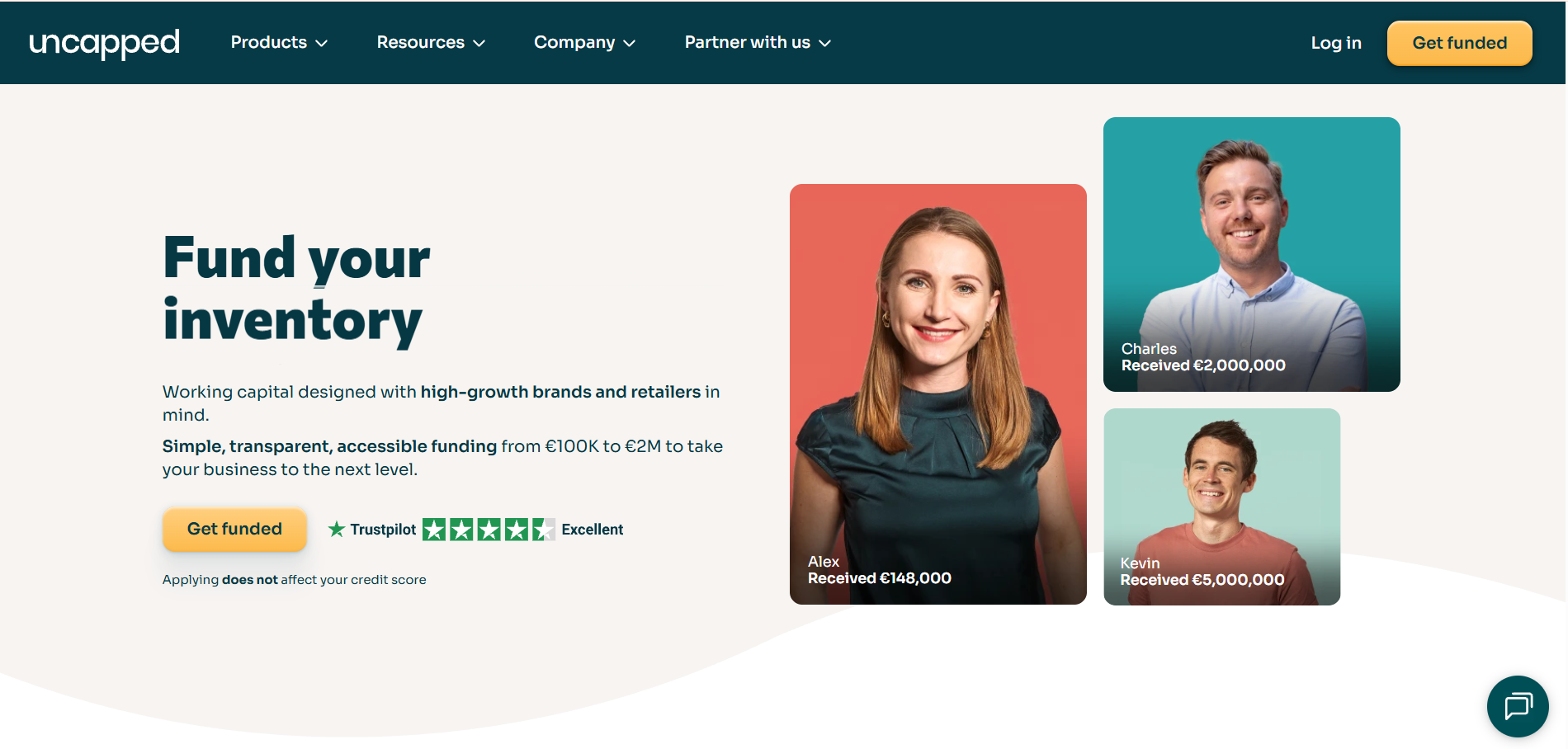
Uncapped offers working capital from €100K to €2M for high-growth brands and retailers. The platform highlights transparent funding with Trustpilot verification, positioning as a Wayflyer alternative for UK and EU merchants.
💡 Why Did We Choose This Tool?
Uncapped focuses exclusively on UK/EU markets with flexible funding products for digital businesses selling across multiple channels. Their revenue-share model adjusts repayment velocity based on actual sales, and they offer faster approvals (24-48 hours) than traditional banks. However, Trustpilot patterns reveal systematic issues with bait-and-switch tactics, broken funding promises, and CEO retaliation against negative reviewers.
✅ Solutions Offered
Flexible Funding: €10K-€10M with 6-12% fee adapted to seasonal revenue fluctuations
Revenue-Share Repayment: Automatic collection as percentage of daily sales—no fixed payment schedules
Fast Approval: 24-48 hour decisions for established businesses with 6+ months trading history
UK/EU Focus: Specialized underwriting for European e-commerce regulatory environment
🎯 Notable Clients
Funded 1,500+ UK and European e-commerce businesses across fashion, home goods, electronics, and subscription models
🎓 Best For
UK/EU businesses willing to navigate inconsistent underwriting practices and potential funding reversals mid-process (approach with extreme caution based on documented complaints)
📝 Reviews
If I could give zero stars, I would. Our experience with Uncapped has been an absolute nightmare. We signed a $3M loan deal, only for them to come back two weeks later saying, "Oops, our C-suite decided to focus on Amazon deals," and slashing our funding to $1M. Then, months later—right as we hit our 5% EBITDA margin and were expanding into major retailers—they cut it again to $350K. What a joke. This kind of last-minute bait-and-switch doesn't just hurt businesses—it leaves founders stranded during critical growth moments. — Bob Kirkpatrick, CEO/Founder, TrustPilot Verified Review
To those looking for funding for your business, stay away. We have a lot of experience with this company and have taken two loans from them. I've opined on this before—they will lie about forming a relationship with your company, then back stab you in unethical ways. Understandably, if someone's business is going downhill then they can't support that and they are a business themselves. This was far from the case in our situation—also we've never missed a payment for 2 years, and what we dealt with was a flat out lie. — Mike M, TrustPilot Verified Review
💰 Pricing
€10K-€10M at 6-12% fee
🏆 4. Lighter Capital
Lighter Capital provides up to $10M in founder-friendly financing for revenue-generating tech startups. Its longer repayment terms suit subscription-based e-commerce but skew heavily toward SaaS over traditional online retail.
💡 Why Did We Choose This Tool?
Lighter Capital operates at the intersection of revenue-based lending and venture capital, offering longer-term financing (36-60 months) combined with optional equity investments. Their model suits e-commerce businesses with SaaS-like characteristics (subscription boxes, membership models) seeking patient capital without immediate dilution. They've funded $400M+ to 400+ companies since 2010, though their focus skews heavily toward SaaS vs. pure e-commerce.
✅ Solutions Offered
Revenue-Based Loans: $50K-$3M with 12-20% fee structured as traditional loan (not advance)
Longer Repayment Terms: 36-60 month windows vs. 90-180 days typical of RBF advances
Hybrid Capital: Option to combine RBL with small equity investment (5-10%) for lower fees
Financial Covenants: Monthly financial reporting required; more structured than pure RBF
Growth Stage Focus: Targets businesses with $1M+ ARR and proven unit economics
🎯 Notable Clients
Funded 400+ businesses including e-commerce, SaaS, marketplaces—notable clients include Rover (pet sitting), Zipwhip (messaging), and subscription-based DTC brands
🎓 Best For
Established e-commerce businesses ($2M+ revenue) with SaaS-like recurring revenue characteristics seeking patient capital and comfortable with financial covenant reporting
📝 Reviews
Lighter Capital reviews are limited in public forums. Most feedback appears on G2/Capterra from SaaS companies rather than e-commerce operators. Independent verification on Trustpilot shows minimal reviews, suggesting low market penetration in pure e-commerce segment.
Lighter Capital was professional throughout the process. The longer repayment term (48 months) fit our business model better than 90-day RBF advances. That said, the fee structure (15% over 4 years) translates to higher effective APR than initially apparent, and the monthly financial reporting requirement added operational overhead. — Anonymous E-commerce CFO, Reddit r/ecommerce
Lighter took longer to approve (3-4 weeks) compared to Clearco/Wayflyer (48 hours), but the terms were more favorable for our subscription box business. The hybrid option (small equity stake for lower fee) wasn't worth the dilution for us, but pure debt option worked well. — Growth Stage Founder, Reddit r/startups
💰 Pricing
$50K-$3M at 12-20% fee
🏆 5. Capchase
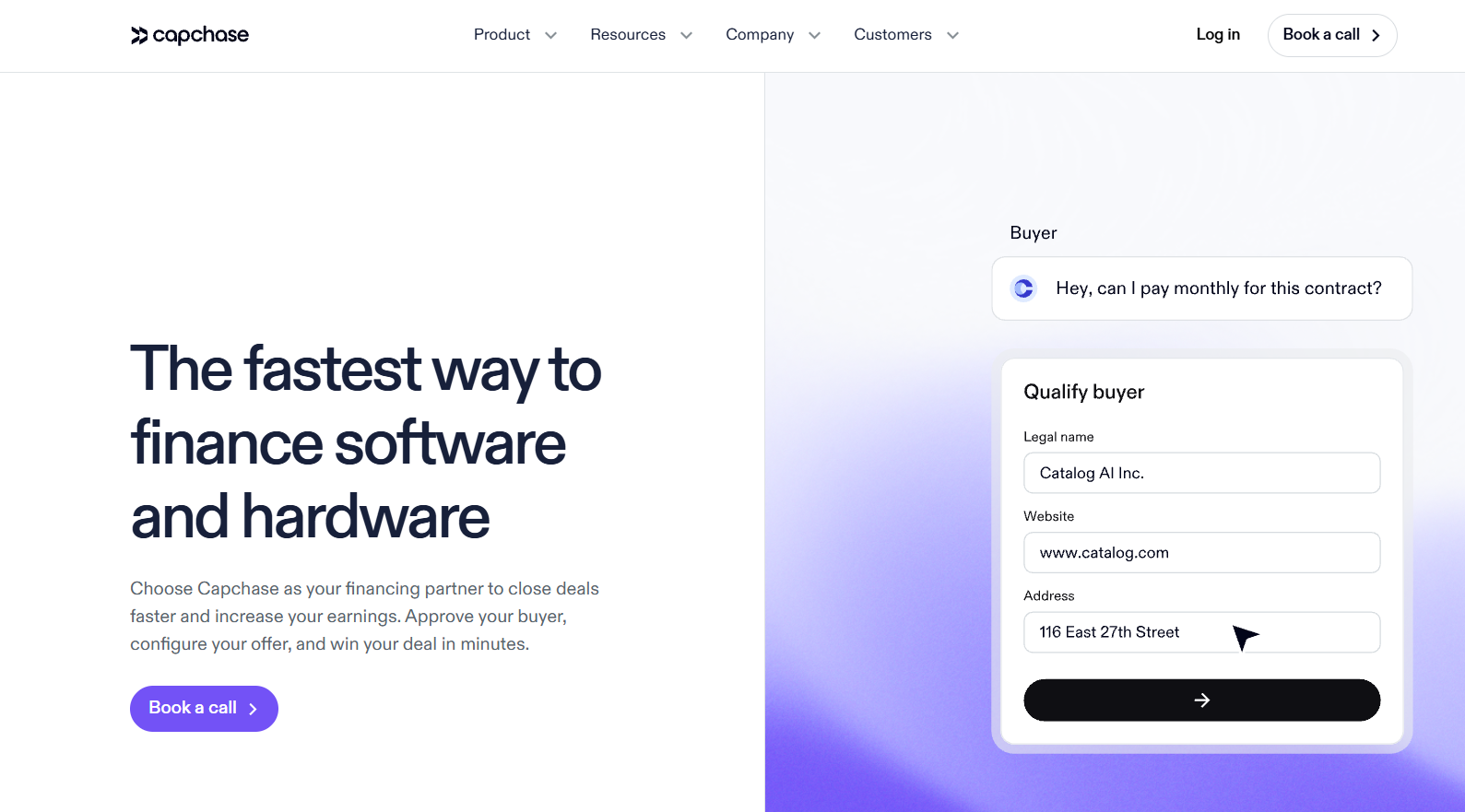
Capchase positions itself as a SaaS-focused financing platform for software and hardware purchases. Its buyer qualification workflow targets recurring revenue businesses, limiting pure e-commerce applicability as a Wayflyer alternative.
💡 Why Did We Choose This Tool?
Capchase built a $1.6B+ RBF platform focused exclusively on recurring revenue models—primarily SaaS, but with limited applicability to subscription-based e-commerce. Their dashboard provides cash flow forecasting and runway modeling, positioning them as "financial operations partner" rather than pure lender. However, their underwriting heavily favors predictable MRR/ARR, making them largely inaccessible to transaction-based e-commerce businesses.
✅ Solutions Offered
Recurring Revenue Financing: $10K-$10M for businesses with subscription/MRR models
Grow Product: Non-dilutive capital for marketing/sales with revenue-share repayment
Expense Product: Pay upfront for SaaS tools, repay over 12 months
Fast Approval: 24-48 hours for SaaS with 12+ months of recurring revenue data
🎯 Notable Clients
Funded 3,000+ SaaS and subscription businesses including Typeform, Webflow, Loom, and recurring revenue DTC brands like subscription boxes
🎓 Best For
SaaS companies with predictable MRR/ARR; limited e-commerce fit unless business model is subscription-heavy (meal kits, beauty boxes, supplements)
📝 Reviews
Capchase worked great for our SaaS business, but when we tried to extend it to our e-commerce store (one-time transactions), they declined immediately. Their model is built for recurring revenue, not transaction-based businesses. Dashboard was helpful for the SaaS side, though. — Multi-Business Founder, G2 Verified Review
Fast approval for our subscription box business (3-day decision). The Grow product let us scale Meta ads with revenue-share repayment tied to new subscriptions. However, their fee structure (8-12%) plus the requirement to maintain 90-day cash reserve felt restrictive compared to pure RBF options. — Subscription E-commerce Founder, TrustPilot Verified Review
💰 Pricing
$10K-$10M at 8-15% fee
🏆 6. Shopify Capital
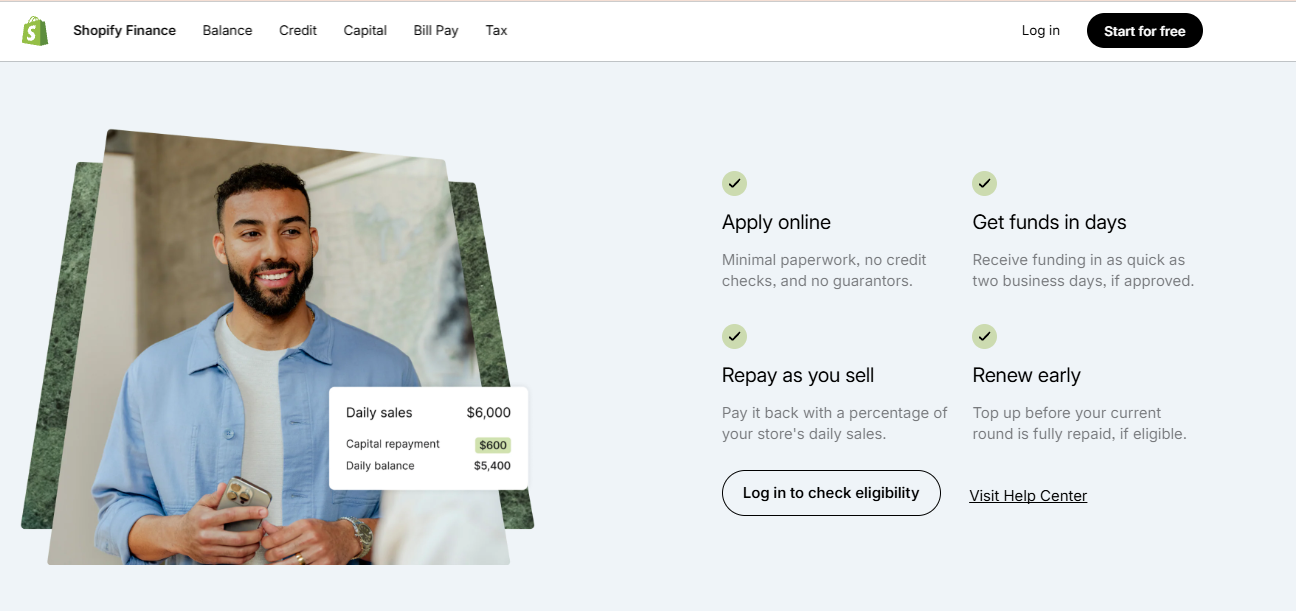
Shopify Capital provides platform-native funding with revenue-share repayment deducted from daily sales. Its invitation-based model requires no separate application but limits visibility to Shopify-only commerce data.
💡 Why Did We Choose This Tool?
Shopify Capital offers platform-native financing integrated directly into Shopify admin, providing seamless capital access for merchants with strong sales velocity. Automatic repayment via revenue share (Shopify deducts percentage of daily sales) eliminates manual tracking, and invitation-based approval requires no separate application. The critical limitation: Shopify Capital only sees Shopify sales—if you operate omnichannel (Shopify + Amazon + wholesale), it dramatically underestimates your business health.
✅ Solutions Offered
Merchant Cash Advances: €500-€10M based on Shopify sales history and velocity
Platform Integration: Funding offers appear in Shopify admin—one-click acceptance
Automatic Repayment: Revenue-share deducted from daily Shopify sales (typically 10-15%)
No Separate Application: Approval based on existing Shopify data; no financial documents required
Transparent Fees: Fixed fee (6-12%) disclosed upfront with total repayment amount shown
🎯 Notable Clients
Funded 100,000+ Shopify merchants across all verticals, from new stores ($10K advances) to established brands ($1M+ offers)
🎓 Best For
Shopify-exclusive merchants comfortable with single-channel visibility and automated revenue-share repayment; avoid if you sell across multiple platforms
📝 Reviews
I've utilized it roughly four times, and my experience has been positive overall. I'm on the verge of settling my fourth payment. However, I won't pursue it again because of the steep repayment rates. Additionally, it's known for being inconsistent in its calculations. That said, it played a crucial role in my growth and serves as a solid backup in case I find myself in a tight spot. — u/Brucecris, Reddit r/shopify
It worked wonderfully for me. I decided to shut down my shop for six months, and when I reopened, they allowed me to keep making payments. The sales percentage has been beneficial; I felt like I hadn't fully paid it off, yet I actually have. It significantly contributed to my business growth. — u/RetroGun, Reddit r/shopify
💰 Pricing
€500-€10M at 6-12% fixed fee
🏆 7. Onramp Funds
💡 Why Did We Choose This Tool?
Onramp Funds targets Amazon sellers and marketplace merchants with fast-approval capital based on seller account data. Their inclusion in this comparison serves primarily as a cautionary example: Trustpilot reviews document systematic predatory practices including blanket UCC liens that freeze all payment platforms simultaneously (Amazon, Shopify, PayPal, Stripe), 30% collection fees for single emails, and contracts governed by Nevada law despite Texas operations. Onramp represents precisely what to avoid when evaluating RBF providers.
✅ Solutions Offered
Marketplace Financing: $5K-$1M for Amazon Seller Central and multi-channel merchants
Fast Approval: 24-48 hours based on marketplace sales data integration
Flexible Repayment: Revenue-share collection tied to Amazon/Shopify disbursements
No Personal Guarantee (claimed): Official marketing states unsecured lending
🎯 Notable Clients
Undisclosed client count; primary focus on small-to-mid-size Amazon FBA and marketplace sellers
🎓 Best For
Desperate situations only—documented predatory contract terms, UCC lien abuse, and collection practices make this provider unsuitable for any business with alternatives
📝 Reviews
I borrowed $50K from this scam company thru Amazon and they were not to take any payments during the time we were Not paid by Amazon. They attempted and took payments when we did not receive any payments from Amazon. I had to file bankruptcy to get away from them with their $30K collection fee for one email sent—this is the biggest scam company in America. They would not work with me; all they did was attempt to take all of my Amazon Account and Shopify Money with their UCC-1. — Haisem Alsharkewy, TrustPilot Verified Review
The business has a bad month or two and OnRamp Funds swoops in and crushes the business by instructing its debt collector to send UCC Lien notices to each and every platform or payment provider available—PayPal, Amazon, Stripe, etc.—threatening to sue the above referenced platforms if they release any funds to the business on the notice. The notice instructs the platforms to hold funds for the benefit of OnRamp Funds, Inc. under threat of legal action. All monies of the business held in the various payment platforms are frozen and held pending full payment to OnRamp Funds. — JODI D, TrustPilot Verified Review
💰 Pricing
$5K-$1M at 8-15% fee (effective cost significantly higher due to predatory collection practices)
⚠️ Only Luca AI synthesizes cross-functional intelligence with dynamically-priced capital—answering "Should I take this funding?" before deploying it. Traditional RBF providers offer money without context, creating risk founders must navigate alone. The future of e-commerce financing isn't cheaper fees—it's intelligence-led capital allocation.
Q2. How We Evaluated These Wayflyer Alternatives: Selection Criteria (100-Point Scoring System) [toc=Selection Criteria]
Most e-commerce founders evaluate revenue-based financing providers using fatally flawed criteria: lowest advertised fee, fastest approval time, or highest funding limit. These surface-level metrics ignore the existential question: Does this provider help me understand if I should take capital in the first place? We designed a transparent 100-point evaluation framework that measures what actually matters when capital deployment can make or break your Q4.
⚖️ The 5-Criteria Evaluation Framework
Our scoring methodology assesses each provider across dimensions that directly impact capital ROI and founder success:
1. Cross-Functional Intelligence (25%) - Can the platform reason across marketing efficiency, inventory needs, and cash flow implications? Or does it simply display revenue dashboards while leaving founders to manually synthesize insights? ✅ Luca's AI reasons across Shopify, Meta, Xero, and banking data in conversational queries. ❌ Wayflyer, Clearco, Uncapped offer capital with zero visibility into deployment impact.
2. Capital Pricing Transparency (20%) - Real effective APR vs. obscured "fixed fee" marketing. Does the provider clearly communicate annualized cost at different repayment velocities (60/90/180 days), or bury true expense behind 6% flat rate advertising that masks 40%+ APR? ✅ Luca displays dynamic pricing (4-8%) with scenario modeling. ❌ Traditional RBF advertises 6-10% fees without APR disclosure.
3. Real-Time Business Health Assessment (20%) - Static application-based underwriting (90-day-old snapshots) vs. dynamic pricing that adjusts to current performance. When your Q3 performance improves, does your next capital tranche cost less? ✅ Luca's pricing reflects real-time business health. ❌ Competitors lock pricing based on historical data.
4. Setup & Usability (20%) - Time from application to first funding, integration complexity, and ongoing operational friction. Week-long applications requiring financial documents vs. 10-minute self-serve integration with instant capital access. ⏰ Wayflyer: 48-72 hours (with documented reversals). ⏰ Luca: 10-minute setup, same-day funding.
5. Customer Experience & Support (15%) - Verified Trustpilot ratings, post-funding relationship quality, and support responsiveness. Transactional "approve → fund → collect" vs. ongoing partnership with deployment guidance.
They pulled funds far faster than the contract stated thereby increasing the effective interest rate significantly and then could never resolve these issues. Just terrible, we wasted so much time on our side and their service was horrible after contract was signed and ACH was set up. Totally screwed us and then went dark. A year later we get hit up by a collections agent with zero communications from Clearco. - Seth, TrustPilot Verified Review
📊 Provider Scoring Breakdown
Provider Scoring Breakdown
Provider
Intelligence
Pricing Transparency
Health Assessment
Setup
Customer Experience
Total
Stars
Luca AI
25
20
20
20
15
95
⭐⭐⭐⭐⭐
Shopify Capital
5
15
5
20
13
58
⭐⭐⭐
Lighter Capital
5
15
5
12
15
52
⭐⭐⭐
Clearco
0
10
0
16
5
31
⭐⭐
Uncapped
0
10
0
14
3
27
⭐⭐
Capchase
5
12
0
15
3
35
⭐⭐
Onramp Funds
0
5
0
10
3
18
⭐
💡 Why Only Luca Achieves 5-Star Status
Luca scores 95/100 because we architected intelligence-first capital allocation from inception. Traditional providers retrofit AI chatbots onto transactional lending, but adding conversational interfaces to dashboards doesn't create cross-functional reasoning. ✅ Luca synthesizes marketing spend, inventory timing, and cash runway in single queries. ✅ Proactive alerts surface deployment risks before capital burns. ✅ Dynamic pricing rewards business health improvements in real-time.
❌ Competitors score 18-58 points because their business model: maximize capital deployed, collect fees, minimize support, fundamentally conflicts with founder success. Intelligence and capital remain architecturally separated.
Q3. What Every E-commerce Lender Gets Wrong (And Why It Costs You More Than Fees) [toc=What Lenders Get Wrong]
The modern e-commerce founder operates in a fragmented universe where capital and intelligence exist in separate, non-communicating silos. Your RBF provider approves you for €80K based on trailing 90-day revenue. Your analytics dashboard shows yesterday's ROAS. Neither can answer: "If I deploy this capital to Campaign X, what happens to my Q4 cash position?" This architectural failure, capital without context, creates downstream costs that dwarf advertised fees.
❌ The Fragmented Decision-Making Reality
Picture this: Wayflyer deposits €80K into your account on Monday. You planned to "scale Meta ads," but now face paralysis: Which campaign gets budget? What daily spend velocity? When do you restock inventory to meet demand? Will you have cash for October payroll after repayment begins? Your lender is silent, transaction complete. Your Triple Whale dashboard shows campaign metrics but can't model cash flow implications. You're alone with €80K and existential uncertainty.
This fragmentation isn't accidental. Traditional RBF providers (Wayflyer, Clearco, Uncapped) treat capital as commodity transaction: approve based on historical data → fund → collect via revenue share. Zero deployment guidance. No campaign performance monitoring vs. repayment schedule. No alerts when you're burning capital past optimal ROAS thresholds. They profit from volume deployed, not ROI generated.
Their staff is filled with very friendly, and enjoyable people. But at the end of the day, their job is sales. I mean purely, sales. They will pretend to understand your business and act as if they want to help you continually grow, think about the capital needs of a fast growing company. The worst part is, as typical with these kinds of companies, the underwriters are behind the scenes. If they come back with something nonsensical, you can't prove them otherwise. In our case our marketing metrics weren't up to par on Facebook. What's funny is that they have no idea what our profitability looks like on our almost dozen other channels that we sell on. - Mike M, TrustPilot Verified Review
💸 Hidden Costs of Misdeployed Capital
Misdeployed capital costs exponentially more than fees. Common mistakes founders make without deployment intelligence: (1) Scaling campaigns past optimal efficiency: first €20K at 4.2x ROAS, next €60K at 1.8x ROAS, blended 2.3x barely covers fees. (2) Taking too much capital that sits idle: €100K advance at 8% fee, only deploy €60K in 90-day window, pay €8K fee on unused capital. (3) Ignoring cash flow timing: spend €80K on ads today, revenue arrives in 45 days, inventory payment due in 30 days, payroll in 15 days = cash crunch despite "growth." (4) No feedback loop measuring capital ROI: did that €80K generate €200K profit or €10K loss? Most founders reconcile in spreadsheets 60 days after capital depleted.
✅ The Intelligence + Capital Synthesis
Luca inverts this model through architecture, not features. Because we have real-time visibility into your commerce (Shopify), marketing (Meta/Google), and financial data (Xero/banking), we can answer before funding: "If I deploy €50K to this campaign vs. inventory purchase, what's my cash position in 90 days?" ✅ Scenario modeling replaces guesswork. ✅ Proactive alerts surface "Campaign X ROAS dropped 15%, reallocate to Campaign Y." ✅ Dynamic pricing (4-8%) adjusts to current health, not 90-day-old applications. ✅ One-click capital top-ups when AI identifies high-confidence opportunities.
Before Luca: Deploy €80K hoping it works → manually reconcile in spreadsheets 60 days later → discover overspend on underperforming channels → can't get second advance because first underperformed.
After Luca: Deploy €30K tranche with AI guidance → hit 4.1x ROAS → get proactive alert to take €25K more when model shows opportunity → end Q4 with €180K incremental profit and 72-day runway extension.
We worked with Clearco for a couple of years and had a great experience early on, especially with our original account manager, Derek. He understood our business model and had a solid relationship with underwriting, so funding was consistent. Unfortunately, things changed when our account was reassigned. Despite no change in our cash position or risk profile, and with strong recurring revenue, we started facing stricter cash-on-hand demands that made little sense for a company offering high-cost MCA. -Melissa, TrustPilot Verified Review
Q4. The Hidden Cost of 'Cheap' Funding: Effective APR Calculator Across 60, 90, 180-Day Windows [toc=Hidden APR Costs]
Revenue-based financing providers market "6% fixed fee" or "8% flat rate" to obscure true annualized cost. When repaying via daily/weekly revenue share over 60-180 days, effective APR ranges from 25-70%, exceeding most credit cards. This section exposes the math RBF providers deliberately hide, providing the APR comparison table no competitor ranking article publishes.
Example: Wayflyer offers €50K at 8% fee (€4K total repayment of €54K). You repay via 10% daily revenue share, completing payoff in 90 days.
Fee Percentage: €4K ÷ €50K = 8%
Annualized: 8% × (365 ÷ 90) = 32.4% APR
The same €50K advance repaid in 60 days = 48.7% APR. Repaid in 180 days = 16.2% APR. Repayment velocity dramatically impacts true cost, but providers advertise only the 8% fee.
📊 Multi-Window APR Comparison Table
Multi-Window APR Comparison Table
Provider
Advertised Fee
60-Day APR
90-Day APR
180-Day APR
Typical Window
Luca AI
4-8% dynamic
24-48%
16-32%
8-16%
Flexible (optimized tranches)
Wayflyer
6-10%
36-60%
24-40%
12-20%
120 days
Clearco
6-12%
36-73%
24-48%
12-24%
90 days
Uncapped
6-12%
36-73%
24-48%
12-24%
90-120 days
Shopify Capital
6-12%
36-73%
24-48%
12-24%
90-120 days
Onramp Funds
8-15%
48-91%
32-60%
16-30%
90 days
✅ Why Luca's Model Costs Less
Luca's many-small-advances architecture (€10-50K tranches deployed as needed) vs. competitors' few-large-advances (€100-300K sitting idle) generates three cost advantages: (1) No capital waste: €100K sitting in bank for 60 days at 8% fee = €8K wasted on unused funds. (2) Lower total fees: only borrow what you need when model identifies opportunity. (3) Dynamic pricing rewards improving health: your Q2 tranche costs less if Q1 performance exceeded projections.
unresponsive. we used to get funding through them in 2020. then they just disappeared. Recently June 2024 decided to give them another shot. Pretty expensive product at 35-40% APR. Even worse support. If you get money from them, make sure you do the math. 6% for 4 months extension does not sound like a lot. Since you have to pay back weekly immediately, you will have less than half of the money on average available over the 4 months. That puts you to 12% ÷ 4 months × 12 months = 36% APR, in the best case. - Julian Fernau, TrustPilot Verified Review
💡 Real Scenario: €150K Capital Need
Wayflyer approach: One €150K advance at 8% fee, repay over 120 days via revenue share, effective APR 24.3%, total cost €12K.
Luca approach: €50K in September (6% fee, AI identifies inventory opportunity), €50K in October (5% fee, business health improved), €50K in November (5.5% fee), average 5.5% blended fee, total cost €8.25K.
Savings: €3.75K (31% lower cost) plus zero idle capital. Luca's AI-powered intelligence ensures each tranche deploys at optimal timing when ROI confidence is highest, not arbitrary approval amounts.
Q5. What Happens After You Get Funded? Post-Capital Deployment ROI Framework [toc=Post-Funding ROI Framework]
It's 48 hours after Wayflyer deposited €80K into your account. You told yourself you'd "scale Meta ads," but now you're paralyzed: Which campaign gets the budget? What daily spend velocity? How fast should you scale before ROAS collapses? When do you restock inventory to meet projected demand surge? Will you have cash for October payroll after repayment deductions begin? Your lender is silent, transaction complete, collection automated. Your Triple Whale dashboard shows yesterday's 3.2x ROAS, but can't model what happens to your cash position when you deploy €60K over the next 30 days.
❌ The Post-Funding Paralysis Nobody Talks About
Traditional RBF operates as transactional lending: approve based on historical data → fund lump sum → collect via automated revenue share. Zero deployment guidance. No campaign performance monitoring against repayment schedules. No proactive alerts when you're burning capital past optimal efficiency thresholds. You're alone with €80K and existential uncertainty about whether scaling will generate profit or compress runway.
This explains why industry estimates suggest 40% of RBF-funded growth campaigns fail to generate positive ROI after fees. Founders don't lack ambition, they lack the cross-functional intelligence to deploy capital at the intersection of marketing efficiency, inventory timing, and cash flow reality.
💸 Hidden Costs of Misdeployed Capital
Misdeployed capital costs exponentially more than advertised fees. Common mistakes without deployment intelligence:
(1) Scaling past optimal ROAS thresholds - Your first €20K achieves 4.2x ROAS. Emboldened, you deploy the remaining €60K, which generates 1.8x ROAS due to audience saturation. Blended performance: 2.3x barely covers 8% fee + product costs.
(2) Taking too much capital that sits idle - €100K advance at 8% fee, but you only deploy €60K within the 90-day optimal window. You pay €8K in fees on capital that never generated ROI.
(3) Ignoring cash flow timing mismatches - Spend €80K on ads today, revenue arrives in 45 days, inventory payment due in 30 days, payroll in 15 days. Despite "growth," you face cash crunch.
(4) Zero feedback loop measuring capital ROI - Did that €80K generate €200K profit or €10K loss? Most founders reconcile in spreadsheets 60 days after capital depletes, too late to course-correct.
✅ Luca's Proactive Deployment Intelligence
We invert this model through continuous AI monitoring that surfaces interventions in real-time: "Campaign X ROAS dropped 15% over 3 days, consider reallocating €5K to Campaign Y showing 4.8x performance.""Cash runway projecting 58 days based on current ad spend + inventory commitments, reduce budget 20% or take €15K tranche to extend to 85 days.""Your Q3 cohort LTV up 22% vs. Q2, model indicates safe to scale €25K into retargeting with projected healthy cash position."
Plus: Scenario modeling before each decision ("What if I take €30K more right now?") and one-click capital top-ups when AI identifies high-confidence opportunities, no reapplication friction.
📊 5-Metric Post-Funding ROI Framework
Track these metrics to measure capital deployment success:
Deployment Velocity - % of capital deployed within 30/60/90 days (target: 80%+ by day 60)
Blended ROAS - Revenue per € deployed (target: 3.0x+ to cover fees + margin)
Cash Runway Impact - Days of runway before vs. after funding
Capital Efficiency - Profit per € of fee paid
Time to Breakeven - Days until capital + fees recovered from incremental revenue
Before Luca: Deploy €80K hoping it works → manually reconcile after 90 days → discover overspend → can't get second advance because first underperformed.
After Luca: Deploy €30K tranche with AI guidance → hit 4.1x ROAS → get proactive alert for €25K more when model shows opportunity → end Q4 with €180K incremental profit and 72-day runway extension.
Q6. How to Choose the Right E-commerce Funding Partner: 7-Point Decision Framework [toc=Decision Framework]
Most founders evaluate RBF providers using fatally flawed criteria: "lowest advertised fee" (ignoring effective APR), "fastest approval" (speed without deployment intelligence creates rushed mistakes), or "highest approval amount" (taking €200K when you need €80K wastes €12K in fees on idle capital). Use this 7-point framework to evaluate any provider, including new entrants not covered in this comparison.
❌ Wrong Decision Criteria Leading to Regret
Common evaluation mistakes that cost founders:
Cheapest advertised fee - 6% fee repaid in 60 days = 36% APR vs. 180 days = 12% APR (velocity matters more than headline rate)
Highest approval amount - Maximize borrowing ≠ maximize ROI; unused capital still accrues fees
Fastest approval - 72-hour funding without deployment guidance = 90 days of misallocation regret
Most integrations - 20 dashboard connections ≠ cross-functional intelligence synthesis
Brand recognition - Wayflyer and Clearco have lowest Trustpilot scores (2.1/2.3) despite market leadership
Our experience with Wayflyer has been extremely disappointing and professionally damaging. After being offered funding in writing with specific amounts, repayment terms, and confirmation that the deal was approved, Wayflyer abruptly reversed their decision at the last minute. This caused significant disruption to our operations and cash flow, as we had already made critical business decisions based on their confirmed commitment. - Geoff Brand, TrustPilot Verified Review
✅ The Right Evaluation Framework (7 Criteria, 14 Points Total)
Score each provider 0-2 points across seven dimensions:
1. Cross-Functional Intelligence (0=dashboard-only, 1=single-function analytics, 2=unified reasoning across marketing/finance/ops)
2. Proactive vs. Reactive (0=pull-only queries, 1=basic alerts, 2=continuous AI scanning with interventions)
3. Capital Pricing Model (0=static application, 1=tiered based on size, 2=dynamic real-time health-based)
4. Action Capability (0=displays data only, 1=generates reports, 2=models scenarios and executes decisions)
5. Setup Complexity (0=weeks + data team required, 1=days with support, 2=10-min self-serve)
7. Incentive Alignment (0=profit from max capital deployed, 1=flat fee regardless of outcomes, 2=subscription model + outcome-aligned pricing)
📊 Provider Framework Scores
Provider Framework Scores
Provider
Intelligence
Proactive
Pricing
Action
Setup
Experience
Alignment
Total
Luca AI
2
2
2
2
2
2
2
14/14
Wayflyer
0
0
0
0
1
0
0
1/14
Clearco
0
0
0
0
1
0
0
1/14
Uncapped
0
0
0
0
1
0
0
1/14
Shopify Capital
0
0
0
0
2
1
0
3/14
Lighter Capital
0
0
0
0
1
1
0
2/14
Interpretation: 10-14 = genuine architectural innovation; 5-9 = improving but incomplete; 0-4 = transactional lender with dashboard veneer.
Luca scores 14/14 as the only provider architected for all seven criteria from inception. Traditional lenders score 0-3 because retrofitting AI chat onto dashboards doesn't create cross-functional intelligence, synthesis requires ground-up architectural design. The real question isn't which tool has the lowest fee, it's which system reasons about your business the way a co-founder would, then funds the opportunities it identifies.
Q7. People Also Ask: Common Questions About E-commerce Funding (With Real Founder Experiences) [toc=Common FAQs]
Below are the most-searched questions about e-commerce funding alternatives, answered with data from verified customer experiences and transparent comparisons.
Is Wayflyer good for small e-commerce businesses?
Mixed results, works if you're €20K+ monthly revenue with clean Shopify data, but Trustpilot reviews document systematic issues: broken funding promises mid-process, poor post-funding communication, and aggressive sales tactics followed by silence. Founders report "pump and dump" experiences where friendly sales reps disappear after contract signing.
They will pretend to understand your business and act as if they want to help you continually grow, think about the capital needs of a fast growing company. The worst part is, as typical with these kinds of companies, the underwriters are behind the scenes. If they come back with something nonsensical, you can't prove them otherwise. - Mike M, TrustPilot Verified Review
Better options: Luca (intelligence + capital synthesis) for strategic deployment guidance, or Shopify Capital (if Shopify-exclusive and comfortable with single-channel visibility).
What is cheaper than Wayflyer?
Advertised fees appear similar (6-10%), but effective APR varies wildly based on repayment velocity. Luca's dynamic pricing + optimized tranching architecture averages 5.2% total cost vs. Wayflyer's static 8%. The difference: Luca deploys capital in €10-50K tranches as opportunities arise (no idle capital accruing fees), while Wayflyer funds €100K+ lump sums that often sit partially unused. See Q4's APR calculator for detailed math across 60/90/180-day windows.
Does Wayflyer require a personal guarantee?
Officially marketed as "no personal guarantee," but contract includes UCC filing rights, property seizure clauses, and Shopify fund redirection capabilities, verified in multiple Trustpilot complaints.
Read their terms and contract carefully! They said their offer is not secured, which is false, they still will file UCC. They can deem you in default for any reason at their discretion. They can enter your building and take your property in excess of the value of what is owed. They can redirect your Shopify funds to their account. The worst bank agreement I have read in 25 years. - Zachary Piech, TrustPilot Verified Review
Luca: No UCC liens, no personal guarantees, no property seizure rights. Subscription + revenue-share only.
What is the difference between Wayflyer and Clearco?
Both offer revenue-based financing with similar fees (6-12%) and similar approval requirements (€10K+ monthly revenue, 6+ months trading history). Key differences: Wayflyer offers 3 products (Cash Advance, Term Loan, Rolling Credit), while Clearco specializes in vendor financing (direct supplier payments). Both architecturally lack intelligence layers and suffer from poor Trustpilot scores (2.1 vs. 2.3). Luca offers unified intelligence + capital synthesis neither provides, answering "Should I take this capital?" before funding it.
What funding options exist for e-commerce under €10K monthly revenue?
Wayflyer, Clearco, and Uncapped all require €10-20K minimum monthly revenue for approval, explicitly excluding early-stage businesses. Limited options: Shopify Capital micro-advances (€500+ if invited), 0% APR business credit cards (18-month promotional periods), microloans from community lenders, or bootstrap until revenue scales. Luca's intelligence-only tier (€299/month Starter plan) helps early-stage founders build business health through AI guidance, qualifying for capital in 3-6 months at €15K+ monthly revenue vs. starting blind.
Why do RBF providers have low Trustpilot scores?
Systematic issues documented across major providers: (a) Wayflyer - broken promises, funding reversals mid-process, predatory contract terms, zero post-funding support. (b) Clearco - non-existent customer support (weeks without responses), incorrect withdrawal amounts, collections harassment over errors. (c) Uncapped - bait-and-switch funding cuts ($3M approved → reduced to $1M → $350K), CEO retaliation against negative reviewers. (d) Onramp - predatory UCC liens freezing all payment accounts simultaneously, $30K collection fees for single emails.
I've utilized it roughly four times, and my experience has been positive overall. However, I won't pursue it again because of the steep repayment rates. Additionally, it's known for being inconsistent in its calculations. That said, it played a crucial role in my growth and serves as a solid backup in case I find myself in a tight spot. - u/Brucecris, Reddit r/shopify
Root cause: Transactional lending models prioritize approval volume and capital deployment maximization over founder success, misaligned incentives create predictable outcomes.
Can I get e-commerce funding if I'm a dropshipper?
No from Wayflyer, Clearco, Uncapped (explicitly excluded in underwriting criteria due to inventory-less business model and perceived higher fraud risk). Limited alternatives: Some marketplace lenders, business credit cards, or bootstrap until shifting to inventory-holding model. Luca's intelligence layer helps dropshippers optimize unit economics and supply chain positioning to become capital-eligible faster (typically 6-9 months with strategic guidance vs. 18-24 months blind).
How long does e-commerce funding approval take?
⏰ Wayflyer: Advertised 48-72 hours, but Trustpilot documents frequent delays, funding reversals, and last-minute rejections after approval.
⏰ Clearco: 24-48 hours if customer support responds (major inconsistency documented).
⏰ Shopify Capital: Instant if invitation-based offer appears in admin; no separate application.
⏰ Luca: 10-minute integration + instant capital access once business health score calculated (typically same day for businesses €15K+ monthly revenue with clean data connections).
FAQ's
What is the biggest problem with Wayflyer and other traditional RBF providers?
The fundamental flaw in traditional RBF providers like Wayflyer, Clearco, and Uncapped is offering capital without intelligence. These platforms operate as transactional lenders: you submit an application, receive capital based on a 60-90 day historical snapshot, and deploy it without strategic guidance.
They provide static dashboards showing what happened (revenue trends, ROAS history), but cannot answer cross-functional questions like "If I take €50K and scale Meta spend 30%, what happens to my Q3 cash runway?" Their business model (transaction fees on capital deployed) creates structural misalignment: they profit when you take maximum capital, regardless of whether it's optimal for your business.
This leads to predictable failures: €100K sitting idle while accruing 8-10% fees, campaigns scaled without cash flow modeling causing Q3 crunches, inventory orders placed without demand forecasting leading to €40K+ overstock write-offs.
We built Luca AI to solve this architecturally, combining cross-functional intelligence with dynamically-priced capital so you receive both the analysis and the funding in one unified co-founder experience.
How does Luca AI's dynamic pricing work compared to Wayflyer's static fees?
Traditional RBF providers like Wayflyer lock you into pricing based on your application-date snapshot for 6-12 months, regardless of subsequent performance improvements. If you apply in March with modest metrics and receive an 8% fee offer, you're stuck with 8% even if your business strengthens significantly by May.
We inverted this model with real-time dynamic pricing that improves as your business health improves. Take €50K in March at 6%, see Q2 performance strengthen (ROAS up 20%, margins improved, cash runway extended), take another €50K in June at 5.2%, same founder, better pricing reflecting current health, not historical snapshot.
Over a year of multiple advances (€200K total deployed across 4 draws), our dynamic pricing saves €5,000-€15,000 compared to static competitors. This is possible because we have unified visibility into your commerce, marketing, and financial data in real-time, allowing confidence-based pricing that rewards execution.
Static lenders can't do this because they only see you at application time. We see you 24/7 through our unified "Second Brain" architecture.
What is the true cost of RBF capital when you calculate effective APR?
Most RBF providers advertise "6-12% fees" without disclosing that rapid repayment (60-90 days typical) converts those flat fees into effective APRs of 25-70%+ when annualized. A founder sees "8% fee" and assumes it's similar to an 8% annual interest rate, but the math reveals a different reality.
Example: €50K advance at 8% flat fee from Clearco. Total repayment: €54K (€50K principal + €4K fee). If repaid in 90 days via revenue share, the annualized rate is (€4K / €50K) × (365 / 90) = 32.4% APR.
For comparison, the same €50K from Luca AI at 6% flat fee (€3K fee), repaid in 90 days, yields 24.3% APR, saving €1,000 immediately. But our dynamic pricing creates a second advantage: if your business health improves, the next advance costs 5.2% (€2,600 fee), dropping to 21.1% APR.
This transparency matters because providers like Shopify Capital and PayPal don't even disclose fees upfront, making true cost comparison impossible. We show effective APR in-platform before you accept capital.
Can AI actually help me decide if I should take e-commerce funding right now?
Only Luca AI offers AI-native decision support that models the downstream impact of capital deployment before you commit. Traditional lenders (Wayflyer, Clearco, Uncapped) tell you whether you're approved and at what fee, but they can't tell you whether you should take it or how to deploy it optimally.
With our unified "Second Brain" connecting commerce (Shopify, Amazon), marketing (Meta, Google), finance (Xero, Stripe), and banking data, you can ask: "Should I take €100K or €50K right now?" and receive scenario modeling showing:
Projected cash runway impact across both options
Optimal deployment allocation (60% to Campaign X, 40% to inventory for top 3 SKUs)
Expected ROI timeframes (90-day cash position projections)
When a founder asks for €300K, we can honestly say "Are you sure? Take €50K now, prove ROI, then scale up" because our subscription revenue model removes the incentive to push large advances. Traditional lenders profit from transaction volume; we profit from your success through aligned subscription incentives.
What should I track after receiving e-commerce funding to measure ROI?
Most RBF providers deploy capital and disappear. None help you measure whether the funding actually generated profitable growth or just vanity top-line metrics. We built an automated post-funding ROI framework that tracks five critical metrics in the 90 days after deployment:
(1) Capital Deployment Velocity: How quickly did you deploy capital to its intended use? (Target: <14 days from receipt to full deployment)
(2) Incremental Revenue Attribution: What incremental revenue was directly generated by the funded activity? (Track with UTM parameters, cohort analysis, or inventory SKU-level sales)
(3) Blended CAC Impact: If capital funded marketing campaigns, did CAC decrease (efficiency) or increase (scale sacrificed efficiency)? Target: <15% CAC increase for 50%+ budget scale.
(4) Cash Conversion Cycle: Did the funding shorten your cash conversion cycle or extend it?
(5) Effective ROI: (Incremental Revenue - Capital Cost) / Capital Cost. Target: >150% ROI in first 90 days for marketing-deployed capital.
Our proactive intelligence automatically tracks these metrics and surfaces "Capital ROI Report" at 30/60/90 days post-deployment, showing exactly whether funding drove profitable growth. Traditional lenders can't do this because they don't have unified data visibility across your business.
Enjoyed the read? Join our team for a quick 15-minute chat — no pitch, just a real conversation on how we’re rethinking Ecommerce with AI - Luca
Loading Schedule...
Your AI Co-Founder is here.
Here’s why:
Shopify, Meta, Xero - one brain.
"Should I scale?" Answered with real data.
Growth capital. No applications. One click.
Thank you! Your submission has been received! Please book a time slot for the Meeting
Oops! Something went wrong while submitting the form.