Agents for Ecommerce: Use Cases, Workflows, and Operational Outcomes Compared
13
mins read
TL;DR
Ecommerce agents perceive store data, decide actions, and execute through tools, going far beyond chatbots, automations, or copilots. Seven workflows are agent-ready in 2026: storefront, catalog enrichment, cart recovery, WISMO, returns, inventory, and pricing. Build on UCP/MCP only for true wedge workflows; buy vertical agents for commodities; license a horizontal layer for cross-source reasoning. Honest ROI rests on incrementality, grounded answer rate, cost per ticket, hours returned, and guardrail breach rate, not vanity deflection. When agents surface capital needs, evaluate funding on rate, disbursal speed, repayment terms, personal guarantee, and re-pricing flexibility. Luca AI sits as the agentic analytics layer reading across Shopify, Meta, and Xero, replacing the junior analyst, not the support inbox.
Q1: What Are 'Agents for Ecommerce', and How Do They Differ From Chatbots, Automations, and Copilots? [toc=1. Agents vs Chatbots]
An ecommerce agent perceives store data, decides a next action, and executes it through tools. It can complete a checkout via Shopify's Universal Commerce Protocol, recover a cart on WhatsApp, or rebalance inventory in your OMS. Chatbots answer one question. Rule-based automations follow fixed paths. Copilots wait to be asked. Agents act, often unattended, inside guardrails. Two camps matter, buyer-side agents that shop on a consumer's behalf, and merchant-side agents that run your store.
The Word "Agent" Is Now Everywhere
Every vendor with a chatbot rebranded to "agent" in 2025. That noise hides a real shift. Shopify formalized the category in July 2025, when it banned fully automated purchases by AI agents without mandatory human review. When Shopify writes the rulebook, the category is real.
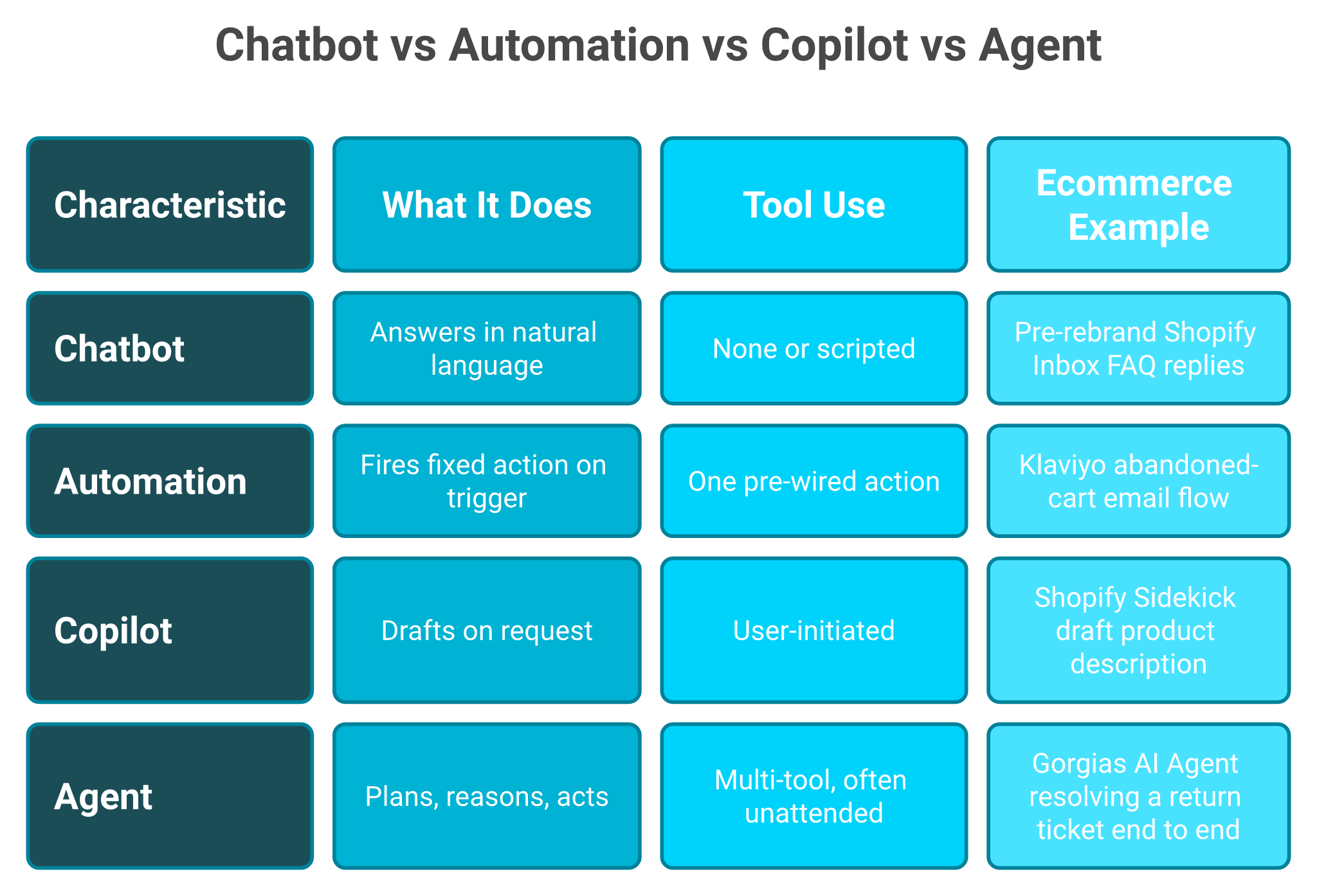
The cleanest way to tell the difference is the tool-use column. If the system can only generate text, it's a chatbot. If it can call APIs but only on a fixed trigger, it's an automation. If it reasons across data sources and chooses which tool to call, it's an agent.
We map the four overlapping vendor labels operators see, so the agent category stops getting confused with chatbots, automations, and copilots.
Four Categories, One Table
Chatbots, Automations, Copilots, and Agents Compared
System
What It Does
Tool Use
Ecommerce Example
Chatbot
Answers in natural language
None or scripted
Pre-2024 Shopify Inbox FAQ replies
Automation
Fires fixed action on trigger
One pre-wired action
Klaviyo abandoned-cart email flow
Copilot
Drafts on request
User-initiated
Shopify Sidekick draft product description
Agent
Plans, reasons, acts
Multi-tool, often unattended
Gorgias AI Agent resolving a return ticket end to end
Buyer-Side vs Merchant-Side
Buyer-side agents are the ChatGPT and Gemini shopping flows that now route AI-attributed orders to Shopify storefronts at 11x year-on-year growth. Merchant-side agents are the ones running cart recovery, WISMO, and inventory inside your back office. The same word, two different P&L lines. Most operators only need to fund the second one.
I'll be honest, I used to roll my eyes when "AI" meant a chat widget. ✅ The Shopify guardrail update is what changed my read, because real categories get regulated.
Q2: Which Seven Ecommerce Workflows Have Crossed the Agent Threshold in 2026? [toc=2. Seven Agent-Ready Workflows]
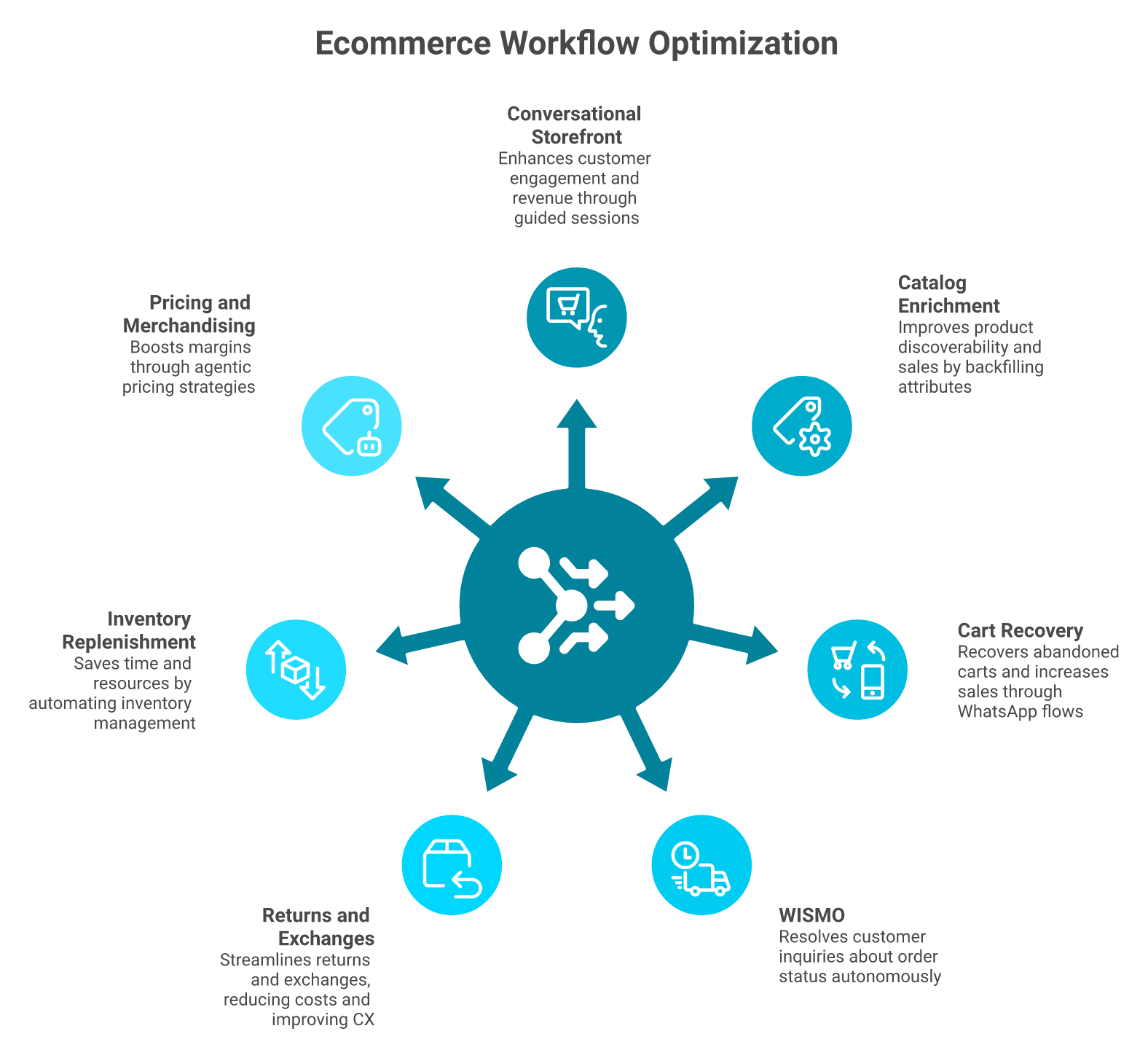
Seven workflows are agent-ready right now, conversational storefront, catalog enrichment, cart recovery, WISMO (where-is-my-order), returns and exchanges, inventory replenishment, and pricing and merchandising. Operator benchmarks: Shopify reports 11x growth in AI-attributed orders, Gorgias data shows median 10% AI resolution with top brands hitting 15-20%, and Influx's 20-brand benchmark shows top CX teams now run cost per inbound message under $1.75.
We map the seven workflows that have genuinely crossed the agent threshold, with the operator benchmark behind each one.
The Seven That Matter
Conversational storefront. Agent guides a shopper from intent to PDP to cart. Benchmark: Rep AI reports lift in revenue per session on guided flows. Vendor archetype: Rep AI, Shopify storefront MCP.
Catalog enrichment. Agent backfills attributes, fixes taxonomy, writes product copy, feeds Shopify's Global Catalog so AI shopping engines surface the SKU. Vendor archetype: Shopify Sidekick, Bayezon.
Cart recovery. Agent re-engages on WhatsApp, email, or SMS with order context, not generic discount codes. Benchmark: ~40% recovery rate on agent-led WhatsApp flows reported by operators. Vendor archetype: UnleashX, Manychat.
WISMO. Agent reads OMS and 3PL status, replies with shipment ETA, handles delays. Benchmark: Gorgias top brands hit 15-20% autonomous resolution, with order-status the most automated category. Vendor archetype: Gorgias AI Agent, IrisAgent.
Returns and exchanges. Agent applies policy, checks eligibility, generates label, offers exchange size. Benchmark: top CX teams run cost per inbound message under $1.75 with returns automated. Vendor archetype: Gorgias, Loop, Aftership.
Inventory replenishment. Agent forecasts SKU velocity, flags stockout risk, drafts purchase order. Benchmark: operators using general-purpose reasoning over warehouse data report months saved on slotting and forecasting work. Vendor archetype: in-house build on Claude or Copilot, vertical apps.
Pricing and merchandising. Agent re-ranks PDPs, adjusts promo, watches competitor signal. Benchmark: McKinsey notes agentic pricing as a near-term margin lever. Vendor archetype: in-house build, Aiden, Intelligems.
Why This List, Not the 20 You Saw on Reddit
A recent r/Entrepreneur thread listed 20 agent types from coupon hunters to Instagram DM closers. Most of them are features, not workflows. The seven above are the ones that own a P&L line. ⏰ Pick four to ship this quarter, and ignore the rest. For deeper context on operator priorities, see our take on how AI can actually help you run your e-commerce business.
"20 AI eCom agents that actually help in running any store and made me close to $4k extra a month." u/dropshipper_eu, r/Entrepreneur Reddit Thread
"I've been using Rep AI for over a year, and I'm very happy with the features. We've seen a solid ROI since the first week." Verified User Rep AI G2 Verified Review
Q3: Buyer-Facing Agents in Action: Storefront, Conversational, and Catalog Workflows [toc=3. Buyer-Facing Agents]
Buyer-facing agents shift the metric from "sessions" to "guided sessions." On Shopify's storefront MCP (Model Context Protocol), an agent can search the catalog, manage the cart, surface FAQs, and hand off to checkout. Brands using Rep AI report personalised recommendations driven by order history and live inventory, the catalog itself becomes the recommender, not a static rule engine. Shopify reports orders from AI-powered searches grew 15x year-on-year through 2025.
The Capability in One Line
A buyer-facing agent reads your storefront like a shopper, answers in your brand voice, and acts inside the cart. ✅ It also exposes your catalog through MCP so external agents (ChatGPT, Gemini) can recommend your SKUs in their own answers.
How It Actually Works on Shopify
Shopify's storefront MCP exposes catalog, cart, and checkout as tools an external agent can call. Customer-accounts MCP adds order history and policy. The agent uses these tools the way a junior CX hire uses your back office, except faster and cheaper.
The plumbing is real, but it's not plug-and-play. A community thread from June 2025 captured the tradeoff well, MCP "requires GraphQL and AI expertise to wire up". High-AOV stores get the payback first because every guided session is worth more. For Shopify-native operators, our Shopify analytics guide covers the data layer that feeds these agents.
Four Use Cases You'll See This Quarter
Size and fit advice. Agent reads product attributes plus past returns, suggests the right size, and cuts return rate.
Bundle suggestion. Agent watches what's in cart and proposes a complement at margin you set.
Attribute backfill. Agent reads your image and copy, writes missing attributes (fabric, occasion, fit), and feeds the Global Catalog.
FAQ resolution. Agent answers shipping, returns, and sizing in-cart so the shopper never bounces to a help page.
Why It Matters: The RPV Math
Revenue per visitor (RPV) is the only metric that combines traffic value and conversion. A 6% lift on a $4 RPV store at 200K monthly visitors is $48K a month. ✅ That's why guided sessions matter more than session count. Pair this with the unit-economics view in our guide on the best way to track e-commerce unit economics.
Comparison Anchor
A static merchandising rule is a recipe. A buyer-facing agent is a line cook reading the table. The recipe doesn't know it's a Tuesday in August, the cook does.
I could be off here, but my read right now is that storefront agents are the workflow most under-bought by sub-$5M brands. The ones doing $20M+ shipped them in 2024, and the gap is widening.
Q4: Merchant-Facing Agents: Cart-Recovery, WISMO, Returns, Inventory, Pricing and Merchandising, A Workflow × Outcome Matrix [toc=4. Merchant-Facing Agents]
It's 11:14 PM on a Thursday. Your support queue is 240 deep. Your cart-abandon flow has a 1.8% recovery rate. Your warehouse just flagged your hero SKU at 38 units. You're toggling between Klaviyo, Gorgias, the OMS tab, and a spreadsheet. This is the workload merchant-side agents were built for.
Why Fragmented Stacks Break Here
Klaviyo sees the cart. Gorgias sees the ticket. Your OMS sees the units. None of them sees all three at the same time. The founder becomes the integration layer. ❌ That's the bottleneck agents remove, not the headcount. Operators feeling this pain often start with our breakdown of why e-commerce founders are drowning in data.
The Hidden Costs
10 to 15 hours a week on manual reconciliation across tools.
15 to 20% variance between platform-reported and actual revenue.
Recovery windows that close before the email even sends.
Stockouts on hero SKUs because the velocity signal sits in a different system from the PO workflow.
The Workflow × Outcome Matrix
Merchant-Facing Agent Workflows and Outcomes
Workflow
Primary Outcome Metric
Operator Benchmark
Integration Touchpoint
Failure Mode
Cart Recovery
Recovery rate, incremental margin
~40% recovery on WhatsApp agent flows
Shopify checkout, WhatsApp/email, CDP
Discount-stuffing erodes margin
WISMO
Tickets deflected, cost per message
15-20% top-quartile AI resolution on Gorgias, $1.00-$1.75 cost per message
OMS, 3PL, helpdesk
Ungrounded ETA = angry customer
Returns and Exchanges
Cost per resolution, exchange-to-refund ratio
Top CX teams under $1.75/message with returns automated
Returns platform, OMS, payment
Off-policy refunds without guardrail
Inventory Replenishment
Stockout rate, weeks of cover
Months of slotting and forecasting work saved on internal Claude/Copilot builds
OMS, ERP, 3PL, supplier
Forecast drift on new SKUs
Pricing and Merchandising
Margin, AOV, sell-through
Agentic pricing flagged as near-term margin lever
Shopify, competitor signal, promo engine
Race-to-bottom without margin floor
What the Numbers Actually Say
Influx pulled performance data from 20+ ecommerce brands and found median AI resolution rate at 10% on Gorgias, with top brands at 15-20% and exactly one brand above 50%. The same dataset pegs cost per inbound message at a $0.89 to $7.35 range, with top operators between $1.00 and $1.50. ⚠️ "Maximum automation" is not the goal, balance is. For operators benchmarking analytics tools alongside agents, our roundup of e-commerce analytics tools that fund your campaigns is a useful next read.
"AI resolution rates across the dataset range from 0% to 51%, with a median of 10%. Most high-performing teams sit in the 8-15% range, and none of the highest-CSAT brands exceed 20%." Influx, Gorgias AI Performance Benchmarks 2026 Influx Source
"Gorgias is the conversational AI platform designed for ecommerce brands, driving sales and resolving support inquiries throughout the entire customer journey." Gorgias Vendor Profile Gorgias G2 Verified Review
"The app reduces customer service workload by handling inquiries and integrates well with Shopify, Gorgias, and Klaviyo." Verified Merchant Rep AI Shopify App Store Review
The Inventory Angle Most Articles Skip
Anthony Mink at Live Bearded uses an internal agent he calls "Atlas" to surface that product-category diversity is the #1 LTV driver in his data. Same reasoning unlocks restock decisions. Ari Tulla at ELO has agents auditing 5,000 session recordings a day to find UX friction humans miss. If inventory cash is tying up your growth, see calculating working capital for ecommerce business needs.
Contrast Close
Before agents, the 11 PM Thursday is four hours across six tools, and two decisions delayed pending more data. After agents, it's a queue that drained itself, a cart-recovery flow that already paid for the month, and a PO draft waiting for your approval. ✅ That's the shift, and it's where the P&L moves. Founders thinking about the funding side can study funding to scale e-commerce marketing campaigns alongside this playbook.
Q5: Build vs Buy: Should You Engineer Agents on Shopify UCP/MCP, or License a Vertical Agent? [toc=5. Build vs Buy]
Build on UCP/MCP if you have the engineering bench and a workflow that is a true wedge. Buy a vertical agent for support and recovery commodities. License a horizontal agent layer when reasoning has to span Shopify, Meta, and your warehouse. Shopify's July 2025 rule, no agent purchases without final human review, adds compliance work to any DIY "buy-for-me" build.
The Decision Most Founders Get Wrong
I've watched two stores burn $200K each trying to build what a $499/month vendor already shipped. The mistake isn't ambition. It's picking the wrong fork without a framework. Most decks compare features. The real comparison is engineering capacity, data scope, and time to value. For a deeper read on the underlying logic, see our take on the intelligence capital thesis.
Cheapest tool wins zero P&L battles. Most integrations wins demos, not retention. ❌ The right question is, "where does our wedge live?"
The Wrong Way to Decide
Picking by integration count.
Picking by demo polish.
Picking the cheapest seat license.
Picking on "AI" branding without seeing a grounded answer.
The 7-Criterion Build vs Buy Framework
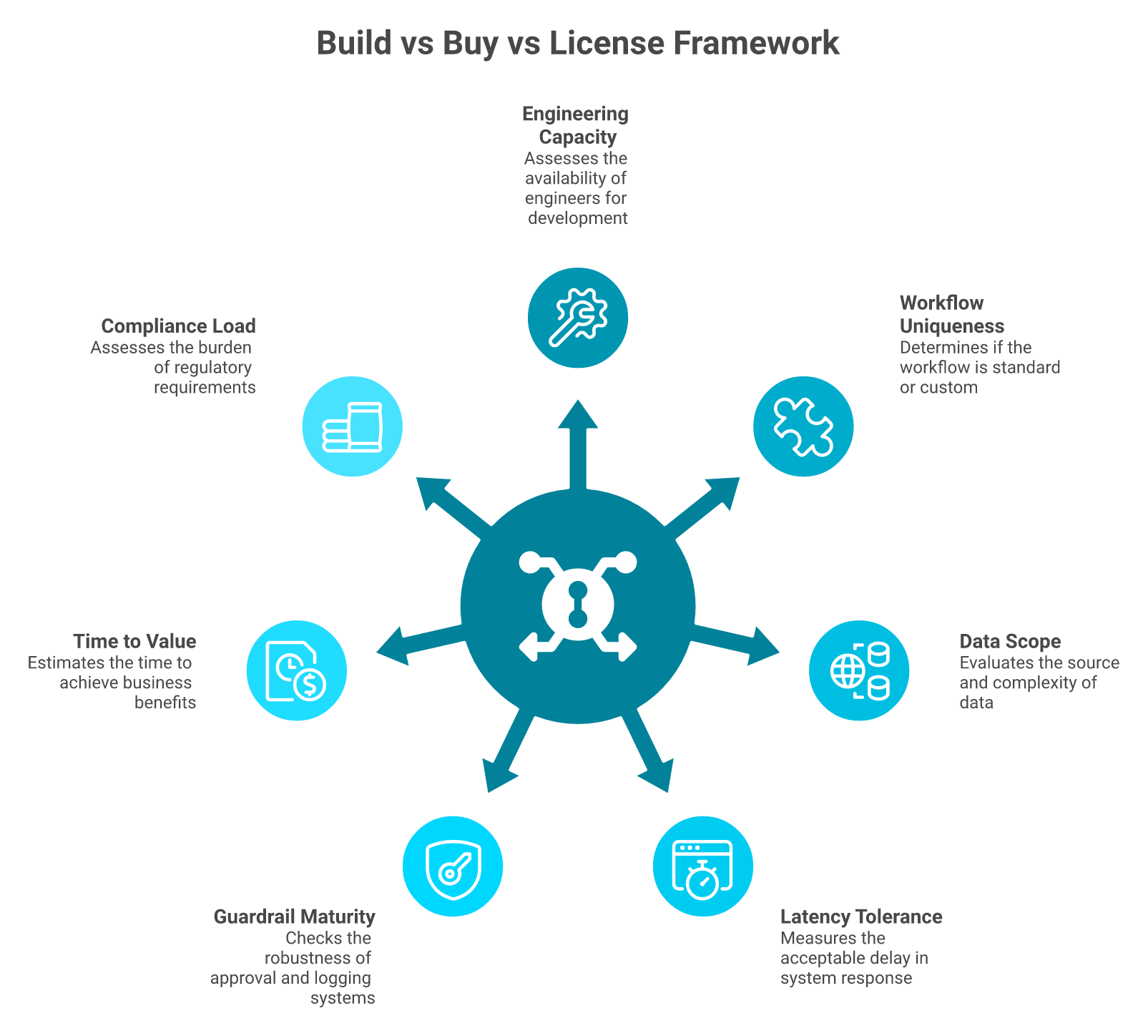
Score each option 0 to 2 on the seven criteria below. A total of 11 or higher means buy. A total of 7 to 10 means license a horizontal layer. A total of 6 or lower means you're not ready to ship anything. For founders evaluating where to point engineering hours, our breakdown of agentic AI for ecommerce founders is a useful companion.
We translate the seven-criterion build vs buy vs license framework into one scoring view operators can apply against any agent decision.
Engineering capacity. Do you have two engineers free for 90 days? A Shopify community thread flagged that MCP "requires GraphQL and AI expertise to wire up properly".
Workflow uniqueness. Is this workflow your wedge or a commodity? Cart recovery is commodity. A custom merchandising algorithm might be wedge.
Data scope. Does the agent need just Shopify, or Shopify plus Meta plus Xero plus 3PL? Single-source = vertical buy. Multi-source = horizontal layer.
Latency tolerance. Buyer-facing agents need sub-second response. Ops agents can run on 5-minute loops.
Guardrail maturity. Shopify mandates human-in-the-loop for any purchase action. Are you ready to log every approval?
Time to value. Vertical agents ship in 2 weeks. UCP builds usually take 3 to 6 months.
Compliance load. GDPR, PCI, and Shopify's agent terms all apply. ⚠️ A solo founder build is a compliance liability waiting to happen.
Where Each Archetype Scores
Build, Buy, or License: Where Each Path Wins
Path
Best For
Time to Value
Engineering Load
Guardrail Burden
Build on UCP/MCP
True wedge workflow, in-house team
3 to 6 months
High
High, you own it
Buy vertical agent
Support, cart recovery, returns
2 weeks
Low
Vendor-managed
License horizontal layer
Cross-source reasoning, alerts
1 to 4 weeks
Low
Shared
The Reddit Receipt
Operators are split. One r/Shopify thread reports MCP "offers really basic functionality" today and needs custom plumbing for richer queries. Another r/ShopifyeCommerce thread says, "if you set up a fresh Shopify store, this is basically a 1-click process". ✅ Translation, simple use cases are plug-and-play, real workflows are not. To stress-test your stack assumptions, our e-commerce tech stack guide is worth a read.
"Shopify's MCP offers really basic functionality. We on the other hand work closely with stores to make general item queries more robust." u/anonymous_dev, r/shopify Reddit Thread
The Meta-Insight
The real question isn't "build or buy". It's "where does our $300K of engineering time return the most P&L?" After looking at thousands of DTC P&Ls, what jumps out is that the answer is almost never customer support. ✅ Buy the commodity, build the wedge. If you want a deeper view of where Luca fits as a horizontal layer, read Meet Luca AI.
Q6: How Do You Orchestrate Multiple Agents Without Losing Control? Guardrails, Grounding, and Hand-off [toc=6. Orchestration and Guardrails]
Orchestration separates a demo from production. Each agent needs grounding (RAG, retrieval-augmented generation, over policy and order data), tool permissions (read-only versus write to OMS), explicit escalation SLAs, and an audit log every CFO can read. AWS and Bedrock contextual-grounding patterns now ship with thresholdable hallucination filters, and Shopify mandates human-in-the-loop for any purchase action.
The Capability Statement
Agent orchestration is the rulebook your agents follow when nobody is watching. ✅ Without it, "AI" is just confident hallucination at scale. For founders thinking about how reasoning and capital plug together, see what is Luca AI, the AI Co-Founder for e-commerce explained.
How Orchestration Actually Works
The pattern that survives production is planner, tool-use, critic, and human-in-the-loop. The planner decides next action. The tool-use layer calls APIs with permissioned scope. The critic reviews the output against policy. The human approves anything risky.
Shopify's July 2025 update bans fully automated purchases by external agents, requiring final human review before checkout. That's not a suggestion. It's the new default for any buy-for-me flow. For a Shopify-specific deep dive, see Shopify's Winter '26 AI Sidekick.
Five Things Your Orchestrator Must Detect
Off-policy refunds. Agent tries to refund outside your 30-day window.
Price drift over threshold. Agent proposes a discount above your margin floor.
OOS overrides. Agent promises stock that the OMS says is gone.
Large discount approvals. Anything above $X kicks to a human queue.
PII exfiltration. Agent never writes customer email or address to a log.
Why It Matters
IrisAgent reports 60% plus resolution rates only because its agents are grounded against live policy and order data. Without grounding, deflection just means the customer was confidently misled. AWS Connect's AI guardrails framework now ships threshold controls for relevance and grounding, with separate filters for sexual content, violence, hate, and prompt attacks. ⚠️ If your vendor can't show you their guardrail config, that's the answer. To see how Luca handles cross-source grounding, our how AI can actually help you run your e-commerce business piece walks through it.
The Comparison Anchor
An orchestration layer is to agents what a CFO is to interns. Bright, fast, occasionally dangerous, and they need rules in writing. The "manual shudder" of Monday Excel exports gets replaced by an audit log of every agent action over the weekend.
I could be off here, but my read is that 2026 is the year orchestration becomes the actual product. The agents themselves are commoditizing. The wrapper that keeps them safe isn't.
Q7: Integration Patterns: How Do Agents Plug Into Shopify, Meta, Klaviyo, Gorgias, OMS, and Your Warehouse? [toc=7. Integration Patterns]
Two patterns dominate. "Agent-on-top" reads from Shopify, Meta, Klaviyo, and OMS through APIs, and writes back through UCP and helpdesk hooks. "Agent-in-place" lives inside the existing tool (Gorgias's AI Agent only acts within the Gorgias helpdesk, for instance). Most scaling brands run a hybrid, vertical agents inside support tools, plus a horizontal layer that reasons across the rest.
A Monday in the Life of an Agent Stack
Here's how a $20M DTC brand actually runs its agent stack on a normal Monday. For founders comparing analytics layers in this stack, our ecommerce analytics platforms guide is a useful reference.
07:30 AM, cross-stack alert. A horizontal layer reads Shopify orders and Meta ad spend, pings Slack, "MER (Marketing Efficiency Ratio, revenue divided by ad spend) dropped 22% over the weekend on Campaign 14".
09:00 AM, cart recovery on WhatsApp. UnleashX agent pings 412 abandoned carts with order-aware context, and recovers 38 of them by lunch.
11:00 AM, WISMO from OMS. Gorgias AI Agent resolves 187 order-status tickets autonomously, grounded on live 3PL data.
02:00 PM, restock recommendation. Agent reads inventory plus 90-day velocity, drafts a PO for the hero SKU, and queues it for founder approval.
04:00 PM, vendor agent action. Klaviyo AI runs a churn-risk segment, builds a winback flow, and ships it pending approval.
05:00 PM, weekly digest in Slack. Horizontal layer pushes a Monday recap, ROAS by channel, cash position, and top 3 anomalies.
Why the Hybrid Wins
Agent-in-place is fast to deploy, but blind beyond its tool. Gorgias agents only act inside Gorgias. Klaviyo agents only see lifecycle. ❌ Neither sees marketing, finance, and ops together. Founders weighing this tradeoff often pair this read with best AI tools for Shopify owners.
Agent-on-top is harder to deploy, but reads across silos. The question becomes, "which layer earns its seat in your stack?" Most $5M+ brands run both, vertical agents for execution, and horizontal for reasoning.
"I provide it with read and write permissions, but I'm planning to switch to just 'read' access due to numerous alarming accounts of data loss." u/Adapowers, r/shopify Reddit Thread
"Gorgias is the conversational AI platform designed for ecommerce brands, driving sales and resolving support inquiries throughout the entire customer journey." Gorgias Vendor Profile Gorgias G2 Verified Review
The Contrast Close
Before, 4 hours across 6 tools, and 2 decisions delayed pending more data. After, 22 minutes of approvals, 3 decisions shipped, and capital deployed where the math says scale. ✅ That's the hybrid stack working.
In our work with bootstrapped Shopify operators, the failure mode is always the same. They buy the agent before they wire the data. The agent then guesses, and the founder loses trust in 14 days. To wire data first, see our Shopify analytics guide.
Q8: The 2026 Vendor Landscape: Fin, Gorgias, Rep AI, Shopify Inbox, IrisAgent, UnleashX, Bayezon, Who Plays Where? [toc=8. 2026 Vendor Landscape]
Today's vendor map splits cleanly into four rows: support agents (Gorgias, Fin, IrisAgent, Crescendo, Decagon), storefront and conversion agents (Rep AI, Shopify Inbox, Bayezon), recovery and lifecycle (UnleashX, Klaviyo AI), and agentic analytics layers (Luca AI). Each row solves a different problem. ⚠️ Confusing them is how operators end up paying for three agents that overlap.
The Comparison Context
Operators rarely fail at vendor choice within a row. They fail by buying two rows that don't talk to each other. A support agent and a storefront agent live in different windows of the customer journey, and stitching them is the founder's job, not the vendor's. Our roundup of the best e-commerce analytics tools that fund your campaigns covers the analytics row in detail.
The 2026 Landscape Map
2026 Ecommerce Agent Vendor Landscape by Workflow Row
Workflow Row
Lead Vendors
Strength
Limitation
Support agents
Gorgias, Fin, IrisAgent, Crescendo, Decagon
Tier-1 ticket deflection, grounded on store data
Limited reasoning beyond support inbox
Storefront and conversion agents
Rep AI, Shopify Inbox, Bayezon
Guided sessions, RPV lift, MCP-native
Doesn't see finance or inventory
Recovery and lifecycle agents
UnleashX, Klaviyo AI, Manychat
Cart recovery, winback, segmentation
Channel-specific, weak cross-source view
Agentic analytics layer
Luca AI
Cross-source reasoning across Shopify, Meta, and Xero, push reports to Slack and email
Not a support inbox, not a checkout
Honest "Who Should Choose What"
Choose Gorgias or Fin if Tier-1 deflection is your bottleneck. Fin reports 67% average resolution rate across 7,000+ customers, and Gorgias data shows median 10% with top brands at 15 to 20%. ✅ Pick by your existing helpdesk, not by deck polish.
Choose Rep AI or Shopify Inbox if your storefront conversion is the constraint. Rep AI holds 4.9 on G2 with reviewers citing "ROI since the first week".
Choose UnleashX or Klaviyo AI if cart recovery and lifecycle are the gap. Choose Luca AI if your problem is, "I open six dashboards before I can answer one question", and you want an AI layer over your data warehouse that extracts, predicts, simulates, root-causes, and pushes scheduled reports to Slack and email. For analytics-tool benchmarking, our best Shopify analytics apps roundup helps narrow the field.
"Super impressive autonomous agent. Fast to spin up. The tradeoff is limited transparency, you can't always see why it decided what it decided." u/anon_cx_lead, r/customerexperience Reddit Thread
"I've been using Rep AI for over a year, and I'm very happy with the features. We've seen a solid ROI since the first week." Verified User Rep AI G2 Verified Review
A r/customerexperience thread on Decagon, Sierra, Fin, and Zendesk landed with a useful warning, evaluate each tool using genuine customer inquiries from your inbox, not the vendor's sandbox. Demos lie. Your last 200 tickets don't. For a Luca-specific deep dive on this evaluation pattern, see what is an AI Co-Founder for e-commerce.
Q9: Where Does an Agentic Analytics Layer Like Luca AI Fit, and How Does It Compare on Analytics Capability? [toc=9. Agentic Analytics Layer]
Luca AI is an AI layer over your data warehouse. It extracts the relevant slice for the question asked, predicts using historical patterns, simulates what-ifs, root-causes anomalies, identifies influencing components, and proactively pushes customised reports to Slack and email on a schedule you set. It is not an attribution tool, and it is not a chatbot wrapper. For the full thesis, read what is Luca AI, the AI Co-Founder for e-commerce explained.
The Capability Statement
Luca's job is to be the AI layer over your warehouse. ✅ You ask in plain English, and it pulls the right slice and explains the why behind the number.
The category readers are usually shopping in is ecommerce analytics, business analytics, marketing analytics, financial analytics, customer analytics, website and UX analytics, operations analytics, sales analytics, competitive analytics, and fraud and risk analytics. Luca sits on top of all of them as one reasoning layer. To benchmark this against legacy tooling, see our roundup of ecommerce analytics platforms.
How It Actually Works
Luca normalises and standardises data on ingestion. Skip the data-cleanup year. ✅ Plug in, ask, act.
No SQL. No analyst. No dashboard-building. ✅ Most analytics tools added AI. Luca is AI. To see how this compares to dashboards founders already pay for, our breakdown of the Shopify analytics dashboard explained is worth a read.
Five Detected Capabilities
Extraction. Pulls the relevant data slice from a pool of tables to answer a specific question.
Prediction. Forecasts based on historical patterns across months and years of your store data.
Simulation. Models what-ifs ("if I shift $20K from Meta to TikTok, what changes?") before you commit spend.
Root-cause analysis. Identifies the influencing components when a metric breaks pattern.
Optimisation areas. Surfaces well-performing zones and underperforming ones, so you know where to push.
Push-Reporting Agent Behaviour
Luca's agentic side is the scheduled side. ⏰ Tell it, "send me a CAC (Customer Acquisition Cost) report every Monday with Meta, Google, and attribution-adjusted channel cost", and it ships graphs, reasoning, and recommendations to Slack or email automatically. For founders concerned about platform-reported numbers, our piece on declining platform ROAS vs true profitability is a useful companion.
It also runs as a sentry. Ask it to alert when ROAS drops 5%, when inventory falls below 500 units, or when CS ticket volume spikes outside seasonal pattern. ✅ Cohort-level vigilance, without the cohort-level dashboard.
Comparison Anchor on Analytics Depth Only
Triple Whale, Northbeam, and Polar Analytics ship strong attribution dashboards. ❌ Operators on Trustpilot have repeatedly flagged "broken integrations" and "fake attribution for external marketplaces" on Triple Whale, with daily revenue totals reportedly inaccurate for weeks. For a fuller landscape view, see Triple Whale alternatives.
Lifetimely and Daasity ship strong cohort and LTV (Lifetime Value) reporting, but readers still have to write the question and read the chart. ❌ Looker and Tableau need a data team to build the dashboard before anyone reads it.
"Broken integrations, fake attribution for external marketplaces. Daily revenue totals are wrong, entire order blocks are missing." XTRA FUEL Triple Whale Trustpilot Verified Review
Luca's analytics edge isn't a prettier dashboard. ✅ It's that the question, the data, and the reasoning live in one chat, and the report writes itself on schedule.
I could be off here, but my read is that the founder who reaches for Luca isn't replacing Triple Whale. ✅ They're replacing the junior analyst they were about to hire. To compare analytics tooling that funds campaigns, see our roundup of the 7 best e-commerce analytics tools that fund your campaigns.
Q10: When the Workflow Needs Capital: How Should You Compare Funding on Rate, Disbursal Speed, and Terms? [toc=10. Comparing Capital Terms]
If an agent surfaces a restock or scaling opportunity that needs cash, evaluate funding on the metrics that matter, effective rate (fee on the advance), disbursal time, repayment structure (% of revenue versus fixed term), personal-guarantee requirement, and whether terms re-price as your business performance changes. 💰 Wayflyer typically disburses in 24 to 72 hours. Luca AI underwrites against live store performance for fast, dynamically-priced capital. For a deeper view, read our Luca AI vs Wayflyer comparison.
The Comparison Context
Capital is not analytics. The reader who lands here wants rate, speed, and terms. ❌ Anyone selling you on "intelligence + capital combined" is changing the subject.
Wayflyer's Approach and Limits
Wayflyer offers funding in 24 to 72 hours, and pulls a fixed percentage of revenue until paid back. The Trustpilot pattern, though, is operator frustration with terms shifting after approval. ❌ Multiple founders report being approved in writing, then reversed at the last minute or denied on follow-up rounds despite no missed payments. For the full alternative set, see Wayflyer alternatives.
"After being offered funding in writing, with specific amounts, repayment terms, and confirmation that the deal was approved, Wayflyer abruptly reversed their decision at the last minute." Geoff Brand Wayflyer Trustpilot Verified Review
"I have used Wayflyer on a number of occasions to help with Q4 stock purchasing only to be told we no longer fit their criteria. Given we have used them multiple years running, this was incredibly disappointing." Joshua Hannan Wayflyer Trustpilot Verified Review
Clearco, 8fig, and Uncapped Patterns
Clearco operators report effective APRs around 35 to 40% with weekly repayment schedules. ❌ A verified Clearco customer flagged, "they pulled funds far faster than the contract stated, thereby increasing the effective interest rate significantly". Uncapped operators flag last-minute funding cuts after signing 7-figure agreements. For deeper coverage, see Clearco alternatives.
"We signed a 3M loan deal, only for them to come back two weeks later saying, our C-suite decided to focus on Amazon deals, and slashing our funding to 1M. Then, months later, right as we hit our 5% EBITDA margin, they cut it again to 350K." Xin Shui Uncapped Trustpilot Verified Review
Luca's Capital Approach on Metrics Only
💰 Luca underwrites against live store performance, not a 60-day-old application. Disbursal is fast, terms re-price as business health changes, and there is no personal guarantee required. To see how this aligns with cash planning, read forecast cash flow for e-commerce.
The Capital Comparison
Capital Comparison Across Funding Providers
Capital Metric
Wayflyer
Clearco
8fig
Luca AI
Effective Rate
Fixed fee on advance, varies
Reported 35 to 40% APR
Reported up to 100% APR by operators
Dynamic, indexed to live performance
Disbursal Time
24 to 72 hours
Days to weeks per operator reports
Variable, with reported delays
Fast, in-chat
Repayment
% of daily revenue
Weekly debit
Cycle-based, often re-priced
Aligned to revenue and performance
Personal Guarantee
UCC filing reported by operators
Direct debit, no PG
Cycle-based, no PG
No personal guarantee
Re-pricing
Static at offer
Static at offer
Reported re-pricing mid-cycle
Dynamic, real-time
Min Revenue
~$200K annual typical
~$10K monthly typical
~$50K monthly typical
Live store data based
Who Should Choose What
Choose Wayflyer if you need a one-shot advance and have one platform. Choose Shopify Capital if your sales sit entirely on Shopify and you accept fixed-fee terms. ⚠️ Avoid stacking Clearco with another MCA, the weekly debit math compounds fast.
Choose Luca for capital if you want terms that move with your business, no personal guarantee, and disbursal that doesn't require a 6-week back-and-forth. 💰 The question isn't who has the slickest sales rep. It's who's still standing by you in month nine. For a structured view of working-capital needs, see calculating working capital for ecommerce business needs.
Q11: How Do You Measure ROI From Agents, Beyond Vanity Deflection Numbers? [toc=11. Measuring Agent ROI]
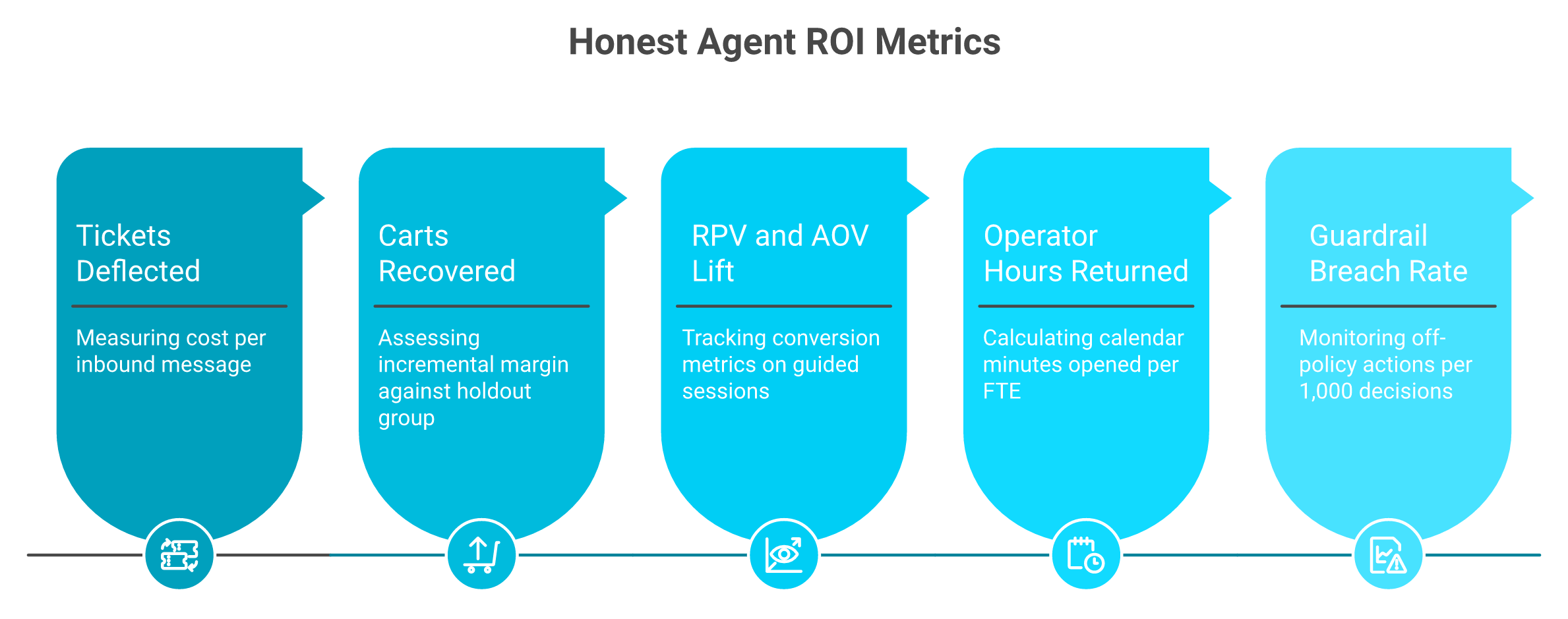
Honest agent ROI rests on five lines, tickets deflected times cost per ticket (Gorgias data benchmarks human-handled tickets at $1.00 to $7.35 per inbound message), carts recovered times incremental margin, RPV/AOV lift on guided sessions, operator hours returned, and guardrail breach rate. Anything outside this is a vendor case study, not a P&L line. For unit-economics framing, see our guide to the best way to track e-commerce unit economics.
The Audit Frame
We replace vanity deflection numbers with five P&L-linked lines, so agent ROI gets evaluated on what actually moves the business.
Score your agent stack against these eight criteria. ✅ Score yourself honestly, not the way the vendor scored their pitch deck.
The 8-Item Agent ROI Checklist
☐ Incrementality test. Have you A/B tested cart-recovery agent on versus off, with a holdout group?
☐ Attribution windows. Are you only crediting recoveries inside a 24-hour window, or stretching to 7 days and double-counting?
☐ Grounded vs hallucinated answer rate. What % of agent answers are tied to live policy and order data?
☐ Cost per resolved ticket. Are you under $1.75? Top CX teams sit between $1.00 and $1.50 per inbound message.
☐ Agent uptime. When the agent goes down, what's the SLA, and how fast does it fail over to humans?
☐ Hours returned per FTE. Has any team member's calendar actually opened up, or did the work just shift?
☐ Guardrail breach rate. How many off-policy actions per 1,000 agent decisions?
☐ Escalation SLA. When the agent hands off, how long does the human queue take?
Three-Tier Score Interpretation
6 to 8 boxes checked. Mature, focus on incremental optimisation.
3 to 5 boxes. Critical gaps, you're flying on vendor-supplied numbers.
0 to 2 boxes. ⚠️ You're tracking deflection without a denominator, the agent could be hurting CSAT.
Gap Coverage
Most agent vendors quote deflection without telling you the denominator. ❌ "60% of tickets resolved" means nothing if the other 40% are now 4-touch escalations that cost more than the original. To see how Luca closes this measurement gap, read Meet Luca AI.
The Influx benchmark across 20+ Gorgias accounts is the cleanest receipt I've seen. Median AI resolution sits at 10%, top quartile at 15 to 20%, and only one brand crossed 50%. ✅ Treat 15% as good, 20% as excellent, and anything above 30% as suspicious until you see the CSAT.
"AI resolution rates across the dataset range from 0% to 51%, with a median of 10%. Most high-performing teams sit in the 8 to 15% range." Influx, Gorgias AI Performance Benchmarks 2026 Influx Source
"Super impressive autonomous agent. Fast to spin up. The tradeoff is limited transparency, you can't always see why it decided what it decided." u/anon_cx_lead, r/customerexperience Reddit Thread
Next Step
Run a 30-day holdout test on your top workflow before signing the annual contract. ✅ If the vendor refuses, that is your answer. For analytics-led ROI tracking, see our piece on AI for e-commerce cash flow forecasting.
Q12: What Comes Next for Agents in Ecommerce, and What Should You Ship in the Next 30 Days? [toc=12. What Comes Next]
By 2027, expect agent-to-agent commerce over Shopify's UCP, GEO (Generative Engine Optimization) replacing classic SEO on PDPs, and tighter Shopify guardrails on autonomous purchases. Practical 30-day plan, pick one workflow (cart recovery is safest), instrument grounding and one guardrail, ship in two weeks, measure incrementality, then expand to a second workflow. For the foundational read, see agentic AI for ecommerce founders.
Three Trends Worth Watching
Agent-to-agent commerce. Shopify reports AI-attributed orders grew 11x year-on-year. By 2027, your merchant agent will be negotiating with a buyer's shopping agent over UCP, not chatting with a human.
GEO replaces SEO on PDPs. Optimisation moves from Google's algorithm to "what does ChatGPT recommend when asked for a beard balm under $25?". Storefronts that don't expose clean catalog data through MCP get skipped. For the merchant-cost angle, see ChatGPT 4% fee starting Jan 2026, what smart merchants do now.
Tighter guardrails. Shopify's July 2025 ban on fully automated purchases is the floor, not the ceiling. Expect mandatory disclosure and audit trails for any agent action by 2027. For the platform-level update, see Shopify's Winter '26 AI Sidekick.
Your 30-Day Shipping Checklist
Day 1 to 5. Pick one workflow. Cart recovery is the safest first ship.
Day 6 to 10. Instrument grounding. The agent should only quote policy and order data from live sources.
Day 11 to 14. Set one guardrail. Discounts above 15% kick to a human.
Day 15 to 21. Ship to 50% of traffic with a holdout. Measure incremental recovery.
Day 22 to 30. Review CSAT, breach rate, and dollar impact. ✅ Expand or roll back.
What I'm Thinking About Next
The shift from siloed data to agentic intelligence is bigger than the move from paper and fax to digital computers in the 1980s. ⏰ The brands shipping their first agent this quarter are the ones whose 2027 P&L will look unrecognisable to their 2025 selves. For the founder-side framing, read what is an AI Co-Founder for e-commerce.
What I keep wondering is whether the winners will be the operators who built their own agent stack, or the ones who licensed a horizontal layer and spent their engineering hours on product. My current bet is the second group. Tell me where you're spending yours, and I'll share what we're seeing in pilot data this quarter. To go deeper on the thesis, read the intelligence capital thesis.
FAQ's
What are agents for ecommerce, and how are they different from chatbots or copilots?
An ecommerce agent perceives store data, decides a next action, and executes that action through tools. It can complete a checkout via Shopify's Universal Commerce Protocol, recover a cart on WhatsApp, or rebalance inventory inside your OMS.
Chatbot: answers in natural language, no tool use.
Automation: fires a fixed action on a fixed trigger.
Copilot: drafts on user request, never acts unattended.
Agent: plans, reasons, and acts across multiple tools, often unattended.
The category became real in July 2025, when Shopify formalised guardrails banning fully automated purchases without human review. Two camps matter: buyer-side agents that shop on a consumer's behalf, and merchant-side agents that run your store. We unpack the merchant-side use cases in our deep dive on agentic AI for ecommerce founders, where we map the workflows that actually move a P&L line versus the noise that doesn't.
Which ecommerce workflows have actually crossed the agent threshold in 2026?
Seven workflows are production-ready right now, with operator benchmarks behind each one.
Conversational storefront, guided sessions and RPV lift.
Catalog enrichment, attribute backfill feeding Shopify's Global Catalog.
Cart recovery, ~40% recovery on WhatsApp agent flows reported by operators.
WISMO, 15 to 20% top-quartile autonomous resolution on Gorgias.
Returns and exchanges, top CX teams under $1.75 per inbound message.
Inventory replenishment, months of slotting and forecasting work saved on internal Claude or Copilot builds.
Pricing and merchandising, agentic pricing flagged as a near-term margin lever.
We recommend picking three to four, not all seven, in your first 90 days. Cart recovery is usually the safest first ship because failure modes are bounded and incremental dollars are easy to measure. For a fuller stack view, see our analysis of the best AI tools for Shopify owners.
Should we build agents on Shopify UCP/MCP, buy a vertical agent, or license a horizontal layer?
The decision rests on seven criteria, scored 0 to 2 each.
Engineering capacity, two engineers free for 90 days?
Workflow uniqueness, wedge or commodity?
Data scope, single-source or cross-source?
Latency tolerance, sub-second or 5-minute loops?
Guardrail maturity, can you log every approval?
Time to value, weeks or months?
Compliance load, GDPR, PCI, Shopify agent terms.
Total 11 or higher means buy. 7 to 10 means license a horizontal layer. 6 or lower means you are not ready to ship anything yet. Cart recovery and support deflection are commodities, license or buy them. A custom merchandising algorithm tied to your brand voice is a wedge, build it. We outline the underlying logic in our piece on the intelligence capital thesis, where engineering hours get matched to P&L return.
How should we measure agent ROI without falling for vanity deflection numbers?
Honest agent ROI rests on five lines that map directly to a P&L.
Tickets deflected times cost per ticket, top CX teams sit between $1.00 and $1.50 per inbound message.
Carts recovered times incremental margin, measured against a holdout group, not a vendor average.
RPV or AOV lift on guided sessions, the only conversion metric that respects traffic value.
Operator hours returned per FTE, calendar minutes that actually opened up.
Guardrail breach rate, off-policy actions per 1,000 agent decisions.
The Influx benchmark across 20+ Gorgias accounts pegs median AI resolution at 10%, top quartile at 15 to 20%, and only one brand crossed 50%. Treat 15% as good and anything above 30% as suspicious until you see CSAT. We go deeper on incrementality and cash math in our guide to the best way to track e-commerce unit economics.
When an agent surfaces a capital need, how should we compare funding from Wayflyer, Clearco, 8fig, and Luca AI?
Evaluate capital strictly on the metrics that move a balance sheet.
Effective rate, Clearco operators report 35 to 40% APR, 8fig customers report up to 100% APR.
Disbursal time, Wayflyer typically 24 to 72 hours, Luca AI underwrites against live store performance for fast in-chat capital.
Repayment structure, percentage of revenue versus weekly fixed debit.
Personal guarantee, some providers file UCC, Luca requires no personal guarantee.
Re-pricing flexibility, static at offer or dynamic with performance.
Trustpilot patterns matter: operators repeatedly flag last-minute reversals, post-funding silence, and surprise debits. The right capital partner is the one still standing by you in month nine, not the one with the slickest sales rep. We compare options head-to-head in Luca AI vs Wayflyer, with deeper context in our roundup of Wayflyer alternatives.
Enjoyed the read? Join our team for a quick 15-minute chat — no pitch, just a real conversation on how we’re rethinking Ecommerce with AI - Luca
Loading Schedule...
Your AI Co-Founder is here.
Here’s why:
Shopify, Meta, Xero - one brain.
"Should I scale?" Answered with real data.
Growth capital. No applications. One click.
Thank you! Your submission has been received! Please book a time slot for the Meeting
Oops! Something went wrong while submitting the form.