9 Best AI-Native Data Platforms for Ecommerce — Warehouse-Native, Vertical and Agentic Players Compared
13
mins read
TL;DR
An AI-native data platform puts agents at the centre of the operating model rather than adding a copilot on top of dashboards you still have to read.
Seven tests separate real from AI-washed: stable identity, enforced data contracts, freshness SLA, auditable delivery, agent autonomy with review, chat and API parity, and no data copy.
The nine platforms split into three honest cohorts: agentic-first with Luca AI, vertical ecommerce with Triple Whale, Daasity, and Peel, and warehouse-native with Kubit, Mitzu, Polar, Snowflake, and Databricks.
Gross margin is the lie behind most bad scaling decisions, because eight costs sit between the supplier invoice and real profit, and no marketing-only tool sees them.
No architecture fixes attribution, since practitioner reports still leave 15 to 30 percent of Meta conversions unmatched on iOS-heavy audiences.
Under $1M GMV, stay on native reporting. Between $1M and $50M, agentic-first wins. Above $50M with an engineer, warehouse-native genuinely wins.
Q1. What Are the 9 Best AI-Native Data Platforms for Ecommerce in 2026? [toc=1. 9 Best Platforms]
The nine best AI-native data platforms for ecommerce in 2026 are Luca AI, Polar Analytics, Triple Whale, Daasity, Peel Insights, Kubit, Mitzu, Snowflake Cortex AI, and Databricks. Luca AI leads because it is an AI reasoning layer over your unified store data that answers plain-English questions, finds root causes, and pushes its own reports, rather than a dashboard with a copilot attached.
I picked these nine after sitting with operators in the $1M to $50M range and watching which tools actually got opened on a Tuesday. Four of them are genuinely agent-first. The rest are strong data infrastructure with a chat box added later, and that difference decides whether you get answers or another tab to maintain. Prices below are the published entry points, and every one of these vendors scales with your GMV or your compute, so treat the low number as the floor, not the bill.
Dedicated Snowflake warehouse, 45+ connectors, custom BI dashboards, attribution, and Klaviyo audience sync
Omnichannel brands above $5M GMV wanting owned data
$720/mo to $7,970/mo (GMV bands)
Triple Whale ⭐⭐⭐⭐
Triple Pixel first-party tracking, multi-touch attribution, MMM, Moby AI agents, and creative analytics
Paid-social heavy DTC brands scaling ad spend
$219/mo to $4,199/mo (GMV bands)
Daasity ⭐⭐⭐⭐
ELT into your warehouse, ecommerce data models, Looker or Sigma layer, and wholesale and retail blending
Brands with real offline or B2B revenue
Custom quote
Peel Insights ⭐⭐⭐
Automated cohort and retention analytics, RFM segments, product affinity, and Shopify-native setup
Subscription and repeat-purchase brands
Custom quote
Kubit ⭐⭐⭐⭐
Agentic digital analytics run directly on the warehouse, no data copy, and funnel and journey analysis
Teams that already own a warehouse and want no duplication
Quote-based
Mitzu ⭐⭐⭐
Warehouse-native product analytics, natural-language querying, and SQL-free funnels on existing tables
Lean teams with BigQuery or Snowflake already live
Quote-based
Snowflake Cortex AI ⭐⭐⭐⭐
Cortex agents, semantic views, text-to-SQL, governance through Horizon, and in-warehouse LLM functions
SQL-first teams building their own agents
Consumption-based credits
Databricks ⭐⭐⭐⭐
Agent Bricks, Unity Catalog governance, Lakebase, and custom ML training on lakehouse data
Python and engineering teams training custom models
Consumption-based DBUs
1. Luca AI [toc=1.1 Luca AI]
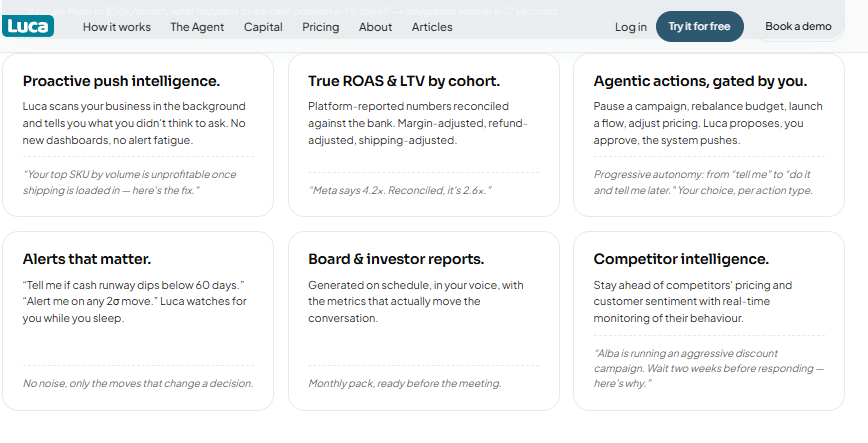
Luca AI pushes reconciled insights, alerts, and gated agentic actions without new dashboards to open.
🧠 Why did we choose this tool?
I put Luca AI first, and I built it, so read this with that in mind. The honest reason it opens the list is architectural, not promotional. Luca AI was designed as a reasoning layer from day one, so the answer arrives as an explanation, not a chart you still have to interpret.
Most analytics tools added AI. Luca is AI. That single sentence is the whole test I applied to every other platform below, and only three of the nine passed it cleanly.
📊 Core capability metrics
Data sources connected: 200+ native connectors across commerce, ads, email, accounting, 3PL, and support
Warehouse posture: Managed, with normalization and standardization done at ingestion
AI interface: Plain-English chat, no SQL, and no dashboard building
Proactive alerting: 24/7 anomaly scanning pushed to Slack, email, or the mobile app
Entry price: €299 per month
✅ Best for
Shopify or WooCommerce stores between roughly $1M and $50M in annual revenue
Teams with piled-up data, no analyst, and no budget for a data engineer
Luca AI is not an attribution pixel and does not replace one. If your core problem is Meta match rates, buy an attribution tool first. Enterprises with an in-house data team also get less out of it, because they already own the layer it provides.
The problem. A European skincare brand doing roughly €3M annual GMV ran Shopify, Meta, Klaviyo, and Xero in four tabs. Their best-selling serum showed 71% gross margin. Reporting took two days and three pivot tables every month.
How Luca AI helped. Luca AI connected all four sources and normalized SKU and channel naming on ingestion, so no ecommerce data integration cleanup project was needed. The founder asked, in plain English, which products actually made money after shipping, returns, discounts, payment fees, and paid acquisition.
The outcome.Contribution margin on the hero serum came back in single digits once returns and Meta spend were loaded in. Two SKUs were repriced, and one was cut. Monthly reporting dropped from two days to a Monday morning alert that arrives before anyone logs in.
2. Polar Analytics [toc=1.2 Polar Analytics]
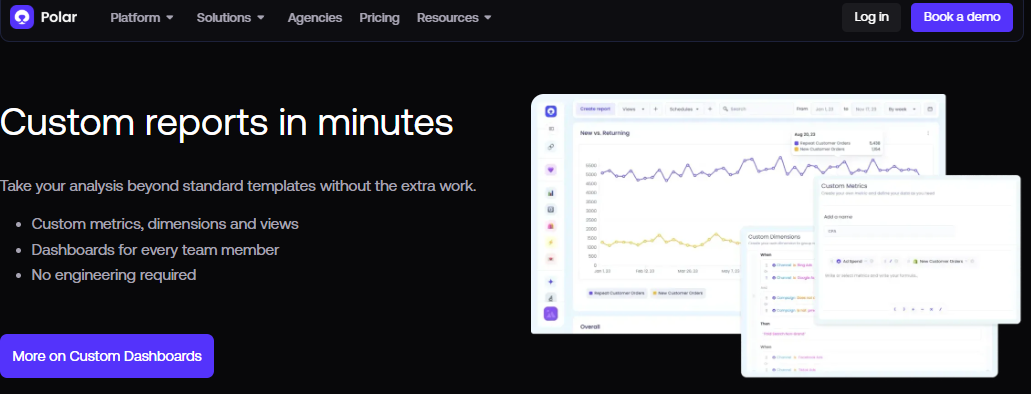
Polar Analytics builds warehouse-native custom dashboards for every team member without engineering work.
🏗️ Why did we choose this tool?
Polar Analytics earns its place because it hands you a dedicated Snowflake warehouse instead of locking your data inside its own store. That matters when you outgrow the vendor and want to keep the tables. It is the strongest warehouse-native option built specifically for ecommerce.
The trade-off is money and effort. Entry sits at $720 per month for brands under $5M annual GMV, and pricing climbs with GMV rather than seats, reaching roughly $2,770 per month in the $20M to $25M band. Incrementality testing is a separate add-on at around $3,200 per month standalone.
📊 Core capability metrics
Data sources connected: 45+ connectors across commerce, ads, email, and retail
Warehouse posture: Dedicated Snowflake instance, data stays queryable by you
AI interface: AI agents plus custom BI dashboards, with SQL access as a paid add-on
Proactive alerting: Scheduled reports and alerts, configured by the user
Entry price: $720 per month under $5M GMV
✅ Best for
Omnichannel brands above roughly $5M GMV that need governed, owned data
Brands blending Shopify with marketplaces, retail, or multiple storefronts
⚠️ Where it is the wrong choice
Below $3M GMV the entry price is hard to justify against the insight you get. It is also not plug-and-play, which the reviews below say more bluntly than I would. If that is your read too, the Polar Analytics alternatives worth shortlisting are covered separately.
💬 Reviews
Not impressed compared to price point. I believe this is a great product, and solves many problems for brands with more complex reporting. However, from the get go there were some discrepancy in the pricing. The pricing communicated when installing the app via Shopify was completely different from the one provided by sales after the installation (which was much higher) Maja, Verified Reviewer Polar Analytics TrustPilot Verified Review
Shortly after onboarding we were assigned an account manager. About a month later, she was laid off and we were never assigned a new account manager. I have the direct email of a support specialist, but the response time has been less than ideal, especially when real-time data is important for our team. Ben S., Director of Commercial Operations Polar Analytics G2 Verified Review
Luca AI takes the opposite bet on setup: normalization happens at ingestion, so the first useful answer arrives in days rather than after a dashboard-building phase. If you want the reasoning behind that architecture, it is documented in how Luca thinks and across the live use cases.
3. Triple Whale [toc=1.3 Triple Whale]
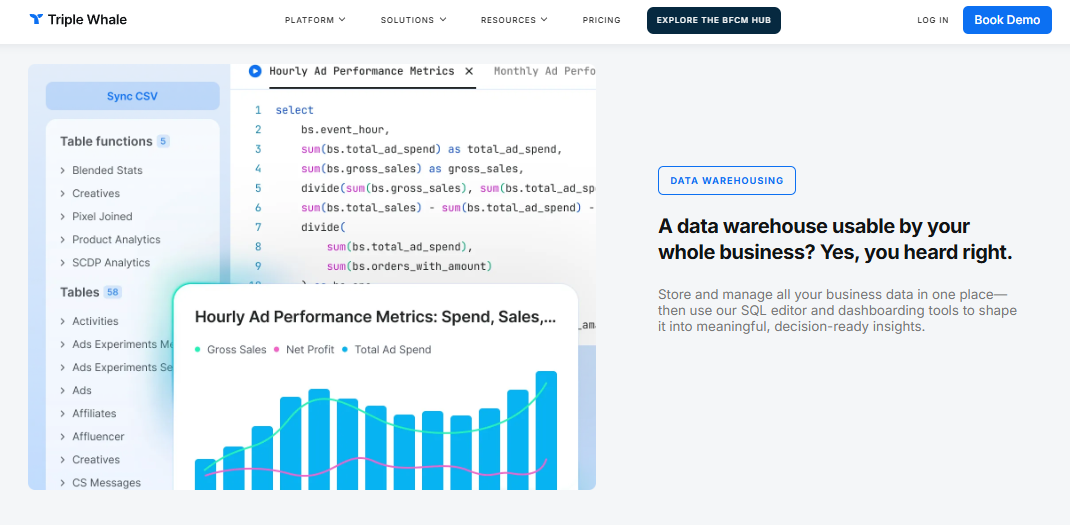
Triple Whale stores ecommerce data in one warehouse, then shapes it with SQL and dashboards.
🐋 Why did we choose this tool?
Triple Whale is on this list because it owns the paid-media half of the problem better than anyone else here. Its Triple Pixel collects first-party click and conversion data independently of the ad platforms. That is real infrastructure, not a wrapper.
The Moby agents also do genuine work. They run scheduled analysis and flag anomalies inside the marketing domain. What they cannot do is reason about your cash position, because Triple Whale does not connect to accounting or banking data.
📊 Core capability metrics
Data sources connected: Commerce, ad platforms, email, and SMS (no accounting or banking)
Warehouse posture: Managed vendor warehouse plus Triple Pixel first-party tracking
AI interface: Moby chat and Moby agents, scoped to marketing and commerce
Proactive alerting: Rule-based anomaly detection on marketing metrics
Entry price: From about $219 per month, scaling with GMV
✅ Best for
Paid-social-heavy DTC brands spending real money on Meta and TikTok
Growth leads who need creative-level performance data daily
Brands that already accept attribution is directional, not exact
⚠️ Where it is the wrong choice
Pricing climbs with GMV, and the Automate tier sits near $749 per month. Reviewers also report numbers that do not tally with Shopify, which matters if finance is the audience. If that gap is your dealbreaker, the Triple Whale alternatives comparison covers the options in depth.
💬 Reviews
Very useful for top down view for a very fast reporting. Supports and tracks many different platforms as well. almost a no brainer for pulling out stats quickly. However, some stats are not so accurate in pulling in data; they do not tally with shopify Verified user, 4/5 Triple Whale G2 Verified Review
Its very easy to use and works good for a multichannel solution. Sometimes it does not update the numbers correctly and has errors with synchronisation. Verified user, 3/5 Triple Whale G2 Verified Review
4. Daasity [toc=1.4 Daasity]
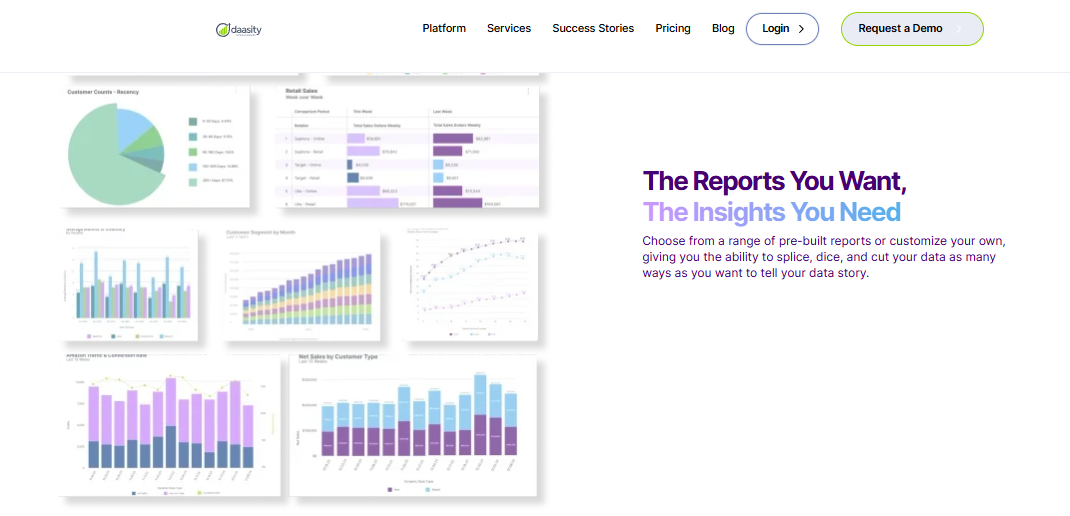
Daasity models DTC, wholesale, and retail data into pre-built reports you can customise.
🔗 Why did we choose this tool?
Daasity is the pick when your revenue is not only DTC. It moves data into your own warehouse and ships ecommerce-specific models on top. Wholesale, retail, and marketplace data land in the same schema as Shopify, which is the core of any real ecommerce omnichannel analytics setup.
That flexibility comes with a services relationship. Reviewers describe the Daasity team as teammates rather than a vendor, which is a compliment and a dependency at the same time.
📊 Core capability metrics
Data sources connected: Broad ELT connector set across commerce, ads, retail, and ERP
Warehouse posture: Your warehouse, with Daasity managing extraction and modelling
AI interface: BI layer through Looker or Sigma, not a native reasoning agent
Proactive alerting: Scheduled and exception reporting, mostly overnight refresh
Entry price: From about $3,499 per year on G2's listed entry tier
✅ Best for
Omnichannel brands with meaningful wholesale or retail revenue
Teams that want a warehouse but cannot hire two data engineers
Operators comfortable with a partner-led implementation
⚠️ Where it is the wrong choice
Ease of setup scores lowest among its rated dimensions on G2, at 7.0. If you want an answer this week, this is not the shape of tool you want, and the Daasity alternatives breakdown is the faster starting point.
💬 Reviews
There are a few platforms that are not yet automated (we market in a few unique channels), so at times there is manual entry to create an overall marketing performance. That said, Daasity has made progress in consistently adding more platforms into their automation. Finally, at times I wish a few reports would refresh in real time (they do overnight). Verified user Daasity G2 Verified Review
Daasity's suite of integrations makes ingesting and consolidating new data sources straightforward and efficient. This makes it easy to build a powerful data warehouse to answer our most challenging business questions. Dave E., Validated Reviewer Daasity G2 Verified Review
5. Peel Insights [toc=1.5 Peel Insights]
Peel layers survey data over Shopify orders to explain repurchase behaviour by household.
🔁 Why did we choose this tool?
Peel Insights does one job unusually well: cohort and retention math on Shopify data, with almost no setup. It backfills your order history automatically and builds LTV curves you would otherwise assemble by hand.
For a subscription or repeat-purchase brand, that single capability can pay for itself. Peel carries a 5.0 average across 35 Shopify App Store reviews and 4.5 on G2. If you are still mapping ecommerce customer lifetime value in a spreadsheet, this is the shortcut.
📊 Core capability metrics
Data sources connected: Shopify-centric, plus Amazon and major ad and email platforms
Warehouse posture: Vendor-hosted, no warehouse of your own required
AI interface: Automated insight surfacing, not a full conversational reasoning layer
Proactive alerting: Scheduled report delivery and segment exports
Entry price: Roughly $449 to $899 per month
✅ Best for
Subscription, replenishment, and consumables brands watching second and third purchases
Retention leads who need cohort LTV without building it in a spreadsheet
Shopify-first stores that do not want a warehouse project
⚠️ Where it is the wrong choice
You cannot pull raw data for custom analysis, so finance questions hit a ceiling fast. A perfect 5.0 with zero negative reviews also deserves a small grain of salt.
💬 Reviews
It's very easy to set up and saves time that would have been spent calculating basic metrics. The reports mostly have helpful definitions. It was a good balance or cost and features for us. You can't pull raw data and do custom analyses. Applying more than 1 filter is also a bit cumbersome since you have to create your own "custom segment." Verified user Peel Analytics G2 Verified Review
Peel Insights tool is providing a details analysis of traffic and users of my Shopify website. it is also helping me to increase my business ROI. Verified user Peel Analytics G2 Verified Review
6. Kubit [toc=1.6 Kubit]
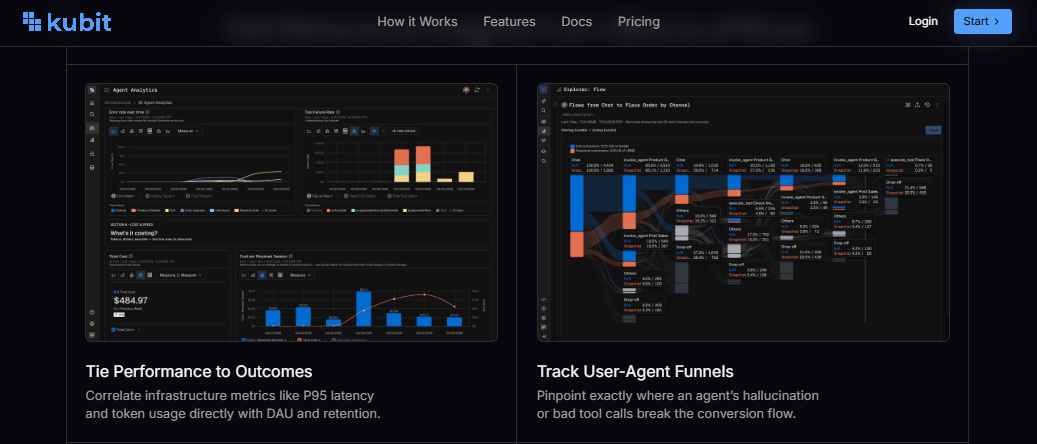
Kubit runs agentic funnel analysis directly on your warehouse, with no data duplication.
🏛️ Why did we choose this tool?
Kubit earns its spot on architecture. It runs analysis directly on your warehouse tables with no data copy into a vendor store. In February 2026, it relaunched as an agentic digital analytics platform built for the warehouse.
Kubit is not built for ecommerce specifically, and that is the honest caveat. You get funnels, journeys, and agentic querying, but nobody has pre-modelled contribution margin for you.
📊 Core capability metrics
Data sources connected: Whatever already lands in your warehouse, no separate connector layer
Warehouse posture: Fully warehouse-native, zero data duplication
AI interface: Agentic querying over governed warehouse tables
Proactive alerting: Anomaly and metric monitoring on defined events
Entry price: Quote-based, aimed at mid-market and enterprise
✅ Best for
Brands that already run Snowflake, BigQuery, or Databricks in production
Teams with data residency or governance requirements
Product and growth teams analysing on-site behaviour at scale
⚠️ Where it is the wrong choice
You need a warehouse and someone to maintain it before Kubit does anything. For a $2M Shopify store, that is a project you have not budgeted for, which is why most operators at that stage start with agentic analytics tools instead.
7. Mitzu [toc=1.7 Mitzu]
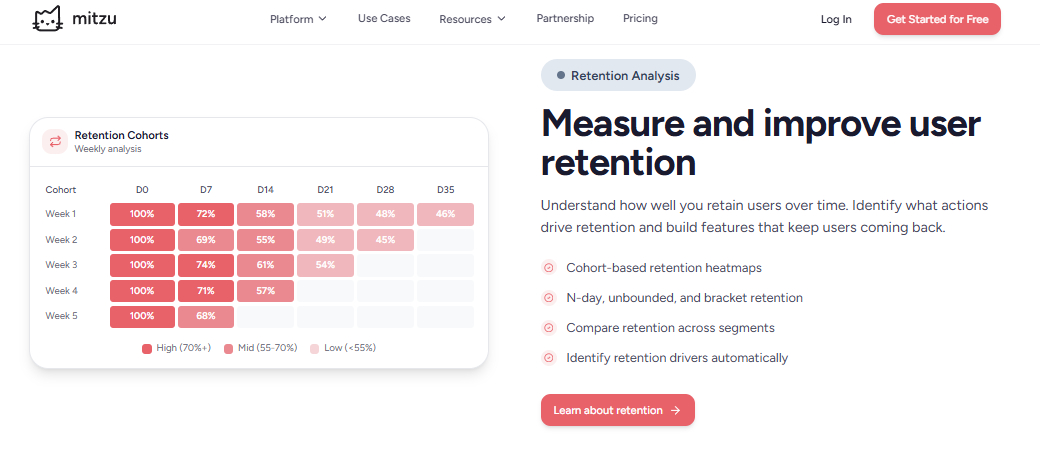
Mitzu measures cohort retention on existing warehouse tables, no SQL or data copy needed.
⚙️ Why did we choose this tool?
Mitzu is the lean warehouse-native option. It queries your existing event tables and lets non-technical users build funnels without SQL. For teams already paying for BigQuery, it adds insight without adding storage cost.
Mitzu publishes its own comparisons of the warehouse-native category, which is a decent sign it understands the trade-offs. It is still a product analytics tool at heart, not a profit engine.
📊 Core capability metrics
Data sources connected: Existing warehouse tables, plus standard event pipelines
Warehouse posture: Warehouse-native, queries run in place
AI interface: Natural-language querying over your event model
Proactive alerting: Metric monitoring, configured per use case
Entry price: Quote-based, positioned below enterprise BI tooling
✅ Best for
Lean teams with a warehouse already live and no analyst to spare
Product-led brands measuring on-site funnels and activation
Operators who want SQL-free access without duplicating data
⚠️ Where it is the wrong choice
Ecommerce finance questions like true CAC or contribution margin are outside its model. You would still need a separate profit layer, which is the gap ecommerce profit margin analysis has to close.
8. Snowflake Cortex AI [toc=1.8 Snowflake Cortex AI]
❄️ Why did we choose this tool?
Snowflake Cortex AI belongs here because it is the substrate several tools above sit on. Cortex agents, semantic views, and text-to-SQL let SQL-first teams build their own analyst inside the warehouse. Governance runs through Horizon, so access control is not an afterthought.
Snowflake's centre of gravity is SQL and analysts, while Databricks pulls toward Python and engineers. Both now ship broadly comparable AI primitives.
📊 Core capability metrics
Data sources connected: Anything you load, with Iceberg support for open tables
Warehouse posture: This is the warehouse, so nothing is copied anywhere
AI interface: Cortex agents, Cortex Analyst text-to-SQL, and in-warehouse LLM functions
Proactive alerting: Build-your-own through tasks, streams, and alerts
Entry price: Consumption-based credits, no fixed monthly floor
✅ Best for
Brands above roughly $50M revenue with an analytics engineer on payroll
Teams standardising many brands or regions onto one governed platform
Organisations with strict data residency and audit requirements
⚠️ Where it is the wrong choice
There is no ecommerce semantic model out of the box. You build the metric definitions, and consumption pricing punishes sloppy queries. Teams without that appetite are usually better served by an AI data analyst for ecommerce.
9. Databricks [toc=1.9 Databricks]
🧱 Why did we choose this tool?
Databricks is the pick when you want to train models, not just query tables. Agent Bricks, Unity Catalog, and Lakebase give engineering teams a governed place to build custom forecasting. Its revenue run rate reached about $5.4 billion in January 2026, growing roughly 65% year over year.
For ecommerce specifically, that power is often more than the question requires. Predicting reorder points does not need a lakehouse, and AI demand forecasting for ecommerce is now available without one.
📊 Core capability metrics
Data sources connected: Any source you pipeline in, with Delta and Iceberg support
Warehouse posture: Lakehouse, your data stays under your governance
AI interface: Agent Bricks plus notebook and SQL access for engineers
Proactive alerting: Custom, built through jobs and workflows
Entry price: Consumption-based DBUs, no fixed monthly floor
✅ Best for
Retailers with a Python-fluent data team and custom modelling needs
Enterprises consolidating ML training and BI on one platform
Brands with large behavioural datasets and real personalisation ambitions
⚠️ Where it is the wrong choice
Below roughly $50M revenue, the engineering load outweighs the payoff. One founder spent $10 million building a meaning layer in-house before concluding an LLM did it better, and that lesson applies here too.
Luca AI sits deliberately at the other end of this list from the last two entries. It handles the normalization, modelling, and monitoring that Snowflake and Databricks expect you to build, and we priced it at €299 per month so a $2M store can start on Monday rather than after a warehouse project. If you want to see the workflows before the pricing, the use cases page shows them.
Q2. How Did We Score These Platforms? [toc=2. Scoring Methodology]
Each platform scored out of 100 across five weighted criteria: Cross-Functional Reasoning Depth 25%, Warehouse Architecture and Data Control 20%, Setup and Time-to-First-Insight 20%, Pricing Transparency 20%, and Verified User Reviews 15%. Scores convert to stars in twenty-point bands, so 0 to 20 earns one star and 81 to 100 earns five. Luca AI scores 5 stars.
⚖️ Why the weighting matters more than the ranking
The ranking is my opinion. The weighting is the part you can argue with, which is why it goes first. If you disagree that reasoning depth deserves a quarter of the score, reweight it and the order changes.
I put the heaviest weight there for one reason. The category is moving from monitoring to recommending, and descriptive dashboards are the losing side of that shift. Luca AI is trained on the relationships between ecommerce KPIs, which is what lets a tool surface an outlier instead of just plotting it.
📋 The five criteria and their pass tests
Scoring Criteria, Weights, and Pass Tests
Criterion
Weight
The pass test
Cross-Functional Reasoning Depth
25%
Can it explain why a metric moved, across ads, orders, and cost data?
Warehouse Architecture and Data Control
20%
Do you keep queryable ownership of the tables when you cancel?
Setup and Time-to-First-Insight
20%
Days to a decision you would act on, not days to a connected account.
Pricing Transparency
20%
Is the published price the price, with no surprise on the sales call?
Verified User Reviews
15%
Real ratings and review counts, weighted for recency and volume.
🔍 What the reviews criterion actually caught
Review data is the least glamorous input and the most useful. Two of the vendors above lost points here on support and pricing consistency, not on features. That pattern repeats across the whole category, which is why any honest ecommerce analytics platform shortlist has to read the one-star reviews too.
Shortly after onboarding we were assigned an account manager. About a month later, she was laid off and we were never assigned a new account manager. I have the direct email of a support specialist, but the response time has been less than ideal, especially when real-time data is important for our team. Ben S., Director of Commercial Operations Polar Analytics G2 Verified Review
Its very easy to use and works good for a multichannel solution. Sometimes it does not update the numbers correctly and has errors with synchronisation. Verified user, 3/5 Triple Whale G2 Verified Review
⭐ How scores become stars
Bands are simple and deliberately blunt. Scores of 0 to 20 get one star, 21 to 40 get two, 41 to 60 get three, 61 to 80 get four, and 81 to 100 get five.
I do not publish the raw scores, because a two-point gap reads as precision that this method does not have. Stars communicate the tier, which is the only claim I can defend.
⚠️ Where this scoring is judgment, not data
Two criteria are close to objective. Pricing transparency and review scores come from published prices and public ratings, so you can check both yourself in ten minutes. Our own pricing page is published for exactly that reason.
Reasoning depth is judgment, and I own the bias there. I built one of these products, so my read on what counts as real reasoning is shaped by that. Luca AI's own scoring on that criterion should be read with the same skepticism you would apply to any founder marking their own homework.
Luca AI earns its five stars mostly on the reasoning criterion, because it answers root-cause and simulation questions rather than stopping at a chart. On warehouse control it scores lower than Kubit or Snowflake by design, and we did not adjust the rubric to hide that.
Q3. What Actually Makes a Data Platform AI-Native and Not Just AI-Washed? [toc=3. AI-Native Defined]
An AI-native data platform is architected so AI agents are the primary operating model, not a copilot bolted onto dashboards. The seven tests: stable identity resolution, enforced data contracts, a freshness SLA, auditable delivery paths, agent autonomy with human review, chat and API parity, and query execution in place without copying your data.
🧱 The five-layer stack versus the agent-first stack
The modern data stack has five layers you operate: ingestion, storage, transformation, business intelligence, and a new AI layer added in 2026. A human drives every layer, and each handoff is a place your numbers can drift. That drift is the reason most ecommerce tech stack audits end in a reconciliation project.
An AI-native platform inverts that. Agents write the queries, assemble the context, and orchestrate the pipeline, while you review the output. Luca AI normalizes and standardizes data on ingestion, which removes the cleanup phase that the five-layer model treats as your job.
❓ Seven questions to ask on a sales call
Does the platform resolve one customer to one identity across every source?
Are data contracts enforced, so a renamed field breaks loudly instead of quietly?
Is there a stated freshness SLA, meaning a promise on how current the data is?
Can you audit the path from raw record to displayed answer?
Can agents act, with a human review step you control?
Do chat, web, and API return the same answer from the same question?
Do queries run on your data in place, without a vendor-side copy?
If four of those get a vague answer, you are looking at a dashboard with a chat box. RudderStack puts it well: an AI-native platform is defined by what it enforces, not by what it collects.
🚩 The bolt-on tell
The clearest signal is output shape. Bolt-on AI produces long, elaborate summaries that read impressively and change nothing. Operators see through that fast, the same way they see through elaborate LinkedIn posts written by a model.
Real reasoning is short and specific. It names the variable that moved, the two things that caused it, and what to do. Ask Luca AI why last week's blended CAC rose, and the answer arrives as an explanation with the contributing channels named, not a chart to interpret. That is the difference between reporting and conversational analytics for ecommerce.
🎨 Visualizations are a courtesy, not the substance
Here is the position most of the category avoids. The dashboard is not the product anymore. The data exists so the model can digest it, draw a conclusion, and tell you what matters, and the human-readable chart is a convenience layer on top.
I could be reading that too strongly, since Luca AI is built on exactly that assumption. But every operator I have watched in the last year opens a chart to confirm a decision, not to find one.
⚠️ What AI-native does not fix
No architecture on this list manufactures identity data your pixel never captured. Practitioner reports put Meta match rates around 70 to 85% on iOS-heavy audiences, leaving 15 to 30% of conversions unmatched. Operators in r/PPC have been saying for years that ROAS should not be read as a 1:1 truth, which is the same gap covered in declining platform ROAS versus true profitability.
Attribution will never be 100% and you shouldn't be measuring roas in a 1:1 u/[deleted], r/PPC Reddit Thread
Luca AI is an intelligence layer, not an attribution pixel, and it does not replace one. If your core problem is Meta match rates, buy attribution first and add reasoning after. Saying that costs us deals, and it is still the honest answer.
Q4. Warehouse-Native, Vertical or Agentic: Which Architecture Fits Your Store? [toc=4. Architecture Cohorts]
Warehouse-native means queries run inside your Snowflake, BigQuery, Databricks, Redshift, or ClickHouse with no vendor-side copy, so governance, residency, and compute cost stay yours. Vertical means ecommerce metrics arrive pre-modelled, but external variables stay invisible. Agentic-first means reasoning leads and dashboards follow. Under roughly $10M GMV, agentic or vertical wins.
🧭 The three cohorts, side by side
Warehouse-Native vs Vertical vs Agentic-First Cohorts
Cohort
What you get
What it costs you
Warehouse-native (Kubit, Mitzu, Polar)
Data stays in your warehouse, full governance, and no duplication
A warehouse to run and someone to maintain the models
Vertical ecommerce (Triple Whale, Daasity, Peel)
Pre-built ecommerce metrics, fast start
Blind to anything outside its domain, including cash
Agentic-first (Luca AI)
Plain-English answers, root cause, and 24/7 anomaly alerts
Not an attribution pixel, and needs enough data to reason against
🔧 Warehouse-native recreates the complexity it removes
The pitch is control, and the control is real. The cost is repetitive engineering: building the data frame, writing the transformation, then translating the result back into a business answer. That loop repeats every time the question changes.
For a brand under $10M GMV, that is a hire you have not budgeted for. Polar Analytics sits at the friendlier end of this cohort, and reviewers still describe it as work. The Polar Analytics alternatives comparison covers the lighter options.
Not impressed compared to price point. I believe this is a great product, and solves many problems for brands with more complex reporting. However, from the get go there were some discrepancy in the pricing. Maja, Verified Reviewer Polar Analytics TrustPilot Verified Review
📦 Vertical tools are rigorous and structurally blind
Vertical platforms model your domain properly, then stop at its edges. Factory lead times, wholesale invoices, and accounting data sit outside the model, so the answer is confident and incomplete.
The reviews show the seam. Numbers that do not tally with Shopify are a reporting problem for a growth lead and a credibility problem for a CFO, and that is where Shopify business intelligence has to be reconciled against the ledger.
Very useful for top down view for a very fast reporting. Supports and tracks many different platforms as well. almost a no brainer for pulling out stats quickly. However, some stats are not so accurate in pulling in data; they do not tally with shopify Verified user, 4/5 Triple Whale G2 Verified Review
🤖 Agentic-first is flexible and fragile without discipline
Agentic platforms are the most adaptable, because the question defines the analysis instead of the dashboard. The fragility is in the prompt. Vague inputs produce padded, generic output that nobody acts on.
Ask Luca AI a specific question, such as which SKUs lost contribution margin last month after returns, and the answer is specific back. Ask it how business is going, and you get a summary. That is a real limitation of the whole cohort, not a fixable quirk.
❄️ The substrate question underneath all three
If you go warehouse-native, you pick a substrate first. Snowflake's gravity is SQL and analysts, through Cortex AI and semantic views. Databricks pulls toward Python, engineers, and cheaper model training, through Agent Bricks, Unity Catalog, and Lakebase.
Both now ship broadly comparable AI primitives, so the choice is about your team, not the feature list. Databricks reached roughly a $5.4 billion revenue run rate in January 2026, growing about 65% year over year.
🛒 Your data is now legible to buyers, not just to you
One more thing changed in 2026. AI traffic and AI-originated orders to Shopify stores tripled year over year in Q2, and AI-referred sessions convert around 50% higher with 14% higher average order values.
Structured catalog data converts at twice the rate of scraped data. So the SKU naming mess that every brand carries, right down to composition and size breaks, is now an acquisition problem too, which makes ecommerce product data management a revenue task rather than a back-office one.
Luca AI handles that normalization at ingestion, which is why the agentic cohort suits brands between roughly $1M and $50M in revenue. Above $50M with an engineer on staff, warehouse-native genuinely wins, and we say so on sales calls. If you want to see the reasoning workflows first, the use cases page walks through them.
Q5. Which Decisions Should an AI-Native Platform Actually Make For You? [toc=5. Decisions It Must Answer]
Judge a platform on five jobs, not features: pull the relevant slice from a pool of data for one situation, predict from history, simulate a change before you make it, find the root cause when a metric moves, and name which components are underperforming or already optimized. If it only reports what happened, it is a dashboard.
📄 The invoice on the table
A founder I sat with slid a supplier invoice across the table. Her hero product showed 72% gross margin, and she had been scaling it for two years. Every dashboard she owned agreed with her.
Twenty minutes later, she was in tears. We rebuilt the number line by line, cost by cost, and actual contribution margin came in at 8%. She had spent two years scaling a product that barely broke even.
💸 Gross margin is the lie, and the eight costs are the gap
Gross margin only tells you what it costs to make the thing. It says nothing about what it costs to sell the thing. Shipping, returns, discounts, payment fees, 3PL, holding cost, customer support, and paid acquisition all sit between the supplier invoice and real profit, which is the whole argument in contribution margin versus gross margin.
That is where brands bleed, and it is invisible to any tool that cannot see your accounting ledger. Luca AI connects commerce, ad, email, accounting, and 3PL sources into one model, which is the only way that calculation runs without a spreadsheet.
🎯 The five jobs, mapped to that story
Extract: pull only the SKUs, costs, and channels relevant to one question
Predict: forecast reorder points and sales from your own history, not a category average
Simulate: answer what happens to profit if you reprice the hero SKU by 8%
Root cause: name why margin fell, and rank the contributing costs
Diagnose the edges: flag what is underperforming, and what is already optimized
A tool that does the first job only is reporting. A tool that does all five replaces the work of a junior analyst, which is exactly the brief for an AI data analyst for ecommerce.
⏰ Why proactive delivery beats any dashboard
The best insight is the one you did not know to ask for. Nobody logs into a dashboard on the Tuesday when their cash conversion cycle quietly stretches by nine days.
Luca AI scans your data 24 hours a day and pings you when ROAS dips, CAC spikes, or inventory drops below your threshold, then sends the weekly report with graphs, reasoning, and recommendations. Alerts land in Slack, email, or the app. Cohort-level vigilance, without the cohort-level dashboard.
📊 What the benchmark data actually justifies
Context helps you read your own numbers. Triple Whale's benchmark set draws on performance data from more than 60,000 ecommerce brands. Analysis of its State of DTC data alongside Klaviyo's puts customer acquisition cost between $5 and $15 on owned channels, rising toward $120 for mega-influencer campaigns.
Those bands only matter if you know your true contribution margin per order. Otherwise, you are comparing a benchmark to a number that is wrong, which is the first thing any unit economics tracking exercise has to fix.
✅ Your Monday action
Pick your top five SKUs by revenue. Rebuild each one on contribution margin, listing all eight cost lines by hand, in a spreadsheet, this week.
If any of the five lands under 15%, stop scaling it before you buy any software. Ask Luca AI to run the same calculation afterward, and check whether the two answers agree.
Luca AI was built to answer these five jobs rather than to display metrics, which is why it moves into root-cause and simulation questions. The honest limit is data volume: below roughly $1M in revenue, there is not enough history for the prediction jobs to be useful, and we tell operators that before they subscribe.
Q6. What Does an AI-Native Data Platform Really Cost You? [toc=6. True Cost Model]
Sticker price is the smallest line. Budget for warehouse compute, an implementation window, and the data cleanup quarter that vertical and warehouse-native setups both quietly assume. Measured against DTC acquisition costs of $5 to $15 on owned channels and up to $120 on paid influencer, one avoided scaling mistake usually covers a year of subscription.
💰 Published prices by cohort
Published Entry Prices by Platform Cohort
Platform
Entry price
What scales the bill
Luca AI
€299 per month
Plan tier, not GMV
Triple Whale
About $219 per month
GMV bands, up to about $749 on Automate
Peel Insights
About $449 per month
Order volume and plan
Polar Analytics
About $720 per month
GMV bands, plus add-ons
Daasity
About $3,499 per year
Sources modelled and services
Snowflake or Databricks
No floor
Consumption, so bad queries cost money
⚠️ The four costs nobody quotes you
Warehouse compute: consumption pricing means an expensive query is a real invoice
Implementation: Daasity's lowest-rated dimension on G2 is ease of setup, at 7.0
The cleanup quarter: every brand names SKUs differently, right down to composition and size breaks
Your own hours: two days and three pivot tables a month is a salary line, not a rounding error
Reviewers price the trade-off honestly. Luca AI absorbs the cleanup cost by normalizing data at ingestion, which is the line item most vendors leave on your side of the table. Doing it manually is the ecommerce data management project nobody budgets for.
💬 What operators say about value for money
It's very easy to set up and saves time that would have been spent calculating basic metrics. The reports mostly have helpful definitions. It was a good balance or cost and features for us. You can't pull raw data and do custom analyses. Verified user Peel Analytics G2 Verified Review
Sometimes the data takes time to update, and some ratios are more difficult to understand. Juliette P., CEO, 4.5/5 Polar Analytics G2 Verified Review
🧾 The build-versus-buy receipt
Ari Tulla of ELO Health spent about $10 million of company money building a system to turn data into meaning. His verdict afterward was blunt: the language models arrived and were ten times better than what that spend produced.
If eight figures could not win that build, your $2M store will not either. The reasoning layer is now something you rent, and the AI-powered BI tools market has made that the default choice.
📐 The break-even math, with assumptions stated
Assume Luca AI at €299 per month, so roughly €3,600 a year. Assume one scaling decision reversed, on a SKU doing €20,000 monthly revenue at a true contribution margin of 8% rather than the 72% you believed.
Three months of scaling that product wrongly costs more than the annual subscription. My assumptions here are deliberately conservative, and you should argue with them rather than accept them.
📈 The adoption context
Roughly 42% of active Shopify merchants now use AI features, and merchants using them report about 18% higher conversion and 26% fewer support tickets. Among merchants with active AI deployments, 74% report measurable return.
Those numbers do not prove any specific tool works. They do suggest you are late rather than early, which changes how much time you should spend evaluating AI tools for Shopify owners.
Luca AI is priced against the cost of a junior ecommerce data analyst, not against a dashboard subscription, because that is the work it replaces. At €299 per month the comparison is roughly one tenth of a hire, and we would rather be measured on that math than on feature counts.
Q7. Which Platform Should You Choose at Your Stage, and How Do You Switch? [toc=7. Stage Pick and Rollout]
Under $1M GMV, stay on native reporting. Between $1M and $50M on Shopify with paid social and an accountant, choose agentic-first. Above $50M with wholesale or marketplace revenue and a data engineer, go warehouse-native. Then switch in 30 days: connect two sources, reconcile three metrics by hand, and set alerts before dashboards.
🧭 The stage table
Which Platform Shape Fits Your Revenue Stage
Your stage
The right shape of tool
Under $1M GMV
Shopify reporting, plus a real contribution margin spreadsheet
$1M to $50M, Shopify plus paid social
Agentic-first reasoning layer, such as Luca AI
$10M to $50M with wholesale or marketplaces
Vertical omnichannel modelling, such as Daasity
Above $50M with a data engineer
Warehouse-native, on Snowflake or Databricks
Buy for the stage you are in, not the one on your pitch deck. I have watched more brands waste a quarter on a warehouse they did not need than lose one by starting simple.
⚠️ Nobody tells sub-$1M stores to wait
Most vendors will sell you anything. Below $1M in revenue, you do not have enough history for prediction to work, so you are paying for a chat interface over thin data. Native Shopify reporting plus a spreadsheet is the honest answer at that stage.
Luca AI is a poor fit there, and it is equally wrong for an enterprise that already employs a data team. Those buyers already own the layer we provide.
🚀 The 30-day switch, five steps
Connect two sources, not twelve. Start with Shopify and your main ad platform. Output: one source live and refreshing.
Reconcile three metrics by hand. Match revenue, orders, and ad spend to your ledger for one closed month. Output: three numbers that tie, or a known reason they do not.
Write down your five Monday questions. The ones you actually ask every week. Output: a test set you can score the tool against.
Set alerts before dashboards. Thresholds on ROAS, CAC, and inventory come first. Output: one alert that fires correctly.
Keep a human on QA. Spot-check every automated output for the first month. Output: a short log of what the tool got wrong.
Ask Luca AI the same five questions in plain English during step three, and compare its answers to your hand-built numbers. Step four is where ecommerce monitoring tools earn their keep.
🛑 Do not let the AI be the QA
A major bike brand once published a road bike on its homepage with a rear derailleur mounted on the front wheel. A brand at that scale, with real photography budgets, still shipped it.
That is what removing the human check looks like. Automate the analysis, never the final approval.
👤 Onboarding beats prompting
Think of a new tool like hiring a brilliant graduate. Hand them a task on day one with no context, and even a genius produces garbage. They need onboarding.
Data tools are identical. Luca AI normalizes and standardizes data on ingestion, which is the onboarding step, so reconciliation in step two usually takes days rather than a quarter. The logic behind that design is spelled out in how Luca thinks.
💬 What smooth and rough rollouts look like
Mobile limitations and the platform isn't a plug-and-play solution, it requires time and effort to learn its advanced features and capabilities. There are instances that certain intergrations are not yet fully functioning so you have to always check with Customer Support. Charlene R., Head of Operations, HR & Culture, 5/5 Polar Analytics G2 Verified Review
I love how seamlessly it connects our ad platforms and CRM data, showing exactly where our conversions come from and which campaigns drive the most revenue. It's made attribution so much clearer. Verified user, 5/5 Triple Whale G2 Verified Review
Luca AI fits operators between roughly $1M and $50M who have data piling up and nobody to read it. Here is the question I am still sitting with: if AI-originated orders tripled in a single year, does your data need to be legible to your buyers' agents before it is legible to you? Tell me what your stack looks like, and I will tell you what I would do.
FAQ's
What is an AI-native data platform, and how is it different from a modern data stack?
An AI-native data platform is architected so AI agents are the primary operating model, not a chat box added to an existing dashboard. Agents generate the queries, assemble the business context, and orchestrate the pipeline, while the operator reviews the output.
A modern data stack is the opposite arrangement. It has five layers you personally operate:
Ingestion, meaning pulling data out of Shopify, Meta, and your accounting tool
Storage, usually a warehouse you pay for by consumption
Transformation, where SQL turns raw records into usable tables
Business intelligence, the dashboards someone has to build and maintain
An AI layer, added on top in 2026 as an afterthought
Every handoff between those layers is a place your numbers can drift, which is why revenue in your dashboard rarely matches revenue in your ledger.
Luca AI normalizes and standardizes data on ingestion, so the cleanup phase the five-layer model treats as your job never lands on your desk. We built it that way because we watched too many operators lose a quarter to a data project before answering a single question. If you want the reasoning behind that architecture, it is documented in how we think about ecommerce data.
How do I tell whether a platform is genuinely AI-native or just AI-washed?
Run seven tests on any sales call. A vendor who answers four of them vaguely is selling a dashboard with a copilot attached.
Does it resolve one customer to one identity across every source?
Are data contracts enforced, so a renamed field breaks loudly instead of silently?
Is there a stated freshness SLA, meaning a promise about how current the data is?
Can you audit the path from raw record to displayed answer?
Can agents act, with a human review step you control?
Do chat, web, and API return the same answer to the same question?
Do queries run on your data in place, without a vendor-side copy?
There is a faster tell than any of those. Look at the shape of the output. Bolt-on AI produces long, elaborate summaries that read impressively and change nothing you do on Monday. Real reasoning is short and specific, naming the variable that moved, the two things that caused it, and the action to take.
Luca AI is trained on the relationships between ecommerce metrics, which is what lets it name a cause rather than plot a line. We wrote a fuller checklist for buyers in our guide to evaluating AI data agents.
Should an ecommerce brand choose warehouse-native, vertical, or agentic-first?
It depends almost entirely on your revenue stage and whether you employ someone technical.
Warehouse-native means queries run inside your own Snowflake, BigQuery, or Databricks with no vendor copy. Governance and residency stay yours. The cost is repetitive engineering and someone to maintain the models.
Vertical ecommerce platforms arrive with metrics pre-modelled, so you start fast. They are structurally blind to anything outside their domain, including factory lead times, wholesale invoices, and your cash position.
Agentic-first platforms let the question define the analysis instead of the dashboard. They are the most flexible and the most sensitive to vague prompts.
Our position, and we say this on sales calls: warehouse-native recreates the complexity it claims to remove for any brand under roughly $10M GMV. That is a hire you have not budgeted for.
Luca AI sits in the agentic-first cohort and suits operators between roughly $1M and $50M in revenue who have data piling up and nobody to read it. Above $50M with a data engineer on payroll, warehouse-native genuinely wins. You can see the workflows we handle across our ecommerce intelligence use cases before deciding which cohort fits.
What does an AI-native data platform really cost for a DTC brand?
Sticker price is the smallest line on the invoice. Published entry points across this category run from roughly $219 per month at the vertical end to about $720 per month for warehouse-native ecommerce BI, with Daasity starting near $3,499 per year and Snowflake or Databricks charging by consumption with no floor.
Budget for four costs nobody quotes you:
Warehouse compute, where one expensive query becomes a real invoice
Implementation, which is the lowest-rated dimension on several vendors' G2 profiles
The cleanup quarter, because every brand names SKUs differently, right down to composition and size breaks
Your own hours, since two days and three pivot tables a month is a salary line, not a rounding error
Measure the whole thing against one avoided mistake. If a SKU doing €20,000 monthly revenue turns out to carry 8 percent contribution margin rather than the 72 percent you believed, three months of scaling it wrongly costs more than a year of software.
Luca AI is priced at €299 per month on Starter, which we deliberately benchmark against roughly one tenth of a junior data analyst rather than against a dashboard subscription. Full tiers are published on our pricing page.
Will an AI-native data platform fix my attribution problem?
No, and any vendor who says otherwise is selling you something. No architecture manufactures identity data your pixel never captured.
Practitioner reports put Meta match rates at roughly 70 to 85 percent on iOS-heavy audiences, which leaves 15 to 30 percent of conversions unmatched no matter where the query executes. Operators in r/PPC have argued for years that ROAS should never be read as a one-to-one truth. Warehouse-native execution improves governance, consistency, and compute control. It does not create data that was never collected.
What an AI-native platform does fix is the reasoning layer above attribution:
Root-cause analysis when blended CAC moves and you need the contributing channels named
Contribution margin per SKU after shipping, returns, discounts, fees, 3PL, and ad spend
Simulation, so you can price a change before you commit cash to it
Continuous monitoring, with alerts when ROAS dips or inventory crosses a threshold
Luca AI is an intelligence layer, not an attribution pixel, and it does not replace one. If match rates are your core problem, buy attribution first and add reasoning after. Saying that costs us deals, and it is still the honest answer. We unpack the measurement gap in declining platform ROAS versus true profitability.
Enjoyed the read? Join our team for a quick 15-minute chat — no pitch, just a real conversation on how we’re rethinking Ecommerce with AI - Luca
Loading Schedule...
Your AI Co-Founder is here.
Here’s why:
Shopify, Meta, Xero - one brain.
"Should I scale?" Answered with real data.
Growth capital. No applications. One click.
Thank you! Your submission has been received! Please book a time slot for the Meeting
Oops! Something went wrong while submitting the form.