10 Best Agentic BI Platforms for Ecommerce - For Monitoring, Insights and Agentic Actions
13
mins read
TL;DR
Agentic BI means agents monitor data continuously, run multi-step investigations, explain what changed, and act with approval. AI-assisted BI simply waits to be asked a question.
Ten platforms are scored on one rubric: cross-functional reasoning depth, proactive monitoring and action, ecommerce data coverage, setup and usability, and verified user reviews.
Most agentic BI comparisons are written for data teams with warehouses and analysts, which is why they fail stores in the one to five million revenue range.
Marketing-only monitoring misses the money. Contribution margin by SKU, cash conversion cycle, refund rates, page speed, and AI-referral revenue all belong in the same feed.
Gross margin is the number that breaks agents. One founder scaled a product at a stated 72 percent gross margin whose real contribution margin was 8 percent.
Watch tier gating closely. On several platforms the entry plan buys a querying assistant, while genuine autonomous execution sits behind a separately priced AI add-on.
Q1. What Are the 10 Best Agentic BI Platforms for Ecommerce in 2026? [toc=1. Top 10 Platforms]
The 10 best agentic BI platforms for ecommerce in 2026 are Luca AI, Triple Whale, Polar Analytics, ThoughtSpot, Sigma Computing, Tableau Pulse, Power BI with Copilot, Domo AI, Tellius, and Knowi. Luca AI leads this list because it reasons across a store's full connected data pool, traces an outlier to its root cause, and pushes the finding to Slack or email without being asked.
I built this list around one test most roundups skip. Can the platform tell you why a number moved, across sources, without a human writing the query? Plenty of tools now flag that ROAS dipped. Far fewer connect that dip to a shipping delay, a returns spike, or a Klaviyo flow that stopped sending. I scored every platform on unprompted monitoring, ecommerce data coverage, root cause depth, delivery channels, and setup time. Reviews came from G2, Trustpilot, and Reddit, never from vendor case studies.
The 10 platforms at a glance
Luca AI, Best for cross-functional ecommerce intelligence and proactive alerts
Triple Whale, Best for DTC marketing attribution with an AI agent layer
Polar Analytics, Best for Shopify-native reporting and cohort views
ThoughtSpot, Best for search-led analytics at enterprise scale
Sigma Computing, Best for spreadsheet-style analysis on a warehouse
Tableau Pulse, Best for metric digests inside existing Tableau stacks
Power BI with Copilot, Best for Microsoft-native finance teams
Domo AI, Best for multi-entity retail groups with data teams
Tellius, Best for automated root cause analysis on structured data
Knowi, Best for blending NoSQL and SQL sources in one agent
10 Best Agentic BI Platforms for Ecommerce in 2026
Tool
Key capabilities offered
Best For
Pricing
Luca AI ⭐⭐⭐⭐⭐
Unified store data, plain-English questions, root cause analysis, predictive reorder and sales alerts, scheduled reports to Slack and email
Shopify and DTC stores at €1M to €5M revenue with no data analyst
DTC brands whose main question is paid media attribution
$179 / Month to Custom (Enterprise)
Polar Analytics ⭐⭐⭐⭐
Shopify-native metrics, cohort and retention views, AI insights feed, alerting
Operators who want Shopify reporting without a warehouse build
Shopify-listed plans to Custom (sales-quoted)
ThoughtSpot ⭐⭐⭐⭐
Natural language search, Spotter agent, automated change analysis, embedded analytics
Retail groups with an existing cloud warehouse and analysts
Custom (quote-based)
Sigma Computing ⭐⭐⭐
Spreadsheet interface on warehouse data, Ask Sigma, write-back workflows
Finance teams comfortable in spreadsheets, on Snowflake or BigQuery
Custom (per-user and compute)
Tableau Pulse ⭐⭐⭐
Metric subscriptions, automated insight digests, Slack and email delivery
Companies already standardised on Tableau
$15 to $75 / user / Month
Power BI with Copilot ⭐⭐⭐
Copilot summaries, semantic models, Fabric data agents, Teams delivery
Microsoft-native CFO and finance functions
$14 to $24 / user / Month (Copilot needs Fabric capacity)
Domo AI ⭐⭐⭐
1,000+ connectors, AI agent catalogue, alerting, app framework
Multi-brand retail groups with internal data teams
Custom (consumption-based)
Tellius ⭐⭐⭐
Automated insight discovery, guided root cause analysis, natural language queries
Analysts who need statistical drivers behind a metric change
Custom (quote-based)
Knowi ⭐⭐⭐
Agentic querying across SQL and NoSQL, scheduled agent workflows, embedded BI
Teams with messy or non-relational data sources
Custom (quote-based)
1.1 Luca AI [toc=1.1 Luca AI]
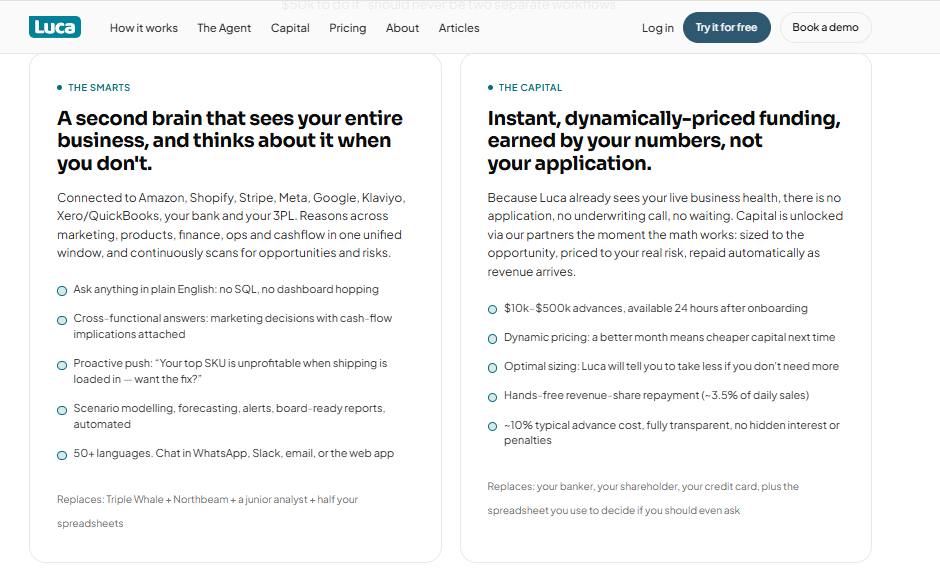
Luca AI positions agentic BI as one window across marketing, products, finance, operations, and cashflow.
⭐ Why did we choose this tool?
I founded Luca AI, so read this section with that in mind. It sits first for one reason I can defend. Luca AI reasons across commerce, marketing, and finance data in a single question, which is the layer most tools skip. Marketing-only platforms can tell you a channel got cheaper. They cannot tell you what that does to cash. Luca AI was built as an AI layer over your unified store data, not a dashboard with a chat box added later.
📊 Solutions offered
Single source of truth across Shopify, Meta, Google, Klaviyo, accounting tools, and operations data
Plain-English questions with no SQL, no analyst, and no dashboard building
Root cause analysis that names the influencing components behind a metric move
Predictive analytics for reorder points, sales forecasts, and product-level trends
Automated reports and anomaly alerts pushed to Slack, email, or mobile
💰 How it scores on the core metrics
Unprompted monitoring: Yes, 24/7 anomaly scanning on ROAS, CAC, and inventory thresholds
Ecommerce data coverage: Commerce, ads, email, accounting, banking, and operations
Root cause depth: Traces outliers across directly and indirectly related metrics
Action and delivery: Scheduled reports plus alerts to Slack, email, and app
Setup time: Data is normalised on ingestion, so there is no cleanup project first
✅ Best for
Shopify and DTC stores between €1M and €5M in revenue with data piling up unused
Teams with no in-house analyst and no budget for a warehouse build
Founders, CFOs, and Heads of Growth who need one number both departments trust
❌ Skip it if
Luca AI is not an attribution pixel. If your only question is which Meta ad drove a sale, a dedicated attribution tool fits better. Stores under roughly $10K monthly revenue also lack the data volume to reason against.
📈 Case study: a home goods brand that stopped triangulating on Sundays
The problem: A European home and kitchenware brand doing just over €2M a year ran weekly reporting by exporting Shopify orders, Meta spend, and Klaviyo revenue into one sheet. The founder rebuilt it every Sunday night. Channel numbers never matched, so decisions slipped by days.
How Luca AI helped: Luca AI connected the store's commerce, ad, email, and accounting sources and normalised them at ingestion. The team then asked questions in plain English instead of rebuilding the sheet. Weekly CAC reports with reasoning and charts started arriving in Slack automatically.
The outcome: The Sunday reporting session went away. Anomaly alerts now reach the founder before the weekly review, not after it. The team argues about the decision instead of arguing about whose number is right. 😊
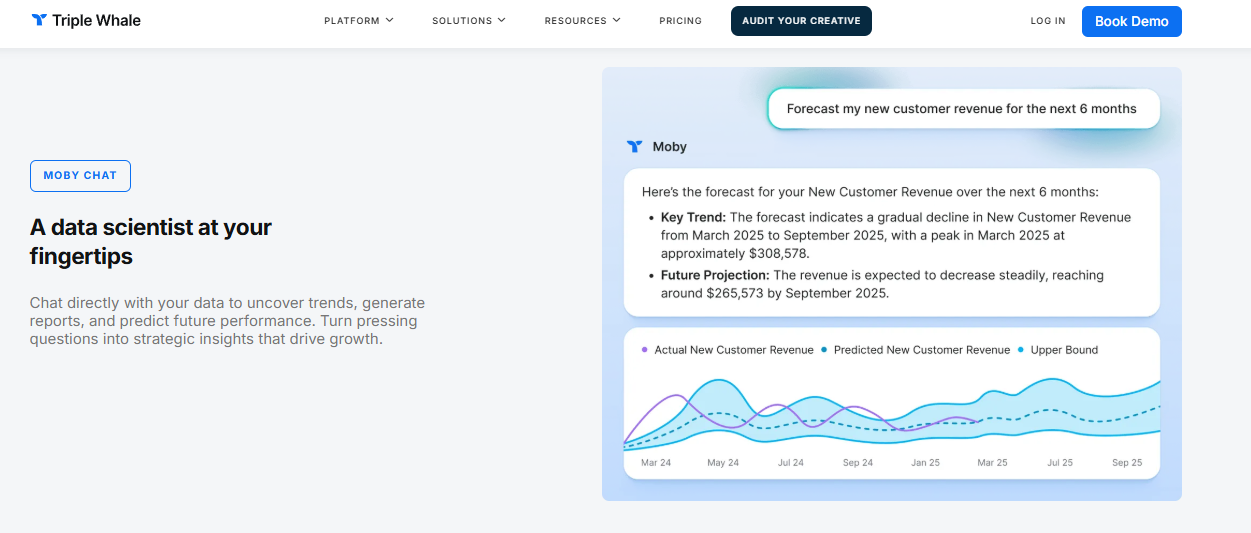
Moby Chat turns a typed question into a six-month new customer revenue forecast.
⭐ Why did we choose this tool?
Triple Whale earned its place because it solved a real problem first. Its Triple Pixel collects first-party tracking data independent of ad platform reporting. Moby, its AI layer, now runs scheduled analysis and drafts recommendations on top of that data. For a brand whose main pain is paid media clarity, it remains the reference point. It is also the platform most operators on this list will already have installed, which is why Triple Whale alternatives get searched so often.
📊 Solutions offered
Triple Pixel first-party attribution across Meta, Google, and TikTok
Marketing mix modeling for budget allocation decisions
Moby AI agents for scheduled analysis and anomaly summaries
Profit and creative dashboards built for daily media review
Shopify, ad platform, and email integrations in one warehouse
💰 How it scores on the core metrics
Unprompted monitoring: Partial, with agent-driven anomaly summaries on marketing metrics
Ecommerce data coverage: Commerce, ads, and email, without accounting or banking
Root cause depth: Strong inside marketing, limited once the cause sits outside it
Action and delivery: Slack and email digests, with full agent execution on a paid add-on
Setup time: Pixel install plus platform connections, typically days
A four-month test on a live Shopify store found that the entry tier from $179 per month behaves as a querying assistant, while Moby 2's autonomous execution sits behind the separate Moby AI Pro add-on. Ask for that in writing before you sign.
✅ Best for
DTC brands spending meaningfully on Meta, Google, and TikTok every day
Growth leads who need creative and channel level attribution, not finance views
Teams comfortable reconciling occasional platform discrepancies by hand
❌ Skip it if
Your open question is cash, margin, or inventory. Triple Whale does not connect to Xero, QuickBooks, or banking, so it cannot tell you whether you can fund the scale it recommends, which is the gap that platform ROAS versus true profitability keeps exposing.
😊 Reviews
"Triple Whale is very user-friendly and easy to navigate to find the data you need across multiple channels. Relevant channels like emails, ads, organic, etc are already broken down for you and when looking at the specific channel, you have the option to customize the table displaying the data to choose which metrics are most relevant for your needs." Verified User, Triple Whale G2 Verified Review
"Its very easy to use and works good for a multichannel solution. Sometimes it does not update the numbers correctly and has errors with synchronisation." Verified User, Triple Whale G2 Verified Review
💸 Pricing
$179 / Month to Custom (Enterprise)
1.3 Polar Analytics [toc=1.3 Polar Analytics]
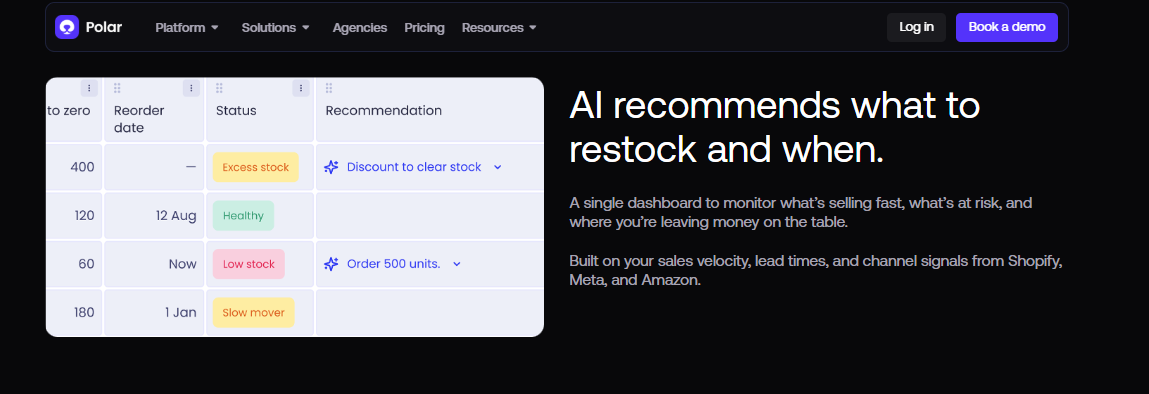
Polar recommends what to restock and when using Shopify, Meta, and Amazon signals.
⭐ Why did we choose this tool?
Polar Analytics earned a place because it is genuinely Shopify-native. It pulls store, ad, and email data into one reporting layer without a warehouse project. Its team also published one of the few clear explanations of agentic analytics applied to ecommerce data rather than enterprise data. For a store that wants trustworthy Shopify reporting first and agents second, it is a fair starting point.
📊 Solutions offered
Shopify-native metrics with prebuilt ecommerce reports
Cohort, retention, and repeat purchase analysis
AI insight feed with anomaly notifications
Connectors for Meta, Google, Klaviyo, and TikTok
Custom metric builder and shareable dashboards
💰 How it scores on the core metrics
Unprompted monitoring: Yes, through an AI insights feed and threshold alerts
Ecommerce data coverage: Commerce, ads, and email, without accounting or banking
Root cause depth: Surfaces the driver metric, then hands the thinking back to you
Action and delivery: Slack and email notifications, no execution layer
Setup time: Days, though advanced features take real learning time
Teams replacing a manual weekly reporting spreadsheet
Operators who value prebuilt ecommerce metrics over full customisation
❌ Skip it if
Your setup is unusual, or you need fast support. Reviewers report slow fixes and pricing quoted higher by sales than the Shopify listing suggested.
😊 Reviews
"Sometimes the data takes time to update, and some ratios are more difficult to understand." Juliette P., CEO, Polar Analytics G2 Verified Review
"Shortly after onboarding we were assigned an account manager. About a month later, she was laid off and we were never assigned a new account manager. I have the direct email of a support specialist, but the response time has been less than ideal, especially when real-time data is important for our team." Ben S., Director of Commercial Operations, Polar Analytics G2 Verified Review
💸 Pricing
Shopify-listed plans to Custom (sales-quoted)
1.4 ThoughtSpot [toc=1.4 ThoughtSpot]
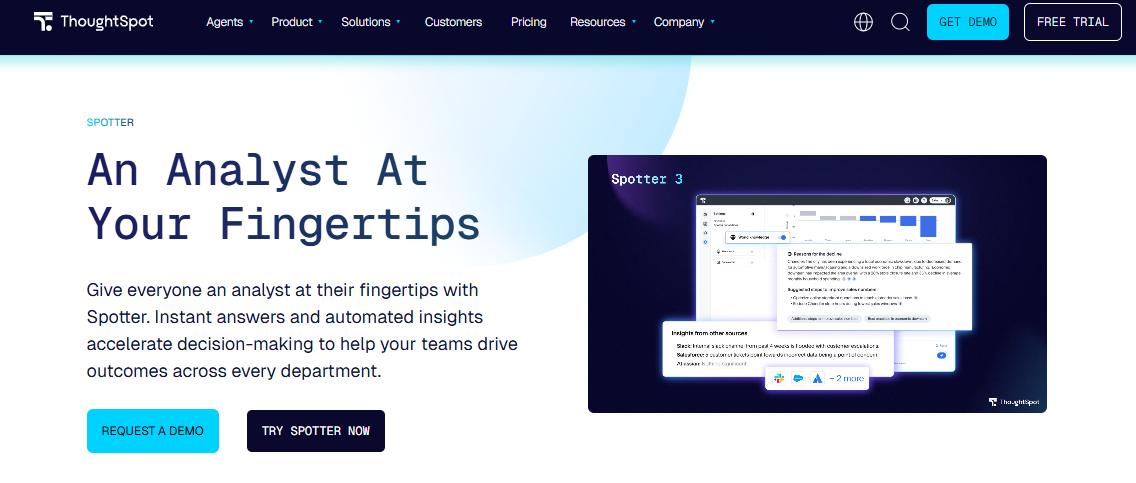
ThoughtSpot's Spotter agent aims to replace the analyst request queue with instant governed answers.
⭐ Why did we choose this tool?
ThoughtSpot pioneered search-led analytics before agents were a category. Its Spotter agent now runs multi-step investigations and explains metric changes in plain language. It appears in nearly every serious agentic BI comparison for good reason. The catch for ecommerce is the foundation it assumes underneath.
📊 Solutions offered
Natural language search across governed data models
Spotter agent for conversational, multi-step analysis
Automated change analysis on tracked metrics
Liveboards with scheduled delivery
Embedded analytics for customer-facing apps
💰 How it scores on the core metrics
Unprompted monitoring: Yes, on modelled metrics you define first
Ecommerce data coverage: Whatever sits in your warehouse, not native store connectors
Root cause depth: Strong statistical driver analysis on well-modelled data
Action and delivery: Slack, email, and embedded surfaces, without ecommerce execution
Setup time: Weeks, since a governed data model comes first
✅ Best for
Retail groups with a cloud warehouse already in place
Companies with at least one analyst or data engineer on staff
Teams needing embedded analytics for partners or merchants
❌ Skip it if
You have no warehouse and no analyst. A €2M Shopify store will spend more time modelling than analysing.
💸 Pricing
Custom (quote-based)
1.5 Sigma Computing [toc=1.5 Sigma Computing]
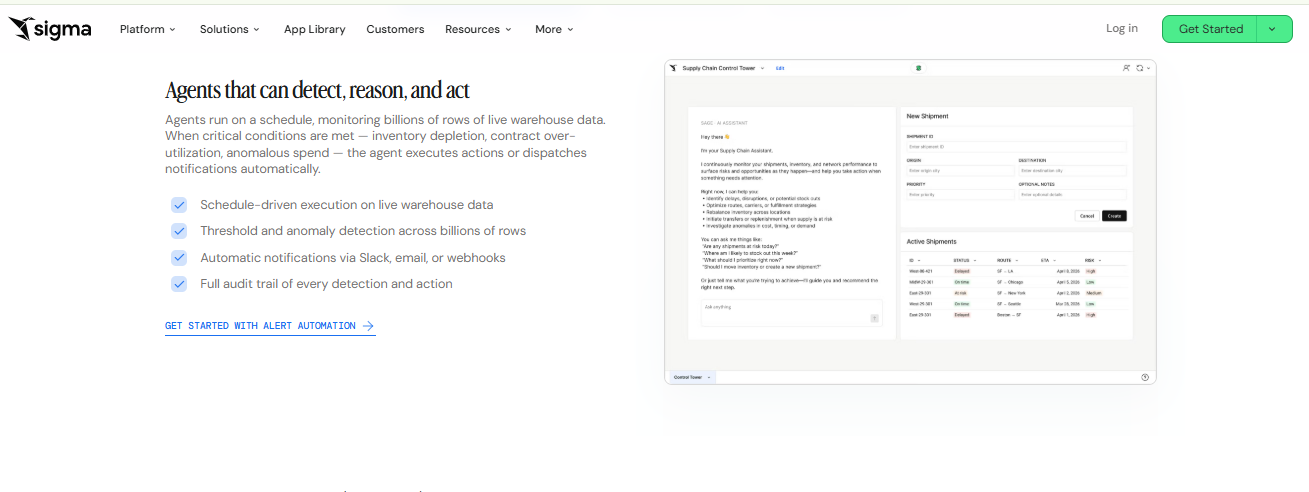
Sigma's supply chain agent detects inventory depletion and anomalous spend, then acts without human prompting.
⭐ Why did we choose this tool?
Sigma solved a real adoption problem. It puts a spreadsheet interface directly on warehouse data, so finance teams work in a format they already trust. Ask Sigma adds conversational querying on top. For a CFO who lives in rows and columns, that removes the biggest barrier to using BI at all.
📊 Solutions offered
Spreadsheet-style interface over warehouse tables
Ask Sigma for natural language exploration
Write-back workflows and input tables
Version-controlled workbooks and shared datasets
Row-level security and governed access
💰 How it scores on the core metrics
Unprompted monitoring: Limited, mostly scheduled rather than agent-driven
Ecommerce data coverage: Warehouse-dependent, with no native store connectors
Root cause depth: As deep as the analyst driving it, not autonomous
Action and delivery: Scheduled exports and alerts, plus write-back to source systems
Setup time: Weeks, and a warehouse is mandatory
✅ Best for
Finance teams on Snowflake, BigQuery, or Databricks
Analysts who want spreadsheet speed with warehouse governance
Companies where write-back into operational systems matters
❌ Skip it if
You want the tool to do the thinking. Sigma is a superb interface, but a human still drives the analysis.
💸 Pricing
Custom (per-user and compute)
1.6 Tableau Pulse [toc=1.6 Tableau Pulse]
⭐ Why did we choose this tool?
Tableau Pulse deserves credit for changing the delivery model. Instead of asking you to open a dashboard, it sends metric digests with written explanations to Slack or email. That is a real step toward proactive reporting. It is also the cheapest way to get agent-style summaries if Tableau already runs in your business.
📊 Solutions offered
Metric subscriptions with automated insight digests
Plain-language explanations of metric movement
Slack and email delivery of scheduled summaries
Follow-up questions on tracked metrics
Integration with existing Tableau data sources
💰 How it scores on the core metrics
Unprompted monitoring: Yes, on metrics you subscribe to
Ecommerce data coverage: Inherits Tableau connections, not ecommerce-specific
Root cause depth: Descriptive summaries, with limited multi-source causal work
Action and delivery: Slack and email digests, with no execution
Setup time: Fast if Tableau exists, slow if it does not
✅ Best for
Companies already standardised on Tableau licences
Teams wanting metric digests without changing tools
Operations leads who prefer a push feed over dashboards
❌ Skip it if
Tableau is not already in the building. Buying the whole stack for Pulse is poor value for a single store.
💸 Pricing
$15 to $75 / user / Month
1.7 Power BI with Copilot [toc=1.7 Power BI with Copilot]
⭐ Why did we choose this tool?
Power BI is where most finance functions already live. Copilot adds report summaries, DAX help, and natural language querying inside that familiar shell. For a CFO consolidating multiple entities, the Microsoft ecosystem advantage is real. The agentic parts, though, come with a capacity bill attached.
📊 Solutions offered
Copilot summaries and natural language report queries
Semantic models for governed metric definitions
Fabric data agents for multi-step questions
Delivery through Teams, Excel, and email
Enterprise-grade access controls and row-level security
💰 How it scores on the core metrics
Unprompted monitoring: Partial, mainly threshold alerts and subscriptions
Ecommerce data coverage: Requires connectors or a pipeline you build
Root cause depth: Depends entirely on how well the semantic model is built
Action and delivery: Teams, Excel, and email, with Power Automate for actions
Setup time: Weeks, plus Fabric capacity for full Copilot features
✅ Best for
Microsoft-native finance teams already using Excel and Teams
Multi-entity retail groups needing consolidated reporting
Companies with in-house BI skills to build the model
❌ Skip it if
You have no analyst. Reviewers consistently flag the DAX learning curve and slowdowns on large datasets.
😊 Reviews
"Power BI can become slow with very large datasets, and complex DAX formulas have a steep learning curve. Also, advanced customization of visuals and version control for reports could be improved." Verified User, Microsoft Power BI G2 Verified Review
"It may allow you to create a multitude of custom calculations but it is not flexible and the query becomes cumbersome. The outcome of these cannot always be good for the dashboard performance or speed. Power BI has a limit on the size of data that it can ingest." Verified User, Microsoft Power BI G2 Verified Review
💸 Pricing
$14 to $24 / user / Month (Copilot needs Fabric capacity)
1.8 Domo AI [toc=1.8 Domo AI]
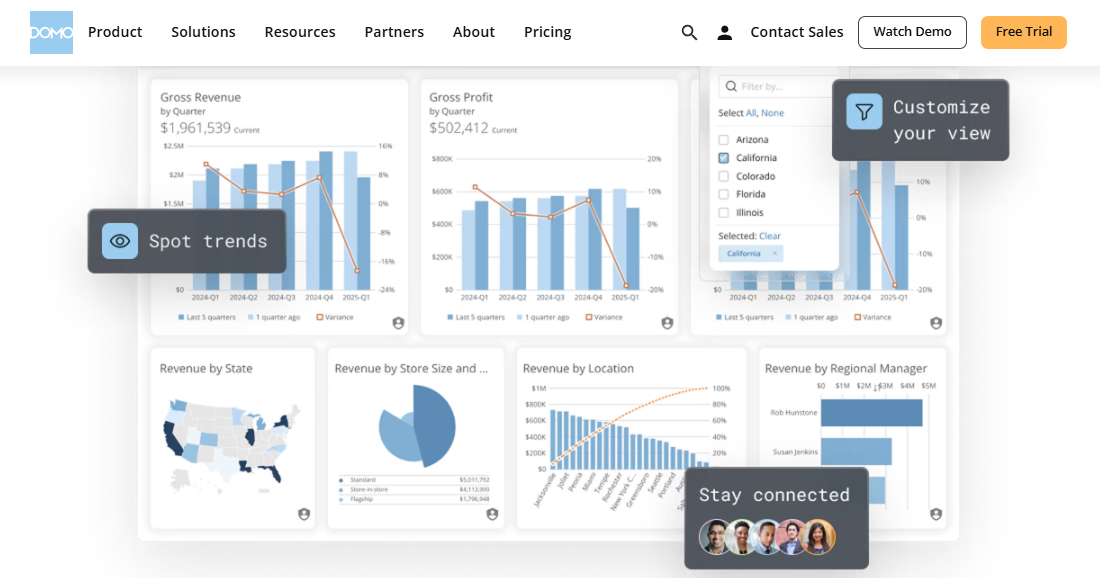
Domo's dashboards spot trends visually, leaving the causal reasoning to whoever opens the report.
⭐ Why did we choose this tool?
Domo brings breadth that few platforms match. It offers over a thousand connectors, an agent catalogue, and an app framework on one platform. For a group running several brands across marketplaces, that consolidation has real value. The cost model is the part that catches smaller stores out.
📊 Solutions offered
Very broad connector library across commerce and ops systems
AI agent catalogue for analysis and workflow tasks
Alerting and scheduled report distribution
App framework for building internal tools
Governance and lineage across datasets
💰 How it scores on the core metrics
Unprompted monitoring: Yes, with configurable alerts and agent workflows
Ecommerce data coverage: Broad, though ecommerce logic still needs building
Root cause depth: Capable, but usually analyst-assisted rather than autonomous
Action and delivery: Email, Slack, mobile, and custom apps
Setup time: Weeks to months, depending on data sprawl
✅ Best for
Multi-brand retail groups with internal data teams
Businesses combining ecommerce, wholesale, and retail data
Companies that want to build internal apps on their data
❌ Skip it if
You are a single store watching cash. Consumption-based pricing makes costs hard to predict at this size, which is why tech stack consolidation matters before you sign anything.
💸 Pricing
Custom (consumption-based)
1.9 Tellius [toc=1.9 Tellius]
⭐ Why did we choose this tool?
Tellius is on this list for one capability, done well. It automates the "why did this change" investigation and returns statistical drivers rather than a chart. That is the closest thing to genuine root cause work in the traditional BI camp. It expects clean structured data to work from.
📊 Solutions offered
Automated insight discovery across large datasets
Guided root cause and driver analysis
Natural language querying with generated visualisations
Anomaly and trend detection
Predictive modelling on structured data
💰 How it scores on the core metrics
Unprompted monitoring: Yes, with automated anomaly and trend discovery
Ecommerce data coverage: Warehouse or database sources, not native store apps
Root cause depth: Strongest in this group for statistical driver analysis
Action and delivery: Dashboards, alerts, and scheduled reports
Setup time: Weeks, with data preparation required first
✅ Best for
Analyst-led teams that need explained drivers, not just charts
Businesses with large, clean, structured datasets
Companies investigating margin or churn changes regularly
❌ Skip it if
Your data still lives across eight disconnected apps. Tellius analyses well but does not solve the plumbing.
💸 Pricing
Custom (quote-based)
1.10 Knowi [toc=1.10 Knowi]
⭐ Why did we choose this tool?
Knowi handles the data most BI tools quietly refuse. It queries NoSQL sources like MongoDB alongside SQL, without a separate pipeline. Its team also published one of the earliest definitions of agentic BI as a category. For teams with messy, mixed data, that flexibility matters more than polish.
📊 Solutions offered
Agentic querying across SQL and NoSQL sources
Scheduled agent workflows for recurring analysis
Natural language search over blended datasets
Alerting on query results and thresholds
Embedded analytics for internal and external users
💰 How it scores on the core metrics
Unprompted monitoring: Yes, through scheduled agent workflows and alerts
Ecommerce data coverage: Flexible source support, without ecommerce-specific logic
Root cause depth: Query-driven, so depth depends on how you configure it
Action and delivery: Email, Slack, webhooks, and embedded views
Setup time: Days to weeks, faster than warehouse-first tools
✅ Best for
Teams with a mix of relational and NoSQL data sources
Product-led businesses embedding analytics for customers
Technical operators comfortable configuring their own agents
❌ Skip it if
You want ecommerce metrics ready on day one. Knowi gives you the engine, not the prebuilt store logic, so ecommerce data management stays your job.
💸 Pricing
Custom (quote-based)
Luca AI sits first on this list because of what the other nine leave to you. Warehouse-first platforms need a model before they answer anything. Marketing-first platforms answer fast, then stop at the channel boundary. Luca AI normalises store data on ingestion, reasons across commerce, marketing, and finance in one question, and pushes the finding to Slack or email on a schedule you set.
Q2. How Were These 10 Agentic BI Platforms Selected and Scored? [toc=2. Scoring Methodology]
Each platform was scored out of 100 across five weighted criteria: Cross-Functional Reasoning Depth 25%, Proactive Monitoring and Action 25%, Ecommerce Data Coverage 20%, Setup and Usability 15%, and Verified User Reviews 15%. Zero to 20 earns one star, 21 to 40 earns two, 41 to 60 earns three, 61 to 80 earns four, and 81 to 100 earns five. Luca AI scores 5 stars.
⭐ Why standard BI rubrics fail store owners
Most agentic BI comparisons score for a data team. They weight semantic modelling, SQL transparency, and warehouse fit heavily. Those matter if you employ an analyst.
A store doing €2M a year usually does not. So I weighted this list toward what an operator can verify in a two-week trial. Luca AI is scored on the same five criteria as every other platform here, with no separate allowance.
📊 The five criteria and what full marks looks like
Scoring Criteria and Weights for Agentic BI Platforms
Criterion
Weight
Full marks requires
Cross-Functional Reasoning Depth
25%
Answers one question using commerce, ad, email, and finance data together
Proactive Monitoring and Action
25%
Detects an outlier unprompted and delivers it outside the app
Ecommerce Data Coverage
20%
Native connectors for every channel carrying real spend
Setup and Usability
15%
First useful answer without a warehouse or an analyst
Verified User Reviews
15%
Consistent public reviews on G2, Trustpilot, or the Shopify App Store
Ecommerce Data Coverage was scored against channels that actually carry money, not connector counts on a pricing page. Common Thread Collective's Q1 2026 benchmark tracked 299 DTC brands splitting $231M across seven paid channels. Seven live channels is the real bar for cross-channel analytics.
⏰ How the star bands work
The bands are simple, and the individual scores stay out of the article on purpose. Numbers imply a precision that a trial-based review cannot honestly claim.
What the stars do tell you is the gap between camps. Warehouse-first platforms lose points on setup. Marketing-first platforms lose points on reasoning depth. Luca AI measures cross-functional depth by testing whether one question spans commerce, ad, and accounting data at once.
😊 What reviewers told us about the review criterion
Public reviews carried 15% because they surface the thing demos hide. Both quotes below praise the product, then name the same limitation.
"Triple Whale is very user-friendly and easy to navigate to find the data you need across multiple channels. Relevant channels like emails, ads, organic, etc are already broken down for you and when looking at the specific channel, you have the option to customize the table displaying the data to choose which metrics are most relevant for your needs." Verified User, Triple Whale G2 Verified Review
"Sometimes the data takes time to update, and some ratios are more difficult to understand." Juliette P., CEO, Polar Analytics G2 Verified Review
⚠️ What was not tested
I did not run identical datasets through all ten platforms. Several are quote-only, so pricing comparisons rely on published figures alone.
I also could not verify enterprise governance claims at store scale. Treat the enterprise entries as directionally scored, not benchmarked.
Luca AI is scored highest on Cross-Functional Reasoning Depth for one testable reason. It is trained on the relationships between ecommerce metrics, so it links a CAC spike to the spend, product, and fulfilment data behind it in a single answer, rather than one domain at a time.
Q3. What Is Agentic BI, and How Is It Different From a Dashboard With AI Bolted On? [toc=3. Agentic BI Defined]
Agentic BI is business intelligence where AI agents run the analytics workflow themselves. They monitor data continuously, plan and execute multi-step investigations against governed definitions, explain what changed, and take approved actions. AI-assisted BI waits to be asked. The test is simple: does the system act before you open it?
⭐ The plainest definition I can give
Traditional BI shows you what happened. AI-assisted BI summarises what happened when you ask. Agentic BI decides what is worth telling you, then tells you.
Think of it as a speedometer versus a GPS. One reports your current speed. The other tells you which turn to take next.
✅ The three tests to run on any demo
Vendors now call almost anything agentic, so I use three questions.
Does it monitor unprompted, or does it wait for a query?
Does it join your commerce, ad, email, and finance data natively?
Can it act, with your approval, rather than only report?
Holistics calls the failure point the copilot limit: chat on top of a dashboard still needs a human to drive every step. Mitzu applies a similar purity test across platforms. Ask Luca AI to send a weekly CAC report with reasoning and charts, and it delivers it to Slack without anyone opening the app, which is what separates agents for ecommerce from a chat box.
💰 The loop, applied to an actual store
Agentic systems run a perceive, reason, act loop. Polar's team mapped that loop onto ecommerce data specifically.
Here is how it looks on a real store. It perceives a ROAS drop in Meta spend. It reasons across Shopify orders, Klaviyo flow performance, and 3PL delivery times to find that a shipping delay lifted refunds. Then it drafts the action for you to approve.
❌ Why dashboards stopped being enough
A dashboard answers questions you already knew to ask. That is its ceiling. It cannot flag the thing you never thought to check.
I have watched operators rebuild the same spreadsheet every Sunday from Shopify exports, ad exports, and returns exports. One founder running £200M in GMV over five years described his early manual reporting years as shudder-inducing. The reporting consumed all the time meant for insight, which is exactly the trap a Shopify analytics dashboard sets.
⚠️ Where the trust breaks
Merchants are already skeptical, and the receipts exist. An analysis of 252 negative reviews across Shopify AI apps found 15% to 20% of complaints cited no visible results, while dashboards claimed everything was optimised.
"Day 3: Analyzed 252 negative reviews across Shopify AI SEO apps. Here's what merchants hate most." u/buildinpublic poster, r/buildinpublic Reddit Thread
Charts are a courtesy to the human reader. The reasoning is the substance. My read is that any platform selling you prettier charts in 2026 is selling the wrong layer.
😊 What operators say about the bolt-on version
"Its very easy to use and works good for a multichannel solution. Sometimes it does not update the numbers correctly and has errors with synchronisation." Verified User, Triple Whale G2 Verified Review
"Power BI can become slow with very large datasets, and complex DAX formulas have a steep learning curve. Also, advanced customization of visuals and version control for reports could be improved." Verified User, Microsoft Power BI G2 Verified Review
Luca AI was built agentic rather than retrofitted onto a dashboard product. It scans connected store data continuously and messages the operator when a pattern breaks, instead of waiting for someone to log in and go looking.
Q4. What Should an Agentic BI Agent Monitor, and Which Numbers Break It? [toc=4. Metrics and Definitions]
An ecommerce agent should watch contribution margin by SKU, blended and channel CAC, cash conversion cycle, inventory cover against velocity, refund and ticket rates, page speed, and AI-referral revenue. It should also work from governed definitions, because an agent fed gross margin will confidently recommend scaling your least profitable product.
⭐ Why marketing-only monitoring misses money
Most agent setups watch ad metrics and stop there. That is where the data was easiest to connect, not where the money leaks.
ROAS is the clearest example. Media buyers lean on it because it moves daily, but it says nothing about what the sale actually cost you after fulfilment, returns, and support. Luca AI is trained on how ecommerce metrics relate, so a ROAS alert arrives with the spend, product, and fulfilment context attached, which closes the gap between platform ROAS and true profitability.
📊 The monitoring checklist
Ecommerce Metrics an Agentic BI Platform Should Monitor
Metric
Alert threshold to set
Data source
Contribution margin by SKU
Below 15%, or falling 3 points month over month
Shopify, accounting, 3PL
Channel and blended CAC
Up 20% against trailing 30 days
Meta, Google, Shopify
Cash conversion cycle
Extends past 60 days
Accounting, banking
Inventory cover
Below 6 weeks at current velocity
Shopify, 3PL
Refunds and ticket rate
Above 2x normal for any SKU
Shopify, support tool
Page load time
Above 2.5 seconds on key templates
Site monitoring
AI-referral revenue
Any week-over-week drop
Shopify referrer data
⏰ The newest blind spot
AI referrals are the metric nobody is watching yet. Shopify's Q1 2026 data showed AI-referred shoppers converting at nearly 50% higher rates, with average order values 14% higher than organic search.
Set this up on Monday. Filter Shopify Analytics by referrer channel, isolate the AI answer engines, and baseline conversion and AOV before you optimise anything.
⚠️ Site speed belongs in the same feed
Technical vitals sit in a separate tool at most stores, which is a mistake. A one-second delay in page load can cut conversions by around 7%.
That is a marketing problem, an engineering problem, and a cash problem at once. An agent watching only ad spend will report the symptom and miss the cause, so keep it inside your ecommerce monitoring feed.
💰 Definitions matter more than models
Agents need agreed definitions to be trustworthy. Cube and Databricks both argue that a governed semantic layer is the substrate for reliable agent output.
The problem is that a €2M store has no warehouse and no analyst to build one. Luca AI normalises and standardises data on ingestion, so consistent definitions arrive with the connectors instead of requiring a modelling project first. Ask it what CAC means for your store and the answer stays the same next week.
❌ The invoice that changed one founder's mind
A founder I know slid an invoice across the table and called a product her best seller at 72% gross margin. Twenty minutes later she was in tears.
Line by line, cost by cost, real contribution margin came in at 8%. She had spent two years scaling something barely breaking even. Gross margin only tells you what it cost to make the thing, never what it cost to sell it, which is the whole point of contribution margin versus gross margin.
The eight costs between a supplier invoice and actual profit are where stores bleed. Anyone still saying "we're just reinvesting our profits" is usually avoiding this calculation. Feed those eight costs to the agent, or the agent will be confidently wrong.
Luca AI performs root cause analysis across commerce, marketing, and accounting sources, so a margin decline gets traced to the influencing components rather than flagged as a number that moved. That is the difference between a metric alert and an answer.
Q5. Can You Trust an Agent to Act on Your Store Data? [toc=5. Trust and Governance]
Give agents full autonomy over reversible actions like alerts, reports, and draft recommendations. Gate anything customer-facing or spend-changing behind approval. Then ask where your data goes: whether the vendor routes store data to third-party model providers, retains it for training, and can show the reasoning behind each conclusion.
⭐ The autonomy dial, not the autonomy switch
Trust is not binary here. It runs on a dial from reporting only, through recommending, through approval-gated action, to full autonomy.
Most stores should sit at level two for months. Luca AI delivers reports that carry graphs, reasoning, and recommendations, so the operator sees the working before deciding anything.
✅ Where to draw the line
Recommended Autonomy Levels by Agent Action Type
Action type
Suggested autonomy
Why
Anomaly alerts and digests
Full autonomy
Reversible, no cost if wrong
Root cause investigations
Full autonomy
Analysis only, output is a draft
Recommendations on spend
Approval gated
A wrong call costs cash immediately
Pausing or scaling campaigns
Approval gated
Direct budget impact
Anything customer-facing
Human review always
Reputation damage is not reversible
❌ The QA lesson that cost one brand its homepage
A premium bike brand let AI run unsupervised on creative work. It published a homepage image of a $20,000 bike with the rear derailleur placed on the front wheel.
Every cyclist who saw it knew instantly. The lesson stuck with me: do not remove the QA, and never let the AI be the QA. Analysis can run unsupervised. Publishing cannot.
⚠️ Ask these five questions before you connect anything
Put them in writing before a single connector goes live.
Does my store data leave your infrastructure to reach a model provider?
Is my data retained or used for training?
Can the agent show its query or reasoning for any conclusion?
Who inside your company can access my raw data?
What happens to my data if I cancel?
Databricks makes the same argument from the enterprise side: governance is the precondition for agentic analytics, not an afterthought. Ask Luca AI to explain the influencing components behind a conclusion, and it returns the reasoning rather than a bare number, which is the standard any agentic AI for ecommerce founders should meet.
😊 What broken trust looks like in reviews
Merchants are skeptical for documented reasons, not vibes.
"The dashboard part, for some reason the data is not correct, its as if the dont take into account returns or something, on the dashboard I get overestimated sales and ROAS" Verified User, Triple Whale G2 Verified Review
"I've also reported an issue with inventory levels, as our inventory is multiplied with 6, since we have 6 different shopify stores connected to the same warehouse. Not really rocket science. But it has taken them closer to 1,5 month, and I've still not received a solution." Maja, Polar Analytics TrustPilot Verified Review
An analysis of 252 negative reviews across Shopify AI apps found 15% to 20% complained of no visible results, while the tool reported everything as optimised.
💰 The honest counter-view
Plenty of smart operators disagree with me on gating. Their argument is that approval queues destroy the speed advantage entirely.
I think they are right about the direction and early on the timing. My read is that explainability, not a confidence score, is what earns the next level of autonomy. Test the agent on a metric you already know cold, then promote it.
Luca AI shows its reasoning and the influencing components behind every conclusion. That gives an operator a way to audit the logic on familiar ground first, before trusting it on a number they cannot check by instinct.
Q6. How Do You Onboard Agentic BI Without Losing a Quarter? [toc=6. Onboarding and Adoption]
Treat the agent like a PhD hire on day one: brilliant, and useless without onboarding. Standardise data on ingestion so naming and calendar mismatches never reach the analytics layer, then give the agent one recurring decision to own before expanding its scope. Adoption fails on process design, not model capability.
⭐ The PhD hire nobody onboarded
Picture hiring someone with a doctorate in everything. It is their first day. You say "you're smart, go write this email," and walk away.
Even that person fails. They do not know your customers, your margins, or your vocabulary. Agents fail the same way, and everyone blames the model.
✅ The five-step sequence
Run these in order. It takes about a week.
Audit connectors first. List every channel over 5% of spend, and make sure the platform reads all of them natively.
Fix your naming before you connect. SKU codes, campaign names, and retail calendar formats must match across sources.
Pick one recurring decision. Weekly budget review works well because you already do it.
Write the process down as it exists today. If you cannot write it, the agent cannot run it.
Set two alerts only. More than that and you train yourself to ignore them.
Luca AI normalises and standardises data on ingestion, which means step two happens in the platform rather than in your spreadsheets, and it removes the usual ecommerce data collection cleanup phase.
📊 The CLEAR framework for prompting
Agentic flexibility needs bowling lane bumpers. CLEAR is the one I keep coming back to.
Clarity: state the precise problem, not the topic.
Logic: give the sequence of steps you expect.
Examples: show the edge cases you care about.
Adaptation: refine after the first wrong answer instead of abandoning.
Results: validate the output against a number you already know.
Ask Luca AI a question in plain English and there is no SQL, no analyst, and no dashboard to build first. That lowers the cost of iterating on step four, which is where conversational analytics pays for itself.
⏰ What week two actually looks like
Here is the part that surprises people. The wins are boring and they are large.
Data manipulation work you would budget two weeks for finishes in around 90 seconds. One operator described exactly that shift after handing over a manual big-data task. The value shows up in narrow, repeatable workflows, not in blanket automation.
⚠️ Where adoption dies
AI adds a layer of complexity before it delivers results. That is the honest sequence, and month two is where most teams quit.
Two failure patterns show up constantly. Teams set fifteen alerts and stop reading them. Or they never define who acts on an alert, so nobody does.
💰 The headcount assumption worth dropping
Scaling revenue does not require scaling staff proportionally. Every hire brings capability and also brings coordination cost, sick days, and handovers.
Shopify's own merchant data shows 42% of active merchants now use its AI features, with 38% on Sidekick. Adoption is happening at the small end, not just the enterprise end. Luca AI is built to stand in for a junior ecommerce data analyst, which is the role most €2M stores skip hiring anyway.
Luca AI shortens the onboarding curve by handling normalisation at ingestion, so the first useful answer comes from asking a question rather than from a modelling project. That matters most for the store with no warehouse, no analyst, and a founder who cannot lose a quarter to setup.
Q7. What Does Agentic BI Actually Cost, and Where Are the Hidden Agentic Tiers? [toc=7. Pricing and Hidden Tiers]
Expect roughly $150 to $600 per month for ecommerce-native platforms, with seat-based enterprise pricing above that. The trap is tier gating. On several platforms the entry plan buys a querying assistant, while genuine autonomous execution sits behind a paid AI add-on. Ask which agentic features are included at your GMV before signing.
⭐ The pricing landscape in plain numbers
There are three pricing camps, and they behave very differently.
Ecommerce-native platforms publish monthly plans in the low hundreds. Enterprise BI charges per seat, per user, per month, with capacity costs on top. Warehouse-first platforms often quote only, which usually means the number is high.
💸 What is actually gated
Agentic BI Entry Pricing and Gated Features by Platform
Platform
Entry price
What the entry tier gives you
Luca AI
€299 / month
Agentic reporting and alerting included in plan
Triple Whale
$179 / month
Querying assistant, autonomous execution on paid add-on
A four-month test on a live Shopify store found Moby 2's autonomous execution sits behind the Moby AI Pro add-on, not the base plan. That is the pattern to watch for everywhere, and it is worth checking against any Triple Whale alternative you shortlist.
💰 Price it against the analyst, not the software line
Comparing agentic BI to another SaaS subscription is the wrong frame. Compare it to the hire you are avoiding.
A junior ecommerce data analyst in Europe costs well into five figures annually, plus onboarding and management time. Luca AI sits beside that number as a direct comparison row, priced from €299 per month with the reporting and alerting layer included.
⚠️ Do not build this yourself
I hear the build case every few months, usually from technical founders. The economics have moved.
One founder described spending roughly $10 million building a system to turn data into meaning. Then general models arrived and were ten times better than what the money bought. If a funded company lost that bet, a €2M store should not take it, and a leaner tech stack beats a bespoke one.
😊 What reviewers say about the money
Pricing complaints in reviews are rarely about the number alone. They are about the gap between the quote and the value.
"The pricing communicated when installing the app via Shopify was completely different from the one provided by sales after the installation (which was much higher)" Maja, Polar Analytics TrustPilot Verified Review
"All of the data was unreliable and always showed different metrics than in our FB/IG accounts. They also consistently removed data features and kept the price the same." Verified User, Supermetrics G2 Verified Review
⏰ Three questions to put in writing
Send these by email, not on a call. You want the answers on record.
Which agentic features are included at my plan and my GMV?
What triggers a price increase, and by how much?
What is the total first-year cost including onboarding and capacity?
Luca AI publishes its plans at Starter €299, Growth €499, and Scale on custom pricing, with the alerting and scheduled reasoning included rather than sold as a separate intelligence tier. That is the number I would want to compare against, line by line.
Here is what I am still sitting with. My read is that by 2027, charging extra for the agentic layer will look like charging extra for the login screen. If your vendor has already unbundled it, I would genuinely like to know what they quoted you.
FAQ's
What is agentic BI, and how is it different from a dashboard with AI bolted on?
Agentic BI is business intelligence where AI agents run the analytics workflow themselves. They monitor connected data continuously, plan and execute multi-step investigations, explain what changed, and take approved actions. AI-assisted BI adds a chat box to a dashboard you still have to drive.
The distinction matters because almost every vendor now uses the word agentic. We apply three tests on any demo:
Unprompted monitoring: does it surface findings before you log in, or only answer questions?
Native data joins: does it read commerce, ad, email, and finance sources together?
Action with approval: can it execute, or does it stop at describing the problem?
A dashboard answers questions you already knew to ask. That is its ceiling. It cannot flag the returns spike caused by a shipping delay that quietly wrecked your ROAS last Tuesday.
Luca AI was built agentic rather than retrofitted onto a reporting product, which is why it scans store data continuously and messages the operator when a pattern breaks. We think of the chart as a courtesy to the human reader, while the reasoning is the actual substance. For the wider category context, our guide to ecommerce business intelligence covers where traditional BI stops and agents begin.
Which agentic BI platform works best for a Shopify store under five million in revenue?
Fit depends almost entirely on whether you employ an analyst. Warehouse-first platforms like ThoughtSpot, Sigma Computing, and Tellius are genuinely strong, but they assume a modelled data warehouse exists before they answer anything useful.
For a store between one and five million in revenue, we look for three things:
Native connectors for every channel that carries real spend, not a large connector count on a pricing page.
No modelling project standing between installation and the first useful answer.
Delivery outside the app, so findings arrive in Slack or email rather than waiting in a dashboard.
Ecommerce-native options fit that shape better. Triple Whale is the reference point if your open question is paid media attribution. Polar Analytics suits Shopify cohort and retention reporting. Neither connects to accounting or banking, so neither can tell you whether you can fund what it recommends.
Luca AI is built for exactly this stage, standing in for the junior data analyst most stores at this size never hire. We normalise data on ingestion, so the cleanup year disappears. Our roundup of the best Shopify analytics apps compares the narrower point solutions alongside these platforms.
Does agentic BI require a data warehouse or a semantic layer?
Agents need agreed metric definitions to be trustworthy, which is where the semantic layer argument comes from. Cube and Databricks both make the case that governed definitions are the substrate for reliable agent output, and they are right about enterprise environments.
The problem is that most ecommerce stores have neither a warehouse nor an analyst to build one. That leaves two realistic paths:
Build the layer first: stand up a warehouse, model your metrics, then point an agent at it. Expect weeks to months and a technical hire.
Buy definitions with the connectors: use a platform that normalises and standardises data at ingestion, so consistent definitions arrive already applied.
The second path is why ecommerce-native tools reach a first useful answer in days rather than quarters. The schema problems that break agents are mundane: SKU codes that differ between systems, campaign names nobody standardised, and retail calendar formats that disagree.
Luca AI handles that normalisation on ingestion, so asking what CAC means for your store returns the same answer next week and the week after. We would still fix your naming conventions before connecting anything, because no platform can guess which of two SKU codes is the real one. See our notes on ecommerce data integration for the sequencing.
How much does agentic BI cost, and which features are usually hidden behind add-ons?
Expect roughly 150 to 600 dollars per month for ecommerce-native platforms, with seat-based enterprise pricing above that. Warehouse-first vendors typically quote only, which usually signals a higher number.
The real trap is tier gating. On several platforms the entry plan buys a querying assistant, while genuine autonomous execution sits behind a separately priced AI add-on. A four-month test on a live Shopify store found Triple Whale's Moby 2 autonomous execution requires the Moby AI Pro add-on rather than the base plan.
Three questions belong in an email, not a sales call, so the answers are on record:
Which agentic features are included at my plan and my GMV?
What triggers a price increase, and by how much?
What is the total first-year cost including onboarding and any capacity charges?
Compare the number to the hire you are avoiding rather than to another software line item. A junior ecommerce data analyst in Europe costs well into five figures annually before management time.
Luca AI publishes plans at Starter 299 euros, Growth 499 euros, and Scale on custom pricing, with alerting and scheduled reasoning included rather than sold separately. You can review the tiers on our pricing page and compare line by line.
Can you trust an agentic BI platform to take actions on your store data?
Trust runs on a dial rather than a switch. We give agents full autonomy over reversible work and gate everything that spends money or reaches a customer.
Full autonomy: anomaly alerts, digests, and root cause investigations. Wrong output costs nothing but attention.
Approval gated: spend recommendations, pausing campaigns, and reorder decisions. A wrong call costs cash immediately.
Human review always: anything customer-facing. Reputation damage does not reverse.
One premium bike brand learned this publicly, publishing a homepage image of a 20,000 dollar bike with the rear derailleur on the front wheel because nobody reviewed the output. Do not remove the QA, and never let the AI be the QA.
Before connecting a single source, ask where your data goes: whether it leaves the vendor's infrastructure to reach a model provider, whether it is retained for training, and who internally can read it. Merchant scepticism is earned, and an analysis of 252 negative reviews across Shopify AI apps found 15 to 20 percent citing no visible results while the tool reported everything optimised.
Luca AI shows the reasoning and influencing components behind each conclusion, so operators can audit the logic on a metric they already know cold. Our view on agentic AI for ecommerce founders explains how we stage that trust.
Enjoyed the read? Join our team for a quick 15-minute chat — no pitch, just a real conversation on how we’re rethinking Ecommerce with AI - Luca
Loading Schedule...
Your AI Co-Founder is here.
Here’s why:
Shopify, Meta, Xero - one brain.
"Should I scale?" Answered with real data.
Growth capital. No applications. One click.
Thank you! Your submission has been received! Please book a time slot for the Meeting
Oops! Something went wrong while submitting the form.