What Are the 10 Best Ecommerce Monitoring Tools for Profitability, Retention, and Inventory in 2026? [toc=1. Best Tools 2026]
The 10 best ecommerce monitoring tools in 2026 are Luca AI, Triple Whale, Polar Analytics, Glew, Northbeam, DataHawk, Cin7, Settle, Price2Spy, and UptimeRobot. Most are retrospective dashboards that report what already happened. The real shift is proactive monitoring, a system that scans your data around the clock and pings you only when ROAS dips or an inventory threshold breaks, instead of forcing a three-hour Monday chart-reading ritual.
A founder doing roughly $400K a month told me last week that her "best seller" carried a 72% gross margin on the invoice. When we walked her real costs line by line, the contribution margin was 8%. That gap is the whole problem. The tools below either help you catch that gap early, or they let it bleed. I picked them across five monitoring layers, profit, retention, inventory, uptime, and competitor pricing, because no single legacy tool watches all five, and founders end up triangulating by hand.
Here is the shortlist with what each one is actually for:
- Luca AI (ask-luca.com), our pick for cross-functional AI monitoring across profit, retention, and inventory
- Triple Whale, best for DTC marketing attribution and ad-spend tracking
- Polar Analytics, best for centralized Shopify analytics and custom reports
- Glew, best for multichannel profitability and product-level reporting
- Northbeam, best for advanced media mix and attribution modeling
- DataHawk, best for Amazon and marketplace analytics
- Cin7, best for real-time inventory and order management
- Settle, best for inventory plus cash-flow and COGS tracking
- Price2Spy, best for competitor price monitoring and repricing
- UptimeRobot, best for website uptime and performance alerts
Quick Comparison: 10 Ecommerce Monitoring Tools
A note on the stars. I scored each tool on five weighted criteria explained in the next section. I am not going to pretend Luca's top spot is neutral. I founded it. The rating reflects coverage across all five layers, which is the gap I keep seeing operators fall into. Read the trade-offs below and judge for yourself.
1.1 Luca AI ⭐⭐⭐⭐⭐

Luca AI is an AI layer that sits over your data warehouse and reads your whole business in plain English. Most analytics tools added AI. Luca is AI. It connects Shopify, Meta, Google, and your finance stack into one source of truth, then reasons across them the way a junior data analyst would, except it never sleeps. You can see the full breakdown of how Luca thinks across your data.
🤔 Why did we choose this tool?
I put Luca first because of what it does, not just because I built it. Traditional dashboards show you charts and leave the thinking to you. Luca is the world's first AI Co-Founder for ecommerce. It reasons across marketing, finance, and operations together, surfaces the outlier before you go looking, and tells you what to do about it. That cross-functional, proactive, second-brain architecture is the reason it anchors this list.
📊 Solutions offered
- Ask any question in plain English, no SQL, no analyst, and no dashboard-building.
- 24/7 outlier alerts to Slack, email, or app when ROAS dips, CAC spikes, or inventory falls below threshold.
- Automated weekly and monthly reports with graphs, reasoning, and recommendations.
- Cross-functional root-cause analysis that links marketing, finance, and inventory signals.
- Data normalized and standardized on ingestion, so you skip the data-cleanup year.
❤️ Best for
Founders and operators who want monitoring that reasons across profit, retention, and inventory and recommends the next move, not just another dashboard.
📈 Case study
The problem: A US-based supplements brand doing mid-seven figures could not see which products actually made money. Their "hero" SKU looked strong on gross margin, but cash kept getting tight every quarter.
How Luca helped: Luca normalized their Shopify, Meta, and finance data on ingestion, then ran contribution-margin analysis at the SKU level. It flagged that returns, support load, and shipping were quietly eating the hero product. It set an alert for when blended margin dropped below target.
The outcome: The team cut spend on the money-losing SKU and shifted budget to two products with real contribution margin. They protected cash heading into Q4 without taking on new debt.
"Luca tells me what changed and why, not just that something changed. It's like having an analyst who already did the digging before my Monday call."
Eric Bidinger, Founder, Luca AI
💰 Pricing
Starter, €299 / Month | Growth, €499 / Month | Scale, Custom Pricing. You can review the latest Luca pricing tiers directly.
1.2 Triple Whale ⭐⭐⭐
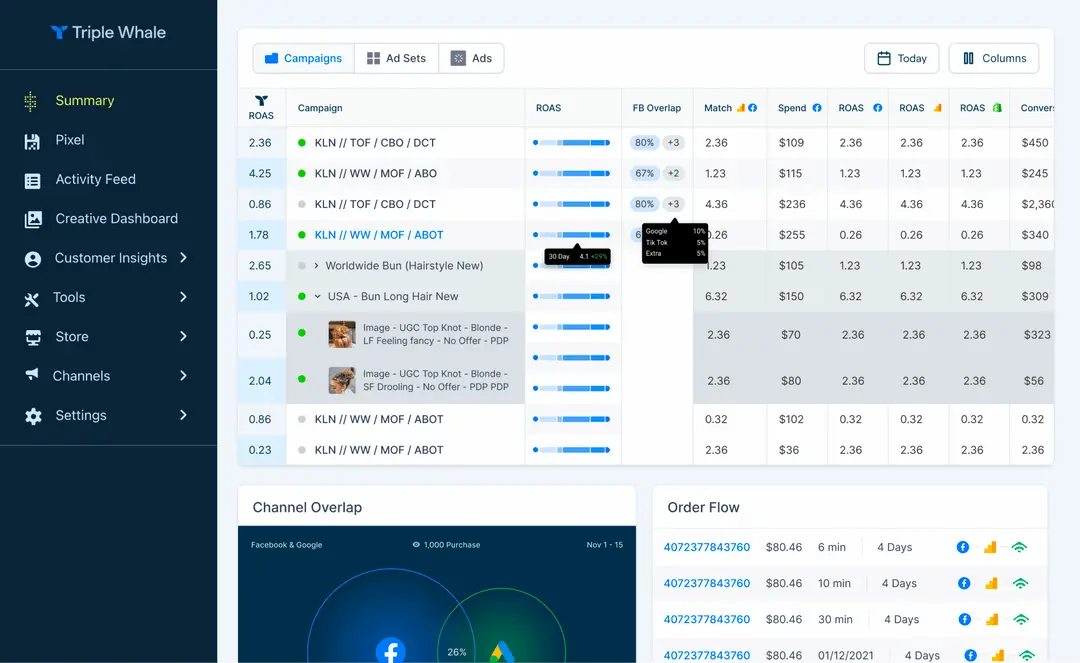
Triple Whale is a marketing analytics and attribution platform built for DTC brands on Shopify. It pulls ad spend and revenue into one dashboard and layers an AI assistant called Moby on top.
🤔 Why did we choose this tool?
It is one of the most widely used attribution tools in DTC, and it does marketing dashboards well. The honest catch is that its strength is marketing, not finance or operations, so founders still triangulate the rest by hand. If you are weighing options, our breakdown of Triple Whale alternatives goes deeper.
📊 Solutions offered
- Multi-channel ad attribution and blended ROAS tracking.
- Real-time marketing dashboards for Shopify stores.
- Moby AI assistant for queries and summaries.
- Creative and product-level performance views.
- Profit summary and basic LTV reporting.
❤️ Best for
DTC brands that want one screen for paid-media attribution across Meta, Google, and TikTok.
😕 Reviews
"1 STAR Broken Integrations Fake Attribution for External Marketplaces... the data has been inaccurate. Daily revenue totals are wrong, entire order blocks are missing... If youre a serious seller, especially if you sell on multiple channels Avoid Triple Whale."
XTRA FUEL Triple Whale Trustpilot Verified Review
"Our experience with Triple Whale has been extremely frustrating and almost categorically terrible. The integrations are inconsistent, building with the AI tool Moby is very buggy and crashes more than half the time, and support is largely unresponsive... we end up reverting back to direct data sources like Meta, Shopify, Recharge, etc."
Matt Huttner Triple Whale Trustpilot Verified Review
1.3 Polar Analytics ⭐⭐⭐⭐
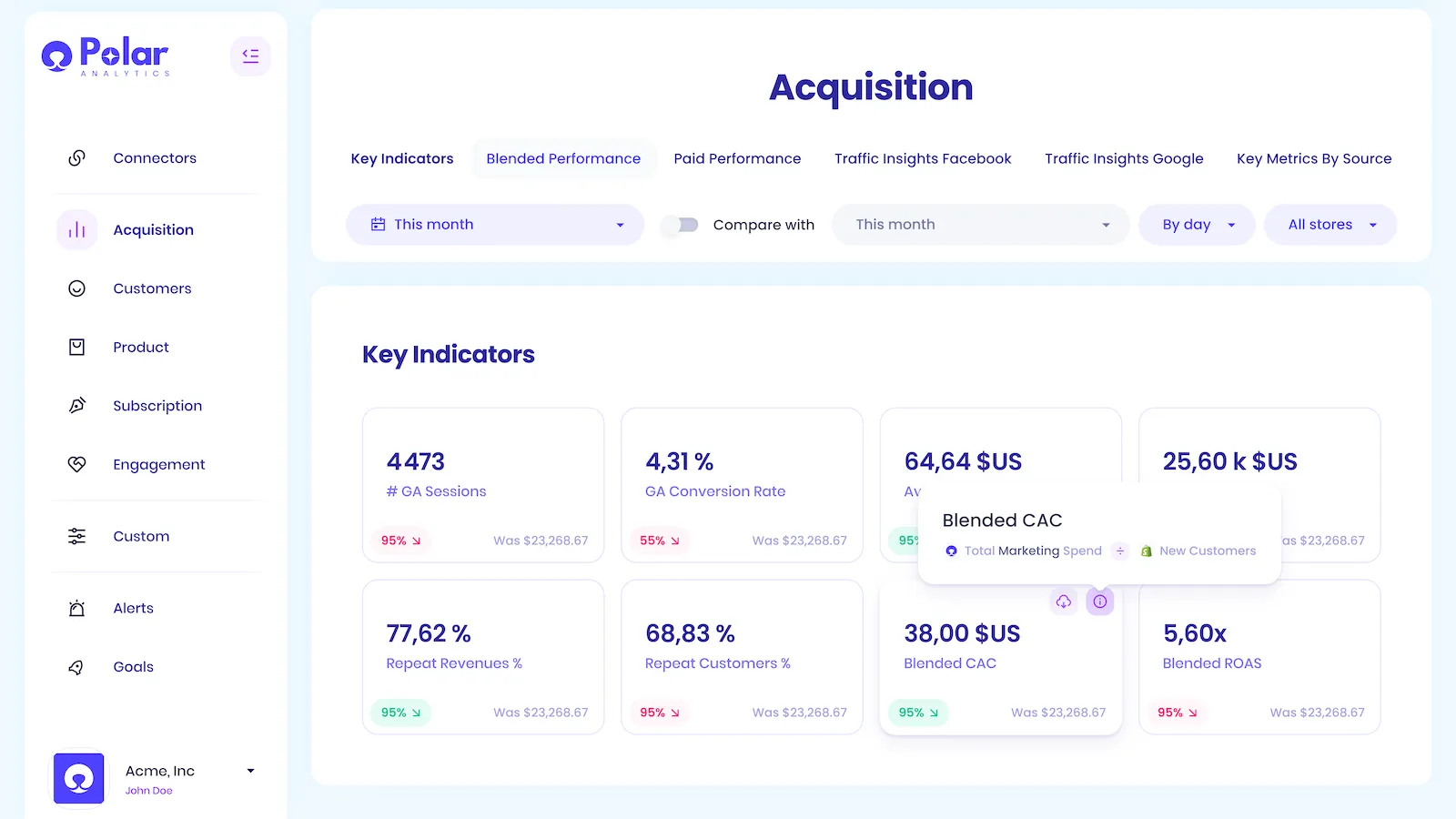
Polar Analytics is a centralized analytics platform for Shopify brands. It unifies data sources into one place and adds custom metrics and AI-assisted insights.
🤔 Why did we choose this tool?
Polar does the single-dashboard job cleanly and gets praised for ease of use and integrations. It is strong on reporting, though it stays in the analytics lane and does not cross into operational action. For more options, see our roundup of the best Shopify analytics apps.
📊 Solutions offered
- Centralized data from Shopify, ad platforms, and email tools.
- Custom metrics and report builder.
- AI-assisted insights and anomaly flags.
- Pre-built DTC dashboards and benchmarks.
- Multi-store reporting.
❤️ Best for
Shopify operators who want one customizable analytics hub without building it from scratch.
😊 Reviews
"Polar solved all of our analytic issues. They have integrations with all major platforms and pulling data is a breeze. Their customer support is also next to none."
Shopify Merchant Polar Analytics Shopify App Store Review
"Polar Analytics is the best eCom analytics tool. User-friendly, customizable reports, and seamless Shopify integration."
Verified User Polar Analytics Shopify App Store Review
1.4 Glew ⭐⭐⭐
Glew is a multichannel business intelligence and profitability tool. It pulls together sales, product, and customer data across stores and marketplaces.
🤔 Why did we choose this tool?
Glew is built around profitability and product-level reporting, which most marketing-first tools skip. It is solid for reporting, but it is a passive BI layer, so the alerts and action sit on you. Compare it against the wider ecommerce analytics platforms we track.
📊 Solutions offered
- Multichannel profitability reporting.
- Product and SKU-level margin analysis.
- Customer segmentation and LTV reports.
- Inventory and reorder reporting.
- Automated scheduled reports.
❤️ Best for
Multichannel sellers who want product-level profit visibility across stores.
📋 Reviews
Glew maintains profile listings on G2 and Capterra, where reviewers highlight multichannel reporting depth and note a learning curve on setup. I am not going to paste a quote I cannot tie to a specific verified reviewer, so I would point you to those profiles directly before buying.
1.5 Northbeam ⭐⭐⭐⭐
Northbeam is an advanced attribution and media-mix modeling platform aimed at brands spending real money on paid media.
🤔 Why did we choose this tool?
It is one of the more rigorous attribution engines on the market and is rated 4.5 stars across 16 verified G2 reviews. The trade-off is cost and complexity, so it fits scaling brands more than early ones. Many of these brands also wrestle with declining platform ROAS versus true profitability.
📊 Solutions offered
- Multi-touch attribution and media mix modeling.
- Customer journey and LTV analysis.
- Paid-media performance forecasting.
- Creative-level reporting.
- Data exports for finance teams.
❤️ Best for
Scaling DTC brands with large ad budgets that need attribution they can defend.
📊 Reviews
"Northbeam has been rated 4.5 stars by 16 verified reviewers on G2, who praise its attribution accuracy while noting the price point and onboarding effort."
Verified Reviewers Northbeam G2 Verified Review
1.6 DataHawk ⭐⭐⭐
DataHawk is an analytics platform focused on Amazon and marketplace sellers. It tracks keywords, prices, and sales performance across marketplaces.
🤔 Why did we choose this tool?
For Amazon-heavy and multichannel sellers, DataHawk fills a gap most Shopify-first tools ignore. It is marketplace analytics, though, so it will not watch your site uptime or your blended P&L. It pairs well with broader ecommerce website analytics.
📊 Solutions offered
- Amazon sales and keyword analytics.
- Marketplace price and Buy Box tracking.
- Profitability and fee monitoring.
- Multi-marketplace dashboards.
- Data warehouse exports.
❤️ Best for
Amazon and multichannel sellers who need marketplace-specific monitoring.
📋 Reviews
DataHawk lists verified reviews on G2, where sellers value its Amazon depth and note that the breadth of data takes time to learn. I would read those before committing, rather than trust a synthesized quote.
1.7 Cin7 ⭐⭐⭐
Cin7 is an inventory and order management platform with real-time stock tracking across channels.
🤔 Why did we choose this tool?
Inventory monitoring is a layer most analytics tools treat as an afterthought, and Cin7 owns it with real-time stock sync and low-stock alerts. Support quality is the recurring complaint, so go in with eyes open. It sits inside a wider ecommerce management software stack.
📊 Solutions offered
- Real-time inventory across channels.
- Multichannel order management.
- Low-stock and reorder alerts.
- Purchase order and supplier management.
- Accounting integrations.
❤️ Best for
Brands that need real-time inventory and order sync across Shopify, Amazon, and retail.
😕 Reviews
"Very poor customer service. They stopped responding to our emails, hence writing here. Our account could not be cancelled when we requested it."
Verified Customer Cin7 Trustpilot Verified Review
"Cin7 Core holds a 4-star average across 224 Trustpilot reviews, with praise for inventory depth and repeated complaints about support."
Verified Customers Cin7 Trustpilot Verified Review
1.8 Settle ⭐⭐⭐
Settle pairs inventory management with cash-flow and COGS tracking, aimed at CPG and ecommerce brands.
🤔 Why did we choose this tool?
Settle connects inventory to the money side, purchase orders, COGS, and cash flow, which is closer to how a CFO actually thinks. It is narrower than a full analytics suite, so it pairs better than it stands alone. It complements tools that forecast cash flow for ecommerce.
📊 Solutions offered
- Inventory tracking and purchase orders.
- COGS and landed-cost calculation.
- Cash-flow and bill-pay management.
- Working-capital financing options.
- Accounting integrations.
❤️ Best for
CPG and inventory-heavy brands that want stock and cash flow in one view.
📋 Reviews
Settle publishes customer stories and carries listings on G2 and Capterra, where users note strong AP and inventory workflows. I will leave you to read verified reviewers there rather than quote one I cannot individually attribute.
1.9 Price2Spy ⭐⭐⭐⭐
Price2Spy is a competitor price monitoring and repricing tool used by ecommerce teams to track rivals and protect margins.
🤔 Why did we choose this tool?
Competitor pricing is the layer almost every analytics article skips, and Price2Spy does it well with real-time change alerts. It is single-purpose, so it is a complement, not a command center. It slots neatly into a modern ecommerce tech stack.
📊 Solutions offered
- Competitor price tracking across sites.
- Automated repricing rules.
- Price-change alerts and reports.
- Product matching across retailers.
- API and integration support.
❤️ Best for
Retailers and brands defending margin against competitor price moves.
😊 Reviews
"Easy-to-use price control... It was easy to set up, and if there was a technical problem, they solved it shortly."
László B., Small-Business Price2Spy G2 Verified Review
"Read the T&C carefully, if you don't want to be double charged... The software itself has all the mandatory features for SME with quite intelligent UX. It takes time to set up."
Kristis A., Growth Strategist Price2Spy G2 Verified Review
1.10 UptimeRobot ⭐⭐⭐⭐
UptimeRobot is a website monitoring tool that checks if your store is up and alerts you the moment it goes down.
🤔 Why did we choose this tool?
A slow or down store quietly kills conversions, and UptimeRobot watches that layer cheaply, with a genuinely useful free plan. It only watches uptime and speed, so it is one piece of the puzzle. It is one of many tools Shopify owners lean on.
📊 Solutions offered
- Uptime checks as frequent as every minute.
- Response-time and performance monitoring.
- Email, SMS, and voice alerts.
- Public status pages.
- Up to 50 monitors on the free plan.
❤️ Best for
Any store that wants instant alerts when the site goes down or slows.
😊 Reviews
"I've been using it for a few years now to monitor various websites, and it's been a lifesaver... add your websites, and if there's an issue, you'll get an email notification."
Matt Crawford UptimeRobot Video Review
"UptimeRobot carries strong verified ratings on G2, where users praise the free tier and simplicity, while some want deeper analytics."
Verified Users UptimeRobot G2 Verified Review
A quick honesty note before the next section. Tools like Triple Whale and Wayflyer are not bad tools, they are narrow ones. The cost is not the subscription. It is the hours you spend stitching marketing, finance, and inventory together at 2am when ROAS tanks and you cannot tell if it is a creative problem, a margin problem, or a stockout. That stitching is the job Luca was built to remove, which is why so many founders are drowning in data.
I might be wrong on exact pricing tiers for a couple of these, since vendors change plans quietly and several hide enterprise numbers behind a call. Treat the pricing column as a starting range, not gospel, and confirm on each tool's site before you commit budget.
What Are the Criteria Behind This Ranking? Our Scoring Methodology [toc=2. How We Scored]
Every tool here was scored on five weighted criteria that add up to 100%. The weights reflect what actually keeps a store alive, not what looks good in a feature list. I built this rubric the way I'd judge a hire, can it reason across my business, will it ping me before things break, and does it cover enough ground to matter.
The five criteria and their weights
I weighted reasoning depth highest on purpose. A pretty dashboard you check on Mondays is worth less than a system that catches a margin leak on Tuesday.
Why these weights, and not a feature count
Most "best of" lists count features. Operators don't buy features. They buy fewer 2am fire drills.
So I leaned the rubric toward reasoning and alerts, because that's the difference between a tool that reports a problem and one that surfaces it early. Coverage matters too, since the whole point of this article is that no single legacy tool watches all five layers at once. That breadth is exactly what an AI Co-Founder for ecommerce is built to deliver.
How scores become stars
Each tool's weighted total maps to a simple star band. I'm only showing the stars, not the raw numbers, because the exact decimals invite arguments that miss the point.
- 0 to 20: ⭐
- 21 to 40: ⭐⭐
- 41 to 60: ⭐⭐⭐
- 61 to 80: ⭐⭐⭐⭐
- 81 to 100: ⭐⭐⭐⭐⭐
Where I'm being transparent
Luca AI sits at five stars, and I founded Luca, so weigh that how you like. The score comes from coverage across all five layers plus cross-functional reasoning, which is the axis most tools skip.
I could be off on a half-star here or there for tools I haven't run daily myself. Where I lacked hands-on time, I leaned on verified G2 and Trustpilot patterns rather than vibes. If a tool nails one layer brilliantly and ignores the rest, that shows up as a strong single-layer fit but a lower coverage score, which is exactly how it should read for a busy founder making a real budget call. It is the same reason so many operators end up drowning in data.
Why Are You "Profitable on Paper, but Broke in Reality"? [toc=3. What It Is]
Ecommerce monitoring is the continuous, automated tracking of the metrics that decide survival, profit, retention, inventory, uptime, and competitor pricing, with alerts that fire the moment something breaks. The trap is monitoring the wrong number. Most founders watch gross margin, which only shows what it costs to make a thing, not the hidden costs between supplier invoice and real profit where businesses quietly bleed.
The five layers, defined simply
Think of monitoring as five smoke detectors, not one. Each watches a different room.
- Profit: contribution margin, your revenue minus every cost to make and sell a unit.
- Retention: how repeat-purchase and lifetime value (LTV) trend per customer group.
- Inventory: stock levels and how fast units sell, called velocity.
- Uptime: whether your store loads, and how fast.
- Price: what competitors charge right now.
Why gross margin lies to you
Gross margin is a deceptive number. It tells you what it costs to make the product. It says nothing about what it costs to sell it.
The costs between the supplier invoice and your actual profit are where stores bleed, returns, support, shipping, discounts, and fees. A knife set I saw once carried about $13,000 a year in support costs, roughly $1.45 per unit, money that never shows up in gross margin. This is exactly the gap a tool built to track ecommerce unit economics is meant to close.
The invoice that made a founder cry
A founder slid an invoice across the table and said her best seller ran a 72% gross margin. Twenty minutes later she was nearly in tears.
When we calculated true contribution margin, line by line, the real number was 8%. The product she was scaling hardest was the one quietly draining her cash. That's the gap between profitable on paper and broke in reality, and it is why platform ROAS and true profitability are not the same thing.
What to monitor instead
Watch contribution margin at the SKU level, cohort retention, and your true landed cost per unit. Those three tell you whether growth is helping or hurting.
This is where I'll mention Luca AI once, plainly. Luca normalizes and standardizes your data on ingestion, so contribution margin is visible from day one instead of after a yearlong data-cleanup project. So if the real numbers are knowable, why do most dashboards still hide them? That's the next section, and our take on financial management goes deeper.
Why Do Proactive Alerts Beat Retrospective Dashboards? [toc=4. Proactive vs Retrospective]
Retrospective dashboards tell you what already happened. Proactive monitoring tells you what to do next. Most founders become "dashboard janitors," exporting Shopify, ad, and returns data into spreadsheets every Monday with no time left to actually decide. The fix is a sentry that surfaces only what changed, then recommends the move.
The Monday morning shudder
You know the routine. Monday rolls around, and you pull your standard reports before you've finished coffee.
One operator who scaled to roughly £200 million in sales told the story plainly. In the early days the business was "so Excel based" that most of the week was tied up in reporting, exports from Shopify, exports from the returns system, stitched together by hand. There was no time left for the actual thinking, the kind of work a real Shopify analytics tool should hand back to you.
Why "later" is too expensive
Speed is money in a way founders underrate. A 1-second delay in page loading can cut conversions by about 7%.
Now stack that against retrospective reporting. If your store slowed down on Tuesday and you find out from a Monday report, you've already lost the week. The whole danger of rear-view-mirror analytics is that the surprise has already cost you by the time you see it, which is why agentic AI for ecommerce founders is becoming the new baseline.
From monitoring to recommending
Here's the contrast laid out the way I see it on real stores.
- ✅ Proactive monitoring scans your data continuously and pings you only on the outlier.
- ✅ It links signals, so a ROAS dip gets traced to the creative, the audience, or the margin.
- ❌ Retrospective dashboards wait for you to open them, then leave the diagnosis to you.
- ✅ The better systems recommend the next move, not just display the chart.
- ❌ A pile of logs you "can go look at" is data you still can't make a decision from.
Where this is heading
The arduous, manual data tasks that used to take two weeks can now run in about 90 seconds. That changes what a founder's week should look like.
This is the one spot I'll point to Luca AI in this section. Luca is agentic, it pushes the situation-relevant report to Slack or email and tells you what to do, crossing the line from monitoring to recommending. Building the dashboard was never the finish line. Acting on it is, and that is the heart of how AI can actually help you run your ecommerce business.
Is Monitoring Without Capital Only Half the Loop? [toc=5. Intelligence and Capital]
Analytics tells you a winning SKU is about to stock out. A financier wires cash with no idea why you need it. Both strand you mid-decision. Monitoring catches the moment to act, but acting on inventory or ad scale needs capital, and capital chosen on its own terms: interest rate, disbursal speed, and repayment flexibility. The emerging model connects the trigger to fast, fairly priced funding.
Pillar one: analytics that stops at insight
Most analytics tools end the job at the chart. They show you the dip, then leave the thinking and the doing to you.
That's not a knock on accuracy, it's a knock on where the work stops. As one founder put it, you can spend millions building a data system, and a modern reasoning engine still reads meaning faster than the old stack. On the analytics axis, this is where Luca AI competes: it reasons across your data and recommends the move, not just renders it, which is the heart of the intelligence and capital thesis.
Pillar two: capital judged on capital terms
Now flip to financing. Revenue-based financing (capital repaid as a slice of sales) only matters on a few hard numbers: rate, speed, and terms.
The complaints pile up exactly there. Founders report last-minute reversals after written approval, with one writing that the lender "abruptly reversed their decision at the last minute," wrecking cash flow planning. It is one reason operators look for Wayflyer alternatives.
"Really disappointing experience. I have used Wayflyer on a number of occasions to help with Q4 stock purchasing and working capital requirements only to be told we no longer fit their criteria."
Joshua Hannan Wayflyer Trustpilot Verified Review
"We signed a 3M loan deal, only for them to come back two weeks later... slashing our funding to 1M. Then, months later... they cut it again to 350K."
Xin Shui, CEO/Founder Uncapped Trustpilot Verified Review
Where I'd judge a capital provider
On the capital axis alone, Luca AI competes on the metrics that actually decide it.
- ✅ Disbursal speed: how fast money lands once you decide.
- ✅ Interest rate and total cost, stated plainly.
- ✅ Repayment flexibility that flexes with your sales.
- ❌ The pattern above is the opposite: written offers reversed, terms cut mid-deal.
- ❌ Capital with no operational context forces you to re-explain your business every round.
Closing the loop
Here's my read, and I'll hedge it. The half-loop problem isn't that analytics or financing are bad, it's that they sit apart.
Data needs action, and action needs capital. Roughly 9 in 10 ecommerce businesses that fail early cite capital, pricing, or costing as the cause. So I'm sitting with one question: what happens to founder survival rates when the alert and the funding live in the same place? If you're testing that, I'd genuinely like to compare notes, and you can see how we think about funding to scale ecommerce campaigns.
How Do You Onboard an AI Monitoring System So Your Team Actually Uses It? [toc=6. Onboarding and Adoption]
Treat an AI monitoring system like a brilliant new hire, not a magic button. Even a PhD-level generalist fails on day one without onboarding. Standardize your data on ingestion to skip the cleanup year, give the tool a human name to cut team resistance, prove each insight with a cheap test before scaling, and keep a human in the loop on anything customer-facing.
Step 1: Standardize data on ingestion
The first failure point is messy data, not the AI. Different systems label the same thing differently, like "retail week 554" in one export and "332" in another.
Clean that at the door. With Luca AI, data gets normalized and standardized on ingestion, which is how you skip the yearlong cleanup project most teams dread. Plug in, ask, act, the same principle behind a clean ecommerce tech stack.
Step 2: Give it a name
Adoption is a people problem, not a tech one. One operator gave their AI a name, "Harry," and told staff to "ask Harry" first.
That small move cut roughly 100 repeat questions a day from new starters. Expected outcome: your team stops fearing the tool and starts using it like a colleague, which is exactly what agentic AI for ecommerce founders is meant to feel like.
Step 3: Run a smoke test before scaling
Don't bet the quarter on an unproven insight. Prove it in the cheapest way possible first.
A smoke test means a small, low-cost trial before you commit real budget. It's one of the simplest, most overlooked habits for a Shopify brand, and it keeps your cash where it belongs, a discipline that pairs well with calculating working capital for ecommerce needs.
Step 4: Keep a human in the loop
Automation without a check goes wrong in public. A major bike brand once published an AI-generated product image with mechanically impossible parts on its homepage.
So set the guardrail. Let the AI monitor, flag, and recommend, but keep a person approving anything customer-facing. That's the difference between leverage and embarrassment, and it is core to how we built process troubleshooting into Luca.
Which Ecommerce Monitoring Tool Is Right for Your Stage and Stack? [toc=7. Choosing Your Tool]
The right tool depends on your stage and stack, not a leaderboard. A small single-channel Shopify brand needs lightweight profit and stock alerts. A multichannel Amazon-plus-Shopify seller needs marketplace-aware monitoring. A scaling brand fighting a cash-conversion-cycle squeeze, the gap between paying suppliers and getting paid, needs monitoring that connects the trigger to action. Match the tool to the layer bleeding you most.
Early single-channel Shopify brand
If you're under a few million in sales on one channel, keep it light. You need profit and stockout alerts, not an enterprise suite.
Polar Analytics or Glew cover reporting well here. When NOT to pick them: if you're spending heavily on paid media and need defensible attribution, you'll outgrow basic dashboards fast, so it is worth scanning the wider ecommerce analytics platforms first.
Multichannel Amazon plus Shopify seller
Selling across Shopify and Amazon adds a data-mismatch problem. The same SKU reports differently across platforms.
DataHawk handles Amazon depth, and Cin7 keeps inventory synced across channels. This is where Luca AI fits on the analytics axis: it normalizes mismatched data on ingestion and reasons across channels, so you stop triangulating by hand and stop drowning in data. Skip a single-channel-only tool here.
Scaling brand with cash-cycle pressure
Once you're scaling, the squeeze is timing. Inventory ties up cash months before sales repay it, and that gap can quietly eat the business.
Here the question shifts from "what do I see" to "can I act fast." On the capital axis, Luca AI competes on disbursal speed and repayment flexibility, so a stockout alert can connect to funding without a separate three-week application, which is why founders compare Luca AI versus Wayflyer.
"0 customer service whatsoever, Ive done 2 loans with these people and cant get ahold of a real person."
Verified Reviewer Clearco Trustpilot Verified Review
Enterprise needing uptime rigor
At scale, downtime is pure lost revenue. A slow or dark store bleeds conversions every minute.
UptimeRobot covers this layer cheaply and reliably, even on its free tier. When NOT to rely on it alone: it watches uptime and speed only, so pair it with a profit and inventory layer, the kind of breadth our ecommerce website analytics guide covers.
Where I'd start
My honest read: pick the layer that's hurting most this quarter, and start there. Don't buy five tools to solve one fire.
I could be wrong on the edges for your specific stack, every store is a little different. If you tell me your channel mix and where cash is getting stuck, I'm happy to think through which layer to fix first, so feel free to reach out to the Luca team.