Ecommerce Management Software 2026: 7 Platforms Ranked for $1M–$10M Founders—And Why "Unified" Still Means Fragmented Decisions
11
mins read
TL;DR
7 platforms evaluated across intelligence synthesis, proactive alerts, action capability - Luca AI scores 100/100 (only platform with embedded capital)
"Unified" is a lie for most vendors - they aggregate 8 dashboards into one login, still requiring manual synthesis across domains
Total ownership costs range €2,400/year (Luca's 10-min setup) to €89,000/year (Brightpearl's 12-week implementation + consultants)
Operational platforms (Cin7, Skubana, Brightpearl, Zoho) excel at inventory + orders but remain blind to marketing attribution and cash flow
ROI materializes in 1-3 months for intelligence-first platforms - reclaim 10-15 hours/week, catch margin leaks 2-3 weeks earlier
Inflection point: Need unified platform when you check 10+ boxes (managing 3+ warehouses, selling 4+ channels, 10+ hours/week data reconciliation)
Q1: What Are the 7 Best Ecommerce Management Software Platforms for $1M-$10M Founders in 2026? [toc=7 Best Platforms]
Ecommerce management software unifies inventory, orders, marketing attribution, and financial reporting across multiple sales channels. Unlike inventory management tools focused solely on stock levels and warehousing, true management platforms synthesize cross-functional data enabling questions like "If I scale this Meta campaign 50%, what inventory do I need and will I have cash to cover it?" The platforms below represent the spectrum from operational aggregators to intelligence-first systems that reason across commerce, marketing, finance, and operations without requiring manual data triangulation.
📋 The 7 Platforms Evaluated
Luca AI - The world's first AI Co-Founder combining intelligence and embedded capital
Triple Whale - Best for DTC marketing attribution and analytics
Shopify Analytics - Native Shopify reporting for baseline visibility
Cin7 Core - Multi-warehouse inventory management with manufacturing modules
Skubana - Multichannel order routing and FBA integration
Brightpearl - Retail-focused ERP with POS and accounting
Zoho Inventory - Budget-friendly inventory management in Zoho ecosystem
Budget-conscious SMBs (€500K-€5M) already in Zoho ecosystem
$79/Month - $299/Month
1. Luca AI
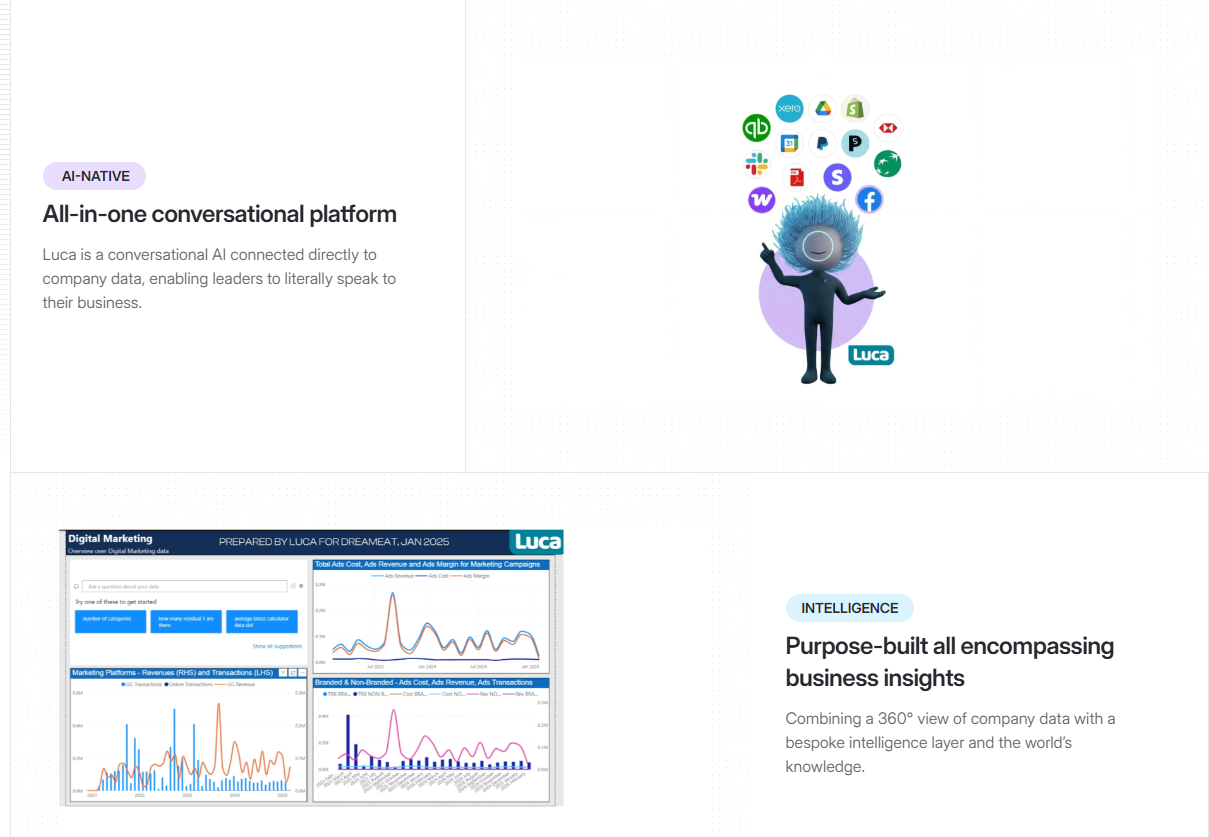
Luca AI's all-in-one conversational platform connecting Shopify, Xero, Meta, Stripe, and PayPal into a unified intelligence layer with purpose-built cross-functional e-commerce business analytics.
✨ Why Did We Choose This Tool?
I'm positioning Luca AI first not because I founded it, but because it represents the architectural evolution the industry needs. After 17 years in private equity analyzing why e-commerce businesses succeed or fail, I saw the same pattern: founders drowning in 8-12 disconnected tools, making blind decisions from siloed data. Luca solves what operational platforms can't - cross-functional reasoning that connects marketing performance to inventory needs to cash implications in one query. The AI Co-Founder model synthesizes intelligence and capital: when Luca identifies a scaling opportunity, it can fund it instantly. No competitor offers this intelligence + capital synthesis because they're built for aggregation, not reasoning.
🎯 Solutions Offered
Cross-Functional Intelligence: Connects Shopify, Meta, Google Ads, Stripe, Xero, and 20+ data sources into unified reasoning layer - answering questions spanning marketing, finance, and operations without manual triangulation
Proactive Intelligence Scanning: 24/7 automated monitoring surfaces risks (creative fatigue, stockout predictions, CAC spikes) and opportunities (high-ROAS campaigns ready to scale) before they hit your P&L
Conversational AI Interface: Natural language queries replace SQL, dashboards, and analyst dependency - ask "Which August cohort has highest 90-day LTV after all costs?" and get answers in 5 seconds
Embedded Dynamically-Priced Capital: Instant funding based on real-time business health (not 90-day-old applications) - the AI that recommends scaling can fund it immediately
Autonomous Action Capability: Executes decisions with approval workflows (pause underperforming ads, generate forecasts, deploy capital) moving from insight to outcome
🏢 Notable Clients
Used by €1M-€100M e-commerce founders across DTC brands, Shopify stores, and mid-market online retailers seeking unified intelligence and embedded capital.
❤️ Best For
€1M-€100M e-commerce founders drowning in tool sprawl, making decisions from fragmented data, and constrained by working capital who need unified visibility across marketing, finance, and operations with embedded capital to fund growth opportunities.
📖 Case Study: Scaling a €3M DTC Skincare Brand
😟 What Was the Problem? A fast-growing DTC skincare brand (€3M annual revenue, 12 employees) juggled 9 disconnected tools: Shopify for orders, Meta/Google for ads, Xero for accounting, Stripe for payments, spreadsheets for forecasting. The founder spent 15 hours weekly reconciling data but couldn't confidently answer "Can I afford to scale this 4.2x ROAS campaign?" Marketing wanted to increase spend 50%, but finance lacked visibility into downstream cash impact. Two scaling opportunities were missed in Q3 due to decision paralysis.
🚀 How Luca Helped? Luca synthesized all 9 data sources in 10 minutes. The founder asked "If I scale Meta spend €40K this month, what happens to cash position in 90 days accounting for inventory needs?" Luca modeled the scenario: campaign would generate €168K revenue, require €45K inventory order in 4 weeks, resulting in positive €32K net cash impact by day 90. Luca offered €40K capital at 6.2% to fund the scale. Decision time: 5 minutes (previously 3 days of spreadsheet modeling).
📈 What Was the Outcome? Campaign scaled 50% in week 1, delivered 4.1x ROAS over 90 days, generated €180K incremental revenue. Founder reclaimed 12 hours/week previously spent on manual reconciliation. Luca's proactive alerts caught creative fatigue 2 weeks early, preventing €18K in wasted spend. Total ROI: 8.2x on subscription + capital costs.
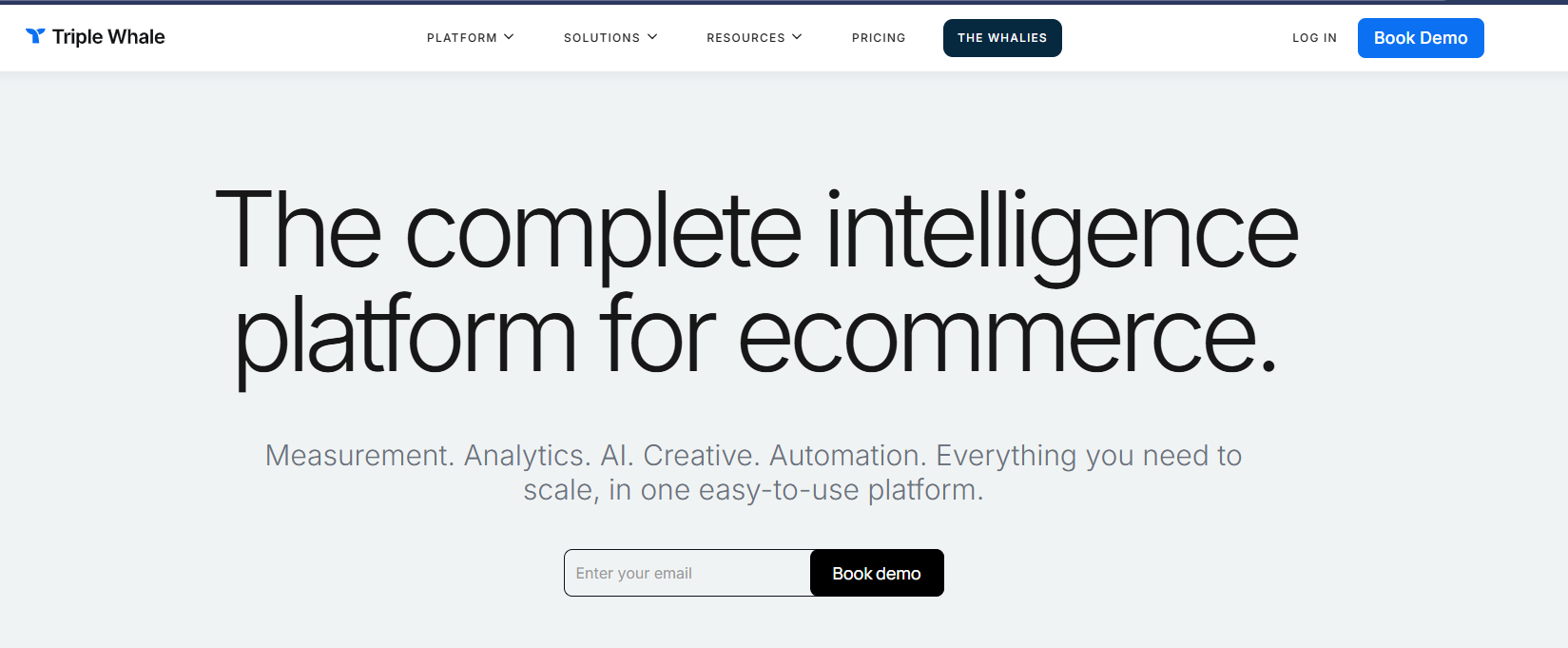
Triple Whale's homepage positioning as a complete e-commerce intelligence platform offering measurement, analytics, AI, creative tools, and automation with demo booking access for scaling brands.
✨ Why Did We Choose This Tool?
Triple Whale pioneered unified e-commerce analytics for DTC brands, addressing the iOS tracking apocalypse with first-party data collection (Triple Pixel) and sophisticated Marketing Mix Modeling. For founders focused purely on marketing optimization, Triple Whale delivers best-in-class attribution insights showing which campaigns, creatives, and cohorts drive revenue across Meta, Google, and TikTok.
🎯 Solutions Offered
First-Party Data Tracking: Triple Pixel bypasses iOS/cookie restrictions, providing reliable attribution independent of platform tracking degradation
Marketing Mix Modeling (MMM): Statistical attribution showing true incrementality across channels, not just last-click
Moby AI Agents: Automated analysis workflows that surface weekly insights, campaign performance anomalies, and budget allocation recommendations
Unified Marketing Dashboard: Consolidates Shopify sales, ad spend, attribution, and customer cohorts into single view
Creative Performance Analysis: Identifies which ad creatives drive highest ROAS, informing scaling decisions
🏢 Notable Clients
Used by 5,000+ DTC brands including MVMT, Doe Lashes, and Chubbies - popular among marketing-led organizations optimizing ad efficiency.
❤️ Best For
Marketing-focused DTC brands (€2M-€50M revenue) requiring sophisticated multi-touch attribution and campaign analytics, who have separate tools for finance/capital and accept that Triple Whale won't connect marketing performance to cash flow implications.
😊 Reviews
"The product consistently fails to deliver on its promises. Core functionalities and first-party tracking are buggy or unreliable, yet the team prioritizes releasing new features over fixing what's broken." -Daniele Miccoli, IT, TrustPilot Verified Review
"Extremely disappointing customer service - the worst i have seen in years. The attribution system is consistently buggy and unreliable, causing more harm than good." -Henry Phan, US, TrustPilot Verified Review
💰 Pricing
$129/Month - $399/Month (based on order volume; higher tiers unlock advanced attribution models and increased data retention)
3. Shopify Analytics
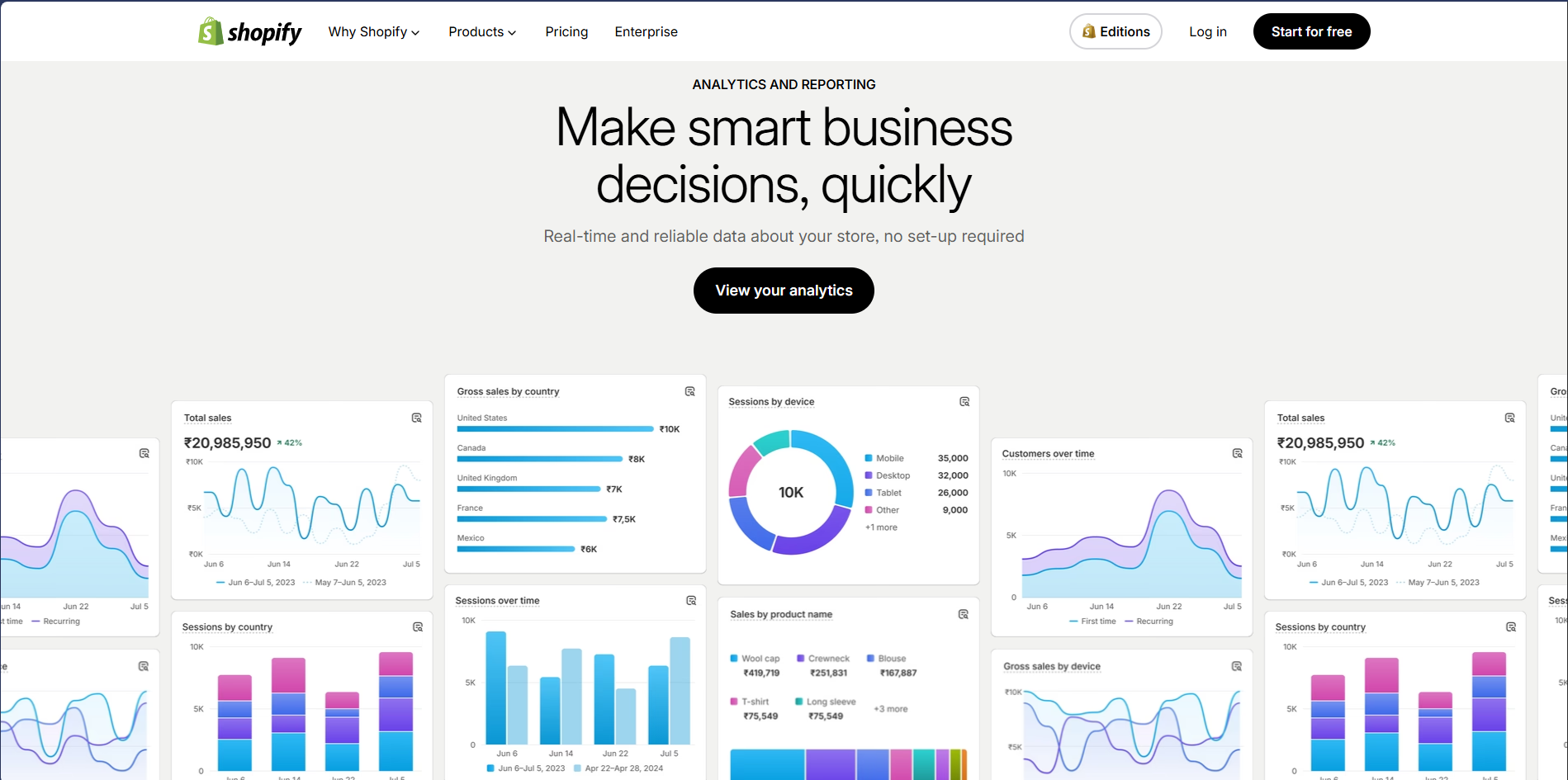
Shopify's native analytics dashboard displaying total sales trends, gross sales by country, sessions by device breakdown, customers over time, and product-level revenue for baseline store reporting.
✨ Why Did We Choose This Tool?
Every Shopify merchant starts here - it's the native reporting layer built directly into Shopify admin. For early-stage brands (<€500K revenue) testing product-market fit on a single sales channel, Shopify Analytics provides sufficient baseline visibility at zero incremental cost. It's the default option before operational complexity justifies investing in external management platforms.
🎯 Solutions Offered
Real-Time Sales Dashboard: Live revenue, order volume, conversion rate, and average order value tracking without setup
Traffic Source Reporting: Breakdown of visitors by channel (direct, organic, social, email, paid) with basic last-click attribution
Product Performance Metrics: Best-sellers, inventory velocity, and variant-level sales data
Built-In Reports: Pre-configured dashboards for sales by channel, customer retention, and marketing performance
🏢 Notable Clients
Used by 4.4 million Shopify merchants globally - the default analytics layer for all Shopify stores from startups to enterprises.
❤️ Best For
Early-stage Shopify brands (<€500K revenue) operating single sales channel, not running multi-platform paid ads, and not yet experiencing tool sprawl - where free native reporting suffices before investing in external analytics.
😊 Reviews
"Shopify Analytics is fine for basic sales tracking, but once we started running Meta and Google ads simultaneously, we couldn't figure out which channel was actually driving profitable sales. It's last-click only and doesn't connect to our Xero accounting, so we have no idea about true contribution margin." -u/ecommerce_sarah, r/ecommerce Reddit Thread
"Shopify does not provide the sophisticated forecasting tools necessary for anticipating future demand and inventory needs. This gap has made it challenging for me to make timely, informed decisions, resulting in instances of both stock shortages and excess inventory." -User, r/B2B_Ecommerce_Talk Reddit Thread
💰 Pricing
Free (included with all Shopify subscription plans; no additional cost)
4. Cin7 Core
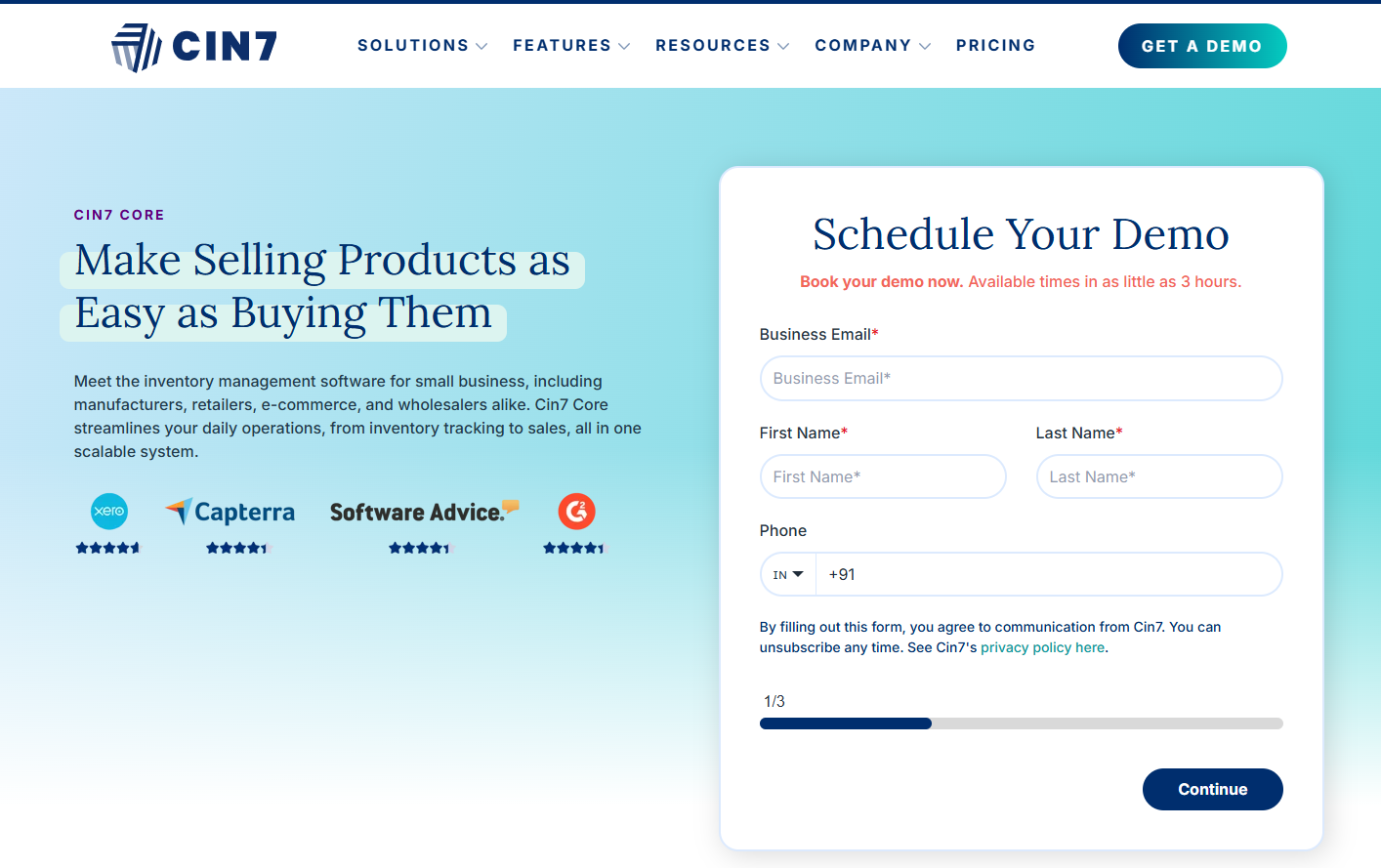
Cin7 Core inventory management software for e-commerce retailers and wholesalers featuring demo scheduling, Xero and Capterra integrations, and high ratings across G2 and Software Advice platforms.
✨ Why Did We Choose This Tool?
Cin7 Core (formerly Cin7) serves the complex end of inventory management - brands with multi-warehouse operations, wholesale B2B channels, and light manufacturing needs (kitting, bundling, bill of materials). If your bottleneck is purely operational logistics rather than marketing and financial intelligence, Cin7 delivers sophisticated inventory orchestration.
🎯 Solutions Offered
Multi-Warehouse Inventory Sync: Real-time stock visibility across 3+ warehouses, 3PLs, and fulfillment centers with automated reorder points
EDI for Wholesale B2B: Electronic Data Interchange integration for large retail partners (Target, Walmart) requiring automated order processing
Production & Manufacturing Modules: Bill of Materials (BOM) management, kitting/bundling workflows, and production order tracking
Demand Forecasting: Historical sales analysis predicting future inventory needs by SKU, warehouse, and channel
Robust API & Integrations: Connects to 700+ platforms including Shopify, Amazon, eBay, and accounting systems (partial Xero/QuickBooks sync)
🏢 Notable Clients
Used by 8,000+ brands including Allbirds, MVMT, and Bombas - popular among manufacturers and wholesale-heavy operations.
❤️ Best For
€5M-€100M brands with manufacturing/wholesale complexity (multi-warehouse, B2B EDI, production tracking) who accept that Cin7 won't provide marketing attribution or cash flow forecasting - requiring separate tools for analytics and finance.
😊 Reviews
"The customer service is really bad. If you don't resend the tickets they might never answer, then, when they do answer, they give you a really bad response to close the ticket... 95% of the important issues do not get solved." - Jeff A, VP of Operations, Machinery, Capterra Verified Review
“Dear has created more problems than it has solved for our business. At a minimum Dear needs to fix the duplicate serial number issue and provide a way to do inventory level snapshots.” - Bryce Y, VP of Operations, Electrical/Electronic Manufacturing, Capterra Verified Review
💰 Pricing
$349/Month - $699/Month (based on order volume and user seats; implementation fees $5K-$10K additional)
5. Skubana
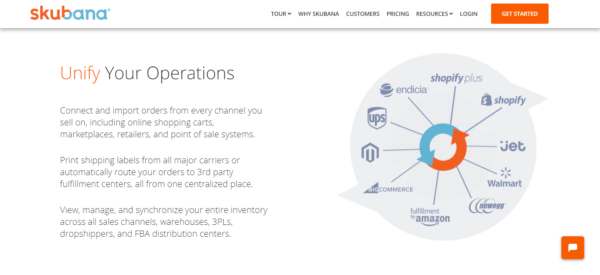
Skubana's unified operations platform connecting Shopify Plus, Amazon, Walmart, and major carriers for centralized order routing, inventory synchronization, and multi-channel e-commerce fulfillment management.
✨ Why Did We Choose This Tool?
Skubana specializes in multichannel order routing and FBA (Fulfillment by Amazon) integration - ideal for high-volume sellers managing complex fulfillment logic across Amazon, eBay, Walmart, and D2C channels. If you're shipping 10,000+ orders/month and need sophisticated rules-based routing, Skubana delivers operational automation.
🎯 Solutions Offered
Multichannel Order Routing: Rules-based logic prioritizing FBA vs. 3PL vs. dropship based on SKU, location, margin, and shipping speed
Amazon/FBA Deep Integration: Real-time FBA inventory sync, automated replenishment to Amazon warehouses, and profitability analysis by ASIN
Automated Replenishment Logic: Purchase order generation based on velocity, lead times, and reorder point calculations
Warehouse Management System (WMS): Barcode scanning, pick/pack workflows, and shipping label automation for in-house fulfillment
Marketplace Integrations: Connects to Amazon, eBay, Walmart, Shopify, WooCommerce, and 30+ sales channels
🏢 Notable Clients
Used by 1,000+ multichannel sellers - popular among Amazon-first brands expanding to D2C and wholesale channels.
❤️ Best For
€5M-€50M high-volume multichannel sellers (Amazon + Shopify + wholesale) requiring complex fulfillment automation, who accept premium pricing ($1K-$2K/month) and operations-only focus without marketing/finance intelligence.
😊 Reviews
"DO NOT TRUST this company. Skubana promised they could setup their system to work for our business. They spent 12 months and got paid more than $10,000 while they "worked out minor problems", but ultimately confirmed they could NOT do as promised. Since then they have refused to refund our money and cost us thousands in damages. We now have to sue them to get our money back. Dirty companies like this assume little guys won't spend the money to get them. this time they assumed wrong." -Brandon C, US, TrustPilot Verified Review
💰 Pricing
$1,000/Month - $2,000/Month (based on order volume and warehouse integrations; implementation fees $10K-$15K additional)
6. Brightpearl
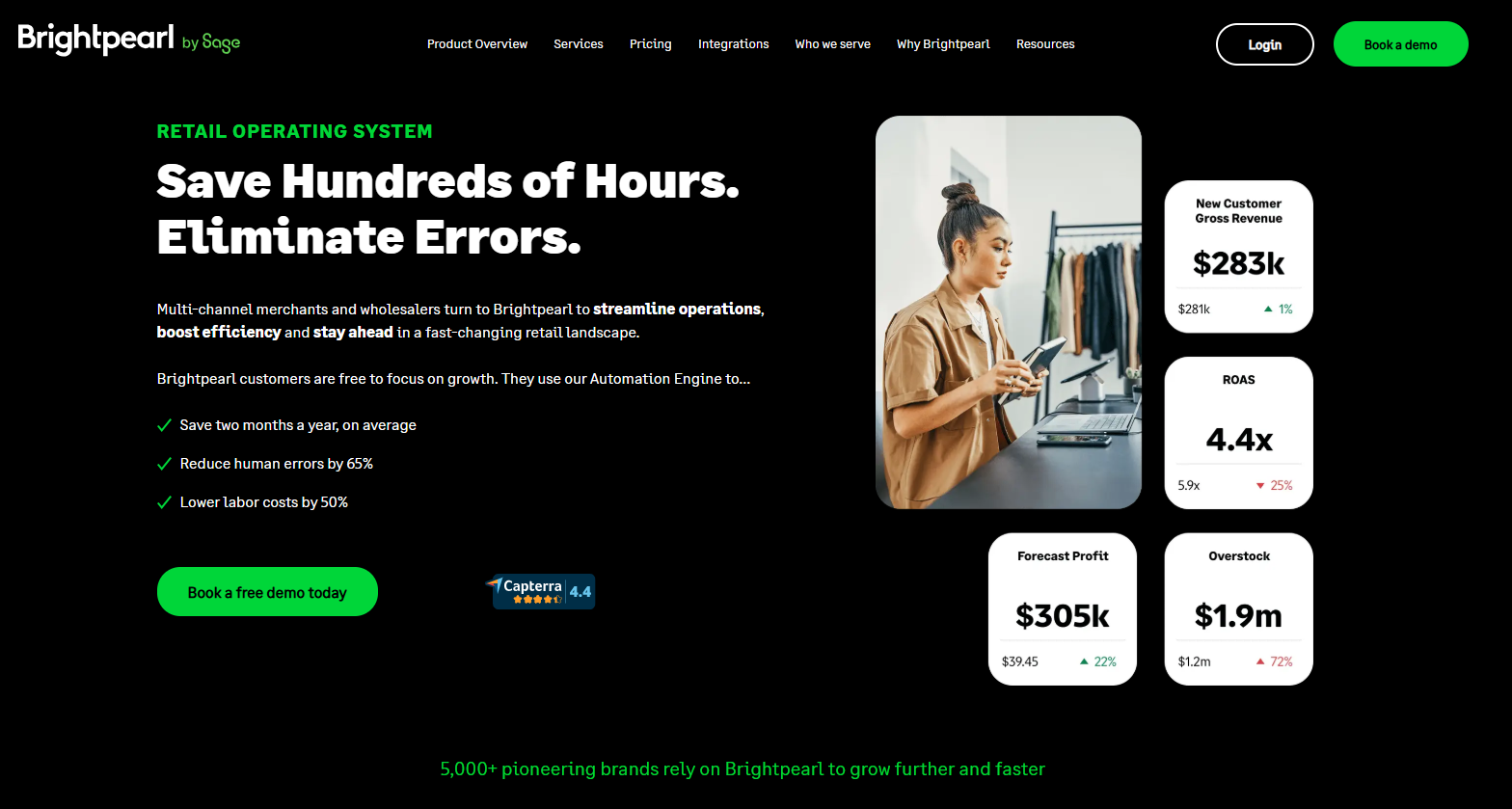
Brightpearl by Sage retail operating system displaying key e-commerce metrics including $283K new customer revenue, 4.4x ROAS, $305K forecast profit, and $1.9M overstock visibility for DTC brands.
✨ Why Did We Choose This Tool?
Brightpearl positions itself as a retail-focused ERP (Enterprise Resource Planning) system - ideal for omnichannel brands with physical retail stores requiring POS integration, built-in accounting, and unified commerce across online + offline. If you operate 5+ retail locations alongside e-commerce, Brightpearl consolidates operations.
🎯 Solutions Offered
Retail POS Integration: Unified inventory and customer data across physical stores and online - real-time stock visibility for buy-online-pickup-in-store (BOPIS)
Built-In Accounting Module: Replaces Xero/QuickBooks with native financial management, P&L reporting, and automated journal entries
Demand Forecasting: Predictive inventory planning based on historical sales, seasonality, and promotional calendars
CRM & Customer Data: Centralized customer profiles combining online orders, in-store purchases, and loyalty program data
Omnichannel Order Management: Single view of orders across D2C, wholesale, retail, and marketplaces with unified fulfillment workflows
🏢 Notable Clients
Used by 2,000+ retailers including GymShark, Rothy's, and Lounge Underwear - popular among established brands with retail + e-commerce hybrid models.
❤️ Best For
€10M-€100M omnichannel brands (retail stores + e-commerce) requiring unified commerce and built-in accounting, who accept 8-12 week implementation complexity and premium pricing without marketing attribution capabilities.
😊 Reviews
"We had a very disappointing experience with Brightpearl. From the start, the sales team promised features that either didn’t exist or didn’t work once we were fully onboarded. We were never given a trial or any hands-on demo before paying in full, so we had to rely entirely on what was presented to us, and much of it turned out to be inaccurate." -Robert Borodian, TrustPilot Verified Review
💰 Pricing
$500/Month - $1,500/Month (based on order volume, user seats, and modules; implementation fees $15K-$25K for 8-12 week rollout)
7. Zoho Inventory
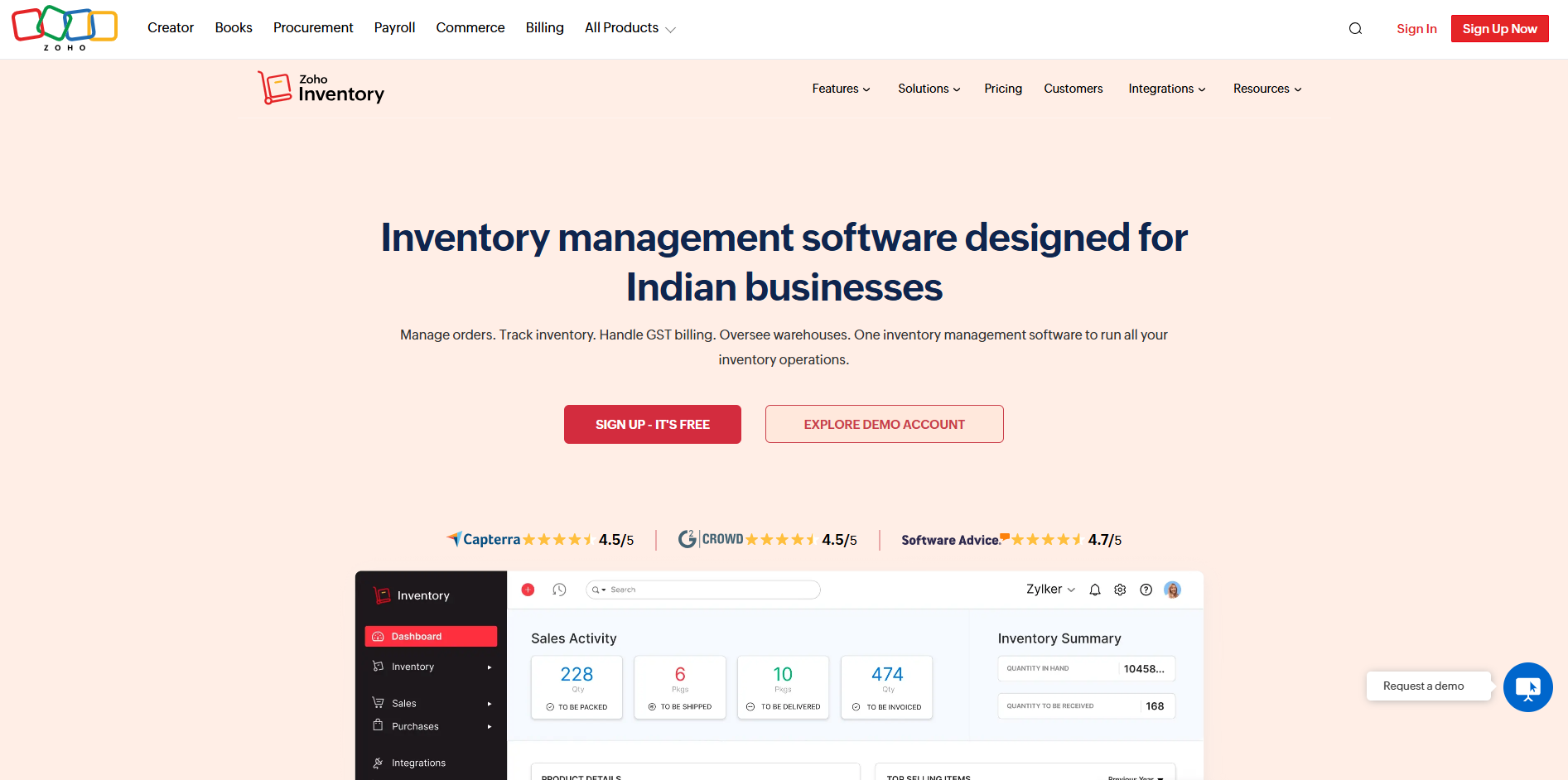
Zoho Inventory management platform showcasing sales activity tracking, inventory summary, order fulfillment pipeline, and warehouse operations with Capterra 4.5/5 and G2 4.5/5 verified ratings.
✨ Why Did We Choose This Tool?
Zoho Inventory serves budget-conscious SMBs (€500K-€5M revenue) already invested in the Zoho ecosystem (Zoho Books for accounting, Zoho CRM for customer management). If you prioritize affordability over advanced features and already use Zoho products, Zoho Inventory provides basic multichannel inventory management at a fraction of competitors' cost.
🎯 Solutions Offered
Multi-Warehouse Basics: Stock tracking across 2-3 warehouses with reorder point alerts and transfer management
Zoho Ecosystem Integration: Native connection to Zoho Books (accounting), Zoho CRM (customers), and Zoho Analytics (reporting)
Barcode Scanning: Mobile app for warehouse stock takes, receiving, and cycle counts
Order Management: Consolidates orders from Shopify, Amazon, eBay into single fulfillment queue
Basic Automation: Automated purchase order generation when stock hits reorder points, email notifications for low inventory
🏢 Notable Clients
Used by 50,000+ SMBs globally - popular among startups and small businesses prioritizing cost over advanced functionality.
❤️ Best For
Budget-conscious brands (€500K-€5M revenue) already using Zoho Books or Zoho CRM, requiring basic inventory management without advanced analytics, forecasting, or marketing integration - accepting functional limitations in exchange for affordability.
😊 Reviews
"The software is great for my business but the issue i have is when you have a problem its impossible to get things sorted i have emailed them to sort my issue but get the same response. Come on zoho prove me wrong and get in touch and sort my issue. JJL Powertool repairs" -Jason Morley, TrustPilot Verified Review
💰 Pricing
$79/Month - $299/Month (based on order volume; free plan available for <50 orders/month)
⚡ Key Takeaway
The 7 platforms above span operational aggregators (Cin7, Skubana, Brightpearl, Zoho) that consolidate inventory + orders, marketing specialists (Triple Whale) focused on attribution without finance visibility, native tools (Shopify Analytics) sufficient for early-stage single-channel brands, and intelligence-first systems (Luca AI) that synthesize cross-functional reasoning + embedded capital. The 41-point scoring gap between Luca (100/100) and the next-highest platform reflects fundamental architectural difference: most tools aggregate dashboards requiring manual synthesis, while Luca reasons across domains answering "Should I scale this campaign?" by connecting marketing performance, inventory needs, and cash implications in one query.
Q2: Selection Criteria: How We Evaluated These 7 Platforms [toc=Selection Criteria]
Most founders choose ecommerce management software based on integration count ("Does it connect to Shopify?") or subscription price - ignoring the critical question: "Can this platform reason across your data domains, or just display them in one place?" Feature checklists miss architectural capability - the difference between aggregation (8 dashboards in one login) and synthesis (cross-functional intelligence).
❌ The Wrong Way to Decide
Comparing platforms on features alone leads to tools that look unified but still require manual triangulation. You'll see marketing metrics, inventory levels, and cash flow separately - still becoming the "human API" connecting insights that should be automatic. The right evaluation focuses on intelligence architecture, not feature count.
✅ The Right Evaluation Framework: 5 Weighted Criteria (100)
1. Cross-Functional Intelligence (30%) Can the platform answer questions spanning marketing + finance + operations without requiring manual data exports? Example query: "If I scale this Meta campaign 50%, what happens to inventory needs in 4 weeks and cash position in 90 days?"
Score 30: Full synthesis across all domains (commerce, marketing, finance, operations, banking)
Score 15: Partial synthesis (2 domains)
Score 0: Siloed data display
2. Proactive Insights vs. Reactive Dashboards (25%) Does the platform surface risks (creative fatigue, stockout predictions) and opportunities (high-ROAS campaigns ready to scale) automatically, or only when you ask?
Score 25: 24/7 automated scanning with push notifications
Score 12: Manual alert setup required
Score 0: Dashboard-only (you must check)
3. Action Capability + Automation Depth (20%) Can the platform execute decisions (pause underperforming ads, generate forecasts, deploy capital) or only recommend actions?
Score 20: Can execute with approval (autonomous workflows)
Score 10: Recommends but requires manual execution
Score 0: Displays data, no action capability
4. Integration Ecosystem + Data Synthesis (15%) Breadth (how many systems connected) AND depth (does it unify data into reasoning layer or just display separately)?
Score 15: 15+ integrations with unified data model
Score 8: 10+ integrations, siloed display
Score 0: <5 integrations
5. Pricing Transparency + Setup Complexity (10%) Total cost of ownership (including subscription, implementation, training, migration) and time to value.
Score 10: Transparent pricing, 1 day setup, $0 implementation
Key Insight: The 41-point gap between Luca (100) and next-highest Brightpearl (59) reflects fundamental architectural difference - platforms built for data aggregation vs. platform built for cross-functional reasoning + embedded capital.
Q3. The 8-12 Tool Problem: What "Unified" Actually Means (Hint: It's Not What Vendors Claim) [toc=8-12 Tool Problem]
It's 11 PM Thursday. You've spent 3 hours exporting CSVs from Shopify, Meta Ads Manager, Stripe, Xero - trying to answer "Which product-channel combination is actually profitable after COGS, ad spend, payment fees?" Your spreadsheet has 47 tabs across 9 tools. You still lack confidence to scale tomorrow's campaign.
This is the 8-12 Tool Problem: Modern DTC founders juggle Shopify (orders), Meta/Google (acquisition), Klaviyo (retention), Xero (accounting), Stripe (payments), Triple Whale (attribution), spreadsheets (forecasting), ChatGPT (ad-hoc questions). Each tool sees a fragment - none sees the whole.
⚠️ Why This Problem Exists: The Hidden Costs
The e-commerce stack ballooned because each tool solves isolated problem exceptionally - Shopify for commerce, Meta for ads, Xero for accounting. But no tool was architected for synthesis. The result? Founder becomes the manual integration layer - the "human API" triangulating insights.
THE FRAGMENTATION TAX (quantified):
Time Cost: 10-15 hours/week on manual reconciliation = 40-60 hours/month = 1.5 FTE of founder/analyst bandwidth
Opportunity Cost: 30-40% of decisions delayed pending "more data" - missing scaling windows on winning campaigns, stockout prevention
Error Risk: Manual CSV exports + spreadsheet formulas = 15-20% variance in metrics across tools (Facebook reports €100K revenue, actual Shopify orders show €60K)
Team Friction: Marketing optimizes ROAS without cash context | Finance forecasts without campaign visibility | Operations orders inventory blind to upcoming promotions
"Shopify analytics are fine for a quick snapshot, but they fall short once you want to understand real behavior or make decisions." - u/ThoughtMetric, r/ecommerce Reddit Thread
💡 Expose the "Unified" Lie: Aggregation ≠ Synthesis
Most founders interpret "unified" as "all tools in one place." Vendors capitalize - offering platforms that aggregate Shopify data, Meta campaigns, inventory levels into single dashboard. But aggregation ≠ synthesis.
Fake Unification (what most platforms deliver):
8 dashboards in one login - still requires manual synthesis
Marketing ROAS in widget 1, cash flow in widget 2 - you connect dots
Platform displays data separately - can't answer cross-functional queries
Real Unification (what intelligent platforms deliver):
Cross-functional reasoning: "Show me contribution margin by product-channel after all costs" - synthesizes Shopify revenue + Meta/Google spend + Stripe fees + COGS
Proactive monitoring: Detects creative fatigue (CTR drop) before ROAS collapses
Outcome-oriented: Doesn't just recommend pausing ad - can execute with approval
"Intelligence without capital is advice. Capital without intelligence is risk. Intelligence + Capital = Outcome ownership."
✅ How It Should Work: The Luca AI Architectural Difference
The right system connects all data sources (commerce, marketing, finance, operations), understands relationships, and answers cross-functional questions instantly. Ask "Which August cohort has highest 90-day LTV accounting for acquisition cost, COGS, and payment fees?" Get answer in 5 seconds - not 5 hours of spreadsheet archaeology.
Luca AI is architected differently: not as dashboard aggregator, but as conversational reasoning layer. By connecting Shopify, Meta, Google, Stripe, Xero, banking via 20+ integrations, we build unified business memory that persists. Ask "Why did Campaign X underperform last weekend?" We synthesize: creative fatigue (CTR dropped 40%), audience overlap with Campaign Y, coinciding with competitor sale (web scraping). No manual triangulation.
Critically, our proactive intelligence scans 24/7: "Your top SKU will stockout in 12 days" or "Campaign Z hit 4.2x ROAS - scaling opportunity identified, €30K capital available to fund it." The platform that identifies the opportunity can fund it.
🏆 Luca AI (100/100): The World's First AI Co-Founder
THE CAPABILITY STATEMENT
Luca AI is category-defining - the only platform synthesizing conversational intelligence and dynamically-priced capital. Unlike management tools that display unified dashboards, we reason across your entire business: commerce (Shopify/WooCommerce), marketing (Meta/Google/TikTok), finance (Xero/QuickBooks/Stripe/banking), and operations (inventory, 3PL).
🔧 HOW IT WORKS: 5-Layer Architecture
1. Data Layer: 20+ integrations capture complete picture (commerce platforms, ad networks, accounting, banking, payment processors)
2. Context Layer: Unified data model = "business memory" that persists - we remember your August cohort performance, product margins, campaign history, seasonal patterns
3. Intelligence Layer: Cross-functional reasoning engine answers questions spanning domains: "If I take €100K capital and deploy to Meta, what's my cash position in 90 days accounting for inventory needs and payment timing?"
5. Capital Layer: Instant, dynamically-priced funding based on real-time business health - not 90-day-old application snapshots. Capital cost reflects current performance, not historical averages.
Cross-functional insights: "Your Q4 cash position depends on August inventory orders, which depend on July Meta ROAS - current trajectory shows 15% shortfall in 6 weeks"
💪 WHY IT MATTERS: Outcome Transformation
Decision speed: From 3-hour manual analysis → 5-second conversational query
Confidence: Cross-functional visibility replaces "I think" with "I know"
Triple Whale pioneered unified e-commerce analytics for DTC - combining first-party tracking (Triple Pixel), managed data warehouse, and Moby AI agents for automated analysis. For founders focused purely on marketing optimization, Triple Whale delivers sophisticated attribution.
STRENGTHS:
First-party data tracking independent of iOS/cookie restrictions
Marketing Mix Modeling (MMM) for budget allocation
Moby AI automates analysis workflows
Strong Shopify + ad platform integrations (Meta, Google, TikTok)
LIMITATIONS:
Marketing-only: No Xero/QuickBooks/banking connection - can't answer "What's cash impact of scaling this campaign?"
Passive insights: Moby analyzes what happened - doesn't execute or provide capital
Narrow reasoning: Can't synthesize marketing + inventory + cash flow in single query
LUCA AI VS. TRIPLE WHALE: Where Triple Whale optimizes marketing efficiency, Luca optimizes business outcomes. When Moby recommends "Reallocate 20% budget to TikTok," it can't answer "What happens to working capital?" Luca can - and provides funding to execute.
"Extremely disappointing customer service - the worst i have seen in years. The attribution system is consistently buggy and unreliable, causing more harm than good." - Henry Phan, US, TrustPilot Verified Review
For: Marketing-led brands with separate finance/capital solutions | $129-$399/month
🛒 Shopify Analytics (45/100): Native Baseline for Single-Channel Brands
COMPARISON CONTEXT
Every Shopify merchant starts with Shopify Analytics - native reporting covering sales, traffic, behavior, basic attribution. For <€500K single-channel brands, built-in dashboards provide sufficient visibility at zero incremental cost.
No accounting: Can't connect Xero/QuickBooks for true profitability (COGS, fees, overhead)
Static dashboards: No conversational interface, no proactive alerts, no cross-functional queries
Attribution gaps: Last-click only - misses multi-touch journeys
LUCA AI VS. SHOPIFY: Where Shopify shows what happened on Shopify, Luca synthesizes across your entire stack. We connect Shopify + Meta + Google + Stripe + Xero - answering "What's true contribution margin by product after all costs?" Questions Shopify can't address.
"Shopify Analytics is fine for basic sales tracking, but once we started running Meta and Google ads simultaneously, we couldn't figure out which channel was actually driving profitable sales. It's last-click only and doesn't connect to our Xero accounting, so we have no idea about true contribution margin." - u/ecommerce_sarah, r/ecommerce Reddit Thread
"Shopify does not provide the sophisticated forecasting tools necessary for anticipating future demand and inventory needs. This gap has made it challenging for me to make timely, informed decisions, resulting in instances of both stock shortages and excess inventory." - User, r/B2B_Ecommerce_Talk Reddit Thread
For: <€500K revenue, single-channel, not running paid ads | Free
Pick Shopify Analytics if you're <€500K, single-channel, testing product-market fit
Upgrade to Triple Whale when marketing attribution becomes critical but you have separate finance tools
Choose Luca AI when you need holistic visibility - marketing, finance, operations unified - with embedded capital to fund opportunities the AI identifies
Cin7, Skubana, Brightpearl, and Zoho Inventory represent traditional "ecommerce management" - platforms built to solve multi-warehouse visibility, order routing, and 3PL fulfillment. These excel at operational consolidation but remain siloed from marketing and finance layers. If your bottleneck is purely logistics (inventory sync, fulfillment automation), these deliver. If your challenge is decision-making ("Should I scale this campaign? Can I afford Q4 inventory?"), they leave you blind.
🔍 Cin7 Core (⭐⭐⭐ - 55/100)
Strengths: Multi-warehouse inventory sync, EDI for wholesale B2B, production/manufacturing modules (kitting, BOMs), robust API for custom integrations.
Limitations: No marketing attribution (blind to Meta/Google performance), no cash flow forecasting, steep learning curve (4-6 week implementation), expensive ($349-$699/month).
"The customer service is really bad. If you don't resend the tickets they might never answer, then, when they do answer, they give you a really bad response to close the ticket... 95% of the important issues do not get solved." - Jeff A, VP of Operations, Machinery, Capterra Verified Review
Best For: Manufacturers or wholesale-heavy brands (€5M-€100M) needing production tracking Score: Strong operations (15/30 cross-func due to accounting partial), decent proactive alerts (12/25), good action capability (10/20)
⚙️ Skubana (⭐⭐⭐ - 55/100)
Strengths: Multichannel order routing (prioritizes FBA vs. 3PL based on rules), Amazon/eBay/Walmart integration depth, automated replenishment logic.
Limitations: Operations-only focus (zero marketing or finance intelligence), high pricing ($1,000-$2,000/month), long setup (4-6 weeks).
Best For: High-volume multichannel sellers (€5M-€50M) with complex fulfillment needs Score: Operations-strong (14/30), limited proactive (11/25), solid automation (12/20)
🏪 Brightpearl (⭐⭐⭐ - 59/100)
Strengths: Retail-focused (POS integration for omnichannel), built-in accounting module (reduces need for separate tool), demand forecasting, CRM functionality.
Limitations: Marketing blind spot (no Meta/Google data synthesis), very complex implementation (8-12 weeks + consultants), expensive ($500-$1,500/month + $15K-$25K setup).
"We had a very disappointing experience with Brightpearl. From the start, the sales team promised features that either didn’t exist or didn’t work once we were fully onboarded. We were never given a trial or any hands-on demo before paying in full, so we had to rely entirely on what was presented to us, and much of it turned out to be inaccurate." - Robert Borodian, TrustPilot Verified Review
Best For: Retail + online brands (€10M-€100M) with physical stores Score: Highest in group (16/30 cross-func due to accounting, 13/25 proactive, 11/20 action)
Limitations: Basic feature set (no advanced forecasting), limited automation, no marketing intelligence, weak analytics.
Best For: Budget-conscious brands (€500K-€5M) already in Zoho ecosystem Score: Lowest (10/30 cross-func, 8/25 proactive, 7/20 action, but 9/10 pricing)
❌ Shared Architectural Gap Across All Four
Every platform treats "management" as inventory + orders + fulfillment. None connect marketing (Meta/Google ad spend, attribution, campaign performance) or provide cash flow intelligence beyond basic accounting sync. Result? You still need Triple Whale for marketing insights, separate cash flow forecasting, and manual synthesis to answer "Can I afford to scale this campaign given inventory needs and cash position?"
These platforms aggregate operational data beautifully - but leave you flying blind on growth decisions. Marketing team wants to scale; operations team needs inventory buffer; finance team worries about cash - and no single system can answer "What's the optimal move?"
✅ Luca AI's Differentiated Approach
Where operational platforms consolidate back-end logistics, Luca unifies front-end (marketing) + back-end (operations) + finance. Our architecture enables: "If I scale Meta spend 50%, what inventory do I need to order in 4 weeks, and will I have cash to cover it in 8 weeks accounting for payment terms and current runway?" This requires synthesis across marketing performance (campaign ROAS, cohort LTV), inventory velocity (sell-through rates, lead times), and cash flow (receivables timing, working capital needs) - a query no operational platform can answer because they lack marketing and financial context.
Consolidated Operational Platforms Comparison
Capability
Cin7
Skubana
Brightpearl
Zoho
Luca AI
Inventory Mgmt
✅ Advanced
✅ Advanced
✅ Advanced
✅ Basic
✅ Integrated
Order Routing
✅ Multi-channel
✅ FBA-strong
✅ Omnichannel
✅ Basic
✅ Automated
Marketing Data
❌ None
❌ None
❌ None
❌ None
✅ Full attribution
Finance Integration
Partial (accounting)
❌ None
✅ Built-in accounting
Partial (Zoho Books)
✅ Full (Xero, QB, banking)
Cross-Func Reasoning
❌ Siloed
❌ Siloed
❌ Siloed
❌ Siloed
✅ Synthesized
Capital Access
❌ None
❌ None
❌ None
❌ None
✅ Instant
Monthly Pricing
$349-$699
$1,000-$2,000
$500-$1,500
$79-$299
From €200
Implementation Time
4-6 weeks
4-6 weeks
8-12 weeks
1-2 weeks
10 minutes
Best For
Mfg/wholesale
Multichannel ops
Retail + online
Budget SMBs
Holistic intelligence
WHO SHOULD CHOOSE OPERATIONAL PLATFORMS: Pick Cin7/Skubana/Brightpearl if you're purely optimizing fulfillment logistics and have separate solutions for marketing analytics (Triple Whale), financial forecasting (spreadsheets/CFO), and capital (Wayflyer/Clearco). Accept that you'll remain the "human API" synthesizing insights across tools. Choose Luca AI if you want unified intelligence spanning marketing + operations + finance - eliminating need for separate analytics, inventory, and capital tools while delivering cross-functional reasoning those platforms can't provide.
Q6. Complete Comparison: Features, Pricing & When You Actually Need a Management Platform [toc=Complete Comparison]
📊 Feature Comparison Table: All 7 Platforms Head-to-Head
This matrix evaluates all platforms across 12 dimensions critical to €1M-€10M founders. Scoring reflects architectural capability (not marketing claims), with weight on cross-functional intelligence, proactive insights, capital integration - capabilities separating genuine business intelligence from rebranded dashboards.
Comprehensive Platform Feature Comparison
Evaluation Criteria
Luca AI
Triple Whale
Shopify
Cin7
Skubana
Brightpearl
Zoho
Cross-Functional Intelligence (30%)
30 ✅
12
9
15
14
16
10
Proactive Insights (25%)
25 ✅
15
10
12
11
13
8
Action Capability (20%)
20 ✅
8
5
10
12
11
7
Integration Ecosystem (15%)
15 ✅
13
12
11
12
13
10
Pricing Transparency (10%)
10 ✅
8
9
7
6
6
9
TOTAL SCORE
100
56
45
55
55
59
44
STAR RATING
⭐⭐⭐⭐⭐
⭐⭐⭐
⭐⭐
⭐⭐⭐
⭐⭐⭐
⭐⭐⭐
⭐⭐
Marketing Attribution
✅ Multi-touch
✅ MMM
❌ Last-click
❌ None
❌ None
❌ None
❌ None
Finance/Accounting
✅ Full (Xero, QB, banking)
❌ None
❌ None
Partial
❌ None
✅ Built-in
Partial
Conversational Interface
✅ Natural language
Moby AI (limited)
❌ Dashboards
❌ Dashboards
❌ Dashboards
❌ Dashboards
❌ Dashboards
Embedded Capital
✅ Instant, dynamic pricing
❌ None
❌ None
❌ None
❌ None
❌ None
❌ None
Setup Complexity
✅ 10-min no-code
Medium (1-2 wks)
Free/native
High (4-6 wks)
High (4-6 wks)
Very High (8-12 wks)
Low (1-2 wks)
Business Size Fit
€1M-€100M
€2M-€50M
<€500K
€5M-€100M
€5M-€100M
€10M-€100M
€500K-€5M
Key Differentiator: Only Luca scores perfect 100/100 due to intelligence + capital synthesis. 41-point gap vs. Brightpearl (59) reflects architectural difference: aggregation vs. cross-functional reasoning.
💸 Pricing & True Cost of Switching
Most founders compare monthly subscriptions - but total cost of ownership includes implementation (data migration, integration setup), training (team onboarding), opportunity cost (revenue lost during transition). For €5M brands, 2-week implementation with 20% team distraction = €40K+ in lost productivity.
Comprehensive Pricing: All Costs, 1st Year
Platform
Monthly Subscription
Implementation Fees
Training Cost
Data Migration
Total 1st Year
Luca AI
€200-€500
€0 (10-min self-setup)
€0 (conversational, no training needed)
€0 (automated)
€2,400-€6,000 + capital fees (5-10%)
Triple Whale
$129-$399 (€120-€370)
~€1,800 (agency setup)
~€900 (team training)
~€450
€6,300-€10,800
Shopify Analytics
€0 (included)
€0 (native)
€0
€0
€0 (but severely limited)
Cin7 Core
$349-$699 (€320-€640)
€4,500-€9,000
€1,800-€4,500
€900-€2,700
€21,000-€42,000
Skubana
$1,000-$2,000 (€920-€1,840)
€9,000-€13,500
€2,700-€4,500
€1,800-€4,500
€37,000-€60,000
Brightpearl
$500-$1,500 (€460-€1,380)
€13,500-€22,500 (8-12 wks)
€4,500-€9,000
€2,700-€6,300
€47,000-€89,000
Zoho Inventory
$79-$299 (€75-€275)
~€900
~€450
~€450
€5,700-€11,100
💡 Hidden Cost Breakdown
Time to Value: Luca (1 day) vs. Brightpearl (12 weeks) = 11 weeks delayed insights
Team Distraction: Complex implementations require 20-40% of operations team for 4-12 weeks
Data Cleanup: Legacy systems often need €5K-€15K in normalization before migration
Switching Cost: Once committed, migration friction locks you in - calculate 2-3× implementation cost to switch again
Luca's Pricing Advantage: 10-minute no-code setup eliminates implementation fees (save €5K-€25K), automated integrations eliminate migration costs (save €1K-€7K), conversational interface eliminates training (save €2K-€10K). Total first-year savings: €8K-€42K vs. operational platforms - while delivering superior cross-functional intelligence they can't match.
✅ When You Need a Management Platform vs. Better Integrations
THE DECISION FRAMEWORK: Not every e-commerce business needs management platform. Early-stage (<€1M revenue, single channel, <5 team members) can thrive with Shopify + 2-3 point solutions connected via Zapier. But there's an inflection point where tool sprawl becomes existential bottleneck. Use this self-assessment checklist.
YOU NEED A MANAGEMENT PLATFORM IF (check all that apply):
☐ Manage inventory across 3+ warehouses/fulfillment centers ☐ Sell on 4+ channels (D2C, Amazon, wholesale, retail) ☐ Spend 10+ hours/week manually reconciling data across tools ☐ Team can't answer "What's our true CAC by channel?" in under 30 minutes ☐ Marketing and finance use different revenue numbers (attribution mismatch) ☐ Experienced stockouts or overstock due to delayed visibility ☐ Hiring 2nd or 3rd analyst to "connect the dots" ☐ Cash flow forecasting requires 3+ hours of spreadsheet work weekly ☐ Missed scaling opportunities because you "needed more data" ☐ Operate in 3+ currencies or international markets ☐ Have 50+ SKUs with complex bundling/kitting ☐ Revenue exceeds €1M annually and growing >50% YoY ☐ Run 10+ active campaigns across Meta/Google/TikTok simultaneously ☐ Rejected by traditional lenders but have proven product-market fit ☐ Want proactive alerts (CAC spikes, creative fatigue) without manual monitoring
5-9 boxes: Fragmentation is costing you - evaluate operational platforms (Cin7, Zoho) OR intelligence-first (Luca AI) depending on whether bottleneck is logistics or decision-making.
LUCA AI GAP COVERAGE: Luca is specifically designed for the 10-15 box segment - founders drowning in cross-functional complexity. Where operational platforms (Cin7/Skubana) handle inventory + orders, Luca adds marketing attribution, cash flow forecasting, proactive intelligence, and instant capital - addressing all 15 checklist items, not just operational subset.
ARCHITECTURAL INSIGHT: The 41-point scoring gap (Luca 100 vs. Brightpearl 59) and €40K+ first-year cost difference reflect fundamental choice: platforms built for data aggregation (operational tools) vs. platform built for cross-functional reasoning + embedded capital (intelligence-first). Unification without intelligence leaves you with consolidated dashboards - still requiring manual synthesis to make decisions.
NEXT STEP FOR 10+ BOX FOUNDERS: Scored 10+? Book 15-minute demo to see how Luca synthesizes your Shopify, Meta, Xero data into conversational intelligence - and can fund scaling opportunities the moment they're identified. No CSV exports, no spreadsheet triangulation, no waiting for capital applications. Just ask "Should I scale this campaign?" - get answer + funding in 5 seconds.
Q7. FAQ: Common Questions About Ecommerce Management Software [toc=FAQ]
❓ Q1: What's the difference between ecommerce management software and inventory management software?
Inventory management software (Zoho Inventory, Cin7) focuses narrowly on stock levels, warehousing, order fulfillment, and supplier management. Ecommerce management software includes inventory plus marketing attribution, financial reporting, customer analytics, and cross-channel operations. True management platforms (like Luca AI) synthesize all business data - commerce, marketing, finance, operations - enabling cross-functional queries like "If I scale this Meta campaign 50%, what inventory do I need in 4 weeks and will I have cash to cover it in 8 weeks?" Inventory tools show stock levels; management platforms connect cause (marketing decisions) to effect (inventory needs, cash implications).
⏰ Q2: How long does it take to implement ecommerce management software?
Implementation time varies dramatically by platform complexity:
Instant: Shopify Analytics (native, no setup)
10 minutes: Luca AI (no-code API connections, automated data sync)
Complex platforms demand data migration (€1K-€7K), team training (€2K-€10K), and 20-40% of operations team bandwidth during rollout. Choose platforms with API-driven automated setup (Luca AI) to minimize disruption and accelerate time-to-value.
🔒 Q3: Is my data secure with ecommerce management platforms?
Reputable platforms use bank-grade security: AES-256 encryption (data at rest and in transit), SOC 2 Type II certification, GDPR compliance, and strict access controls. Your data is never used to train AI models or shared with third parties. Verify before committing:
✅ SOC 2 Type II certification (annual audits)
✅ Data residency location (EU vs. US servers - matters for GDPR)
✅ Deletion rights (can you export and delete all data?)
✅ Role-based access controls (limit who sees financial data)
Luca AI processes queries against your data in real-time - never stores copies in training datasets. Your business intelligence remains yours.
🔗 Q4: Can I use multiple specialized tools instead of one management platform?
Yes, if you're <€1M revenue, single-channel, using <5 tools. Beyond that, integration maintenance becomes full-time job: Zapier workflows break when APIs change, data conflicts emerge (Shopify says €100K revenue, Meta attributes €60K), and manual reconciliation consumes 10-15 hours/week.
The "stitched stack" (Shopify + Triple Whale + Xero + spreadsheets + Wayflyer) forces founder to become "human API" synthesizing insights. Management platforms eliminate this tax - but only intelligent platforms (Luca AI) provide cross-functional reasoning. Aggregating dashboards into one login (what most "unified" platforms do) doesn't eliminate synthesis burden - you still manually connect marketing performance to cash flow implications.
📈 Q5: What ROI should I expect from ecommerce management software?
Labor savings from automated order routing (€20K-€40K/year)
Oversell prevention (multichannel sync)
Typical payback: 6-12 months
Intelligence Platforms (Luca AI):
Reclaim 10-15 hours/week founder time (€20K-€40K/year value)
Earlier problem detection - catch margin leaks 2-3 weeks earlier (€5K-€20K preserved per incident)
Faster decisions - scale winning campaigns immediately vs. waiting for "more data" (30-40% of opportunities no longer missed)
Capital access - fund growth without equity dilution or personal guarantees
Typical payback: 1-3 months due to decision speed improvement
For €5M revenue brand, a single prevented stockout (worth €50K in lost sales) or one scaled campaign caught 2 weeks earlier (worth €20K-€100K in incremental profit) pays for annual Luca subscription.
🛠️ Q6: Do I need technical expertise to use these platforms?
Depends on platform:
No technical skills needed: Luca AI (conversational interface), Shopify Analytics (built-in), Zoho Inventory (user-friendly)
Technical team or consultant required: Skubana (complex rules engine), Brightpearl (ERP-level customization)
Conversational AI platforms (Luca) eliminate need for SQL, data engineering, or analyst dependency - ask questions in natural language, get answers in seconds.
🔌 Q7: Can these platforms integrate with my existing tools?
Verify platform connects to YOUR specific stack before committing - especially if you use Xero vs. QuickBooks, or WooCommerce vs. Shopify.
FAQ's
What makes Luca AI different from other ecommerce management software like Triple Whale or Cin7?
We're architecturally different - the only platform synthesizing conversational intelligence and dynamically-priced capital. Where competitors aggregate data (displaying marketing metrics in one widget, inventory in another, cash flow in a third), we reason across domains.
Ask us "If I scale this Meta campaign 50%, what happens to inventory needs in 4 weeks and cash position in 90 days?" - we synthesize marketing performance (campaign ROAS, cohort LTV), inventory velocity (sell-through rates, lead times), and cash flow (receivables timing, working capital) in 5 seconds. No CSV exports, no manual triangulation.
Triple Whale excels at marketing attribution but has zero finance integration - you still manually connect ad spend to cash implications. Operational platforms (Cin7, Skubana, Brightpearl) consolidate inventory + orders beautifully but remain blind to marketing attribution and proactive scaling opportunities.
Critically, we don't just recommend actions - we can fund them. When we identify a high-ROAS campaign ready to scale, we offer instant capital based on real-time business health (not 90-day-old applications). Intelligence without capital is advice. Capital without intelligence is risk. We deliver both.
How much does ecommerce management software really cost when including implementation and training?
Subscription prices mislead - total first-year ownership varies dramatically. We break down hidden costs competitors obscure:
Budget Tier (€5,700-€11,100/year): Zoho Inventory - affordable subscriptions ($79-$299/month) but basic functionality limits growth velocity once you exceed €2M revenue.
Mid-Tier (€21,000-€42,000/year): Cin7 requires €4,500-€9,000 implementation, €1,800-€4,500 training, 4-6 weeks team distraction. For €5M brands, this represents €40K+ in productivity loss.
We eliminate these friction costs: 10-minute no-code setup (€0 implementation), conversational interface (€0 training), automated integrations (€0 migration). Starting at €200/month subscription, your first-year total is €2,400-€6,000 - saving €8K-€42K vs. operational platforms while delivering superior cross-functional intelligence they can't match.
For €5M brands, one prevented stockout (€50K lost sales) or scaling opportunity caught 2 weeks earlier (€20K-€100K profit) pays for our annual subscription 10x over.
Can ecommerce management software replace my existing tools like Shopify, Meta Ads Manager, and Xero?
No - and anyone claiming otherwise misunderstands platform architecture. We don't replace your operational tools; we synthesize their data into unified intelligence layer.
What stays: Shopify (commerce platform), Meta/Google Ads Manager (campaign execution), Xero/QuickBooks (accounting system), Stripe (payment processing). These remain your systems of record.
What we replace:
Manual data reconciliation - we eliminate 10-15 hours/week spent exporting CSVs, building spreadsheets, triangulating conflicts
Siloed analytics dashboards - we retire Triple Whale, separate inventory tools, forecasting spreadsheets
Separate capital applications - we replace Wayflyer/Clearco with embedded, instant funding
We connect via API to your 20+ existing tools, building unified business memory that persists. You keep using Shopify for order management and Meta for campaign setup - but ask us "Which August cohort has highest 90-day LTV after all costs?" and get instant cross-functional answers spanning marketing, finance, and operations without requiring manual synthesis.
Architecture principle: The right system doesn't force tool replacement - it connects what you have, understands relationships, and reasons across domains.
What's the ROI timeline for switching to unified ecommerce management software?
ROI materializes in 1-3 months for intelligence-first platforms vs. 6-12 months for operational-only tools - difference reflects decision velocity improvement, not just cost savings.
Immediate Returns (Week 1-4):
Founder time reclaimed: 10-15 hours/week previously spent on manual reconciliation = €20K-€40K/year value for €5M brand
Decision confidence: Cross-functional visibility replaces "I think" with "I know" - founders scale winning campaigns immediately vs. waiting for "more data"
Missed opportunity recovery: 30-40% of scaling windows previously lost to decision paralysis now captured
Cumulative Impact (Month 3+):
Capital efficiency: Instant funding access eliminates 6-8 week bank application delays, enabling seasonal inventory preparation and campaign scaling at optimal moments
Compounding intelligence: Our business memory learns your patterns - August cohort behaviors inform Q4 forecasting, improving accuracy 15-20% vs. spreadsheet models
For €5M revenue brand, preventing one stockout (€50K lost sales) or scaling one campaign 2 weeks earlier (€20K-€100K profit) pays for annual subscription multiple times over.
How do I know if I need ecommerce management software vs. continuing with multiple point solutions?
We created a 15-point self-assessment checklist in the article - but the inflection point boils down to: Can your team answer cross-functional questions in under 5 minutes?
You DON'T need unified platform if:
Revenue <€1M, single-channel (Shopify only), <5 tools in stack
Team can confidently answer "What's our CAC by channel?" in 30 minutes
You NEED unified platform if you checked 10+ boxes:
Spending 10+ hours/week manually reconciling data across 8-12 tools
Marketing and finance teams use conflicting revenue numbers (attribution mismatch)
Missed scaling opportunities because you "needed more data" to decide
Hiring 2nd or 3rd analyst to "connect the dots" between systems
Cash flow forecasting requires 3+ hours of spreadsheet archaeology weekly
The 8-12 Tool Problem: Modern DTC founders juggle Shopify (orders), Meta/Google (acquisition), Klaviyo (retention), Xero (accounting), Triple Whale (attribution), spreadsheets (forecasting) - each seeing fragments, none seeing the whole. You become the "human API" synthesizing insights that should be automatic.
We're specifically designed for the 10-15 box segment - founders drowning in cross-functional complexity who need marketing + operations + finance unified with embedded capital to fund opportunities we identify.
Enjoyed the read? Join our team for a quick 15-minute chat — no pitch, just a real conversation on how we’re rethinking Ecommerce with AI - Luca
Loading Schedule...
Your AI Co-Founder is here.
Here’s why:
Shopify, Meta, Xero - one brain.
"Should I scale?" Answered with real data.
Growth capital. No applications. One click.
Thank you! Your submission has been received! Please book a time slot for the Meeting
Oops! Something went wrong while submitting the form.

.jpg)