9 Best Conversational Analytics and BI Tools for Ecommerce Brands in 2026
13
mins read
TL;DR
The nine tools we rank are Luca AI, Triple Whale, Polar Analytics, Shopify Sidekick, By the Numbers, ThoughtSpot Spotter, Power BI Copilot, Tableau Pulse, and Cube.
Conversational analytics is not customer chat analysis. Sorting your shortlist by what data each tool reads saves you a wasted two-week trial.
Accuracy comes from a governed semantic layer, not chat quality. One live-store test logged Triple Whale totals 10% to 18% below native Shopify reporting.
Run our five-question trust test in any trial, ending with show me how you calculated that. No calculation trail means no audit.
Pricing splits into three bands: native tools bundled free, ecommerce reasoning layers at roughly 200 to 800 per month, and general BI plus warehouse and analyst costs.
Chat is table stakes now. The 2026 differentiator is push-based alerting with a probable cause and a recommended move attached.
Q1. What Are the 9 Best Conversational Analytics and BI Tools for E-commerce in 2026? [toc=1. Top 9 Tools]
The nine best conversational analytics and BI tools for ecommerce in 2026 are Luca AI, Triple Whale (Moby), Polar Analytics (Ask Polar), Shopify Sidekick, By the Numbers Copilot, ThoughtSpot Spotter, Microsoft Power BI Copilot, Tableau Pulse, and Cube. Luca AI ranks first because it reasons over your normalized store, ad, and accounting data, traces a margin drop to its causes, and pushes reports without being asked.
Shopify logged 34 million Sidekick conversations in Q2 2026, and daily active merchant use rose 3.6x year over year. Operators already talk to their data. The open question in 2026 is not whether conversational analytics for ecommerce works. It is which of these tools returns a number you can act on with real cash.
I picked these nine on operator fit, not brand size. Every entry below carries a reconciliation note, because a confident wrong number costs more than no number at all.
🧾 The Shortlist at a Glance
Luca AI: Best for cross-functional ecommerce reasoning in plain English
Triple Whale (Moby): Best for DTC marketing analytics with an AI agent layer
Polar Analytics (Ask Polar): Best for Shopify data with a governed semantic layer
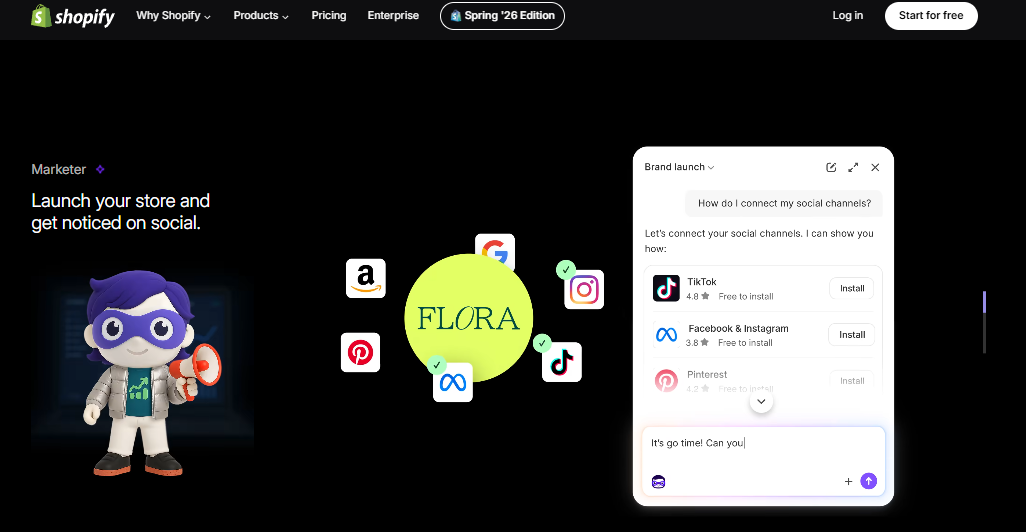
Shopify Sidekick: Best for native store questions at zero extra cost
By the Numbers Copilot: Best for lightweight Shopify reporting via chat
ThoughtSpot Spotter: Best for search-first BI on a warehouse
Microsoft Power BI Copilot: Best for teams already inside Microsoft Fabric
Tableau Pulse: Best for metric digests inside existing Tableau reporting
Cube: Best for building the semantic layer other AI tools query
9 Best Conversational Analytics and BI Tools for E-commerce in 2026
Tool
Key Capabilities Offered
Best For
Pricing
Luca AI ⭐⭐⭐⭐⭐
Plain-English querying across store, ad, email, and accounting data; root-cause analysis; predictive reorder and sales forecasting; anomaly alerts to Slack and email; scheduled reports with reasoning
SMB and mid-market stores at €1M to €5M with data sitting unused
Semantic layer and metric definitions; AI API for agents; caching; BI and LLM connectivity
Data teams giving other AI tools a trustworthy metric layer
Free tier to Custom
1.1 Luca AI [toc=1.1 Luca AI]
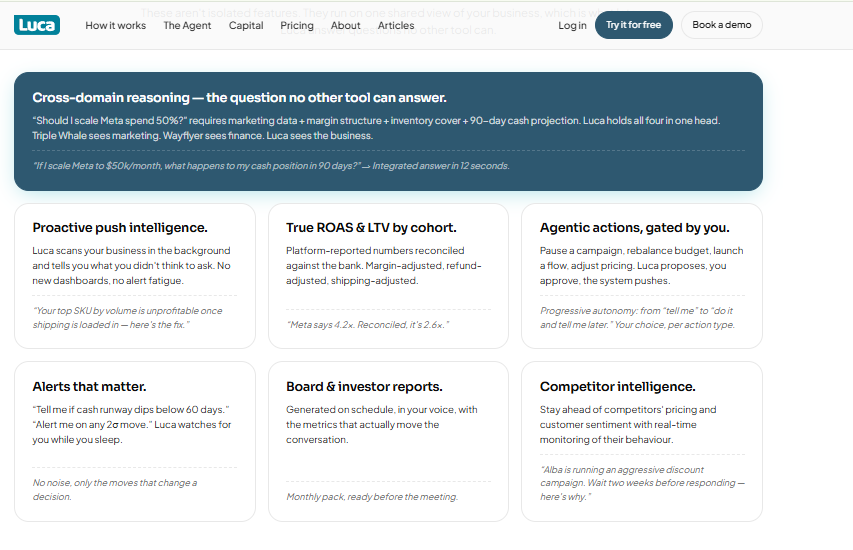
Luca AI answers cross-domain questions marketing, finance, and inventory tools cannot reach alone.
🎯 Why Did We Choose This Tool?
I built Luca AI, so treat this entry with the skepticism it deserves. It sits first for one reason. Luca AI reasons across commerce, marketing, and accounting data in a single question, which is the layer most tools skip.
Most analytics products bolted a chat window onto a dashboard. Luca AI is the AI data analyst for ecommerce itself. It normalizes data at ingestion, so you skip the cleanup year and start asking questions in week one.
🧩 Solutions Offered
Ask questions in plain English with no SQL, no analyst, and no dashboard building
Root-cause analysis that names the influencing components behind a metric move
Predictive work: sales forecasts, reorder alerts, and product-level projections
Anomaly monitoring that pings Slack, email, or mobile when ROAS dips or stock runs low
Scheduled reports containing graphs, reasoning, and a recommended next move
📊 How It Scores on the Core Metrics
Data sources connected: commerce, ads, email, 3PL, support, and accounting
Reconciliation with Shopify: definitions normalized on ingestion, calculations auditable
Plain-English depth: multi-step questions across functions, not single-metric lookups
Proactive alerting: continuous scanning with threshold and pattern alerts
Time to first answer: days, not a modelling project
✅ Best For
Shopify and WooCommerce stores between €1M and €5M in revenue
Teams without a data analyst but with years of unused order and ad data
Operators who want push alerts, not another tab to check
💰 Pricing
[ Starter: €299 / Month | Growth: €499 / Month | Scale: Custom Pricing ]. The full breakdown sits on the Luca AI pricing page.
📈 Case Study
What was the problem? A 14-person European supplements brand on Shopify, subscription-first, doing mid-seven figures, rebuilt three pivot tables every month to find true per-SKU profitability. Ad, email, and accounting numbers never matched.
How did Luca help? Luca AI connected Shopify, Meta, Google, Klaviyo, and their accounting stack, normalized the metric definitions, then answered margin questions directly in chat. The team set two alerts: contribution margin by SKU, and stock cover below four weeks.
What was the outcome? ⏰ The monthly reporting cycle dropped from two days to one morning. 💰 Two hero SKUs turned out to be near break-even after shipping and discount costs, and the brand repriced both. The founder's line to me was blunt: the reports finally arrive before the decision, not after. You can see more of these workflows in the Luca AI use cases.
1.2 Triple Whale (Moby) [toc=1.2 Triple Whale]
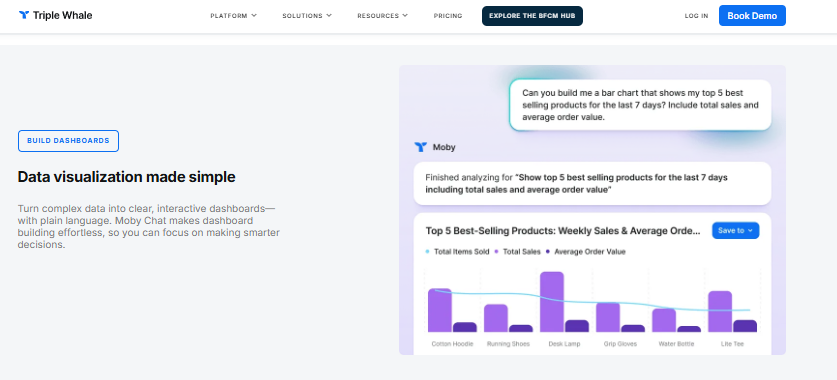
Moby builds dashboards from plain language, though attribution numbers still need reconciling against Shopify.
🎯 Why Did We Choose This Tool?
Triple Whale earned its place because no other tool on this list has as much DTC paid-media depth. Its Moby assistant is trained on data from 50,000+ brands, and Moby 2 now proposes and executes budget rebalances.
That strength is also its boundary. Triple Whale sees commerce and marketing. It does not read your accounting or banking data, so it cannot answer what a spend shift does to your cash position in 90 days, which is the gap I unpack in our guide to Triple Whale alternatives.
🧩 Solutions Offered
First-party Triple Pixel tracking, independent of platform reporting
Multi-touch attribution plus marketing mix modelling
Moby chat and agents for automated analysis and budget suggestions
Creative and ad-level performance reporting
Free Founders Dash tier for early-stage stores
📊 How It Scores on the Core Metrics
Data sources connected: commerce, ads, email, and some retention tools
Reconciliation with Shopify: one four-month live-store test logged totals running 10% to 18% below native Shopify reporting
Plain-English depth: strong on marketing questions, thin outside them
Proactive alerting: available, with fuller agent autonomy sold as an add-on
Time to first answer: fast, once the pixel has collected history
⚠️ Where Operators Push Back
Attribution complaints cluster hard. The rating spread tells the story: roughly 4.5 on G2, 4.2 on the Shopify App Store, and about 3.0 on Trustpilot for the same product. On the App Store the distribution is bimodal, near 79% five-star and 16% one-star.
DTC brands spending meaningfully on Meta and Google every month
Teams whose primary decision is channel and creative budget allocation
Stores with enough order volume for attribution modelling to mean something
💬 Reviews
"Triple Whale centralizes all my data in one place and gives me a clear view of performance across different platforms. The attribution system is very helpful to understand where sales really come from, and the dashboards make it easy to make better decisions every day. Customer support is really helpfull and fast. Pricing can also be a bit high for smaller businesses." Verified user, 5/5, Triple Whale - G2 Verified Review
"Really bad app. Almost impossible to reach customer service. For the AI help section you need to buy credits. The same bad UI interface has been active for years. Seems like they are not innovating at all. Also Triple Whale just casually leaves includes VAT in your revenue (revenue should never be including VAT). I wonder how many people don't even realize this." Verified Shopify merchant, Triple Whale - Shopify App Store Verified Review
❌ Not For You If
You need one number that survives a conversation with your accountant. Triple Whale is a marketing analytics and attribution platform, and it is honest about that scope. Budget for reconciliation time if finance signs off on your ecommerce reporting.
💰 Pricing
$219 / Month to $749 / Month (Professional), with a free Founders Dash tier.
Polar's client roster skews mid-market Shopify Plus, which matches its $750 monthly entry price.
🎯 Why Did We Choose This Tool?
Polar Analytics earned its spot because it solved the accuracy problem before it shipped a chat window. It puts a semantic layer, a shared dictionary of metric definitions, between your question and the raw data.
That order matters. Ask Polar answers from governed definitions, so gross sales means the same thing every time you ask. If you are weighing this against other options, our roundup of Polar Analytics alternatives lays out the trade-offs.
🧩 Solutions Offered
45+ connectors feeding a dedicated Snowflake warehouse per customer
Ecommerce semantic layer with custom metrics and dimensions
Ask Polar chat for plain-English reporting
MCP access, so ChatGPT, Claude, or Slack can query your live store data
Prebuilt agents for media buying, email, and inventory planning
📊 How It Scores on the Core Metrics
Data sources connected: commerce, ads, email, support, and finance tools
Reconciliation with Shopify: strong, governed by a semantic layer
Plain-English depth: multi-step questions across connected sources
Proactive alerting: yes, with agent-driven recommendations
Time to first answer: days, with onboarding support
✅ Best For
Shopify and Shopify Plus brands above roughly $3M in revenue
Teams that want to own their warehouse, not rent a dashboard
Operators comfortable paying for setup help on custom connectors
💬 Reviews
"We've had a great experience with Polar Analytics! It makes it easy to see all of our e-commerce and marketing data in one place without having to jump between a bunch of different platforms. The dashboards are easy to use, and their team has been super helpful and responsive whenever we have questions." Verified Shopify merchant,Polar Analytics - Shopify App Store Verified Review
"Polar solved all of our analytic issues. They have integrations with all major platforms and pulling data is a breeze. Their customer support is also next to none. They are well worth the price we pay." Vitaly, Shopify merchant,Polar Analytics - Shopify App Store Verified Review
❌ Not For You If
Your store does under $1M a year. The App Store listing shows $750 per month, and G2 reviewers flag a real learning curve. Below that revenue line, the payback math gets hard, and a leaner ecommerce analytics platform makes more sense.
💰 Pricing
$300 / Month to $750+ / Month (custom above that).
1.4 Shopify Sidekick [toc=1.4 Shopify Sidekick]
Sidekick handles store tasks well, but cannot answer a blended CAC question on its own.
🎯 Why Did We Choose This Tool?
Sidekick is the default most operators already have. It reads your actual products, orders, and store settings, which is the one thing ChatGPT cannot do without integration work.
Shopify logged 34 million Sidekick conversations in Q2 2026. Free and already installed beats paid and unused, at least for basic questions you would otherwise dig out of the Shopify analytics dashboard.
🧩 Solutions Offered
Plain-English questions about store and order data
Report generation inside the Shopify admin
Customer segment building from a description
Product content editing and image tweaks
Natural-language setup of simple Shopify Flow automations
📊 How It Scores on the Core Metrics
Data sources connected: Shopify only, no ad or accounting data
Reconciliation with Shopify: perfect, since it is the source itself
Stores under roughly $50K per month on Shopify alone
Merchants who need admin tasks and reports, not attribution
Teams testing whether conversational analytics fits their workflow
💬 Reviews
"It works well for simple administrative tasks, but when it comes to editing themes, the results can be inconsistent. For crucial edits, it's still wise to do it manually or consult someone experienced with the theme." r/ecommerce commenter, r/ecommerce Reddit Thread
"Sidekick excels at handling tasks for merchants rather than addressing customer needs. It effectively assists with activities such as drafting product detail page (PDP) content, generating discount codes, and refining images." r/shopify commenter, r/shopify Reddit Thread
❌ Not For You If
You spend real money on Meta or Google. Sidekick cannot see ad spend, so it cannot answer a CAC or blended ROAS question, which is where AI marketing analytics for ecommerce earns its keep.
💰 Pricing
Included with Shopify plans ($39 / Month to $2,300+ / Month).
1.5 By the Numbers Copilot [toc=1.5 By the Numbers]
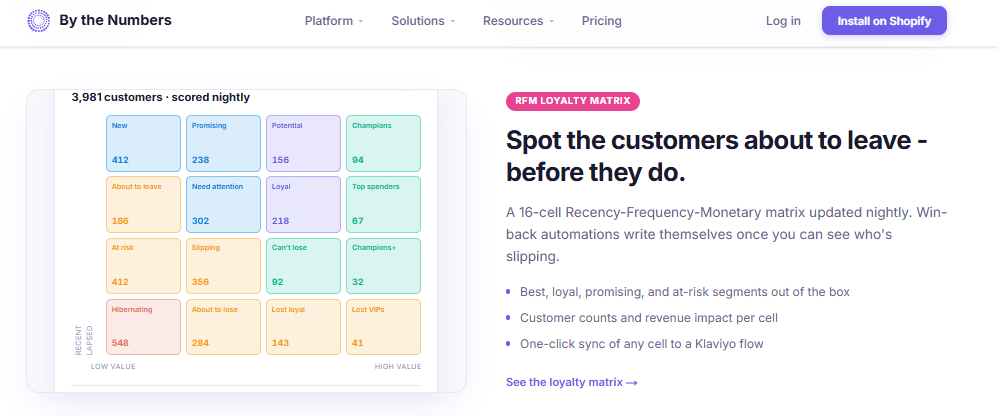
Cohort and RFM depth at $19 to $199 monthly suits stores under $200K.
🎯 Why Did We Choose This Tool?
By the Numbers sits in the price gap almost nobody serves. It gives small Shopify stores cohort retention, repeat purchase rate, and LTV reporting through a chat interface.
The app holds a 5.0 rating across roughly 100 Shopify App Store reviews. Merchants mostly praise clarity and support, not raw analytical power.
🧩 Solutions Offered
Copilot chat that builds tables and charts from a question
Cohort retention and repeat purchase reporting
Customer lifetime value and segment analysis
50+ prebuilt reports, plus pixel and dashboard views
Klaviyo and marketing tool integrations for action
📊 How It Scores on the Core Metrics
Data sources connected: Shopify plus a limited set of marketing tools
Reconciliation with Shopify: close, since it reads Shopify order data directly
Plain-English depth: good on retention questions, thin on paid media
Operators replacing four single-purpose reporting apps
💬 Reviews
"Incredible Insights & Outstanding Support! By The Numbers has completely transformed how we understand our business. The tool gives us so much valuable data and deep insights into customer behavior, sales trends, and performance metrics that we were never able to see so clearly before." Verified Shopify merchant,By the Numbers - Shopify App Store Verified Review
"App is slow and been essentially in beta testing forever. Still doesn't provide anything that I can't calculate in under 60 seconds with a calculator. Uninstalling." Verified Shopify merchant,By the Numbers - Shopify App Store Verified Review
❌ Not For You If
You run multi-channel paid acquisition and need cross-source root-cause work. This is reporting with a chat layer, not a reasoning engine.
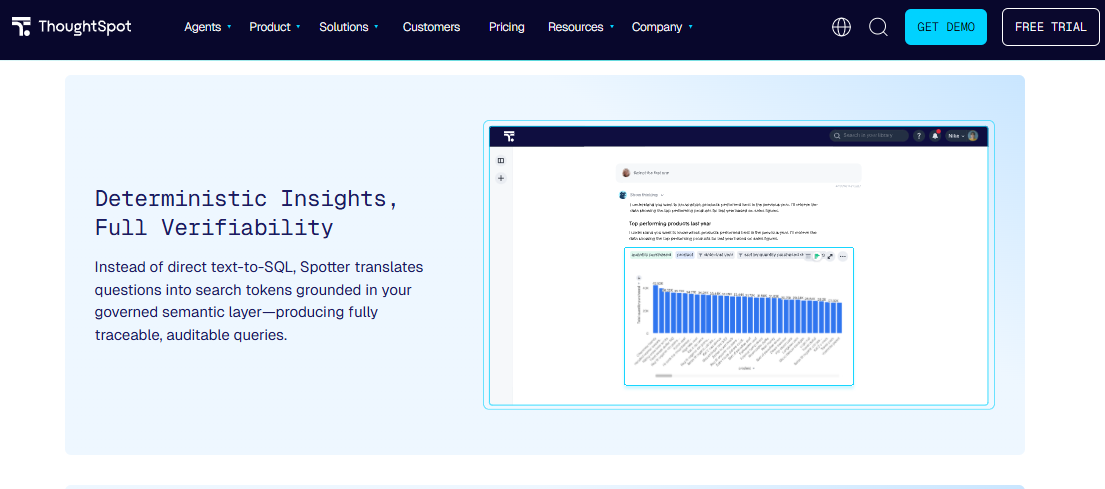
Spotter's traceable queries answer the show-me-your-calculation test, provided someone models your warehouse first.
🎯 Why Did We Choose This Tool?
ThoughtSpot built search-first analytics before conversational BI had a name. Spotter, its AI analyst, answers questions against governed metrics in a warehouse and holds a 4.4 rating across 321 G2 reviews.
For ecommerce, the catch is upstream. You need a warehouse and someone to model it before Spotter is useful, which is a different commitment from most AI-powered BI tools for ecommerce.
🧩 Solutions Offered
Natural-language search and chat on warehouse data
Spotter agentic analytics with follow-up questions
Liveboards for shared, governed reporting
Change analysis to explain metric movements
Embedded analytics for customer-facing products
📊 How It Scores on the Core Metrics
Data sources connected: warehouse tables, not native ecommerce apps
Reconciliation with Shopify: depends entirely on your own data model
Plain-English depth: high, when the model behind it is clean
Proactive alerting: yes, through monitoring and change analysis
Time to first answer: weeks to months, including modelling work
✅ Best For
Mid-market and enterprise retailers with a data team
Companies already running Snowflake, BigQuery, or Databricks
Teams needing governed self-service for many internal users
💬 Reviews
"It takes a little getting used to. especially if you're used to traditional BI tools like Tableau." Verified user,ThoughtSpot - G2 Verified Review
"Any formula you try to build won't work (it's not even recognized by the tool even when you use the right syntax). We had to create all metrics in dbt to be able to calculate them properly in Thoughtspot. Natural language doesnt work well. Our users found it very non-intuitive" Verified user,ThoughtSpot - G2 Verified Review
❌ Not For You If
You are a founder without a data engineer. That second review is the whole risk: metrics had to be rebuilt in dbt first.
💰 Pricing
From $25 / user / Month to Custom.
1.7 Microsoft Power BI Copilot [toc=1.7 Power BI Copilot]
🎯 Why Did We Choose This Tool?
Power BI Copilot is on the list because so many finance teams already live in Microsoft tooling. If your CFO builds in Power BI, Copilot is the cheapest conversational layer available.
Set expectations low. Operator feedback is consistently harsher here than for any other tool on this list.
🧩 Solutions Offered
Natural-language report and visual creation
DAX formula generation and explanation
Automatic summaries of existing reports
Q&A on published semantic models
Fabric integration for larger data estates
📊 How It Scores on the Core Metrics
Data sources connected: anything you load into Power BI or Fabric
Reconciliation with Shopify: your responsibility, via connectors and modelling
Plain-English depth: weakens quickly as models grow complex
Proactive alerting: available through Power BI alerts, not Copilot itself
Time to first answer: weeks, after the model is built
✅ Best For
Businesses standardized on Microsoft 365 and Fabric
Finance teams that already own Power BI licenses
Retailers blending ecommerce data with ERP reporting
💬 Reviews
"My experience of CoPilot so far on anything non trivial is that it's fantastic at producing very plausible garbage" r/PowerBI commenter, r/PowerBI Reddit Thread
"I'm wasting about $30 of the $35 a month I pay for Copilot." r/PowerBI commenter, r/PowerBI Reddit Thread
❌ Not For You If
You want answers this week. Copilot needs a Fabric capacity and a well-modelled dataset before it produces anything trustworthy, whereas an ecommerce business intelligence layer ships pre-modelled.
💰 Pricing
$14 / user / Month to $24 / user / Month (plus Fabric capacity).
1.8 Tableau Pulse [toc=1.8 Tableau Pulse]
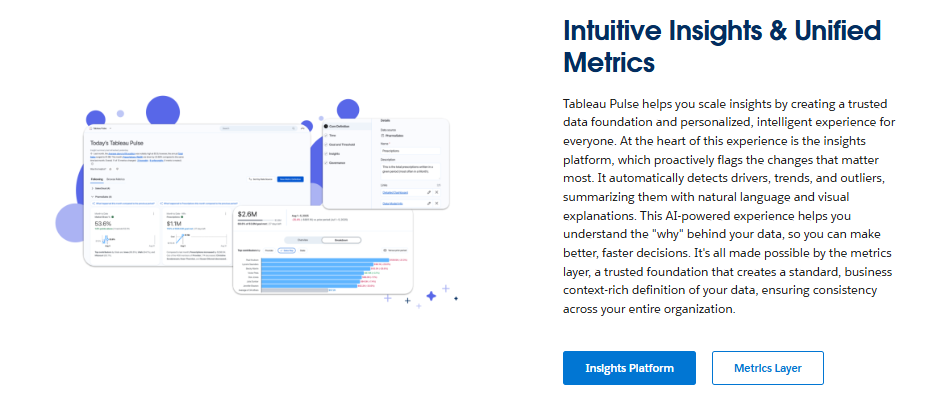
Pulse pushes written metric digests, though analysts call its feature set thin beyond time series.
🎯 Why Did We Choose This Tool?
Tableau Pulse takes the push approach, which I like in principle. It watches metrics you subscribe to and mails a written digest of what changed.
The narrative summaries are genuinely useful for executives. Analysts find the feature set thin, and they say so loudly.
🧩 Solutions Offered
Metric subscriptions with automated insight digests
Plain-language explanations of metric movement
Natural-language follow-up questions on a metric
Slack and email delivery of summaries
Mobile-friendly metric views
📊 How It Scores on the Core Metrics
Data sources connected: whatever already sits in Tableau Cloud
Reconciliation with Shopify: inherited from your existing Tableau sources
Plain-English depth: shallow, and limited to time-series metrics
Proactive alerting: its core strength, with scheduled digests
Time to first answer: fast if Tableau is already deployed
✅ Best For
Retailers already running Tableau Cloud
Leadership teams that want digests, not dashboards
Organizations tracking a stable set of headline metrics
💬 Reviews
"Pulse is just a toy with lots of marketing. It is only on cloud, has very few features and only works with time series. A real disappointment." r/tableau commenter, r/tableau Reddit Thread
"It has its quirks being a "v1.0" but my executives and sales leaders use it every day and love it. I'm looking forward to seeing how it matures." r/tableau commenter, r/tableau Reddit Thread
❌ Not For You If
You do not already own Tableau. Buying the platform to get Pulse makes no sense for a sub-$10M store, and automated ecommerce reporting costs far less standalone.
💰 Pricing
$15 / user / Month to $115 / user / Month.
1.9 Cube [toc=1.9 Cube]
🎯 Why Did We Choose This Tool?
Cube is on this list for a different reason than the rest. It is the semantic layer, the governed metric definitions that other AI tools query when they need a trustworthy number.
If you have engineers and want to build your own conversational layer, Cube is the foundation. It rates 4.5 across 27 G2 reviews.
🧩 Solutions Offered
Semantic layer defining metrics once, for every tool
AI API so agents and LLMs query governed definitions
Pre-aggregations and caching for query speed
Connections to BI tools and notebooks
Embedded analytics for software products
📊 How It Scores on the Core Metrics
Data sources connected: your warehouse, through your own pipelines
Reconciliation with Shopify: you define it, so accuracy is on you
Plain-English depth: none by itself, it powers other tools
Proactive alerting: not included, built downstream
Time to first answer: an engineering project, not a signup
✅ Best For
Brands with in-house data engineering capacity
Software companies embedding analytics for customers
Teams standardizing metrics across several BI tools
💬 Reviews
"Using CubeJS Cloud to build our semantic layer has been great! It really just takes a lot of development effort off our shoulders." Verified user,Cube - G2 Verified Review
"Pre-aggregations has sometimes been hard to work with, having partitions not refreshing correctly. But that has only been the exception, not the rule." Verified user,Cube - G2 Verified Review
❌ Not For You If
You are the operator, not the engineer. Cube gives you no answers on its own, only the plumbing that makes answers reliable, so most teams pair it with dedicated ecommerce data integration work.
💰 Pricing
Free tier to Custom.
⚠️ What I Left Off, and Why
Northbeam and Daasity are strong tools that kept coming up during this research. Both got cut for scope reasons, not quality.
Northbeam is an attribution platform, not a conversational layer. Daasity is closer to a data pipeline plus modelling service, so it belongs in a build-your-own comparison, and our Daasity alternatives breakdown covers that path.
⏰ The One-Line Verdict by Stage
Under $50K per month: stay on Shopify Sidekick, and add By the Numbers if retention is your lever.
$80K to $1M per month: pick a reasoning layer over normalized multi-source data.
Above that, with engineers on staff: ThoughtSpot or Cube justify their setup cost.
Luca AI belongs in the middle band, and I will not pretend otherwise. It was built for stores between €1M and €5M with years of order, ad, and accounting data sitting unused, and no analyst to interrogate it. Above that line, with a data team already hired, the general BI options earn their complexity. If you want to see where your stack sits, talk to the Luca AI team.
Q2. How Did We Score and Select These Tools? [toc=2. Scoring Methodology]
Each tool was scored on five weighted criteria: Reasoning Depth across sources (30%), Data Trust and Semantic Governance (25%), Setup and Time-to-First-Answer (20%), Pricing Transparency and Verified Reviews (15%), and Agentic and Proactive Capability (10%). Bands run from one star at the bottom to five stars at the top. Luca AI scores five stars, while general BI platforms lose points on ecommerce time-to-value.
Scoring Criteria and Weights for Conversational Analytics Tools
Criterion
Weight
What It Measures
Reasoning Depth across sources
30%
Can it answer a question that spans ads, orders, and costs
Data Trust and Semantic Governance
25%
Are metric definitions locked and auditable
Setup and Time-to-First-Answer
20%
Days or months before a useful answer
Pricing Transparency and Verified Reviews
15%
Published pricing, plus real G2 and App Store ratings
Agentic and Proactive Capability
10%
Does it alert you, or wait to be asked
📊 Why Reasoning Depth Carries the Most Weight
A chat box that reads one data source is a search bar. The questions that move money span sources: ad spend, shipping cost, discount rate, and returns.
Luca AI is trained on the relationships between ecommerce variables, which is the specific skill this criterion tests. Single-source tools answer "what happened." Multi-source reasoning answers "why, and what it costs me," which is the whole promise of ecommerce data analytics.
⚠️ Why Data Trust Sits Second
A confident wrong answer costs more than no answer. That is not theory. One ThoughtSpot reviewer had to rebuild every metric in dbt, a data modelling tool, before natural language worked at all.
Ask Luca AI where a number came from and it returns the source metrics behind it. Governance is not a feature you can bolt on later, which is why we treat ecommerce data management as the base layer, not an add-on.
⏰ Why Setup Speed Beats Feature Count
Most operators reading this have no data engineer. A tool that needs a warehouse, a modelling layer, and a contractor is a nine-month project.
Ari Tulla of ELO Health spent roughly $10 million building a proprietary data platform, then watched LLMs outperform it. His conclusion was blunt: buying the reasoning layer beats building it, a trade-off we unpack in our guide to evaluating AI data agents.
💬 What Reviewers Told Us
"We've had a great experience with Polar Analytics! It makes it easy to see all of our e-commerce and marketing data in one place without having to jump between a bunch of different platforms. The dashboards are easy to use, and their team has been super helpful and responsive whenever we have questions." Verified Shopify merchant,Polar Analytics - Shopify App Store Verified Review
"Any formula you try to build won't work (it's not even recognized by the tool even when you use the right syntax). We had to create all metrics in dbt to be able to calculate them properly in Thoughtspot. Natural language doesnt work well. Our users found it very non-intuitive" Verified user,ThoughtSpot - G2 Verified Review
❌ What We Refused to Score
Logo walls got zero weight. So did funding rounds, analyst badges, and connector counts, because a tool with 200 connectors and one usable answer is still one answer.
Reweight this yourself in ten minutes. If you already own a warehouse, drop Setup to 10% and raise Reasoning Depth. If you have no analyst, do the reverse.
Luca AI scores highest on Reasoning Depth for one structural reason: it reads commerce, marketing, and accounting data inside a single model. That is what lets it answer a margin question and a cash-impact question in the same conversation, instead of routing you to a second tool. The Luca AI use cases show that reasoning in practice.
Q3. What Are Conversational Analytics Tools, and How Do They Differ From Conversational BI? [toc=3. Category Definitions]
Conversational analytics tools let you ask questions about your business data in plain English and get numbers, charts, and explanations back. Conversational BI is the narrower case: a natural-language layer inside an existing BI stack. A third category, conversation analytics, analyses customer calls and chats. Ecommerce operators want the first two, and the search results mix all three.
🧭 Three Categories, One Confusing Search Page
That mixing is why your shortlist gets polluted. You search "conversational analytics tools" and land on a page about support ticket sentiment.
Three Categories Compared: What Each Type of Tool Actually Reads
Category
What It Reads
Example
Conversation analytics
Customer calls, chats, tickets
Support QA platforms
Conversational BI
Warehouse tables inside a BI tool
Power BI Copilot
Conversational intelligence
Your unified store, ad, and cost data
Luca AI
The third column is the one that answers a margin question. Luca AI sits there, and it is not an attribution pixel, so it does not replace one.
🔧 The Six Jobs These Tools Actually Do
Skip the feature lists. A reasoning layer earns its money on six jobs.
Pulls the relevant slice out of a large, messy data pool
Predicts from your own history, including reorder timing and sales
Simulates a decision before you spend the cash
Finds the root cause behind a metric move
Isolates which components influenced that move
Flags what is already working well, not just what broke
Ask Luca AI to run any of these in plain English, with no SQL and no dashboard building. That list is the real category definition, and it is why predictive analytics for ecommerce now sits inside the same conversation.
🖥️ The Same Question, Two Different Tools
Say your conversion rate dropped 14% last Tuesday. Here is the difference in practice.
A dashboard shows you the dip. You then open five tabs, check ad spend, check site speed, check a Klaviyo send, and guess. That is the limit of a static ecommerce analytics dashboard.
A reasoning layer answers the question. Luca AI traces the dip to its influencing components, then names the likely cause with the supporting numbers attached.
💡 Why Visualizations Are Not the Substance
One operator I spoke with put it well: the data is for the model, and the human readable charts are a courtesy, not the substance. That reframe is worth sitting with.
Charts were never the goal. They were the only interface available before machines could reason about the numbers underneath them, which is the shift behind today's generative BI tools.
⚠️ The Association That Kills Trust
Say "AI chat" to a store owner and half of them picture a support widget. Those widgets earned their bad reputation honestly.
This category is the opposite. Nobody outside your team ever sees it, because it points inward at your data, not outward at your customers.
❌ Why the Distinction Changes Your Shortlist
Get the category wrong and you burn a two-week trial. Support analytics vendors cannot answer a CAC question, and BI vendors cannot answer it without a data model you do not have.
Sort your shortlist by what the tool reads before you look at anything else. Data sources first, chat quality second, pricing third.
Luca AI belongs in the conversational intelligence column, which is why it connects accounting and payment data alongside Shopify and Meta. Analytics tools stop at insight. A reasoning layer is expected to explain, predict, and then push what it found to Slack without being asked, the behaviour we describe in agentic AI for ecommerce founders.
Q4. Why Do Two Tools Report Two Different Revenue Numbers, and How Do You Test for It? [toc=4. Data Trust Test]
Two tools disagree because each defines the metric differently and reads the raw tables its own way. Without a governed semantic layer, a shared dictionary of metric definitions, the model answers confidently and wrongly. Luca AI normalizes and standardizes data at ingestion, which is why definition drift shows up before you act on it, not after.
🔍 The Four Steps Behind a Trustworthy Answer
Every reliable answer follows the same path. Break any link and the number is fiction.
Ingest the raw data, then normalize field names and currencies
Map it to locked metric definitions (what counts as revenue)
Translate your question into a query against those definitions
Return the answer plus the calculation trail
Step two is where most tools fail. One counts shipping in revenue, another does not, and neither tells you.
💸 The Reconciliation Gaps Are Documented
This is measurable, not hypothetical. A four-month live-store test found Triple Whale's totals running 10% to 18% below native Shopify reporting.
Merchants report the same pattern across sources. Accuracy holds on the platform a tool was built for, then degrades on everything bolted on afterward, which is a recurring theme across ecommerce omnichannel analytics.
"I found found that the data it is pulling from Shopify looks to be almost 100% accurate, however, Amazon is wayyyy off." r/shopify commenter, r/shopify Reddit Thread
"I find that the shopify analytics isn't that accurate or at least recent data is. Seems to take a day or two for it to update a little." r/shopify commenter, r/shopify Reddit Thread
🧩 Why Your Data Arrives Inconsistent
Richie Jones, who works across a portfolio of brands, described the core problem plainly. No two brands categorize their data the same way, right down to SKU-level composition fields.
Luca AI handles that normalization in the background, so you skip the cleanup year. That is not a convenience feature. It is the precondition for every answer that follows, and the reason ecommerce data collection deserves attention before tooling.
✅ The Five-Question Trust Test
Run this inside any trial. Ten minutes, five questions, in this order.
Question 1: "What were my gross sales yesterday?" Compare it against your Shopify admin. Accept variance under 2%, and treat anything above 5% as a definition mismatch you must resolve before signing.
Question 2: "What was my blended CAC last month?" A good answer names the spend sources included. A red flag is a single number with no breakdown, because blended CAC means nothing without knowing what spend went into it.
Question 3: "What is contribution margin on my best-selling SKU?" Contribution margin is revenue minus all variable costs, including shipping, payment fees, and discounts. If the tool only knows gross margin, it cannot tell you which products actually fund the business.
Question 4: "Why did conversion rate drop last Tuesday?" Ask Luca AI or any candidate this, then judge whether the answer names causes or just restates the dip. Restating the dip is a dashboard wearing a chat interface.
Question 5: "Show me how you calculated that." This is the one that separates real tools from confident guessers. No calculation trail means no audit, and no audit means you cannot defend the number to your accountant.
⚠️ What a Failed Test Actually Costs
A supply chain consultant told a story I think about often. A founder brought in an invoice for her best seller at 72% gross margin.
Twenty minutes of line-by-line costing later, real contribution margin was 8%. She had scaled that product for two years, barely breaking even, on a number no tool had ever questioned. This is exactly the failure that better unit economics tracking prevents.
📋 Three Questions for the Vendor
Before you pay anyone, ask these. How is revenue defined, and does it include shipping, tax, and refunds? Which source wins when two disagree? Can I see the calculation behind any answer?
Luca AI answers the fifth test question by design, returning the reasoning and source metrics behind every number it reports. My read is simple: an unauditable answer is unusable once real ad spend or inventory money rides on it.
Q5. How Do You Move From Monitoring Dashboards to Prescriptive, Proactive Analytics? [toc=5. Prescriptive & Agentic Shift]
Stop opening dashboards and start configuring thresholds. Set alerts on the four numbers that change decisions (blended ROAS, CAC by channel, inventory cover, and contribution margin by SKU), route them to Slack, and require every alert to carry a probable cause plus a recommended move. Luca AI scans store data continuously and pings you when ROAS dips or stock falls below a threshold, without you opening anything.
🚗 The Speedometer Problem
A dashboard is a speedometer. It tells you how fast you were going, accurately, after the fact.
You need the GPS. The question is never "what was my ROAS," it is "which turn do I take now, and what does it cost me if I miss it." That gap is the difference between reporting and decision intelligence tools.
One analytics leader I read recently framed the shift well. No more descriptive analytics, he argued, we are supposed to tell a brand go right, and that going right beats going left.
🔔 The Four Alerts to Configure First
Skip the 40-metric dashboard. Configure these four, with numbers you would actually act on.
The Four Alerts Worth Configuring First
Alert
Example threshold
Why it earns the ping
Blended ROAS
Drops below 2.0 for 3 days
Protects the ad budget before month end
CAC by channel
Rises 25% week over week
Catches a broken creative or audience
Inventory cover
Below 4 weeks on any A-item
Stockouts cost more than overstock
Contribution margin
Any SKU below 15%
Stops you scaling a loss
Ask Luca AI to watch all four at once, since it studies performance across months and years before deciding what counts as an outlier. Pair the inventory threshold with a proper ecommerce inventory management process and the alert becomes actionable rather than annoying.
⏰ Reasoned Reports Beat Rebuilt Pivots
Here is the workflow most operators still run. Export Shopify, export Meta, rebuild three pivot tables, and lose two days a month to it.
Now flip it. A scheduled weekly CAC report arrives with graphs, the causes behind the change, and a recommended next move attached, which is what automated data reporting in ecommerce should mean.
Luca AI ships that report on a cadence you set, to Slack, email, or the app. The reader gets cohort-level vigilance without maintaining a cohort-level dashboard.
🔌 Ask From Where You Already Work
The newer shift is access, not interface. Polar's MCP layer connects live commerce data to ChatGPT, Claude, Slack, and 60+ agents, feeding from 45+ connectors with a 15-minute refresh.
That matters because nobody wants a tenth tab. If the answer arrives inside Slack, someone actually reads it, and the same logic drives ChatGPT for ecommerce data analysis.
📉 Where Autonomy Is Still Oversold
Triple Whale's Moby 2 shipped budget rebalancing in May 2026, but the fuller autonomy sits behind an add-on. That gap between demo and default is worth checking on any vendor call.
Merchants have already formed the habit anyway. Shopify logged 34 million Sidekick conversations in Q2 2026, with daily active merchant usage up 3.6x.
⚠️ The Honest Limit
Prescriptive systems still fail on judgement. Anthony Mink of Live Bearded described early agent output as 20 executive summaries, 25 pages each, with no idea how to use any of it.
Volume is not insight. My rule: if an alert cannot name the money at stake in one line, it should not fire.
Luca AI closes the loop on the four alerts above by pairing each with the reasoning behind it and a recommended action, then delivering it where the team already talks. What I am watching next is whether operators start trusting confidence-gated execution by 2027, or keep the approval click forever. My read is they keep the click on anything that spends money, a debate we cover in agentic analytics tools.
Q6. What Does It Cost, and Which Tool Fits Your Stage and Stack? [toc=6. Pricing & Stage Fit]
Expect three bands. Native tools like Shopify Sidekick are bundled at no marginal cost. Ecommerce-native reasoning layers run roughly $200 to $800 per month, with Triple Whale Professional at $749 and agent autonomy often sold separately. General BI starts near $25 per user per month, then adds warehouse, modelling, and analyst time that dwarfs the licence.
💰 What Each Tool Actually Costs
Monthly Cost and Tier Triggers Across the Nine Tools
Tool
Monthly cost
What triggers the next tier
Shopify Sidekick
Included ($39 to $2,300+ plan)
Your Shopify plan, not usage
By the Numbers
$19 to $199
Report depth and store count
Luca AI
€299 to €499, then custom
Data volume and connected sources
Triple Whale
$219 to $749
GMV tiers, plus autonomy add-ons
Polar Analytics
$300 to $750+
Connector count and warehouse size
ThoughtSpot
From $25 per user
Seats, plus your warehouse bill
Power BI Copilot
$14 to $24 per user
Fabric capacity, billed separately
Tableau Pulse
$15 to $115 per user
Creator versus Viewer seats
Cube
Free tier, then custom
Query volume and support tier
💸 The Three Costs Nobody Quotes
Warehouse spend is the first. ThoughtSpot at $25 per user looks cheap until Snowflake compute lands on the same invoice.
Modelling labour is the second. One ThoughtSpot reviewer rebuilt every metric in dbt before natural language worked, which is contractor time nobody budgeted.
Reconciliation time is the third. A four-month live-store test found Triple Whale's totals running 10% to 18% under native Shopify reporting, and someone has to explain that gap monthly. Our Triple Whale alternatives comparison covers who absorbs that work.
⏰ The Real Total at $5M Revenue
Run the math on labour, not licences. Richie Jones of VAST described the early years as almost entirely Excel, with the business tied up in manual exports from Shopify and the returns system.
Call that 20 hours a month of founder or analyst time. At any reasonable rate, that hidden cost exceeds every subscription in the table above. Luca AI is priced against the junior ecommerce analyst it replaces, not per dashboard seat, which is the only comparison that matters at this stage. The current tiers sit on the Luca AI pricing page.
👤 Under $50K Per Month: Stay Native
Picture an operator selling ceramic mugs on Shopify, $40K a month, one Meta account. Sidekick plus By the Numbers covers it, alongside the free Shopify analytics reports you already own.
Reject the $750 tier here. The data volume is too thin to reason against, and the subscription eats real margin.
👤 $80K to $1M Per Month: Buy the Reasoning Layer
Now picture a supplements brand at $300K a month across Shopify, Meta, Google, and Klaviyo. This is where triangulation starts costing weekends.
Luca AI targets exactly this band, stores between €1M and €5M in revenue with piled-up data and no analyst. Above it, general BI starts earning its complexity, which is the trade-off mapped in our ecommerce tech stack guide.
💬 What Operators Say About Each Band
"App is slow and been essentially in beta testing forever. Still doesn't provide anything that I can't calculate in under 60 seconds with a calculator. Uninstalling." Verified Shopify merchant,By the Numbers - Shopify App Store Verified Review
"It works well for simple administrative tasks, but when it comes to editing themes, the results can be inconsistent. For crucial edits, it's still wise to do it manually or consult someone experienced with the theme." r/ecommerce commenter, r/ecommerce Reddit Thread
❌ Who Should Not Buy Anything Yet
Two groups. Stores under $50K a month have too few orders for pattern detection to mean much.
Enterprises with a data team already pay for the reasoning. Luca AI does not fit either end, and I would rather say that here than after your card is charged.
Q7. Where Does Conversational Analytics Still Fail, and How Do You Roll It Out Safely in 30 Days? [toc=7. Limits & Rollout Plan]
Conversational analytics still fails on cross-platform attribution, sparse data at low volume, and judgement calls about brand or customer intent. Never give a model unsupervised control of bidding scripts or published creative. Luca AI normalizes data at ingestion, which is what lets a four-week rollout start with reconciliation instead of a modelling project.
⚠️ The Four Failure Modes
Attribution across platforms is the worst offender. Merchants report near-perfect Shopify figures from the same tool that gets Amazon badly wrong, a pattern familiar to anyone reading Amazon brand analytics next to their store data.
Metric definitions are the second. One App Store reviewer found VAT quietly included in reported revenue, which changes every margin number downstream.
Low data volume is the third, and brand judgement is the fourth. No model knows whether a product belongs in your line.
🛑 Where the QA Gate Goes
Richie Jones described a major bike brand publishing a road bike image with the rear derailleur mounted on the front wheel. His conclusion stuck with me: do not remove the QA, and never let the AI be the QA.
Put the human gate on anything that spends money or faces a customer. Analytics can run unsupervised, and publishing cannot.
💬 What the Failure Sounds Like
"Really bad app. Almost impossible to reach customer service. For the AI help section you need to buy credits. The same bad UI interface has been active for years. Seems like they are not innovating at all. Also Triple Whale just casually leaves includes VAT in your revenue (revenue should never be including VAT). I wonder how many people don't even realize this." Verified Shopify merchant,Triple Whale - Shopify App Store Verified Review
"My experience of CoPilot so far on anything non trivial is that it's fantastic at producing very plausible garbage" r/PowerBI commenter, r/PowerBI Reddit Thread
🤔 What I Am Still Unsure About
Bid automation is the open question. I have not seen anything I would push the button on and walk away from, and I have watched people try.
Luca AI operates on progressive autonomy, where you set the trust level per action type. My read is that most operators will stay at recommendation level for another year, and that is rational.
✅ Week One: Connect and Reconcile
Owner is you, not an agency. Connect Shopify, your ad accounts, Klaviyo, and your accounting tool, then reconcile three metrics against source systems. Clean ecommerce API integrations make this a two-day job rather than a two-month one.
Ask Luca AI for yesterday's gross sales on day two, and compare it to your Shopify admin. Failure signal: variance above 5% that nobody can explain by Friday.
📋 Week Two: Lock Your Definitions
Write down what revenue means. Include or exclude shipping, tax, refunds, and discounts, then have the tool confirm it uses the same rule.
Failure signal: two people in your team define contribution margin differently. Fix that before any alert fires, and align it with the ecommerce KPIs your team already reports.
🔔 Week Three: Configure Four Alerts and One Report
Set the four thresholds from earlier, and schedule one weekly report. Luca AI delivers those through Slack, email, or app notifications, so nobody has to remember to check.
Failure signal: an alert fires and nobody acts. That means the threshold was wrong, not the tool.
⏰ Week Four: Retire Two Dashboards
This is the real test. If you cannot delete two dashboards or one recurring spreadsheet by day 30, the rollout failed.
Roxane Sabbe of Color Rush described knowing her net profit on a new South Africa customer in five minutes, where the same answer once took two days and an expert. That is the bar.
Luca AI treats onboarding the way you would treat a brilliant new hire, since even a PhD fails on day one without context about your business. Where I think this lands by 2027: the tools that win will be judged on how few dashboards their customers still open. Tell me how many you managed to retire, or send the Luca AI team your stack and we will look at it together.
FAQ's
What are conversational analytics tools, and how do they differ from conversational BI tools?
Conversational analytics tools let you ask questions about your business data in plain English and get numbers, charts, and reasoning back. Conversational BI is the narrower case: a natural-language layer bolted onto an existing BI platform such as Power BI or Tableau.
There is a third category that pollutes the same search results. Conversation analytics reads customer calls, chats, and support tickets. It is useful, but it will never answer a CAC question.
Conversation analytics: customer conversations, support QA platforms
Conversational BI: warehouse tables queried inside a BI tool
Conversational intelligence: your unified store, ad, and cost data
Luca AI sits in the third group, reading commerce, marketing, and accounting sources together, and it is not an attribution pixel, so it does not replace one. We built it that way because the questions that move money span sources: ad spend, shipping cost, discount rate, and returns.
Sort any shortlist by what the tool actually reads before you compare chat quality or pricing. If you want the deeper category breakdown, our guide to conversational analytics for ecommerce walks through each type with worked store examples.
Why do two conversational BI tools report two different revenue numbers for the same store?
Because each tool defines the metric differently and reads your raw tables its own way. One counts shipping inside revenue, another excludes it, a third includes VAT, and none of them announce the choice. Without a governed semantic layer, a shared dictionary of locked metric definitions, the model answers confidently and wrongly.
The gaps are documented, not hypothetical. A four-month live-store test found one popular platform running 10% to 18% below native Shopify reporting, and merchants regularly report accuracy holding on the platform a tool was built for while degrading on everything bolted on afterward.
Ask three questions before you sign:
How is revenue defined, and does it include shipping, tax, and refunds?
Which source wins when two disagree?
Can I see the calculation behind any answer?
Luca AI normalizes and standardizes data at ingestion, so definition drift surfaces before you act on it rather than after your accountant finds it. We treat that normalization as the precondition for every answer, not a convenience feature.
If you want the mechanics of how sources get reconciled first, our breakdown of ecommerce data integration covers the ingestion side in detail.
How do we test whether an AI analytics tool is actually accurate during a trial?
Run five questions in ten minutes, in this order, and compare every answer against a source system you already trust.
Yesterday's gross sales: compare against your Shopify admin, accept variance under 2%, and treat anything above 5% as a definition mismatch.
Last month's blended CAC: a good answer names which spend sources it included.
Contribution margin on your top SKU: if the tool only knows gross margin, it cannot tell you which products fund the business.
Why a specific metric moved on a specific day: judge whether it names causes or just restates the dip.
Show me how you calculated that: no calculation trail means no audit.
Luca AI returns the reasoning and the source metrics behind every number it reports, which is what makes that fifth question answerable rather than a shrug. We added it because a founder moving inventory or ad budget cannot act on a figure they are not allowed to check.
The cost of skipping this test is real. We have seen a hero SKU reported at 72% gross margin turn out to sit near 8% once shipping, fees, and discounts were counted line by line. Our guide on tracking ecommerce unit economics shows how to build that check into your monthly close.
What do conversational analytics tools cost for a DTC brand doing 1M to 5M in revenue?
Pricing splits into three clean bands, and the licence is rarely the real cost.
Native tools: Shopify Sidekick is bundled with your plan, so the marginal cost is zero.
Ecommerce reasoning layers: roughly 200 to 800 per month, with Triple Whale Professional at 749 and fuller agent autonomy often sold as a separate add-on.
General BI: from about 25 per user per month, before warehouse compute, data modelling, and analyst time land on the same invoice.
Three costs almost nobody quotes: warehouse spend, modelling labour, and monthly reconciliation time when a tool disagrees with your store admin. At mid-seven-figure revenue, twenty hours a month of founder or analyst time usually exceeds every subscription in the comparison.
Luca AI is priced against the junior ecommerce analyst it replaces rather than per dashboard seat, starting at 299 per month, because that is the only comparison that matters at this stage. We publish the tiers openly on the Luca AI pricing page.
One honest caveat. Below roughly 50K per month in revenue, the data volume is too thin for pattern detection to earn its keep, and native tooling plus a cheap reporting app is the better call.
Is chatting with your data enough, or should the tool alert you first?
Chat is table stakes in 2026. Shopify alone logged 34 million Sidekick conversations in a single quarter, with daily active merchant usage up 3.6x year over year, so the habit is already formed. The differentiator now is whether the system interrupts you before the month closes.
Configure four alerts before you build a single dashboard:
Blended ROAS: drops below 2.0 for three consecutive days
CAC by channel: rises 25% week over week
Inventory cover: below four weeks on any A-item
Contribution margin: any SKU under 15%
Every alert should arrive with a probable cause and a recommended move. Volume without judgement is how operators end up with twenty-five-page summaries nobody reads.
Luca AI scans connected data continuously and pings Slack, email, or the app when those thresholds break, then ships scheduled reports with graphs, reasoning, and a next step attached. We keep a human approval gate on anything that spends money or faces a customer, because unsupervised bid and creative execution still is not trustworthy.
For the wider shift from monitoring to recommending, see our take on agentic analytics tools.
Enjoyed the read? Join our team for a quick 15-minute chat — no pitch, just a real conversation on how we’re rethinking Ecommerce with AI - Luca
Loading Schedule...
Your AI Co-Founder is here.
Here’s why:
Shopify, Meta, Xero - one brain.
"Should I scale?" Answered with real data.
Growth capital. No applications. One click.
Thank you! Your submission has been received! Please book a time slot for the Meeting
Oops! Something went wrong while submitting the form.