
An ecommerce marketing budget is safe when three limits hold: each platform's spend still leaves contribution margin after product costs, fees and returns; new customers pay back what they cost to win within the months your cash can wait; and the cash forecast stays above your floor once the spend goes out. Luca AI shows all three from Shopify, Amazon, Meta, Google and Xero or QuickBooks data, read-only, so you take the founder a number with its evidence rather than a percentage of revenue.
Picture the head of growth at Fernlow, a skincare brand on Shopify and Amazon, with Meta, Google and Amazon ads and the books in Xero. At the quarterly budget meeting the founder asks for "the usual 15%" of revenue, a habit rather than a benchmark, and the CFO asks what it does to cash. Your job is to show what the brand can actually carry, platform by platform.
At a glance
| Question | Answer |
|---|---|
| What sets the budget? | Three limits: contribution after ads on each platform, the CAC payback period, and the cash forecast against your floor. |
| Where does each figure come from? | Contribution after ads from Shopify, Amazon and your cost rules; CAC and payback from ad spend and new customers; cash from Xero or QuickBooks. |
| What does a spend scenario return? | Ask "+20% on Meta: what happens to 90-day cash?" and Luca follows the extra spend through to the cash forecast. |
| Who sets up the contribution views? | Luca's team, with your cost rules, during onboarding. |
| What does Luca never do? | Change your budgets, bids or campaigns. It recommends and models; you decide in Meta, Google or Amazon. |
| Does it link orders to individual ads? | Only through an attribution model that Luca's team sets up with your brand. Otherwise it compares spend with store revenue and margin. |
The three limits on your ad budget
Every pound of ad spend has to clear three tests before it belongs in next quarter's budget. Each one can fail while the other two pass, so read all three before you name a figure.
The profit limit: contribution after ads stays positive
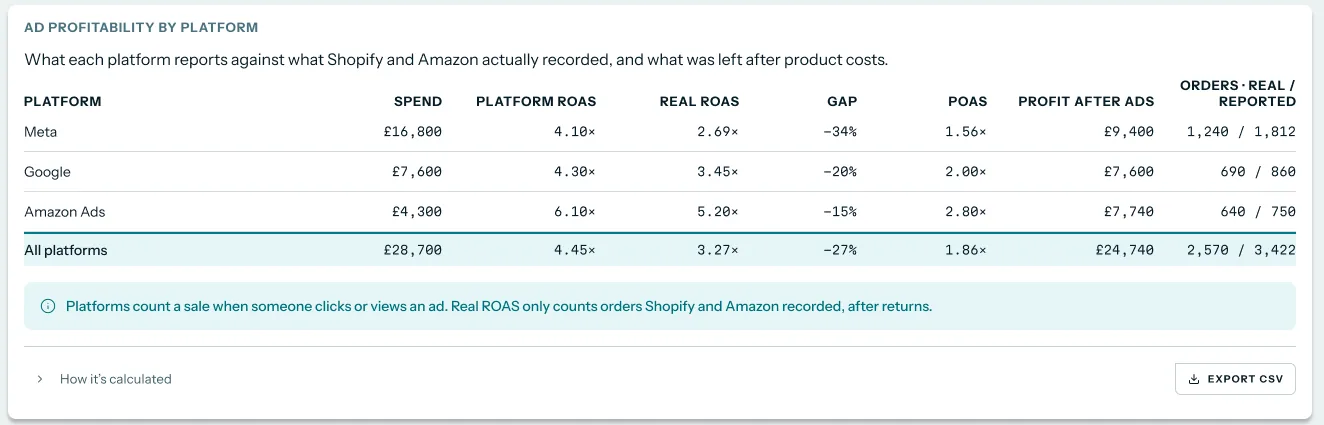
Start with each platform on its own. Spend on Meta, Google or Amazon Ads is safe to keep only while the orders it brings still leave contribution margin after product costs, fees, returns and the ad spend itself. A platform that reports a healthy ROAS can still fail this test once returns and fees come off. The arithmetic of break-even ROAS is covered on its own page; here you only need to know which platforms are above zero and by how much.
 Illustrative example · demo brand
Profit after ads by platform is the first limit: a platform with thin profit after ads has little room for more spend. The figures are sample data for a demo brand.
The payback limit: new customers repay CAC in time
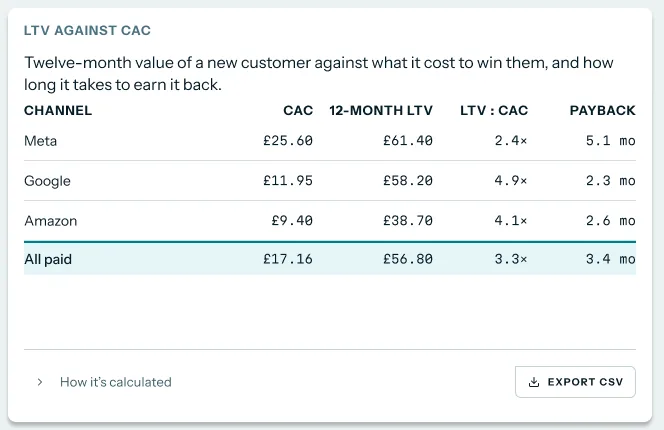
A platform can be profitable over a year and still be too slow for your cash. The second test is how many months a new customer takes to repay their acquisition cost, set against how long the brand can wait for that money. A brand whose customers reorder often can wait longer than a brand that sells one gift box a year. Shopify's guide to customer lifetime value makes the same point: the familiar 3:1 LTV to CAC ratio does not fit every business, so compare it with your payback period and cash needs. The CAC payback page shows how the figure is worked out.
 Illustrative example · demo brand
Payback in months per channel tells you how long each platform's new customers take to earn back their cost. The figures are sample data for a demo brand.
The cash limit: the forecast stays above your floor
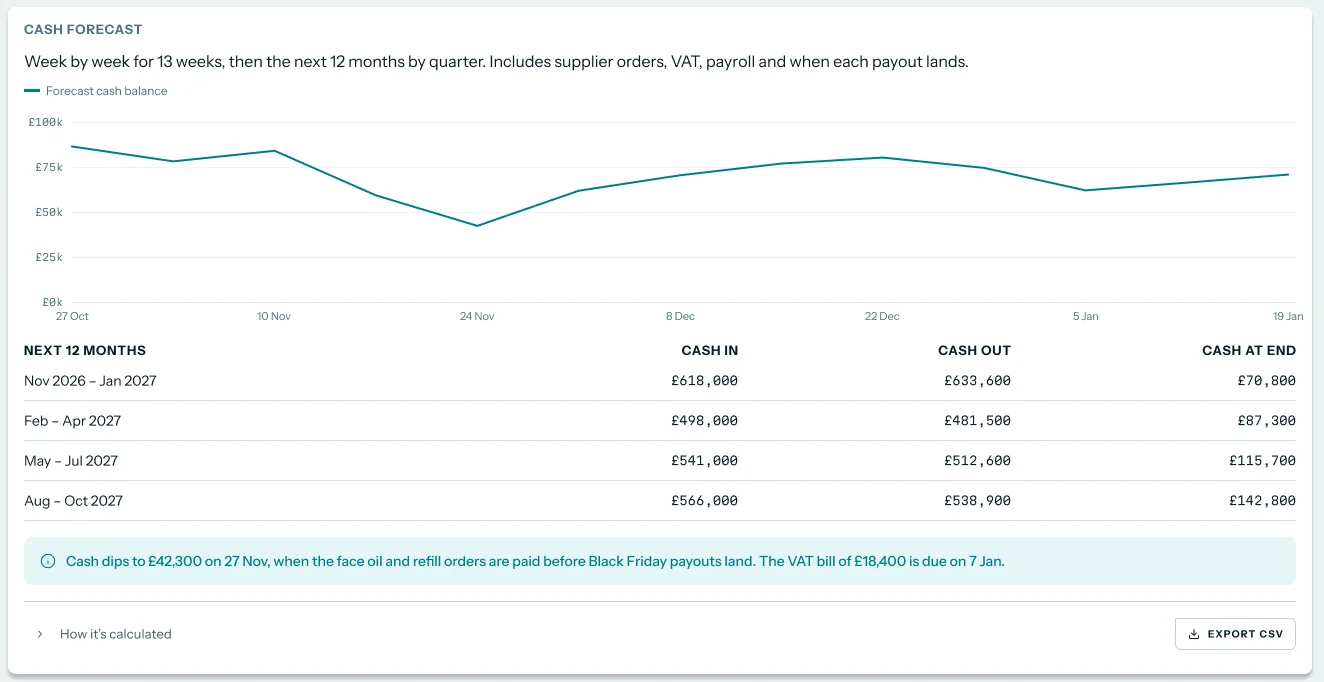
Ad spend leaves the bank weeks before the repeat orders it buys arrive. So the third test is whether the cash forecast stays above the floor the CFO will accept once the extra spend is paid out. Watch the low point, not the quarter-end balance: a stock buy or a VAT bill landing in the same weeks can push a safe-looking plan under the line. Shopify's cash flow forecasting guide describes using net cash flow to schedule a marketing investment against other spending. If the low point gets close, check how many months of runway the brand would have left.
 Illustrative example · demo brand
The cash forecast shows the low point the extra ad spend must not breach, alongside VAT and supplier payments. The figures are sample data for a demo brand.
Combine them into one number for the meeting
Take the lowest figure the three limits allow. The profit limit sets a ceiling per platform, the payback limit trims platforms whose customers repay too slowly, and the cash limit caps the total for the quarter. That total, with each limit's evidence behind it, is the number you defend. Where the money should move between Meta, Google and Amazon is a separate decision, which a later guide on budget reallocation covers.
How brands usually set the number
Most ecommerce teams reach for one of three rules. Each is quick, and each leaves out one of the three limits.
A percentage of revenue
Shopify's guide to the marketing efficiency ratio notes that teams often express marketing spend as a share of revenue, and works an example where spend is 25% of revenue. The percentage is easy to agree in a meeting. It misses whether each platform earns contribution, and it says nothing about cash timing.
A target CAC
A target CAC caps what you pay for each new customer. It misses what those customers are worth after product costs and returns, and it ignores how long they take to repay.
A payback rule
A rule such as "every channel pays back within six months" protects cash better. It still misses the moment when several months of spend leave the bank together, ahead of a stock buy or a tax bill.
Reading it in Luca
Each step below starts from one view and ends with a question you can ask in chat. Luca answers from your connected Shopify, Amazon, ad and accounting data.
Start with the Marketing tab cards
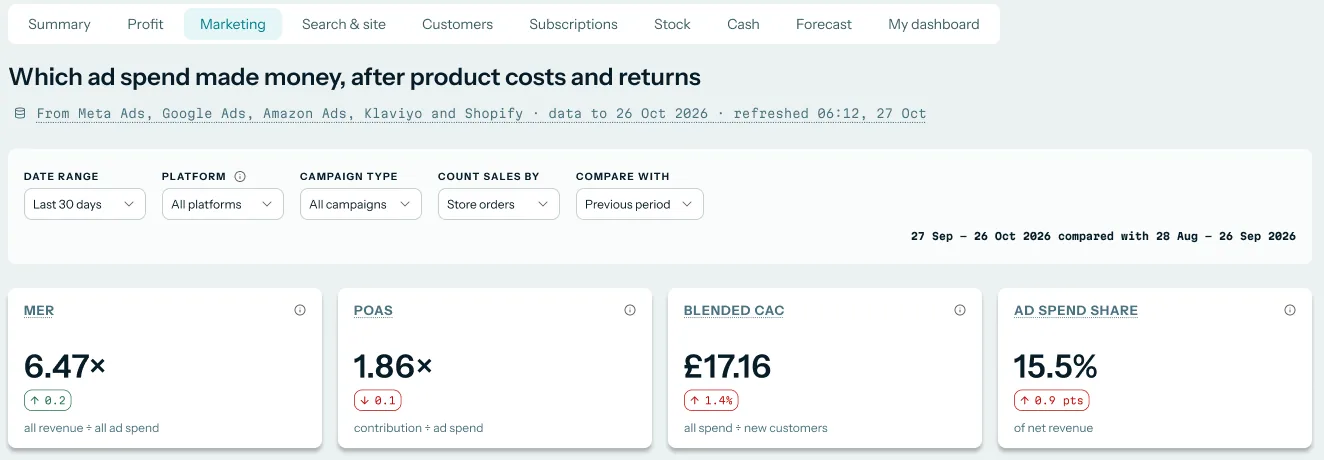
Open Numbers › Marketing, headed Which ad spend made money, after product costs and returns. Four cards give the starting read: MER, POAS, Blended CAC and Ad spend share of net revenue. Ad spend share answers the founder's percentage question directly. MER and platform ROAS are explained on their own page, and Luca shows MER and blended CAC every week.
 Illustrative example · demo brand
The four cards give the opening read for the budget meeting, including ad spend as a share of net revenue. The figures are sample data for a demo brand.
Try asking Luca:
What was our ad spend as a share of net revenue each month this year?
Contribution after ads by platform
Below the cards, Luca sets ROAS against contribution margin by channel, so you see which spend actually makes money. ROAS by channel and campaign goes deeper when one platform looks weak.
Which platform has the least contribution left after ads this quarter?
Blended CAC and payback
Blended CAC is all marketing spend divided by new customers, shown beside the CAC on each platform. The CAC page shows both. The LTV against CAC card then gives payback in months per channel.
How many months does a new Meta customer take to pay back their CAC?
The spend scenario, followed to cash
Now test the budget you plan to propose. In chat, ask for a spend scenario. Luca models the extra spend and shows what happens to cash, which you then check on Numbers › Cash against your floor.
If we add 20% to Meta next month, what happens to cash 90 days out?
Worked example: Fernlow's next-quarter Meta budget
Fernlow is the brand from the opening and Luca's demo brand. This is an illustrative calculation with sample figures, not a Luca output. Here is where Fernlow starts the quarter.
| Starting point (last month) | Figure |
|---|---|
| Ad spend against net revenue | £28,700 ÷ £185,000 = 15.5% ad spend share |
| Profit after ads by platform | Meta £9,400; Google £7,600; Amazon Ads £7,740 |
| Payback | 3.4 months across all paid channels; 5.1 months on Meta |
| Cash | Forecast low point £42,300 in late November; the CFO's floor is £40,000 |
The growth lead tests two Meta increases. The scenario assumes the extra spend returns 1.3 times its cost in contribution before ads, and that six weeks of extra spend go out before the low point.
| Step | +20% on Meta | +10% on Meta |
|---|---|---|
| Extra Meta spend per month (£16,800 × 20% or 10%) | £3,360 | £1,680 |
| Contribution before ads from the extra spend (× 1.3) | £4,368 | £2,184 |
| Profit limit: contribution after ads (£4,368 − £3,360; £2,184 − £1,680) | +£1,008 | +£504 |
| Payback limit: Meta payback against a six-month limit | 5.8 months | 5.4 months |
| Extra spend out before the low point (× 1.5 months) | £5,040 | £2,520 |
| Cash back from those customers by the low point | £1,900 | £950 |
| Cash limit: low point (£42,300 − £5,040 + £1,900; £42,300 − £2,520 + £950) | £39,160 | £40,730 |
Both options pass the profit and payback limits. Only +10% keeps the low point above the CFO's floor, so the budget lands at +10% on Meta. The growth lead takes that figure to the founder, with the cash line that rules out +20% until after the November payouts land.
Check the budget once it is running
Once the quarter starts, read ad spend share against the plan with budget against actual, where Luca paces each line to plan. Read the same three limits monthly: contribution after ads by platform, payback in months, and the cash low point. If one of them slips, bring the figure back to the founder before the next meeting.
Setting it up
Connect Shopify, your ad accounts and Xero or QuickBooks read-only, as shown in set up Luca. Your cost rules and contribution views are agreed with Luca's team during onboarding, and the cash forecast is switched on per client.
How Luca AI compares for ecommerce ad budget planning
For ecommerce ad budget planning, Luca reads the ad spend you actually ran and follows a proposed change through to cash. The two tools below document a different starting point.
Ecommerce ad budget planning features, from each platform's public documentation:
| Platform | Luca AI | Lifetimely by AMP | Daasity |
|---|---|---|---|
| Budget read from connected ad spend | Yes | Partly (modelled as a % of sales, not connected spend) | Partly (targets typed in by hand, compared with connected actuals) |
| Spend change followed to the cash forecast | Yes | Not in docs | Not in docs |
| Planned spend against actual, with the cash forecast beside it | Yes | Not in docs | Partly (targets against actuals, no cash forecast) |
Yes: documented and built in. Partly: documented with a limit, shown in brackets. Not in docs: not found in the vendor's public documentation.
Why Luca AI is the stronger choice for ecommerce ad budget planning
- Spend scenarios start from real spend. Lifetimely's forecasting sets marketing investment as a percentage of net sales, while Luca's spend scenario reads your connected Meta, Google and Amazon spend. See Lifetimely alternatives.
- The budget reaches cash. Daasity's Marketing Budget tab compares targets you enter with actuals. Luca also follows a spend change to the 90-day cash forecast. See Daasity alternatives.
- Plan against actual, with cash beside it. Daasity's Marketing Budget tab compares target spend, CPA and ROAS with actuals and documents no cash forecast. Luca paces spend against the plan and shows the cash low point that plan leads to.
Competitor details checked against each vendor's public documentation on 20 November 2026. Features and plans change, so confirm with the vendor before you decide.
Limits and things to know
- Luca never changes your budgets, bids or campaigns. It recommends and models; every change is made by you in Meta, Google or Amazon. All connections are read-only.
- Spend is judged against store revenue and margin. Luca reads spend by platform, campaign and creative. Tying orders to individual ads needs an attribution model, which Luca's team sets up with your brand.
- Non-ad marketing costs come from the books. Agency, influencer and content costs appear only as costs read from Xero or QuickBooks.
- Benchmarks come from public sources. Comparisons with similar brands are drawn from public data, so treat any percentage as context, not as Luca's norm.
- Contribution views and the cash forecast are set up per brand. Luca's team agrees the cost rules with you, and the cash forecast needs Xero or QuickBooks.
Common questions
What share of revenue do brands like ours spend on ads?
There is no single right share, because margins, repeat rates and cash differ. Luca shows your own ad spend share of net revenue and can benchmark it against similar brands from public sources. Use that as context, then set the budget from your three limits.
How often should we reset the ad budget?
Set it quarterly, when the founder and CFO approve it, and read the three limits monthly. Reset early if contribution after ads turns negative on a platform or the cash low point moves towards your floor.
Should Black Friday have its own budget?
Yes, treat peak weeks as a separate scenario. Spend rises before the payouts land, so the cash limit often binds first. Run the scenario against the revenue forecast for those weeks before you commit.
Can I set a budget per platform?
Yes. The profit and payback limits are read per platform, so each one gets its own ceiling. Luca shows the figures for each platform, and you set the budgets in each ad account yourself.
What if payback is fine but cash is tight?
Then cash decides. A fast payback still needs the spend paid out first. Cut or delay the increase until after the low point, as in the worked example, or phase it across the quarter.
Does Luca move budget between platforms for me?
No. Luca is read-only and can only recommend. It can suggest a budget reallocation in chat, but any change happens in Meta, Google or Amazon, made by you.
How do new and returning customers change the answer?
Ad spend mostly buys new customers, so payback depends on how often they come back. Brands with strong cohort retention can carry a longer payback, because repeat orders repay CAC sooner.
Which costs count against ad spend in contribution?
Product costs, fees, shipping and returns, following the cost rules you agree with Luca's team at onboarding. Those rules are yours, so contribution after ads matches how your finance team counts margin.
Can I include TikTok or Amazon Ads in the budget?
Yes. Luca covers TikTok Ads spend, and Amazon Ads connects self-serve beside Meta and Google, so each platform gets its own limits. Read Amazon Seller Central data beside it to see marketplace fees in the same contribution figure.
Why does our platform ROAS look better than contribution after ads?
Each platform counts a sale when someone clicks or views an ad, so platforms overlap. Luca counts orders your store recorded, after returns. Our post on why ecommerce ROAS can mislead explains the gap.
How fresh are the figures I take to the meeting?
Every source refreshes automatically once a day, overnight. The figures you read in the morning cover everything up to the previous day, across Shopify, the ad accounts and the books.
Can I show the founder the scenario itself?
Yes. Ask the scenario question in chat and take the answer's figures into your pack. Luca answers across sources, so the spend, margin and cash figures sit in one reply.
Updated 20 November 2026: first published, with the three limits on an ad budget, a Fernlow spend scenario worked example and twelve common questions.