
A weekly business review is a short, fixed meeting where the team reads last week's numbers in the same order every week, asks why the big movers moved, and leaves with named decisions. Luca AI supplies the figures and the reasons: a weekly review by email built to be read in fifteen minutes, last week compared in Numbers, and chat answers you can share with the team. Luca prepares the meeting's inputs; your team runs the meeting, makes the calls and records who owns each one.
At a glance
| Question | Answer |
|---|---|
| What the meeting is for | Reading one agreed set of last week's figures, finding out why the big movers moved and leaving with decisions that each have an owner |
| How long the reading takes | Luca's weekly review is built to be read in fifteen minutes, so the meeting can start from what changed |
| What Luca supplies | The weekly review and Monday health digest by email, what to do this week ranked by impact, last week against a comparison period, and answers on why a figure moved |
| What the team does | Chairs the meeting, questions the figures, decides, names an owner and a check date for each decision, and records them in its own tool |
| Where the figures come from | One private warehouse that Luca fills from your store, marketplaces, ad accounts and books, refreshed once a day overnight |
| How answers are shared | A private, revocable link that search engines don't index, or in Slack on the Leadership plan and above |
An ecommerce weekly business review agenda
Copy this agenda into your meeting invite and keep the order the same every week. A fixed order means a figure that moves stands out, and nobody spends the first ten minutes asking where to look. Each item names the page that explains its metric, so a new lead can learn what it counts. The time boxes add up to thirty minutes.
- Headline: net revenue and orders (5 minutes). Read both against the week before and the same week last year. Net revenue is sales after returns, allowances and discounts, so refunds don't flatter the week.
- Ad spend, MER and new-customer CAC (5 minutes). The growth lead reads total spend, revenue per pound of spend and the cost of each new customer. MER and platform ROAS and blended CAC explain each one.
- Contribution margin (4 minutes). The finance lead reads what the week earned after product costs, fees and ad spend. Contribution margin by order and channel shows the layers.
- New and returning customers (4 minutes). Split orders between first-time and repeat buyers, because each has a different fix. The repeat purchase rate page explains who comes back.
- Stock cover and items near their reorder point (4 minutes). The operations lead names any product that will run short before the next delivery can land. Reorder points for every product explains the trigger.
- Cash and anything unusual in the books (3 minutes). The finance lead reads the bank balance, the weeks of cash left and any odd bill or payout. Cash runway covers the months-left view.
- Decisions, owners and check dates (5 minutes). Read back each decision, the person who owns it and the date the meeting checks it. Write them in your own task tool before anyone leaves.
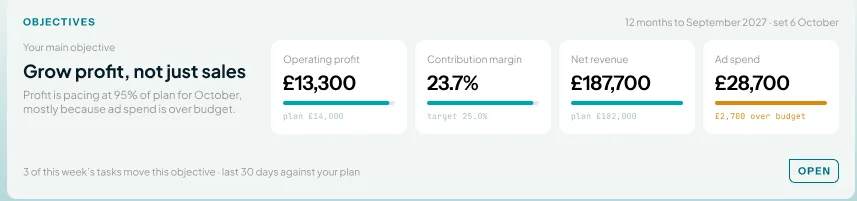 Illustrative example · demo brand
Headline figures like these feed the first three agenda items, each read against plan before the meeting starts. The figures are sample data for a demo brand.
If you track more than these figures, keep them out of the meeting and in the written pack. The ecommerce KPIs guide lists the wider set and what each one tells you.
How weekly business reviews are usually run
Most teams run the meeting in one of three ways. Each works for a large company, but each strains differently in an ecommerce team of five to fifteen people.
A fixed metrics deck
The Amazon-style weekly business review reads the same deck of metrics, in the same order, every week, and discusses only what moved. It catches change well because the layout never shifts. For a small team, the cost is building the deck each week: someone has to copy figures from Shopify, Amazon, the ad accounts and Xero before Monday, and that job tends to fall to the founder.
A spreadsheet pack each lead fills in
Each lead pastes their own numbers into a shared spreadsheet on Friday or Monday morning. It's cheap to start and every lead owns a tab. What it misses is agreement: the growth lead's revenue comes from the ad platforms, the finance lead's comes from the books, and the meeting spends its first twenty minutes reconciling them.
A dashboard walked through on screen
The chair shares a dashboard and scrolls through it. The figures agree because they come from one place. The weak spot is the question that follows a moving figure: the dashboard shows what changed but not why, so someone takes an action to "dig into it" and the answer arrives next week.
Run the review from Luca
Luca changes the work around the meeting, not the meeting itself. Before Monday, everyone reads the same figures. During the meeting, the chair asks why on screen. Afterwards, the answer goes to the people who need it. If Luca isn't connected yet, set up your sources first, then check how the digests reach your inbox.
Before the meeting
- Read the weekly review and the Monday health digest. Both arrive by email, so each lead reads them before the meeting without logging in. The Monday digest gives the state of the business in one read.
- Check what to do this week. Luca lists this week's actions ranked by impact. Treat it as the draft for agenda item seven, not the final list.
- Set last week against two comparison periods. In Numbers, use the filter bar to pick the date range and comparison period. Run it once against the week before and once against the same week last year. Your dashboard, set up by Luca's team, holds the views each lead reads.
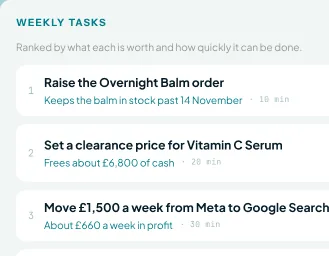 Illustrative example · demo brand
A ranked list like this gives the meeting a draft of item seven; your team still decides who owns each task. The figures are sample data for a demo brand.
During the meeting
When a figure moves, ask Luca why with the chat open on the shared screen. Luca answers with figures, a chart where useful and next steps, and each figure links to the table it came from. Ask a follow-up and Luca keeps the thread, so you can go from "why did returning orders fall?" to "which products?" without starting over. An answer can join store, ad and accounting data in one reply.
Try asking Luca:
"Why did net revenue fall last week compared with the week before? Split the change between new and returning customers and show the products behind it."
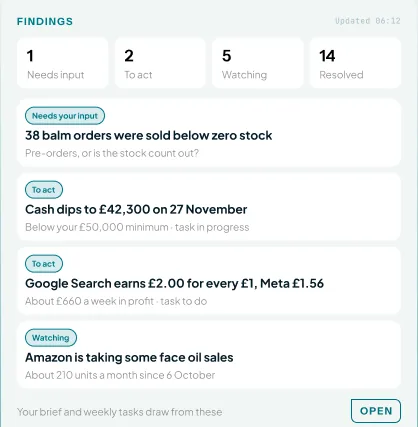 Illustrative example · demo brand
Findings like these give the chair a reason ready for a mover before anyone has to dig. The figures are sample data for a demo brand.
After the meeting
Share the answer that settled a question by private link, so the lead who missed the meeting reads the same figures. On the Leadership plan and above, the team can ask Luca from Slack too. Then record the decisions, owners and check dates in your team's own tool. Luca doesn't keep minutes or chase actions, so the next meeting opens by reading that list back.
How it's checked
Two checks before the meeting starts save the arguments that eat its first ten minutes.
- The overnight refresh covers the whole of last week. Luca refreshes every source once a day, overnight. On Monday morning, check that each source refreshed overnight before anyone reads a figure. A source that failed to refresh will make the week look short.
- Every lead reads the same definition. Hover over a metric name in Numbers to see its definition, which shows as your brand's definition based on Luca's default. If the growth lead and the finance lead mean different things by revenue, settle it here, not in the meeting.
For the deeper checks before a figure goes outside the company, follow how to check a KPI report. Behind both checks, Luca runs daily audits that compare its data with Shopify, Amazon and QuickBooks, and each figure traces to its source table.
A worked example: one week's review
This is an illustrative calculation with sample figures for a demo kitchenware brand selling on Shopify and Amazon. It is not a Luca output. It shows the agenda filled in, the three movers, one chat answer and two decisions.
| Agenda item | Last week | Week before | Same week last year |
|---|---|---|---|
| Net revenue | £84,000 | £90,000 | £76,000 |
| Orders | 1,400 | 1,500 | 1,330 |
| Ad spend | £21,000 | £18,000 | £17,000 |
| MER (net revenue ÷ ad spend) | 84,000 ÷ 21,000 = 4.0 | 90,000 ÷ 18,000 = 5.0 | 76,000 ÷ 17,000 = 4.5 |
| New customers | 600 | 600 | 560 |
| New-customer CAC (ad spend ÷ new customers) | 21,000 ÷ 600 = £35 | 18,000 ÷ 600 = £30 | 17,000 ÷ 560 = £30 |
| Returning-customer orders | 800 | 900 | 770 |
| Product costs (40% of net revenue) | £33,600 | £36,000 | £30,400 |
| Fees and shipping (15% of net revenue) | £12,600 | £13,500 | £11,400 |
| Contribution after ad spend | £16,800 (20%) | £22,500 (25%) | £17,200 (23%) |
| Cast-iron casserole stock cover | 3 weeks against a 6-week lead time | 4 weeks | n/a |
The three movers. Net revenue fell by 6,000 on the week before but rose by 8,000 on last year. Ad spend rose by 3,000 while new customers stayed at 600, so CAC went from 30 to 35 and MER fell from 5.0 to 4.0. Returning-customer orders fell by 100, which explains the whole drop in orders.
The chat answer. The chair asks Luca why returning orders fell. In this sample, the answer shows the week before included a sale email to past buyers, and returning orders last week sat close to the brand's usual level. That mover needs no action.
The two decisions. The growth lead takes spend back to 18,000 next week and the meeting checks MER next Monday. The operations lead places the casserole reorder this week, because three weeks of cover is half the lead time.
Who brings what
The meeting works when each lead owns a part of the agenda and arrives having read it. These four roles cover most brands of this size.
The founder chairs
The founder or CEO keeps the order, keeps the time and asks the "why" questions. Their figure is the headline: net revenue and orders against last week and last year. A founder who also sells on Amazon reads both channels in one view, as on Shopify and Amazon in one place.
The growth lead owns ad spend, MER and CAC
The growth lead explains what the business spent on ads, what each pound of spend returned in total revenue and what a new customer cost. Shopify's guide stresses using the same revenue and spend definitions each time so MER compares across weeks. The ROAS analysis page goes channel by channel.
The operations lead owns stock cover
The operations lead names the products that will run short before the next delivery and the order date for each. Luca sets reorder points and you choose the quantity and place the order. For the season ahead, plan stock against lead times.
The finance lead owns margin and cash
The finance lead reads contribution margin, which counts only the variable costs of each sale, then the cash position and anything odd in the books. Luca reads Xero's P&L, balance sheet, bank transactions, invoices and bills, so the Xero ledger sits beside store sales.
Limits
- Luca prepares the meeting; it doesn't run it. Luca supplies the figures, the reasons and the ranked priorities. It doesn't keep minutes, assign owners or track actions, so record decisions in your team's own tool.
- Digests arrive on Luca's schedule. The weekly review and Monday health digest come by email. There's no screen for building your own schedule or choosing send times.
- Slack needs the Leadership plan or above. On other plans, share answers by private link.
- Figures are as of the overnight refresh. Changes made during the day appear after the next overnight refresh, so a Monday meeting reads the week up to the last refresh.
- Luca reads; it doesn't act. Luca is read-only, so it never changes your store, ads, email or books. Read-only access explains how.
Common questions
How long should a weekly business review take?
Thirty minutes suits most ecommerce teams of five to fifteen people. The agenda on this page fits that time when every lead has read the figures beforehand. If the meeting runs long, the cause is usually reconciling numbers, which a shared source removes.
Should we compare with the week before or the same week last year?
Use both. The week before shows short-term change, such as a promotion ending. The same week last year removes seasonality, which matters for kitchenware in the run-up to Christmas. Shopify's guide notes that analysis works best when comparing two things.
What if a lead disagrees with a figure?
Check the definition first: hover over the metric in Numbers and read how your brand defines it. If the definition matches, ask Luca for the table behind the figure. Agree the fix after the meeting so the next review reads the corrected figure.
Can the review cover Amazon and Shopify together?
Yes. Luca connects Amazon Seller Central and Amazon Ads alongside Shopify, so one review can read both channels side by side. Amazon seller analytics covers fees, settlements and FBA stock.
Who should attend?
The founder or CEO, plus the leads who own growth, operations and finance. Keep it to the people who own a line on the agenda. Others can read the shared answers afterwards.
What do we do in peak season?
Keep the agenda and shorten the gap between reviews if you need to. Add one line on stock cover for your best sellers, because a stock-out in peak costs more than in any other week. Black Friday planning covers targets, stock and spend for the peak.
What if a figure moved and nobody knows why?
Ask Luca on screen, during the meeting. If the answer needs more digging, give one person the question and a date, and read the answer at the next review. The why sales dropped guide walks through the usual causes.
Does everyone need a Luca login?
No. The digests arrive by email and answers can be shared by private link. Anyone you share a link with can read the answer without changing anything.
Should we review profit or revenue first?
Start with revenue and orders, because they explain most of what follows. Then read ad spend and contribution margin, so the meeting can see whether the revenue made money.
How is this different from the daily morning check?
The morning check is a quick read of yesterday for one person. The weekly review is a team meeting with decisions and owners. The daily view of the whole business covers the morning check.
Can we use the review for the board?
The weekly review is for the team running the business. For the board, build a monthly or quarterly pack instead; board and investor reporting covers that.
What should we do with decisions that keep coming back?
If the same decision returns three weeks running, it usually needs a plan rather than a weekly fix. Move it to your monthly planning and read it against budget and plan.
Updated 20 November 2026: new page with an ecommerce weekly business review agenda, how the meeting is usually run, how to run it from Luca, two checks, a worked example, who brings what, limits and twelve questions.