
Black Friday planning for an ecommerce brand means settling four things months before the sale: how much you will sell, which products you must order and by when, what discount and ad spend you can afford, and how low cash will dip afterwards. Luca AI answers each from last year's peak and this year's forecasts, reading Shopify, Amazon, your ad accounts and Xero or QuickBooks, so the plan rests on your own numbers rather than last year's spreadsheet.
Picture the operations lead at Fernlow, a skincare brand that sells on Shopify and Amazon. It is early December, the peak results are a week old, and the supplier of its Overnight Balm needs eight weeks from order to delivery. Every plan for next year starts with a review of the peak just gone, while she still remembers why each number moved.
At a glance
| When to start | Months ahead, counted back from your longest supplier lead time, not from the sale date |
|---|---|
| What it is built from | Last year's peak in your Shopify and Amazon orders, your ad spend and your books, plus forecasts that allow for Black Friday |
| The four decisions | The revenue target, the stock you order and by when, the discount and ad spend, and the cash low point after the peak |
| The next peak | Thanksgiving is Thursday 25 November 2027, Black Friday is Friday 26 November 2027 and Cyber Monday is Monday 29 November 2027 (update this line each year) |
| Who switches forecasting on | Luca's team, per client |
| What Luca never does | Change prices, discount codes or ad budgets, or place supplier orders. It only reads your data |
The peak planning calendar
The peak is short and unforgiving. Over Black Friday Cyber Monday 2025, the latest year with published results, more than 94,900 Shopify merchants had their highest-selling day ever. Shopify notes that its figures are approximate and unaudited. A record day only helps if the stock is on the shelf, which is why the calendar runs backwards from your lead times.
The offsets below suit a brand whose longest lead time is about eight weeks. Luca holds your supplier lead times as context, so read each step as "from your lead time" and move it earlier for slower suppliers.
- Two weeks after the peak: review it while the data is fresh. The operations lead and the founder compare each product's Black Friday week with the forecast, and check what each discount earned after ads. The sales analysis view and chat answer this.
- Four to six months ahead: set the target and order long-lead stock. The founder signs off the revenue target, and the operations lead orders anything with a long lead time. The demand forecast gives units and run-out dates per SKU.
- Eight to twelve weeks ahead: settle the discount and confirm the second stock order. The growth lead picks the discount depth, and the operations lead confirms the faster-moving reorders against their reorder points.
- Four weeks ahead: set peak ad spend and check the cash low point. The growth lead sets the budget, and the finance lead checks the cash flow forecast through January.
- Peak week: pace daily against the plan. Everyone watches one number each morning, which is revenue against plan, with budgets and pacing showing the gap.
For the stock side of the season in more depth, the blog's guide to seasonal inventory management covers safety stock and overstock risk.
Plan the peak in Luca, step by step
Work through these four in order. Each one feeds the next, and each ends with a question you can paste into Luca's chat.
Review last year's peak
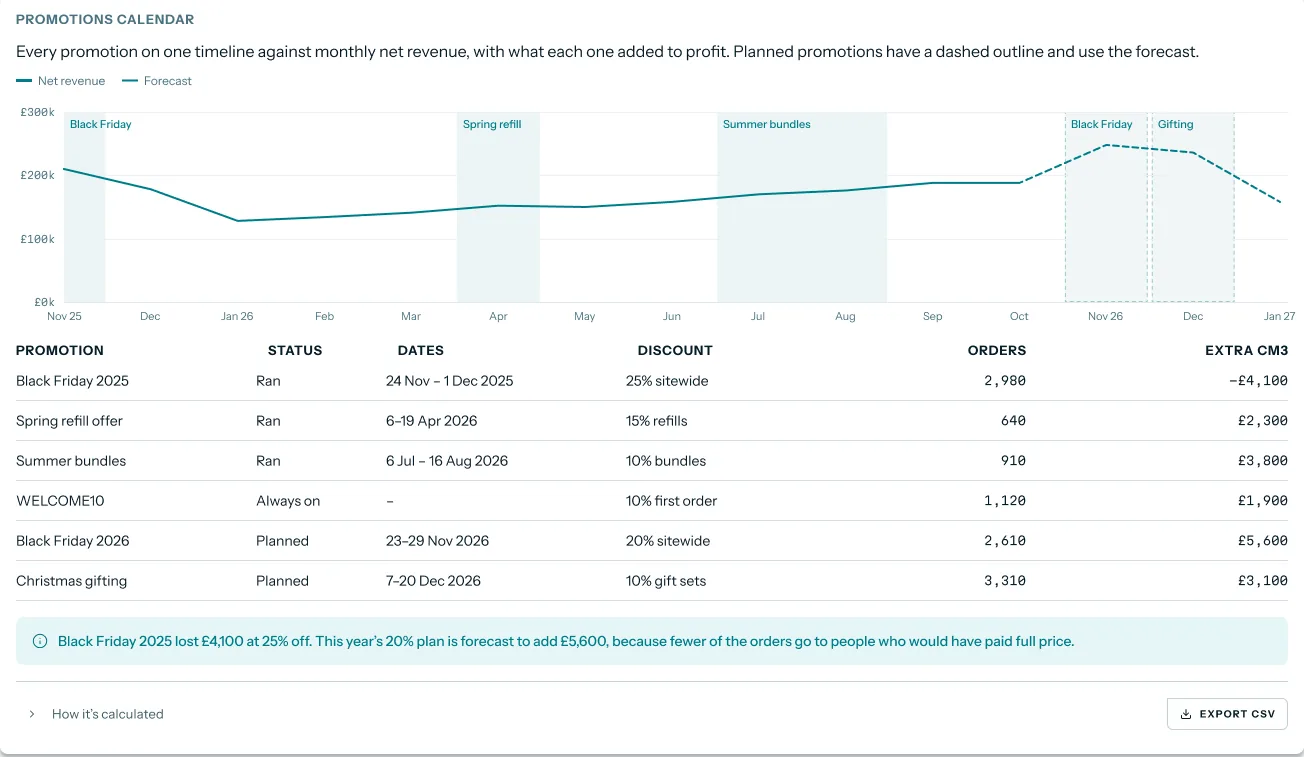
Start with what actually happened. Ask for last year's Black Friday week by product, with the discount depth and the profit after the promotion. Luca shows discount depth, discount-code usage and the profit impact of each promotion, and it answers whether a sale made money. The promotions calendar puts every promotion on one timeline against monthly net revenue.
 Illustrative example · demo brand
The promotions calendar shows that a deeper Black Friday discount can add orders and still lose contribution. The figures are sample data for a demo brand.
Look for two traps while you review. A product that sold out early understates demand, and a big discount can lift revenue while cutting profit. The product profitability view ranks products by profit after fees, so you can see which ones carried the peak.
Try asking Luca:
"Show last year's Black Friday week by product, with the discount on each and the profit after the promotion."
Set the target
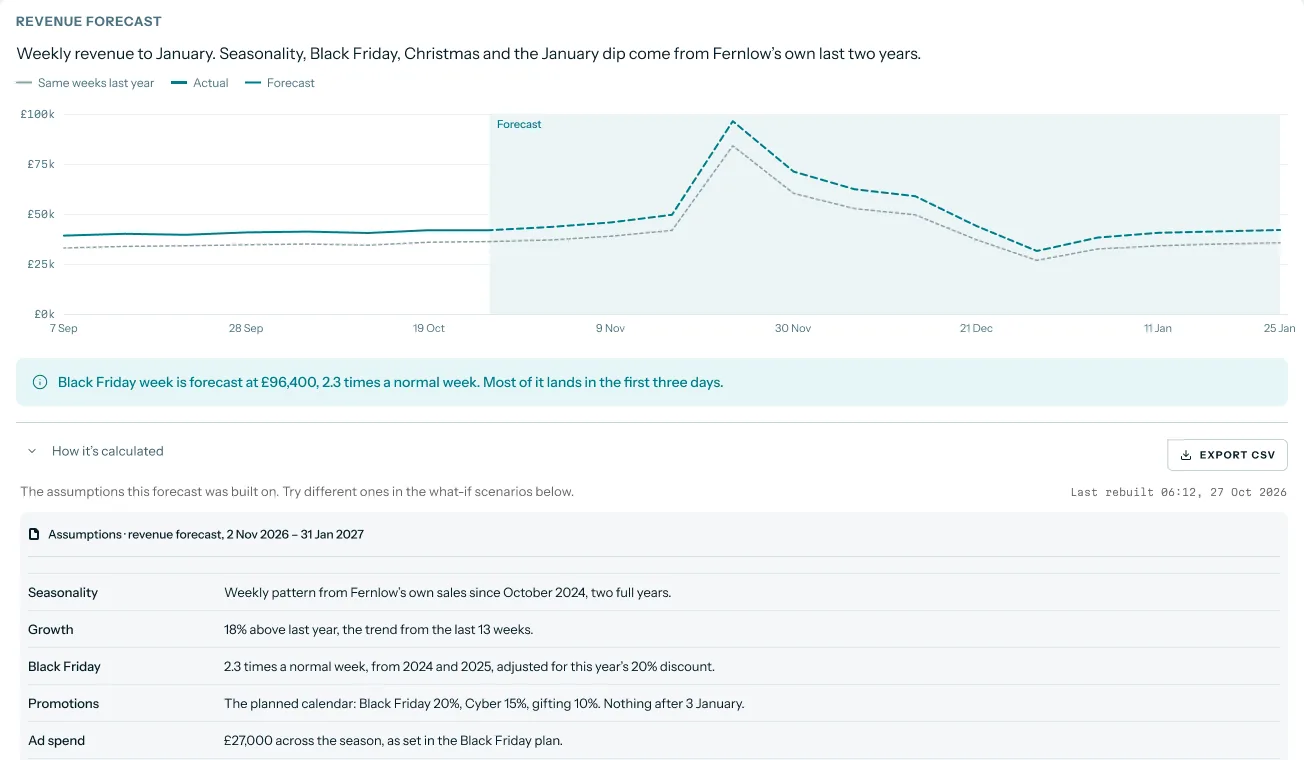
Open Numbers › Forecast. The Revenue Forecast card shows actual revenue, the same weeks last year and the forecast, and forecasts account for seasonality and holidays such as Black Friday. How it's calculated lists the assumptions behind it, so you can see the Black Friday multiple before you commit to a target. The forecast method itself is covered under planning for Black Friday.
 Illustrative example · demo brand
Read the assumptions before you set the target: the Black Friday multiple, growth and planned promotions all sit in the table. The figures are sample data for a demo brand.
"What is Black Friday week forecast at, and how many times a normal week is that compared with last year?"
Order the stock
Open Numbers › Stock to see stock cover, run-out dates and order-by dates. Luca sets them against the supplier lead times it holds as context, with seasonality built into stock planning. Reorder points sit per product. You choose the quantity and place the order with your supplier. The day-to-day stock method lives on inventory planning.
"Which products run out before Black Friday at the forecast rate, and what is the order-by date for each?"
Test discount and ad spend
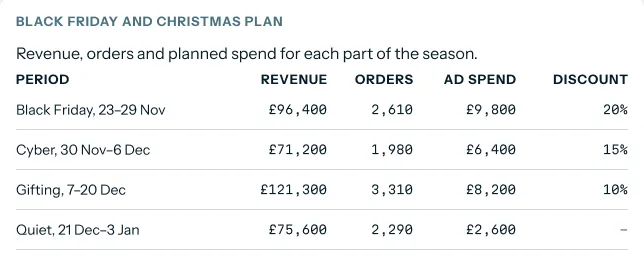
Before you lock the offer, run what-if scenarios such as "ad spend +20%". Spend scenarios follow the change through to cash, for example "+20% on Meta: what happens to 90-day cash?". Compare each option on contribution after ads, using the break-even logic on ad profitability.
 Illustrative example · demo brand
The Black Friday plan puts revenue, orders, ad spend and discount for each part of the season in one table. The figures are sample data for a demo brand.
"Compare a 20% and a 30% Black Friday discount on contribution after ad spend, and show what each does to cash in January."
Black Friday planning: a worked example
The situation. Fernlow, the brand from the opening, is planning next year's peak from last year's results. Everything below is an illustrative calculation with sample figures, not a Luca output.
Step 1: the target. Last year's Black Friday week was twice a normal week. The forecast applies the same multiple to this year's normal week.
| Last year | This year | |
|---|---|---|
| Normal week revenue | £30,000 | £40,000 (forecast) |
| Black Friday week multiple | £60,000 ÷ £30,000 = 2.0 | 2.0 |
| Black Friday week revenue | £60,000 | £40,000 × 2.0 = £80,000 |
Step 2: the order-by dates. Stock must land by Monday 8 November 2027, 18 days before Black Friday, to leave time for receiving and Amazon check-in.
| Product | Supplier lead time | Must land by | Order by |
|---|---|---|---|
| Overnight Balm 50ml | 8 weeks (56 days) | 8 Nov 2027 | 13 Sep 2027 |
| Rosehip face oil 30ml | 6 weeks (42 days) | 8 Nov 2027 | 27 Sep 2027 |
Both dates fall in September, two months before the sale. Miss them and the peak sells out of the two products that carry it.
Step 3: the discount. Average order value is 50 pounds before discount, and product, fees and shipping cost 20 pounds an order.
| 20% off | 30% off | |
|---|---|---|
| Orders | 2,000 | 2,400 |
| Average order after discount | £40 | £35 |
| Revenue | 2,000 × £40 = £80,000 | 2,400 × £35 = £84,000 |
| Product, fees and shipping | 2,000 × £20 = £40,000 | 2,400 × £20 = £48,000 |
| Ad spend | £12,000 | £14,000 |
| Contribution after ads | £28,000 | £22,000 |
The deeper discount adds 4,000 pounds of revenue and loses 6,000 pounds of contribution. The 20% plan wins. Contribution is explained in full on contribution margin.
Step 4: the cash low point. Cash starts at 150,000 pounds on 1 September.
| Month | Net cash flow | What drives it | Closing cash |
|---|---|---|---|
| September | −£50,000 | Stock orders paid (£60,000), normal trading (+£10,000) | £100,000 |
| October | +£5,000 | Trading while ad spend builds | £105,000 |
| November | +£45,000 | Black Friday week | £150,000 |
| December | +£10,000 | Gifting sales | £160,000 |
| January | −£90,000 | VAT on peak sales (£35,000), supplier balance (£40,000), quiet trading (−£15,000) | £70,000 |
What to plan for. Cash is highest in December and lowest at the end of January, at 70,000 pounds. Plan the January bills before the peak, not after it.
Check the plan during and after the peak
In peak week, pace revenue against the plan every morning. Goals and pacing to plan run through forecasting and the control centre, so a slow first day shows as a gap you can act on by lunchtime. The forecast is also checked against actuals every night and corrected, as the revenue forecast page explains under its nightly check.
Two weeks after the peak, run the review again on the finished season. Compare each product's week with its forecast, note which order-by dates were tight, and record the discount that earned most after ads. That review becomes next year's starting point, and the calendar begins again.
Setting it up
Forecasting is switched on per client by Luca's team. Your goals, cost rules, supplier lead times and seasonality are agreed with the team and held as business context; the steps to connect your sources are on setting up Luca.
How Luca AI compares for Black Friday planning
Tools differ in scope here, and most cover one slice of the peak. Shopify's own reports can compare your data across two time periods, so last year's sales are there too. Luca joins the target, the order-by dates and the cash low point in one plan.
Black Friday planning features, from each platform's public documentation:
| Platform | Luca AI | Northbeam | Lifetimely by AMP |
|---|---|---|---|
| Plan for the big sale | Yes | Partly (tracking audit before the sale) | Not in docs |
| Order-by dates against lead times | Yes | Not in docs | Partly (predicted stockout date) |
| Cash forecast through January | Yes | Not in docs | Not in docs |
Yes: documented and built in. Partly: documented with a limit, shown in brackets. Not in docs: not found in the vendor's public documentation.
Why Luca AI is the stronger choice for Black Friday planning
- A plan, not only an audit. Luca forecasts Black Friday week and the stock behind it, while Northbeam's big-sale guide is an audit of your tracking before the sale.
- Seasonality in the forecast. Luca's forecasts account for holidays such as Black Friday, while Lifetimely's forecasting does not apply seasonality. See Lifetimely alternatives.
- Cash after the peak, not only sales. Shopify's reports compare two time periods, while Luca carries the plan through to a 13-week and 12-month cash forecast.
Competitor details checked against each vendor's public documentation on 20 November 2026. Features and plans change, so confirm with the vendor before you decide.
Limits of Black Friday planning in Luca
- Luca never changes your store, prices or discount codes, and never changes ad budgets or campaigns. It is read-only by design.
- Luca never drafts or places supplier orders. It shows order-by dates and reorder points; you choose the quantity and order.
- Which Black Friday ad produced which order is shown only where Luca's team has set up an attribution model with your brand.
- Forecasting is switched on per client by Luca's team.
- Site speed, email creative and shipping cut-offs are outside Luca's job.
Common questions
How far ahead should a brand with an eight-week lead time start?
Count back eight weeks from the date stock must land, then add a few weeks to decide. For a late-November peak, that usually puts the first order in September and the target in summer.
What if last Black Friday was distorted by a stock-out?
A product that sold out sold less than buyers wanted, so its history understates demand. Ask Luca for the day it ran out and treat the sales after that day as lost, not as the true level.
Can I plan Cyber Monday separately?
Yes. The Black Friday plan on the Forecast tab splits the season into periods, each with its own revenue, orders, ad spend and discount, so Cyber week can carry a different offer.
How do I plan a first Black Friday with no history?
Without a past peak there is no multiple to copy, so start from your normal weeks and a cautious lift. The guide to sales forecasting from your own order history covers short histories.
Does Luca allow for Black Friday moving date each year?
Luca's forecasts account for holidays such as Black Friday rather than treating the peak as an ordinary week. Open How it's calculated on the Forecast tab to see which past years the Black Friday assumption uses.
Can Amazon Prime Day be planned the same way?
The calendar works for any peak: review, target, stock, discount, cash, then pacing. Ask Luca's team to hold Prime Day as part of your seasonality context, since Amazon stock comes from Seller Central.
What discount depth did we break even at last year?
Ask Luca whether each past sale made money. It shows the profit impact of each promotion, so you can see the deepest discount that still added contribution after ads.
Can the plan be shared with the team in Slack?
Yes, on the Leadership plan and above. Ask Luca from Slack and it posts its own answers into the channel, so the team can discuss the plan's numbers there.
Does Luca show which Black Friday ads drove sales?
Only where Luca's team has set up an attribution model with your brand, case by case. Without one, Luca sets ad spend beside store revenue, as marketing performance analysis describes.
Can I plan Amazon FBA stock beside Shopify stock?
Yes. Amazon Seller Central brings in marketplace sales, fees and FBA stock, so both channels sit in one stock view. Allow extra time for FBA check-in when you set the land-by date.
What if the peak beats the forecast in the first two days?
Pacing shows the gap each morning, and the forecast corrects itself overnight. Then check run-out dates for the fast sellers; any reorder or offer change is yours to make.
Will Luca remember last year's rules, such as never discounting a hero product?
Yes. Luca keeps a persistent memory across conversations, shared with everyone in your organisation, so a rule you set last year applies to this year's plan.
Updated 20 November 2026: first published, with the peak planning calendar, the four planning steps, a worked example and twelve questions.