10 Best Insight Engines for Ecommerce — Search, Retrieval and Answer Generation Across Your Data Stack
14
mins read
TL;DR
The ten engines we ranked are Luca AI, Triple Whale, Coveo, Glean, Algolia, Elastic, Lucidworks, Sinequa, Mindbreeze, and IBM watsonx Discovery.
Nine of the ten index documents or catalogs. Only a full-stack answer layer can resolve a true contribution margin question across commerce, ads, ledger, and support data.
We scored on Commerce Data Coverage 25%, Retrieval and Answer Quality 25%, Time-to-First-Answer 20%, Verified Reviews 15%, and Pricing Transparency 15%.
Retrieval quality beats model quality. Shopify data showed structured Catalog products converting roughly 2x better in AI search than scraped feeds.
Five of the ten publish no pricing at all. Mindbreeze starts near EUR 83,000 per year, while Luca AI starts at 299 euros per month.
Skip an insight engine if you have under twelve months of clean history, or if you already run a governed warehouse with a data team.
Q1. What Are the 10 Best Insight Engines for Ecommerce in 2026? [toc=1. Top 10 Insight Engines]
The ten best insight engines for ecommerce in 2026 are Luca AI, Triple Whale, Coveo, Glean, Algolia, Elastic, Lucidworks, Sinequa, Mindbreeze, and IBM watsonx Discovery. Luca AI leads for SMB and mid-market operators because it sits as an AI layer over a unified commerce, ad, and accounting warehouse, then answers plain-English profit questions instead of returning ranked documents.
Most lists for this keyword are written for IT helpdesks, not stores. Gartner's own category page frames insight engines around enterprise search, intranet search, and knowledge management. That framing is useless if your data lives in Shopify, Meta, Klaviyo, a 3PL, and Xero. So I ranked these by the job they do for an operator, split into three groups: an answer layer over your whole stack, enterprise knowledge retrieval, and storefront product search.
📋 The Shortlist
Luca AI, Best for AI-native ecommerce intelligence across the full data stack
Triple Whale, Best for DTC marketing attribution and creative analytics
Coveo, Best for enterprise commerce relevance and site search
Glean, Best for internal knowledge retrieval across work apps
Algolia, Best for storefront product search and discovery
Elastic, Best for developer-built search and vector retrieval
Lucidworks, Best for retail search personalization at scale
Sinequa, Best for regulated, document-heavy enterprises
Mindbreeze, Best for metadata enrichment and enterprise knowledge
IBM watsonx Discovery, Best for document mining on the IBM stack
📊 Insight Engine Comparison Table
Insight Engine Comparison for Ecommerce in 2026
Tool
Key Capabilities Offered
Best For
Pricing
Luca AI ⭐⭐⭐⭐⭐
Unified commerce, ad, finance, and ops data; plain-English questions; root-cause analysis; predictive alerts; scheduled reports to Slack and email
Shopify operators at $1M to $5M revenue with no data team
Triple Pixel first-party tracking, multi-touch attribution, creative analytics, cohort analysis, and Moby AI agents
DTC brands whose main question is which ad channel actually worked
$0 (Free) to $749 / Month, then quoted
Coveo ⭐⭐⭐
Unified index, relevance tuning, commerce search, and generative answering
Enterprise commerce teams with a search owner on staff
Quote only
Glean ⭐⭐⭐
Work-app connectors, permission-aware retrieval, and assistant layer
Internal knowledge search across company tools
Quote only
Algolia ⭐⭐⭐
Hosted product search, AI ranking, and merchandising rules
Storefront search and category discovery
Usage-based, quoted above free tier
Elastic ⭐⭐⭐
Open search stack, vector search, and RAG building blocks
Teams with engineers who want to build it themselves
Usage-based cloud pricing
Lucidworks ⭐⭐
Retail search personalization and signals-based ranking
Large retailers tuning conversion on site search
Quote only
Sinequa ⭐⭐
Deep document connectors, metadata enrichment, and compliance controls
Regulated enterprises with document archives
Quote only
Mindbreeze ⭐⭐
InSpire appliance or cloud, semantic indexing, and insight apps
Enterprise knowledge management teams
Quote only
IBM watsonx Discovery ⭐⭐
Document understanding, enterprise NLP, and IBM ecosystem integration
Organizations already standardized on IBM
Quote only
Coveo, Elastic, IBM, Lucidworks, Microsoft, Mindbreeze, and Sinequa are the vendors Gartner has named Leaders in this market. Six of them are quote-only. Read that as a signal about who they are built for.
1.1 Luca AI [toc=1.1 Luca AI]
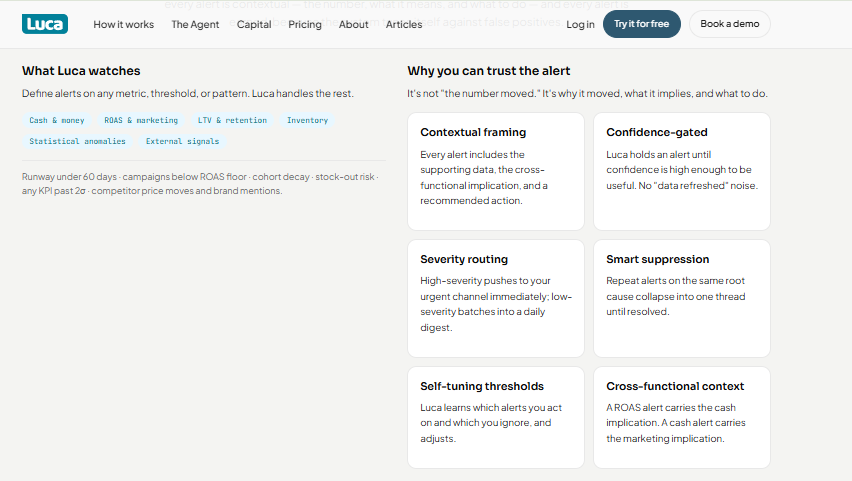
Luca AI defines alerts on any metric, then explains why the number moved and what to do.
⭐ Why Did We Choose This Tool?
I built Luca AI, so treat this entry with the skepticism it deserves. It sits first for one reason: it is the only tool here that indexes commerce, ad, accounting, and operations data in the same layer. Every other engine on this list stops at either the marketing boundary or the document boundary. Most analytics tools added AI on top of a dashboard. Luca AI was built as the answer layer first, with the dashboard as an output option, not the product.
📊 Core Evaluation Metrics
Connected data sources: Shopify, Meta, Google, Klaviyo, Stripe, Xero, QuickBooks, 3PL, and support
Retrieval type: Unified warehouse, normalized on ingestion
Answer generation: Plain English question to reasoned answer with recommended action
Proactive capability: 24/7 anomaly scanning, alerts to Slack, email, and mobile
Entry pricing: €299 per month
✅ Best For
Shopify and WooCommerce operators in the $1M to $5M revenue band
Teams with piling data and no analyst, no SQL, and no warehouse budget
Founders who want root-cause answers, forecasts, and scheduled reports without building dashboards
💰 Pricing
[ Starter, €299 / Month | Growth, €499 / Month | Scale, Custom Pricing ]. Full plan details sit on the Luca AI pricing page.
📈 Case Study: The 72% Margin That Was Actually 8%
The problem. A European home goods brand doing roughly €2.4M a year scaled its hero SKU for two years on a reported 72% gross margin. Cost data sat in Xero, ad spend in Meta, freight in a 3PL export, and support volume in a helpdesk. Nobody had joined them.
How Luca AI helped. Luca AI ingested all four sources, normalized the cost fields, and answered one question in plain English: what is the true contribution margin on this SKU, all-in.
The outcome. ⚠️ Real contribution margin came back at 8%. The team repriced, cut two loss-making variants, and moved spend to the third-best seller, which carried a 31% true margin. The join took minutes, not a quarter.
Luca AI's read on this category is that retrieval quality, not model quality, is what separates a useful answer from a confident wrong one, which is why normalization happens at ingestion rather than as a paid onboarding project.
1.2 Triple Whale [toc=1.2 Triple Whale]
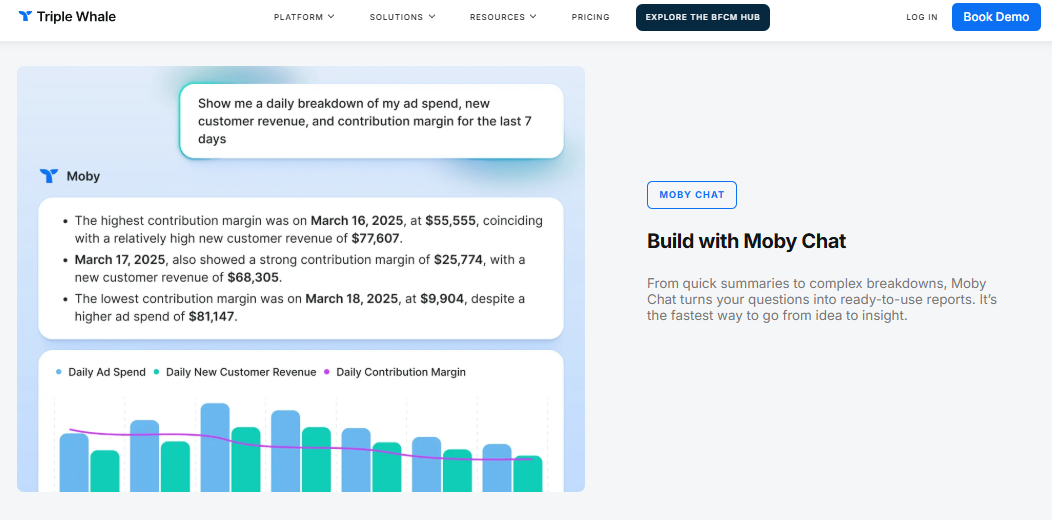
Triple Whale's Moby Chat returns a seven-day ad spend and contribution margin breakdown from one question.
⭐ Why Did We Choose This Tool?
Triple Whale earns its spot because it solved a real problem well. Its Triple Pixel collects first-party conversion data independent of platform tracking. That gives media buyers a cleaner read on which channel drove the sale.
The trade-off is scope. Triple Whale optimizes marketing efficiency, not business health. When it tells you to move 20% of budget to TikTok, it cannot tell you what that does to your cash position in 90 days, because it does not see your ledger.
📊 Core Evaluation Metrics
Connected data sources: Shopify, Meta, Google, TikTok, Klaviyo, and Amazon Seller Central
Retrieval type: Managed warehouse with proprietary pixel data
Answer generation: Moby AI agents for marketing analysis and automation
Proactive capability: Anomaly alerts and automated rules, marketing scope
Entry pricing: $219 per month on the Foundation plan
✅ Best For
DTC brands running meaningful spend across Meta, Google, and TikTok
Agencies managing attribution reporting for multiple Shopify clients
Teams whose primary daily question is channel-level ROAS and CAC
💰 Pricing
Triple Whale lists a free Founders Dashboard, Foundation at $219 per month, and Automate at $749 per month on its Shopify App Store listing, with Enterprise quoted. Pricing scales with trailing 12-month GMV, so growth moves you up a band automatically. Paid plans are 12-month subscriptions. Operators weighing the cost against other options usually end up comparing Triple Whale alternatives at the same time.
💬 Reviews
Triple Whale holds 4.5 out of 5 across 482 G2 reviews. The recurring complaints are pricing and data accuracy.
"Getting one dashboard with every stat your heart desires. I can get a pretty good understanding of what is happening on any given day. The price is high with many add-on options that only drive up the cost. I run two shops but can only afford this software with one." — Andrew W., Ecommerce Manager, Triple Whale - G2 Verified Review
"Only Shopify. Lack of a lot of interesting insights : retention, CVR, etc." — Marius G., Small-Business, Triple Whale - G2 Verified Review
"we started with 100 per month with a Shopify setup running Google ads and meta ads. of course they upsell you and you have to go to 300 a month to get the attribution." — u/Repulsive-Word, r/shopify Reddit Thread
❌ Skip this if: you need cash flow, landed cost, or P&L context in the same answer. Triple Whale is not built to see your accounting layer.
Luca AI takes a different architectural bet than Triple Whale, connecting the finance and operations layer alongside commerce and ads, which is what allows a single question to resolve margin, cash, and channel performance together.
1.3 Coveo [toc=1.3 Coveo]
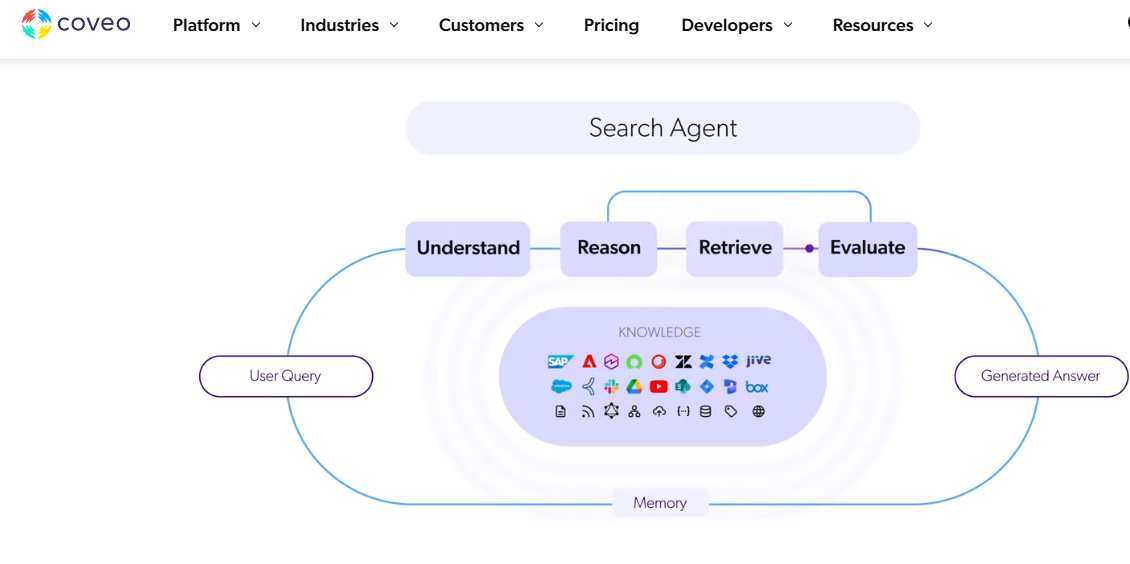
Coveo's Search Agent moves a user query through understand, reason, retrieve, and evaluate before answering.
⭐ Why Did We Choose This Tool?
Coveo is the reference point for this category. Gartner has named it a Leader in insight engines, alongside Elastic, IBM, Lucidworks, Microsoft, Mindbreeze, and Sinequa. Its strength is relevance tuning across many sources at once.
For commerce, Coveo powers site search, product recommendations, and support self-service. The catch is that it expects an owner. Reviewers repeatedly flag a steep learning curve during setup and customization.
📊 Core Evaluation Metrics
Connected data sources: CRM, CMS, commerce, support, and intranet connectors
Retrieval type: Unified index with machine-learning relevance tuning
Answer generation: Generative answering and conversational experiences
Proactive capability: Search analytics and recommendations, not business alerts
Entry pricing: Not published, quote only
✅ Best For
Enterprise commerce teams with a dedicated search or platform owner
Brands running large catalogs plus a heavy support knowledge base
Salesforce and Sitecore shops wanting one index across systems
💰 Pricing
Coveo does not publish pricing. G2 reviewers describe it as best suited to mid-to-large enterprises with dedicated technical resources. Operators at a smaller stage usually end up comparing ecommerce analytics platforms instead.
💬 Reviews
Coveo holds 4.3 out of 5 from 142 G2 reviews.
"Integration with multiple platforms with unified Index. A typical search would create index per data source. Coveo makes your life easy that can combine multiple data source into a single search index." — Balaji K., Senior Consultant, Coveo - G2 Verified Review
"Cost. Realistically the price point for Coveo is geared towards larger corporations making difficult for smaller firms to afford its services." — Verified User in Insurance, Enterprise, Coveo - G2 Verified Review
⚠️ Skip this if: you are under $10M and do not have someone who owns relevance tuning as part of their job.
1.4 Glean [toc=1.4 Glean]
Glean answers a natural language question with ranked internal documents, owners, and last updated timestamps.
⭐ Why Did We Choose This Tool?
Glean does internal knowledge retrieval better than anything else here. It indexes Slack, email, Jira, Drive, and Confluence, then answers in plain language. Permissions carry through from the source systems.
That is a real job, but it is not your P&L. Glean answers "what did we decide about the Q4 promo," not "what is my true margin on SKU 4471." Know which question you are buying for, because unit economics questions need a different index.
📊 Core Evaluation Metrics
Connected data sources: Work apps (Slack, Drive, Jira, Confluence, and Salesforce), plus MCP connectors
Retrieval type: Permission-aware unified index across work tools
Answer generation: Conversational answers with source citations
Proactive capability: Custom agents, limited business anomaly detection
Entry pricing: Not published, quote only
✅ Best For
Teams above roughly 200 people with knowledge scattered across many tools
Support and HR functions building tier-zero deflection agents
Companies that need permission-aware retrieval as a hard requirement
💰 Pricing
Glean quotes privately. Reviewers note the value case is much clearer at larger headcount.
💬 Reviews
Glean holds 4.7 out of 5 from 332 G2 reviews.
"The main thing I'd improve is the consistency of search results, especially when looking for very specific or less common information. Some integrations can also take a little time to get fully set up and configured. From a pricing/ROI perspective, it can be harder to justify for smaller teams, so the value is much more noticeable at a larger scale." — Shivang M., Operational Engineer Senior, Glean - G2 Verified Review
"I like the fact that it's integrated with our company data so I can search how certain tools work with our product." — Merced K., Enterprise, Glean - G2 Verified Review
⚠️ Skip this if: your team is under 50 people. The math does not work yet.
1.5 Algolia [toc=1.5 Algolia]
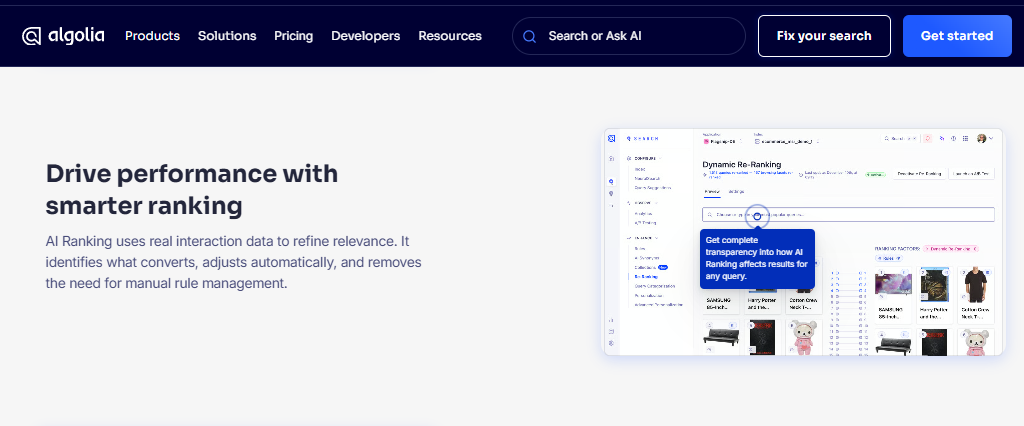
Algolia's AI Ranking uses real interaction data to refine relevance without manual merchandising rule management.
⭐ Why Did We Choose This Tool?
Algolia is the storefront search answer, not the back-office answer. It handles 1.75 trillion searches a year across 18,000 companies. If shoppers cannot find products, this fixes revenue directly.
Merchandising teams get real control here. One reviewer described setting rules, synonyms, and neural re-ranking to match what the team wants to sell. That is money, not tidiness.
📊 Core Evaluation Metrics
Connected data sources: Product catalog, content, and CMS feeds via API
Retrieval type: Hosted index with keyword, neural, and vector ranking
Answer generation: Query understanding and recommendations, not business Q&A
Proactive capability: No-results analytics and A/B testing
Entry pricing: Free tier, then usage-based
✅ Best For
Stores with catalogs large enough that native Shopify search fails
Merchandising teams that want rules and synonyms without dev tickets
Algolia offers a free tier and bills on usage. Reviewers consistently warn that cost climbs with traffic and record count.
💬 Reviews
Algolia holds 4.5 out of 5 from 453 G2 reviews.
"The price of Algolia is not cheap and compared to competitors it is higher, so it is not accessible to everyone, but it is worth it." — Michele C., Responsabile IT, Algolia - G2 Verified Review
"What I like least about Algolia is the new pricing structure and the strategy the company is now pursuing. Compared to before, Algolia has become significantly more expensive, which we do not like at all." — Marco M., Head of E-Commerce and Digital Innovation, Algolia - G2 Verified Review
⚠️ Skip this if: you want answers about your business. Algolia searches your catalog, not your numbers.
1.6 Elastic [toc=1.6 Elastic]
⭐ Why Did We Choose This Tool?
Elastic is the build-it-yourself option. You get keyword search, vector search, hybrid retrieval, and the pieces to assemble a RAG pipeline. RAG means retrieval augmented generation, where a model answers using your indexed data.
The trade-off is honest and well documented. Reviewers describe a steep learning curve, heavy memory use, and painful version upgrades. You are hiring engineering time, not buying an outcome.
📊 Core Evaluation Metrics
Connected data sources: Any source you write an ingest pipeline for
Retrieval type: Keyword, vector, and hybrid search on your own index
Answer generation: Available, but you build the layer
Proactive capability: Alerting and anomaly detection via the Elastic Stack
Entry pricing: Usage-based cloud, serverless tier available
✅ Best For
Teams with in-house engineers who want full control of the stack
Log analysis and observability alongside product search
Companies already running Kibana dashboards
💰 Pricing
Elastic bills on cloud usage. One CTO called the serverless option affordable, while others flag rising infrastructure cost as data grows. That build-versus-buy call is the same one operators face when they compare reverse ETL tools against a managed answer layer.
💬 Reviews
Elasticsearch holds 4.5 out of 5 from 292 G2 reviews.
"One thing I dislike about Elasticsearch is that it can become complex to manage as it grows. It requires careful planning and monitoring to avoid performance and stability issues. Licensing and pricing changes over time have also created some uncertainty for users." — Mustafa U., Senior Solution Architect, Elasticsearch - G2 Verified Review
"As your dataset grows, the hardware requirements for running Elasticsearch grow with it. For companies on a limited budget, those increasing infrastructure needs can quickly become financially overwhelming." — Gilles d., Consultant, Elasticsearch - G2 Verified Review
⚠️ Skip this if: nobody on your team writes code. This is infrastructure, not a product.
1.7 Lucidworks [toc=1.7 Lucidworks]
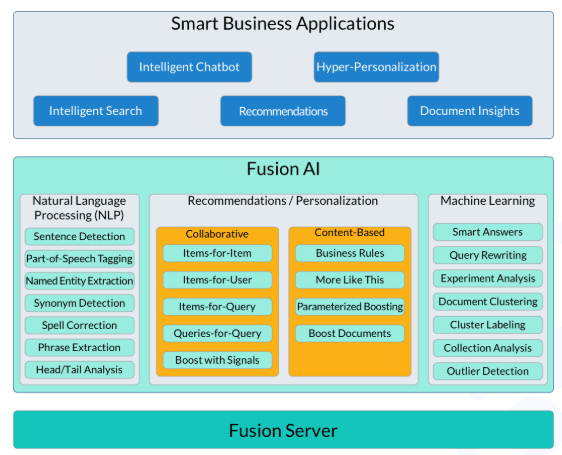
Lucidworks Fusion stacks NLP, recommendation, and machine learning modules beneath intelligent search and chatbot applications.
⭐ Why Did We Choose This Tool?
Lucidworks Fusion is a Gartner-recognized insight engine built around signals. It watches what shoppers click, skip, and buy, then re-ranks results from that behavior. For very large retail catalogs, that loop matters.
Fusion sits closer to the search-team world than the founder world. Its G2 review volume is thin at 12 reviews, so treat the sample with caution.
📊 Core Evaluation Metrics
Connected data sources: Commerce catalogs, content repositories, and behavioral signals
Retrieval type: Signals-based ranking on a Solr foundation
Answer generation: Search and recommendations, with AI add-ons
Proactive capability: Query rewriting and relevance experiments
Entry pricing: Not published, quote only
✅ Best For
Large retailers with high query volume and rich click data
Search teams running continuous relevance experiments
Organizations with an existing Solr or Lucene footprint
💰 Pricing
Lucidworks quotes privately. One G2 reviewer specifically praised flexible licensing across organization sizes.
💬 Reviews
Lucidworks Fusion holds 4.5 out of 5 from 12 G2 reviews.
"Great customer service! Team is always there for help! Their consulting and on site support teams have been nothing but stellar." — Verified User, Lucidworks Fusion - G2 Verified Review
⚠️ Skip this if: you do not generate enough search traffic for signals to mean anything.
1.8 Sinequa [toc=1.8 Sinequa]
⭐ Why Did We Choose This Tool?
Sinequa is built for document-heavy, regulated organizations. Think pharma research archives, aerospace engineering files, and bank compliance records. Its connector depth and metadata enrichment are genuinely strong.
Sinequa is on this list because Gartner names it a Leader, and because operators searching this keyword will see it. Being on the list is not the same as being right for a Shopify store.
📊 Core Evaluation Metrics
Connected data sources: 200-plus enterprise content and document repositories
Retrieval type: Hybrid semantic and keyword retrieval with metadata enrichment
Answer generation: Search and synthesis apps for AI assistants
Proactive capability: Limited to search-driven workflows
Entry pricing: Not published, quote only
✅ Best For
Regulated enterprises with large unstructured document archives
Research and engineering teams searching technical corpora
Organizations with strict data residency and governance rules
💰 Pricing
Sinequa quotes per deployment. Nothing published, which itself tells you the buyer profile.
⚠️ Skip this if: your data is transactional rather than documentary. This is a document engine, so a store with order-level data is better served by an AI data analyst for ecommerce.
1.9 Mindbreeze [toc=1.9 Mindbreeze]
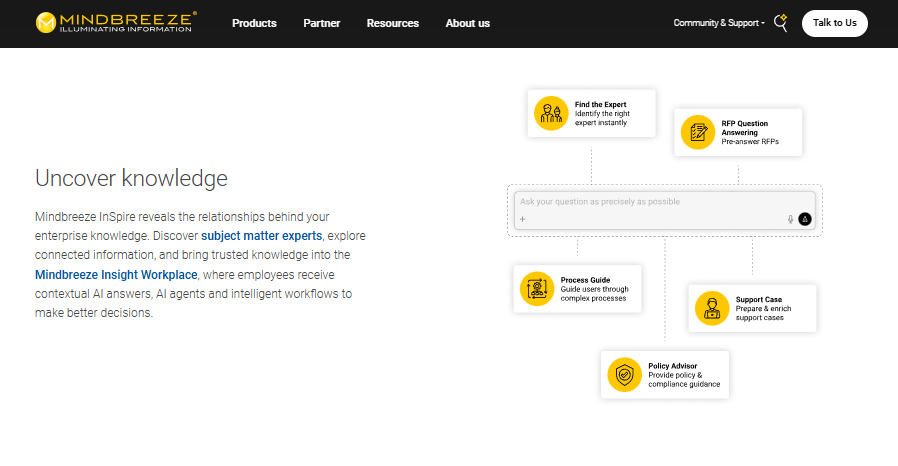
Mindbreeze InSpire routes one precise question into expert finding, RFP answering, and compliance guidance workflows.
⭐ Why Did We Choose This Tool?
Mindbreeze InSpire is another Gartner-recognized Leader, sold as an appliance, cloud, or hybrid deployment. It bills on indexed documents rather than seats, which is unusual and worth understanding before you evaluate.
Published entry pricing starts at EUR 83,000 per year for a one-million-document package. That single number tells you whether the rest of this entry applies to you.
📊 Core Evaluation Metrics
Connected data sources: Enterprise content systems, ERP, CRM, and file shares
Retrieval type: Semantic index with automatic metadata enrichment
Answer generation: Insight apps and natural language question answering
Proactive capability: Limited to search and insight app workflows
Entry pricing: From EUR 83,000 per year for 1M documents
✅ Best For
Enterprises consolidating information across many legacy systems
Organizations needing on-premises or appliance deployment
Teams where indexed document count, not headcount, drives value
💰 Pricing
Mindbreeze publishes a Small package from EUR 83,000 per year for up to one million indexed documents. The 5M, xM, and Infinity tiers are quote-based. For context, most stores in the $1M to $5M band run their entire ecommerce tech stack for a fraction of that.
💬 Reviews
Mindbreeze InSpire holds 4.4 out of 5 from 11 G2 reviews and 4.7 from 47 Gartner Peer Insights reviews.
"Although it was pretty straightforward to implement and use, it does have a steep learning curve. But once you figure it out, it becomes a breeze." — Verified User, Mindbreeze InSpire - G2 Verified Review
"I don't like Mindbreeze InSpire for its poor user friendly features. It takes time to get the hang of it once you do it becomes quite difficut to use." — Verified User, Mindbreeze InSpire - G2 Verified Review
⚠️ Skip this if: your annual software budget is smaller than this tool's entry price.
1.10 IBM watsonx Discovery [toc=1.10 IBM watsonx Discovery]
⭐ Why Did We Choose This Tool?
IBM is a named Leader in Gartner's insight engine evaluation, so leaving it out would be dishonest. watsonx Discovery handles document understanding and enterprise natural language processing at scale.
It makes sense in exactly one situation: you already run IBM infrastructure. Outside that, the integration overhead outweighs the capability for a commerce team.
📊 Core Evaluation Metrics
Connected data sources: Enterprise documents, IBM stack systems, and custom connectors
Retrieval type: Document understanding with vector and semantic search
Answer generation: Question answering over indexed enterprise content
Proactive capability: Built through custom workflows, not out of the box
Entry pricing: Not published, quote only
✅ Best For
Organizations already standardized on IBM cloud and data services
Contract, claims, and technical document mining at volume
Teams with data engineers available for the integration work
💰 Pricing
IBM prices per deployment and consumption. Nothing published for direct comparison.
⚠️ Skip this if: you are a DTC brand. Nothing about this is built for your stack, and a purpose-built Shopify business intelligence layer will answer more of your questions.
Luca AI sits at the top of this list because nine of the ten engines above index documents or catalogs, while the question an operator actually asks is about money. Connecting Shopify, Meta, Klaviyo, the 3PL, and the ledger in one normalized layer is what makes a margin question answerable in minutes.
Q2. How Did We Score These Insight Engines? [toc=2. Scoring Methodology]
Every engine on this list was scored across five weighted criteria: Commerce Data Coverage at 25%, Retrieval and Answer Quality at 25%, Time-to-First-Answer at 20%, Verified User Reviews at 15%, and Pricing Transparency at 15%. Luca AI earns five stars on this rubric, losing ground only on enterprise-scale deployment, where engines built for hundred-thousand-seat intranets remain the stronger technical fit.
📊 The Weighting
Insight Engine Scoring Rubric and Weights
Criterion
Weight
What It Measures
Commerce Data Coverage
25%
Does it index commerce, ads, ledger, 3PL, and support?
Retrieval and Answer Quality
25%
Does the returned answer survive a manual check?
Time-to-First-Answer
20%
Days from signup to a correct, useful answer
Verified User Reviews
15%
Rating plus review volume on G2 and Gartner
Pricing Transparency
15%
Is a real number published, or is it quote-only?
💰 Why Data Coverage Carries the Most Weight
An engine can only answer what it can see. Miss the accounting ledger and every margin answer stops at gross margin. Miss the helpdesk and support cost per unit stays invisible.
That is why coverage outranks features. Six of the ten engines here are quote-only enterprise platforms indexing documents, not transactions, which is why an operator comparing ecommerce analytics platforms gets a different shortlist than an IT buyer.
⭐ Why Retrieval Is Scored Separately From the Model
Everyone runs similar models now. The difference is what gets retrieved before the model speaks. Shopify's own Q2 2026 data showed products exposed through structured Catalog data converted roughly twice as well in AI search as scraped or third-party feeds.
Luca AI measures this by scoring answers against a known-truth benchmark, where the operator already knows the correct number. That is the only honest way to test retrieval.
📈 The Star Bands
Star Ratings Across All Ten Insight Engines
Tool
Rating
Luca AI
⭐⭐⭐⭐⭐
Triple Whale
⭐⭐⭐⭐
Coveo
⭐⭐⭐
Glean
⭐⭐⭐
Algolia
⭐⭐⭐
Elastic
⭐⭐⭐
Lucidworks
⭐⭐
Sinequa
⭐⭐
Mindbreeze
⭐⭐
IBM watsonx Discovery
⭐⭐
Star bands run in twenty-point steps across the hundred-point rubric. Two-star tools are not bad products. They are enterprise document engines being judged on an ecommerce job.
❌ What We Deliberately Did Not Score
Analyst quadrant placement was excluded. Gartner named fifteen vendors in this market and seven as Leaders, which is useful context but tells you nothing about Shopify connectors.
Dashboard depth was also excluded. My read is that visualizations are a courtesy, not the substance. The model digests the data and tells you what matters, and the chart is what you show your board afterward, which is the same argument against buying another ecommerce analytics dashboard.
⚠️ Where This Rubric Could Be Wrong
Review volume favors incumbents. Lucidworks Fusion carries 12 G2 reviews, while Elasticsearch carries 292. A thin sample punishes newer tools, including ours.
I could be reading Time-to-First-Answer too generously. It rewards products that normalize automatically, which is the architecture Luca AI happens to use. Weigh that bias when you score your own shortlist.
Luca AI normalizes and standardizes every connected source on ingestion, which is what drives its Time-to-First-Answer result rather than any advantage in model choice. Run the same five criteria against your own shortlist and the ranking will shift with your ecommerce tech stack.
Q3. What Is an Insight Engine, and How Is It Different From a Dashboard, Enterprise Search or RAG? [toc=3. Insight Engine Defined]
An insight engine connects to your data sources, builds one unified index, interprets a plain-English question, and returns a direct answer with reasoning. A dashboard shows numbers and leaves interpretation to you. Enterprise search returns documents when asked. A raw RAG pipeline retrieves text chunks. An insight engine adds intent detection, relevance tuning, and proactive alerting on top.
📊 The Four Things People Confuse
Dashboard vs Enterprise Search vs RAG vs Insight Engine
System
What You Give It
What You Get Back
Dashboard
A metric selection
Charts you interpret yourself
Enterprise search
Keywords
A ranked list of documents
RAG pipeline
A question
Text chunks plus a generated summary
Insight engine
A question or nothing at all
A reasoned answer, plus alerts you did not request
Gartner defines insight engines as systems that apply relevancy methods to discover, analyze, describe, and organize content and data. That definition is accurate and slightly bloodless. The operator version is simpler: it answers, and it interrupts you when something breaks.
⭐ The Mechanics Underneath
Three parts do the work. Intent detection reads what you actually meant, so "how did last month go" resolves to a date range and a metric set.
Semantic and vector retrieval then pull the relevant records. Vector retrieval means matching by meaning rather than exact words. Relevance tuning ranks what comes back, and it is the part nobody owns internally. Coveo reviewers describe a steep learning curve on exactly this configuration work.
✅ One Query, Traced End to End
Ask this: "Why did contribution margin drop last month?"
The engine pulls order and discount data from Shopify, spend from Meta and Google, freight from your 3PL, and COGS from Xero. It joins them on SKU and date, compares against the prior twelve months, and isolates the variance. Then it names the cause.
You can ask Luca AI to run that exact query in plain English, with no SQL and no dashboard build, which is what separates conversational analytics tools from report builders.
⏰ Three Hours Versus Three Minutes
Here is the shift I keep seeing. Reading dashboards to answer one question takes an afternoon. Asking the question conversationally takes minutes.
The larger move is from monitoring to recommending. Descriptive analytics logs what happened. Prescriptive systems tell you to go right instead of left, and say why, which is the whole premise behind decision intelligence tools.
⚠️ Where This Breaks
An insight engine is only as honest as its index. If your fiscal calendar is inconsistent across sources, it will answer confidently and wrongly.
That failure mode is worse than a blank dashboard. A blank dashboard makes you go look. A wrong answer makes you act.
Luca AI was built on the monitoring-to-recommending distinction, scanning connected sources continuously and pinging the operator when ROAS dips, CAC spikes, or inventory falls below a set threshold. Nobody has to open anything for that to happen.
Q4. What Does an Insight Engine Need to Connect, Normalize and Govern Before It Is Trustworthy? [toc=4. Data Foundation Requirements]
A trustworthy ecommerce insight engine must index at least seven sources: your commerce platform, Meta and Google Ads, Klaviyo, your 3PL or WMS, your accounting ledger, your payment processor, and your helpdesk. It must then reconcile fiscal calendars and cost fields on ingestion, and enforce the same permissions your source systems do.
✅ The Seven-Source Checklist
Minimum Connector Set for an Ecommerce Insight Engine
Source
What It Unlocks
Shopify or WooCommerce
Orders, SKUs, discounts, and returns
Meta and Google Ads
Spend, CAC by channel
Klaviyo
Retention and email-driven revenue
3PL or WMS
Landed freight, stock position
Xero or QuickBooks
COGS, true contribution margin
Stripe or PayPal
Processing fees, chargebacks
Helpdesk
Support cost per unit
Coveo's own must-have list puts connectors and one unified index first for the same reason. No data in, no answer out, which is why ecommerce data integration is the first thing to audit.
💰 The Ledger Gap
Skip the accounting connector and your engine caps out at gross margin. Gross margin only tells you what it costs to make the thing.
It says nothing about what it costs to sell the thing. Freight, duties, processing fees, discount depth, and returns all live outside your commerce platform, which is the practical difference between contribution margin and gross margin.
💸 The Helpdesk Gap Nobody Connects
One operator I spoke with found that 42% of all support tickets traced to a single product. That worked out to $1.45 per unit in support cost.
That number never appears in a marketing dashboard. It only surfaces when ticket data joins order data on the SKU.
⚠️ The Schema and Calendar Tax
This is the unglamorous killer. Brands report invoice sales in one system and demand sales in another. Retail calendars run 5-4-4 in one place and 4-4-5 in another.
An engine that does not reconcile these produces confident nonsense. Luca AI normalizes and standardizes every connected source on ingestion, which removes the cleanup year most platforms quietly bill as onboarding.
⭐ Permission-Aware Retrieval
Your engine must inherit permissions from each source. Otherwise a warehouse coordinator can ask a question and receive supplier pricing or payroll data.
Glean reviewers consistently name permission-aware access as the reason the tool clears security review. Ask any vendor to demo this with two different user logins, not one.
💬 What Buyers Actually Say About Connectors
"Integration with multiple platforms with unified Index. A typical search would create index per data source. Coveo makes your life easy that can combine multiple data source into a single search index." — Balaji K., Senior Consultant, Coveo - G2 Verified Review
"Some integrations can also take a little time to get fully set up and configured. From a pricing/ROI perspective, it can be harder to justify for smaller teams, so the value is much more noticeable at a larger scale." — Shivang M., Operational Engineer Senior, Glean - G2 Verified Review
"One thing I dislike about Elasticsearch is that it can become complex to manage as it grows. It requires careful planning and monitoring to avoid performance and stability issues." — Mustafa U., Senior Solution Architect, Elasticsearch - G2 Verified Review
⏰ Your 30-Minute Audit
List all seven sources and mark which ones export cost data. Check whether two systems disagree on last month's revenue. Then ask one vendor to answer a question you already know the answer to.
The readiness gap is real and measured. Across 485 audited Shopify stores, average AI search readiness scored 31.4 out of 100. A separate audit of 1,000 stores averaged 42, with collection pages worst at 35.
Luca AI connects commerce, ads, ledger, 3PL, and support into one normalized layer, which is what lets a single question resolve margin, cash, and channel performance together. Ask your shortlist to prove the same join before you sign.
Q5. Why Does Retrieval Quality Decide Your Revenue in 2026? [toc=5. Retrieval and Revenue]
AI-referred sessions to Shopify storefronts grew 197% year over year in Q2 2026, and AI-driven orders tripled. AI-referred shoppers carry roughly 14% higher average order values. Structured Catalog product data converted about twice as well in AI search as scraped feeds. Retrieval quality, not model quality, is now the variable operators control.
⚠️ What These Numbers Do Not Mean
AI did not replace Google. Shopify's own data shows organic search still sends merchants far more traffic, and it grew 12% on a much larger base.
The story is about buyer quality, not volume. Around 55% of AI-referred sessions land straight on a product page, against roughly 20% for organic. Those visitors arrive with the research already done, which changes how you read your ecommerce website analytics.
📊 The Structured Versus Scraped Gap
Here is the number that should change your week. Products exposed through structured Catalog data converted roughly 2x better than products left to scraping.
Same product. Same shopper. Different retrieval path. An independent study of 2,417 Shopify stores found top-quartile structured-data stores earning 3.8x more AI-referred revenue, which puts real money behind ecommerce product data management.
⏰ Conversational Retrieval Is Already Normal
Shopify's Sidekick handled around 34 million merchant conversations in Q2 2026, with daily active merchant use up 3.6x year over year.
Operators are already asking questions instead of reading dashboards. And 75% of AI-attributed purchases came from outside the top 100 categories, which means long-tail retrieval is doing real work.
❌ The Readiness Gap Nobody Fixed
Demand moved before the data stacks did. Across 485 audited Shopify storefronts, average AI search readiness scored 31.4 out of 100.
A separate audit of 1,000 stores averaged 42, with collection pages worst at 35. That gap is the constraint, not the models.
💸 Why This Costs Real Money Internally
The same failure runs inside your business. If your engine cannot retrieve clean cost data, it answers on revenue alone.
Poor inventory accuracy alone drives over $1.1 trillion in retail revenue distortion. Scaling ad spend on top of an unindexed cost base is how profitable-looking stores quietly lose money, and it is the same trap behind declining platform ROAS versus true profitability.
✅ What to Check This Week
Three checks, thirty minutes total.
Open Shopify Analytics and filter referrer channel for AI answer engines. Compare conversion and AOV against organic.
Confirm your product feed publishes through Shopify Catalog rather than leaving engines to scrape.
Check whether two of your internal systems disagree on last month's revenue. If they do, no engine will save you.
⭐ My Read, With Uncertainty Attached
I could be over-reading the Q2 spike. One quarter of 197% growth off a small base is not a trend line, and I have watched channels flatten before.
What I am confident about is the mechanism. Structured retrieval beat unstructured retrieval by 2x in Shopify's own telemetry. That relationship holds whether the traffic doubles again or stalls.
Luca AI treats retrieval quality as the product, indexing and normalizing source data first so the answer layer reasons over clean joins rather than guessing across mismatched exports. The model is the easy part. The index is where the money is.
Q6. What Questions Can an Insight Engine Actually Answer for Your Store? [toc=6. Questions It Answers]
A capable insight engine answers five query classes: what happened and where, why it happened through root-cause tracing, which variables influenced it, what happens next based on historical patterns, and what changes if you alter a variable. Luca AI covers all five and pushes scheduled answers into Slack or email, so the answer often arrives before the question does.
📊 The Five Query Classes
Five Query Classes an Insight Engine Should Handle
Class
A Real Question
Descriptive
What was true contribution margin by SKU last month?
Root cause
Why did CAC jump 31% in week three?
Influencing factors
Which variables move repeat purchase rate most?
Predictive
What will I sell in November at current run rate?
Simulation
What happens to cash if I raise prices 8%?
If a vendor cannot demo all five on your data, you are buying a dashboard with a chat box.
💸 The 72% Margin That Was Not
A founder slid an invoice across the table and called it her best seller. Gross margin, 72%. She had scaled it for two years.
Twenty minutes later she was crying. Real contribution margin, calculated line by line, came in at 8%, a gap that shows up constantly in ecommerce profit margins.
⚠️ Why the Data Was Already There
Nothing was missing. Freight sat in the 3PL export. Processing fees sat in Stripe. Support cost sat in the helpdesk. COGS sat in Xero.
Eight joins stood between her and the truth. Nobody had made them, because making them by hand takes a week and breaks the next month.
⭐ Root Cause, Not Just the Alert
Anyone can tell you CAC spiked. That is a threshold, not an answer.
The useful version traces it. Creative fatigue on two ad sets, a discount code leaking into paid traffic, and a stockout pushing spend toward lower-converting SKUs. Ask Luca AI to name the contributing factors and rank them by impact.
⏰ Prediction and Simulation for the Seasonal Buy
One operator told me he spends three weeks before every buying cycle analyzing vendor performance. Three weeks, twice a year.
That work is pattern matching against history. Luca AI studies performance across months and years, then flags where the current pattern breaks from the usual one, which is the practical use of predictive analytics for ecommerce.
✅ The Part That Runs Without You
Here is the shift that matters most for a small team. You should not have to remember to ask.
Set the report once and it arrives. A weekly CAC breakdown with graphs and reasoning, accounting for Meta and Google spend, delivered to Slack every Monday morning, is exactly what automated ecommerce reporting should look like.
❌ The Failure Mode to Avoid
More output is not the goal. One operator ran five cohort analyses and ended up with twenty executive summaries, each 25 pages long.
His reaction was fair: how do I actually use this? An answer that does not name the next action is just a longer dashboard.
💰 The Test to Run on Any Demo
Bring one question you already know the answer to. Something painful you calculated by hand last quarter.
If the engine gets it right, you learned something about retrieval. If it gets it wrong confidently, you learned more, which is the whole point of evaluating AI data agents before you sign.
Luca AI is a replacement for a junior ecommerce data analyst, trained on the relationships between ecommerce metrics to surface outliers, trace causes, and push recommendations. Gross margin only tells you what it costs to make the thing. Everything expensive happens after that.
Q7. What Will It Cost, Who Should Skip It, and How Do You Deploy in 30 Days? [toc=7. Cost, Fit and Rollout]
Entry pricing runs from low three figures monthly for commerce-focused engines to five and six figure annual contracts for enterprise platforms, most of them quote-only. Skip an insight engine entirely if you have under twelve months of clean transaction history, or if you already run a governed warehouse with a data team. Otherwise, budget four weeks from connector audit to first alert.
💰 What Published Pricing Actually Looks Like
Published Entry Pricing Across the Shortlist
Tool
Published Entry Price
Luca AI
€299 per month
Triple Whale
$219 per month, Automate at $749
Mindbreeze
From EUR 83,000 per year for 1M documents
Coveo, Glean, Sinequa, Lucidworks, and IBM
Not published, quote only
Five of ten publish nothing. That silence tells you who they sell to. Full plan detail for our own tiers sits on the Luca AI pricing page.
💸 The Four Costs Nobody Quotes
Connector build: custom sources your vendor does not support natively
Schema reconciliation: aligning fiscal calendars and cost field definitions
Relevance tuning: the ongoing work Coveo reviewers describe as a steep learning curve
Internal owner time: somebody's afternoon, every week, forever
For a $5M GMV store, the internal owner line is usually the biggest number on the page. Nobody puts it on a quote.
❌ Three Reasons to Not Buy
Skip it if you have under twelve months of clean history. The engine has nothing to reason against and will answer confidently on noise.
Skip it if you already employ a data team running a governed warehouse. You have the capability, and you are buying a friendlier interface at enterprise prices, so a self-service BI tool may be the cheaper answer.
Skip it if your category runs on curation more than measurement. One operator put it plainly: they got too data driven and lost touch with the emotional side of the business.
⚠️ Do Not Remove the QA
A premium bike brand once published a road bike image with the front derailleur mounted on the wrong wheel. A $20,000 product, wrong on the homepage.
Automation is not quality assurance. Keep a human between the answer and the action.
⏰ The Four-Week Rollout
Four-Week Insight Engine Rollout Plan
Week
Work
1
Audit and connect your seven core sources
2
Reconcile fiscal calendars and cost fields
3
Run the ten-question accuracy benchmark
4
Set three alerts, then stop opening the dashboard
Luca AI charges no implementation fee, and because normalization happens at ingestion, most stores compress week two to a single afternoon.
✅ The Ten-Question Benchmark
Run these against any vendor, including ours.
True contribution margin on your top SKU, all-in
CAC by channel, last 90 days
Which SKU carries the highest support cost per unit
Any question your accountant answered by email last quarter
💬 What Buyers Say About Cost
"What I like least about Algolia is the new pricing structure and the strategy the company is now pursuing. Compared to before, Algolia has become significantly more expensive, which we do not like at all." — Marco M., Head of E-Commerce and Digital Innovation, Algolia - G2 Verified Review
"Cost. Realistically the price point for Coveo is geared towards larger corporations making difficult for smaller firms to afford its services." — Verified User in Insurance, Enterprise, Coveo - G2 Verified Review
"we started with 100 per month with a Shopify setup running Google ads and meta ads. of course they upsell you and you have to go to 300 a month to get the attribution." — u/Repulsive-Word, r/shopify Reddit Thread
Luca AI publishes its pricing at €299, €499, and custom, and it is built for operators between $1M and $5M who have piling data and no analyst. Where I am still uncertain: whether the twelve-month history floor holds for stores with very high order counts. If you are running 40,000 orders in six months, tell me what you find. I would like to be wrong about that one.
FAQ's
What is an insight engine, and how is it different from a BI dashboard?
An insight engine connects to your data sources, builds one unified index, interprets a plain-English question, and returns a direct answer with reasoning attached.
A dashboard does something narrower. It renders numbers you selected and leaves every interpretation to you. Enterprise search returns a ranked list of documents. A raw RAG pipeline returns text chunks plus a summary.
The differences that matter in practice:
Intent detection. The engine resolves what you meant, so a vague question maps to a real date range and metric set.
Unified retrieval. One index spans many sources instead of one silo per tool.
Proactive alerting. A good engine interrupts you when something breaks, rather than waiting to be opened.
Luca AI was built on that last distinction, scanning connected sources continuously and pinging the operator when ROAS dips, CAC spikes, or inventory drops below a set threshold. Reading dashboards to answer one question takes an afternoon. Asking the question conversationally takes minutes.
If you are still weighing whether to replace your charts, our breakdown of the ecommerce analytics dashboard explains where visual reporting still earns its place and where it stops paying.
Which insight engine is best for a Shopify store doing 1 to 5 million in revenue?
At that stage the constraint is almost never search relevance. It is that cost data and revenue data live in different systems and nobody has time to join them.
Most engines in this category were built for IT service desks, intranets, and document archives. Coveo, Glean, Sinequa, Mindbreeze, and IBM watsonx Discovery all expect an internal owner and an enterprise contract. Algolia handles storefront product search well, but it searches your catalog, not your numbers.
What a store at this stage actually needs:
Connectors to commerce, ad platforms, Klaviyo, the 3PL, the ledger, the payment processor, and the helpdesk
Normalization on ingestion, so fiscal calendars and cost fields reconcile automatically
Answers that name the next action, not another chart
Luca AI is built specifically for operators in that 1 to 5 million band who have piling data and no analyst, no SQL, and no warehouse budget. It does not fit enterprises that already employ a data team.
If you are assembling the wider toolset around it, our guide to the ecommerce tech stack shows how the answer layer sits over everything else.
How much do insight engines cost, and what does the quote leave out?
Published entry pricing spans a wide range. Commerce-focused engines start in the low three figures per month. Enterprise platforms run into five and six figure annual contracts, and five of the ten tools we reviewed publish no number at all.
Mindbreeze publishes a Small package from around EUR 83,000 per year for one million indexed documents. Triple Whale lists 219 dollars per month on Foundation and 749 on Automate. Coveo, Glean, Sinequa, Lucidworks, and IBM quote privately.
Four costs almost never appear on the quote:
Connector build for sources the vendor does not support natively
Schema reconciliation to align fiscal calendars and cost field definitions
Relevance tuning, the ongoing configuration work reviewers describe as a steep learning curve
Internal owner time, somebody's afternoon every week, indefinitely
For a 5 million GMV store, that last line is usually the largest number on the page.
Luca AI publishes its tiers at 299 euros, 499 euros, and custom, with no implementation fee, and because normalization happens at ingestion the reconciliation week largely disappears. You can compare the tiers on our pricing page.
What data sources must an insight engine connect before its answers can be trusted?
Seven sources are the practical minimum for an ecommerce store: your commerce platform, Meta and Google Ads, Klaviyo, your 3PL or WMS, your accounting ledger, your payment processor, and your helpdesk.
Miss the ledger and every margin answer stops at gross margin, which only tells you what it costs to make the thing. Freight, duties, processing fees, discount depth, and returns all sit outside your storefront.
Miss the helpdesk and support cost per unit stays invisible. One operator we spoke with traced 42 percent of all support tickets to a single product, which worked out to 1.45 dollars per unit.
Two more requirements decide whether the answers hold up:
Schema and calendar reconciliation. Invoice sales in one system and demand sales in another, or 5-4-4 against 4-4-5 retail weeks, produce confident nonsense.
Permission-aware retrieval. The engine must inherit source permissions, or a warehouse coordinator can surface supplier pricing.
Luca AI normalizes and standardizes every connected source on the way in, which removes the cleanup year most platforms quietly bill as onboarding. Our walkthrough of ecommerce data integration covers the audit order.
How do we test an insight engine for accuracy before we buy it?
Bring one question you already know the answer to. Something painful you calculated by hand last quarter, where you can check the output line by line.
If the engine gets it right, you learned something real about its retrieval. If it gets it wrong confidently, you learned more, and you learned it before signing.
Run these ten during the trial:
True contribution margin on your top SKU, all-in
CAC by channel over the last 90 days
Which SKU carries the highest support cost per unit
Repeat purchase rate by acquisition cohort
Cash impact of your next inventory order
Why revenue moved last month, ranked by cause
Forecast next month's units for one product
Effect of an 8 percent price rise on profit
Which discount codes destroy margin
Any question your accountant answered by email last quarter
Also ask for a permissions demo with two different user logins, not one.
Luca AI measures its own retrieval this way, scoring answers against a known-truth benchmark where the operator already has the correct number. Run the same benchmark on us. Our note on evaluating AI data agents expands the method.
Enjoyed the read? Join our team for a quick 15-minute chat — no pitch, just a real conversation on how we’re rethinking Ecommerce with AI - Luca
Loading Schedule...
Your AI Co-Founder is here.
Here’s why:
Shopify, Meta, Xero - one brain.
"Should I scale?" Answered with real data.
Growth capital. No applications. One click.
Thank you! Your submission has been received! Please book a time slot for the Meeting
Oops! Something went wrong while submitting the form.