9 Best ETL Tools for Small Ecommerce Businesses in 2026
14
mins read
TL;DR
The nine tools compared are Luca AI, Airbyte, Hevo Data, Fivetran, Stitch, Skyvia, Estuary Flow, Saras Daton, and Weld, scored on a published 100-point rubric.
Budget three line items, not one: the connector tool, the warehouse, and the human hours nobody quotes when they show you a price page.
Shopify charges a data-access tax. WooCommerce to BigQuery runs near $5 a month, while the same job on Shopify commonly runs $500 or more.
Fivetran's January 2026 shift to connector-level metering added $5 per-connector minimums and billable deletes, and operators report bills more than doubling.
Connectors move rows but rarely reconcile meaning. SKU structure, retail calendars, and refund timing are where pipeline projects actually stall.
Under $1M GMV with three sources, skip the pipeline entirely. Between $1M and $10M, run a managed pipeline plus an intelligence layer above it.
Q1. What Are the 9 Best ETL Tools for E-commerce in 2026? [toc=1. Best ETL Tools 2026]
The nine best ETL tools for small ecommerce businesses in 2026 are Luca AI, Airbyte, Hevo Data, Fivetran, Stitch, Skyvia, Estuary Flow, Saras Daton, and Weld. Luca AI normalizes Shopify, Meta, Google, Klaviyo, accounting, and 3PL data on ingestion, then answers questions in plain English. No SQL, no analyst, and no dashboard build sits between you and the answer.
Most store owners I talk to do not want a pipeline. They want their Monday numbers to be right without three exports and a pivot table. That gap is why this list exists. I picked tools a lean team can actually run, priced them from vendor pages, and cross-checked ratings on G2 and operator threads. Some of these move rows into a warehouse. One sits above the warehouse and does the thinking. Both jobs matter, and confusing them is how founders overspend. Here is the shortlist, then the honest detail.
Airbyte: Best free and open-source pipeline for technical teams
Hevo Data: Best fully managed no-code pipeline with 24x7 support
Fivetran: Best connector reliability at enterprise scale
Stitch: Best simple, predictable row-based replication
Skyvia: Best low-cost no-code option for very small volumes
Estuary Flow: Best for real-time change data capture
Saras Daton: Best prebuilt ecommerce and marketplace data models
Weld: Best flat-fee pipeline plus transformation in one tool
🔎 How I Priced and Rated Them
Prices come from vendor pricing pages and published plan tables, not sales decks. Ratings come from G2 review counts, checked in August 2026. Cost claims are sanity-checked against operator threads where real invoices get posted.
Best ETL Tools for Small Ecommerce Businesses in 2026
Tool
Key capabilities offered
Best For
Pricing
Luca AI ⭐⭐⭐⭐⭐
Unified store data, normalization on ingestion, plain-English questions, proactive anomaly alerts, predictive and root-cause analysis
Stores at $1M to $5M revenue with data piling up and no analyst
Free to $100 / Month per connector plus $0.50 / GB
Saras Daton ⭐⭐⭐
Prebuilt ecommerce and marketplace schemas, Amazon and Shopify models, reporting layer
Multi-marketplace sellers wanting ready data models
Custom quote
Weld ⭐⭐⭐
ELT plus SQL transformations, MAR-based flat plans, reverse ETL, AI assistant
Teams wanting pipeline and modelling in one bill
€99 / Month to €999 / Month
1.1 Luca AI [toc=1.1 Luca AI]
Luca AI connects sources in minutes, then reasons, decides, and acts inside one conversation.
⭐ Why did we choose this tool?
I co-founded Luca AI, so put my bias on the table before you read further. It sits first for one honest reason. Most stores on this list still need a person to interpret the data after the pipeline runs. Luca AI removes that step. It normalizes data on ingestion, reasons across marketing, commerce, and finance together, and pushes findings before you ask. That cross-functional reasoning is the part a row-mover cannot do, however cheap it is.
🧩 Solutions Offered
Connects Shopify, Meta, Google, Klaviyo, accounting, payments, and 3PL into one source of truth
Normalizes and standardizes data on ingestion, so you skip the cleanup year
Answers plain-English questions across sales, product, customer, and profit data
Scans data 24/7 and alerts on ROAS dips, CAC spikes, and low stock via Slack or email
Runs predictive work: reorder alerts, sales forecasts, and root-cause analysis
📊 Core Evaluation Metrics
Ecommerce connectors: 200+ native sources
Setup to first answer: minutes, no warehouse modelling required
Pricing model: flat monthly subscription, not row-metered
Normalization on ingestion: yes, handled in the backend
Analyst dependency: none for standard questions
✅ Best for
Ecommerce stores between $1M and $5M revenue with unused data sitting idle
Teams without a data analyst, or bandwidth to build and maintain models
Operators who want recommendations, not another dashboard to scroll
What was the problem? A European home-fragrance brand doing roughly €2M a year ran Shopify, Meta, Google, Klaviyo, and Xero side by side. Their Monday report took two people most of a morning. Refunds and ad spend never reconciled, so margin numbers were argued over instead of used.
How Luca AI helped: Luca AI connected all five sources and standardized SKUs, refunds, and channel spend on ingestion. We set three alerts with the founder: a ROAS drop threshold, a stock-cover floor, and a CAC spike flag. Questions moved from spreadsheets into plain English.
What was the outcome? ⏰ The Monday report went from half a day to a scheduled email that arrives with reasoning attached. The team caught a repeat-purchase decline in a hero SKU weeks earlier than before. 💸 Reorder timing improved, which mattered more to cash than any ad tweak that quarter.
Luca AI is not an attribution pixel and does not replace one. It also does not fit stores with too little data to reason against yet.
1.2 Airbyte [toc=1.2 Airbyte]
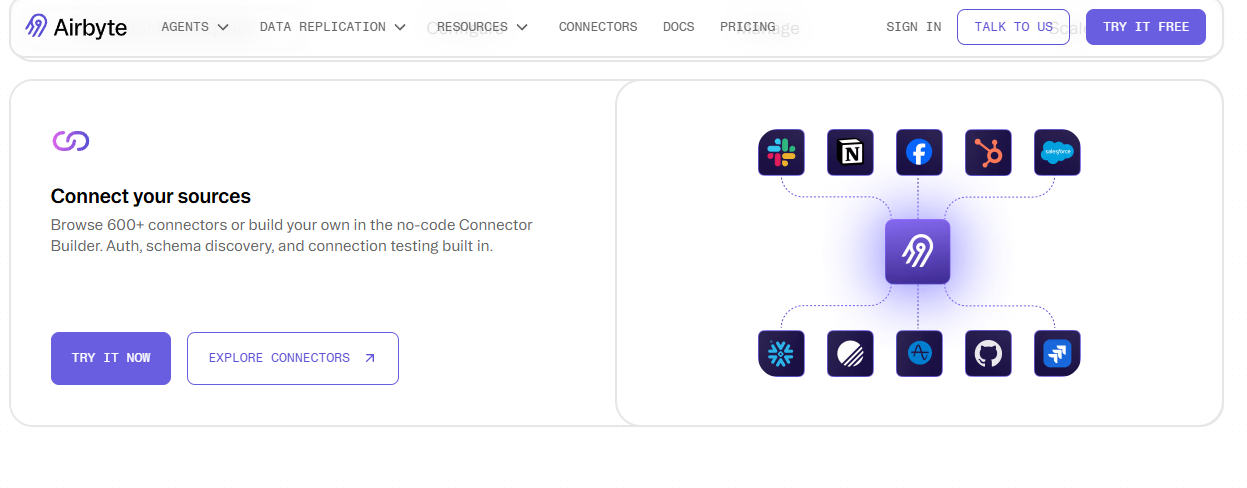
Airbyte offers 600-plus connectors and a no-code builder, free to license when self-hosted.
⭐ Why did we choose this tool?
Airbyte earns its place because it is the honest free option. The open-source Core costs nothing to license, and it ships 600+ connectors. Self-hosting saves real money for teams with DevOps capacity. That saving is not free, though. Published estimates put setup at 40 to 80 hours and maintenance at 20 to 40 hours a month. If nobody on your team owns Docker or Kubernetes, that bill lands as engineering time instead of subscription cost.
🧩 Solutions Offered
Open-source Core for self-hosted pipelines under an MIT licence
Cloud Standard plan with volume-based credit billing for managed syncs
600+ connectors covering Shopify, Amazon, Meta, Google Ads, Klaviyo, and Postgres
Connector Development Kit for custom sources, typically built in 2 to 5 days
dbt handoff for transformations after load
📊 Core Evaluation Metrics
Ecommerce connectors: 600+ across sources and destinations
Setup to first sync: 40 to 80 hours self-hosted, minutes on Cloud
Pricing model: free Core, then credits at $2.50 each on Cloud Standard
Normalization on ingestion: no, transformation needs external dbt
Verified rating: 4.4/5 on G2 from 78 reviews
✅ Best for
Engineering-led teams comfortable running and patching their own infrastructure
Stores with data residency or sovereignty requirements that rule out managed clouds
Low-volume pipelines where Cloud Standard stays near its $10 entry point
🗣️ Reviews
"It works just fine and I don't personally see a lot of advantages going cloud. My issues are edge cases like not being able to do log based replication (no access, not that airbyte cant), not being able to add a where clause, slow load for connector, slow load for single large table." u/Drekalo, r/dataengineering Reddit Thread
"What I definitely don't recommend is running Airbyte in Kubernetes. We tried it and it always had lots of bugs, with not so much attention from the maintainers. We ended up simply hosting it in an EC2 instance with Docker compose." u/henriquemeloo_, r/dataengineering Reddit Thread
Watch the meter if you pick Cloud. ⚠️ Reviewers report usage moving up and down without a clear explanation, and memory spikes on large syncs forcing over-provisioned workers. Also note the gap between plans. Standard starts at $10 a month, while Plus starts at $25,000 a year. There is very little middle ground for a growing store.
Luca AI sits above this layer rather than beside it, so a store already happy self-hosting its data integration can keep the pipeline and still remove the interpretation work. For teams weighing the wider stack, our breakdown of the ecommerce tech stack and our guide to automated ecommerce reporting cover what sits on either side of the pipeline.
1.3 Hevo Data [toc=1.3 Hevo Data]
Hevo Data runs managed ingestion, processing, and loading, so lean ecommerce teams skip infrastructure work entirely.
⭐ Why did we choose this tool?
Hevo Data earns its spot for one reason that matters to lean teams: predictable bills. It runs 150+ connectors as a fully managed service, with a free tier before the paid Starter plan at $239 a month. Operators pick it mostly to escape row-metered pricing. The trade-off is depth. Transformations stay light, and you still need something above it to interpret the data.
🧩 Solutions Offered
Fully managed no-code pipelines with automatic schema mapping
150+ connectors covering Shopify, Amazon, Meta, Google Ads, and databases
Event-based billing instead of monthly active row metering
Pipeline failure alerts with 24x7 live chat support
Light in-pipeline transformations with Python or drag-and-drop
📊 Core Evaluation Metrics
Ecommerce connectors: 150+ managed sources
Setup to first sync: minutes, no infrastructure to run
Pricing model: event-based tiers, free plan then $239 / Month
Normalization on ingestion: partial, schema mapping only
Review signal: praised for predictable billing and fast support
✅ Best for
Stores with steady daily event volume and no data engineer on payroll
Teams burned by usage-metered invoices that spike in peak season
Multi-source setups needing hands-off syncs into BigQuery or Snowflake, then an ecommerce analytics platform above them
🗣️ Reviews
"I'm currently utilizing Hevo and am quite satisfied with it. The platform's stability has been impressive, as we handle between 500,000 to 600,000 events daily without encountering any issues or downtime." u/semanticsgandalf, r/dataengineering Reddit Thread
"I've experimented with several ETL tools, including Fivetran, Stitch, and Airbyte, but my top choice has been Hevo. Their customer support is outstanding, and I encountered no problems when creating pipelines for transferring large volumes of data." u/DueHorror6447, r/dataengineering Reddit Thread
1.4 Fivetran [toc=1.4 Fivetran]
⭐ Why did we choose this tool?
Fivetran is on this list because it works, and because you should know what it costs. Connectors are reliable, and schema drift gets handled for you. The billing model is the risk. It charges on monthly active rows, and January 2026 changes added a $5 minimum per connector, billable deletes, and connection-level tiering. For a 12-connector store, that math moves fast.
🧩 Solutions Offered
Broad connector catalog with automated schema drift handling
Free tier covering 500,000 monthly active rows
Starter plan from $120 a month for small teams
dbt integration for transformations after load
Log-based database replication for Postgres and MySQL
📊 Core Evaluation Metrics
Ecommerce connectors: 700+ sources including Shopify and Amazon
Setup to first sync: minutes, fully managed
Pricing model: monthly active rows, plus $5 per-connector minimum
Normalization on ingestion: no, transformation happens downstream
Review signal: cost is the most cited con in recent G2 reviews
✅ Best for
Teams with budget certainty and volumes above a few million rows
Stores needing enterprise-grade connector uptime and support SLAs
Setups where engineering time costs more than the subscription, and where API integrations are already mapped
🗣️ Reviews
"In our case, we use Fivetran and are quite satisfied with its performance. We also work with both Salesforce and HubSpot. You might find it challenging to keep your expenses under $10,000 USD; we actually spend about 2.5 times that." u/GreyHairedDWGuy, r/dataengineering Reddit Thread
"Our usage of Fivetran has surged, reaching over 40 million Paid MAR monthly. With the recent changes in pricing, which now charges based on per-connection MAR, costs are starting to escalate." u/pedrocwb_biotech, r/dataengineering Reddit Thread
⚠️ Ask the pricing questions before you sign. How are rows counted, are deletes billable, and what happens in a Q4 spike?
1.5 Stitch [toc=1.5 Stitch]
Stitch replicates from 130-plus sources, with no transformations and no real-time change data capture.
⭐ Why did we choose this tool?
Stitch is the no-frills option. It replicates data from 140+ sources into a warehouse and nothing more. The 14-day trial has unlimited rows, which makes evaluation cheap. Two cautions matter. There are no built-in transformations and no true real-time change data capture, meaning no live streaming of database changes. Ownership has also moved twice, from Talend to Qlik.
🧩 Solutions Offered
Simple batch replication into Snowflake, BigQuery, Redshift, or Postgres
140+ connectors with fast, low-config setup
Row-based plan tiers with predictable published limits
Cron-style scheduling from minutes to hours
Log-based replication for selected database sources
📊 Core Evaluation Metrics
Ecommerce connectors: 140+ sources
Setup to first sync: fast, documentation is solid
Pricing model: row-based, $100 / Month up to $1,500 / Month at 100M rows
Normalization on ingestion: no, and no built-in transformations
Review signal: G2 reviewers flag reliability and support gaps
✅ Best for
Single-warehouse stores wanting plain replication and nothing else
Low-volume setups under a few million rows a month
🗣️ Reviews
"Whilst Stitch might appear to work, you can not trust it to continue to work, and if it fails you can expect to spend a significant amount of time to recover." Verified User, Stitch G2 Verified Review
"I've had to be quite mindful of both budget and time in my current situation. This leads us to prioritize Fivetran as our first choice. However, if a specific data source proves to be too pricey, we then consider Stitch as an alternative." u/Humble_Ostrich_4610, r/dataengineering Reddit Thread
1.6 Skyvia [toc=1.6 Skyvia]
⭐ Why did we choose this tool?
Skyvia is the cheapest credible no-code entry point here. It bundles ETL, backup, query, and automation modules, with a free plan and paid tiers that stay modest. The catch is volume. Pricing depends on both plan features and record counts, so overage fees and sync frequency limits bite as you grow. Read the record cap before you commit annually.
🧩 Solutions Offered
No-code ETL and reverse ETL wizards with visual mapping
Free plan, then record-based paid tiers up to $499 / Month
Backup and restore for cloud apps
SQL query tool against cloud sources
Scheduled automation for recurring syncs
📊 Core Evaluation Metrics
Ecommerce connectors: 200+ cloud apps and databases
Setup to first sync: minutes, wizard-driven
Pricing model: records per month plus feature tier, overages apply
Normalization on ingestion: no, mapping is manual
Review signal: strong G2 ratings for no-code ease of use
✅ Best for
Very small stores syncing modest record volumes each month
Teams needing backup and integration in one low-cost tool, alongside basic ecommerce data management
Operators who want a wizard, not a repository of pipeline code
🗣️ Reviews
"We decided to try out several tools and ultimately chose Skyvia. It offers a more affordable option compared to Fivetran and is simpler to implement without excessive complexity. While it may not address every single use case, it's effective for achieving quick results as you work on the larger strategy." u/Vibe-Sphere, r/dataengineering Reddit Thread
1.7 Estuary Flow [toc=1.7 Estuary Flow]
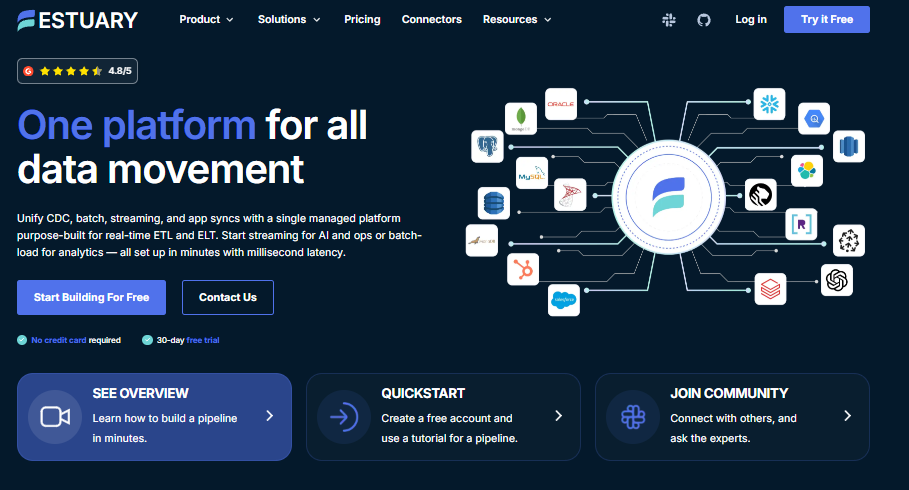
Estuary Flow unifies CDC, batch, and streaming syncs for stores needing near-live order data.
⭐ Why did we choose this tool?
Estuary Flow is the real-time pick. It reads database change logs, so data moves as it changes instead of on a schedule. Pricing is unusually legible: $0.50 per GB moved, plus $100 a month per connector instance, with a free tier at 10GB across two connectors. Most stores do not need live data. Inventory-tight ones do.
🧩 Solutions Offered
Real-time change data capture from Postgres, MySQL, and MongoDB
200+ connectors with streaming and batch pipelines in one flow
Exactly-once delivery with automatic schema evolution
Internal data lake that makes backfills cheap and non-disruptive
UI setup with command-line control for advanced tweaks
📊 Core Evaluation Metrics
Ecommerce connectors: 200+ sources and destinations
Setup to first sync: fast for standard connectors, deeper config for CDC
Pricing model: $0.50 per GB plus $100 / Month per connector instance
Normalization on ingestion: partial, schema handling is automated
Review signal: praised for simple setup, mixed feedback on CDC mode
✅ Best for
Stores where stale inventory or order data causes real losses, especially those tightening ecommerce inventory management
Teams replicating operational databases, not just SaaS apps
Setups that value predictable per-GB billing over per-row metering
🗣️ Reviews
"We frequently utilize Estuary because it operates smoothly without the hassle of complicated setups, and its pricing structure is logical. While the Estuary user interface may not be the most polished, it aims to offer greater flexibility compared to many alternatives." u/Jameswinegar, r/dataengineering Reddit Thread
"I chose not to implement it in CDC mode mainly due to a few reasons: first, the mixed online reviews I encountered; second, it would necessitate downgrading our MySQL databases." u/maxbranor, r/dataengineering Reddit Thread
1.8 Saras Daton [toc=1.8 Saras Daton]
Saras Daton ships prebuilt ecommerce and marketplace models, cutting weeks of schema mapping work.
⭐ Why did we choose this tool?
Saras Daton is the only pipeline here built specifically for ecommerce and marketplace data. It ships prebuilt models for Shopify, Amazon, Google Ads, and Klaviyo, so you skip weeks of schema work. That matters if you sell across marketplaces with inconsistent SKU and fee reporting. Pricing is quote-based, which makes comparison harder than published tiers.
🧩 Solutions Offered
Prebuilt ecommerce and marketplace data models out of the box
Connectors for Shopify, Amazon, Google Ads, Meta, and Klaviyo
Marketplace fee, return, and ad-spend normalization
Warehouse loading into BigQuery, Snowflake, or Redshift
Reporting layer on top of the pipeline
📊 Core Evaluation Metrics
Ecommerce connectors: ecommerce and marketplace focused catalog
Setup to first sync: fast, models are prebuilt for common sources
Pricing model: custom quote, no published tiers
Normalization on ingestion: yes, via prebuilt ecommerce schemas
Review signal: recommended by ecommerce operators over general tools
✅ Best for
Sellers running Shopify plus Amazon or other marketplaces together, who also track Amazon brand analytics
Teams that want ecommerce schemas instead of raw table dumps
Brands with messy fee, refund, and SKU reporting across channels
🗣️ Reviews
"While I'm not sure what industry your company operates in, if you're in the ecommerce sector, I strongly suggest giving Saras Daton a try. Its pricing is both stable and more affordable when compared to the other tools available." u/Temporary_You5983, r/dataengineering Reddit Thread
1.9 Weld [toc=1.9 Weld]
⭐ Why did we choose this tool?
Weld bundles the two bills most stores pay separately. Extraction and SQL transformations sit in one tool, with plans starting on a Basic tier and published pricing running up to $959 a month. A 14-day free trial makes testing low risk. Public review volume is thin, so treat vendor claims as claims until your own trial proves them.
🧩 Solutions Offered
ELT pipelines plus SQL modelling in a single workspace
Connectors across Shopify, ad platforms, CRMs, and databases
Reverse ETL to push warehouse data back into tools
AI assistant for writing and editing SQL models
Flat monthly plans with a 14-day trial
📊 Core Evaluation Metrics
Ecommerce connectors: broad SaaS and database catalog
Setup to first sync: fast, no infrastructure to manage
Pricing model: tiered plans, up to $959 / Month published
Normalization on ingestion: no, handled in your SQL models
Review signal: limited independent review volume to date
✅ Best for
Teams that want pipeline and transformation on one invoice
Small analytics teams comfortable writing SQL models
Seven of these nine tools do the same core job: they move rows and hand you a warehouse. 💸 The spend that follows is the part nobody quotes, because someone still has to model the data and read it.
Luca AI sits above that layer, normalizing store data on ingestion and answering questions in plain English, which is why a founder without an analyst can act the same week rather than next quarter. If you are still mapping the wider setup, our guides to ecommerce data integration and automated ecommerce reporting cover what belongs on either side of the pipeline, and Luca AI pricing shows where the flat-fee model lands against metered tools.
Q2. How Did We Score These ETL Tools? [toc=2. Scoring Methodology]
Each tool was scored out of 100 across five weights: Cross-Functional Intelligence 25%, Ecommerce Connector Depth 20%, Pricing Transparency 20%, Setup and Usability 20%, and Verified User Reviews 15%. Scores of 0 to 20 earn one star, 21 to 40 two, 41 to 60 three, 61 to 80 four, and 81 to 100 five. Luca AI holds five stars; Fivetran loses most of its points on pricing transparency.
📊 The Rubric
Scoring Rubric for ETL Tools
Criterion
Weight
What it measures
Cross-Functional Intelligence
25%
Can the tool reason across commerce, ads, and finance data, or only move rows?
Ecommerce Connector Depth
20%
Shopify, WooCommerce, Amazon, Klaviyo, and Meta coverage that works without patching
Pricing Transparency
20%
Published tiers, predictable metering, and no surprise line items
Setup and Usability
20%
Time to first sync, and whether a non-engineer can run it
Verified User Reviews
15%
G2 and Reddit sentiment from operators, not vendor case studies
⭐ Why Intelligence Carries the Most Weight
Connector counts are the easiest number to inflate and the least useful to a founder. A tool with 600 connectors still leaves you reading tables. Luca AI is trained on the relationships between ecommerce metrics, which is why it scores highest here, and why I weighted reasoning above raw catalog size.
⚠️ The Automatic Deductions
Four things cost points, every time. Row-metered pricing that reprices as you grow. Billable deletes. Per-connector minimums applied to contracts already signed. Multi-year commitments with pricing you cannot forecast.
Fivetran's January 2026 shift to connector-level metering triggered three of those four at once. That is not a claim about product quality. Their connectors are good. The billing model just moves risk onto the buyer.
🗣️ What Operators Said About Pricing Risk
"Ultimately, Fivetran's MAR pricing model can leave you facing a significantly higher monthly invoice than anticipated. If you underestimate the volume of rows being extracted or overlook an issue in one of your connections, even for just a few days, you could find your bill tripling compared to your usual amount." u/bcsamsquanch, r/Fivetran Reddit Thread
"You make a valid point, MAR can be quite erratic, and I would definitely steer clear of Fivetran for handling large, unpredictable data transfers. However, it becomes very appealing if you can accurately project your monthly data volume and have numerous diverse systems to integrate." u/joemerchant2021, r/Fivetran Reddit Thread
❌ What I Deliberately Ignored
Logo walls, funding announcements, and analyst badges got zero weight. None of them predict whether your Monday numbers arrive correct.
I also discounted AI features bolted onto legacy tools. One operations director I spoke with put it plainly about his inventory system: the built-in AI forecasting was rubbish, so after six months they stopped using it and exported to a general model instead. Bolted-on models inherit the old data structure, and that structure is usually the problem, which is why evaluating AI data agents on architecture matters more than on feature lists.
✅ How to Reuse This Rubric
Take the five weights and re-score them for your own store. If you already employ an analyst, drop Cross-Functional Intelligence to 10% and push Connector Depth up. If you are the analyst, do the reverse.
Luca AI scores five stars on this rubric because it reasons across commerce, marketing, and finance in one system instead of reporting metric by metric. That is also its limit. Stores that already run a data team will value connector depth more than reasoning, and should weight the rubric accordingly.
Q3. What Does an ETL Pipeline Actually Do for a Small Ecommerce Store? [toc=3. How Ecommerce ETL Works]
ETL extracts data from Shopify, Amazon Seller Central, Klaviyo, and Google Ads, standardizes it, and loads it into one warehouse. It replaces manual CSV exports with scheduled syncs. Most small stores should use ELT instead: load raw data first, transform later. Reverse ETL is a later problem, pushing warehouse segments back into Klaviyo or Meta.
🔧 One Order, End to End
Say a customer buys two candles on Shopify. The connector pulls the order, the line items, the discount, and the shipping charge into a raw table in BigQuery.
A transformation step then joins that order to the Meta ad click that preceded it and the Klaviyo email before that. Now one row tells you what the sale cost you, not just what it earned.
📐 ETL, ELT, or Reverse ETL
ETL vs ELT vs Reverse ETL for Small Stores
Approach
What moves
When a small store needs it
ETL
Data transformed before loading
Rarely, mostly fixed on-premise systems
ELT
Raw data loaded, transformed in warehouse
Default choice for Shopify and marketplace stores
Reverse ETL
Warehouse data pushed back into tools
Once segments are stable and you want them in Klaviyo
💸 Why Pipe Data At All
Because platform-reported numbers flatter you. Common Thread Collective analyzed 299 DTC brands and $231 million in paid spend in Q1 2026, and found Meta acquisition took 58.71% of spend at an incrementality factor of 1.13x.
That gap between reported and incremental results only shows up when your ad data, order data, and margin data sit in the same place. Ask Luca AI which channel actually paid for itself last month and the answer draws on all three at once, which is the same gap covered in our breakdown of declining platform ROAS versus true profitability.
⏰ The Monday Ritual It Replaces
One merchandising director described his old routine to me, and it stuck. Monday meant standard ecommerce reports built from Shopify exports and returns-system exports, with most of the business tied up in manual reporting.
Another operator was blunter about marketplace data. Everyone assumes you can just get it from Amazon, but it takes two days and three pivot tables to rebuild every month, which is exactly the loop automated ecommerce reporting is meant to close.
💰 Price That Labour Honestly
Two days a month at a €55,000 salary is roughly €5,000 a year in reporting time. That is a recurring line item, not an inconvenience.
Static spreadsheets also go stale the moment they are shared. My read is that this is the real cost of skipping a pipeline, not the software fee you avoided.
⚠️ The Position Most Guides Avoid
Classic ETL rarely fits a store under $10M. Transformation-first pipelines sell engineering hours, and small teams do not have them to spend.
Load raw, model lightly, and only add structure when a specific question demands it. I could be wrong at the top end of mid-market, but below it, this holds consistently.
Luca AI standardizes data as it lands rather than after a modelling project, so the first useful answer arrives in days. Traditional stacks reach the same place, just after a quarter of schema work someone has to pay for, as our guide to ecommerce data integration sets out.
Q4. What Does an Ecommerce Data Pipeline Really Cost at $500K, $2M, and $10M GMV? [toc=4. Real Cost by Stage]
Budget three line items, not one: the connector tool, the warehouse, and human hours. Row-metered tools reprice as you grow, because order, refund, and line-item churn multiplies billable rows. Getting WooCommerce data into BigQuery runs about $5 a month. The same job on Shopify commonly runs $500 or more, because Shopify gives no direct database access.
📊 Modelled Cost by Stage
Assumptions: 3 to 8 sources, a 4% refund rate, and BigQuery on its free tier of 10GB storage and 1TB of queries.
Modelled Data Pipeline Cost by GMV Stage
Stage
Typical monthly cost
Where the money goes
$500K GMV, 3 sources
$0 to $250
Free warehouse tier, app-layer reporting, no pipeline needed
$2M GMV, 5 to 8 sources
$250 to $700
Managed pipeline ($10 to $239), warehouse, 4 to 8 hours of upkeep
$10M GMV, 10+ sources
$700 to $2,500
Metered connectors, modelling time, someone owning the stack
⚠️ The Shopify Data-Access Tax
Shopify hosts your database, so you rent access to your own orders. A Shopify connector on Fivetran starts around $500 a month, while Shopify Plus native BigQuery access requires a $2,000-plus plan.
Over five years that compounds. WooCommerce with a direct pipeline lands near $9,600, Shopify with Fivetran near $35,340, and Shopify Plus with native access near $120,600. Weigh that against what the rest of your ecommerce tech stack already costs.
💸 What Changed in January 2026
Fivetran moved from account-level monthly active row tiers to connector-level pricing. Connectors under one million rows lost the discount they previously inherited from larger ones.
Add the $5 per-connector minimum and billable deletes, and a store with twelve small connectors pays more for less movement. Luca AI charges a flat monthly subscription instead of metering rows, which is why its Q4 invoice looks like its August one, and you can compare the tiers on Luca AI pricing.
🗣️ What Operators Actually Pay
"We've noticed a significant increase in our monthly expenses, more than double, following the pricing adjustments in March 2025 and the recent updates in January 2026." u/onksssss, r/dataengineering Reddit Thread
"We're currently spending approximately $10,000 each month on Fivetran and have hired someone to transition us to a custom-built in-house solution. I believe the return on investment will be favorable in about three months." u/blueadept_11, r/dataengineering Reddit Thread
"Our annual expense for Fivetran amounts to €10,000. While we are actively exploring alternative options, hiring someone to develop a substitute solution would result in a return on investment that could take several years to materialize." u/Odd-String29, r/dataengineering Reddit Thread
✅ Four Questions for Any Pricing Call
How exactly are rows counted, and are deletes billable?
Is there a per-connector minimum, and does it apply to existing contracts?
What did a store my size pay last December, not last April?
What happens to the bill if a connector misconfigures for three days?
⏰ Build Versus Buy, Honestly
Custom pipelines look cheap until you price the build. One founder I follow described spending roughly $10 million building a system to turn data into meaning, then watching general reasoning models close much of that gap.
That is the extreme case. The everyday version is an engineer spending two weeks on connectors instead of on your checkout, while the cash flow forecast that build was meant to serve stays unbuilt.
Luca AI prices as one intelligence layer rather than per row moved, which removes the seasonal spike that turns a $200 pipeline bill into a $2,000 one in Q4. Stores with predictable volume and an in-house engineer will still do fine on metered tools, and our view on tracking ecommerce unit economics explains which numbers justify either choice.
Q5. Where Do Off-the-Shelf Connectors Break on Ecommerce Data? [toc=5. Where Connectors Break]
Connectors move rows; they rarely reconcile meaning. SKU naming, size breaks, composition fields, retail calendars (4-5-4 versus 5-5-4 week patterns), invoice versus demand sales, and refund timing differ by brand and by channel. That mismatch, not the sync itself, is where pipeline projects stall. It is also where clean-looking dashboards start reporting numbers that are quietly wrong.
✅ The Setup That Looks Fine
Picture a womenswear brand doing $2M on Shopify, also selling on Amazon. The connectors install in an afternoon. Every sync shows green.
Two weeks later, the finance lead asks a simple question. Why does Amazon revenue in the warehouse not match the settlement report? Nothing failed. The definitions never agreed in the first place.
⚠️ The Four Mismatches You Will Hit in Week One
SKU structure: the same product carries different codes across Shopify, the 3PL, and the marketplace listing
Size and composition fields: brands describe size breaks and materials in their own formats, with no shared standard
Retail calendar: some partners report on 4-5-4 weeks, others on 5-5-4, so week-over-week comparisons drift
Refund timing: a refund lands in one system on the order date and in another on the settlement date
Luca AI standardizes these fields at ingestion across Shopify, ad platforms, accounting, and 3PL feeds, which is why the reconciliation step never becomes a project. Our guide to ecommerce product data management covers the same mapping decisions in more depth.
🗣️ What Operators Running Multi-Brand Data Say
A retail data lead I spoke with described it as the core tax of the job. Every brand they work with reports differently, right down to stock item composition and inconsistent size breaks.
He raised the calendar problem too. Retail weeks, 4-5-4 or 5-5-4, are non-standard across brands, so even basic weekly reporting needs a mapping decision before anything loads.
💰 The Contested Ground: Prebuilt Versus Custom
Two honest camps exist here, and the answer depends on how weird your catalog is.
Prebuilt normalization wins when your SKU structure is conventional. You skip the cleanup year and start asking questions. Custom pipelines win when composition, kitting, or bundle logic breaks standard schemas, because no off-the-shelf connector understands your product hierarchy.
One founder I know spent heavily learning that lesson. He is not an IT specialist, so he hired people to build strong integrations, and now runs three or four ERP systems linked together. Those integrations cost real time and real money, which is the hidden line item in most ecommerce platform integration plans.
❌ What This Costs When You Skip It
A mapping layer is not free. Budget it honestly: one to three weeks of engineering, then ongoing upkeep whenever a channel changes its format.
Skipping it costs more, just later. You get dashboards that look authoritative and margin numbers nobody trusts, which is worse than no dashboard at all.
⏰ The Week-One Decision List
Write down four answers before you pick a tool. Which system owns the master SKU. Which calendar your reporting follows. Whether refunds attribute to order date or settlement date. Whether bundles report as one line or many.
Get those four wrong and every downstream number inherits the error. My read is that this single page of decisions predicts pipeline success better than any connector count, and it decides whether your ecommerce profit margins are reported accurately.
Luca AI resolves this mapping at ingestion rather than leaving it as a quarter of engineering work, which is how operators reach a usable answer without a data-cleanup year. Stores with genuinely unusual catalog logic will still want a custom layer, and I would tell them so.
Q6. Which ETL Setup Fits Your Stage and Team? [toc=6. Choosing by Stage]
You need a warehouse when three conditions hold: more than four data sources, questions your platform reports cannot answer, and someone burning over a day a month rebuilding the same report. Below that, app-layer analytics around $129 a month beats a warehouse stack. Between $1M and $10M with a lean team, run a managed no-code pipeline into BigQuery.
📊 The Stage Matrix
Recommended ETL Setup by Store Stage
Stage
Sources
Recommended setup
Monthly budget
Skip if
Under $1M GMV
2 to 3
App-layer analytics, no pipeline
$0 to $150
You have fewer than three channels
$1M to $10M GMV
4 to 8
Managed pipeline into BigQuery, plus an intelligence layer
$250 to $700
Nobody will own the stack
$10M+ or unusual SKUs
8+
Managed pipeline plus a mapping layer
$700 to $2,500
Your catalog is conventional
Luca AI sits in the middle row, built for operators past the four-source mark but short of a data team.
❌ Why Most Sub-$1M Stores Should Buy Nothing
I will say the thing no vendor list says. If you run Shopify, Meta, and Klaviyo only, a pipeline solves a problem you do not have yet.
App-layer tools already cover that shape. The Shopify-native analytics category serves roughly 11,000 active stores and $40B in attributed GMV as of mid-2026, mostly without a warehouse in sight. Spend the $300 on inventory instead, and start with the best Shopify analytics apps.
✅ The $1M to $10M Sweet Spot
This is where data starts piling up faster than anyone can read it. Five to eight sources, real ad spend, and a founder still building the weekly report by hand.
Managed pipelines fit here because nobody has DevOps time. Ask Luca AI for a weekly CAC report with graphs and reasoning, and the interpretation step stops depending on someone's Sunday night, which is the shift our AI data analyst for ecommerce guide walks through.
🗣️ How Operators Actually Chose
"We decided to try out several tools and ultimately chose Skyvia. It offers a more affordable option compared to Fivetran and is simpler to implement without excessive complexity. While it may not address every single use case, it's effective for achieving quick results as you work on the larger strategy." u/Vibe-Sphere, r/dataengineering Reddit Thread
"I've had to be quite mindful of both budget and time in my current situation. This leads us to prioritize Fivetran as our first choice. However, if a specific data source proves to be too pricey, we then consider Stitch as an alternative." u/Humble_Ostrich_4610, r/dataengineering Reddit Thread
⚠️ Cost Pressure Is Shaping These Choices
Sellers are not shopping for elegance right now. Jungle Scout's 2026 seller research found 47% naming rising fees as their top challenge, while 80% already use AI tools in some form.
That combination explains the pattern I see. Operators want the interpretation layer, and they want it without a metered surprise attached.
⏰ Migrating Later Without Rework
Pick a warehouse first, then the pipeline. BigQuery or Snowflake both survive a tool swap, so your models stay portable.
Also keep raw tables. One ex-AWS operator described enterprise data lakes as logs and logs of data you cannot make a decision from, and he was right about the failure mode. Raw storage is cheap insurance; raw storage as your only plan is not, which is why ecommerce business intelligence has to sit above the storage layer.
Luca AI serves the stage between spreadsheets and a data hire, where an analyst is premature and manual reporting has already broken. Stores that already employ analysts will get more from connector depth, and should weight their shortlist that way. What stage are you actually at right now?
Q7. How Do You Turn a Working Pipeline Into Decisions Without a Data Team? [toc=7. From Data to Decisions]
A pipeline gives you rows and a dashboard gives you charts; neither tells you what to do. The missing layer is reasoning: anomaly alerts, root-cause analysis, simulation against historical data, and cohort work delivered to Slack or email without opening a tool. Build one clean line graph, then spend the rest of your effort on interpretation.
❌ The Dashboard Is Not the Finish Line
Most stores treat the dashboard as the deliverable. Then it gets opened on Monday, scanned for red numbers, and closed.
An analytics engineer I follow put the design advice bluntly. Stop building weird visuals nobody understands, start with a basic line graph, add gridlines, numbers, a summary, and a date selector. Our ecommerce analytics dashboard breakdown applies the same restraint.
✅ What the Reasoning Layer Actually Does
Four jobs sit above the pipeline, and none of them are charting.
Anomaly detection: flag the metric that moved outside its normal range
Root-cause analysis: name the components driving the move, not just the move
Simulation: model what happens if you change price, spend, or reorder timing
Cohort work: watch repeat behaviour by acquisition month without building a cohort dashboard
Luca AI runs these against connected store data and pushes findings on a schedule, so nobody has to remember to check. For the wider category view, see our guide to agentic analytics tools.
⏰ Three Alerts to Set This Week
Do this in under an hour, whatever tool you use.
ROAS drop: alert when blended return on ad spend falls below your break-even for two consecutive days
Stock cover floor: alert when any A-class SKU drops under your lead time in days
CAC spike: alert when customer acquisition cost rises more than 20% week over week
Ask Luca AI to deliver these to Slack with the reasoning attached, or configure the same thresholds in whatever ecommerce monitoring tools your stack already has.
⚠️ Do Not Let the AI Be the Quality Check
Automation earns trust by being checked, not by being trusted. A premium bike brand once published a homepage image with the rear derailleur mounted on the front wheel, on a bike retailing near $20,000.
That is what happens when the review step disappears. Keep a human between the model and anything customer-facing, permanently.
💸 Keep Customer Data Out of Free Tiers
One operations director I spoke with banned his marketing team from free AI tools outright. His reasoning was simple: analyzing sales figures or customer activity in a free tier means uploading customer data you do not want uploaded.
Read the data-processing terms before anyone pastes an export. This is a five-minute check that prevents a very long conversation later.
🗣️ What Reviewers Say About Bolted-On AI
"The easines with which we can set data extractions from different platforms. That users can be onboarded easily. Good customer suppor when tickets are created. Too much push for AI. Inconsistent data delivery based on the settings selected. Lack of reporting / status information for data extractions." Verified User, Improvado G2 Verified Review
"They're very slow to update their existing connectors (beyond just making sure that they work). For example, their Meta connector is still called 'Facebook' despite that company being renamed in 2021. As a result, they're missing lots of features and updates within their connectors." Verified User, Supermetrics G2 Verified Review
💰 The Structural Lesson
Automation that ignores the workflow around it fails, however fast the engine runs. A UK pharmacy once trialled a 350,000 pound dispensing robot that picked eight items a minute but could not be reloaded without shutting down.
Speed in the wrong place is just expensive. My read is that most data stacks fail the same way, at the interpretation step rather than the sync, which is the argument behind agentic AI for ecommerce founders.
Luca AI scans connected store data continuously and pings you in Slack or email when ROAS dips, stock falls below threshold, or CAC spikes, then sends weekly reports with reasoning and recommendations. It is not an attribution pixel, and stores that need one should still buy one.
What would you actually change on Monday if the alert arrived before you asked for it?
FAQ's
What is ETL, and does a small ecommerce business actually need it?
ETL stands for extract, transform, load. It pulls data out of Shopify, Amazon Seller Central, Klaviyo, and Google Ads, standardizes it, and loads it into one warehouse, replacing manual CSV exports with scheduled syncs.
Most small stores do not need it on day one. We look for three conditions before recommending a pipeline at all:
More than four connected data sources feeding your reporting
Questions your platform reports genuinely cannot answer
Someone burning more than a day a month rebuilding the same report
Below that threshold, an app-layer analytics tool around $129 a month does the job, and the $300 you saved belongs in inventory instead. Above it, the manual reporting cost quietly becomes a salary line. Two days a month at a €55,000 salary is roughly €5,000 a year spent producing numbers rather than acting on them.
Luca AI sits above the pipeline layer, normalizing store data on ingestion so operators skip the cleanup year. If you want the fuller mechanics before you buy anything, our guide to ecommerce data integration walks through what each layer is genuinely responsible for.
Which ETL tools are cheapest for a small ecommerce store in 2026?
Cheapest depends on whether you count engineering hours as free. On published pricing alone, the entry points look like this:
Airbyte: open-source Core is free to license, Cloud Standard starts around $10 a month
Skyvia: free plan, then record-based tiers rising toward $499 a month
Stitch: from roughly $100 a month, up to $1,500 at 100 million rows
Hevo Data: free tier, then $239 a month on Starter
Fivetran: free at 500,000 monthly active rows, Starter from $120 a month
The catch sits in the maintenance column. Self-hosted Airbyte carries published setup estimates of 40 to 80 hours plus 20 to 40 hours of upkeep monthly, so free software becomes an engineering invoice.
Row-metered and record-metered tools also reprice as you grow, because refunds, order edits, and line items multiply billable rows. Luca AI charges a flat monthly subscription rather than metering rows, which is why its December invoice matches its August one. If forecastability is what you are optimizing for, compare the tiers on the Luca AI pricing page against the metered alternatives before committing annually.
Why does getting Shopify data into a warehouse cost so much more than WooCommerce?
Because Shopify hosts your database and you rent access to your own orders. WooCommerce runs on your server, so a direct pipeline into BigQuery can cost around $5 a month. The same job on Shopify commonly lands at $500 or more, since every row has to travel through an API and a paid connector.
Over five years the gap compounds badly:
WooCommerce with a direct pipeline: roughly $9,600
Shopify with a managed connector: roughly $35,340
Shopify Plus with native BigQuery access: roughly $120,600, and that native route requires a plan above $2,000 a month
This is the line item no vendor comparison prices for you, and it changes the build-versus-buy answer entirely. It also means the platform decision you made years ago still governs your data budget today.
We are not suggesting anyone replatform over a warehouse bill. The practical move is to stop paying twice: once to move rows, then again for someone to interpret them. Luca AI connects the sources and returns reasoned answers directly, and our breakdown of the ecommerce tech stack shows where that removes duplicate spend.
How much does Fivetran really cost for a Shopify store, and what changed in 2026?
Fivetran starts free at 500,000 monthly active rows, with Starter from $120 a month, but Shopify stores frequently land far higher because order edits and refunds count as active rows.
January 2026 brought three changes worth understanding before you sign:
A $5 minimum per connector, applied to existing contracts as well as new ones
Deletes became billable events
Metering moved from account-level tiers to connection-level tiers, so small connectors lost the discount they used to inherit from larger ones
A store with twelve modest connectors can therefore pay more while moving less data. Operators on r/dataengineering have reported monthly costs more than doubling after the adjustment.
None of this is a verdict on connector quality, which is genuinely strong. It is a warning about who carries the volume risk. Ask any vendor four questions: how rows are counted, whether deletes bill, whether per-connector minimums apply retroactively, and what a store your size paid last December rather than last April. Luca AI prices as one intelligence layer instead of per row moved, and our view on tracking ecommerce unit economics explains which numbers justify either model.
What breaks after the pipeline is running, and how do we fix it?
Connectors move rows; they rarely reconcile meaning. Syncs show green while the numbers quietly disagree, which is where most pipeline projects stall.
Four mismatches surface in week one:
SKU structure: the same product carries different codes in Shopify, the 3PL, and the marketplace listing
Retail calendar: partners report on 4-5-4 or 5-5-4 week patterns, so weekly comparisons drift
Refund timing: one system books a refund on order date, another on settlement date
Bundles and composition: kits report as one line in one place and many in another
Decide four things before choosing a tool: which system owns the master SKU, which calendar reporting follows, when refunds attribute, and how bundles resolve. Get those wrong and every downstream number inherits the error.
After that comes the layer nobody budgets for: interpretation. A dashboard is prettier logs unless something flags the anomaly, names the cause, and suggests the move. Luca AI standardizes these fields at ingestion and pushes alerts with reasoning attached to Slack or email, and our guide to automated ecommerce reporting covers the three alerts worth configuring first.
Enjoyed the read? Join our team for a quick 15-minute chat — no pitch, just a real conversation on how we’re rethinking Ecommerce with AI - Luca
Loading Schedule...
Your AI Co-Founder is here.
Here’s why:
Shopify, Meta, Xero - one brain.
"Should I scale?" Answered with real data.
Growth capital. No applications. One click.
Thank you! Your submission has been received! Please book a time slot for the Meeting
Oops! Something went wrong while submitting the form.