Dynamic Pricing in E-commerce: Elasticity, Markdowns and Competitor Prices
13
mins read
TL;DR
Dynamic pricing changes prices on market signals like demand, stock, and competitors; personalized pricing based on shopper data is a different and riskier practice.
Start with your own elasticity: in our example, a 10% price rise cut units 8% but raised weekly contribution margin from $1,600 to $1,840.
Set a price floor per SKU from full unit cost and a minimum contribution margin before any automation, plus ceilings for trust and MAP.
Mark down early and shallow when weeks of cover exceed weeks left in the season; late, deep cuts usually earn less total margin.
Treat competitor prices as listed offers: alert on gaps above about 5%, wait 48 to 72 hours, compare the whole offer, and check your own sales.
Market-based dynamic pricing is generally legal, but undisclosed personal-data pricing and fake reference prices draw FTC and state scrutiny.
It is Monday morning, and a founder selling premium kitchenware on Shopify and Amazon has a spreadsheet open. Column D holds competitor prices that an intern typed in three weeks ago. Column F holds her own prices, which have not moved since spring. A rival just dropped its 8-inch chef's knife by $12, and she is wondering whether to follow.
That spreadsheet is where most dynamic pricing starts, and where most of it goes wrong. The useful version does not begin with the competitor column. It begins with your own demand data: how many units you sell at each price, how much stock you hold, and what each order really earns after every cost. This guide sits inside our wider work on predictive analytics for e-commerce, and it walks through elasticity, markdowns, competitor prices, and the legal lines, in the order you would use them.
What is dynamic pricing in e-commerce, and what does it change for a store your size?
Dynamic pricing in e-commerce means changing a product's price in response to market signals such as demand, stock levels, time, and competitor prices, using rules or models. It is different from personalized pricing, which sets a price for one shopper from their personal data. For a small or mid-size store, the useful version is narrow: a few rules on a few SKUs (stock keeping units), bounded by margin floors.
What the term covers, and what it does not
💡 Market signals, not shopper profiles
BigCommerce draws the line clearly: dynamic pricing reacts to the market, while personalized pricing reacts to the individual. That difference matters later, when we get to the legal section. A price that rises because stock is low is a market move. A price that rises because a shopper's browsing history says they will pay more is a profile move.
For a store your size, dynamic pricing is not Amazon changing millions of prices a day. It is a weekly decision on a short list of products. Luca AI's view is that most stores doing $1M to $5M a year need a pricing cadence before they need a pricing algorithm.
📦 The three signals that drive every decision
Every sensible price change in this guide traces back to three signals:
The three signals behind every price change
Signal
What it tells you
Where it lives
Price elasticity
How much unit sales move when price moves
Your Shopify and Amazon order history
Inventory position
Whether stock will run out early or sit too long
Your inventory system or 3PL feed
Competitor prices
What a shopper sees when they compare
Scraped listings or manual checks
The order matters. Elasticity and inventory are your own data, and they describe your customers. Competitor prices describe someone else's business.
Why most stores get the order backwards
⚠️ Price followers lose the margin first
I see the same pattern again and again. A store tracks competitors closely, knows its own elasticity not at all, and treats every rival price cut as an instruction. Ryan Daniel Moran put the alternative plainly in 12 Months to $1 Million: "When you start with people and create products for them, you become a price setter, not a price follower".
That does not mean prices should never move. It means the reason for a move should come from your data first. A competitor's price is one input, not the decision.
✅ What changes on Monday
In practice, dynamic pricing changes three habits:
You set a floor and a ceiling for every SKU you might reprice.
You check stock cover before planning any discount.
You review competitor gaps on a schedule, not on impulse.
Luca AI connects Shopify, Amazon, ad platforms, and accounting data, and it normalizes them on ingestion, so price, units, and margin sit in one place before any rule gets written. That is the groundwork. Without it, every pricing rule is built on numbers that disagree with each other.
What is predictive pricing, and how is it different from rule-based repricing?
Rule-based repricing reacts: if a competitor drops below you, move to a set gap. Predictive pricing anticipates: it forecasts demand at different prices and stock levels, then picks the price expected to earn the most contribution margin. Rules are fine for commodity SKUs. Branded products need the forecast, because a competitor's price says little about what your own customers will pay.
How the two approaches work
⚙️ Rule-based repricing: if this, then that
A repricing rule is a short instruction. "Stay $1 below the lowest competitor, but never below $40." Shopify has no native auto-repricing engine, so Shopify stores usually add these rules through third-party apps. On Amazon, repricers are common because sellers share one listing and fight over the Buy Box (the default "Add to Cart" slot).
Rules are fast and easy to audit. Their weakness is that they only know how to follow. Cyndi Thomason, citing Amazon consultant Robyn Johnson, warns sellers to "watch your gross margins to ensure that your repricing software and other costs of sales have not eroded your profit margin".
🔮 Predictive pricing: forecast first, then price
Predictive pricing starts from demand. It asks how many units you will sell at $80, $85, and $90, given the season and current stock. It then picks the price with the best expected contribution margin. ASOS built its markdown system this way, with a price elasticity model at the core that forecasts outcomes across possible prices.
Rule-based, predictive, manual, and Luca AI pricing compared
Factor
Rule-based repricer
Predictive pricing
Spreadsheet by hand
Luca AI
Main input
Competitor price
Own demand, stock, elasticity
Whatever someone updated last
Own sales, stock, ads, and margin data
Best for
Commodity and marketplace SKUs
Branded and seasonal SKUs
Very small catalogs
Stores wanting the analysis without a data hire
Changes prices itself
Yes
Depends on tool
No
No, you decide and act
Main risk
Margin erosion
Bad data in, bad price out
Stale data
Needs enough order history
⚠️ The data problem nobody budgets for
Both methods break when the numbers underneath are wrong. Reviews of analytics tools show how often that happens:
"Sometimes it does not update the numbers correctly and has errors with synchronisation." G2 reviewer, 3 stars, April 2023, Triple Whale - G2 Verified Review
"I've also reported an issue with inventory levels, as our inventory is multiplied with 6, since we have 6 different shopify stores connected to the same warehouse." Maja, November 2025, Polar Analytics - Trustpilot Verified Review
An inventory count that is six times too high would tell a predictive model to mark down stock you do not have. Luca AI reads sales history alongside inventory and ad spend, so a pricing question is answered with demand context rather than a competitor feed alone. Luca AI does the analysis; the operator still sets the price.
How do you estimate price elasticity from your own order data?
A price rise that loses a few units can still grow contribution margin, so judge it in margin.
Price elasticity is the percent change in units sold divided by the percent change in price. Take a past price change on one SKU, compare weekly units before and after over equal windows, and remove promotions, stockouts, and seasonality. An elasticity smaller than 1 (ignoring the minus sign) means a price rise likely grows revenue. Larger than 1 means revenue shrinks, so check contribution margin, not revenue.
The calculation, step by step
🧮 The formula in plain words
Elasticity answers one question: when my price moved, how hard did demand push back? The formula is:
Elasticity = % change in units ÷ % change in price
The result is almost always negative, because higher prices usually sell fewer units. Most operators drop the minus sign and talk about the size. An elasticity of 0.5 is "inelastic," meaning customers barely react. An elasticity of 2.0 is "elastic," meaning they react a lot.
📝 A worked example
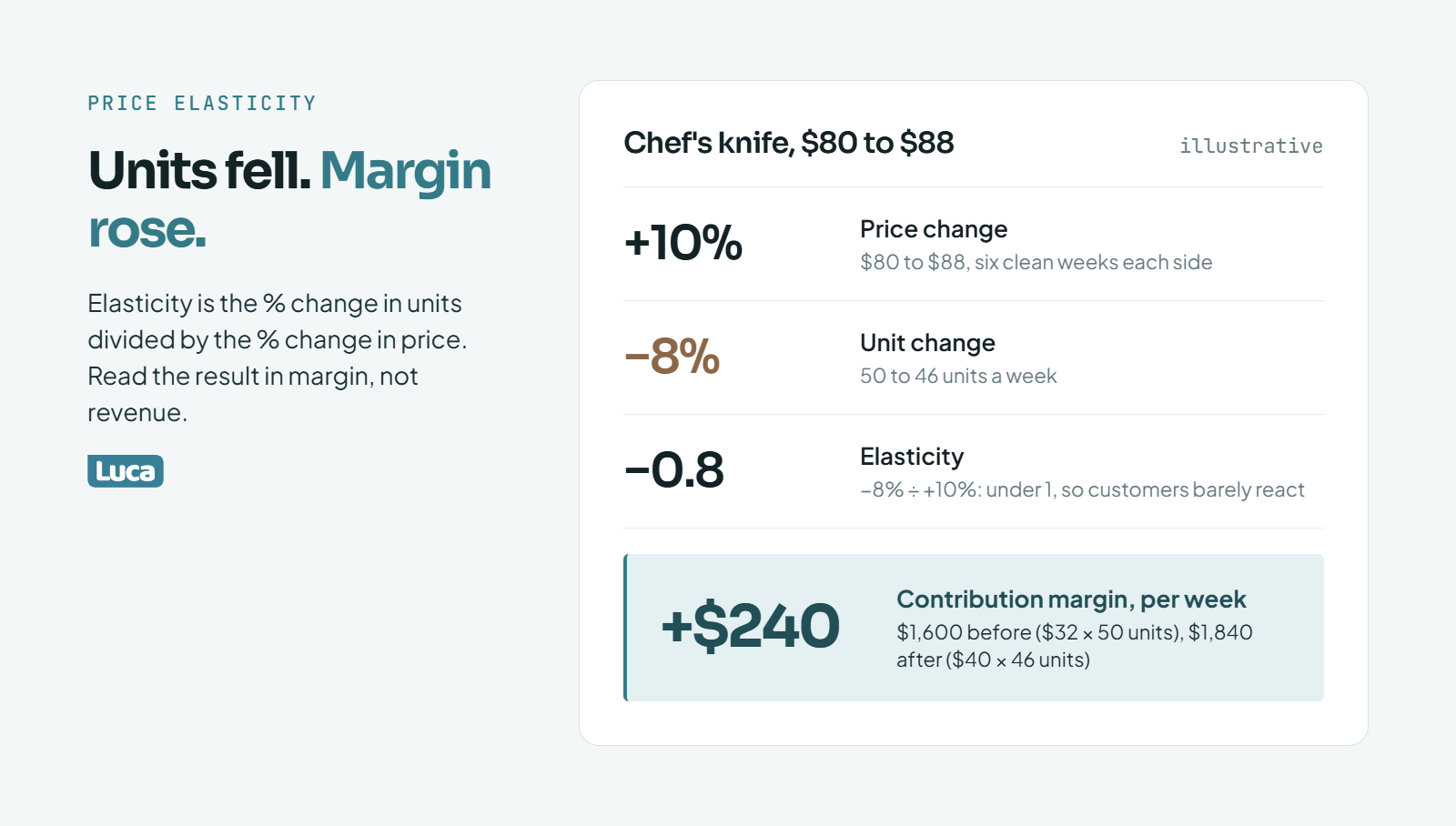
Here is an illustrative example, not client data. A chef's knife sold for $80 and moved 50 units a week for six clean weeks. The price went to $88, and it moved 46 units a week for the next six clean weeks.
Price change: $80 to $88 is +10%.
Unit change: 50 to 46 is -8%.
Elasticity: -8% ÷ +10% = -0.8.
Revenue: $4,000 a week before, $4,048 after.
Contribution margin, with $48 of variable cost per unit: $1,600 a week before ($32 × 50), $1,840 after ($40 × 46).
Units fell, and margin rose by $240 a week. That is the point most stores miss.
The traps that ruin the number
⚠️ Promotions, stockouts, and seasons
Three things corrupt an elasticity estimate:
Promotions. A discount week inside your window inflates units. Drop it.
Stockouts. If the SKU sold out for four days, demand looks lower than it was. Drop those days.
Seasonality. Comparing November with October tells you about the holidays, not about price. Use the same weeks a year earlier as a check.
Run the estimate on your top 20 SKUs first. They carry most of your margin, and they have enough orders for the number to mean something.
💰 Read it in margin, not revenue
Supply Chain Lara's story of an operator called Maya shows why. Maya raised a knife set from $49.99 to $59.99. "She lost some volume but the customers who stayed were more committed and returned less," and the SKU went from losing money to a 23% contribution margin. Revenue alone would have hidden that.
My read is that most branded DTC products sit below 1.0 on their hero SKUs. I could be wrong for your category, which is exactly why you should measure it.
Luca AI can answer "what happened to weekly units on this SKU after the last price change, excluding promotion weeks and stockout days" in plain English. That turns a half-day spreadsheet job into a question, and it keeps the comparison windows honest.
Which dynamic pricing strategies fit a DTC store, and which fit a marketplace seller?
On Amazon, you share a listing and compete for the Buy Box, so competitor-based repricing within a floor is often necessary. On your own Shopify store, you own the listing, so demand and inventory signals matter more than rivals. Channel fees change the math too. One seller reports Amazon taking 10 to 15 percent, eBay 6 to 7 percent, and his own site about 3 percent.
The strategy menu
📋 Four strategies, four signals
Four dynamic pricing strategies by channel
Strategy
Signal it follows
Fits best on
Main risk
Competitor-based
Rival prices
Amazon, eBay, Google Shopping
Price wars
Demand-based
Conversion rate and weekly units
Own Shopify store
Noisy data on small SKUs
Inventory-based
Weeks of stock cover
Both
Training customers to wait
Time-based
Season, day, or event
Both
Looking arbitrary to loyal buyers
Most stores need two of these, not four. A DTC store usually runs demand-based and inventory-based pricing. A marketplace seller adds competitor-based rules on top.
Why the channel changes the rules
🛒 Amazon: the Buy Box punishes a higher price elsewhere
On Amazon, many sellers can sit on the same listing, and price heavily influences who wins the Buy Box. There is a second trap too. Ecom Engine describes how Amazon may suppress your Buy Box if it finds the item cheaper somewhere else: "all of a sudden your conversion rate goes way down because nobody has the buybox on that skew".
So a discount on your own site can hurt your Amazon sales. Price changes need to be planned across channels, not one at a time.
🏠 Own store: conversion is your demand signal
On Shopify, you own the page. If conversion rises and daily orders climb, that is a demand signal you can price against. Operators in the Shopify Community lean the same way and warn against reflexive matching:
"Set a floor from landed cost plus the minimum margin you will accept," AppAvio, August 2026, Shopify Community Thread
💸 Fees decide where a price cut hurts most
Leon Surrman, a seller interviewed by Luca, describes the gap: "Amazon takes like 10 to 15% selling fee. eBay takes way less... 6 7%... when I have an own marketplace and own website I just have the transaction fees which are the 3% round about 3%". On an $88 knife, that is about $13.20 to Amazon at 15%, against about $2.64 on your own site at 3%. A $5 cut costs the same everywhere, but it eats a bigger share of what is left on Amazon.
Luca AI reports contribution margin by channel after fees, so the founder can see whether a price change helps on Shopify and hurts on Amazon before making it. The pricing logic stays separate per channel, and the decision stays with the person running the store.
How do you set price floors and ceilings before you automate anything?
Set a floor from the full cost of an order before any repricer or rule touches the price.
A price floor is the lowest price that still leaves your minimum contribution margin after landed cost, fulfillment, shipping, payment fees, returns, and acquisition cost. A ceiling caps how far a rule can raise a price before it hurts trust or breaks a MAP (minimum advertised price) agreement. Set both per SKU before any automation, because a repricer without a floor only knows how to go down.
Start with the real cost of one order
🔪 The knife set that looked like a hero
Supply Chain Lara tells the story of Maya, who believed her ceramic knife set was her best product. It cost $14 to make and sold for $49.99, a 72% gross margin. Then Maya added up every cost that one order really carried:
Maya's full cost per knife set
Cost line
Per unit
Landed cost (product, freight, duties)
$17.75
Warehousing
$0.65
Pick and pack
$4.10
Outbound shipping
$8.40
Payment processing
$1.75
Returns
$6.20
Customer service
$1.45
Customer acquisition cost (CAC)
$31.00
Total
$71.30
At $49.99, she lost $21.31 on every sale. Her "hero" was a money pit.
✅ How Maya fixed it
Maya raised the price to $59.99. She added product videos, which cut returns from 18% to 9%, and changed the packaging to save $0.80 per order. Six months later, the SKU earned a 23% contribution margin. Contribution margin means what is left from each order after every variable cost, including acquisition.
Turning the teardown into a floor
🧮 The floor formula
Once you know the full variable cost per unit, the floor is simple:
Floor price = variable cost per unit ÷ (1 − minimum contribution margin)
Take the chef's knife from the elasticity example, with $48 of variable cost per unit. If your minimum contribution margin is 25%, the floor is $48 ÷ 0.75 = $64. Any rule, app, or tired human that tries to price below $64 should be blocked.
Cyndi Thomason's Profit First for Ecommerce Sellers makes the same demand from the accounting side: reconcile average selling prices against your books, not against a repricer's dashboard.
⚠️ Ceilings and fairness limits
Floors protect margin. Ceilings protect trust. Three ceiling rules work for most stores:
Never raise a price more than a set step (for example, 15%) inside 30 days.
Never price above a MAP agreement you have signed with a brand.
Never surge prices on essentials during a shortage or emergency. Many US states have price gouging laws for exactly this.
Where the floor lives day to day
📍 Floors drift when costs change
A floor set in January is wrong by June if freight or CAC moved. That is the quiet way margins erode. Luca AI watches realized selling price and contribution margin per SKU, and it can alert the founder when a SKU's price falls near its floor. The alert arrives in Slack or email, instead of showing up as a surprise in the month-end P&L.
How does markdown optimization decide when and how deep to discount?
Markdown optimization picks the timing and depth of discounts that clear stock by a deadline at the highest total margin. Compare weeks of cover with weeks left in the season. If cover is longer, the gap tells you how much extra demand you need, and elasticity tells you roughly what discount buys it. Early, shallow markdowns usually beat late, deep ones.
If weeks of cover is shorter than weeks left, do nothing. You might even raise the price. If it is longer, you have a markdown decision to make.
🔮 Elasticity sets the depth
The gap between the two numbers tells you how much faster you must sell. Elasticity tells you roughly how much price cut buys that speed. ASOS built its markdown engine on exactly this pairing, an elasticity model that forecasts sales at each possible discount.
A worked markdown decision
📝 Cast-iron set, ten weeks left
Here is an illustrative example. A store holds 600 cast-iron sets at $100, with $55 of variable cost each. It sells 40 a week, and the season ends in 10 weeks. Weeks of cover is 600 ÷ 40 = 15. It needs to sell 60 a week, which is 50% faster. Assume this seasonal SKU has an elasticity of 2.0.
Mark down now versus wait and cut deep (illustrative)
Plan
What happens
Units
Margin per unit
Total margin
Mark down now
25% off ($75) lifts sales 50% to 60 a week
600
$20
$12,000
Wait 4 weeks
160 sold at $100
160
$45
$7,200
Then cut deep
440 left, 6 weeks, needs about 73 a week, about 42% off ($58)
440
$3
$1,320
Waiting earns $8,520. Marking down early earns $12,000. The early, shallow cut wins by $3,480. This uses elasticity in a straight line, which is rough for big cuts, so read it as direction, not a forecast.
⚠️ The hidden cost of deep discounts
Deep, frequent markdowns teach customers to wait. Ryan Daniel Moran makes the opposite point that is just as useful: price is a speed valve. "You may need to increase your price until sales move at a manageable level," he writes, when stock is selling faster than you can restock. Markdown optimization works in both directions.
Where it fits in the week
⏰ Markdowns belong to the ops plan
I would put markdowns on the inventory calendar, not the marketing calendar. The trigger should be cover against time, not "we need a sale this month." Luca AI can flag SKUs whose weeks of cover run longer than the weeks left in their season. The founder then sees the problem with six or ten weeks of runway, when a shallow cut still works.
How do you know whether a promotion created real lift or just pulled sales forward?
A promotion can sell more units and still lose money once pull-forward and the discount are counted.
Real promotional lift is the extra units you sold beyond the baseline you would have sold anyway, minus the sales the promotion pulled forward from the weeks after. Compare the promo window with a clean baseline, then check the two to four weeks after. If units dip below baseline afterwards, part of the lift was borrowed, and the discount paid for sales you already had.
The story that teaches it best
🧘 A yoga mat, a price cut, and an empty shelf
Ryan Daniel Moran describes chasing a higher Amazon ranking with a price cut. "So we slashed the price, handing out a better bargain to the customer... When we cut our price, we sold really well... but we ran out of stock". A four-week restock lag followed. When stock returned, the listing had lost its momentum. "We had to run another discount to get moving again".
The sales spike looked like a win. The full cycle was a loss: lower margin, a stockout, and a second discount to recover.
How to measure lift properly
📏 Three windows, not one
Measure every promotion across three windows:
Baseline. Average weekly units over the four clean weeks before, with no other promo or stockout.
Promo window. Units during the promotion.
After window. Units in the two to four weeks after.
True lift = (promo units − baseline) − (baseline − after units, for each dip week).
📝 A worked example
Here is an illustrative example. A $50 product with $30 of variable cost sells 200 units a week. A 20% off week sells 380 units. The next two weeks sell 150 each.
Gross lift in promo week: 380 − 200 = 180 units.
Pull-forward: (200 − 150) × 2 = 100 units.
True lift: 80 units over three weeks.
Now the margin. Without the promo, three weeks earn 600 × $20 = $12,000. With it, the promo week earns 380 × $10 = $3,800, and the next two weeks earn 300 × $20 = $6,000. That is $9,800. The promotion sold 80 more units and lost $2,200 in margin.
💰 Model the bounds before you run it
Kunle Campbell's advice in E-commerce Growth Strategy is the right habit. No pricing decision should go ahead without finance and marketing "modelling with an upper and lower bound so that finance can see the likely best- and worst-case scenarios". If the worst case loses money and the best case barely breaks even, skip the promotion.
Counting lift in dollars
✅ Margin dollars, never orders
Order count is the vanity number of promotions. Margin dollars across all three windows is the real one. Luca AI compares promo-period contribution margin with the pre-promo baseline and the weeks after in one answer. So the founder can ask, "Did last month's 20% off actually make money?" and get the three-window view, not just the spike.
How do you monitor competitor prices without starting a price war?
Track a short list of truly comparable offers, alert on gaps above about 5%, wait 48 to 72 hours to see if the move sticks, and compare the full checkout cost, not the sticker. Treat scraped prices as listed offers, not what customers paid. Luca AI then checks whether your own conversion and units actually moved, so you match only when the offer is identical, sales dropped, and your floor still holds.
Why scraped prices mislead
🍷 Listed prices are not transaction prices
Thomas Hear runs UWine, an online wine retailer. His team employs one to one and a half full-time data analysts to work through scraped competitor prices, and still struggles. "The problem is when a pricing is shown on internet it doesn't mean it is transactional," he says. A listed price can be a stale page, an out-of-stock item, or a promotion nobody uses.
He also names the deeper frustration: "I know for sure they are always someone selling at a less expensive wine so I'm doing the promotion for having this wine sold by a competitor".
❌ The fake discount trick
Some "discounts" are not real. In one recorded operator interview, a store owner described a competitor who "had inflated their prices by 30% so they could reduce them by 30%". Matching that "sale" means matching the regular price, while giving up your own margin to do it.
Same offer? "First work out whether customers are comparing an identical offer," wrote WefJoren.
Big enough gap? Alert only above about 5%.
Did it stick? "Wait for the lower price to stay live for 48 to 72 hours," wrote clickfromai.
Whole offer? Compare shipping, returns, bundles, and reviews, not just the sticker.
Floor intact? If matching breaks your floor from Q5, do not match.
Test any change on a few SKUs for a week, and judge it by gross profit, not order count.
⭐ What tool users report
Monitoring tools save real time, and they need upkeep:
"This has saved us a tremendous amount of time we used to spend manually checking pricing on competitive products." Roll Off Truck, Roll Off Trailer, Dump & Lugger Truck Parts, October 2026, Prisync - Shopify App Store Review
"I would strongly recommend verifying compatibility very early in the onboarding process." LOADEDSHOP.se, August 2026, Prisync - Shopify App Store Review
A competitor price is a question, not an answer. The answer lives in your own conversion rate and weekly units on the affected SKUs. Luca AI checks whether those moved after a competitor change, and it explains which variables shifted alongside them. If nothing moved, the rival's cut is not costing you customers, and holding your price is the profitable call.
Is dynamic pricing legal?
Yes. Changing prices in response to demand, stock, or competitors is generally legal in the US, UK, and EU. Risk comes from three things: setting individual prices from personal data without disclosure, advertising fake reference prices or discounts, and sharing pricing tools or data with competitors in ways that look like coordination. This is general information, not legal advice, so check your situation with a lawyer.
Market pricing versus surveillance pricing
⚖️ Where regulators are looking
Regulators now separate two practices. Dynamic pricing responds to market conditions, such as a demand spike or excess stock. Surveillance pricing (also called personalized pricing) uses a shopper's personal data, such as browsing history, location, or device, to set a price for that one person.
The scrutiny is on the second. The FTC published a staff study on surveillance pricing in January 2025. In August 2026, it issued a proposed enforcement policy statement saying that undisclosed, data-driven individual pricing could violate Section 5 of the FTC Act. In late October 2026, it sent 6(b) orders (formal information demands) to nine companies, including Target and Walmart.
🗽 States are moving faster
New York's Algorithmic Pricing Disclosure Act took effect on November 10, 2025. If a price is set by an algorithm using a shopper's personal data, the seller must show the words "THIS PRICE WAS SET BY AN ALGORITHM USING YOUR PERSONAL DATA". Connecticut, Maryland, and New Jersey also have personalized pricing rules, and California's attorney general announced a surveillance pricing sweep in January 2026.
The three ways a store gets in trouble
❌ Fake reference prices
A "was $100, now $70" claim must be true. The FTC's Guides Against Deceptive Pricing (16 CFR Part 233) say the former price must be one you actually offered in good faith for a reasonable period. In the EU, a price reduction notice must show the lowest price from the previous 30 days. The competitor that "inflated their prices by 30% so they could reduce them by 30%" (Q8) is the exact pattern these rules target.
🔒 Personal data you did not need
Using customer data to price raises privacy exposure too. Kunle Campbell reminds e-commerce sellers that GDPR fines can reach "2 per cent of their annual global turnover, or €10 million, whichever is greater".
🤝 Shared tools that look like collusion
Two competitors that feed private pricing data into the same algorithm can look like they are coordinating prices, even without a meeting. US antitrust enforcers have pursued exactly this theory against shared pricing software. Keep your pricing inputs to your own data and public prices.
A five-point check for your store
✅ Stay on the safe side
Price on market signals (stock, demand, season, public competitor prices), not on individual shopper profiles.
Keep reference prices honest and documented.
Do not surge prices on essentials during emergencies.
Keep your rules written down, with floors and ceilings.
Ask a lawyer before any personalized offer that varies by shopper.
Luca AI works on store-level and SKU-level data such as orders, stock, ad spend, and margin. That keeps pricing analysis on market signals rather than on individual shopper profiles, which is the side of the line regulators currently treat as lower risk.
What does a dynamic pricing week look like for one store?
For a 300-SKU kitchenware store, a pricing week is four checks: which SKUs sit near their floor, which hold more weeks of cover than season left, which competitor gaps have held for 72 hours, and whether last week's changes moved contribution margin. Luca AI sends these checks as a weekly report, with reasoning, so the founder spends the week deciding instead of compiling. Most weeks, only two to five SKUs change price.
The store and the setup
🏪 One founder, one ops hire, 300 SKUs
Let us go back to the founder from the opening, with her stale spreadsheet. She sells premium kitchenware on Shopify and Amazon. Every number below is an illustrative example, built from the worked examples earlier in this guide.
Her setup took one afternoon. She set floors on her top 40 SKUs using the formula from Q5. She estimated elasticity on her top 20, as in Q3. Then she wrote down one rule: no competitor-driven change without the five checks from Q8.
Monday to Friday
📅 Monday: floors and cover
Monday starts with two lists. The first shows SKUs whose realized price sits within 10% of the floor. The chef's knife sells at $88, and its floor is $64, so it is safe.
The second list shows SKUs whose weeks of cover outrun the season. The cast-iron set shows 15 weeks of cover with 10 weeks left. Following Q6, she marks it down 25% now, to $75, rather than waiting for a deep cut in a month.
🔍 Wednesday: the competitor drop
Remember the rival who cut its chef's knife by $12? That puts it at $76, a 13.6% gap, so it passes the alert threshold. It has held for 72 hours, and the offer is comparable.
But her own conversion rate and weekly units on the knife have not moved. Matching would cost $12 on every sale, about $552 a week at 46 units. She holds her price. The rival may not be taking her customers at all.
💰 Friday: did last week's changes pay?
Friday is the margin review. The knife's earlier move from $80 to $88 still earns $1,840 a week in contribution margin, against $1,600 before. The cast-iron markdown is too new to judge, so it gets checked again next Friday against its 60-a-week target.
This week, two SKUs changed price and 298 held. That is normal, and it is healthy. Luca AI can be set to send this four-check report every Monday by Slack or email, with the reasoning attached. The founder still decides each change; Luca AI does the gathering and the math that used to eat her Sunday night.
When should you not use dynamic pricing at all?
Skip dynamic pricing on branded hero products where price signals quality, on SKUs with too little sales history to estimate elasticity, and when you cannot see contribution margin per order. Premium brands often win by setting price, not following it. Organifi launched at $70 while rivals fought between $19 and $29. Moving price often on those products teaches customers to wait.
The case for standing still
🥤 Organifi did not follow the market
Ryan Daniel Moran describes how Drew Canole launched Organifi into a juice powder category stuck in a price war between $19 and $29. Organifi priced a 30-day supply at $70. That margin paid for better ingredients and paid acquisition. It outsold cheaper rivals while staying profitable.
Alex Hormozi, citing Dan Kennedy, puts the logic bluntly in $100M Offers: "There is no strategic benefit to being the second cheapest in the marketplace, but there is for being the most expensive". Dynamic pricing is a tool for SKUs that compete on price. It is the wrong tool for products that compete on brand.
⚠️ Price moves can signal weakness
Hormozi also points to a blind taste test, where people rated three identical wines in order of their price. Price is part of the product. If your hero SKU drops every few weeks, customers learn two things: it was never worth the full price, and waiting pays.
Signs your store is not ready
🚦 A readiness checklist
Hold off on dynamic pricing if any of these are true:
Thin history. A SKU with a few orders a week cannot give you a usable elasticity.
That last one is common. Here is what reviewers of a popular data connector reported:
"Data is inaccurate when it comes to Daily Total Sales and Returning Orders figures." G2 reviewer, October 2022, Supermetrics - G2 Verified Review
"All of the data was unreliable and always showed different metrics than in our FB/IG accounts." G2 reviewer, June 2021, Supermetrics - G2 Verified Review
📣 If you raise prices, say so
When the answer is a higher fixed price, tell people first. "Never raise your prices without letting people know," Hormozi writes. A short "prices go up on the 1st" email clears pending demand and keeps trust.
The honest close
💬 Price setter or price follower
Luca AI can tell you which SKUs have enough clean history to price dynamically, and which hero products are better left alone. My honest view is that most stores should reprice fewer products than they think, and know their numbers better than they do. If you are weighing that choice on your own catalog, tell us which SKU keeps you up at night, and we will walk through it with you.
Supply Chain Lara, "Profitable on Paper, Broke in Reality: The Math You're Avoiding" (video).
Ecom Engine, "Unlock Hidden Profits: Simple Data Insights for Brand Success" (video).
Leon Surrman, recorded operator interview.
Thomas Hear (UWine) and other store owners, recorded operator interviews.
FAQ's
What is an example of dynamic pricing in e-commerce?
A simple example is a seasonal markdown driven by stock, not by the calendar. Say a store holds 600 cast-iron sets at $100, sells 40 a week, and has 10 weeks left in the season. At that pace, the stock lasts 15 weeks, so the store needs to sell 50% faster.
If the product's price elasticity is about 2.0, a 25% cut (to $75) should lift sales to roughly 60 a week.
Marking down now clears the stock at about $12,000 in total margin in this illustrative case.
Waiting four weeks and then cutting about 42% earns about $8,520.
Other common examples include raising a price when stock runs low and a restock is weeks away, and adjusting Amazon prices within a floor to stay competitive for the Buy Box.
In our experience, the best examples share one trait: the price change starts from the store's own sales and inventory data, not from a competitor's sticker. Luca AI surfaces SKUs whose weeks of cover outrun the season, so the markdown decision can start early, when a shallow cut still works.
What are the disadvantages of dynamic pricing?
Dynamic pricing has four real downsides, and we think each is manageable if you plan for it.
Margin erosion. A repricer with no floor only knows how to go down, and the damage often shows up only in the month-end P&L.
Price wars. Automatic matching can drag you into a race to the bottom with a rival who is not even taking your customers.
Customer trust. Frequent drops on hero products teach shoppers to wait for the next discount.
Legal exposure. Personalized prices based on shopper data, or fake reference prices, draw regulator attention.
The fixes are boring and effective. Set a floor and a ceiling for every SKU you reprice. Wait 48 to 72 hours before reacting to a competitor. Judge every change by contribution margin, not order count. Keep pricing on market signals rather than individual profiles.
Luca AI tracks realized selling price and contribution margin per SKU, so we can flag a product drifting toward its floor before it becomes a quarterly surprise.
How often should an online store change its prices?
For most stores doing $1M to $5M a year, we recommend a weekly pricing review, with only a handful of SKUs changing in a typical week. Real-time repricing makes sense mainly for commodity products on marketplaces like Amazon, where many sellers share one listing.
A practical weekly rhythm looks like this:
Monday: check which SKUs sit near their price floor and which hold more weeks of stock than season left.
Midweek: review competitor gaps above about 5% that have held for 72 hours.
Friday: check whether last week's changes moved contribution margin.
Monthly: reconcile average selling prices against your accounting records.
Changing prices too often has costs of its own. You lose the clean before-and-after windows needed to measure elasticity, and loyal customers notice the movement.
Luca AI can send this four-check summary as an automated weekly report by Slack or email. That way, the founder spends the review deciding instead of compiling spreadsheets, and holding a price becomes a deliberate decision rather than a default.
Does Shopify support dynamic pricing natively?
Not fully. Shopify gives you pricing infrastructure, such as Markets pricing by region, compare-at prices, and discount rules, but it has no native engine that automatically reprices products based on demand or competitors. Most Shopify stores add dynamic pricing through third-party apps that track competitor prices and apply rules.
Before installing one, we suggest checking three things:
Floors. Can you set a hard minimum price per SKU from your full unit cost?
Product matching. Does the app match your product to truly identical competitor offers, including shipping and bundles?
Alerts versus automation. Can it alert you without changing prices automatically?
Store owners in the Shopify Community generally prefer alerts that inform a human decision over automatic matching, because auto-matching can start a price war.
The other half of the job is demand data. Luca AI connects Shopify with Amazon, ad platforms, and accounting tools, so you can ask in plain English how units and margin changed after a price move. Our Shopify analytics guide covers the native reports worth checking first.
What data do you need before using predictive pricing?
Predictive pricing is demand forecasting with price as one of the inputs, so it needs the same clean history a forecast does. Luca AI looks for four things before pricing analysis on any SKU is worth trusting.
Sales history with price changes. Several clean weeks on each side of a past price change, without promotions or stockouts inside the window.
Accurate inventory. Stock counts that match reality across every store and warehouse.
Full unit costs. Landed cost, fulfillment, shipping, payment fees, returns, and acquisition cost, so you can set a contribution margin floor.
Consistent numbers across tools. If Shopify, your ad platforms, and your accounting disagree, any model will price on noise.
SKUs with only a few orders a week rarely give a usable elasticity, so we leave them on fixed prices.
Luca AI normalizes data from connected sources on ingestion, so sales, stock, ad spend, and margin line up before a pricing question is asked. If you want to see how this fits a broader forecasting setup, our guide to predictive analytics for e-commerce walks through the data foundations.
Enjoyed the read? Join our team for a quick 15-minute chat — no pitch, just a real conversation on how we’re rethinking Ecommerce with AI - Luca
Loading Schedule...
Your AI Co-Founder is here.
Here’s why:
Shopify, Meta, Xero - one brain.
"Should I scale?" Answered with real data.
Growth capital. No applications. One click.
Thank you! Your submission has been received! Please book a time slot for the Meeting
Oops! Something went wrong while submitting the form.