AI Solution for Facebook Analytics: Creative Tagging, Fatigue Detection, and Attribution Workflows for DTC Operators
13
mins read
TL;DR
Facebook analytics broke in 2026 after Meta deprecated 7-day and 28-day view-through windows, leaving operators with 200+ active ads and zero unified reasoning. Four architectural categories exist: native Meta AI, vertical SaaS like Triple Whale, custom LLM pipelines, and warehouse-native AI reasoning layers. Multimodal creative tagging plus a 4-state fatigue framework (Fatigued, Declining, Stable, Improving) flags losers 7 days before CPA breaks. Agentic push to Slack and email replaces the Sunday-night dashboard ritual with proactive root-cause explanations, not red numbers on charts. Luca AI wins on warehouse-native reasoning, scenario simulation, and embedded capital, the only platform closing the loop from insight to funded action.
Q1. Why Has Facebook Analytics Become Unworkable Without an AI Layer in 2026? [toc=1. Facebook Analytics Broken]
Facebook analytics broke the moment iOS14 stripped click-level signal, Meta deprecated the 7-day and 28-day view-through windows, Andromeda turned ad ranking into a black box, and creative volume requirements jumped 10x. Operators now juggle 200+ active ads weekly while companies misidentify up to 23% of their best customers, who drive over 50% of revenue. AI is no longer a productivity upgrade. It is the only way to extract reasoning from a Meta surface where humans cannot keep pace.
The 11 PM Sunday Shudder
It is 11 PM on a Sunday. A founder I work with, doing $480K a month on Shopify, is exporting CSVs from Ads Manager, Shopify, and Stripe. He has 47 spreadsheet tabs open. He still cannot tell me which product-channel combo is profitable.
This is the "Monday Shudder": the routine of manual exports that blocks actual insight generation. ⏰ Multiply that by 200+ active ads, and you see why founders are drowning in data and why manual Meta analysis quietly died this year.
Why This Broke in 2026
Three forces stacked. First, iOS14 erased click-level signal back in 2021, and the gap kept widening. Second, Meta's 2026 attribution overhaul pulled long-window view-through data and rewired the surface around incremental measurement. Third, Andromeda, Meta's ranking model, made delivery decisions opaque even to senior buyers.
The Marketing API still emits the data. The problem is that one human cannot reason across 200 active ads, 5 audiences, 12 placements, and a Shopify cart in real time, which is exactly where declining platform ROAS hides true profitability.
The Hidden Costs ⚠️
10 to 15 hours per week per operator on manual reconciliation across Meta, Shopify, and Klaviyo.
23% of best customers misattributed, who account for 50%+ of revenue. 💸
Decision lag of 5 to 7 days, which is the difference between a $10K creative refresh and a $40K CPA blowout.
How It Should Work ✅
The right system reads Meta, Shopify, and your warehouse in one context window. You ask, "Why did Campaign 14 underperform this weekend?" and get back: creative fatigue (CTR -38% week over week), audience overlap with Campaign 9, and a 17% CPM lift in your top zip codes. No exports. No spreadsheets. No 11 PM tabs.
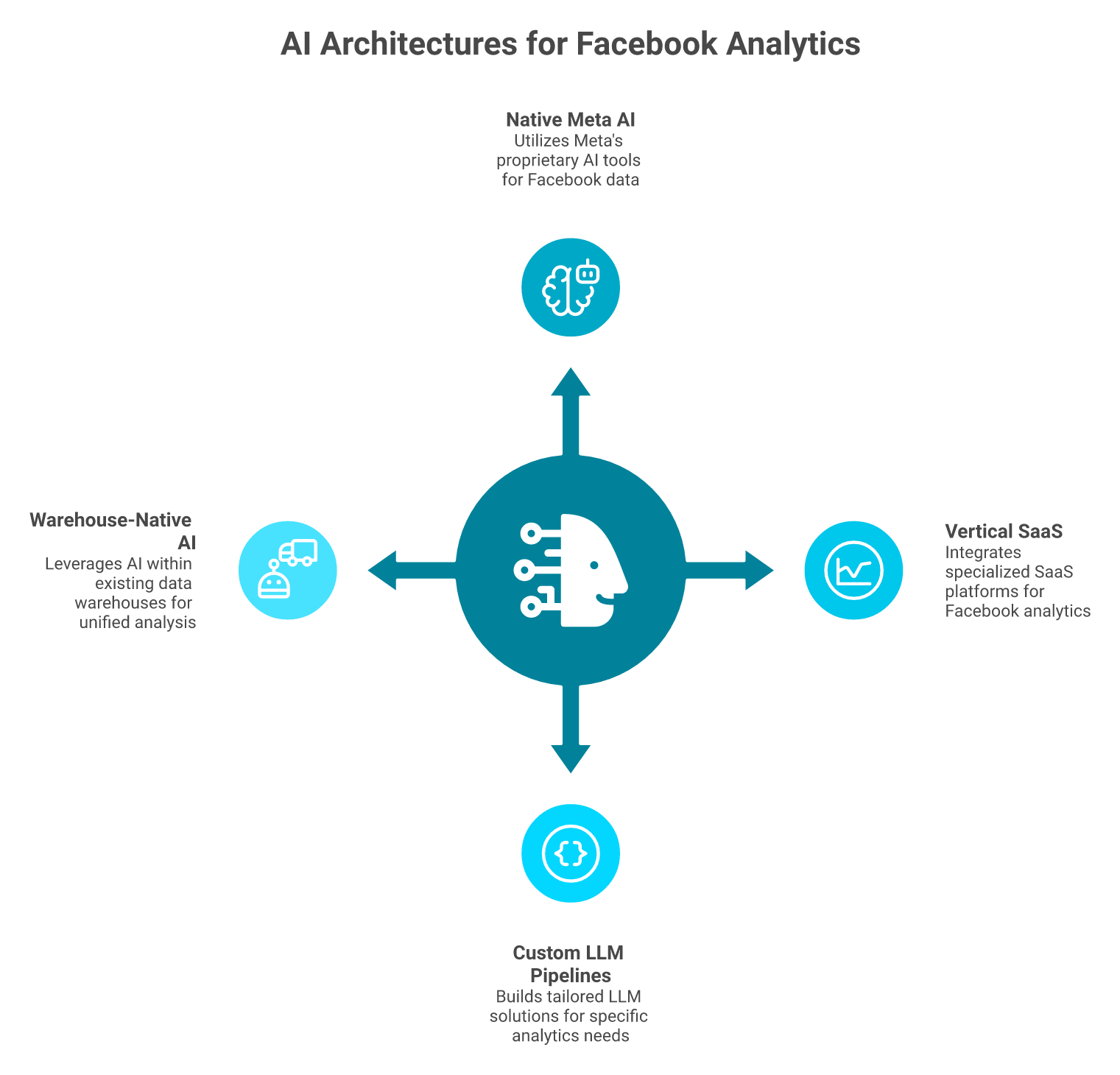
The four architectures operators choose between when picking an AI solution for Facebook analytics.
That is the shift from reporting to reasoning, and it is the core idea behind the AI Co-Founder model for e-commerce. As Ken Price at Blake Mill puts it, running Meta and merchandising data without a reasoning layer is "drinking from a fire hydrant."
"Broken Integrations. Fake Attribution for External Marketplaces. Daily revenue totals are wrong, entire order blocks are missing... they still appear in attribution. Completely fake data." XTRA FUEL Triple Whale Trustpilot Verified Review
"Our experience with Triple Whale has been extremely frustrating and almost categorically terrible... we end up reverting back to direct data sources like Meta, Shopify, Recharge." Matt Huttner Triple Whale Trustpilot Verified Review
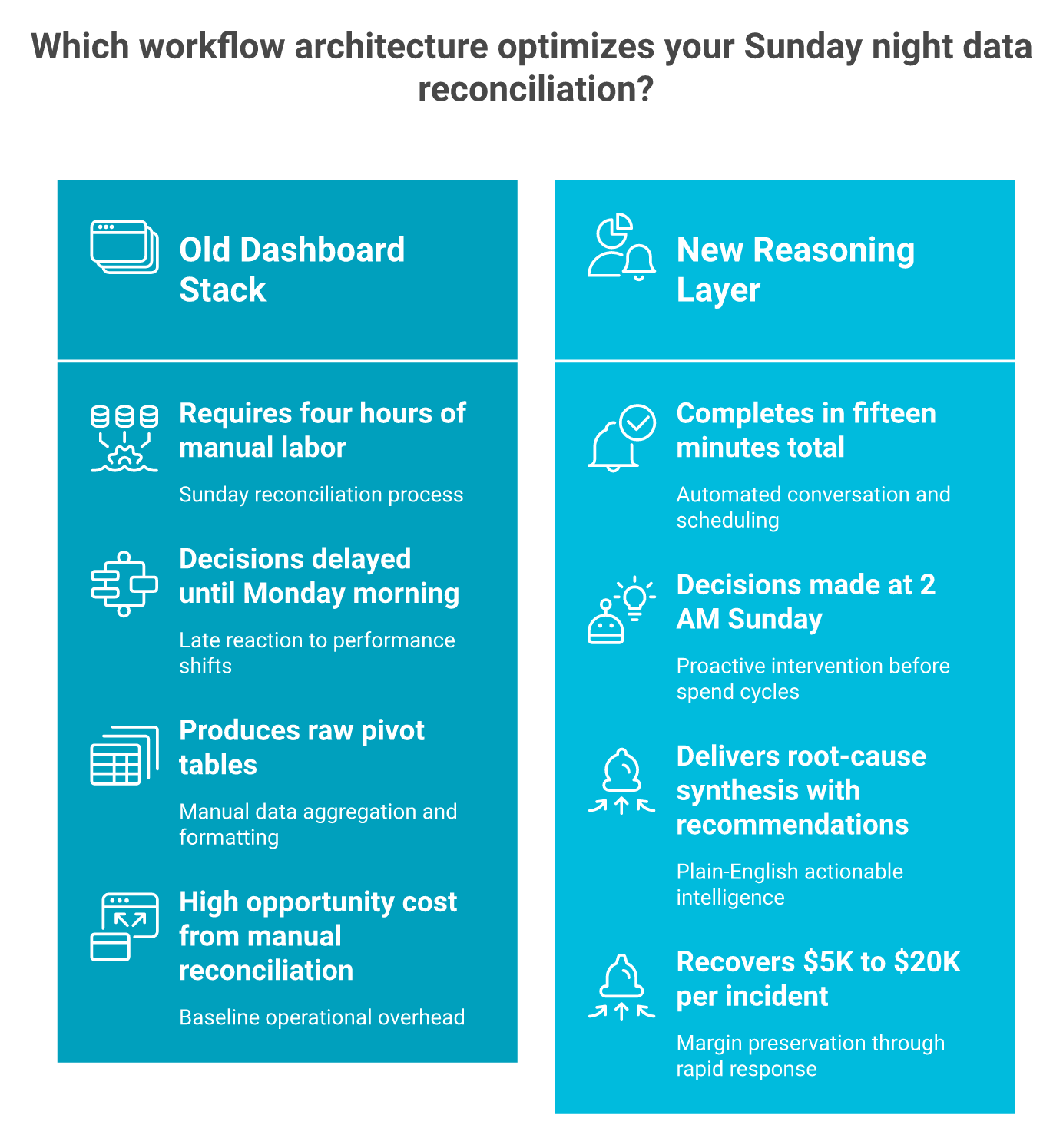
From 4-hour Sunday reconciliation to 5-second answers. That is the gap an AI layer is now expected to close.
Q2. What Exactly Is an AI Solution for Facebook Analytics, and What Are the Four Architectural Categories? [toc=2. Four AI Architectures]
An AI solution for Facebook analytics is a reasoning system that ingests Meta Marketing API data into a unified store, applies LLMs and multimodal models, and surfaces decisions a senior media buyer would make without dashboard navigation. Four categories exist in 2026: native Meta AI, vertical SaaS, custom LLM pipelines, and warehouse-native AI reasoning layers.
The Four Architectures
1. Native Meta AI (Andromeda, Advantage+). Meta's own ranking and optimization stack. Strong inside the walled garden, blind everywhere else. It cannot tell you what a $10K Meta spend does to your August inventory cash position.
2. Vertical SaaS (Triple Whale, Northbeam, Motion, Polar Analytics). Adds attribution modeling, creative intelligence, and dashboards over Meta data. Useful, but operators repeatedly hit data accuracy and integration limits, which is why so many teams now look at Triple Whale alternatives.
3. Custom LLM Pipelines (n8n + Cursor + Claude). Operators like Andrew Faris and his peers extract Marketing API data into a warehouse and run LLMs on top. High control, high build cost. Fits agencies and elite in-house teams.
4. Warehouse-Native AI Reasoning Layers (Luca AI). A single context-aware system that ingests Meta plus Shopify, Klaviyo, Stripe, and Xero, then reasons across them in plain English, anchoring the broader e-commerce tech stack.
Capability Matrix
AI Solution Architectures Compared
Capability
Native Meta
Vertical SaaS
Custom LLM
Warehouse-Native AI
Cross-channel reasoning
❌
Partial
✅
✅
Multimodal creative tagging
Limited
✅
✅
✅
Conversational interface
❌
Partial
✅
✅
Connects to Shopify and finance
❌
Partial
✅
✅
Build cost
None
Medium
High
Low
Capital integration
❌
❌
❌
✅
What Operators Are Actually Doing
Ari Tulla at ELO Health spent $10M building a proprietary algorithmic engine that became 10x less effective the moment LLMs arrived. That story is now an industry parable. ⭐ Building from scratch in 2024 looks like building a fax network in 1995.
The contrarian read: most "native AI" features inside vertical SaaS are bolt-ons, not architecture. Most analytics tools added AI. A born-AI system reasons natively across silos, which is the heart of the intelligence-capital thesis.
Where Luca Fits
We sit in category four. Luca AI is a warehouse-native reasoning layer that ingests Meta plus Shopify plus your finance stack into a single context window, then answers questions in plain English. The differentiator is the closed loop: insight, recommendation, and capital to act on it inside one chat, which is how funding to scale e-commerce marketing campaigns stops being a separate process.
"Their integrations are inconsistent, building with the AI tool Moby is very buggy and crashes more than half the time." Matt Huttner Triple Whale Trustpilot Verified Review
The category is mature enough now that the architectural choice, not the feature list, decides whether the tool survives your next quarter.
Q3. How Does Multimodal Creative Tagging Work, and What's a Scoring Rubric for Tagging Depth? [toc=3. Multimodal Tagging Rubric]
Multimodal tagging uses vision-language models like GPT-4V, Claude, and Gemini to label creatives across 40+ dimensions: hook type, pacing, on-screen copy, talent demographics, and offer salience. Static-tag systems score 1 to 2 on a 6-axis rubric. Modern multimodal pipelines score 5 to 6. The rubric exposes which vendors actually do multimodal versus which slap an LLM on metadata.
How a Multimodal Tagging Pipeline Works
A vision-language model (VLM) ingests every creative frame by frame. It also reads the audio transcript and the on-screen copy. It outputs structured tags: hook archetype, pacing curve, color temperature, talent age band, and offer prominence at second 3.
These tags get stored in a vector database and joined to performance data: spend, CTR, hold rate, and 90-day LTV. The system then runs correlation analysis to surface which tag clusters drive ROAS and which leak budget, which feeds directly into marketing analysis and automation.
The 6-Axis Tagging Depth Rubric
Score any vendor 0 to 2 per axis. Total 10+ means real multimodal depth. Below 7 means metadata with extra steps.
6-Axis Multimodal Tagging Depth Rubric
Axis
What to Check
Tag granularity
Does it tag 5 dimensions or 40+?
Multimodal coverage
Does it read video, audio, text, and on-screen copy together?
Update cadence
Daily, weekly, or only on import?
Performance correlation
Does it tie tags to LTV and contribution margin, not just CTR?
Customizability
Can you add brand-specific tags (e.g., "founder UGC")?
Explainability
Does it show why a tag was assigned?
The Volume Fallacy ⚠️
Luke Bean at Valente argues that even after spending millions, humans cannot predict creative winners. The Meta algorithm demands volume so high that 90% of creative work belongs in the rubbish bin. The 10% that wins is what the algorithm finds, not what the strategist picked.
So tagging is not for picking winners pre-launch. It is for understanding patterns across thousands of post-launch outcomes you could not parse manually, the same logic that powers data analysis and deep industry research.
What Luca Does Differently
We extract tag-performance correlations directly from the warehouse. You ask, "Which hook types drove the highest 90-day LTV in Q1?" Luca joins your Meta creative data with Shopify cohorts and answers in seconds, with the SQL path visible if you want it.
"Most agencies just tag for the sake of tagging. The brands that scale tag for correlation, not categorization." u/ppcboss, r/FacebookAds Reddit Thread
Think of tagging less as labels on a creative and more as a search index over your performance history. The deeper the index, the faster you find the next 10% that actually works.
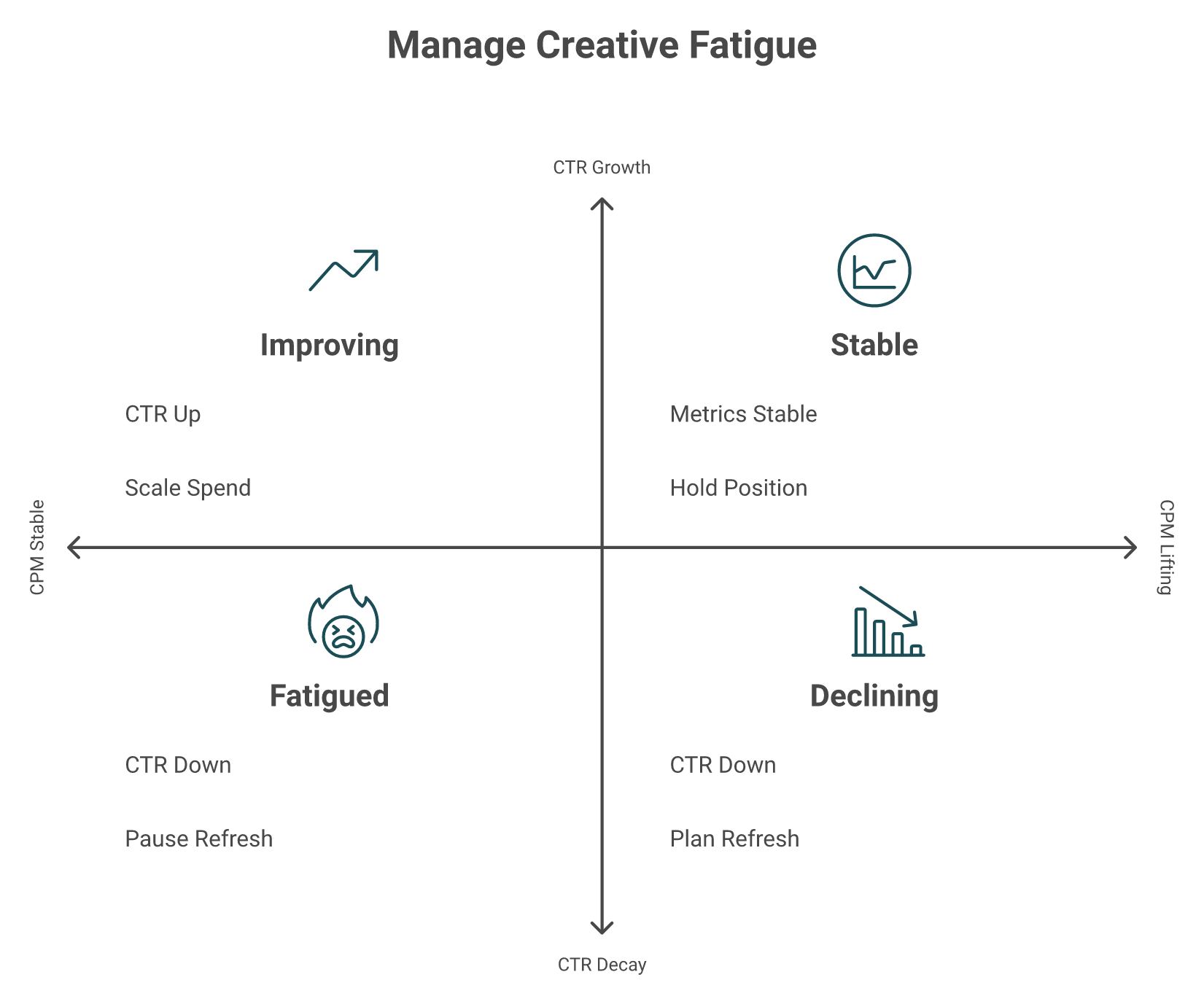
The 4-state creative fatigue matrix that flags losing ads 7 days before CPA breaks.
Q4. How Can AI Detect Creative Fatigue 7 Days Before CPA Blows Up? [toc=4. Fatigue Detection Playbook]
AI fatigue detection scores ads weekly on volume-weighted CTR, CPM, frequency, and CVR over a 14-day window. ROAS is intentionally excluded because last-click bias hides early decay. The system classifies each creative as Fatigued, Declining, Stable, or Improving, flagging losers 7 days before CPA breaks. Operators recover $5K to $20K per incident in preserved margin.
The 4-State Scoring Framework
Fatigued. CTR down 30%+ WoW, CPM up 15%+, frequency above 4. Pause or refresh now.
Declining. CTR down 10 to 30%, CPM drifting up. Plan a refresh in 7 days.
Stable. Metrics within ±10% of baseline. Hold.
Improving. CTR up 10%+, CPM stable. Scale spend 20 to 30%.
Why exclude ROAS? Because ROAS lags 3 to 7 days behind real performance. By the time blended ROAS dips, you have already burned a week of bad spend.
Setup Steps for the Playbook
Pull the last 14 days of ad-level data from the Meta Marketing API.
Calculate volume-weighted CTR, CPM, frequency, and CVR per creative.
Compare week 1 vs. week 2 deltas.
Apply the 4-state classification.
Route alerts to Slack or email every Monday at 8 AM.
Leading vs Lagging Signals
Leading and Lagging Fatigue Signals
Signal
Type
Lead Time
Frequency above 4
Leading
7 to 10 days
CTR decay 20%+ WoW
Leading
5 to 7 days
CPM drift up 15%+
Leading
3 to 5 days
CVR drop on landing page
Leading
3 to 5 days
ROAS dip
Lagging
-2 to -7 days
CPA breakout
Lagging
-7 to -14 days
What Luca Does at 2 AM 💰
Luca scans your Meta data 24/7 against these thresholds. When CTR drops 38% on Campaign 14 and CPM lifts 19% in three of your top zip codes, you get a Slack ping with the diagnosis: "Refresh top 3 creatives. Audience overlap with Campaign 9 at 32%. Estimated saved spend if paused today: $8,400 over the next 7 days."
This is what the Luca team calls a Sentry: a 24/7 outlier scanner that explains its reasoning, not a black-box alert, and it sits alongside agentic AI for e-commerce founders.
"Creative fatigue is real. We refresh every 10-14 days based on frequency, not ROAS. By the time ROAS drops, you've already lost the week." u/Lazy-Wedding-3174, r/FacebookAds Reddit Thread
Detection is the easy part. The hard part is acting before Tuesday's spend cycle. That is where a reasoning layer that pings you, recommends the action, and unlocks the capital to fund the next creative test wins the week.
Q5. How Do Conversational 2-AM Assistants Replace the "Open 5 Dashboards" Workflow? [toc=5. Conversational 2-AM Assistants]
At 2 AM, founders don't want a dashboard. They want one answer: "Why did ROAS drop yesterday?" A conversational AI assistant returns creative fatigue (CTR -40%), audience overlap (32% with Campaign Y), and CPM drift (+18%) in one synthesis. Zero-SQL independence means executive summaries in plain English. Reddit and G2 are full of operators who pay for Triple Whale yet still export CSVs at midnight, proof that dashboards aren't conversational reasoning.
A Real 2 AM, Walked Through
Here's how a $3M DTC founder I work with handled a Sunday-night ROAS scare last quarter. The pattern is the same one we see across every operator who finally drops Triple Whale alternatives into their stack.
2:00 AM. The ping. Slack alert from the warehouse: "Meta blended ROAS down 31% vs 7-day avg. Top driver: Campaign 14. Probable cause: creative fatigue + audience overlap." No login required. No dashboard opened.
2:05 AM. Root-cause query. He types in plain English: "Why did Campaign 14 drop?" Answer in 11 seconds: CTR fell 40% week over week, frequency hit 4.8, audience overlap with Campaign 9 is 32%, and CPM lifted 18% in three top zip codes.
The Old Workflow vs the New One ⏰
How a warehouse-native reasoning layer collapses the Sunday-night dashboard ritual into one Slack ping.
2:10 AM. Simulation. "If I pause Campaign 14 and shift $15K to TikTok testing this week, what happens to my August cash position?" The system runs the scenario across Meta spend, Shopify cohort velocity, and Stripe payouts, the same logic that powers cash flow forecasting for e-commerce. Answer: cash dips $9K then recovers by week 3.
2:15 AM. Schedule the agent. "Send me a CAC report every Monday 8 AM with Meta plus Google plus Klaviyo, broken out by attribution model." Done. The Sunday tab-juggling ritual is over.
Why Dashboards Stopped Cutting It ❌
Operators are paying for Triple Whale and still exporting CSVs at midnight. The pattern is well-documented in real reviews, and it lines up with everything we see in why e-commerce founders are drowning in data.
"Their integration simply does not work. Daily revenue totals are wrong, entire order blocks are missing, and they still appear in attribution. Completely fake data." XTRA FUEL Triple Whale Trustpilot Verified Review
"We end up reverting back to direct data sources like Meta, Shopify, Recharge. We've consistently encountered errors in tracking, attribution, and reporting." Matt Huttner Triple Whale Trustpilot Verified Review
A dashboard is a wall of charts. A reasoning layer is a colleague who already opened the tabs and synthesized the answer.
What This Unlocks 💰
Anthony Mink used AI to discover that buying across 3+ product categories drives 100% higher LTV than purchase frequency. That insight does not exist on a dashboard. It only surfaces when something reasons across customer, product, and channel data in one prompt, the way agentic AI for e-commerce founders is built to operate.
What we've seen with Luca operators: a 4-hour Sunday reconciliation collapses to 15 minutes of conversation. The decisions ship before Monday's spend cycle.
Q6. What's the Right Attribution Stack After Meta's Jan 12 2026 Deprecations? [toc=6. 2026 Attribution Stack]
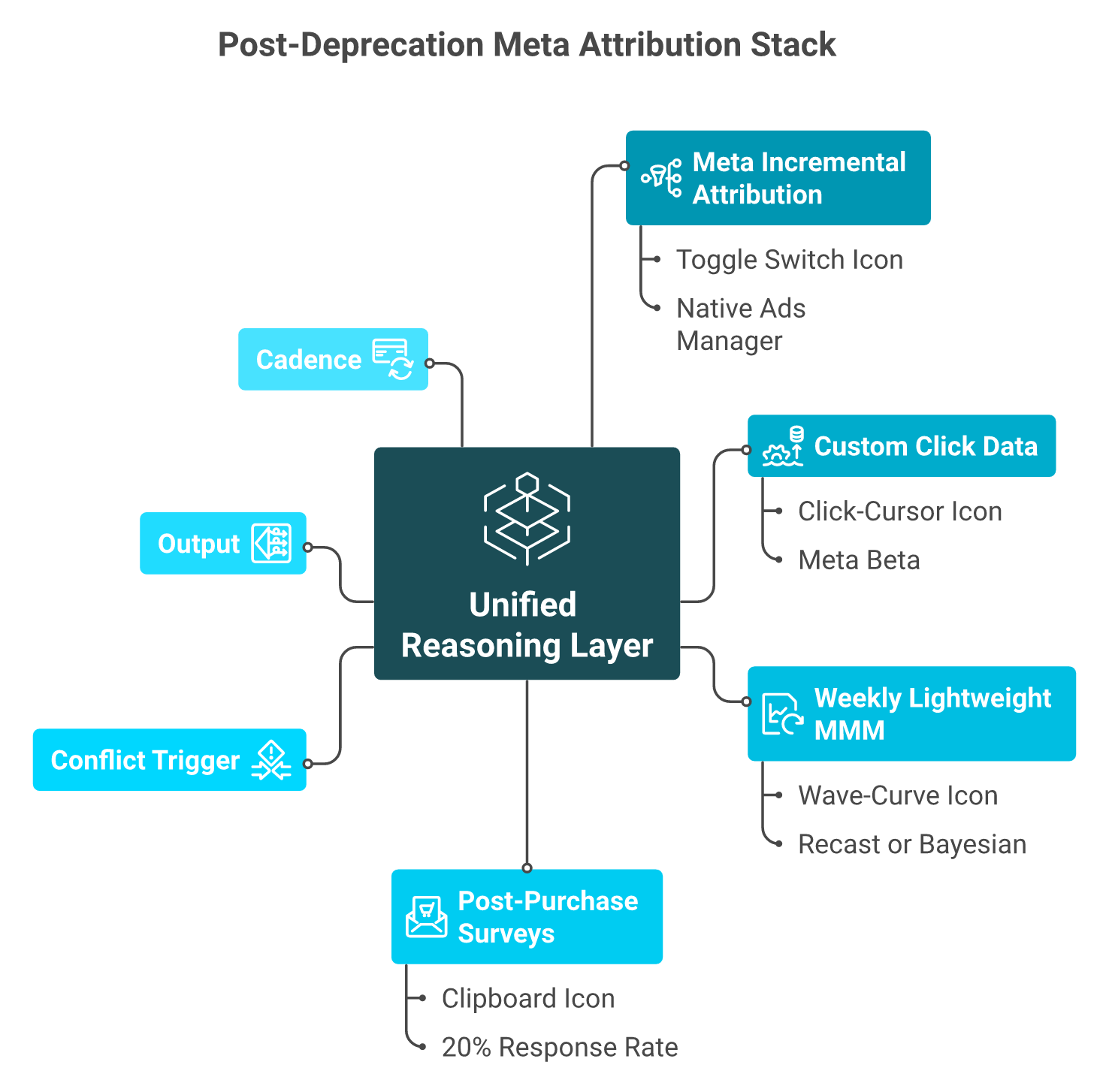
On Jan 12 2026, Meta deprecated the 7-day and 28-day view-through windows and shifted MMM (Marketing Mix Modeling) breakdowns to async-only. The operator-grade recovery stack: enable Meta's incremental attribution toggle, integrate the custom attribution beta with Triple Whale or Adobe click data, run lightweight MMM weekly, and layer post-purchase surveys for ground truth. AI reconciles the four, flagging when MTA over-credits Meta by 30%+ vs MMM. The reasoning layer, not any single model, is the answer.
What Actually Changed in 2026
Three things shifted on the Meta surface this year. First, view-through windows past 24 hours are gone, which gutted long-tail credit for video-led brands. Second, Meta rolled out an incremental attribution toggle inside Ads Manager, plus a custom attribution beta that ingests Triple Whale and Adobe click data. Third, "Profit ROAS" became a native optimization goal, which is exactly the lens behind declining platform ROAS vs true profitability.
The operator translation: you are now flying with one fewer instrument unless you rebuild the stack manually.
The 4-Step Signal Recovery Playbook ✅
The 4-signal attribution stack operators rebuild after Meta deprecates view-through windows.
Turn on incremental attribution. Inside Ads Manager, switch the default reporting view to incremental. This filters out clicks Meta would have won anyway.
Plug in custom click data. Use the Meta beta to feed Triple Whale or Adobe Analytics click streams back into Meta's bidder. This restores some of the lost view-through signal.
Run weekly lightweight MMM. Don't wait for a quarterly agency MMM. Tools like Recast or homegrown Bayesian models give you a weekly read on channel-level lift.
Layer post-purchase surveys. A "How did you hear about us?" question on the order confirmation page is the cheapest ground truth in DTC. Aim for 20%+ response rate.
Reconciliation: Where the AI Layer Earns Its Keep
Attribution Source Strengths and Weaknesses
Source
Strength
Weakness
Meta incremental
Fast, native, and free
Only sees Meta
MMM
Cross-channel and causal
Slow and directional
MTA + click data
Granular and real-time
Last-click bias
Post-purchase survey
Ground truth
Sample size and recency bias
What Operators Are Actually Doing
Andrew Faris has been blunt for two years now: ROAS without incrementality testing is vanity. The 2026 stack pairs Meta's optimization with weekly holdout tests on geos or audiences, which is the same discipline behind tracking e-commerce unit economics. ⚠️ When MTA tells you Meta drove $200K and MMM says $140K, that 30% gap is not a rounding error. It's a budget reallocation.
Here's the reconciliation problem: no single founder has time to run four models in parallel. We built Luca to ingest all four signals into one warehouse and surface the conflicts automatically. When MTA over-credits Meta by 30%+ versus MMM, you get a Slack ping with the diagnosis and the recommended reallocation, all inside the broader e-commerce analytics platforms conversation.
The 2026 attribution stack is no longer a single tool. It is a portfolio of signals reconciled by a reasoning layer.
Q7. Should You Build a Custom LLM Pipeline or Buy a Warehouse-Native AI Layer? [toc=7. Build vs Buy Framework]
Custom LLM pipelines (n8n + Cursor + Claude over BigQuery) cost $40K to $120K to build and need 1 to 2 engineers to maintain, viable above $20M revenue with a data team. Below that, warehouse-native AI layers ship the same architecture as a product: pre-wired Meta + Shopify + Klaviyo ingestion, multimodal tagging, root-cause reasoning, and agentic Slack push. The "sausage factory" of execution moves at magnitudes higher velocity when the pipeline is already plumbed.
The Decision Dilemma
Choosing between build and buy in 2026 is not a feature comparison. It is a commitment to a maintenance burden. Pick wrong, and you are either paying $25K a month for an engineer to babysit a pipeline, or paying $1,500 a month for a SaaS that doesn't reason across your finance data, the same trade-off discussed in e-commerce tech stack.
Most founders I talk to default to "build it ourselves" because LLMs feel approachable now. That instinct is right at $20M+ revenue. It is wrong below it.
The Wrong Way to Decide ❌
The common failure modes:
Counting integrations instead of reasoning depth.
Picking the cheapest tool, then bolting on consultants.
Building a custom pipeline before you have a data engineer who will stay 18 months.
The 7-Criteria Build-vs-Buy Framework
Score each option 0 to 2 per criterion. 12+ wins.
7-Criteria Build vs Buy Framework
Criterion
What It Measures
Time to value
Days to first useful answer
Build cost
One-time engineering spend
Maintenance burden
Hours per month to keep alive
Model swappability
Can you change LLM without rewriting?
Multimodal coverage
Video, audio, and on-screen copy, all together
Agentic push
Slack, email, or SMS without manual queries
Root-cause depth
Does it reason across silos?
Applying the Framework
A custom n8n + Cursor + Claude pipeline scores 2 on swappability and 2 on multimodal, but 0 on time-to-value (90+ days) and 0 on maintenance (1 engineer minimum). It works for $20M+ brands with a CTO who already runs a warehouse. ⏰
Warehouse-native AI layers like Luca AI score 2 on time-to-value, 2 on maintenance (zero), and 2 on agentic push. The trade-off: less control over the underlying model. For 90% of sub-$20M DTC brands, that trade is correct, which is why the best AI tools for Shopify owners increasingly look warehouse-native.
"We considered building our own. By the time you've paid the engineer, paid for the warehouse, paid for the LLM tokens, and lost 4 months, the SaaS bill looks small." u/dtcops, r/ecommerce Reddit Thread
Where Luca Lands
Luca AI is the buy option that mimics the build option's flexibility. We ship pre-wired Meta, Shopify, Klaviyo, Stripe, and Xero ingestion, with multimodal tagging and agentic Slack reports out of the box. The system was designed warehouse-native, not retrofitted onto a dashboard, which is the founding idea behind what an AI Co-Founder for e-commerce actually is.
The meta-insight: build if your data team is your moat. Buy if your product is your moat.
Q8. Top 8 AI Solutions for Facebook Analytics in 2026 [toc=8. Top 8 AI Solutions]
The 8 platforms operators evaluate in 2026, ranked by reasoning depth, multimodal coverage, agentic push, and warehouse integration: Luca AI, Triple Whale, Motion, Northbeam, Cometly, SegmentStream, Automads, and Connecty AI. Luca leads because it operates as an AI reasoning layer over a unified data warehouse, extracting, predicting, simulating, and pushing root-cause analyses agentically, not displaying pre-built charts.
How I Ranked These
Four axes: cross-functional reasoning, multimodal creative tagging, agentic push (Slack, email, and SMS without manual queries), and warehouse integration depth, the same axes used in our roundup of the 7 best e-commerce analytics tools that fund your campaigns.
The Ranking ⭐
1. Luca AI. Warehouse-native reasoning layer. Ingests Meta, Shopify, Klaviyo, Stripe, and Xero into one context window. Multimodal creative tagging, scenario simulation, root-cause discovery, and agentic Slack reports. The only platform with embedded capital, so the system that surfaces the opportunity can also fund it. ICP fit: $1M to $50M DTC brands without a data team.
2. Triple Whale. Strongest brand recognition in DTC attribution. Solid pixel and Sonar attribution. Operators report integration and data accuracy issues at scale. ICP fit: $5M+ brands with a dedicated analyst.
"Daily revenue totals are wrong, entire order blocks are missing... they still appear in attribution. Completely fake data." XTRA FUEL Triple Whale Trustpilot Verified Review
3. Motion. Best-in-class for creative reporting and tagging. Visual ad library and performance-by-tag views. Limited cross-functional reasoning beyond creative. ICP fit: agencies and high-creative-volume brands.
4. Northbeam. Strong MTA and incrementality testing. Heavier setup. Best for brands spending $200K+ a month on paid. ICP fit: $10M+ DTC with a marketing analyst.
Mid-Pack and Specialists
5. Cometly. Server-side tracking and AI-assisted attribution. Lighter than Northbeam and easier setup. ICP fit: $1M to $5M brands wanting MTA without complexity, often surfaced alongside the best Shopify analytics apps.
6. SegmentStream. ML-driven attribution with strong privacy posture. Useful in Europe under GDPR. ICP fit: EU-based brands.
7. Automads. Pure-play AI fatigue detector. Narrow but cheap. ICP fit: solo operators running 30 to 80 active ads.
8. Connecty AI / ADEN's LAB. Emerging AI tagging tools. Promising but unproven at scale. ICP fit: experimentation and pilot programs.
The Comparison Table
Top 8 AI Solutions Capability Matrix
Tool
Reasoning
Multimodal Tagging
Agentic Push
Warehouse-Native
Capital
Luca AI
✅
✅
✅
✅
✅
Triple Whale
Partial
Partial
❌
❌
❌
Motion
❌
✅
Partial
❌
❌
Northbeam
Partial
❌
❌
Partial
❌
Cometly
❌
❌
❌
❌
❌
SegmentStream
Partial
❌
❌
Partial
❌
Automads
❌
Partial
✅
❌
❌
Connecty AI
Partial
✅
❌
Partial
❌
My Honest Read
What shipping Luca to real ecom founders has taught me is that operators don't actually want a "best tool." They want a tool that reads their stack and tells them what to do.
"Their integrations are inconsistent, building with the AI tool Moby is very buggy and crashes more than half the time." Matt Huttner Triple Whale Trustpilot Verified Review
If you spend under $50K a month on Meta, Triple Whale and Motion are probably overkill. ✅ If you spend over $200K a month and have an analyst, the Triple Whale + Motion combo is defensible. If you want one reasoning layer across marketing, finance, and operations, this category collapses to one architectural choice.
Q9. Triple Whale vs Northbeam vs Motion vs Luca AI: Head-to-Head on Analytics Capability [toc=9. Triple Whale vs Luca]
Triple Whale wins on attribution breadth for $5M+ brands with analysts. Northbeam wins on MTA modeling rigor. Motion wins on creative-only intelligence for agencies. Luca AI wins on warehouse-native reasoning, the only platform that simulates "what if I pause Campaign X?", performs root-cause decomposition across Meta + Shopify, and pushes agentic reports to Slack and email. Choose by bottleneck: creative (Motion), attribution (Triple Whale or Northbeam), or cross-functional reasoning (Luca).
Why This Comparison Matters
Most operators end up running two of these tools in parallel. They pay $1,500 a month for Triple Whale, another $1,000 for Motion, and still export CSVs on Sunday. The real question is which architecture replaces the tab-juggling, not which has more dashboards, the same lens we use across Triple Whale alternatives.
Each of these tools solves a slice of the problem. Only one tries to solve the synthesis layer above the slices.
Triple Whale: Attribution Breadth, Data Drift Pain
Triple Whale ships strong pixel-based attribution and the Sonar identity graph. ✅ Best fit: $5M+ brands with a dedicated analyst.
❌ The pattern in real reviews is data drift versus Meta Ads Manager. Operators repeatedly report missing orders and broken Moby AI sessions, which is also why teams stress-test e-commerce analytics platforms before committing.
"Daily revenue totals are wrong, entire order blocks are missing. We end up reverting back to direct data sources like Meta, Shopify, Recharge." Matt Huttner Triple Whale Trustpilot Verified Review
Northbeam: MTA Rigor, Heavy Setup
Northbeam's modeling depth is the strongest in the category for MTA (multi-touch attribution). ✅ Best fit: $10M+ brands spending $200K+ a month on paid.
❌ Setup is heavy. Founders below $10M revenue rarely extract enough lift to justify the complexity or the price, especially when measured against tracking e-commerce unit economics.
Motion: Creative-Only Intelligence
Motion is the visual ad library plus performance-by-tag tool agencies live inside. ✅ Best fit: agencies and creative-led brands shipping 30+ ads a week.
❌ Motion is creative-only. It doesn't reason across Shopify cohorts, finance, or operations, which is precisely where marketing analysis and automation needs to extend today.
Luca AI: Warehouse-Native Reasoning ⭐
Luca sits one layer above the others. We ingest Meta, Shopify, Klaviyo, Stripe, and Xero into one warehouse, then reason across them in plain English. ✅ The unique capabilities: scenario simulation ("what if I pause Campaign X?"), root-cause decomposition (CPM lift + creative fatigue + audience overlap in one answer), and agentic Slack push, all rooted in the intelligence-capital thesis.
❌ Where Luca is not the right fit: pure agencies that only need creative tagging, or brands under $50K MRR.
The 7-Criteria Comparison
Triple Whale vs Northbeam vs Motion vs Luca AI
Criterion
Triple Whale
Northbeam
Motion
Luca AI
Attribution breadth
✅
✅
❌
✅
Multimodal creative tagging
Partial
❌
✅
✅
Cross-functional reasoning
❌
❌
❌
✅
Scenario simulation
❌
Partial
❌
✅
Root-cause decomposition
❌
Partial
❌
✅
Agentic Slack push
Partial
❌
Partial
✅
Embedded capital
❌
❌
❌
✅
Who Should Choose What
Choose Motion if creative is your bottleneck and you ship 30+ ads weekly. Choose Triple Whale or Northbeam if attribution rigor at $10M+ is your blocker and you have an analyst. Choose Luca if the bottleneck is cross-functional reasoning, the kind that connects a Tuesday CPM spike to your Friday inventory landing.
"Their integrations are inconsistent, building with the AI tool Moby is very buggy and crashes more than half the time." Matt Huttner Triple Whale Trustpilot Verified Review
The architectural difference, not the feature list, decides which one survives your next quarter.
Q10. How Does an Agentic AI Layer Push Insights to Slack and Email Without You Asking? [toc=10. Agentic Slack and Email]
Agentic AI sits on top of your Meta + Shopify warehouse and runs scheduled reasoning jobs: Monday 8 AM weekly creative report to Slack, daily fatigue digest to email, and real-time anomaly alerts to mobile. Unlike pull-based dashboards that wait for queries, agentic systems detect that CAC (customer acquisition cost) spiked 15%, decompose the cause (CPM +18%, CVR -8%), and push the explanation before you open Ads Manager. The "Sentry" framing matters because it explains its reasoning, not just the alert.
How Agentic Scheduling Works
You set a goal in plain English: "Tell me every Monday at 8 AM how creative fatigue tracked last week, with charts and recommendations." The system schedules the job, runs the query against your warehouse, and reasons over the result, the same architecture explored in agentic AI for e-commerce founders. The output drops in Slack, formatted, with the math shown.
This is different from a dashboard alert. Dashboard alerts say "ROAS dropped 12%." Agentic systems say "ROAS dropped 12% because CPM lifted 18% in your top 3 zip codes and creative CTR decayed 31% on Campaign 14. Recommend pausing 3 creatives, refreshing 2."
Five Push Patterns That Actually Earn Their Keep ✅
Slack weekly creative report. Monday 8 AM. Top performers, fatigued ads, and recommended refreshes.
Email daily fatigue digest. Every morning. Ads above frequency 4, and ads with CTR decay 20%+.
Mobile real-time anomaly alerts. ROAS deviates 15%+, CAC spikes, or inventory drops below threshold.
Executive monthly synthesis. First of the month. CAC, MER (marketing efficiency ratio), contribution margin trend, and cash position.
Founders using agentic intelligence catch margin leaks 2 to 3 weeks earlier than manual monitoring. That timing gap translates to $5K to $20K in preserved profit per incident, which compounds when paired with cash flow forecasting for e-commerce.
The framing matters. We call it a Sentry inside Luca because it explains its logic, not just the symptom. ⚠️ "ROAS is dipping because Meta CPMs increased 20% in this specific zip code" beats a red number on a chart every time.
The Comparison Anchor 💰
Think of it as a CFO, an analyst, and an ops manager watching your dashboards 24/7, except it costs $499 a month, not $25,000 a month in salaries. That is the trade most founders eventually make once they realize their analyst spends 40% of their time on reporting, not insight, the same realization driving operators toward how AI can actually help you run your e-commerce business.
Pull-based tools wait for you to ask the right question. Agentic systems detect the question you should be asking and answer it before Tuesday's spend cycle.
Q11. Audit Your Facebook Analytics Stack: Are You Reasoning or Just Reporting? [toc=11. Stack Health Audit]
Score your stack on 8 criteria. Most founders score 2 out of 8 on the first audit, then jump to 7 out of 8 within their first week on a warehouse-native system. The audit below is the same one I walk through with founders who are renewing a $1,500-a-month Triple Whale seat or staring down a Wayflyer offer that is already three weeks stale, the same kind of trade-off explored in Wayflyer alternatives.
Run the Audit Honestly
Each item is a yes or a no. No "kind of." If you need to open a CSV to answer, the answer is no.
The 8-Item Stack Health Checklist ✅
Can you answer "true contribution margin by creative" in under 60 seconds, with COGS, shipping, and ad spend already netted?
Does the system flag creative fatigue 7 days before CPA breaks, using leading signals like frequency and CTR decay, not lagging ROAS?
Can it simulate "if I scale Meta 30%, what happens to CAC and August cash position?" across Meta, Shopify, and Stripe payouts in one answer?
Does it perform root-cause decomposition automatically, breaking a ROAS drop into CPM lift, CTR decay, CVR drop, and audience overlap without you triangulating?
Are Meta, Shopify, Klaviyo, Stripe, and your accounting stack (Xero or QuickBooks) in one unified view, or still in five tabs?
Does it push agentic reports to Slack or email on a schedule you set, without manual queries?
Can a non-technical operator get answers without SQL knowledge or a junior analyst?
Does it reconcile MTA versus MMM and surface the gap when Meta over-credits itself by 30%+?
Score Interpretation
Stack Health Score Interpretation
Score
Read
6 to 8
Mature stack. Focus on optimization, not overhaul.
3 to 5
Critical gaps. You are likely making capital and spend decisions on incomplete data.
0 to 2
Fragmentation is bleeding revenue. Manual exports dominate your workflow.
What Each Unchecked Box Costs ⚠️
The numbers are not abstract. Companies misidentify up to 23% of their best customers, who drive 50%+ of revenue, because attribution and cohort data live in separate tools. ⏰ A week of late fatigue detection on a single $30K campaign equals roughly $8K in burned spend, which is exactly the kind of leak calculating working capital for e-commerce exposes.
For Heads of Finance running NetSuite plus Triple Whale plus a fractional CFO: the unchecked boxes are the same boxes you reconcile manually before every Tuesday leadership sync. That is recoverable hours, not a tooling cost.
What a Warehouse-Native Layer Closes
A unified reasoning layer turns most unchecked boxes into checks within 7 days. Cross-functional synthesis, proactive alerts, scenario modeling, and agentic Slack push are accessible through plain-English queries, the same capability set that anchors the 7 best e-commerce analytics tools that fund your campaigns. We've watched bootstrapped founders go from 2 of 8 to 7 of 8 in a single week of parallel-running, without firing their analyst or migrating off NetSuite.
Next Step
Scored below 5? The bottleneck is architectural, not effort. Bolting another dashboard onto fragmented data does not fix it. Replacing the architecture, or layering a reasoning system on top of it, does. ✅ The cheapest first move: pick one question from this list, run it on a 14-day parallel trial, and see whether your current stack answers it without a CSV.
Q12. "I Don't Trust an AI With My Ad Account": Handling Security, Hallucination, and Switching Objections [toc=12. Trust and Switching Objections]
Three objections dominate adoption: data security, hallucination risk, and switching cost. The pattern across operators I work with is identical. Verification beats promises every time.
Objection 1: "I'm not comfortable giving an AI access to all my financial data."
Validate. This is the most common concern, and it's rational. Headlines about AI training on user data are real.
Reality. SOC 2 Type II, AES-256 encryption at rest and in transit, no training on customer data, and full GDPR compliance with deletion rights. The system queries against your data without copying it into training sets, the same standard documented in our privacy policy.
Verify. Ask for the SOC 2 report. If a vendor cannot produce one, walk.
Objection 2: "What if the AI hallucinates and I act on a wrong number?"
Validate. Hallucination is the single biggest blocker for AI in financial workflows. Every operator I talk to asks this.
Reality. Reasoning-with-citations architecture means every answer shows the SQL path and the underlying rows. You see the math, not just the verdict, the same transparency principle behind financial management with Luca. If the system cannot explain how it got the number, it shouldn't be in your stack.
"We were burned by Moby AI hitting random walls and crashing mid-query. The lesson: if you can't see the reasoning, you can't trust the answer." Matt Huttner Triple Whale Trustpilot Verified Review
Verify. Run a live query on your own data during the demo. Ask the system to show its work. Reject black-box answers.
Objection 3: "Switching cost is too high. I'm already on Triple Whale." ⏰
Validate. Migration fatigue is real. Nobody wants another 4-week implementation.
Reality. Warehouse-native systems run parallel to your existing stack for 14 days. 10-minute Shopify and Meta integration. No data team required, and no SQL, the same low-friction setup behind the best AI tools for Shopify owners.
"After using Triple Whale and spreadsheets for 2 years, I found critical cross-functional gaps. Most tools show marketing or finance, never both together." Eric Bidinger, Luca AI Founder Luca Founder Note
Verify. Run parallel for 14 days. Compare answers daily. Switch only if the new system answers questions the old one cannot.
What I'm Thinking About Next
The next 18 months are about agentic execution, not just agentic reasoning. Right now, Luca tells you Campaign 14 is fatigued and recommends pausing it. By 2027, the question will be whether the system should also pause it autonomously, refresh the creative from your library, and reallocate the spend to TikTok, the same forward arc sketched in what is an AI Co-Founder for e-commerce.
I don't have a clean answer yet. The closed loop of intelligence, capital, and autonomous execution is where this category is heading. My read right now: founders will give up the manual click before they give up the strategic call. That is where the line gets drawn.
If you are sitting with this same question, I'd love to compare notes on the Luca contact page.
FAQ's
What is an AI solution for Facebook analytics, and why do DTC operators need one in 2026?
An AI solution for Facebook analytics is a reasoning system that ingests Meta Marketing API data into a unified store, applies LLMs and multimodal models, and surfaces decisions a senior media buyer would make without dashboard navigation.
We see four architectural categories operating in 2026:
Native Meta AI (Andromeda, Advantage+), strong inside the walled garden, blind everywhere else.
Vertical SaaS like Triple Whale, Northbeam, and Motion, useful but limited at cross-functional reasoning.
Custom LLM pipelines built on n8n, Cursor, and Claude, viable above $20M revenue with a data team.
Warehouse-native AI reasoning layers like the AI Co-Founder for e-commerce, which unify Meta, Shopify, Klaviyo, Stripe, and Xero into one context window.
Operators now juggle 200+ active ads weekly while companies misidentify up to 23% of best customers, who drive over 50% of revenue. Manual reconciliation eats 10 to 15 hours weekly. AI is no longer a productivity upgrade, it is the only way to extract reasoning from a Meta surface where humans cannot keep pace.
How does AI detect Facebook ad creative fatigue 7 days before CPA blows up?
We score ads weekly on volume-weighted CTR, CPM, frequency, and CVR over a 14-day window. ROAS is intentionally excluded because last-click bias hides early decay by 3 to 7 days.
Each creative is classified into one of four states:
Fatigued. CTR down 30%+ WoW, CPM up 15%+, frequency above 4. Pause or refresh now.
Declining. CTR down 10 to 30%, CPM drifting up. Plan a refresh in 7 days.
Stable. Metrics within ±10% of baseline. Hold.
Improving. CTR up 10%+, CPM stable. Scale spend 20 to 30%.
Operators recover $5K to $20K per incident in preserved margin. We layer this detection into agentic AI workflows for e-commerce founders so a Slack ping arrives the moment thresholds break. The diagnosis includes the math: Refresh top 3 creatives. Audience overlap with Campaign 9 at 32%. Estimated saved spend if paused today: $8,400 over the next 7 days.
What is the right Meta attribution stack after the January 12, 2026 deprecations?
On January 12, 2026, Meta deprecated the 7-day and 28-day view-through windows and shifted MMM breakdowns to async-only. The operator-grade recovery stack uses four reconciled signals.
Enable Meta's incremental attribution toggle inside Ads Manager to filter clicks Meta would have won anyway.
Plug in custom click data via the Meta beta, feeding Triple Whale or Adobe Analytics streams back into the bidder.
Run weekly lightweight MMM using Recast or homegrown Bayesian models for channel-level lift.
Layer post-purchase surveys on the order confirmation page for ground truth, targeting 20%+ response rate.
The reconciliation problem is real. When MTA tells you Meta drove $200K and MMM says $140K, that 30% gap is a budget reallocation, not a rounding error. We built our reasoning layer to ingest all four signals into one warehouse and surface the conflicts automatically, the same logic behind declining platform ROAS vs true profitability. The 2026 stack is a portfolio of signals reconciled by AI, not a single tool.
Should we build a custom LLM pipeline or buy a warehouse-native AI layer for Meta analytics?
The decision is not a feature comparison, it is a commitment to a maintenance burden.
Custom LLM pipelines built on n8n, Cursor, and Claude over BigQuery cost $40K to $120K to build and need 1 to 2 engineers to maintain. They are viable above $20M revenue with a dedicated data team.
Below that threshold, warehouse-native AI layers ship the same architecture as a product:
Pre-wired Meta, Shopify, Klaviyo, Stripe, and Xero ingestion.
Multimodal creative tagging out of the box.
Root-cause reasoning across silos.
Agentic Slack and email push.
Score each option 0 to 2 across 7 criteria: time-to-value, build cost, maintenance burden, model swappability, multimodal coverage, agentic push, and root-cause depth. A custom pipeline scores 2 on swappability but 0 on time-to-value (90+ days). Warehouse-native layers score 2 on time-to-value and 2 on maintenance.
For 90% of sub-$20M DTC brands, buy is correct, which is why operators increasingly evaluate the best AI tools for Shopify owners. Build if your data team is your moat. Buy if your product is your moat.
How does Luca AI compare to Triple Whale, Northbeam, and Motion for Facebook analytics?
Each tool solves a slice. Only one solves the synthesis layer above the slices.
Triple Whale wins on attribution breadth for $5M+ brands with analysts, though Trustpilot reviews flag persistent data drift versus Meta Ads Manager.
Northbeam wins on MTA modeling rigor for $10M+ brands spending $200K+ monthly on paid.
Motion wins on creative-only intelligence for agencies shipping 30+ ads weekly.
Luca AI wins on warehouse-native reasoning, the only platform that simulates what if I pause Campaign X, performs root-cause decomposition across Meta plus Shopify, and pushes agentic reports to Slack and email.
We are also the only option with embedded capital, so the system that surfaces the opportunity can fund it inside the same chat. This is the closed loop behind the intelligence-capital thesis.
Choose by bottleneck. Creative bottleneck, pick Motion. Attribution rigor at scale, pick Triple Whale or Northbeam. Cross-functional reasoning that connects a Tuesday CPM spike to your Friday inventory landing, pick Luca. The architectural difference, not the feature list, decides which one survives your next quarter.
Enjoyed the read? Join our team for a quick 15-minute chat — no pitch, just a real conversation on how we’re rethinking Ecommerce with AI - Luca
Loading Schedule...
Your AI Co-Founder is here.
Here’s why:
Shopify, Meta, Xero - one brain.
"Should I scale?" Answered with real data.
Growth capital. No applications. One click.
Thank you! Your submission has been received! Please book a time slot for the Meeting
Oops! Something went wrong while submitting the form.