10 Best Reverse ETL Tools for Data Analytics in 2026
12
mins read
TL;DR
The 10 best reverse ETL tools for e-commerce in 2026 are Luca AI, Hightouch, Census, Fivetran, RudderStack, Polytomic, Hevo Activate, Omnata, GrowthLoop, and Skyvia.
Most tools move modeled warehouse data into daily tools well; few tell you which data to move, which is the human middleware problem we built Luca to close.
We scored tools across five weighted criteria: Activation Intelligence, Destination Breadth, Setup and Usability, Pricing Transparency, and Verified User Reviews.
Pricing is deceptive: row-based and MAR models multiply through fan-out, so 3M rows across four destinations often costs two to three times the sticker price.
Evaluate on destination coverage, transformation fit, sync latency, governance, and team fit; the last one stalls more rollouts than any feature gap.
Once an audience is activated, funding it wisely matters; dynamically-priced, right-sized capital can beat a flat-fee lump advance for a healthy brand.
Q1. What are the 10 best reverse ETL tools for e-commerce in 2026? [toc=1. Best Reverse ETL Tools]
The 10 best reverse ETL tools for e-commerce in 2026 are Luca AI, Hightouch, Census, Fivetran, RudderStack, Polytomic, Hevo Activate, Omnata, GrowthLoop, and Skyvia. Most move modeled warehouse data into the tools your team lives in every day. They differ most on destination breadth, sync speed, no-code depth, and how they price. So the right pick depends on your stack and who actually operates it.
Here is the thing nobody tells you when you search this keyword. Reverse ETL is plumbing. It moves data from your warehouse (Snowflake, BigQuery, Redshift) back into Meta, Klaviyo, and Salesforce so your team stops copy-pasting exports every Monday. That is real work worth automating. But moving data is not the same as knowing which data to move. I looked at these tools the way a store owner would, not a data engineer, and the split that matters in 2026 is simple: most tools sync, a few actually tell you what to sync. If you want to understand the wider stack these tools plug into, our guide to e-commerce data integration lays out where each layer sits.
The tools, at a glance:
Luca AI: Best for founders who want the insight and the action in one plain-English chat.
Hightouch: Best for marketing teams that want the widest destination catalog.
Census: Best for dbt-native analytics engineering teams.
Fivetran: Best for teams already running Fivetran ETL who want one vendor.
RudderStack: Best for infra-as-code and warehouse-native CDP setups.
Polytomic: Best for B2B teams syncing account data to a CRM.
Hevo Activate: Best for lean teams wanting low-cost entry.
Omnata: Best for Snowflake-first, Salesforce-heavy stacks.
GrowthLoop: Best for marketers building audiences on top of a warehouse.
Skyvia: Best for simple, budget cloud data sync.
📊 How the tools compare at a glance
Reverse ETL Tools Compared at a Glance
Tool (Rating)
Key capabilities
Best for
Pricing (Min/Month to Max/Month)
Luca AI ⭐⭐⭐⭐⭐
AI layer over your warehouse; plain-English querying, root-cause, predictions, 24/7 alerts, auto reports
Founders and lean teams who want insight plus action in one chat
Bundled ETL and reverse ETL, MAR pricing, wide connectors
Teams already on Fivetran wanting one vendor
~$2,000+ (MAR-based)
RudderStack ⭐⭐⭐⭐
Warehouse-native CDP, event and reverse ETL, infra-as-code
Engineering-led, code-first teams
Free to custom
Polytomic ⭐⭐⭐⭐
Two-way sync, strong CRM support, real-time account data
B2B sales syncing account data
Custom
Hevo Activate ⭐⭐⭐
No-code activation, connector library, add-on model
Lean teams wanting a low entry price
~$239+ plus add-on
Omnata ⭐⭐⭐
Snowflake-native, Salesforce-focused syncs
Snowflake-first, Salesforce-heavy stacks
Custom
GrowthLoop ⭐⭐⭐⭐
Warehouse-native audience builder, AI activation
Marketers building audiences on the warehouse
Custom
Skyvia ⭐⭐⭐
Simple cloud sync, ETL and reverse ETL, low cost
Budget-conscious, simpler use cases
Free to ~$399
Ratings reflect the scoring rubric explained in the next section (Q2), which weights how much a tool helps you decide, not just move rows.
1.1 Luca AI [toc=1.1 Luca AI]
Luca homepage promoting a single intelligence layer for €1M–€100M ecommerce brands, reflecting how reverse ETL tools push warehouse data into business apps for actionable decision-making.
⭐ Why did we choose this tool?
I'll be straight with you, since I founded Luca: I put it first because of what it does differently, not because my name is on it. Most tools on this list added AI on top of a sync engine. We built Luca as an AI layer that sits over your data warehouse and reasons in plain English. You ask a question, it pulls the relevant data, finds the root cause, and tells you which audience is worth activating. No SQL, no analyst, no dashboard-building. That is the shift the category is heading toward: from moving data to recommending the move. If you want the fuller picture, see how AI can actually help you run your e-commerce business.
📊 Core capabilities
Query in plain English: ask "which lapsed customers are worth a win-back push," get a reasoned answer, not a chart to decode.
Root-cause and pattern detection: it finds why ROAS dipped or CAC spiked across connected sources, not just that it did.
24/7 proactive alerts: Slack, email, or app pings when ROAS drops, inventory falls below threshold, or CAC spikes.
Automated reports: weekly or monthly CAC or contribution reports with graphs, reasoning, and recommendations.
Data standardized on ingestion: plug in, ask, act. You skip the data-cleanup year most tools assume you already finished.
✅ Best for
Founders and lean teams (roughly $300K to $10M revenue) with no in-house data analyst.
Shopify-first DTC brands running Meta, Google, and Klaviyo who want one source of truth.
Operators tired of being the human middleware between their warehouse and their marketing tools.
❤️ Case study
The problem: A skincare DTC brand doing mid-seven-figure revenue believed its hero product carried a 72% gross margin and kept scaling spend behind it. 💸 The founder spent Mondays exporting Shopify and returns data by hand, never seeing true per-SKU profitability.
How Luca helped: We connected Shopify, Meta, and Xero, then ran a contribution-margin breakdown across landed cost, storage, pick-pack, and product-specific CAC. In about 20 minutes, Luca surfaced the real number and flagged the SKU as a cash drain. 📊
The outcome: The hero product was running an 8% contribution margin, not 72%. The founder reallocated spend to two higher-margin lines and set a standing alert for per-SKU margin drift, ending the Monday export ritual. ✅
Hightouch is the tool that coined "reverse ETL," and it still sets the bar for pure data activation. It rates 4.6 out of 5 across roughly 397 verified G2 reviews, and it holds the #1 spot in the G2 Reverse ETL category. If your job is to get warehouse data into as many destinations as possible with a marketer-friendly interface, this is the strongest specialist on the list. It syncs to over 200 destinations and, by the company's own reporting, most customers have data flowing within about 23 minutes of setup. It sits among the common Triple Whale alternatives teams weigh when building a warehouse-first stack.
📊 Core capabilities
200+ destinations: syncs to Meta, Klaviyo, Salesforce, and most SaaS tools a DTC brand touches.
No-code audience builder: marketers build segments without engineering help.
SQL, dbt, and Python models: flexible modeling for teams that have a data engineer.
Detailed sync logs: surfaces granular errors to troubleshoot failed syncs.
Composable CDP add-ons: identity resolution and event collection layered on top.
✅ Best for
Marketing teams that need the widest possible destination catalog.
Mid-market brands with a warehouse already treated as the source of truth.
Teams with at least light SQL or dbt capability in-house.
😊 Reviews
"Easy to use product that powers multiple data use cases for our business. Very intuitive UX, with constant updates that improve the user experience... The huge variety of destinations means our data team can partner with Marketing, Operations, Growth and Finance team." Benjamin Dyne, Senior Analyst Product and Growth at SiteMinder, Hightouch G2 Verified Review
The catch operators raise most often is cost. Hightouch prices on monthly tracked rows, so syncing the same audience to several destinations can push your bill well past the entry tier. It is powerful plumbing. It still hands the "what should I do with this data" question back to you, which is exactly the gap the next tools, and our own agentic AI for e-commerce founders approach, try to close.
1.3 Census [toc=1.3 Census]
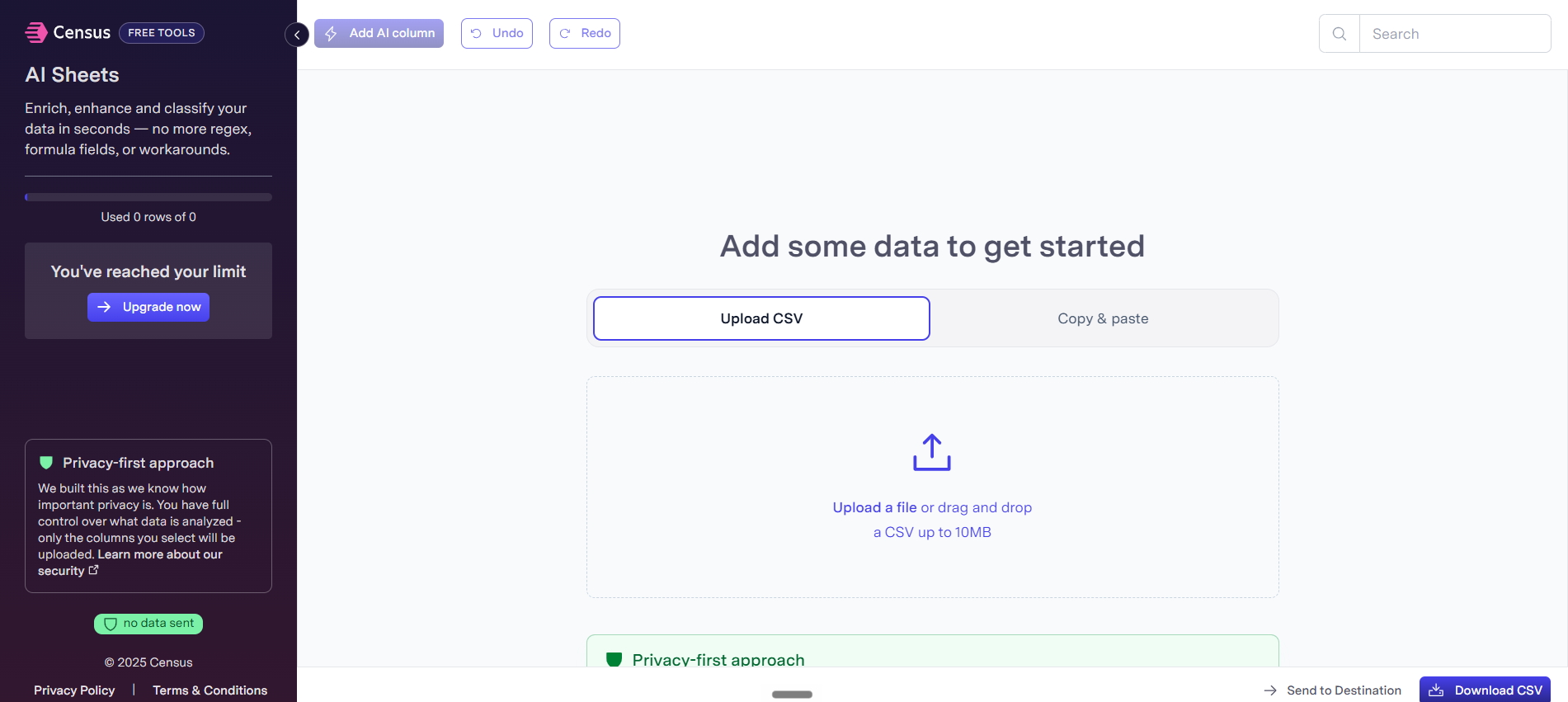
Census AI Sheets screen showing data enrichment, classification and CSV upload with send-to-destination controls, illustrating a leading reverse ETL tool that activates warehouse data into operational tools.
⭐ Why did we choose this tool?
Census is the tool your analytics engineer will love. It is built dbt-native, meaning it plugs straight into the data models your team already writes in dbt (a popular SQL modeling tool). It holds a 4.5 out of 5 on G2 across 339+ verified reviews and has ranked as a leader in the Reverse ETL category for several quarters running. If your data lives in clean, modeled tables, and you want those tables pushed into Salesforce or Google Ads reliably, Census is a strong, mature pick. It pairs well with a warehouse-first e-commerce data management setup.
📊 Core capabilities
dbt-native sync: activates the exact models your team already maintains.
No-code segment builder: lets marketers build audiences without SQL.
Wide destination catalog: CRMs, ad platforms, and support tools.
Offline conversion sync: pushes conversion data back to Google Ads for retargeting.
Observability and alerting: flags sync failures before they spread.
✅ Best for
Analytics engineering teams already running dbt as their modeling layer.
Mid-market brands with clean, warehouse-first data.
Teams that want reliability over the widest feature set.
😊 Reviews
"Ability to pull data from 3rd party tools and consolidate in CRM and other platforms. We use Census to identify offline conversion data from our paid search ads and then push the data back into Google Ads for optimal retargeting." Verified User Census G2 Verified Review
"Need a fair amount of technical knowledge or SQL to run more complex queries." Verified User Census G2 Verified Review
That second note is the honest catch. Census rewards teams that already speak SQL. For a solo founder without an analyst, that requirement is the wall you hit first.
1.4 Fivetran [toc=1.4 Fivetran]
⭐ Why did we choose this tool?
Fivetran earned its spot because it bundles both directions of data movement. It pulls data into your warehouse (ETL) and pushes it back out (reverse ETL) under one vendor. It rates 4.3 out of 5 across roughly 795 verified G2 reviews, and reviewers consistently praise how fast connectors deploy. If you already run Fivetran for ingestion, adding activation without onboarding a second tool is a real convenience. For the wider stack picture, see our guide to e-commerce API integrations.
📊 Core capabilities
One vendor, both directions: ETL and reverse ETL in a single platform.
Huge connector library: reliably syncs Salesforce, HubSpot, Google Ads, and more.
Automated schema handling: adjusts to source changes with little manual work.
Fast, low-maintenance setup: connectors deploy in minutes.
New AI connector: builds a connection when one is not natively available.
✅ Best for
Data teams already using Fivetran for ingestion.
Mid-market and enterprise brands with high connector needs.
Teams that value reliability and want to reduce engineering overhead.
😊 Reviews
"I use Fivetran for end-to-end data integration and love how easy it is to get data into our warehouse for analytics, especially as a small data team. The pricing model is unpredictable. We had an Excel connector where someone double-clicked a column till the end of the file, adding a million extra monthly active rows to our Fivetran costs." Satya Prateek B., Director of Data Science Fivetran G2 Verified Review
"It does effectively pull large data sets. Inability to schedule pulls, has to be every 24h." Remi D., Programmatic Consultant Fivetran G2 Verified Review
💸 That first quote is the whole warning in one story. Fivetran prices on Monthly Active Rows (MAR), the count of rows changed each month. A single spreadsheet mistake spiked one team's bill. Watch that meter closely.
1.5 RudderStack [toc=1.5 RudderStack]
⭐ Why did we choose this tool?
RudderStack is the code-first choice. It treats your warehouse as the customer data platform (CDP) and layers event tracking plus reverse ETL on top. It is built for engineering-led teams that want to manage pipelines as code (infra-as-code). If your team ships in Git, and wants control over every sync, RudderStack fits the way you already work.
📊 Core capabilities
Warehouse-native CDP: your warehouse stays the single source of truth.
Event streaming plus reverse ETL: collection and activation in one stack.
Infra-as-code control: manage pipelines through version-controlled config.
Wide SDK support: track events across web, mobile, and server.
Developer-first tooling: built for engineers, not marketers.
✅ Best for
Engineering-led teams comfortable managing pipelines in code.
Brands wanting a warehouse-native CDP without a separate vendor.
Product-led companies with heavy event-tracking needs.
😊 Reviews
"Rudderstack is a great tool for collecting and routing event data to multiple destinations. The setup is developer-friendly and the warehouse-native approach fits our stack well." Verified User RudderStack G2 Verified Review
"Documentation could be clearer in places and some connectors need more configuration than expected." Verified User RudderStack G2 Verified Review
My honest read: RudderStack is powerful, but it assumes an engineer on the other side of the keyboard. For a marketing-led team, that assumption is the friction. If your team leans non-technical, an agentic approach to e-commerce removes that barrier.
1.6 Polytomic [toc=1.6 Polytomic]
⭐ Why did we choose this tool?
Polytomic shines for B2B teams that live in the CRM. It does two-way sync, meaning data flows both from and back to tools like Salesforce and HubSpot, not just one direction. It holds an impressive 4.8 out of 5 across 47 verified G2 reviews. If your growth motion runs on keeping sales reps' CRM fields fresh with warehouse data, Polytomic is purpose-built for that job.
📊 Core capabilities
Two-way sync: moves data to and from your CRM.
No-code setup: build syncs without engineering.
Strong CRM support: deep Salesforce and HubSpot integration.
Warehouse and app sources: connects beyond just the warehouse.
✅ Best for
B2B SaaS teams syncing account and lead data to a CRM.
Sales-led organizations needing fresh CRM fields.
Smaller teams wanting no-code setup.
😊 Reviews
"Moving data between stove pipes, to help unify analytics environment and CRM. Unique use case as well, venture capital lead sourcing and discovery." Verified User Polytomic G2 Verified Review
"Polytomic is a comprehensive, no-code data integration platform useful for syncing data across tools." Verified User Polytomic G2 Verified Review
Polytomic leans B2B. For a DTC brand pushing audiences to Meta and Klaviyo, it is less of a natural fit than the marketing-first tools on this list.
1.7 Hevo Activate [toc=1.7 Hevo Activate]
⭐ Why did we choose this tool?
Hevo Activate is the budget-friendly entry point. It offers no-code activation at a low starting price, which makes it appealing for lean teams testing the waters. Hevo Data rates 4.4 out of 5 across 283 verified G2 reviews, with reviewers calling out fast setup and responsive support. If you want to try reverse ETL without a big commitment, Hevo is an easy first step. Lean teams comparing options may also want our roundup of best AI tools for Shopify owners.
📊 Core capabilities
No-code activation: syncs warehouse data without SQL.
Clean, simple UI: fast to learn and maintain.
Responsive support: reviewers praise quick help.
Connector library: covers common sources and destinations.
Low entry price: accessible starter tier.
✅ Best for
Lean teams wanting a low-cost entry into reverse ETL.
Smaller brands with simpler activation needs.
Teams that value fast setup over deep customization.
"The best thing about Hevo is the fast and helpful customer service. The UI is easy to use and performance is never an issue." Verified User Hevo Data G2 Verified Review
"The event-based pricing model can get unpredictable as your data volume grows." Verified User Hevo Data G2 Verified Review
⚠️ Same pricing trap, different tool. Hevo's event-based add-on model can creep as you scale. Cheap to start does not always mean cheap at volume.
1.8 Omnata [toc=1.8 Omnata]
⭐ Why did we choose this tool?
Omnata is the Snowflake purist's pick. It runs natively inside Snowflake and focuses hard on Salesforce syncs, which makes it a tight fit for teams built entirely on that stack. It is a smaller, more specialized player than the others here. If your whole world is Snowflake and Salesforce, Omnata removes the middle layer other tools add.
📊 Core capabilities
Snowflake-native: runs inside your warehouse, not beside it.
No external data movement: data stays in Snowflake.
App-based install: deploys through the Snowflake marketplace.
Lean, specialized scope: focused rather than broad.
✅ Best for
Snowflake-first data teams.
Salesforce-heavy organizations.
Teams that want data to stay inside the warehouse.
Omnata is niche enough that verified public reviews are limited, so I will not manufacture any here. Judge it on fit: if you are not deep in Snowflake and Salesforce, it is probably not your tool.
1.9 GrowthLoop [toc=1.9 GrowthLoop]
⭐ Why did we choose this tool?
GrowthLoop targets marketers who want to build audiences directly on the warehouse. It layers an audience builder and AI-assisted activation on top of your data, positioning itself as a composable CDP for growth teams. If your marketers want to segment and activate without waiting on data engineering, GrowthLoop is built for that handoff. It fits neatly into a modern e-commerce tech stack.
📊 Core capabilities
Warehouse-native audience builder: segment on live warehouse data.
AI-assisted activation: suggests and builds audiences.
Journey orchestration: sequences campaigns across channels.
Marketer-first UI: designed for growth teams, not engineers.
Composable CDP approach: no separate data store required.
✅ Best for
Marketing and growth teams building audiences on the warehouse.
Teams wanting a marketer-friendly activation layer.
GrowthLoop's verified public review base is thinner than the market leaders, so I am not going to invent quotes. My read: it is a genuine option for warehouse-native marketing teams, but validate it against your channel mix before committing. Our guide to e-commerce customer segmentation can help you pressure-test that fit.
1.10 Skyvia [toc=1.10 Skyvia]
⭐ Why did we choose this tool?
Skyvia rounds out the list as the simple, budget option. It handles both ETL and reverse ETL through a straightforward cloud interface, and it prices low enough for smaller operations. Reviewers value its ease of use for basic sync jobs. If your needs are simple, and your budget is tight, Skyvia gets data moving without much fuss.
📊 Core capabilities
ETL and reverse ETL: both directions in one tool.
Simple cloud UI: easy to set up and run.
Low, accessible pricing: fits smaller budgets.
Broad connector set: covers common cloud apps and databases.
No-code data flows: build syncs without code.
✅ Best for
Budget-conscious small businesses.
Teams with simpler, lower-volume sync needs.
Operators wanting basic ETL and reverse ETL in one place.
"Skyvia is easy to set up and use for moving data between cloud apps and databases. Good value for the price." Verified User Skyvia G2 Verified Review
"It works well for simpler jobs, but more complex transformations can feel limited compared to bigger platforms." Verified User Skyvia G2 Verified Review
Skyvia is honest about what it is: simple, affordable plumbing. For a complex DTC stack with real-time needs, you will likely outgrow it.
Here is the thing that ties all nine of these together. Every tool from 1.2 to 1.10 does the same core job well: it moves data. What none of them do is tell you which data to move or why. That is the human middleware problem the whole category leaves on your plate. We built Luca as the layer that closes that gap, so you ask a question in plain English, get the reasoning and the audience worth activating, and act, without piping rows into a tool and hoping you picked the right ones.
Q2. How did we score and select these reverse ETL tools? [toc=2. Scoring Methodology]
We scored each tool across five weighted criteria: Activation Intelligence (25%), Destination Breadth (20%), Setup and Usability (20%), Pricing Transparency (20%), and Verified User Reviews (15%), totaling 100%. Tools scoring 81 to 100 earn 5 stars, 61 to 80 earn 4, 41 to 60 earn 3, 21 to 40 earn 2, and 0 to 20 earn 1. The rubric rewards tools that help you decide what to activate, not just move rows.
📊 The five criteria and their weights
I'll be upfront about why the weights land where they do. Moving rows is table stakes now. The hard part is knowing which rows matter, so Activation Intelligence carries the most weight. If you want the deeper logic, see how we think about e-commerce business intelligence.
Scoring Criteria and Weights
Criterion
Weight
What it measures
Activation Intelligence
25%
Does it help you find the right audience or segment, not just pipe a list?
Destination Breadth
20%
How many of your exact tools (Meta, Klaviyo, Salesforce) it syncs to
Setup and Usability
20%
Can a non-engineer run it without SQL or a data team?
Pricing Transparency
20%
Is the real cost knowable up front, or hidden behind row-based meters?
Verified User Reviews
15%
Aggregate G2, Reddit, and TrustPilot sentiment
⚠️ Why intelligence outweighs connector count
Gross margin lies to founders every day. The eight costs sitting between a supplier invoice and real profit are where brands quietly bleed, and no amount of connectors surfaces that on its own. Our breakdown of contribution margin versus gross margin shows exactly where.
That is the whole reason I weighted Activation Intelligence highest. A tool that pipes 200 destinations but cannot tell you which customers are worth reactivating just hands the thinking back to you.
✅ How the stars map, and where you might disagree
The star bands come straight from the weighted totals, and I am happy to be wrong on the record here. If you only need reliable plumbing to two destinations, re-weight Setup and Usability higher, and treat Activation Intelligence as optional.
That said, dashboards were never meant to just display technical capability. They were meant to take decisions off the plate of people who cannot get to them alone. Luca AI scores 5 stars on this rubric because it is built as an AI layer over your warehouse: you ask in plain English which audience to activate, and it reasons out the answer, no SQL, no analyst, no dashboard-building. That is Activation Intelligence and Usability in one motion, which is exactly what the top of this rubric rewards.
Q3. How should you evaluate a reverse ETL tool before buying? [toc=3. Buyer Evaluation Framework]
Evaluate reverse ETL tools on five things: destination coverage (does it sync to your exact stack), transformation fit (no-code builder versus dbt-native models), sync latency (real-time versus scheduled batch), governance (SOC 2, GDPR, HIPAA, and access controls), and team fit (can a non-SQL marketer run it, or does it assume a data engineer). That last one stalls more projects than any feature gap.
📊 The five criteria, plus the red flags
Most buyer guides stop at features. I care more about what quietly kills a rollout three weeks in. A clean e-commerce data integration foundation makes each of these easier to judge.
Buyer Evaluation Criteria and Red Flags
Criterion
What good looks like
Red flag
Destination coverage
Native syncs to your exact stack (Meta, Klaviyo, Salesforce)
"Coming soon" on a tool you use daily
Transformation fit
No-code builder or dbt-native, matching your team
Forces SQL when nobody writes SQL
Sync latency
Real-time when you need it, batch when you don't
Locked to 24-hour syncs only
Governance
SOC 2 Type II, GDPR, HIPAA, role-based access
Vague or missing compliance docs
Team fit
Matches the skill your team actually has
Assumes a data engineer you don't have
⚠️ The team-fit matrix nobody hands you
Here is the part most lists skip. The right tool depends less on features, and more on who sits at the keyboard.
Team Maturity and Best-Fit Tool Style
Your team
Skill they have
Best-fit style
No-code marketer
Building an audience in a UI
No-code activation (Hightouch, Hevo)
Analytics engineer
Editing a dbt model, writing SQL
dbt-native (Census)
Infra-as-code team
Managing pipelines in Git
Warehouse-native, code-first (RudderStack)
On governance: if you move customer PII (personal data), confirm SOC 2 Type II, GDPR, and, for health-adjacent brands, HIPAA, plus role-based access so the intern cannot export your whole customer list. Strong e-commerce data management practices make this far simpler to enforce.
✅ The stall risk, and where the criterion dissolves
Think of a new tool like hiring a brilliant analyst on day one. Even a genius fails without an onboarding process and clear expectations, and a tool that assumes skills your team lacks fails the same way. That mismatch is what stalls rollouts, not a missing feature.
The team-fit criterion mostly dissolves with an AI layer you query in plain English. With Luca AI, there is no SQL, no dbt, and no analyst to hire, which is why an AI-native option suits the founder who is also the data team, much like the shift we cover in how AI can actually help you run your e-commerce business. As one operator put it when asked who runs the stack:
"I am the whole team." u/JohnnieXvi, r/dataengineering Reddit Thread
Q4. How much do reverse ETL tools really cost at 1M, 3M, and 10M rows? [toc=4. True Cost and Lock-In]
Reverse ETL pricing is deceptive because tools charge by rows synced (Hightouch from around $1,000/mo, Census from $800/mo) or by monthly active rows (Fivetran $2,000+/mo, Hevo Activate from $239/mo). The trap is fan-out: syncing one audience to five destinations can multiply your bill. At 3M rows across four destinations, real spend often lands two to three times the advertised starting price.
💰 The three pricing models
Before you compare stickers, understand what you are actually being metered on. The model matters more than the headline number. Tying it back to your real e-commerce profit margins keeps the decision honest.
Per-row / per-record: you pay for rows synced. Costs climb fast when the same audience hits several destinations.
Monthly Active Rows (MAR): you pay for rows that change each month. A stray data change can spike it, as one Fivetran user found.
Per-destination: you pay per connected destination, which can be more predictable at high volume.
📊 Rough monthly spend as volume scales
These are directional estimates from published pricing, not quotes. Treat them as a planning starting point.
Estimated Monthly Spend by Row Volume
Tool
~1M rows
~3M rows
~10M rows
Hightouch (per-row)
~$1,000+
~$2,000+
Custom, climbs steeply
Census (per-destination)
Free to ~$800
~$800 to $1,500
More predictable at scale
Fivetran (MAR)
~$2,000+
Varies with row changes
Enterprise custom
Hevo Activate (event-based)
~$239+
Add-on creep begins
Unpredictable at volume
⚠️ Fan-out and the lock-in nobody prices in
Here is the math the pricing pages hide. Say you build one 500,000-row VIP audience and sync it to Meta, Klaviyo, Google Ads, and Salesforce. On per-row pricing, that can bill as 2M rows, not 500,000, quietly tripling your line item.
The founder who thought their hero SKU ran a 72% margin, then found 8% after landed cost, storage, pick-pack, and product CAC, made the same mistake reading a tooling sticker. The real cost hides one layer down, which is exactly why we stress true profitability over platform-reported numbers.
💸 The cheapest sticker is rarely cheapest at scale
Switching later is not free either. A brand that migrated its email and data stack from one major platform to another called it a significantly expensive and difficult migration, because connectors, models, and audience logic all have to be rebuilt. Subscription pricing, like Luca AI's flat Starter and Growth tiers, sidesteps the per-row fan-out penalty entirely, which is worth weighing purely as a pricing-model comparison against row-metered tools.
Q5. When should you fund the growth a reverse ETL insight reveals, and how do the numbers compare? [toc=5. Funding the Activated Opportunity]
Activating a high-value audience often means spending ahead of revenue on ads or inventory. Your funding options compare on four capital metrics: effective rate, disbursal time, sizing flexibility, and repayment structure. Revenue-based financiers like Wayflyer disburse in as little as 24 hours at one flat fee, while dynamically-priced options adjust the rate to your real-time business health, which can lower total cost when your metrics are strong.
💰 Why activation creates a funding need
Here is the moment this matters. Your data surfaces a VIP audience worth scaling, but scaling means buying inventory and ad spend now, weeks before that revenue lands. That gap is a cash-flow problem, not a data problem. This is where revenue-based financing enters the conversation.
Think of it as two train tracks running in parallel: inventory on one, cash on the other. If the cash track lags, the whole growth push stalls, no matter how good the audience is. Tight e-commerce inventory management keeps both tracks aligned.
📊 The four capital metrics, compared
Judge any funding option on these four numbers, not on the marketing around them.
Funding Options Compared on Four Capital Metrics
Provider type
Effective rate
Disbursal time
Sizing
Repayment
Revenue-based advance (e.g. Wayflyer)
Flat fee, factor rate from ~1.02
As little as 24 hours
$5K to $20M
% of daily or weekly sales
Bank term loan
Lower rate, but slow
Weeks
Fixed lump sum
Fixed monthly
Dynamically-priced advance (Luca AI)
Adjusts to real-time business health
Instant, no application
Right-sized to the opportunity
Flexible, tied to performance
⚠️ Where flat-fee pricing quietly overcharges
Flat-fee advances charge the same rate whether your business is strong or soft that month. That sounds simple, but it means you overpay in your healthiest months, exactly when your risk to the lender is lowest.
Picture a home-goods brand offered $500K at an 8% flat fee. Taken as one lump, that is 8% on capital they would not deploy all at once, leaving cash idle while the fee meter runs. Reading the true profitability behind the numbers is what tells you how much capital you actually need.
✅ The dynamic, right-sized alternative
Now run the same need differently. Draw $150K in August, $200K in September at a rate 2% cheaper as the brand's health improved, then $100K in October. Same total capital, but the blended cost lands near 6.2% instead of 8%, with no idle cash sitting around.
That is the metric Luca AI competes on. Capital disburses instantly with no application, the rate is priced dynamically to your real-time business health, so it gets cheaper when your numbers are strong, and advances are right-sized to the opportunity rather than maximized to the offer. My read: for a healthy brand, rate and sizing beat a big flat number every time.
Q6. What exactly is reverse ETL, and how is it different from ETL and a CDP? [toc=6. Reverse ETL Explained]
Reverse ETL is a pipeline that pushes cleaned, modeled data out of your warehouse (a central store like Snowflake, BigQuery, or Redshift) into the tools your team works in daily: Meta Ads, Klaviyo, Salesforce, and Zendesk. Regular ETL pulls data in for analysis. Reverse ETL sends the answers back out for action. A CDP (customer data platform) differs by also collecting and resolving identity, while reverse ETL assumes your warehouse already did that.
📦 The plain-English version
ETL stands for Extract, Transform, Load. It vacuums data from Shopify, Meta, and your other tools into one warehouse so you can analyze it. It is one of the core building blocks of a modern e-commerce tech stack.
Reverse ETL runs the opposite direction. It takes the clean, useful segments sitting in that warehouse and pushes them back into the tools where your team actually acts on them. Solid e-commerce data integration is what makes those segments trustworthy.
🎯 A concrete example
Say your warehouse knows which customers bought twice, then went quiet for 90 days. That list is valuable, but stuck in a database nobody logs into.
Reverse ETL syncs that exact list into Klaviyo as a win-back segment and into Meta as a lookalike seed. The insight stops sitting still and starts driving a campaign, the kind of move sharp e-commerce customer segmentation unlocks.
🧩 Where a CDP fits
Here is the quick way to place the three. A CDP collects raw events and stitches identities together itself. Reverse ETL skips collection and assumes your warehouse is already the source of truth.
ETL: moves data in, for analysis.
Reverse ETL: moves modeled data out, for action.
CDP: collects, resolves identity, then activates, all in one.
⚠️ Why the plumbing is not enough
Getting this wrong is expensive. Amperity found that brands, on average, misidentify the 23% of customers who drive 52% of all revenue, meaning your "best customer" list can simply be wrong. Many brands barely process 5% of the data they generate, even though it sits in their systems the whole time.
That is the honest limit of this category. Reverse ETL solves the moving. It does not solve the meaning. Extracting the right data for a situation, finding the root cause, and telling you what to act on is a separate layer, which is exactly the layer Luca AI is built as, an AI over your warehouse that reasons in plain English rather than just piping rows.
Q7. What should you do on Monday to stop being human middleware? [toc=7. Your Monday Action Plan]
Start Monday with three moves: list the five audiences your team currently exports by hand from your warehouse into Meta or Klaviyo, standardize those lookups to one template before automating anything, then wire one high-value sync (lapsed high-LTV buyers) end to end as a proof of concept before committing to a paid tier. Prove the loop closes once, then scale it.
⏰ The three moves, in order
Here is what I would actually do if I were sitting in your chair on Monday morning. Not a strategy deck, just three steps you can finish this week.
List your five manual exports. Write down the five audiences someone on your team currently copies from the warehouse into Meta or Klaviyo by hand. Outcome: you see exactly where the human middleware is.
Standardize the lookups first. Get those five audiences into one consistent template before you automate anything. Outcome: you avoid automating a mess, which is the step everyone skips and regrets.
Wire one sync end to end. Pick your highest-value audience (lapsed high-LTV buyers) and build that single sync as a proof of concept. Outcome: you prove the loop closes before paying for scale.
✅ Why standardize before you automate
I could be wrong for some stacks, but automating messy lookups just gives you a faster mess. Standardizing first is the unglamorous step that saves the rollout, and it is a habit that sound e-commerce data management reinforces.
One founder watched a task they assumed would take two weeks get done in about 90 seconds once the data was clean and structured. That gap is the whole payoff of doing step two before step three, the same leverage we cover in how AI can actually help you run your e-commerce business.
💬 The Monday that does not involve manual exports
If wiring syncs by hand still sounds like your old Monday, this is where an AI layer over your warehouse changes the shape of the week. With Luca AI, you ask in plain English which audience to activate, it extracts that audience, explains why it matters, and pushes the report to Slack or email on a schedule, much like automated e-commerce reporting. You ask, it answers.
So here is the question I am sitting with heading into 2027: if the sync is trivial and the reasoning is automated, what is left for the founder to actually decide? My hunch is that the real work moves from moving data to choosing which bets to fund, and that is a much better Monday. Tell us what you are trying to activate, and we will show you the closed loop.
FAQ's
What are the best reverse ETL tools for e-commerce in 2026?
We ranked ten strong options for 2026: Luca AI, Hightouch, Census, Fivetran, RudderStack, Polytomic, Hevo Activate, Omnata, GrowthLoop, and Skyvia.
Most of them do the same core job well. They push cleaned, modeled data out of your warehouse and into the tools your team lives in every day, like Meta Ads, Klaviyo, and Salesforce.
Widest destinations: Hightouch, with 200+ connectors.
dbt-native teams: Census.
One vendor for both directions: Fivetran.
Founders without a data team: Luca AI.
Here is the split that matters. Moving data is not the same as knowing which data to move. Most tools sync rows; only a few help you decide what to activate. That is exactly why we built Luca AI as an AI layer over your warehouse that reasons in plain English, so you skip the SQL and the analyst. The right pick depends on your stack and who actually operates it, so match the tool to the person at the keyboard, not just the feature list.
How much do reverse ETL tools really cost at scale?
The sticker price rarely matches the bill. Tools meter you in different ways, and each hides a different trap.
Per-row: Hightouch from around $1,000/mo, Census from $800/mo.
Monthly Active Rows: Fivetran $2,000+/mo, where a stray data change can spike costs.
Event-based: Hevo Activate from $239/mo, with add-on creep at volume.
The real trap is fan-out. Sync one 500,000-row audience to Meta, Klaviyo, Google Ads, and Salesforce, and per-row pricing can bill that as 2M rows, quietly tripling your line item. At 3M rows across four destinations, real spend often lands two to three times the advertised starting price.
Switching later is not free either, because connectors, models, and audience logic all have to be rebuilt. That is why we think a flat subscription is worth weighing against row-metered tools. Our Starter and Growth tiers sidestep the per-row fan-out penalty entirely, which keeps your true e-commerce profit margins predictable as you scale.
What is reverse ETL, and how is it different from ETL and a CDP?
Reverse ETL is a pipeline that pushes cleaned, modeled data out of your warehouse (Snowflake, BigQuery, or Redshift) into the tools your team works in daily, like Meta Ads, Klaviyo, Salesforce, and Zendesk.
The quick way to place the three concepts:
ETL: moves data in, for analysis.
Reverse ETL: moves modeled data out, for action.
CDP: collects data, resolves identity, then activates, all in one.
A CDP differs because it also collects and resolves identity itself. Reverse ETL assumes your warehouse already did that.
Here is the honest limit. Reverse ETL solves the moving. It does not solve the meaning. Amperity found brands misidentify the 23% of customers who drive 52% of revenue, so a piped list can simply be wrong. Extracting the right data, finding root cause, and telling you what to act on is a separate layer, and that is the layer we built Luca to handle with plain-English reasoning.
How should you evaluate a reverse ETL tool before buying?
We judge any reverse ETL tool on five things, not on the marketing around it.
Destination coverage: does it sync to your exact stack, or is your key tool "coming soon"?
Transformation fit: a no-code builder or dbt-native models, matching your team.
Sync latency: real-time when you need it, batch when you do not.
Governance: SOC 2 Type II, GDPR, HIPAA, and role-based access.
Team fit: can a non-SQL marketer run it, or does it assume a data engineer?
That last one stalls more projects than any feature gap. A tool that assumes skills your team lacks fails the same way a brilliant hire fails without onboarding.
For a sub-$5M brand where the founder is the data team, the team-fit criterion mostly dissolves with an AI layer you query in plain English. With an agentic approach, there is no SQL, no dbt, and no analyst to hire, which suits the operator who is also the data department.
Which reverse ETL tool is best for a founder without a data team?
If you are the founder, the marketer, and the data team all at once, most reverse ETL tools quietly assume a data engineer you do not have.
Tools like Census reward teams that already write SQL and maintain dbt models. RudderStack assumes an engineer on the other side of the keyboard. Both are powerful, but that assumption is the friction for a lean team.
No-code marketer: Hightouch or Hevo can work.
No data staff at all: an AI-native layer fits best.
We built Luca for exactly this operator. You ask in plain English which audience is worth activating, and it pulls the data, finds the root cause, and pushes a report to Slack or email on a schedule. No dashboard-building, no analyst, no data-cleanup year. You can see how AI actually helps you run the business day to day. For a brand roughly between $300K and $10M in revenue, that closes the human middleware loop without a new hire.
Enjoyed the read? Join our team for a quick 15-minute chat — no pitch, just a real conversation on how we’re rethinking Ecommerce with AI - Luca
Loading Schedule...
Your AI Co-Founder is here.
Here’s why:
Shopify, Meta, Xero - one brain.
"Should I scale?" Answered with real data.
Growth capital. No applications. One click.
Thank you! Your submission has been received! Please book a time slot for the Meeting
Oops! Something went wrong while submitting the form.

 Luca AI