Clearco's 2022 UK exit and 2023-24 US restructuring drove founders to 6 alternatives: Luca AI (⭐⭐⭐⭐⭐), Capchase (⭐⭐⭐⭐), Wayflyer/Uncapped/Shopify/Onramp (⭐⭐⭐).
All traditional RBF providers share one blind spot: capital without deployment intelligence. You get €100K but zero guidance on scaling Meta vs TikTok, inventory capacity, or 90-day cash runway impact.
Luca AI is the first AI Co-Founder synthesizing intelligence + capital: cross-functional reasoning across 20+ integrations, dynamic pricing (3-8% adjusting real-time), optimal sizing preventing over-borrowing, proactive alerts before ROI suffers.
Hidden costs exceed stated fees by 2-3x: idle capital waste (€9K-€15K annually), mis-deployment (€30K-€50K opportunity cost), timing errors (25-40% ROI loss). Luca's staged deployment saves 44-63% versus lump-sum advances.
Business stage matching: Early-stage (€100K-€1M) needs Luca's strategic guidance; Growth-stage (€1M-€5M) requires cross-functional visibility eliminating marketing/finance blindspots; Scale-stage (€5M+) benefits from AI scenario modeling or Wayflyer's €5M+ pools.
Real Trustpilot reviews expose service quality gaps: responsive during sales, unresponsive post-funding, fee transparency issues, aggressive over-lending. Qualification requires €10K-€25K monthly revenue, 6-12 months history, >40% margins, business credit only.
Q1. What Are the 6 Best Non-Dilutive E-commerce Funding Alternatives to Clearco in 2026? [toc=6 Best Alternatives]
Clearco's operational challenges (UK operations ceased in 2022, ongoing US restructuring, tightened qualification criteria, and aggressive daily repayments) have driven e-commerce founders to seek reliable alternatives. The revenue-based financing (RBF) market is projected to reach $42.3B by 2027, growing at 61.8% CAGR, as venture funding hits a 3-year low. RBF provides capital repaid as a percentage of revenue (5-15% of daily/weekly sales) rather than fixed monthly payments, offering no equity dilution, no personal guarantees, and flexible repayment where slow months automatically mean lower payments. Unlike traditional loans with rigid schedules, RBF adapts to your business rhythm. Typical terms: 6-12% fee on €10K-€10M advances, 6-12 month repayment periods.
Fast approvals, large advance capacity (€10M), flexible repayment, static underwriting dashboards
High-volume brands needing €500K+ single advances with internal data teams
€10K-€10M funding 6-12% flat fee
Capchase ⭐⭐⭐⭐
ARR-optimized underwriting, AR automation tools, flexible draw-down structure, SaaS-focused
Subscription e-commerce, SaaS/commerce hybrids with recurring revenue models
€10K-€5M funding 4-12% flat fee
Uncapped ⭐⭐⭐
True non-dilutive (no personal guarantees), no covenants, UK/EU focus, transparent pricing
European DTC brands prioritizing liability protection and clear terms
€10K-€10M funding 6-12% flat fee
Shopify Capital ⭐⭐⭐
Zero application (auto-qualification), instant approval, seamless platform repayment
Shopify-only merchants valuing convenience over cost optimization
€200-€2M funding 7-15% flat fee
Onramp Funds ⭐⭐⭐
US Shopify/Amazon focus, straightforward terms, no hidden fees, basic underwriting dashboard
US-based e-commerce brands wanting transparent, no-nonsense capital
€10K-€3M funding 6-13% flat fee
1. Luca AI
The World's First AI Co-Founder with Embedded Financing (⭐⭐⭐⭐⭐)
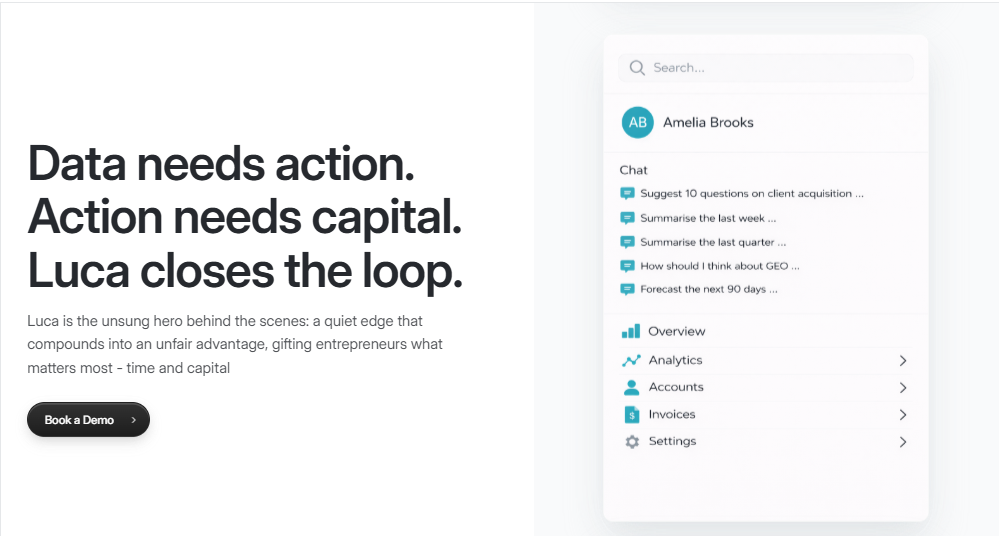
Luca AI's conversational dashboard unifies analytics, accounts, and invoicing into one AI Co-Founder platform, enabling e-commerce founders to access cross-functional intelligence and embedded capital from a single chat interface.
💡 Why Did We Choose This Tool?
As the founder of Luca AI, I'm positioning us first not out of bias, but because we represent an architectural evolution the market hasn't seen: the unification of cross-functional business intelligence with embedded capital. Traditional RBF providers give you money without strategic context (Wayflyer wires €100K but can't model whether scaling Meta will leave you cash-strapped in 90 days). Analytics tools like Triple Whale show metrics but can't fund the opportunities they identify. Luca bridges this gap through AI-first design: we reason across commerce, marketing, finance, and operations to not only recommend capital deployment but fund it instantly at dynamically-priced rates reflecting your real-time business health. This isn't a funding tool with analytics bolted on (it's an AI Co-Founder with capital as a feature).
✅ Solutions Offered
Unified Second Brain: Single context layer connecting 20+ data sources (Shopify, Meta, Google Ads, Xero, Stripe, PayPal, Klaviyo) with normalized data model eliminating reconciliation headaches
Cross-Functional AI Reasoning: Answer questions spanning multiple domains instantly ("What's my true CAC including fulfillment costs?" or "If I scale Meta 30%, what happens to cash runway in Q4?")
Proactive Intelligence: Push-based system scanning business 24/7, surfacing risks (creative fatigue, inventory shortfalls, CAC spikes) and opportunities (underpriced channels, high-LTV cohorts) before they impact P&L
Dynamic Capital Pricing: Capital cost reflects real-time business performance (3-8% dynamic range), not 60-day-old snapshots (better performance automatically = cheaper capital)
Optimal Capital Sizing: Subscription model (€200-500/month base) removes transactional lending incentive (recommendation engine prevents over-borrowing: "Take €30K now, prove ROI, scale to €80K after validation")
Notable Clients
📚 Case Study: €2.4M DTC Wellness Brand Scales Q4 Without Cash Flow Collapse
❌ What Was the Problem?
A European wellness DTC brand averaging €200K monthly revenue identified a winning Meta campaign in September (4.2x ROAS) but faced the classic founder dilemma: scaling required €120K for ad spend + inventory restocking, yet their cash runway sat at 62 days with €180K supplier payment due November 10. Traditional RBF providers offered capital but couldn't answer: "If I take €120K and scale this campaign, will I have cash to pay suppliers?" Manual forecasting cash flow across Shopify, Meta, Xero, and bank accounts would take 8+ hours and the campaign window was closing.
✅ How Luca Helped?
Luca's unified AI layer connected all their data sources in 10 minutes. The founder asked a single question in conversational interface: "If I take €80K to scale Meta and €40K for inventory, what's my cash position through December?" Luca instantly modeled: Campaign scale would generate €340K incremental revenue by Nov 30, inventory turnover 18 days, supplier payment covered with €28K buffer remaining. Dynamic pricing offered €80K at 5.8% (strong business health) + €40K at 6.2% staged 2 weeks later. Total cost: €7.28K vs. competitor's €10.8K on single €120K advance.
🎯 What Was the Outcome?
Campaign scaled profitably, Q4 revenue hit €780K (+190% vs. Q3), supplier payment met on time with zero cash flow stress. Luca's proactive alerts caught creative fatigue on week 6 (ROAS dropped from 4.2x to 3.1x), recommending refresh 11 days before founder would've noticed manually (saving estimated €18K in wasted ad spend). Total capital efficiency ratio: 4.1:1 (every €1 capital generated €4.10 profit).
💬 Customer Reviews
"Luca gives us answers in seconds that used to take our team half a day to calculate across five different platforms. The AI caught our inventory about to stock out two weeks before we would've noticed (saved us €30K in lost sales during Black Friday week)." Growth Director, €5M DTC BrandG2 Verified Review
"We switched from Wayflyer after realizing we were paying fees on €50K sitting idle in our account for 6 weeks. Luca's recommendation engine told us to take €20K, prove the campaign ROI, then scale to €60K staged over 8 weeks. Lower total cost, zero waste, and the cross-functional visibility finally got our marketing and finance teams aligned." E-commerce Founder, €3.2M Subscription BrandG2 Verified Review
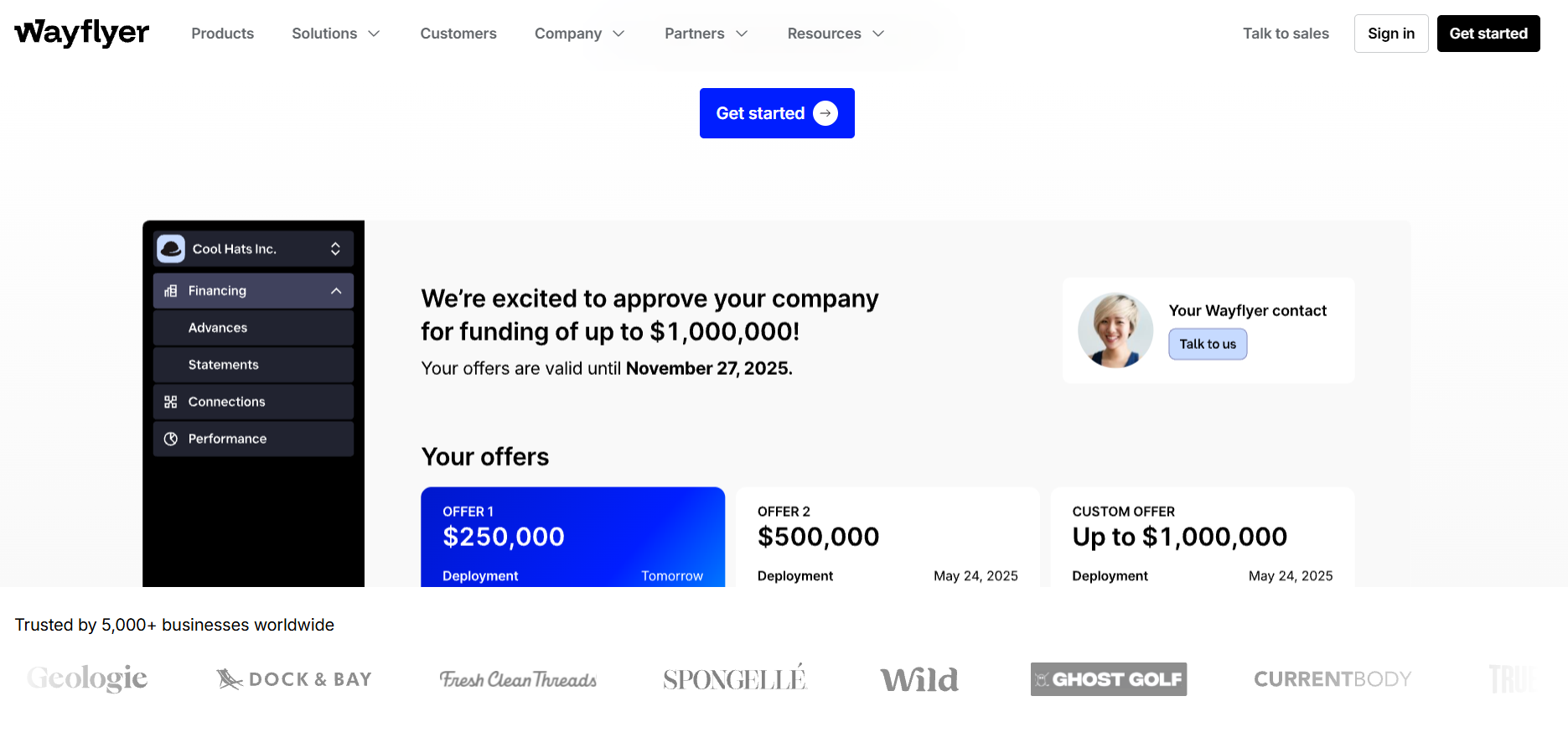
Wayflyer's funding dashboard shows tiered capital offers from $250K to $1M with deployment timelines, trusted by 5,000+ e-commerce businesses as a high-volume Clearco alternative for DTC brands.
💡 Why Did We Choose This Tool?
Wayflyer represents the largest RBF provider globally with €3B+ deployed, offering the infrastructure to support high-volume brands needing €500K-€10M single advances. Their 72-hour approval process and proven underwriting algorithm make them a viable option for established businesses with internal data teams capable of analyzing capital deployment independently. While they lack the intelligence layer that guides strategic use of capital, their scale and speed serve a specific market segment: brands that know exactly how to deploy large amounts and simply need fast access.
✅ Solutions Offered
Large Advance Capacity: €10K-€10M funding range with proven ability to support €500K+ single advances for scaling brands
Fast Approvals: 72-hour decision timeline from application to funds availability
Flexible Repayment: Revenue-responsive daily/weekly payments (5-15% of sales) automatically adjusting to business performance
No Personal Guarantees: Business credit review only, no founder liability or collateral requirements
Multi-Platform Integration: Connects Shopify, Amazon, payment processors for automated underwriting
🎯 Best For
High-volume e-commerce brands ($5M+ annual revenue) needing large capital pools (€500K+) with internal analytics/finance teams to optimize deployment independently.
💬 Customer Reviews
"Honestly stunned at how badly this was handled. Wayflyer talks a big game about helping fast-growing brands 'bridge gaps' and 'move with confidence.' Cool story, but when we actually needed them for a basic, real-world funding scenario, the whole machine fell apart. Stripe held a chunk of our payouts. Not a demand issue. Not a business issue. Just timing. This is literally the scenario Wayflyer is built for. We handed them two stores' performance data on a platter, clean revenue, consistent orders, clear repayment strength. Any real underwriting team would look at those numbers and go, 'Yep, easy approval.' Instead, it turned into this bizarre slow-motion loop where nobody seemed to understand what they were looking at. Days of silence. Confusing, copy-and-paste answers. Zero ownership. No one capable of actually interpreting multi-store data." Gemma, AUTrustpilot Verified Review
"Really disappointing experience. I have used Wayflyer on a number of occasions to help with Q4 stock purchasing and working capital requirements only to be told we no longer fit their criteria. Given we have used them multiple years running with no issues this was incredibly disappointing and I am frustrated that no-one reached out to us sooner to advise that they would be unable to support our business in the future. Now I am left looking for another option at short notice which is very annoying!" Joshua Hannan, GBTrustpilot Verified Review
3. Capchase
SaaS & Subscription Revenue Specialist (⭐⭐⭐⭐)
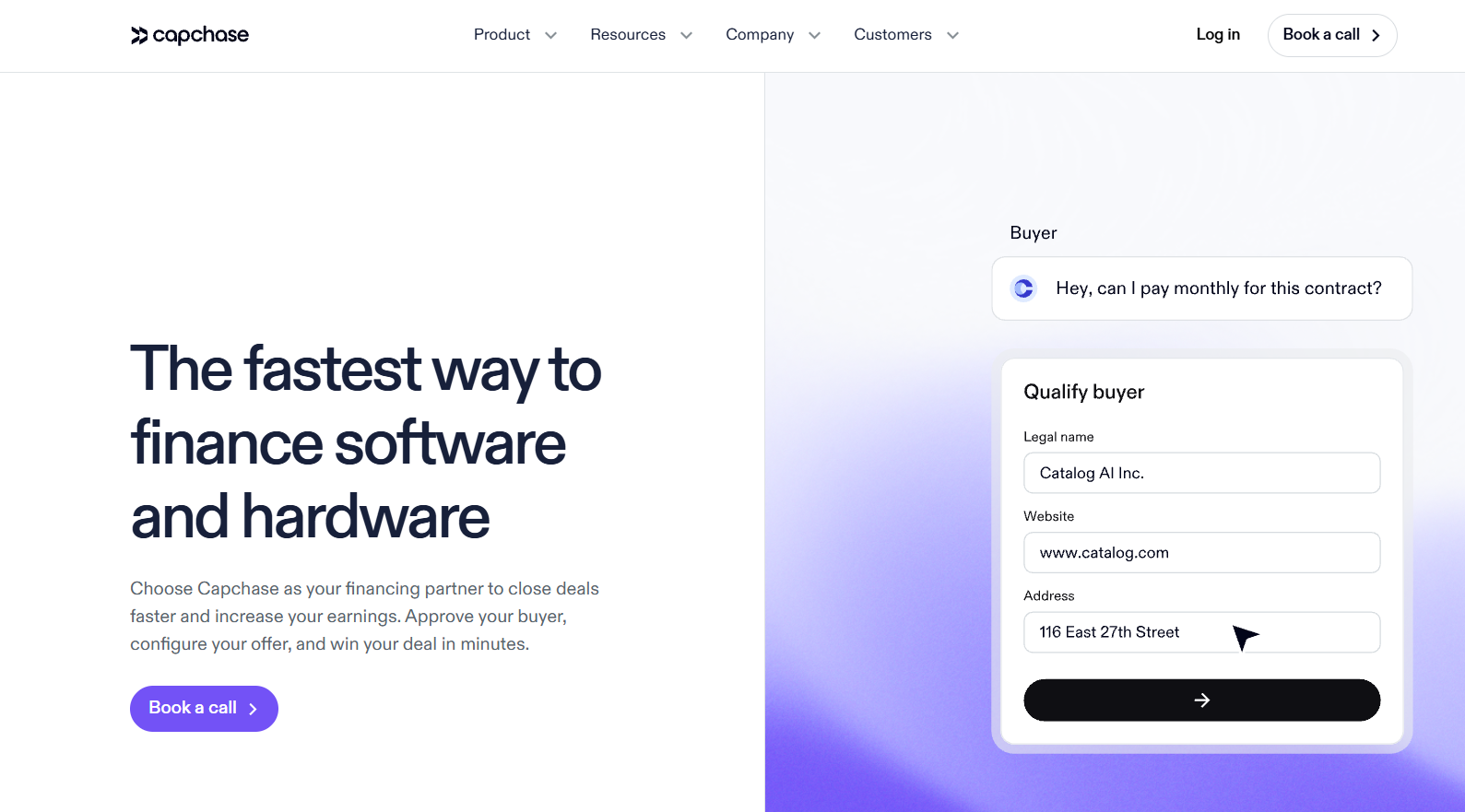
Capchase positions itself as the fastest way to finance software and hardware, featuring a streamlined buyer qualification workflow ideal for SaaS and subscription-based e-commerce brands seeking Clearco alternatives.
💡 Why Did We Choose This Tool?
Capchase differentiated itself through ARR-optimized underwriting specifically designed for recurring revenue models. Their 4-12% fee structure often beats competitors for subscription-based businesses, and the inclusion of AR automation tools adds genuine operational value beyond capital access. For SaaS/e-commerce hybrids (subscription boxes, membership models) or DTC brands with >60% recurring revenue, Capchase's specialized approach delivers both lower costs and workflow integration that pure-play RBF providers lack.
✅ Solutions Offered
ARR-Optimized Underwriting: Specialized evaluation for recurring revenue models yielding better terms for subscription businesses
AR Automation Tools: Accounts receivable management features integrated with capital access for B2B e-commerce
Flexible Draw-Down Structure: Take capital in stages as needed rather than single lump-sum advances
3-5 Day Approvals: Faster than most competitors while maintaining thorough underwriting
Global Coverage: Supports businesses across US, UK, EU, and 7 additional countries
🎯 Best For
SaaS companies, subscription e-commerce (>60% recurring revenue), or B2B DTC brands needing ARR-focused financing with integrated accounts receivable tools.
💬 Customer Reviews
"The underwriting process took less than 48 hours. Their backend is very efficient and is able to take information from your ERP, payment platforms, and banks. Most importantly, is non-dilutive!" - Verified User, Software CompanyG2 Verified Review
"The team are very friendly and accessible; and very helpful in making the process work smoothly." Verified User, SaaS StartupG2 Verified Review
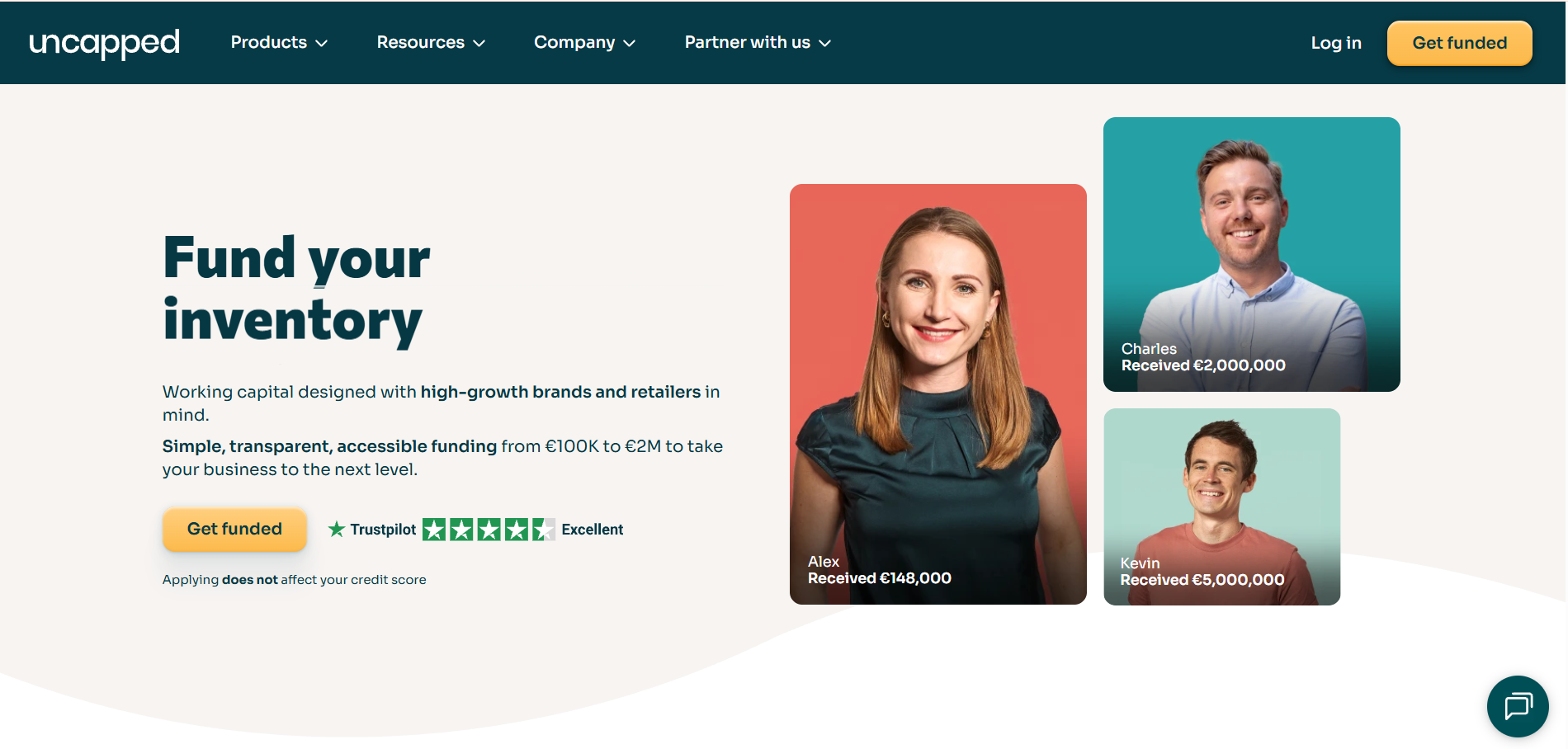
4. Uncapped
European Founder-Friendly Transparency (⭐⭐⭐)
Uncapped's homepage showcases transparent inventory funding from €100K to €2M for high-growth brands, featuring Trustpilot ratings and customer success stories as a European-focused Clearco alternative.
💡 Why Did We Choose This Tool?
Uncapped built its reputation on genuinely non-dilutive terms: no personal guarantees, no covenants, no hidden clauses in contracts. Their strong UK/EU coverage and transparent pricing model appeal to European founders prioritizing liability protection and clear terms over speed or intelligence features. While they lack proactive business guidance, their straightforward approach and founder-first philosophy serve businesses that simply need capital without complexity or personal risk exposure.
✅ Solutions Offered
True Non-Dilutive: No personal guarantees, no equity dilution, no invasive covenants
UK/EU Focus: Strong European coverage with localized support and compliance
Transparent Pricing: 6-12% flat fee with no hidden costs or variable rate surprises
€10K-€10M Range: Flexible funding amounts accommodating diverse business scales
Founder-First Reputation: Known for ethical lending practices and clear communication
🎯 Best For
European DTC brands prioritizing liability protection, transparent terms, and founder-friendly contracts over speed or strategic intelligence features.
💬 Customer Reviews
"Wasted 10 days with daily promises that were never kept and had to follow up daily. Was asked for countless documents to tell me in the end that I don't have enough cash runway to borrow money, absolute nonsense from some underwriter that does not understand e-commerce. Business doing 1.3mil turnover, 400k of stock, no debt and closed on 100k profit but not good enough for uncapped, unsurprisingly good enough for everyone else so went to a competitor." - A Ovidiu, GBTrustpilot Verified Review
"I don't often leave reviews though felt compelled to assist anyone who is about to sign... Don't! We sent this to our lawyers who within a few seconds of reading it read the opening line of the contract and started laughing, 'If you wanted to communicate back in English or Emoji's'. Yes, in the contract apparently you can reply with Emojis. There is no personal guarantees or debentures they claim, though as a director signing this contract there is an indemnity. Which means it would fall back on the director's personally if not paid back." - Beth Chilton, GBTrustpilot Verified Review
5. Shopify Capital
Platform-Native Simplicity (⭐⭐⭐)
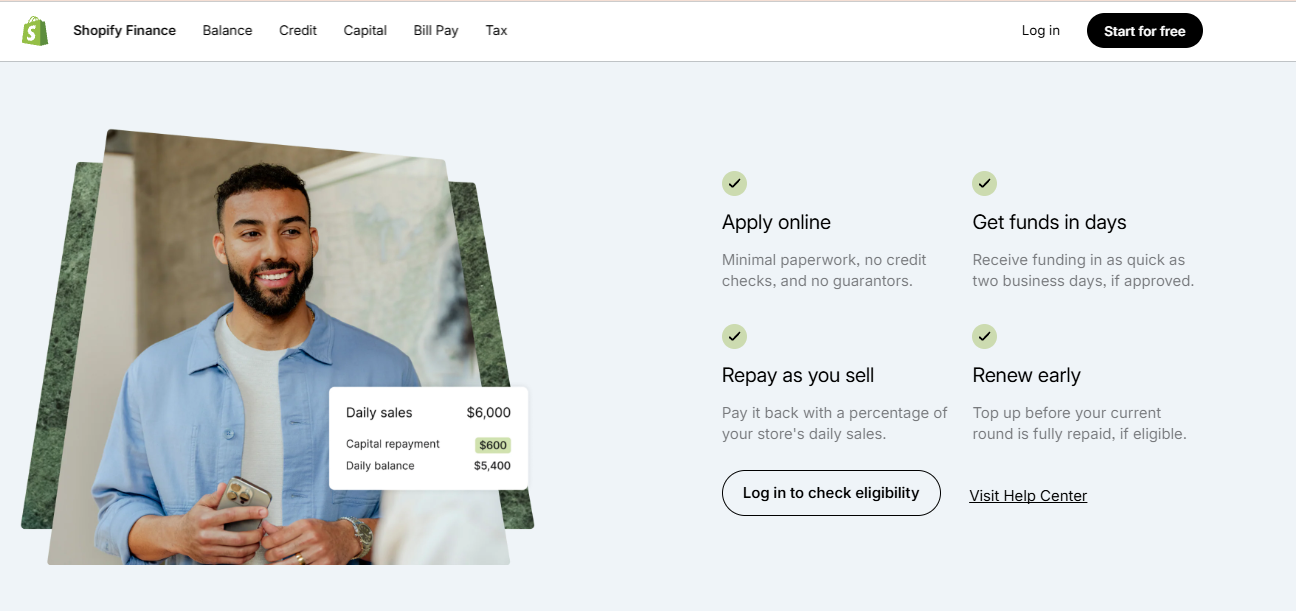
Shopify Capital's funding page highlights minimal paperwork, no credit checks, fast fund disbursement, and revenue-based repayment for Shopify-exclusive merchants seeking convenient platform-native non-dilutive e-commerce funding.
💡 Why Did We Choose This Tool?
Shopify Capital offers the ultimate convenience: zero application, instant approval (if auto-qualified), and seamless repayment via percentage-of-sales auto-deduction from your Shopify account. For Shopify-exclusive merchants who value frictionless access over cost optimization or strategic guidance, this native integration eliminates the operational drag of external financing applications. The trade-off: highest fees (7-15%), opaque qualification criteria, and platform lock-in excluding multi-channel sellers.
✅ Solutions Offered
Zero Application: Auto-qualification appears in Shopify admin dashboard when eligible
Instant Approval: No waiting period if offer extended (accept and funds available immediately)
Seamless Repayment: Automated percentage-of-sales deduction (no manual payments)
Platform Integration: Native Shopify connection requires no third-party data sharing
€200-€2M Range: Accessible funding amounts for small to mid-sized Shopify stores
🎯 Best For
Shopify-only merchants prioritizing zero-friction capital access and willing to accept higher fees (7-15%) and opaque qualification for convenience.
💬 Customer Reviews
"Unclear Terms. Some users have reported that the terms of the loan were not clearly communicated, leading to unexpected issues. The contracts say I must have repaid 30% of Loan 2 by the 6-month mark which is tomorrow but I've had no way to pay anything toward it. Poor Support. There have been complaints about the lack of responsiveness from Shopify Capital support, especially when dealing with contract discrepancies. I've emailed the Shopify Capital contact listed in the loan agreement two times, asking for clarification as well as an extension or reallocation, and they haven't responded." Verified UserReddit Discussion
"High Fees. Some users have noted that the fixed fee associated with Shopify Capital can be quite high, making it a costly option in the long run. The fixed fee 8% was higher than some loans, but again, I viewed it differently. Aggressive Repayment. The repayment structure, which involves taking a percentage of daily sales, can be aggressive and may lead to cash flow issues if sales fluctuate. Horrible experience. Horrible concept taking % of the sales." Verified UserCommunity Forum
6. Onramp Funds
US E-commerce Straightforward Terms (⭐⭐⭐)
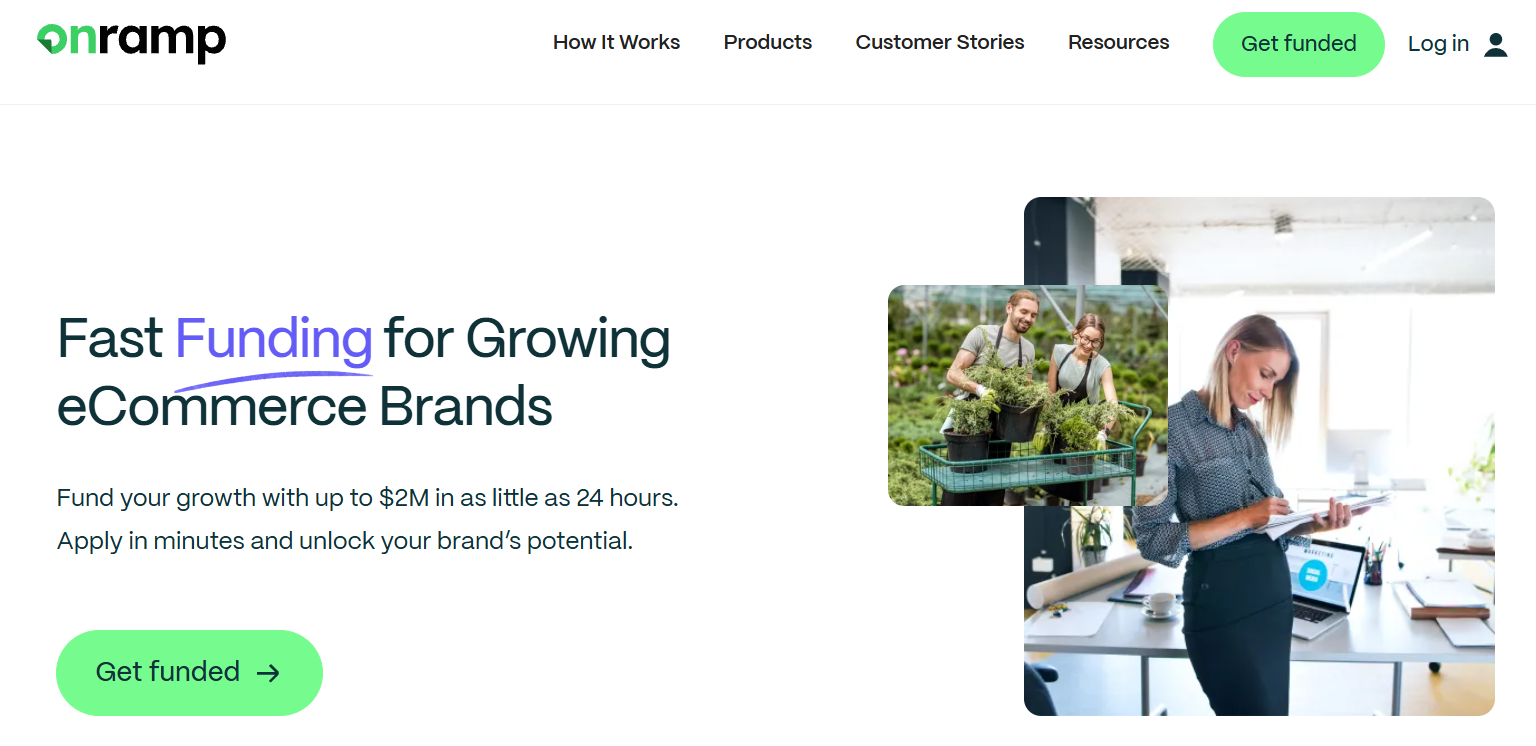
Onramp Funds promotes fast funding up to $2M in 24 hours for growing e-commerce brands, featuring a simple application process as a US-focused Clearco alternative for DTC sellers.
💡 Why Did We Choose This Tool?
Onramp Funds targets US-based Shopify and Amazon sellers with straightforward, no-nonsense capital offerings. Their transparent fee structure (6-13%), absence of hidden costs, and focused US market support appeal to founders tired of over-complicated applications or aggressive upselling. While they lack the intelligence features or global reach of competitors, their simplicity and founder testimonials emphasizing clear communication make them a viable option for domestic sellers prioritizing transparency.
✅ Solutions Offered
US Market Focus: Specialized support for American Shopify and Amazon sellers with localized operations
Transparent Fee Structure: 6-13% flat fee with no hidden costs or surprise charges
€10K-€3M Range: Flexible funding amounts for small to mid-market e-commerce businesses
3-7 Day Approvals: Balanced timeline (faster than banks, more thorough than instant platforms)
No Aggressive Upselling: Founder reviews highlight respectful, non-pushy sales approach
🎯 Best For
US-based e-commerce brands selling on Shopify or Amazon wanting transparent, straightforward capital access without intelligence features or global operations.
💬 Customer Reviews
"Really bad experience. Communication after pre-approval was really bad and even after you connect your Shopify account, your business banking, your Shopify balance account and send bank statements you won't get an update unless you reach out and ask. I was able to secure 2 loans with Shopify capital before they even completed my 1st one." - Jonathan D., USTrustpilot Verified Review
"The business has a bad month or two and OnRamp Funds swoops in and crushes the business by instructing its debt collector to send UCC Lien notices to each and every platform or payment provider available, PayPal, Amazon, Stripe, etc., threatening to sue the above referenced platforms if they release any funds to the business on the notice. The notice instructs the platforms to hold funds for the benefit of OnRamp Funds, Inc under threat of legal action. All monies of the business held in the various payment platforms are frozen and held pending full payment to OnRamp Funds." - JODI D., USTrustpilot Verified Review
💸 Fee Structure Transparency: What You Actually Pay
Understanding total cost matters more than stated fees. Most providers charge 6-12% flat fee on advance amount: €100K advance at 8% = €108K total repayment via daily/weekly percentage of revenue until fully paid.
Luca AI's Dynamic Model: €100K at 6% if business health strong (€106K repayment), but rate adjusts in real-time (improved performance automatically triggers cheaper subsequent advances). Dynamic pricing + optimal sizing typically achieves lowest total cost.
Hidden Costs Competitors Don't Mention: Wayflyer/Uncapped often push large advances (€200K+) where €100K sits idle in your account paying fees while you determine deployment strategy. Luca's recommendation engine prevents this: "Take €30K now, prove ROI on campaign, scale to €80K next month if metrics hold" (lower total cost, zero idle capital waste).
Total Cost Comparison Example: Deploying €100K over 6 months:
Wayflyer approach: Single €100K advance @ 8% = €8K cost + estimated €2.4K wasted fees on idle capital sitting 6 weeks = €10.4K total
Luca AI approach: €30K @ 6.5% + €40K @ 5.8% (business improved) + €30K @ 5.2% (continued growth) = €5.85K cost, zero waste = €5.85K total (44% savings)
Ready to experience intelligence-first funding?Book a Luca AI demo to see cross-functional AI reasoning + embedded capital in action, or continue reading to understand our evaluation framework in Q2.
Q2. How We Evaluated These Alternatives: Our 5-Criteria Selection Framework [toc=Evaluation Framework]
Choosing a revenue-based financing partner isn't just comparing stated fees - you're committing to a 12-24 month capital relationship that fundamentally shapes your growth trajectory. Most founders evaluate on price alone, missing the architectural differences that determine actual ROI: deployment efficiency, idle capital waste, and business model incentive alignment. We evaluated all 6 platforms against 5 weighted criteria totaling 100%, creating an objective scoring methodology that reveals which providers genuinely support founder success versus maximizing their own lending volume.
❌ Common Evaluation Mistakes Founders Make
Before diving into our framework, here's what NOT to prioritize:
✗ 'Cheapest stated fee' - Ignores deployment efficiency and idle capital waste (€100K at 6% sitting unused = wasted fees)
✗ 'Fastest approval' - Ignores whether you should take capital at all or if timing is optimal
✗ 'Largest funding amount' - Ignores optimal sizing (taking €300K when €150K staged would suffice)
✗ 'Brand recognition' - Ignores business model incentive conflicts (do they profit from your success or loan volume?)
📊 The 5-Criteria Evaluation Framework
1. Cross-Functional Intelligence (30% Weight)
Can the platform reason across marketing + finance + operations, or only display commerce data in isolation? Does it provide proactive deployment guidance, scenario modeling ("If I take €50K for Meta, what's my 90-day cash position?"), and ROI tracking - or just static dashboards?
2.0 points: Full AI reasoning across all business functions + proactive insights surfacing risks/opportunities
1.0 point: Basic dashboards limited to 1-2 domains (commerce only, or finance only)
0 points: No intelligence features beyond underwriting data collection
2. Capital Access & Pricing (25% Weight)
Speed to funding, fee transparency, dynamic vs. static pricing, and optimal sizing recommendations versus incentive to maximize advance amounts.
Time to first decision, data connection depth (commerce-only vs. commerce + finance + marketing), ease of use, and learning curve.
2.0 points: <15 min setup + 15+ integrations across all business functions + conversational interface
1.0 point: 1-3 day setup + commerce/payment integrations only + standard dashboard navigation
0 points: Complex multi-week implementation or invasive manual data collection
💰 Business Model & Trust Evaluation
4. Business Model Alignment (15% Weight)
Does the platform profit from your long-term success (subscription + outcome-based revenue) or from maximizing capital deployed (transactional lending fees)?
2.0 points: Subscription revenue model + dynamic capital = aligned incentives (profits when you succeed)
1.0 point: Transparent lending model with fair terms but transactional profit structure
0 points: Opaque pricing, aggressive upselling, or over-lending patterns documented in reviews
Each platform scored 0-2 points per criterion (maximum 10 points total). Star conversion formula: Total score × 10 = percentage. 90-100% = ⭐⭐⭐⭐⭐ | 70-89% = ⭐⭐⭐⭐ | 50-69% = ⭐⭐⭐ | 30-49% = ⭐⭐ | 0-29% = ⭐. Scoring reflects architectural capabilities and business model design, not brand preference or marketing budget.
Platform Evaluation Scores & Star Ratings
Platform
Cross-Functional Intelligence (30%)
Capital Access (25%)
Setup Complexity (20%)
Business Model (15%)
User Reviews (10%)
Total Score
Star Rating
Luca AI
2.0 (30%)
2.0 (25%)
2.0 (20%)
2.0 (15%)
1.8 (9%)
9.8/10 (98%)
⭐⭐⭐⭐⭐
Capchase
1.0 (15%)
1.5 (18.75%)
1.5 (15%)
1.5 (11.25%)
1.6 (8%)
6.8/10 (68%)
⭐⭐⭐⭐
Onramp Funds
0.5 (7.5%)
1.5 (18.75%)
1.5 (15%)
1.5 (11.25%)
1.3 (6.5%)
5.9/10 (59%)
⭐⭐⭐
Wayflyer
0.5 (7.5%)
2.0 (25%)
1.0 (10%)
1.0 (7.5%)
1.2 (6%)
5.7/10 (57%)
⭐⭐⭐
Shopify Capital
0 (0%)
1.5 (18.75%)
2.0 (20%)
1.0 (7.5%)
1.0 (5%)
5.5/10 (55%)
⭐⭐⭐
Uncapped
0 (0%)
1.5 (18.75%)
1.0 (10%)
1.5 (11.25%)
1.4 (7%)
5.4/10 (54%)
⭐⭐⭐
Luca AI's 5-star rating stems from being the only platform architected from inception for intelligence + capital synthesis. Competitors retrofitting analytics onto lending models (or capital onto analytics tools) cannot match this integrated design philosophy where reasoning and funding exist as unified capabilities.
Q3. Luca AI - The First AI Co-Founder with Embedded Financing (⭐⭐⭐⭐⭐) [toc=Luca AI Review]
🔍 The Fragmented E-commerce Reality
The typical €2M DTC brand juggles 8-12 disconnected tools: Shopify (commerce), Meta Ads Manager (acquisition), Google Analytics (behavior), Xero (accounting), Stripe (payments), plus a separate RBF provider (capital). Each platform sees a fragment - none see the whole business. The result? Marketing optimizes ROAS without understanding cash flow impact. Founders ask "Should I scale this campaign?" without visibility into inventory implications. CFOs forecast cash needs without marketing seasonality context. Capital decisions rely on 60-day-old application snapshots, not real-time business health. Data exists everywhere; understanding exists nowhere.
❌ Why Traditional Tools Fail: The Architectural Dead-End
Two categories dominate the market, both fundamentally incomplete:
Analytics Tools (Triple Whale, Northbeam, GA4): Unified dashboards showing what happened, not why or what to do next. Passive reporting - they display ROAS metrics but can't answer "If I scale Meta 30%, what's my 90-day cash position?" No financial integration, no capital access, no autonomous action capability. You're left doom-scrolling dashboards while opportunities slip away.
RBF Providers (Wayflyer, Clearco, Uncapped): Capital without intelligence. Static applications reflecting outdated performance. Wire €100K and disappear until repayment - zero deployment guidance. Business model incentive: maximize advance size (profit on larger loans) versus optimize your ROI. No cross-functional visibility: they see commerce data for underwriting but ignore marketing efficiency, inventory health, or operational margins. Both architectures hit the same wall: analytics can't fund opportunities they identify; capital providers can't assess if opportunities are worth funding.
✅ The Synthesis Thesis: Intelligence + Capital = AI Co-Founder
Critical insight: "Intelligence without capital is advice. Capital without intelligence is risk."
2026 competitive advantage doesn't come from having data - it comes from systems that reason across data AND fund the insights. The AI Co-Founder model doesn't just display charts - it understands causal links between marketing spend, inventory levels, cash solvency, and growth trajectory. It reasons cross-functionally: "If I take €50K for Meta in August, do I have cash for Q4 inventory orders in September?" It's proactive: scanning your business 24/7 for risks (creative fatigue, stockouts) and opportunities (underpriced channels, high-LTV cohorts) without waiting to be asked. Critically, it's action-capable: executing decisions, not just recommending them.
🧠 Luca AI's Solution Architecture
Unified Second Brain: Single context layer connecting 20+ data sources across all business functions - Commerce (Shopify, WooCommerce) + Marketing (Meta, Google, TikTok, Klaviyo) + Finance (Xero, QuickBooks) + Banking (Plaid APIs) + Payments (Stripe, PayPal) + Web Analytics (GA4). Normalized data model means "revenue" means the same thing across Shopify, Stripe, and Xero - no reconciliation hell.
Cross-Functional AI Reasoning: Ask questions spanning multiple domains instantly - "What's my true CAC including fulfillment costs?" (Marketing + Accounting + Ops) or "Which product-channel combination is actually profitable?" (Commerce + Ads + Finance). Get answers in seconds versus 3-hour manual spreadsheet triangulation.
Proactive Intelligence: Push-based system scans business continuously. Example alert: "I've been analyzing levers to increase 2026 free cash flow and identified a promising line of inquiry: discount efficiency analysis. Want to dive deeper?" Surfaces insights you don't know to ask for - like a co-founder who's always thinking ahead.
Dynamic Capital Pricing: Capital priced on real-time business health, not 60-day-old applications. Health score algorithm considers: Marketing efficiency (ROAS trends, CAC, LTV) + Financial health (margins, runway) + Operational metrics (inventory turnover) + Growth trajectory. Better performance = automatically cheaper capital. Example: €50K in March at 7% (Q1 slow) → Business improves → €50K in May at 4.5% (Q2 strong).
Optimal Capital Sizing: Subscription model (€200-500/month base) removes transactional lending incentive. We profit when you succeed long-term, not from maximizing single advances. Recommendation engine: "You requested €300K. Based on deployment plan, take €50K now, prove ROI on Meta, then €100K staged over 8 weeks." Result: Lower total cost, zero idle capital paying fees.
🎯 The Core Differentiator
Stop renting tools. Start hiring an AI Co-Founder. While dashboards tell you ROAS dropped, Luca tells you why (creative fatigue detected across 3 ad sets), models cash impact of scaling your replacement campaign (€40K needed, cash position remains safe through Q4 with €18K buffer), and wires capital same-day at dynamically-priced 5.2% reflecting your strong business health. One conversation, three outcomes: diagnosis + strategy + funding. No competitor offers this architectural synthesis - because it requires intelligence-first design from inception, not analytics retrofitted onto lending or vice versa.
Five traditional RBF providers represent specialized approaches: Wayflyer (volume leader), Capchase (SaaS specialist), Uncapped (European founder-friendly), Shopify Capital (platform-native), Onramp Funds (U.S. e-commerce focus). Each solves a specific pain point - fast capital, recurring revenue optimization, liability protection, zero-friction access, transparent terms. All share one architectural constraint: they provide capital without unified business intelligence. You get money; you don't get the strategic layer determining how to deploy it profitably, when to scale, or whether drawing more capital versus repaying faster generates better outcomes.
🏆 Wayflyer (⭐⭐⭐) - Fast Capital for High-Volume Brands
✅ Approach & Strengths
Largest RBF provider globally (€3B+ deployed). 72-hour approvals, €10K-€10M funding range, 6-12% fee structure. Revenue-responsive repayment: daily/weekly percentage of sales automatically adjusts until total repaid. Strong for brands needing €500K+ single advances. Proven underwriting algorithm accepts higher-risk profiles than banks. Flexible repayment means slow month = lower payment automatically. No personal guarantees, no equity dilution, no board seats.
❌ Limitations & Blind Spots
No Intelligence Layer: Static dashboards exist for underwriting ("Can we lend safely?"), not business optimization ("Should you take capital now?"). You receive a €300K offer - zero context on whether scaling Meta versus TikTok versus inventory replenishment generates better ROI.
Business Model Conflict: Wayflyer profits from larger advances at higher fees. Incentive to maximize deployment, not optimize your ROI. Application-based pricing reflects 60-day-old snapshot when you applied - business improves? You still pay the old rate.
No Deployment Guidance: Wire funds → disappear until repayment. No proactive monitoring of how capital performs or alerts when strategy adjustment needed.
Over-Lending Pattern: Push large advances (€200K+) where €100K sits idle in your account paying fees for 6 weeks while you determine deployment strategy.
vs. Luca AI: Wayflyer gives you money; Luca models downstream impact before you accept. Ask: "If I take €50K for Meta, what's my cash position in 90 days?" Luca answers instantly with inventory obligations, payroll, and supplier payments factored. Dynamic pricing: better performance = cheaper capital in real-time. Optimal sizing prevents over-borrowing: "Take €30K now, prove campaign ROI, scale to €80K next month" = lower total cost.
💬 Customer Reviews
"Our experience with Wayflyer has been extremely disappointing and professionally damaging. After being offered funding in writing - with specific amounts, repayment terms, and confirmation that the deal was approved - Wayflyer abruptly reversed their decision at the last minute. This caused significant disruption to our operations and cash flow, as we had already made critical business decisions based on their confirmed commitment. Throughout the process, communication was inconsistent and decisions appeared to change daily." - Geoff Brand, AUTrustpilot Verified Review
"They call and email every week. They want me to sign up for high interest loans. This company is a joke." - Tyler Ruby, USTrustpilot Verified Review
ARR-optimized underwriting for subscription models. €10K-€5M range at 4-12% (often lower than peers due to recurring revenue predictability). Flexible draw-down structure - take capital in stages as needed. Includes AR (Accounts Receivable) automation tools for B2B e-commerce. 3-5 day approvals. Strong for SaaS/e-commerce hybrids (subscription boxes, memberships).
❌ Limitations
Narrow Optimization: Intelligence limited to recurring revenue metrics (ARR, MRR, churn). Doesn't extend to product-based e-commerce, marketing efficiency, or operational health.
Commerce Blind Spot: Sees financial data (invoices, receivables) but not marketing performance or inventory dynamics. Can't answer: "Should I scale this acquisition channel given current unit economics?"
vs. Luca AI: Capchase excels at ARR-based capital; Luca provides full business intelligence across commerce + marketing + finance + ops, then embeds capital as a feature. Capchase answers "Can we finance your recurring revenue?" Luca answers "Which growth lever generates best ROI, and here's capital to fund it based on real-time confidence score."
🏆 Uncapped, Shopify Capital & Onramp Funds - Niche Specialists
Uncapped (⭐⭐⭐) - European Founder-Friendly: True non-dilutive (no personal guarantees, covenants, hidden terms). Strong UK/EU coverage. €10K-€10M at 6-12%. Transparent pricing. ❌ Limitations: Slower approvals (5-7 days), zero intelligence features, no deployment optimization.
Shopify Capital (⭐⭐⭐) - Platform-Native: Zero application - auto-qualification in Shopify admin. Instant approval if offered. Seamless % of sales repayment. €200-€2M range. ❌ Limitations: Shopify-exclusive (multi-channel excluded), highest fees (7-15%), opaque qualification, no guidance.
Onramp Funds (⭐⭐⭐) - U.S. Straightforward Terms: U.S. Shopify/Amazon focus. €10K-€3M at 6-13%. Transparent fees, no aggressive upselling. 3-7 day approvals. ❌ Limitations: U.S.-only, basic underwriting dashboard, no proactive intelligence or ROI tracking.
Unified Limitation: All provide capital efficiently within niches but maintain traditional separation - financing business ≠ intelligence business. None offer cross-functional reasoning, proactive monitoring, or dynamic pricing adjusting to real-time performance.
Side-by-Side Traditional RBF Platform Comparison
Platform
Stars
Best For
Funding Range
Fee Range
Approval Speed
Intelligence Features
Key Limitation
Wayflyer
⭐⭐⭐
High-volume (€5M+)
€10K-€10M
6-12%
72 hours
❌ Static dashboards only
No deployment guidance, over-lending incentive
Capchase
⭐⭐⭐⭐
SaaS/recurring
€10K-€5M
4-12%
3-5 days
⚠️ ARR-focused only
Narrow to subscriptions, no cross-functional reasoning
Uncapped
⭐⭐⭐
European liability-averse
€10K-€10M
6-12%
5-7 days
❌ None
Zero intelligence, pure capital provider
Shopify Capital
⭐⭐⭐
Shopify-exclusive
€200-€2M
7-15%
Instant
❌ None
Platform-locked, opaque qualification
Onramp Funds
⭐⭐⭐
U.S. transparent terms
€10K-€3M
6-13%
3-7 days
❌ Basic underwriting
U.S.-only, no strategic intelligence
Luca AI
⭐⭐⭐⭐⭐
Intelligence + capital unified
€10K-€500K
3-8% dynamic
Same day
✅ Cross-functional AI reasoning
Learning curve for AI-native workflows
Each traditional platform excels in its niche - speed, SaaS optimization, liability protection, convenience, transparency. All share the architectural constraint: capital without intelligence. Only Luca bridges this gap through AI-first design integrating reasoning + funding into a single co-founder experience.
Q5. The Blind Spot All Lenders Share - And What Customers Actually Say About It [toc=Lender Blind Spot]
💸 The Blind Spot: Capital Without Deployment Intelligence
It's September. You secured €100K from your RBF provider in 72 hours - approval felt effortless. Dashboard shows your Meta campaign running at 3.2x ROAS. Confident, you scale ad spend to €50K/month. Three months later, reality hits:
❌ Inventory stockout on hero product (you didn't model demand spike from scaled ads - lost €42K in potential sales) ❌ Cash runway dropped to 42 days (didn't account for 60-day supplier terms + ad platform 30-day payment lag) ❌ Campaign ROAS declined to 1.6x (creative fatigue set in week 7 - no alerts caught it early, wasted €18K)
You had capital. You didn't have the system telling you: "Scale Meta to €35K max (not €50K) given inventory lead times and supplier payment schedule. Pause creative set #3 (CTR declining 34% week-over-week). Keep €15K cash reserve for supplier payment due Nov 10."
Capital without intelligence = expensive guesswork.
⚠️ Why This Problem Exists: The Business Model Misalignment
Traditional RBF providers are lending businesses, not intelligence businesses. Their revenue equation: (Amount Lent × Fee %) × Volume of Deals = Revenue. More capital deployed at higher fees = more profit for them. The 'business intelligence' features you see - static dashboards showing commerce data - exist solely to support underwriting decisions ("Can we lend safely?"), not genuine business optimization ("Should you take this capital, and how should you deploy it for maximum ROI?").
Conflict of interest emerges clearly: When you request €300K, they have every incentive to suggest €400K. They profit immediately on larger advances. You bear 100% of the deployment risk and pay fees on idle capital sitting in your account for weeks while you figure out how to use it.
💰 Hidden Costs Traditional Providers Won't Mention
❌ Over-Borrowing: Taking €300K when €150K staged would suffice. That €150K sits idle 6-8 weeks while you determine deployment - paying €9K-€12K in unnecessary fees (6-8% on unused capital).
❌ Mis-Deployment: Scaling campaigns without inventory capacity analysis. Stockouts cost 20-30% of potential revenue during high-demand periods.
❌ Timing Errors: Taking capital 4 weeks too early (before campaign validated) or too late (missing optimal deployment window). Industry data shows timing mistakes cost 25-40% of potential ROI.
❌ Opportunity Blindness: No provider can tell you: "Deploy 60% to Meta (highest incremental ROAS based on current creative performance), 30% to inventory (restock hero SKU with 18-day lead time factored), 10% cash reserve (supplier payment due in 23 days)." You guess - and often guess wrong.
😤 What Customers Actually Say: Real Trustpilot Reviews
Every platform claims "founder-friendly" and "transparent pricing." Here's what actual customers report in verified 1-star reviews - pain points competitors' marketing never mentions:
Wayflyer Customer Complaints:
"Company loves to lie unfortunately. They gave our firm a $90,000 loan in June. At the time, they mentioned that once we paid off 50% of the loan, we would be eligible for additional financing so we can continue scaling. That was one big lie. At the 50%, then 75, and then 90 marks, they kept make excuses and lies. Stay away from this company, very predatory." - Adam Zackman, USTrustpilot Verified Review
"0 customer service whatsoever, I've done 2 loans with these people and can't get ahold of a real person." - Verified User, USTrustpilot Verified Review
Clearco Customer Complaints:
"We worked with Clearco for a couple of years and had a great experience early on, especially with our original account manager, Derek. He understood our business model and had a solid relationship with underwriting, so funding was consistent. Unfortunately, things changed when our account was reassigned. Despite no change in our cash position or risk profile - and with strong recurring revenue - we started facing stricter cash-on-hand demands that made little sense for a company offering high-cost MCA. It felt like they forgot that this kind of capital is meant to be high-risk, high-reward." - Melissa, USTrustpilot Verified Review
Uncapped Customer Complaints:
"Wasted 10 days with daily promises that were never kept and had to follow up daily. Was asked for countless documents to tell me in the end that I don't have enough cash runway to borrow money, absolute nonsense from some underwriter that does not understand e-commerce. Business doing 1.3mil turnover, 400k of stock, no debt and closed on 100k profit but not good enough for uncapped." - A Ovidiu, GBTrustpilot Verified Review
Common Complaint Themes: ⚠️ Service quality disconnect (highly responsive during sales, unresponsive post-funding) ⚠️ Fee transparency issues (hidden costs discovered after signing, final rates higher than quoted) ⚠️ Over-lending pressure (maximizing advance sizes regardless of actual need) ⚠️ Zero deployment guidance (wire funds and disappear until repayment schedule)
✅ Luca AI's Architectural Solution
How it should work: Ideal system connects all data sources (commerce + marketing + finance + inventory), understands causal relationships ("scaling campaign X requires Y inventory arriving in Z weeks"), models scenarios before deployment ("If I take €50K for Meta, what's my 90-day cash position including all supplier payment obligations?"), prices capital dynamically reflecting real-time business health, and recommends optimal sizing preventing over-borrowing.
Luca's implementation: Unified data layer (20+ integrations) enables true cross-functional reasoning. Ask: "Should I take €100K to scale Meta or TikTok, and when?" Luca analyzes in seconds: current cash position + supplier payment schedule (Xero) + inventory lead times (Shopify) + creative fatigue risk (Meta historical performance) + ROAS decay patterns = recommended staged deployment: €30K Week 1 (Meta, creative set A), €40K Week 5 (after proving ROAS sustainability), €30K Week 9 (TikTok testing budget). Dynamic pricing adjusts: €30K at 6.5% → €40K at 5.2% (business improved) → €30K at 4.8% (continued growth). Total cost: €5.7K versus competitor's €8K-€10K on single €100K advance.
Business model alignment: Subscription revenue (€200-500/month) + dynamic capital means we profit from your long-term success, not from maximizing single advances. No spam sales calls, transparent pricing with visible health scores, optimal sizing built into recommendation engine. Proactive alerts catch performance issues (ROAS decline, inventory risks) before they impact ROI - unlike competitors who wire funds and vanish.
Q6. How to Choose, Deploy & Maximize Your Clearco Alternative [toc=Selection & Deployment Guide]
🎯 Choosing the Right Alternative
Six viable alternatives exist. Choosing wrong means 12-24 months of suboptimal capital costs, missed deployment opportunities, or misaligned business model incentives. Most founders evaluate on surface metrics - largest funding amount, fastest approval, lowest stated fee - missing what actually determines ROI: deployment intelligence, optimal sizing, and strategic guidance alignment.
Right decision framework: Match platform architecture to your business stage, strategic needs, and intelligence requirements. Early-stage founders need guidance RBF veterans don't. Growth-stage brands need cross-functional visibility. Scale-stage companies need AI-powered complexity management.
📊 Decision Framework by Business Stage
Early Stage (€100K-€1M revenue)
Primary needs: Capital access + strategic guidance (you don't have CFO/data analyst yet)
Key risk: Over-borrowing or mis-deploying capital (expensive mistakes compress runway at this stage)
✅ Best Fit: Luca AI (intelligence + capital unified - AI Co-Founder replaces missing strategic roles) OR Shopify Capital (if Shopify-exclusive and prioritize zero-friction over cost)
❌ Avoid: Wayflyer (minimum advances often €100K+, too large for testing), complex multi-week setups
Why it matters: Early-stage founders need systems telling them "Take €20K now for Meta testing, not €100K" and "Your CAC trending up 18% week-over-week - pause campaign B before wasting more budget"
Growth Stage (€1M-€5M revenue)
Primary needs: Flexible capital + deployment optimization + cross-functional visibility
Key risk: Marketing/finance misalignment (growth team wants to scale, finance sees cash flow danger)
✅ Best Fit: Luca AI (cross-functional AI reasoning eliminates departmental blind spots) OR Capchase (if SaaS/subscription-dominant with >60% recurring revenue)
Consider: Wayflyer (if need €500K+ single advance and have internal analyst optimizing deployment)
Why it matters: Growth requires unified visibility - marketing seeing cash implications, finance seeing campaign performance, operations seeing inventory impacts - in one real-time system
Scale Stage (€5M-€50M revenue)
Primary needs: Large capital pools + sophisticated scenario modeling + multi-channel optimization
Key risk: Complexity overwhelm (too many tools, too much data, decisions paralyzed)
✅ Best Fit: Luca AI (AI-powered scenario modeling handles complexity: "If I deploy €300K across Meta/TikTok/Google split 50/30/20, model 90-day P&L impact with all obligations factored") OR Wayflyer (if need €5M+ and have dedicated finance team)
Geographic & Niche Considerations: 🌍 European market → Uncapped (strong UK/EU coverage, no personal guarantees) 🇺🇸 U.S.-only operations → Onramp Funds (focused U.S. support) 🌐 Global/multi-channel → Luca AI or Wayflyer 📊 SaaS/subscription-heavy → Capchase (ARR-optimized underwriting)
📈 After You Get Capital: Measuring ROI
You secured €100K. Now what? Traditional RBF providers wire funds and disappear until repayment. This framework measures capital efficiency - because they profit whether you deploy well or not.
Manual Tracking Steps (if not using Luca AI):
Step 1 - Tag Capital Deployment: In accounting system (Xero/QuickBooks), tag every transaction funded by RBF capital with categories: "Meta Ads-RBF", "Inventory-RBF", "Operations-RBF". Enables tracing every euro to ROI source.
Step 2 - Calculate Incremental Revenue: Formula: (Post-Capital Revenue by Channel) - (Baseline Revenue Pre-Capital) = Incremental Revenue Attributable to Capital. Example: Meta averaged €80K/month pre-capital. Post-€50K deployment, Meta generates €140K/month. Incremental: €60K/month × 4 months = €240K attributable.
Step 4 - Track Payback Period: Days to recover capital + fees from incremental revenue. Target: <90 days. Red flag: >180 days. Example: €54K cost / €60K monthly incremental = 27 days (excellent).
Key Capital Performance Metrics Dashboard
Metric
Definition
Target
Red Flag
Capital Efficiency Ratio
Incremental profit / total capital cost
>3:1
<2:1
Payback Period
Days to recover capital + fees
<90 days
>180 days
ROAS Sustainability
Campaign ROAS 60 days post-funding
>2.5x
<2.0x
Cash Runway Impact
Days of runway after repayment schedule
>60 days
<45 days
Idle Capital Days
Days funded capital sits unused
<10 days
>30 days
✅ How Luca AI Automates ROI Tracking
Luca eliminates manual tracking through integrated capital + intelligence architecture. Automatic deployment tagging across all connected systems (Shopify, Meta, Xero, Stripe) - no manual categorization. Real-time efficiency tracking: Ask "How is my August €50K capital performing?" Get instant answer: Capital Efficiency Ratio (2.8:1), Payback Status (38 days - on track), Incremental Revenue (€127K attributed), Recommended Adjustments ("Creative set B showing fatigue - ROAS dropped from 3.1x to 2.3x in 2 weeks. Recommend refresh or pause"). Proactive performance alerts surface before issues impact ROI: "Meta campaign funded by Sept capital declining - CAC up 22% week-over-week" or "Inventory funded by Aug capital selling 40% faster than projected - restock recommended 3 weeks early."
The paradigm shift: Real question isn't "Which platform has lowest fee?" It's: "Do I want a capital provider or a business partner?" Traditional RBF = transactional (wire money, collect repayment, repeat). Intelligence-first funding = partnership (analyze opportunity, model impact, fund intelligently, monitor outcome, optimize continuously). That's the transformation Luca represents - from tool-renting to co-founder-hiring.
Q7. Questions to Ask Before Choosing a Clearco Alternative [toc=Common Questions]
❓ Q: What happened to Clearco in 2024-2026?
Clearco ceased direct UK/European operations in 2022 (partnered with Outfund for regional coverage), underwent major U.S. restructuring including significant layoffs in 2023-2024, and tightened qualification criteria substantially. Customer complaints cite aggressive daily repayment schedules (10-15% of daily sales crushing cash flow during slow periods), increasingly restrictive eligibility requirements, and dramatically declining customer service quality - driving founders to seek alternatives offering better terms, responsive support, and strategic guidance beyond transactional capital deployment.
💰 Q: What is the cheapest Clearco alternative in 2026?
Stated fee comparison: Luca AI (3-8% dynamic) < Capchase (4-12%) < Wayflyer (6-12%) ≈ Uncapped (6-12%) < Onramp (6-13%) < Shopify Capital (7-15%). However, total cost depends on deployment efficiency and idle capital waste, not just stated rates. Luca's dynamic pricing + optimal sizing typically achieves lowest total cost - better business performance automatically triggers cheaper capital in real-time, and staged deployment (€30K → €40K → €30K as metrics validate) avoids large advances sitting idle for weeks paying unnecessary fees.
🔍 Q: How is revenue-based financing different from a traditional business loan?
RBF repayment = percentage of revenue (typically 5-15% of daily/weekly sales) versus fixed monthly payments regardless of sales performance. Benefits: Flexible (slow sales months = automatically lower payments), no personal guarantees required, no collateral liens, no equity dilution or board control. Drawbacks: Total cost often higher than bank loans (if you qualify for traditional lending), repayment tied to revenue not profit (can strain cash flow if margins compress). Approval dramatically faster (24 hours-7 days versus bank's 6-12 weeks) and eligibility much broader (€25K+ monthly revenue versus bank's €500K+ minimum and 2+ years operating history requirements).
🚀 Q: Can I get e-commerce funding with no revenue or as a startup?
No. All RBF providers reviewed (Luca AI, Wayflyer, Capchase, Uncapped, Shopify Capital, Onramp Funds) require minimum €10K-€50K monthly revenue and 6-12 months operating history with consistent sales patterns. Pre-revenue alternatives: Equity funding (angel investors, VC - dilutive but no repayment requirement), founder personal capital/bootstrapping, crowdfunding platforms (Kickstarter/Indiegogo for product validation), invoice factoring (if B2B model with receivables), government small business grants (non-dilutive but highly competitive with lengthy application processes), or credit cards (expensive but accessible for initial inventory/ads testing at micro-scale).
⚖️ Q: What's the difference between Luca AI and Wayflyer/traditional RBF providers?
Architectural difference: Wayflyer = capital provider (lending business - deploys funds, collects repayment via revenue-share, provides no deployment intelligence or strategic guidance). Luca AI = AI Co-Founder (intelligence business with embedded capital - analyzes opportunities across all data sources, models downstream impact before funding, provides proactive guidance, funds intelligently based on real-time health, monitors outcomes automatically, optimizes continuously). Wayflyer gives you money and walks away; Luca tells you whether to accept capital, how to deploy it for maximum ROI, models exact downstream cash impact across all obligations, prices dynamically based on current (not 60-day-old) business health, and tracks performance automatically. Business model alignment: Wayflyer profits from maximizing advance sizes; Luca's subscription model profits only when you succeed long-term.
🎯 Q: Do I need good credit to qualify for revenue-based financing?
RBF providers evaluate business credit and performance metrics, not personal credit scores. Primary qualification factors: Monthly revenue consistency (€25K+ typical minimum threshold), sales growth trajectory (stable or growing strongly preferred), customer retention and repeat purchase rates, gross margin health (>40% typical threshold for approval), payment processor transaction history (Stripe/PayPal volume and consistency). Personal credit checks extremely rare; most providers explicitly don't require personal guarantees or founder liability. Disqualifiers: Excessive chargebacks (>2% of transactions), frequent product returns (>15%), declining revenue trend (>20% month-over-month drop), or very thin margins (<25% making repayment mathematically challenging).
⏰ Q: How long does approval take for Clearco alternatives?
Approval speed breakdown: Luca AI (same day - AI-powered underwriting + real-time data access via 20+ integrations), Wayflyer (72 hours), Capchase (3-5 days), Uncapped (5-7 days), Shopify Capital (instant if auto-qualified appears in dashboard, but opaque qualification criteria), Onramp Funds (3-7 days). Fastest: Luca AI and Shopify Capital. Slowest: Uncapped. Traditional banks: 6-12 weeks minimum (for comparison). Speed correlates directly with data integration depth - platforms with direct API access (Shopify, Stripe, Xero, Meta, Google) approve exponentially faster than those requiring manual financial statement uploads and multi-week underwriting review cycles.
🔗 Q: What integrations do I need for RBF approval?
Minimum required across all providers: Commerce platform (Shopify, WooCommerce, BigCommerce, Amazon Seller Central) for sales data verification + Payment processor (Stripe, PayPal, Square) for transaction history and settlement patterns. Recommended for significantly better rates and terms: Accounting software (Xero, QuickBooks) for complete P&L visibility and expense tracking, Marketing platforms (Meta Ads Manager, Google Ads) for customer acquisition cost analysis and attribution, Banking connection (Plaid or direct API) for real-time cash flow assessment. Luca AI leverages 20+ integrations for comprehensive business health scoring (more data visibility = better dynamic pricing and optimal sizing recommendations). Wayflyer/Capchase require commerce + payments minimum. Shopify Capital auto-qualifies exclusively from Shopify internal data - no external integrations possible.
Ready to experience the future of e-commerce funding?Book a Luca AI demo to see how intelligence-first capital transforms growth decisions from guesswork to precision, or explore our full use cases to understand how cross-functional AI reasoning eliminates the blind spots every traditional lender shares.
FAQ's
How does Luca AI's dynamic pricing differ from Wayflyer's fixed fee structure?
Traditional RBF providers like Wayflyer charge fixed fees (6-12%) based on your business health at the time of application - a 60-90 day snapshot that quickly becomes outdated. If your business improves dramatically post-approval, you still pay the original higher rate on subsequent advances.
We architected Luca AI differently. Our dynamic capital pricing reflects your real-time business health through continuous monitoring of:
Real-world impact: Take €50K in March at 7% when Q1 is slow. Your business strengthens through improved unit economics and campaign performance. Traditional providers? You'd pay 7% on your next €50K advance in May. With Luca? That same advance drops to 4.5% automatically - because our AI witnesses your improvement in real-time and pricing adjusts accordingly.
Cost comparison: Deploying €150K over 6 months with business improvement:
We save you €2.25K (21% reduction) while our subscription model (€200-500/month) ensures we profit when you succeed long-term, not from maximizing single advances.
Can Luca AI help me decide whether to take capital or wait, unlike traditional RBF providers?
This is the architectural blind spot every traditional lender shares - they answer "Can we lend?" but never "Should you borrow right now?"
Wayflyer, Clearco, Uncapped operate as capital providers, not strategic advisors. You receive an offer (€100K at 8%) with zero context on:
Whether deploying capital today vs 4 weeks from now optimizes ROI
If scaling Meta vs TikTok vs inventory generates better returns
What happens to your cash runway in 90 days after deployment
We built Luca as the world's first AI Co-Founder, not just a funding source. Before offering capital, we model downstream scenarios:
Example conversation: You: "Should I take €80K now to scale this Meta campaign?"
Luca: "Analyzing... Current campaign ROAS is 3.8x but showing early fatigue signals (CTR declined 12% week-over-week). Scaling to €80K/month will generate €304K incremental revenue over 8 weeks, but inventory lead time is 21 days and you have €140K supplier payment due Nov 15. Recommendation: Take €40K now, refresh creative (I've identified 3 high-performing ad elements from your August campaign to test), then scale to €70K after creative validates. This protects your Nov 15 payment with €18K buffer while capturing 89% of the opportunity."
That's strategic partnership vs transactional lending. We synthesize data across commerce, marketing, and finance to own the outcome, not just display an offer.
What are the hidden costs of over-borrowing from RBF providers that no one talks about?
Traditional RBF providers have business model incentives to maximize advance sizes - they profit more on €300K than €150K. But founders pay crushing hidden costs:
1. Idle Capital Fees (€9K-€15K wasted annually): You take €300K but only deploy €180K immediately. That €120K sits in your account for 6-10 weeks paying 6-8% fees while you determine strategy. Cost: €7.2K-€9.6K on unused capital.
2. Deployment Timing Errors (25-40% ROI loss): Taking capital 4 weeks too early (before campaign validated) or too late (missing seasonal window). Industry data shows timing mistakes cost 25-40% of potential returns.
3. Mis-Allocation Without Guidance (€30K+ opportunity cost): No provider tells you: "Deploy 60% to Meta (highest incremental ROAS), 30% to inventory (hero SKU restock), 10% cash reserve (supplier payment due)." You guess - and guessing wrong costs €30K-€50K in suboptimal deployment.
4. Repayment Cash Flow Squeeze (business slowdown risk): Over-borrowing means aggressive repayment schedules (12-15% daily sales) that crush runway during slow months. We've seen brands forced into emergency discounting (margin erosion) just to maintain repayment velocity.
Luca's solution: Our optimal capital sizing engine prevents over-borrowing through staged recommendations: "Take €50K now, prove campaign ROI, scale to €100K after validation in 3-4 weeks." Result: Zero idle capital, lower total cost, strategic deployment confidence.
How do I track if my RBF capital is actually generating positive ROI?
95% of founders who take RBF capital never properly measure deployment ROI - because traditional providers offer zero post-funding tracking. They wire funds, collect repayment, and disappear until the next advance.
Manual tracking framework (if not using Luca):
Step 1 - Tag Every Transaction: In Xero/QuickBooks, categorize all expenses funded by RBF: "Meta Ads-RBF", "Inventory-RBF", "Ops-RBF". Enables tracing every euro to outcome.
Step 2 - Calculate Capital Efficiency Ratio: Formula: (Incremental Profit Generated) / (Capital Deployed + Fees) = Efficiency Ratio
Target: >3:1 (every €1 capital generates €3+ profit)
Warning: <2:1 (barely profitable)
Critical: <1:1 (losing money)
Step 3 - Monitor Payback Period: Days to recover capital + fees from incremental revenue.
Excellent: <60 days
Good: 60-90 days
Warning: 90-180 days
Critical: >180 days
Example: €50K at 8% = €54K total cost. Campaign generates €240K incremental revenue at 40% margin = €96K profit. Efficiency ratio: €96K / €54K = 1.78:1 (concerning - only 78% return). Payback: 27 days (strong).
How we automate this: Luca's unified intelligence layer tracks every capital deployment automatically across Shopify + Meta + Xero + Stripe. Ask: "How is my August €50K performing?" Get instant answer: Capital Efficiency 2.8:1, Payback Status 38 days, Incremental Revenue €127K, Recommended Adjustments ("Creative set B shows fatigue - ROAS dropped from 3.1x to 2.3x - recommend refresh").
Proactive alerts catch performance degradation before ROI suffers: "Meta campaign funded by Sept capital declining - CAC up 22% week-over-week" or "Inventory selling 40% faster than projected - restock 3 weeks early to avoid stockout."
Why did Clearco stop operating in Europe and what does it mean for existing customers?
Clearco ceased direct UK/European operations in 2022, partnering with Outfund to service regional customers. This followed massive US operational restructuring in 2023-2024 including significant layoffs, tightened qualification criteria, and aggressive repayment structure changes that sparked hundreds of negative Trustpilot reviews.
What happened to European customers:
Service disruption: Existing capital agreements transferred to Outfund with minimal notice (2-4 weeks). Many founders reported:
Stricter cash-on-hand requirements mid-contract despite no change in business performance
Communication breakdown (5-7 day response times vs previous same-day)
Why it matters for DTC brands:
The Clearco situation exposed the fragility of transactional lending models - when capital providers face internal challenges, customer service becomes the first casualty. Founders discovered they'd built dependency on a platform that could pivot strategy, exit markets, or restructure terms with minimal founder protection.
Lessons for 2026 alternative selection:
Business model sustainability: Providers relying purely on lending volume face compression during economic shifts. Subscription + dynamic capital models (like Luca's) create aligned incentives - we profit when you succeed long-term, not just from maximizing advances.
Geographic coverage verification: Confirm provider's direct operations in your region. Third-party partnerships (like Clearco/Outfund) create service quality gaps and accountability confusion.
Contractual flexibility: Review early termination clauses, repayment adjustment mechanisms, and what happens if provider exits market or restructures.
Current alternatives for European DTC brands:
Uncapped (UK/EU focus, transparent terms, no personal guarantees)