Shopify Capital 2026: How It Works, Real Costs, Eligibility, and Smarter Funding Alternatives
mins read
TL;DR
Shopify Capital offers MCAs, business loans, and Capital Flex with factor rates of 1.10 to 1.17 translating to 10 to 60%+ effective APR depending on repayment speed. Eligibility is invite-only based on sales consistency, chargeback rates, and growth trajectory with no way to proactively apply or check status. MCAs are not loans for accounting purposes and the borrowing cost is a financing expense deductible on Schedule C, Form 1120-S, or per your entity election. Luca AI offers dynamically-priced staged draws at roughly 6.2% effective cost with 24 to 48 hour disbursal and zero platform lock-in across Shopify, Amazon, and WooCommerce. Use the 7-criteria decision framework scoring deployment ROI, effective APR, urgency, alternatives, timing, runway, and exit impact before accepting any offer.
Q1. What Is Shopify Capital and How Does It Actually Work in 2026? [toc=What Is Shopify Capital]
Shopify Capital is Shopify's embedded financing program that provides e-commerce merchants with working capital ranging from $200 to $2 million without personal credit checks, collateral requirements, or leaving the Shopify admin. Since launching in 2016, Shopify Capital has disbursed over $5 billion to thousands of merchants, making it one of the largest embedded lending programs in e-commerce.
💰 Why Shopify Built an In-House Funding Program
Shopify sits on a unique data advantage. With real-time access to every merchant's GMV, order velocity, chargeback rates, and customer patterns, Shopify can underwrite based on live business performance rather than credit scores or paper applications. As merchant demand for fast working capital has grown alongside Shopify's platform (which exceeded $235B in total GMV in 2023), Capital became a natural extension of the ecosystem.
The program is invite-only. Shopify's machine-learning model evaluates your store continuously and surfaces a funding offer in your admin when it determines you qualify. You cannot proactively apply; the offer either appears, or it doesn't.
⚙️ Three Funding Products Under One Roof
Shopify Capital currently operates three distinct products:
Shopify Capital Product Comparison
Feature
Merchant Cash Advance (MCA)
Business Loan
Capital Flex
Structure
Purchase of future receivables
Fixed-cost term loan
Revolving line of credit
Pricing
Factor rate (1.10 to 1.17)
Fixed borrowing fee
Revolving fee structure
Repayment
Daily % of sales
Daily % of sales + minimum milestones
Repayments replenish available credit
Max Term
Until fully repaid
18 months maximum
18 months per withdrawal
Minimum Payments
None (zero-sales days = $0)
1/6th of total owed every 60 days
Per-withdrawal repayment schedule
Renewal
At 65% repayment
At 65% repayment
Continuous (no renewal needed)
Availability
US, CA, UK, AU
US, CA, UK, AU
US only
When an offer appears in your Shopify Admin under Finances > Capital, you'll see three pre-set options with different funding amounts and borrowing costs. These are non-negotiable; you select one or decline all three.
📋 The 4-Step Funding Process
Offer surfaces: Shopify's algorithm evaluates your store and presents an offer in your admin.
Select your terms: Choose from 3 pre-set options (higher amounts come with higher factor rates).
Receive funds: Money deposits in 2 to 5 business days into your Shopify Balance or linked bank account.
Repay automatically: A fixed percentage of daily sales is deducted through Shopify Payments until the total owed is repaid.
Shopify Capital operates as a continuous cycle: once you repay 65% of your advance, a new offer may appear, restarting the loop.
On days with zero sales, you owe nothing. Repayment scales proportionally with revenue: pay more on strong days, and less on slow ones. Once you've repaid 65% of your outstanding balance, Shopify may offer a new funding round, often at a higher amount.
🔗 Part of a Broader Financial Ecosystem
Shopify Capital doesn't operate in isolation. It's integrated with Shopify Balance (a business money management account with cashback and daily earnings), Shopify Credit (a Visa business card with up to 3% cashback), and Shopify Bill Pay (supplier payment management), creating a closed-loop financial ecosystem within your admin.
Luca AI helps merchants model the downstream cash flow impact of accepting Shopify Capital before committing, connecting funding decisions to real-time marketing performance, inventory needs, and runway projections in one unified view.
Q2. Who Qualifies for Shopify Capital? (Eligibility Criteria Decoded) [toc=Eligibility Criteria]
Shopify Capital's biggest frustration isn't its cost; it's the opacity of eligibility. Unlike traditional lenders where you submit an application and receive a decision, Shopify Capital is entirely invite-only. There is no application form, no eligibility checker, and no way to proactively request funding. Either an offer appears in your Shopify Admin, or it doesn't.
Shopify's ML-based underwriting model continuously evaluates every store on the platform and surfaces offers under Finances > Capital when its risk scoring determines a merchant qualifies.
✅ Known Public Eligibility Criteria
Based on Shopify's published requirements and merchant-reported patterns, these are the established criteria:
Active Shopify store for 90+ days: Brand-new stores are not eligible.
Shopify Payments enabled as your primary payment processor.
Business registered in an eligible geography: US, Canada, UK, or Australia.
Consistent sales history with a stable or upward trajectory.
Low chargeback and dispute rate: High disputes signal risk to the algorithm.
No unresolved Shopify policy violations on your account.
For Capital Flex specifically: US-based entity with $50K+ trailing-twelve-month GMV.
🔍 Hidden Signals Shopify's Algorithm Evaluates
Beyond the published criteria, Shopify's proprietary model also weighs:
As of early 2026, Shopify announced expansion of its fixed funding offering to select European markets, though availability remains limited.
⚠️ Common Rejection Reasons (and What Merchants Report)
The invite-only model means merchants are often left in the dark about why they don't see an offer. Common rejection triggers include:
Sudden sales dips: Even a single bad month can delay offers.
High dispute/chargeback rates: The algorithm is particularly sensitive here.
Previous incomplete repayment: Merchants report being effectively blacklisted after failing to complete a prior round.
"You're likely blacklisted indefinitely if you weren't able to fully complete the loan." u/nanlycc, r/shopify Reddit Thread
"Our recent Shopify Capital $180,000 loan has been declined after we applied. This is strange to me, as since 2025 we've successfully been accepted for and repaid over $500k in capital loans." r/shopify Reddit Thread
"I had the same thing happen to me in July. I believe it was an AI error." u/nwkrkhe, r/shopify Reddit Thread
🧠 How Luca AI Helps With Eligibility Visibility
Luca AI's predictive intelligence layer monitors the exact business health metrics Shopify's underwriting algorithm evaluates: sales consistency, dispute trends, growth trajectory, and revenue stability. Rather than guessing why an offer hasn't appeared, Luca extracts the relevant signals from your data warehouse and proactively alerts you when metrics are trending toward or away from likely eligibility.
Q3. What Does Shopify Capital Really Cost? (Factor Rate vs. Effective APR) [toc=True Cost and APR]
Shopify Capital uses factor rates, not interest rates, to price its merchant cash advances. This distinction matters enormously, because a factor rate of 1.15 looks like a 15% cost but can translate to an effective APR of 60% or higher depending on how fast you repay.
Here's the formula: Total Repayment = Principal x Factor Rate. A $10,000 advance at a 1.15 factor rate means you owe $11,500 total, regardless of how long repayment takes.
📊 The Hidden Variable: Repayment Speed
Unlike APR, factor rates don't account for time. The borrowing cost is fixed upfront, but the annualized cost depends entirely on how quickly your daily sales repay the advance. Faster repayment equals a higher effective APR.
Effective APR Formula:
The factor rate Shopify shows you is just the tip of the iceberg. Your effective APR depends on how fast your daily sales repay the advance.
APR = [(Borrowing Cost / Principal) / (Days to Repay / 365)] x 100
💸 Worked Example: $10,000 Advance at 1.15 Factor Rate
Effective APR by Repayment Timeline ($10,000 at 1.15)
Repayment Timeline
Total Owed
Borrowing Cost
Effective APR
3 months (90 days)
$11,500
$1,500
~60.8%
6 months (180 days)
$11,500
$1,500
~30.4%
9 months (270 days)
$11,500
$1,500
~20.3%
12 months (365 days)
$11,500
$1,500
~15.0%
18 months (540 days)
$11,500
$1,500
~10.1%
The same $1,500 fee looks radically different depending on your sales velocity. A high-volume store repaying in 3 months pays the equivalent of a 60%+ APR, while a slower store stretching to 18 months pays closer to 10%.
💰 Worked Example: $50,000 Advance at 1.13 Factor Rate
Total owed: $56,500. Borrowing cost: $6,500. At 10% daily sales remittance:
Effective APR by Daily Sales Volume ($50,000 at 1.13)
Daily Sales Volume
Days to Repay
Effective APR
$500/day
~1,130 days
⚠️ Exceeds 18-month max (triggers accelerated payments)
$1,000/day
~565 days
~8.4%
$2,000/day
~283 days
~16.7%
$5,000/day
~113 days
~42.9%
📈 How Shopify Capital Compares to Other Funding Sources
⚠️ Critical note on early repayment: Paying off an MCA early does NOT reduce your total cost. You owe the full factored amount regardless. Early repayment only frees cash flow faster and unlocks renewal eligibility sooner.
🗣️ What Merchants Say About Cost
"I got $78k and I owe $85k back at 5% of daily sales." u/nwlrvlx, r/shopify Reddit Thread
"Good value for money? No. Quick money in a pinch? Yes." u/nkl7e6h, r/shopify Reddit Thread
"The fixed fee 8% was higher than some loans, but again, I viewed it differently." u/m5nhpie, r/shopify Reddit Thread
Luca AI models the effective APR of any Shopify Capital offer based on your actual sales velocity and historical revenue patterns, so you know whether you're paying 15% or 60% before you accept.
Q4. What Is Shopify Capital Flex? (The New Line of Credit Explained) [toc=Capital Flex Explained]
Capital Flex is Shopify's revolving line of credit, launched in early access for US-based merchants as part of the Winter 2026 Edition updates. Unlike one-time merchant cash advances, Capital Flex provides continuous access to working capital. Repayments immediately replenish your available credit, eliminating the 65% renewal threshold and the wait for new offers.
⚙️ Key Facts at a Glance
🇺🇸 US-only: Requires a US-based business entity and bank account.
💰 Minimum $50K trailing-twelve-month GMV to qualify for access.
Withdraw on demand: The amount you draw is your withdrawal, not the total credit limit.
⏰ Standard review: 1 to 3 business days | Enhanced review: 2 to 5 business days.
Repayments restore capacity instantly: No waiting for renewal offers or hitting repayment thresholds.
18-month maximum term per individual withdrawal.
Best suited for seasonal and recurring capital needs where merchants draw, repay, and draw again within the same credit facility.
📋 Capital Flex vs. Traditional MCA vs. Business Loan
Capital Flex vs. MCA vs. Business Loan
Dimension
MCA
Business Loan
Capital Flex
Funding type
One-time lump sum
One-time lump sum
Revolving credit line
Access pattern
Single draw, then wait for renewal
Single draw, then wait for renewal
Draw and repay continuously
Renewal
New offer after 65% repaid
New offer after 65% repaid
Automatic (repayments restore capacity)
Pricing
Factor rate (1.10 to 1.17)
Fixed borrowing fee
Per-withdrawal fee structure
Minimum payments
None (% of daily sales)
1/6th every 60 days
Per-withdrawal schedule
Best for
One-time inventory or marketing pushes
Structured funding with predictable timeline
Ongoing, seasonal, or recurring needs
💡 When Capital Flex Makes Sense
Capital Flex is strongest for merchants with recurring capital needs: seasonal inventory cycles, rolling marketing budgets, or regular supplier payments. Instead of accepting a $100K MCA and letting unused capital sit idle (while you're paying the full factor rate on it), Capital Flex lets you draw $25K now, repay as you sell, and draw another $30K next month when the next inventory order is due.
This aligns with how many DTC founders actually need capital: not as a single large sum, but as a revolving credit facility that matches their operational rhythm.
However, Capital Flex remains in early access with limited availability. Merchants outside the US cannot access it, and the $50K trailing GMV threshold excludes newer or smaller stores that might benefit most from flexible credit.
Luca AI helps merchants evaluate whether Capital Flex's revolving structure or a traditional MCA better fits their cash flow cycle, simulating seasonal draw-down patterns against projected revenue from your historical data to optimize capital timing and cost.
Q5. What Are the Pros and Cons of Shopify Capital? (Honest Merchant Assessment) [toc=Pros and Cons]
Shopify Capital's biggest advantage is frictionless access: no credit checks, no applications, funds deposited in days, and repayment that flexes with your revenue. Its biggest drawback is cost opacity and platform dependency. The factor rate disguises effective APR, terms are non-negotiable, and you're locked into Shopify Payments for the duration of repayment.
✅ Pros
No personal credit check or collateral required: Approval is based entirely on store performance.
Fast funding: 2 to 5 business days from acceptance to deposit.
Revenue-proportional repayment: Pay less on slow days, and zero on no-sale days.
No compounding interest: Total cost is fixed upfront via the factor rate.
Renewal available at 65% repayment: Access more capital without fully paying off the current round.
Seamless integration: The entire process lives within the Shopify admin, with no external platforms.
Proven growth impact: Shopify's own research found merchants experienced a 36% larger increase in sales in the six months after taking Capital compared to matched peers.
❌ Cons
Invite-only with opaque eligibility: No way to proactively apply or know why you're excluded.
Factor rate of 1.10 to 1.17 can translate to 30 to 60%+ effective APR on fast repayment (see Q3).
Requires Shopify Payments: Creates platform lock-in for the repayment period.
Non-negotiable terms: 3 pre-set offers, take it or leave it, zero room for discussion.
No dedicated human support: Merchants report AI-only support with unresolved escalations for Capital-specific issues.
Geographic restrictions: Limited to US, CA, UK, and AU only.
Early repayment doesn't reduce total cost on MCAs: You owe the full factored amount regardless of speed.
The 1/6th milestone rule on business loans creates minimum payment obligations regardless of sales volume.
🗣️ What Real Merchants Say
"Good value for money? No. Quick money in a pinch? Yes." u/nkl7e6h, r/shopify Reddit Thread
"I've taken almost a million total. You can make it work well in some industries. Now I do SBA." u/n7yyk6y, r/shopify Reddit Thread
"Horrible experience. Horrible concept taking a % of the sales." u/m5md3n8, r/shopify Reddit Thread
The pattern is clear: merchants who use Shopify Capital strategically, for short-term inventory pushes or proven campaign scaling, tend to view it positively. Those who rely on it as a long-term financing strategy eventually migrate to cheaper alternatives like SBA loans once they qualify.
Q6. How Should You Record Shopify Capital in Your Books? (Accounting, Tax, and Valuation Impact) [toc=Accounting and Tax Treatment]
Most Shopify merchants incorrectly record Capital funding as revenue or miscategorize the borrowing fee as a generic expense. Getting this wrong inflates your top line, understates liabilities, and creates errors in tax filings. The correct accounting treatment depends on two factors: (a) whether you received an MCA or a business loan, and (b) whether you use accrual or cash-basis accounting.
📋 Accrual Method: MCA Journal Entries
For a $50,000 MCA at a 1.13 factor rate (total owed: $56,500, borrowing cost: $6,500):
Accrual Method Journal Entries for Shopify Capital MCA
Event
Account
Debit
Credit
On receipt of funds
Cash
$50,000
-
-
Deferred Financing Cost (Asset)
$6,500
-
-
MCA Payable (Liability)
-
$56,500
Each daily remittance (e.g., $200)
MCA Payable
$200
-
-
Cash
-
$200
Amortize borrowing cost (monthly)
Financing Expense
$XXX
-
-
Deferred Financing Cost
-
$XXX
⚠️ MCAs are technically a purchase of future receivables, not a loan, so the $6,500 cost is classified as a financing expense, not interest expense. For business loans, use the same structure but classify the borrowing fee as Interest Expense.
💰 Cash Method Treatment
Under cash-basis accounting, record the MCA receipt as a liability when cash arrives. Each daily remittance reduces both the liability and cash simultaneously. The borrowing cost hits the income statement proportionally with each payment, meaning expense recognition is naturally spread over the repayment period without requiring a deferred cost asset.
📑 Tax Implications by Entity Type
The borrowing cost (the factor rate premium above the principal) is generally deductible as a business expense, but classification matters:
Business loans: Deductible as interest expense under IRS Publication 535, reported on the applicable business tax form.
MCAs: Since MCAs technically aren't loans, the cost is deductible as a financing or factoring expense, not interest, though IRS Publication 535 allows a deduction if a "true debtor-creditor relationship" exists.
Sole proprietors: Report on Schedule C (Form 1040), Line 16 (Interest) or as "Other Expenses" depending on MCA vs. loan classification.
S-Corps: Deduct as a business expense on Form 1120-S.
LLCs: Follow the entity's elected tax treatment (disregarded entity, partnership, or S-Corp).
⚠️ Only the borrowing cost is deductible, not the principal repayment itself. Deducting total remittances (principal + cost) is a common mistake that inflates deductions and triggers audit risk.
📊 Impact on Business Valuation and Due Diligence
Outstanding Shopify Capital obligations appear as liabilities on your balance sheet and will surface during acquisition due diligence or investor review. Buyers typically adjust the purchase price downward by the remaining obligation amount. Multiple active rounds of Capital can signal cash flow dependency to sophisticated buyers, a red flag during valuation.
If you're planning to sell your store or raise a funding round within 12 months, factor the Capital repayment timeline into your exit planning. Aim to have Capital fully repaid before entering negotiations.
Luca AI integrates with your accounting stack and automatically categorizes Shopify Capital transactions, separating principal repayment from financing costs across your P&L and balance sheet, and simulating how outstanding Capital obligations affect your valuation multiples during due diligence.
Q7. When Should You Take Shopify Capital? (Timing Strategy, Use Cases, and Success Stories) [toc=Timing and Use Cases]
Most DTC founders take Shopify Capital reactively: they accept an offer when it appears in the admin, not when it's strategically optimal. This reactive approach leads to misaligned funding, such as taking capital in January for inventory you won't need until September, or finding no offer available pre-BFCM because you already have an outstanding advance at only 40% repaid.
Strategic timing is the difference between Capital as a growth accelerator and Capital as an expensive convenience loan.
⏰ Seasonal Timing Framework
The highest-ROI windows for Shopify Capital deployment follow predictable seasonal patterns:
Pre-Q4/BFCM (August to September): Inventory procurement + ad budget scaling. This is the single highest-ROI window for Capital deployment, where bulk inventory purchases and scaled campaigns generate peak returns.
Post-holiday bridge (January to February): Cover cash flow gaps during the seasonal revenue dip when supplier payments and operating costs continue but sales drop 30 to 50%.
New channel/campaign launch (any time): Fund proven ROAS opportunities with fast capital when a channel shows validated unit economics above 3x return.
🔄 Multi-Round Stacking Strategy
Once you've repaid 65% of your current advance, Shopify may offer a new round, often at a higher amount. Strategic stacking means timing Round 1 completion to align with your next seasonal capital need.
⚠️ Warning: Some merchants report an "early promotion trap," with new offers appearing at half the previous amount with worse factor rates. Don't assume each subsequent round is larger or cheaper.
"The contracts say I must have repaid 30% of Loan 2 by the 6-month mark which is tomorrow but I've had no way to pay anything toward it." r/shopify Reddit Thread
"Best thing really is to get better at cash management which I know sucks but it's the only thing in your control." u/nq69hjr, r/shopify Reddit Thread
💰 Three Primary Use Cases
1. Inventory Purchasing
Bulk discounts, pre-season stocking, and avoiding stockouts on winning SKUs. Purchasing 3 months of inventory at a 15% bulk discount versus buying monthly at full price can offset the factor rate cost entirely.
2. Marketing and Advertising
Scaling proven campaigns (ROAS > 3x), influencer partnerships, and new channel testing. The key rule: deploy Capital only into campaigns with validated unit economics.
3. Operational Costs
Hiring seasonal staff, supply chain management, equipment upgrades, and warehouse expansion during growth phases.
⭐ Real Success Stories
The Public Pet: Used Shopify Capital for inventory expansion, increasing revenue by 40 to 50% by avoiding stockouts on best-selling products. Founder Jordan Lee noted: "Funding allowed me to grow my inventory, expand my team, and improve my retail store."
Shock Surplus: Secured approximately $2M across 3 funding rounds, using each round to scale inventory and marketing in lockstep. The company saw 100% year-over-year revenue growth for five consecutive years, with bulk purchasing adding 5 to 10% to profit margins.
Porter Road: Deployed $1M from Capital into marketing campaigns that yielded $11M in sales. CEO Chris Carter stated: "Our $1M marketing spend generated over $11M in sales today."
Luca AI's simulation engine models the downstream impact of Capital deployment before you commit. Ask: "If I invest this $50K into Meta campaigns, what's the projected revenue return and cash position in 90 days?" Luca synthesizes your historical ROAS data, inventory commitments, and payables into a single answer. Luca also pushes automated reports to your Slack or email, flagging when seasonal capital windows are approaching based on your historical sales patterns.
Q8. Should You Accept That Shopify Capital Offer? (Decision Framework with ROI and Unit Economics) [toc=Decision Framework]
An offer just appeared in your Shopify Admin: $75K at a 1.13 factor rate with 10% daily sales repayment. Funds arrive in 3 days. It feels urgent. But accepting $75K in funding based on a factor rate alone, without modeling the effective APR at your sales velocity, the ROI of your intended deployment, or the unit economics of the inventory you're buying, is how merchants end up paying 40%+ effective APR on capital that generates 15% returns.
❌ The Wrong Way to Decide
Most merchants evaluate with only two questions: "Do I need money?" and "Can I live with the total repayment amount?" This ignores four critical variables:
Repayment velocity: Which determines your true APR (see Q3).
Deployment ROI: Whether the capital generates enough return to justify the cost.
Alternative rates: Whether cheaper funding is available elsewhere.
Timing: Whether now is the optimal moment in your seasonal cycle.
✅ The Right Evaluation Framework: 7 Criteria
Score each criterion 0 (fail), 1 (marginal), or 2 (strong):
Before accepting that Shopify Capital offer, score these 7 criteria. A total below 7 means you should explore alternatives or wait.
Deployment ROI: Will the capital generate returns exceeding the borrowing cost? Minimum threshold: projected ROI must be 2x+ the factor rate premium.
Effective APR at your velocity: At your current daily sales volume, what APR are you actually paying? Use the formula from Q3.
Urgency vs. optionality: Is this capital for survival (bridge financing) or growth (scaling opportunity)? Growth capital requires higher ROI justification.
Alternative cost: Have you priced SBA loans, bank credit lines, or other RBF providers for the same amount?
Seasonal timing: Are you deploying pre-BFCM for maximum return, or in January when ROI is typically lowest?
Cash runway impact: Does taking Capital extend your runway meaningfully, or just marginally?
Exit/valuation impact: Are you planning a sale or funding round within 12 months?
💸 ROI Threshold Analysis: Break-Even Math
For a $50K advance at 1.13 factor rate ($6,500 borrowing cost):
ROI Break-Even by Deployment Type
Deployment Type
Required Return to Break Even
Example
Inventory (50% gross margin)
$26,000 incremental revenue
$13,000 gross profit covers $6,500 cost
Marketing (3x ROAS)
$50K spend > $150K revenue
$6,500 fee = 4.3% cost-of-revenue ✅
Marketing (1.5x ROAS)
$50K spend > $75K revenue
$6,500 fee = 8.7% cost-of-revenue ⚠️
Unit economics lens: If your average product costs $20 (COGS) and sells for $50 (60% margin), each unit generates $30 gross profit. You need 217 incremental units sold to cover the $6,500 borrowing cost. If your average daily velocity is 50 units, that's approximately 4.3 days of sales, meaning Capital pays for itself quickly in a high-margin, high-velocity scenario.
📊 Score Interpretation
Capital Acceptance Score Guide
Score
Recommendation
10 to 14
✅ Accept with confidence: the math supports it.
7 to 9
⚠️ Proceed with caution: model scenarios carefully before committing.
Below 7
❌ Explore alternatives or wait for better timing.
Luca AI automates this entire evaluation. Its simulation engine models effective APR at your actual sales velocity, projects deployment ROI against historical channel performance, and calculates unit economics break-even, surfacing a clear accept/decline recommendation before you commit. Every criterion in this framework is a question Luca can answer in seconds from your connected data.
Q9. What Are the Best Shopify Capital Alternatives in 2026? (With Head-to-Head Cost Comparisons) [toc=Best Alternatives Compared]
If Shopify Capital doesn't fit, whether due to eligibility, cost, geography, or platform lock-in, several alternatives serve e-commerce merchants with meaningfully different capital trade-offs. The key question isn't just "who gives me money?" but "who gives me the right amount, at the right price, at the right time?"
Here are the top alternatives ranked by overall funding value for scaling merchants in 2026.
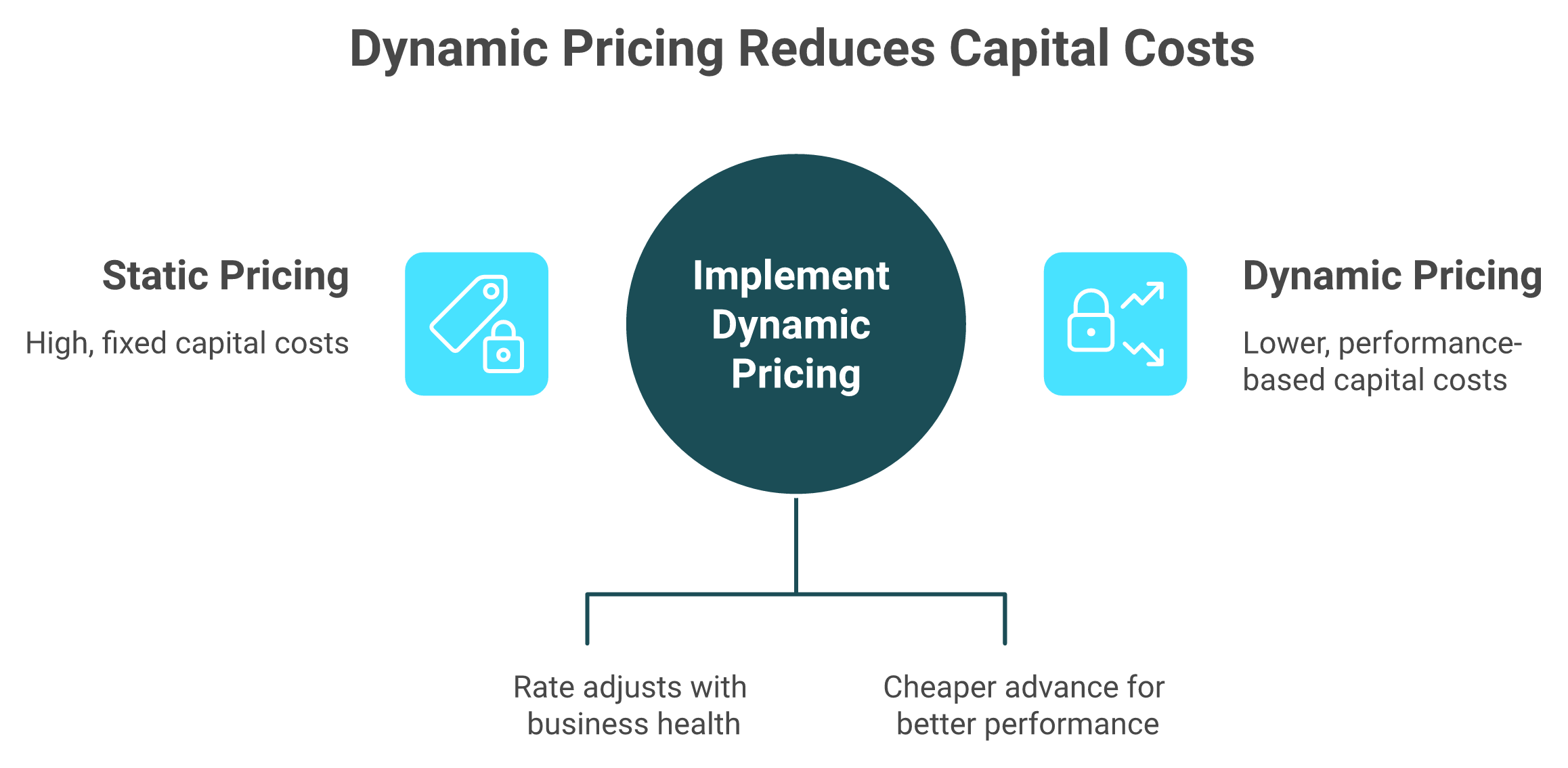
Luca AI competes on the capital metrics that matter most: rate, speed, and sizing efficiency. Unlike Shopify Capital's static factor rates or Wayflyer's snapshot-based underwriting, Luca's capital pricing reflects real-time business health. If your Q2 performance improves, your April advance is priced cheaper than your March advance. Shopify Capital cannot do this.
Static factor rates lock you into a price set at offer time. Dynamic pricing rewards performance improvements with lower rates on every subsequent draw.
💰 Dynamic pricing: Rates update continuously with business performance, not 60-day-old snapshots.
⏰ 24 to 48 hour disbursal: Faster than Shopify Capital's 2 to 5 day window.
Optimal capital sizing: Frequent small draws ($10K to $50K) rather than large lump sums, meaning zero idle capital and lower total cost.
No platform lock-in: Works across Shopify, WooCommerce, Amazon, and multi-channel setups.
No invite-only gatekeeping: Capital is an earned capability unlocked with one click.
Aligned incentives: Subscription revenue model means zero incentive to push larger advances. If $50K is enough, Luca will tell you.
💸 #2 to #6: Other Alternatives
#2 Wayflyer: Revenue-based financing for merchants doing EUR1M+. Typical 2 to 8% flat fee, 72-hour disbursal, and a solid track record. However, static per-advance underwriting and a lending-first model create incentive to push larger advances.
#3 Stripe Capital: Available to Stripe-processed merchants only. Competitive factor rates with a similar MCA structure. Fast approval but ecosystem-locked.
#4 PayPal Working Capital: Similar MCA model tied to PayPal sales only. One active advance at a time. Merchants report cash flow disruption during slow periods.
#5 SBA Loans: Lowest APR available (6 to 10%), but a 6 to 8 week process, personal guarantee required, and extensive documentation. Best for merchants who can plan 2+ months ahead.
#6 Traditional Bank Lines of Credit: 8 to 15% APR, requires an established banking relationship and strong financials. Slowest option but cheapest for well-qualified merchants.
📊 Head-to-Head: $50,000 Funding Scenario
$50,000 Funding Scenario Comparison
Provider
Total Repayment
Effective Cost
Disbursal
Platform Lock-in
Rate Structure
Luca AI
~$53,100
~6.2% (staged draws)
24 to 48 hours
❌ None
Dynamic / continuous
Wayflyer
~$53,000
6% flat fee
72 hours
❌ None
Static per-advance
Shopify Capital
$56,500
13% (factor 1.13)
2 to 5 days
✅ Shopify Payments
Static factor rate
PayPal WC
~$55,000
~10%
Minutes (PayPal users)
✅ PayPal only
Static factor rate
SBA Loan
~$54,300
~8% APR/12mo
6 to 8 weeks
❌ None
Fixed APR
Bank LOC
~$56,000
~12% APR
2 to 4 weeks
❌ None
Variable APR
🗣️ What Merchants Say About the Alternatives
"I have used Wayflyer on a number of occasions to help with Q4 stock purchasing and working capital requirements only to be told we no longer fit their criteria. Given we have used them multiple years running with no issues this was incredibly disappointing." Joshua Hannan Wayflyer - Trustpilot Verified Review
"At the end of the day they are no different than any merchant advance company/loan shark with insanely high interest rates. Their portal is an absolute joke to use as well." Terry Clearco - Trustpilot Verified Review
"Company loves to lie unfortunately. They gave our firm a $90,000 loan in June. At the 50%, then 75%, and then 90% marks, they kept making excuses and lies." Adam Zackman Wayflyer - Trustpilot Verified Review
✅ Who Should Choose What
Choose Shopify Capital if you need frictionless, no-hassle funding, are fully committed to Shopify Payments, and accept the premium for pure convenience.
Choose Luca AI if you want the lowest effective cost through dynamic pricing and staged draws, faster disbursal, multi-platform flexibility, and a provider whose subscription model means they'll advise you to take less if that's what your business actually needs.
Choose SBA if you can wait 6 to 8 weeks and want the absolute lowest APR.
Choose Wayflyer if you're doing EUR1M+ and want established RBF with fast deployment.
Consider how Luca's staged-draw model works in practice: a merchant needing $450K for Q4 takes $150K in August, $200K in September (at a cheaper rate due to improved performance), and $100K in October. The total cost is 6.2% vs. a competitor's 8% for the same total deployed, with zero idle capital sitting in the bank account accruing cost.
Q10. Shopify Capital FAQ: Quick Answers to Common Questions [toc=FAQ]
Is Shopify Capital a loan?
Not exactly. Merchant Cash Advances (MCAs) are technically a purchase of future receivables, not a loan, which means different legal protections apply. Business loans and Capital Flex are structured lending products. The distinction matters for accounting treatment and tax filing.
Does Shopify Capital affect my credit score?
No personal credit check is performed. Approval is based entirely on store performance data: sales volume, consistency, chargeback rates, and growth trajectory. However, defaulting on repayment may affect future eligibility and could have consequences if Shopify pursues collections.
Can I get Shopify Capital more than once?
✅ Yes. Once you've repaid at least 65% of your current advance, Shopify may present a new offer, often at a higher amount. Some merchants have accessed funding repeatedly:
"I've taken almost a million total. You can make it work well in some industries." u/n7yyk6y, r/shopify Reddit Thread
What happens if my sales drop to zero?
For MCAs, no payment is owed on zero-sales days. Repayment is purely a percentage of daily sales. For business loans, however, the 1/6th milestone rule still applies: you must repay at least 1/6th of total owed within every 60-day period, regardless of sales. Missing this milestone can trigger default provisions.
Can I pay off Shopify Capital early?
Yes, there's no early repayment penalty. But ⚠️ early repayment does NOT reduce total cost on MCAs. You owe the full factored amount regardless of how quickly you repay. Early repayment only frees cash flow sooner and triggers renewal eligibility faster.
How much can I borrow?
$200 to $2 million, determined by Shopify's algorithm based on your store's performance. Most merchants report offers in the $5K to $200K range. Higher amounts are reserved for established, high-volume stores with consistent sales histories.
Is Shopify Capital available in India or the EU?
❌ No. Currently limited to the US, Canada, UK, and Australia. As of early 2026, Shopify announced expansion of fixed funding to select European markets, but broad availability has not been confirmed. No official timeline exists for India.
What if I switch payment processors?
Shopify Capital requires Shopify Payments for repayment. Switching processors during an active advance creates complications; daily percentage remittances cannot be collected. Contact Shopify support before making any payment processor changes while Capital is active.
How is Capital Flex different from a regular MCA?
Capital Flex is a revolving line of credit where repayments immediately restore your available balance. MCAs are one-time advances with a fixed total owed; you repay, then wait for a new offer at 65% completion. Capital Flex eliminates the renewal cycle entirely but is currently US-only with a $50K trailing GMV minimum.
Can I use Shopify Capital for any purpose?
Generally yes: inventory, marketing, operations, hiring, and equipment. There are no formal restrictions on use of funds, though Shopify's terms may restrict certain activities like gambling-related or prohibited-category spending.
How does Shopify Capital work with Shopify Balance and Bill Pay?
Capital deposits into your Shopify Balance account. You can use Bill Pay to pay suppliers directly from Balance, creating a closed-loop cash management system within Shopify. Shopify Credit (a business Visa card) adds cashback on spending, together forming Shopify's integrated financial ecosystem.
What if I'm denied: when can I try again?
There's no formal reapplication process. Shopify continuously re-evaluates stores and surfaces offers when the algorithm determines eligibility. Focus on improving sales consistency, reducing disputes and chargebacks, and maintaining clean account standing. Most merchants report checking back in 30 to 60 days.
💡 Can I get e-commerce funding if I'm not eligible for Shopify Capital?
Yes. Luca AI offers dynamically-priced capital to e-commerce merchants across platforms, not just Shopify. Eligibility is based on continuous, real-time business health assessment rather than a static invite-only model. Merchants on Shopify, WooCommerce, Amazon, and multi-channel setups can access funding with 24 to 48 hour disbursal and rates that update with your performance: no applications, no negotiations, and no gatekeeping.
FAQ's
What is the real effective APR of Shopify Capital in 2026?
Shopify Capital uses factor rates, not interest rates, to price merchant cash advances. A factor rate of 1.10 to 1.17 looks like a 10 to 17% cost, but the effective APR depends entirely on how fast your daily sales repay the advance. Faster repayment means a higher annualized cost.
For example, a $10,000 advance at a 1.15 factor rate costs $1,500 in total borrowing fees. If your sales velocity repays that in 3 months, the effective APR is roughly 60.8%. If repayment stretches to 12 months, it drops to approximately 15%. High-volume stores are effectively penalized with higher APRs because they repay faster.
We help merchants model this before they commit. Luca AI's financial management tools calculate your projected effective APR based on your actual historical sales velocity, so you know whether you are paying 15% or 60% before accepting. Early repayment does not reduce total cost on MCAs either. You owe the full factored amount regardless of speed.
How do I qualify for Shopify Capital if no offer appears in my admin?
Shopify Capital is entirely invite-only. There is no application form, no eligibility checker, and no way to proactively request funding. Shopify's machine-learning model continuously evaluates every store and surfaces an offer under Finances > Capital when its risk scoring determines you qualify.
Known eligibility signals include:
Active Shopify store for 90+ days
Shopify Payments enabled as primary processor
Consistent or upward sales trajectory
Low chargeback and dispute rates
No unresolved Shopify policy violations
US, Canada, UK, or Australia registration
If no offer appears, focus on improving sales consistency, reducing disputes, and maintaining clean account standing. Most merchants report checking back in 30 to 60 days. We built Luca AI's analytics layer to monitor the exact business health metrics Shopify's algorithm evaluates, alerting you when metrics trend toward or away from likely eligibility.
How should I record Shopify Capital in my accounting books?
The correct accounting treatment depends on whether you received an MCA or a business loan and whether you use accrual or cash-basis accounting. Most merchants incorrectly record Capital as revenue or miscategorize the borrowing fee as a generic expense.
For accrual accounting, record the principal as Cash (debit) and MCA Payable as a liability (credit). The borrowing cost goes into a Deferred Financing Cost asset account, amortized monthly as a Financing Expense. MCAs are technically a purchase of future receivables, not a loan, so classify the cost as a financing expense, not interest.
For cash-basis accounting, record the receipt as a liability. Each daily remittance reduces both the liability and cash, with expense recognition spread naturally over the repayment period.
The borrowing cost is generally tax-deductible: as interest expense for loans and as a financing or factoring expense for MCAs. Only the borrowing cost is deductible, not principal repayment. Luca AI integrates with your accounting stack and automatically separates principal from financing costs across your P&L and balance sheet.
What are the best alternatives to Shopify Capital for e-commerce funding?
If Shopify Capital doesn't fit due to eligibility, cost, geography, or platform lock-in, several alternatives offer different trade-offs for scaling merchants in 2026:
Luca AI: Dynamically-priced capital with staged draws at roughly 6.2% effective cost, 24 to 48 hour disbursal, and zero platform lock-in across Shopify, WooCommerce, and Amazon.
Wayflyer: Revenue-based financing for merchants doing EUR1M+, with 2 to 8% flat fees and 72-hour disbursal.
Stripe Capital: Competitive factor rates for Stripe-processed merchants only.
SBA Loans: Lowest APR (6 to 10%) but 6 to 8 week processing with personal guarantees required.
Bank Lines of Credit: 8 to 15% APR for well-qualified merchants with established banking relationships.
In a $50,000 head-to-head scenario, Luca AI's staged-draw model delivers the lowest total repayment (~$53,100) versus Shopify Capital's $56,500, with the added advantage that rates update continuously as your business performance improves.
When is the best time to accept a Shopify Capital offer for maximum ROI?
Strategic timing is the difference between Shopify Capital as a growth accelerator and an expensive convenience loan. Most merchants accept reactively when an offer appears, rather than aligning funding with peak-ROI deployment windows.
The highest-return windows follow predictable seasonal patterns:
Pre-Q4/BFCM (August to September): Inventory procurement and ad budget scaling generate peak returns during the holiday season.
Post-holiday bridge (January to February): Cover cash flow gaps when operating costs continue but sales drop 30 to 50%.
Proven channel launches (any time): Fund campaigns with validated ROAS above 3x return.
For a $50K advance at a 1.13 factor rate, you need just $26,000 in incremental revenue from inventory (at 50% margins) or a 3x ROAS on marketing spend to break even. We built Luca AI's cash flow forecasting to flag when seasonal capital windows approach based on your historical sales patterns and simulate the downstream impact before you commit.
Enjoyed the read? Join our team for a quick 15-minute chat — no pitch, just a real conversation on how we’re rethinking Ecommerce with AI - Luca
Loading Schedule...
Your AI Co-Founder is here.
Here’s why:
Shopify, Meta, Xero - one brain.
"Should I scale?" Answered with real data.
Growth capital. No applications. One click.
Thank you! Your submission has been received! Please book a time slot for the Meeting
Oops! Something went wrong while submitting the form.