Shopify's Winter '26 AI | Sidekick Is Huge But Missing One Critical Thing
10
mins read
TL;DR
Shopify Winter '26 shipped 150+ features including Sidekick Pulse, voice commands, no-code app generation, and Agentic Storefronts for AI-powered shopping discovery.
Sidekick excels at store-level operations but cannot access Xero, QuickBooks, or banking APIs, creating a cash flow visibility gap for scaling decisions.
Agentic commerce requires profitability clarity since AI shopping agents comparison-shop the internet, making margin analysis critical before promoting products.
Cross-functional questions need unified intelligence because decisions spanning marketing, finance, and inventory require data from 4+ systems Sidekick cannot connect.
The AI Co-Founder model synthesizes intelligence and capital into one system that reasons across your entire business and funds opportunities when the math supports scaling.
Most founders hit the limitation wall between €1M-€5M revenue when operational AI becomes insufficient and business-level intelligence becomes essential.
Q1. What Shopify Actually Shipped in Winter '26 [toc=Winter '26 Features]
Shopify's Winter '26 Edition, codenamed "Renaissance", represents the most ambitious AI update in the platform's history. Released in December 2025, this edition shipped over 150 product updates designed to transform how merchants interact with their stores, positioning AI as the centerpiece of Shopify's commerce infrastructure.
The release marks a philosophical shift from reactive tools to proactive systems. Tobi Lütke, Shopify's CEO, framed it explicitly: this edition brings "every entrepreneur their own AI employee" through upgraded capabilities across Sidekick, Shopify Magic, and entirely new features like Agentic Storefronts.
⚡ Core AI Infrastructure Changes
The foundation models powering Sidekick received substantial upgrades in Winter '26. Faster inference speeds mean responses arrive in under 3 seconds for most queries, a significant improvement from the 8-10 second delays merchants experienced in earlier versions.
Token budgets expanded considerably, enabling more complex multi-turn conversations without context loss. The shift from pull-based (you ask, it answers) to push-based (it alerts you proactively) architecture fundamentally changes the merchant-AI relationship. Sidekick Pulse now runs background analysis and surfaces recommendations directly on your admin home screen without requiring prompts.
🛠️ Business Impact Features
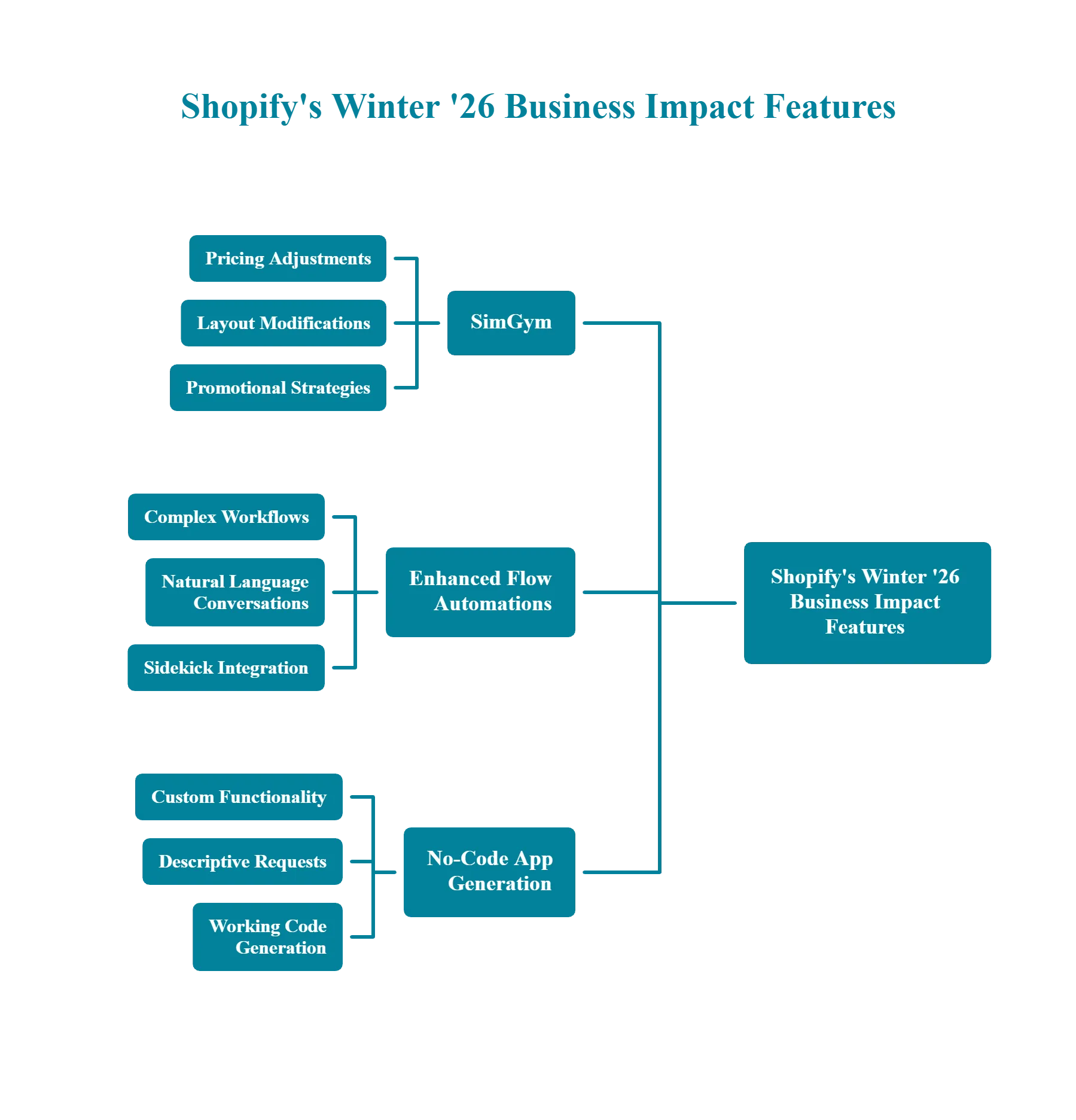
Flowchart illustrating Shopify's Winter '26 business impact features including SimGym for A/B testing, enhanced Flow automations with natural language, and no-code app generation for custom store functionality.
SimGym emerged as one of the most anticipated features for data-driven merchants. This A/B testing environment lets you simulate changes, including pricing adjustments, layout modifications, and promotional strategies, before deploying them live. For founders tired of "learning through costly mistakes," SimGym offers a sandbox for experimentation.
Enhanced Flow Automations received significant upgrades. Merchants can now create and edit complex automation workflows directly through natural language conversations with Sidekick. Previously, Flow creation required navigating multiple admin screens and understanding conditional logic syntax. For brands seeking deeper marketing analysis and automation, these improvements streamline operational workflows considerably.
No-Code App Generation allows non-technical merchants to build custom functionality by describing what they need. Request "an app that sends a thank-you email with a discount code after a customer's third purchase," and Sidekick generates working code.
📊 What This Means for Merchants
The operational efficiency gains are measurable. Early access merchants report saving 5-10 hours weekly on routine tasks, including theme adjustments, discount setup, basic reporting, and customer segmentation. The reduced dependency on developers for basic customizations translates to both time and cost savings.
Shopify Winter '26 Performance Improvements
Feature
Before Winter '26
After Winter '26
Response Time
8-10 seconds
Under 3 seconds
Flow Creation
Manual, multi-step
Conversational
Theme Editing
Developer-dependent
Sidekick-assisted
Proactive Alerts
None
Sidekick Pulse
However, these improvements exist within Shopify's operational domain. The platform excels at store-level tasks, including product management, theme customization, and marketing automation. The foundation is genuinely impressive.
Now let's examine what Sidekick specifically can do with these upgrades, and where its capabilities end.
Q2. Sidekick's New Capabilities: What It Can Do Now [toc=Sidekick Capabilities]
Sidekick evolved from a basic query-response chatbot into a proactive operational assistant with Winter '26. The upgrades deliver genuine productivity improvements across store management, content creation, and workflow automation, transforming daily admin tasks from manual navigation to conversational commands.
✅ Expanded Capability Set
The feature additions address real merchant pain points:
Sidekick Pulse continuously scans store performance and surfaces recommendations without prompting. Inventory alerts, bundle suggestions, and performance anomalies appear directly on your admin dashboard
Voice Commands enable hands-free store management through screen share and real-time guidance, particularly valuable during warehouse operations or multitasking
No-Code App Generation creates custom functionality from natural language descriptions. Describe the behavior you need, receive working code
Flow Automation Creation allows building complex workflows through conversation rather than navigating the visual Flow editor
Theme Customization handles layout adjustments, color changes, and section modifications directly through chat
Shopify Magic Integration generates product descriptions, email content, and marketing copy with improved quality and brand-voice alignment
⏰ Practical Efficiency Gains
For operational tasks such as campaign setup, theme tweaks, basic reporting, and customer segmentation, Sidekick now handles what previously required developer time or extensive dashboard navigation. Merchants testing Winter '26 report setup tasks completing in seconds rather than the 10-15 minutes typical of manual processes.
The contextual awareness improved significantly. Sidekick now customizes suggestions based on your specific store data, inventory levels, and historical performance rather than offering generic recommendations. When asked "How do I set up free shipping for orders over $50?", it provides step-by-step guidance tailored to your existing shipping configuration.
Task Completion Time Comparison
Task
Manual Time
With Sidekick
Discount Setup
5-8 minutes
Under 30 seconds
Theme Color Change
10-15 minutes
1-2 minutes
Flow Creation
20-30 minutes
3-5 minutes
Product Description
15-20 minutes
Under 1 minute
⚠️ The Honest Assessment
These are genuine productivity gains, not marketing exaggeration. Sidekick legitimately reduces friction for store-level operations.
The question isn't whether Sidekick is useful. It demonstrably is. The question is whether operational efficiency alone is sufficient for scaling businesses navigating complex decisions about cash flow, capital deployment, and cross-channel profitability. For founders requiring financial management capabilities alongside operational tools, the architectural boundaries become apparent.
Sidekick excels within Shopify's walls. What happens when your questions span systems Shopify doesn't control?
Agentic Storefronts represent Shopify's most forward-looking bet in Winter '26, a new commerce channel where AI shopping agents discover, recommend, and facilitate purchases on behalf of consumers. This isn't incremental improvement; it's infrastructure for an emerging buying paradigm.
🤖 Defining Agentic Commerce
AI shopping agents, including ChatGPT, Perplexity Shopping, and Microsoft Copilot, can now browse Shopify catalogs, compare products, and complete purchases within their native interfaces. When a user asks ChatGPT "Find me a sustainable skincare brand with free shipping under $50," your products become discoverable if they match the criteria.
Tobi Lütke positioned this as "AI becoming the new storefront." Rather than customers navigating to your website, AI intermediaries bring qualified buyers directly to checkout. The transaction can complete without the customer ever visiting your domain.
⚙️ Technical Implementation
Shopify syndicates product data to AI platforms via structured feeds optimized for machine parsing. The system works through several components:
Structured Data Requirements: Complete schema markup with accurate product attributes, pricing, availability, and shipping information
Real-Time Inventory Sync: AI agents access current stock levels to avoid recommending unavailable products
Review Signal Aggregation: Product ratings and review content influence AI recommendation rankings
📋 Merchant Readiness Checklist
Winning in agentic commerce requires operational excellence AI agents can verify. Brands focused on product management optimization will find these requirements familiar:
Agentic Commerce Readiness Requirements
Requirement
Why It Matters
⭐ 4.5+ Star Reviews
AI agents prioritize social proof in recommendations
💰 Competitive Pricing
Agents comparison-shop the entire internet instantly
⏰ 2-Day Shipping
Fast fulfillment commitments rank higher
✅ Complete Product Data
Missing attributes mean missed recommendations
✅ Clear Differentiation
Generic descriptions lose to specific value propositions
💸 The Strategic Implication
Agentic commerce favors stores with clear value propositions, operational excellence, and, critically, margin clarity. AI agents will surface your products to qualified buyers. But if you're promoting items that appear profitable on ROAS but lose money after shipping, returns, and COGS, you're scaling losses.
This is where operational AI meets its architectural limits. Sidekick can help you optimize product listings for AI discovery. It cannot tell you which products are actually profitable to promote after all costs are calculated.
Profitability analysis requires financial visibility that Sidekick, by design, doesn't have access to. That gap isn't a bug; it's an architectural boundary. For merchants needing data analysis and deep industry research capabilities, this limitation becomes significant.
Q4. The Architectural Gap: What Sidekick Still Can't See [toc=Sidekick Limitations]
Sidekick connects to Shopify admin, marketing platforms, and operational data with impressive depth. But it cannot access Xero, QuickBooks, banking APIs, or your actual cash position. It sees your store, not your business. This isn't a criticism of execution; it's an acknowledgment of architectural scope.
The distinction matters enormously for scaling founders. Your store performance and your business health are related but not identical. Optimizing one doesn't automatically optimize the other.
❌ Specific Capability Boundaries
Sidekick's Winter '26 limitations stem from data access constraints, not AI capability:
Flowchart illustrating five key Shopify Sidekick limitations in Winter '26: no cash flow forecasting, no Xero or QuickBooks integration, no cross-functional reasoning, limited proactive insights, and no true profitability calculation.
No Cash Flow Forecasting: Cannot model "If I scale this campaign to €50K/month, will I have cash for inventory reorders in 90 days?"
No Financial System Integration: Cannot read or write to Xero, QuickBooks, or banking APIs
No Cross-Functional Reasoning: Cannot connect marketing spend to COGS to cash runway to profitability in a single query
Proactive Insights Limited to Shopify Data: Sidekick Pulse scans store metrics, not bank balances or accounting anomalies
No True Profitability Calculation: Cannot assess contribution margin by product/channel after shipping, returns, and overhead
💸 The Cash Flow Blind Spot
Your CFO asks about Q4 cash impact from scaling your best-performing campaign. Sidekick shows ROAS. You spend 3 hours building a spreadsheet connecting Shopify to Stripe to Xero to your bank account. By the time it's finished, the underlying numbers have shifted.
This manual triangulation is exactly what scaling founders describe:
"I've noticed that the analytics from Shopify don't align at all with what I'm seeing in Google Analytics. At this point, Shopify's analytics seem pretty ineffective for my needs." — u/FlakyNegotiation4717, r/shopify Reddit Thread
"One of the significant challenges Shopify merchants encounter is the analysis of their online store data. Merchants often struggle with uncertainty about how to respond to the data they collect and insufficient forecasting regarding sales." — u/RemyOswalt, r/shopify Reddit Thread
⚠️ Why This Boundary Matters
Sidekick optimizes your storefront. But scaling decisions, including whether to take capital, scale campaigns, or order inventory, require cross-functional visibility spanning commerce, marketing, finance, and operations simultaneously. Understanding how Luca thinks about these interconnected systems reveals the architectural difference.
Cross-Functional Decision Requirements
Decision Type
Data Required
Can Sidekick Answer?
Scale campaign to €50K/month?
Marketing + Cash + Inventory
❌ No
True contribution margin by channel?
Shopify + Meta + Xero + Shipping
❌ No
Accept €100K capital offer?
All systems + scenario modeling
❌ No
🧠 The Synthesis Thesis
Intelligence without capital is advice. Capital without intelligence is risk. Sidekick delivers operational efficiency within Shopify's domain, genuinely valuable for daily store management.
A Co-Founder delivers business orchestration: reasoning across every system that affects your decisions, surfacing risks before they hit your P&L, and providing capital when the opportunity justifies it. That architectural difference separates store optimization from business intelligence.
Luca AI bridges this gap by connecting 20+ data sources, including the financial systems Sidekick can't access, into a unified reasoning layer where cross-functional questions get answered in seconds, not spreadsheet-hours. Explore Luca's use cases to see how unified intelligence transforms decision-making for scaling e-commerce brands.
Q5. The Cross-Functional Questions Only a Co-Founder Can Answer [toc=Cross-Functional Questions]
It's Monday morning. Your inbox holds three decisions that can't wait:
Should I scale this 4.2x ROAS campaign to €50K/month? Can I afford the inventory reorder for Q4 if I do? What's my true CAC including all costs, not just what Meta reports?
Each question seems straightforward. Each is actually impossible to answer without data from multiple systems that don't talk to each other.
❌ Why Fragmented Tools Fail These Questions
The scale-campaign question requires Meta Ads data (performance), Xero data (cash position), Shopify data (inventory costs), and banking data (actual runway). The true CAC question needs ad spend plus payment processing fees plus shipping costs plus return rates plus customer service allocation.
No single tool, including Shopify Sidekick, connects all four domains. And this fragmentation isn't theoretical:
"Data fragmentation consumes more time than the analysis itself. Each store operates on various platforms, and unfortunately, they don't communicate effectively with one another." — u/FederalScale2863, r/SaaS Reddit Thread
"From what it seems, most people have data fragmented in many different places, generally including Shopify, Google Analytics, Ad Accounts, etc." — u/Tephra9977, r/ecommerce Reddit Thread
📋 The Questions That Matter
For founders focused on sales performance optimization, these cross-functional questions define scaling success:
Cross-Functional Questions and System Requirements
Question
Systems Required
Can Sidekick Answer?
"If I scale Meta spend 50%, what's my 90-day cash position?"
Meta + Xero + Banking + Inventory
❌ No
"What's my true contribution margin by channel?"
Shopify + Meta + Google + Xero + Shipping + Returns
❌ No
"Should I take €100K capital and where should I deploy it?"
All systems + scenario modeling + unit economics
❌ No
"Which August cohort has the highest 90-day LTV?"
Meta + Shopify + Stripe + Repeat purchase data
❌ No
These aren't edge cases. They're the decisions that determine whether scaling is profitable or accelerates losses.
✅ How a Co-Founder Answers
Luca AI connects 20+ data sources, including Shopify, Meta, Google Ads, Stripe, Xero, QuickBooks, and banking APIs, into one reasoning layer. We don't display dashboards. We answer questions.
Ask "If I scale this campaign to €50K and order 10,000 units, what's my cash position in 90 days?" in natural language. Receive an answer in seconds that synthesizes marketing performance, inventory costs, payment timing, and cash runway, with the confidence to act immediately.
The distinction is architectural: Sidekick answers "How did my store perform?" A Co-Founder answers "What should I do next, and can I afford it?"
Q6. When You Need More Than a Storefront AI [toc=When You Need More]
Sidekick is now genuinely capable. Adding more tools adds complexity. The practical question: when is storefront AI sufficient, and when do you need business-level intelligence?
This isn't about selling software. It's about matching tools to operational reality.
✅ When Sidekick Is Sufficient
Sidekick handles the job effectively when:
Revenue under €500K with straightforward operations
Single sales channel (Shopify-only, no wholesale or marketplaces)
No external financing needs, growth funded entirely from cash flow
Marketing decisions don't require cash flow modeling, you can afford to scale without checking runway
You have time for manual cross-platform analysis, 5-10 hours/week feels sustainable
For early-stage stores with simple operations, Sidekick's operational efficiency delivers real value without additional tool complexity.
Cash flow timing directly affects scaling decisions, you can't scale without knowing runway impact
Preparing for funding rounds requiring metrics clarity and defensible unit economics
Team spends 10+ hours/week on manual reporting across fragmented dashboards
Capital access would accelerate proven opportunities, you've found winning channels but lack budget to scale
💰 The Inflection Point
Most founders hit the wall between €1M-€5M revenue. At this stage, understanding your financial management needs becomes critical:
Storefront AI vs Business Intelligence Capabilities
Challenge
Storefront AI
Business Intelligence
Theme editing
✅ Handles well
Overkill
Flow automation
✅ Handles well
Overkill
Cross-functional reasoning
❌ Can't access data
✅ Core capability
Cash flow forecasting
❌ No financial integration
✅ Core capability
Capital access
❌ Not available
✅ Embedded
Scenario modeling
❌ Store-level only
✅ Business-level
Operational AI handles the store. Business decisions, including capital deployment, channel expansion, and inventory timing, require something that understands the whole picture.
📊 Evaluation Criteria Checklist
Before adding tools, score your needs:
☐ Do I need cross-functional reasoning (marketing + finance + ops)?
☐ Do I need cash flow visibility beyond Shopify?
☐ Would capital access accelerate proven opportunities?
☐ Do I need proactive alerts across all business functions?
☐ Does my team need answers without SQL or analyst dependency?
Three or more checks suggest storefront AI alone isn't sufficient. Review the FAQ for common questions about transitioning to unified intelligence.
Q7. How Luca AI and Shopify Work Together [toc=Luca and Shopify Integration]
Luca AI is not a Shopify replacement or competitor. It's the intelligence layer that sits above your Shopify store, connecting it to the financial, marketing, and operational systems Sidekick architecturally cannot access.
This complementary relationship is deliberate. Shopify excels at commerce infrastructure. Luca excels at cross-functional reasoning. Together, they cover ground neither can alone.
🔗 Integration Architecture
Luca connects to Shopify as one of 20+ data sources. Your Shopify data, including orders, customers, inventory, and fulfillment, feeds into Luca's unified model alongside:
Visual showing Luca AI's unified data integration architecture connecting five sources: Shopify commerce data, Meta and Google marketing data, Stripe payment data, Xero accounting records, and banking APIs
Marketing: Meta Ads, Google Ads, TikTok, Klaviyo
Payments: Stripe, PayPal, Square
Accounting: Xero, QuickBooks, Wave
Banking: Direct bank APIs via Plaid
Sidekick optimizes within Shopify's walls. Luca reasons across everything. Understanding how Luca thinks reveals this architectural difference.
Sidekick helps you set up a new product listing and create the marketing Flow for launch automation. Luca tells you whether that product is actually profitable after all costs (COGS + shipping + returns + payment fees), models the cash impact of scaling it, and provides capital to fund the inventory order if the math works.
One builds the operational infrastructure. One ensures the operations are financially sound. Explore Luca's use cases to see specific workflow examples.
"Yeah, totally agree. What I've seen is that brands drown in dashboards but still ask: 'what now?' That gap between data and action is exactly what we're trying to solve." — u/techlov2028, r/smallbusiness Reddit Thread
🤝 The Partnership Model
Think of Sidekick as your store manager, handling daily operations, customer-facing tasks, and store optimization. Think of Luca as your CFO/strategist, handling cross-functional analysis, financial modeling, and capital deployment.
You need both. They do different jobs. The question isn't Sidekick or Luca. It's whether your business complexity requires the strategic layer on top of operational efficiency.
Q8. What Does 'AI Co-Founder' Actually Mean? [toc=AI Co-Founder Defined]
The market currently offers fragmented categories that each solve part of the founder's problem:
Analytics tools (Triple Whale, Northbeam): Marketing visibility without financial context
Financing tools (Wayflyer, Clearco): Capital without intelligence on deployment
General AI (ChatGPT, Claude): Reasoning without your business context
Each is genuinely useful. None sees the whole business. Founders become the manual integration layer, synthesizing insights across tools to make decisions.
🧠 What a Human Co-Founder Does
A human co-founder brings specific capabilities that individual tools lack:
Cross-functional: Can reason across marketing, finance, operations simultaneously
Contextually aware: Knows your business history, patterns, and preferences
Proactive: Doesn't wait to be asked, surfaces risks and opportunities autonomously
Invested: Has skin in the game, their success depends on business success
Evolving: Gets smarter about your specific business over time
⚙️ Luca's Architecture Mirrors This
Co-Founder Traits Mapped to Luca AI
Co-Founder Trait
Luca AI Implementation
Cross-functional
Connects 20+ sources across commerce, marketing, finance, operations
Contextually aware
Persistent memory of business patterns, history, and decisions
Proactive
Scans 24/7, surfaces risks/opportunities without prompting
Invested
Provides capital, literally puts money where its math is
Evolving
Learns preferences and business patterns over time
This isn't metaphor. It's architectural specification. Learn more about us and how this architecture was designed.
🔄 The Synthesis Formula
The AI Co-Founder model combines capabilities that currently exist in isolation:
Triple Whale analytics depth + Wayflyer capital access + ChatGPT reasoning + proactive monitoring + cross-functional visibility = AI Co-Founder
No competitor can replicate this by adding features. The architecture must be designed for synthesis from the beginning. Retrofitting intelligence onto a lending platform or capital onto an analytics dashboard produces half-measures, tools that technically offer both but integrate neither.
💡 The Category Shift
The fundamental reframe: founders don't need better tools. They need a partner.
Tools display data. Partners own outcomes. Tools wait to be queried. Partners surface what matters. Tools operate in silos. Partners reason across the business.
Luca AI is designed from the ground up as an AI Co-Founder, not a dashboard with a chatbot, not a lender with a reporting feature. A unified system that understands your business, predicts needs, and funds growth. Check pricing to see how this partner model translates to accessible value.
Stop renting tools. Start hiring an AI Co-Founder.
Q9. What Are the Best AI Tools for Shopify Store Owners in 2026? [toc=Best AI Tools 2026]
The Shopify AI ecosystem has expanded dramatically post-Winter '26. Founders now navigate a landscape that includes native tools (Sidekick, Magic), specialized analytics (Triple Whale, Northbeam), financing platforms (Wayflyer, Clearco), and unified intelligence systems (Luca AI). Each serves genuinely different needs, and choosing wrong costs time and money.
The comparison isn't about which tool is "best" universally. It's about which tool matches your operational reality.
📊 Category Breakdown
Native Shopify AI (Sidekick + Magic) ✅ Best for: Operational tasks within Shopify admin, including theme editing, Flow automation, product content ❌ Limitation: Cannot access financial systems or reason across external data sources
Triple Whale / Northbeam ✅ Best for: Marketing analysis and automation with deep ad platform integration ❌ Limitation: No financial visibility, no cash flow modeling, no capital access
Wayflyer / Clearco ✅ Best for: Fast capital access with revenue-based repayment ❌ Limitation: No intelligence on deployment, capital without strategic guidance
ChatGPT Plugins ✅ Best for: General questions and content generation ❌ Limitation: No persistent business context, blank slate every session
Luca AI ✅ Best for: Cross-functional intelligence + capital synthesis in one platform ✅ Unique: The only tool that can both analyze an opportunity AND fund it
🔍 Head-to-Head Comparison
AI Tools Capability Comparison for Shopify
Capability
Sidekick
Triple Whale
Wayflyer
Luca AI
Marketing Analytics
✅ Basic
✅ Deep
❌
✅ Unified
Financial Visibility
❌
❌
✅ Basic
✅ Full
Cash Flow Forecasting
❌
❌
❌
✅
Capital Access
❌
❌
✅
✅ Dynamic
Cross-Functional Reasoning
❌
❌
❌
✅
Proactive Intelligence
✅ Store-level
❌
❌
✅ Business-level
Setup Complexity
Low
Medium
Medium
Low (10 min)
The fragmentation frustration is real:
"Given platform data you can anticipate losing conversion data on 25-40% of your total spend. For a company doing well over $30k in spending a month, that means there is over 10k+ in ad spend that can be challenging to optimize." — u/shady_lurker_7, r/ecommerce Reddit Thread
✅ Who Should Choose What
Choose Sidekick if you need operational efficiency within Shopify and your decisions don't require financial management modeling.
Choose Triple Whale if marketing attribution is your primary gap and you have separate solutions for finance.
Choose Wayflyer if you only need capital and already have a data team analyzing deployment opportunities.
Choose Luca AI if you need intelligence that spans your entire business, including marketing, finance, and operations, AND can fund what it recommends. Understanding how Luca thinks reveals why this architectural difference matters.
The deciding question: Can it reason across your data, or just display it?
Q10. Getting Started: From Fragmented Tools to Unified Intelligence [toc=Getting Started]
Before adding any tool, assess your current stack against practical criteria. Not every business needs unified intelligence, but most scaling founders discover their fragmentation cost only after it's already expensive.
📋 Data Stack Health Checklist
Score your current setup honestly:
Data Stack Health Assessment Criteria
#
Criterion
✅ or ❌
1
Can you answer cross-functional questions in under 60 seconds?
-
2
Does your system alert you to anomalies (CAC spikes, inventory shortfalls) automatically?
-
3
Can you model "If I scale spend 30%, what happens to cash in 90 days?"
-
4
Are marketing, finance, and operations data in one unified view?
-
5
Can you access growth capital without a separate application process?
-
6
Does your analytics tool take action (pause ads, generate reports), or just display data?
-
7
Can your team get answers without SQL knowledge or analyst dependency?
-
📈 Score Interpretation
⭐ 6-7 Checks: Your stack is mature. Focus on optimization, not overhaul. Luca AI may add incremental value but isn't urgent.
⚠️ 3-5 Checks: Critical gaps exist. You're making decisions on incomplete data. The manual triangulation tax is costing you 10-15 hours weekly and likely missing opportunities.
❌ 0-2 Checks: Fragmentation is actively costing revenue. Every scaling decision involves guesswork. This is the profile where unified intelligence delivers immediate ROI.
The gap is measurable:
"Data fragmentation consumes more time than the analysis itself. Each store operates on various platforms, and unfortunately, they don't communicate effectively with one another." — u/FederalScale2863, r/SaaS Reddit Thread
"From what it seems, most people have data fragmented in many different places, generally including Shopify, Google Analytics, Ad Accounts, etc." — u/Tephra9977, r/ecommerce Reddit Thread
✅ How Luca AI Addresses Each Gap
Luca AI is designed to turn every unchecked box into a check:
Luca AI Gap Coverage Solutions
Gap
Luca AI Solution
Cross-functional questions
Natural language queries across 20+ connected sources
Proactive alerts
24/7 scanning for anomalies and opportunities
Scenario modeling
"What if" analysis connecting marketing to cash to inventory
Unified view
Single reasoning layer across all business functions
Capital access
Instant, dynamically-priced funding without applications
Action capability
Execute decisions, not just recommend them
No-code access
Conversational interface replaces SQL and dashboards
⏰ Onboarding Reality
Setup takes 10 minutes. Connect Shopify, Meta, Google, Stripe, and Xero via OAuth. No data engineering required. No implementation consultants. Explore all use cases to see how unified intelligence applies to your specific workflows.
Most founders go from 2-3 checks to 7/7 within the first week, not because the platform is magic, but because the unified architecture eliminates the manual integration work that fragments their current stack.
💰 Next Step: Scored below 5? Start with a 15-minute gap assessment to see exactly where unified intelligence changes your decision-making, and what that's worth in recovered time and captured opportunities. Check pricing to understand how accessibility scales with your business, or review the FAQ for common questions about getting started.
FAQ's
What new features did Shopify Sidekick get in the Winter '26 update?
Shopify's Winter '26 Edition delivered significant upgrades to Sidekick, transforming it from a basic chatbot into a proactive operational assistant. Key new capabilities include:
Sidekick Pulse: Background scanning that surfaces recommendations without prompting
Voice Commands: Hands-free store management through screen share and real-time guidance
No-Code App Generation: Create custom functionality from natural language descriptions
Flow Automation Creation: Build complex workflows through conversation
Theme Customization: Layout adjustments and modifications directly through chat
Response times improved from 8-10 seconds to under 3 seconds. Token budgets expanded for longer conversations. However, these improvements remain within Shopify's operational domain. For cross-functional decisions spanning marketing, finance, and operations, we at Luca AI provide the unified reasoning layer that connects Sidekick's store-level insights to business-level intelligence.
What are Shopify Sidekick's limitations in 2026?
Despite Winter '26 improvements, Sidekick has architectural boundaries that affect scaling founders:
No Cash Flow Forecasting: Cannot model "If I scale this campaign, will I have cash for inventory in 90 days?"
No Financial System Integration: Cannot access Xero, QuickBooks, or banking APIs
No Cross-Functional Reasoning: Cannot connect marketing spend to COGS to cash runway in one query
Proactive Insights Limited to Shopify Data: Sidekick Pulse scans store metrics, not bank balances
No True Profitability Calculation: Cannot assess contribution margin by channel after all costs
These limitations exist because Sidekick sees your store, not your business. We designed Luca AI's financial management capabilities specifically to bridge this gap, connecting 20+ data sources including the financial systems Sidekick cannot access.
What are Shopify Agentic Storefronts and how do they work?
Agentic Storefronts represent Shopify's new AI commerce channel where shopping agents like ChatGPT, Perplexity Shopping, and Microsoft Copilot can discover, recommend, and facilitate purchases from your store.
When users ask AI assistants product questions, your catalog becomes discoverable if it meets criteria. Checkout can complete within the AI interface without customers visiting your website.
Readiness requirements include:
Structured product data with complete schema markup
Competitive, accurate real-time pricing
Strong review signals (4.5+ stars preferred)
Fast fulfillment commitments (2-day shipping favored)
The strategic challenge: AI agents comparison-shop the entire internet. Winning requires knowing which products are truly profitable to promote. Sidekick cannot provide this visibility. We built Luca AI's data analysis capabilities to help founders identify profitable product-channel combinations before scaling.
Can Shopify Sidekick do cash flow forecasting?
No. Shopify Sidekick cannot perform cash flow forecasting because it lacks integration with financial systems like Xero, QuickBooks, and banking APIs.
Sidekick sees store-level data: orders, inventory, customer information. It cannot see:
Your actual bank balance
Accounts payable and receivable timing
Payment processor settlement schedules
Overhead costs and operational expenses
This means Sidekick cannot answer questions like "If I scale Meta spend to €50K/month and order 10,000 units, what's my cash position in 90 days?"
For cross-functional business intelligence that connects marketing decisions to cash impact, we at Luca AI unify commerce, marketing, finance, and operations data into one reasoning layer. Ask the question in natural language. Get an answer in seconds that synthesizes marketing performance, inventory costs, and cash runway.
What are the best AI tools for Shopify store owners in 2026?
The 2026 Shopify AI ecosystem includes several categories:
Native Shopify AI (Sidekick + Magic) Best for operational tasks within Shopify admin. Limited to store-level data.
Triple Whale / Northbeam Best for marketing attribution and ROAS optimization. No financial visibility or capital access.
Wayflyer / Clearco Best for fast capital access. No intelligence on deployment strategy.
Luca AI Best for cross-functional intelligence + capital synthesis. The only platform that can both analyze opportunities AND fund them.
The deciding question: Can it reason across your data, or just display it?
For founders needing unified business intelligence, we designed Luca AI as an AI Co-Founder that connects 20+ data sources and provides instant capital when the math supports scaling. Learn how Luca thinks about cross-functional decisions.
Enjoyed the read? Join our team for a quick 15-minute chat — no pitch, just a real conversation on how we’re rethinking Ecommerce with AI - Luca
Loading Schedule...
Your AI Co-Founder is here.
Here’s why:
Shopify, Meta, Xero - one brain.
"Should I scale?" Answered with real data.
Growth capital. No applications. One click.
Thank you! Your submission has been received! Please book a time slot for the Meeting
Oops! Something went wrong while submitting the form.

.jpg)
.webp)
.webp)